
A complete issue · 48 pages · 1912
Life — February 1, 1912
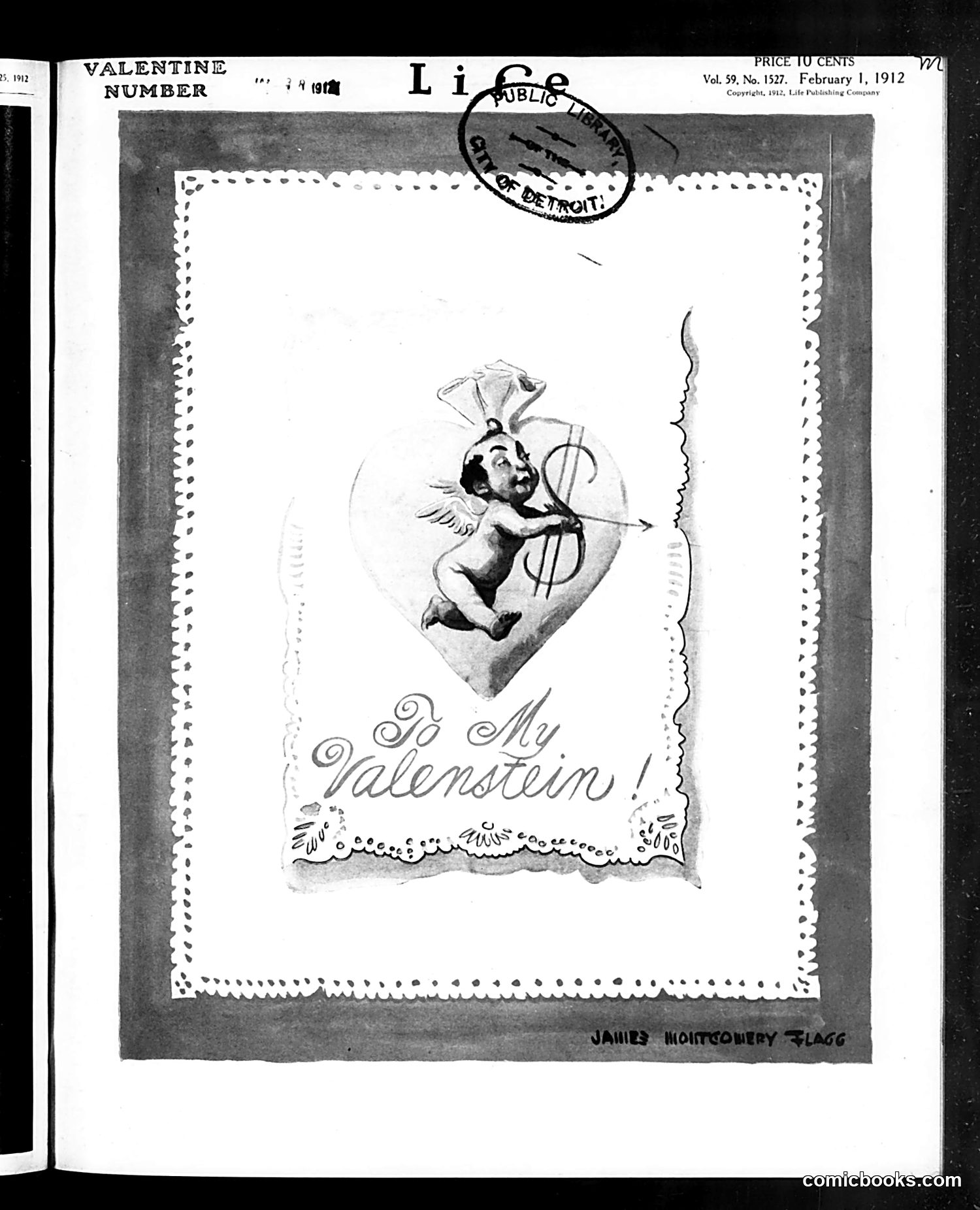
This is a Valentine's Day card design by James Montgomery Flagg featuring Cupid (the winged cherub) shooting an arrow at a heart marked with a dollar sign ($). The text reads "To My Valenstein!" (likely a pun on "Valentine"). **The Satire:** The cartoon satirizes commercialization of Valentine's Day and American materialism. Rather than romantic love, Cupid targets wealth/money, suggesting that 1912 romance had become transactional or mercenary. The deliberate misspelling "Valenstein" may be additional mockery. This reflects Progressive Era criticism of crass commercialism creeping into traditional holidays—a common theme in Life's social commentary during this period.
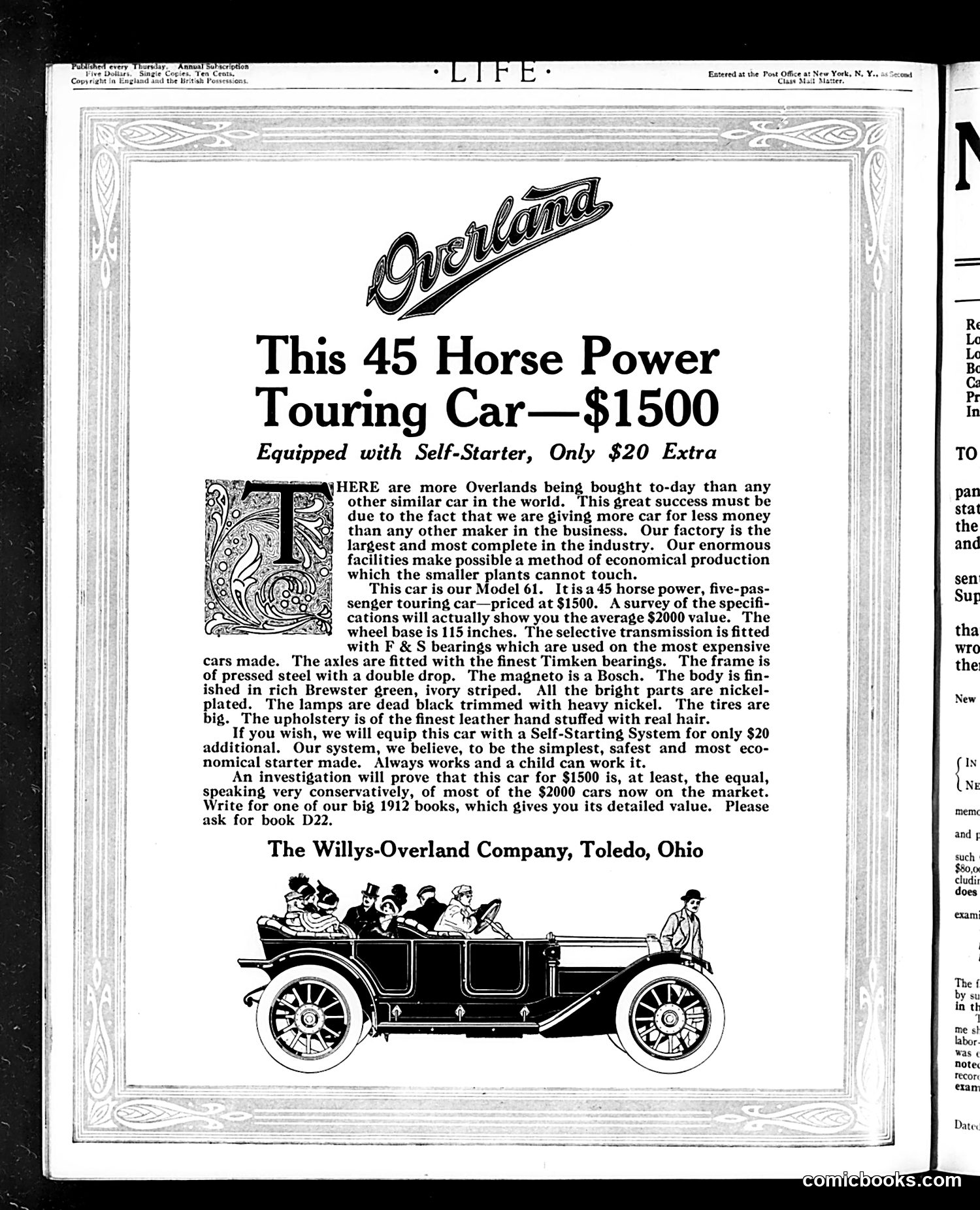
This page is primarily an **advertisement, not satire or political commentary**. It's a Willys-Overland Company ad from *Life* magazine promoting their Model 61 touring car. The ad emphasizes the vehicle's value: 45 horsepower, $1,500 price tag, and optional self-starter for an additional $20. The text uses competitive language ("more Overlands being bought to-day than any other similar car") and claims economical manufacturing methods. The illustration shows a side-view of the touring car with five passengers aboard, rendered in the standard promotional style of early 1910s automotive advertising. **This is commercial promotion, not editorial satire.** While *Life* was known for humor and social commentary, this particular page serves as a straightforward product advertisement typical of the era.
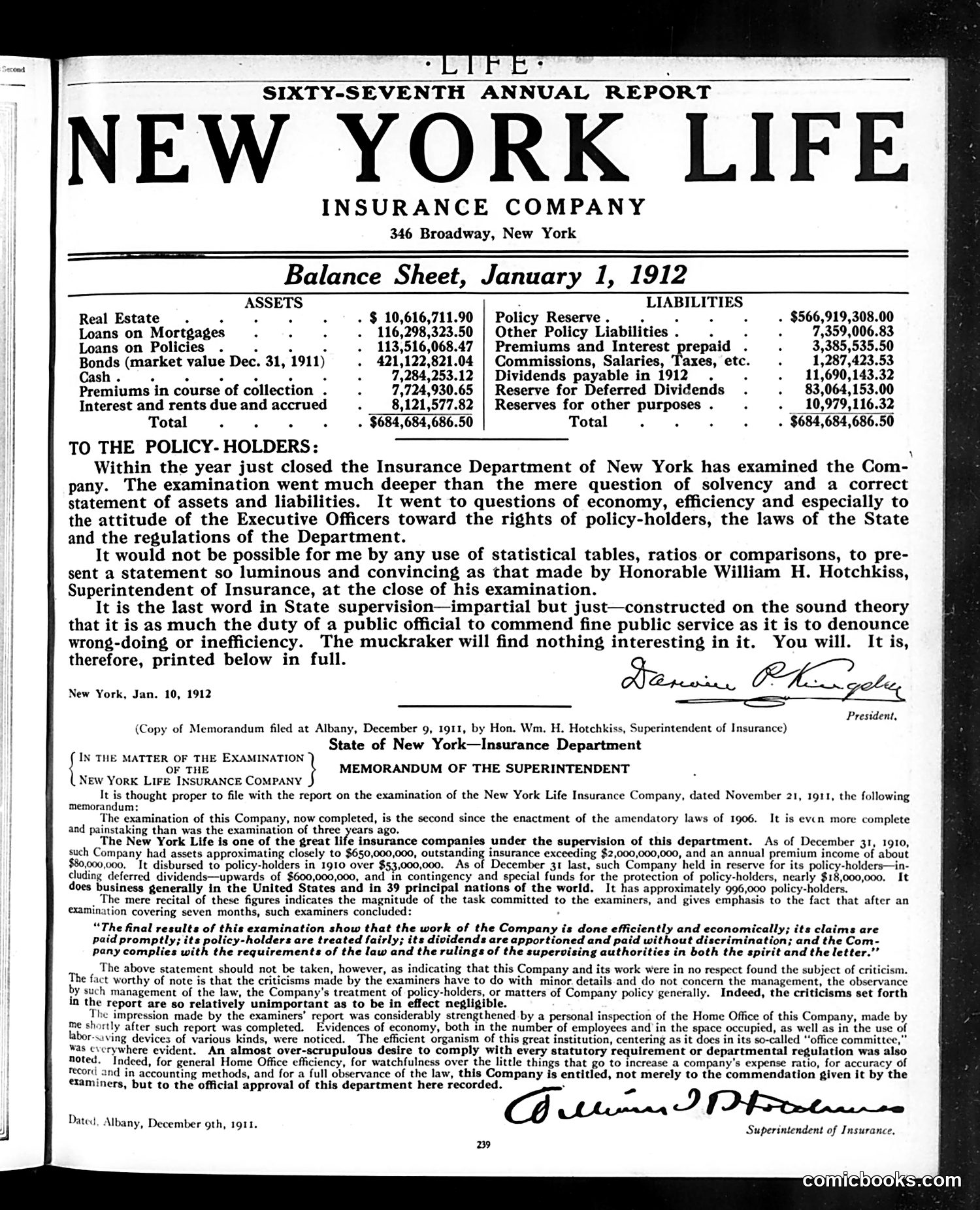
This page contains **no cartoon or satirical content**. It is a financial document: the Sixty-Seventh Annual Report of the New York Life Insurance Company, dated January 1, 1912. The page displays a balance sheet showing assets ($684,684,686.50) and liabilities of equal amount. It includes a letter from the company president and a memorandum from the New York Insurance Department's superintendent praising the company's efficiency and financial soundness following an examination. This appears to be a standard corporate financial disclosure published in *Life* magazine, likely as paid content or public notice rather than editorial satire. There are no political figures, caricatures, or satirical commentary present.
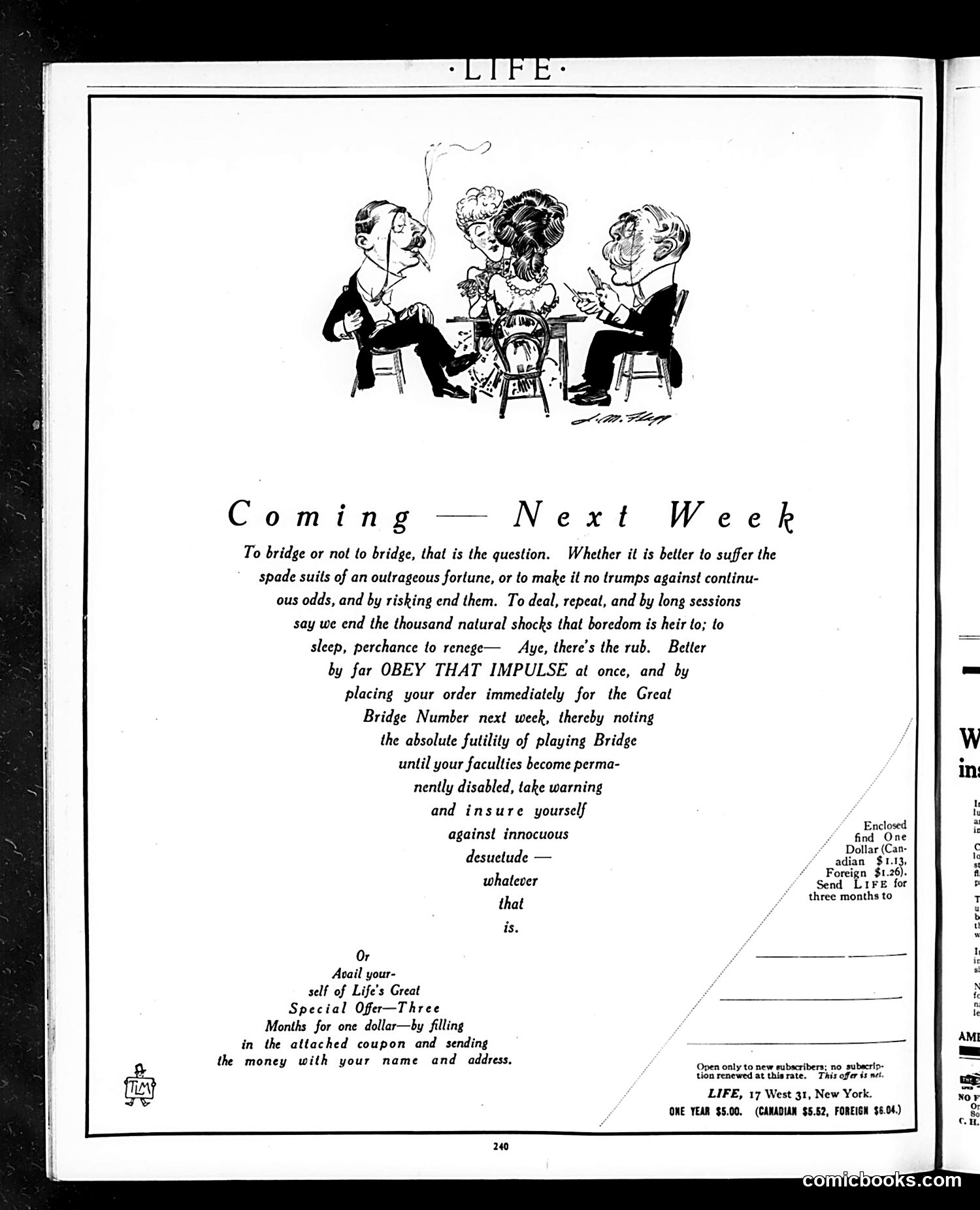
This page is primarily a **subscription advertisement** for Life magazine, not a political cartoon. The small illustration at top shows three caricatured figures—two men and a woman—seated together, appearing to be in social conversation or gossip. The ad text humorously parodies Shakespeare's *Hamlet* ("To bridge or not to bridge..."), sarcastically promoting bridge (the card game) as a cure for boredom. The satire suggests that taking up bridge is preferable to suffering life's tedious afflictions. The real content here is the **marketing pitch**: Life offers a three-month subscription for one dollar. The illustration likely represents typical Life readers—fashionable urbanites engaged in social leisure activities—reinforcing the magazine's appeal to middle and upper-class audiences seeking entertainment and satire.
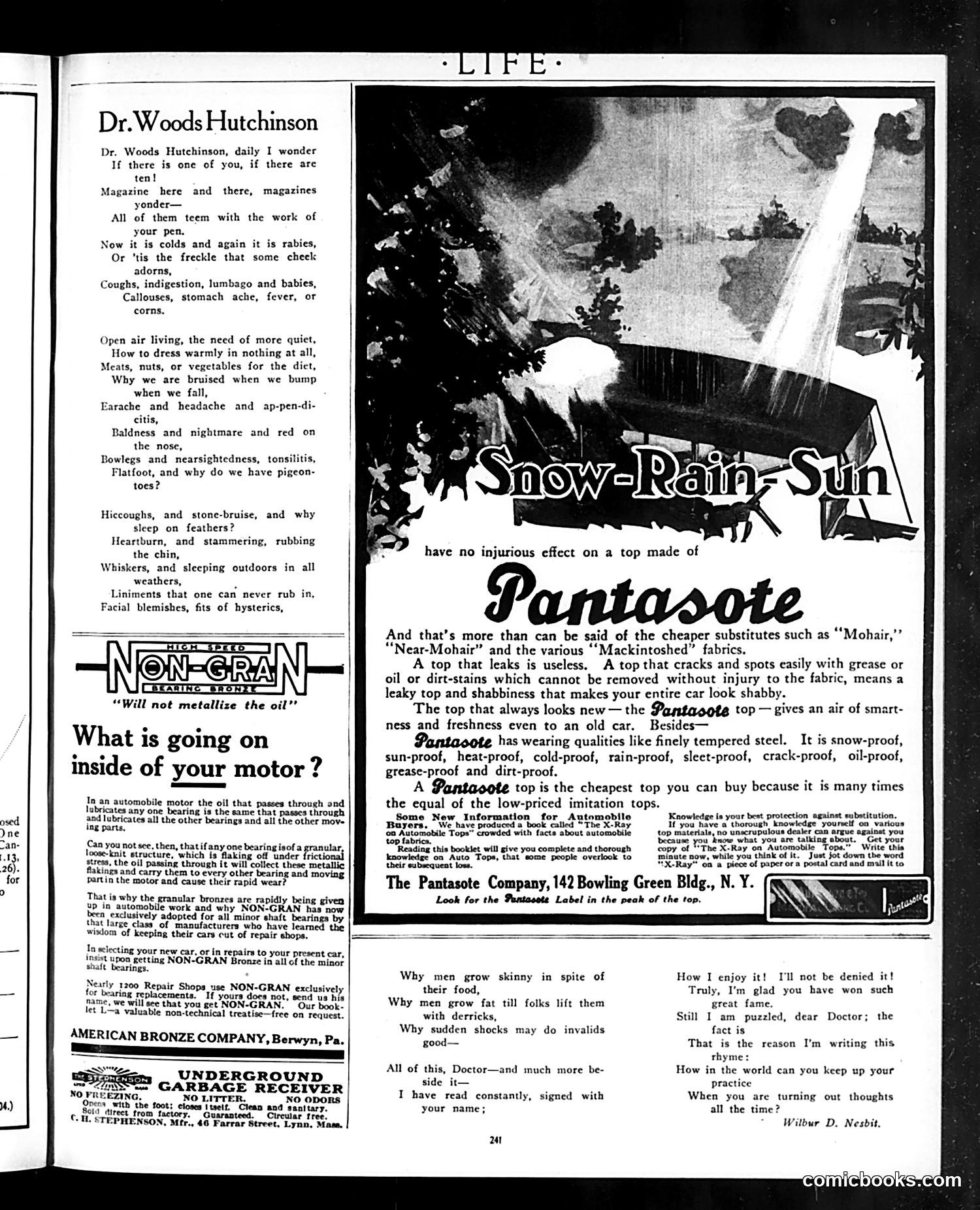
This page is **primarily advertising**, not satire or political cartoons. The main advertisement promotes **Pantasote**, a fabric top for automobiles, emphasizing its durability against "snow, rain, sun" and other weather conditions. The ad claims superiority over cheaper substitutes like "Mohair" and "Mackintoshed" fabrics. Below are smaller ads for **Non-Gran motor oil** and an **Underground Garbage Receiver**. The left column features "Dr. Woods Hutchinson," a medical advice column listing common ailments (coughs, indigestion, rabies, etc.) with remedies—typical of early 20th-century magazines. A poem at page bottom by "Wilbur D. Nesbit" discusses poverty and doctors, likely commentary on healthcare accessibility. This reflects the era's mix of practical advice, medical content, and commercial products targeting automobile owners.
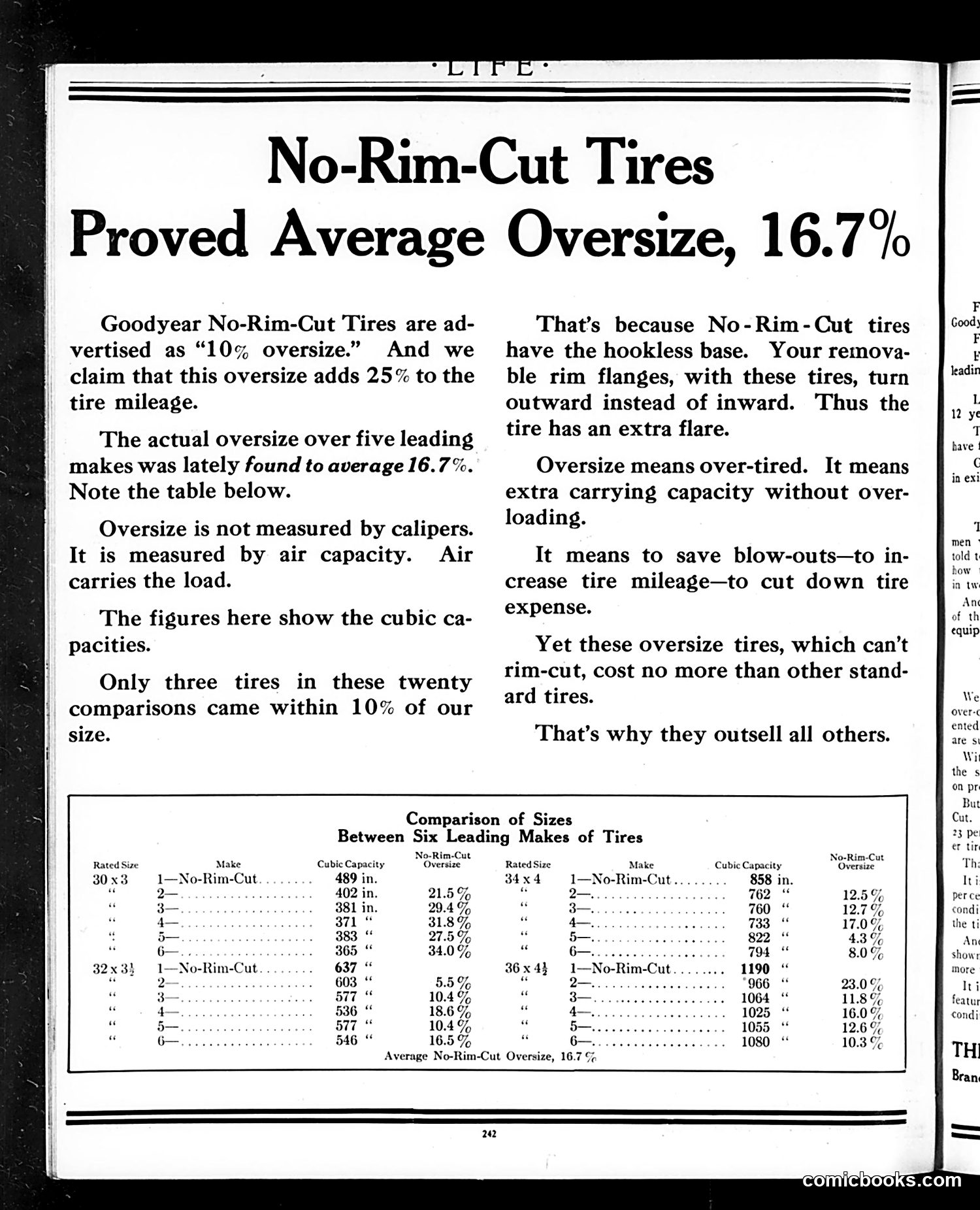
This is not a political cartoon or satirical piece—it's **advertising content** for Goodyear No-Rim-Cut Tires, presented as editorial material in *Life* magazine. The ad compares Goodyear's No-Rim-Cut Tires against five competitors, claiming they average 16.7% larger capacity than rival brands, despite being advertised as only "10% oversize." The text emphasizes practical benefits: increased load capacity, improved mileage, reduced blowouts, and lower tire expenses—all at standard pricing. A comparison table shows cubic capacities across tire sizes (30×3, 32×3¼, 34×4, 36×4) and competing makes (numbered 1-6), with percentage advantages listed. There is no satire here—this is straightforward commercial messaging using comparative data to market product superiority.
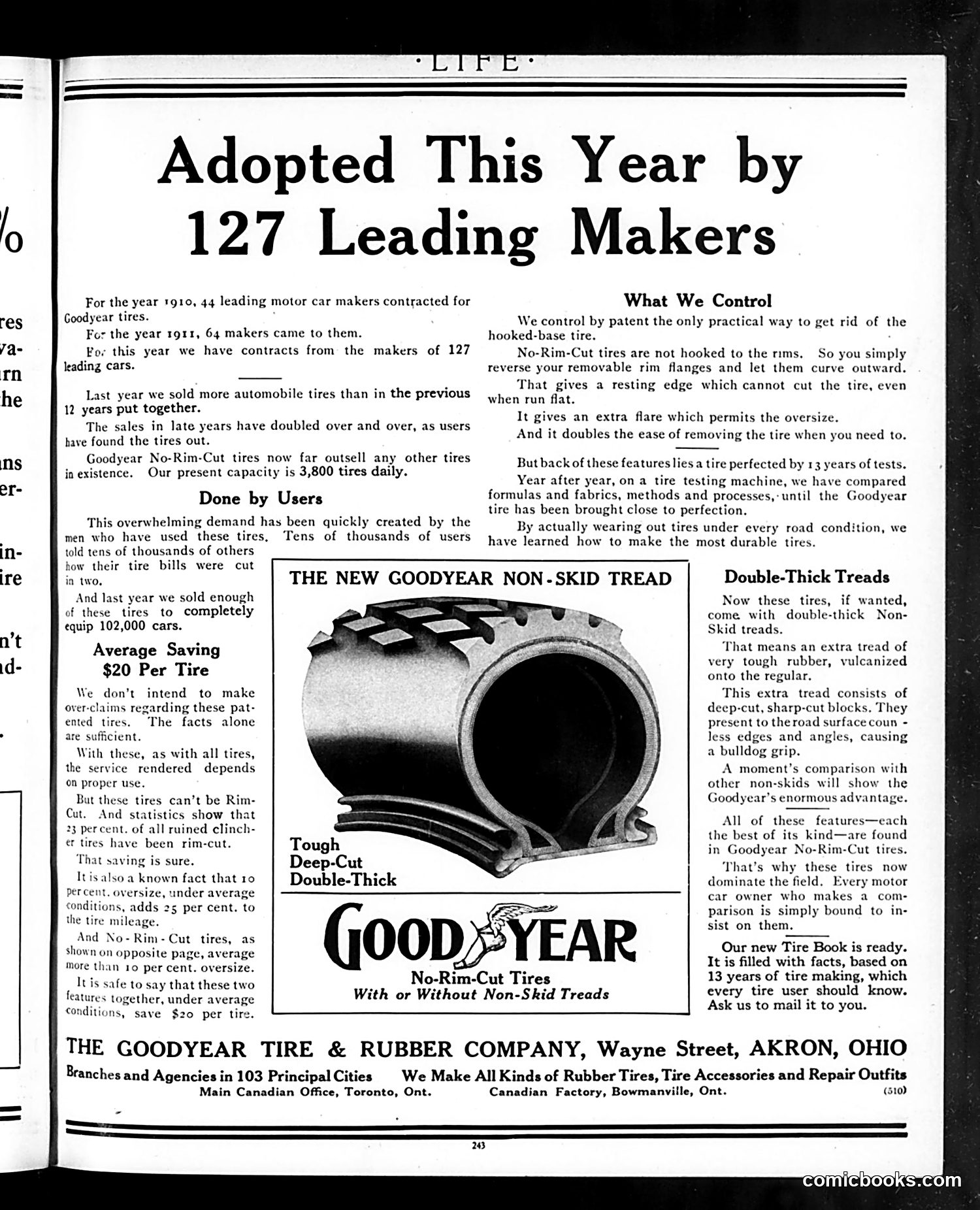
This page is **primarily an advertisement**, not satire or editorial content. It advertises Goodyear's "Non-Rim-Cut" tires, marketed as a major innovation for 1912. The ad claims that 127 leading automobile manufacturers adopted these tires that year, emphasizing their durability and cost-effectiveness ($20 savings per tire). The key innovation was the "Non-Skid Tread" with "Double-Thick" blocks—a practical safety feature preventing tire slippage. The advertisement targets early automobile owners by emphasizing real consumer benefits: reduced tire costs, longer tire life, and improved road safety. Rather than satire, this represents straightforward early 20th-century product marketing, highlighting how quickly automobile tire technology was evolving to meet the booming demand from the newly motorized public.
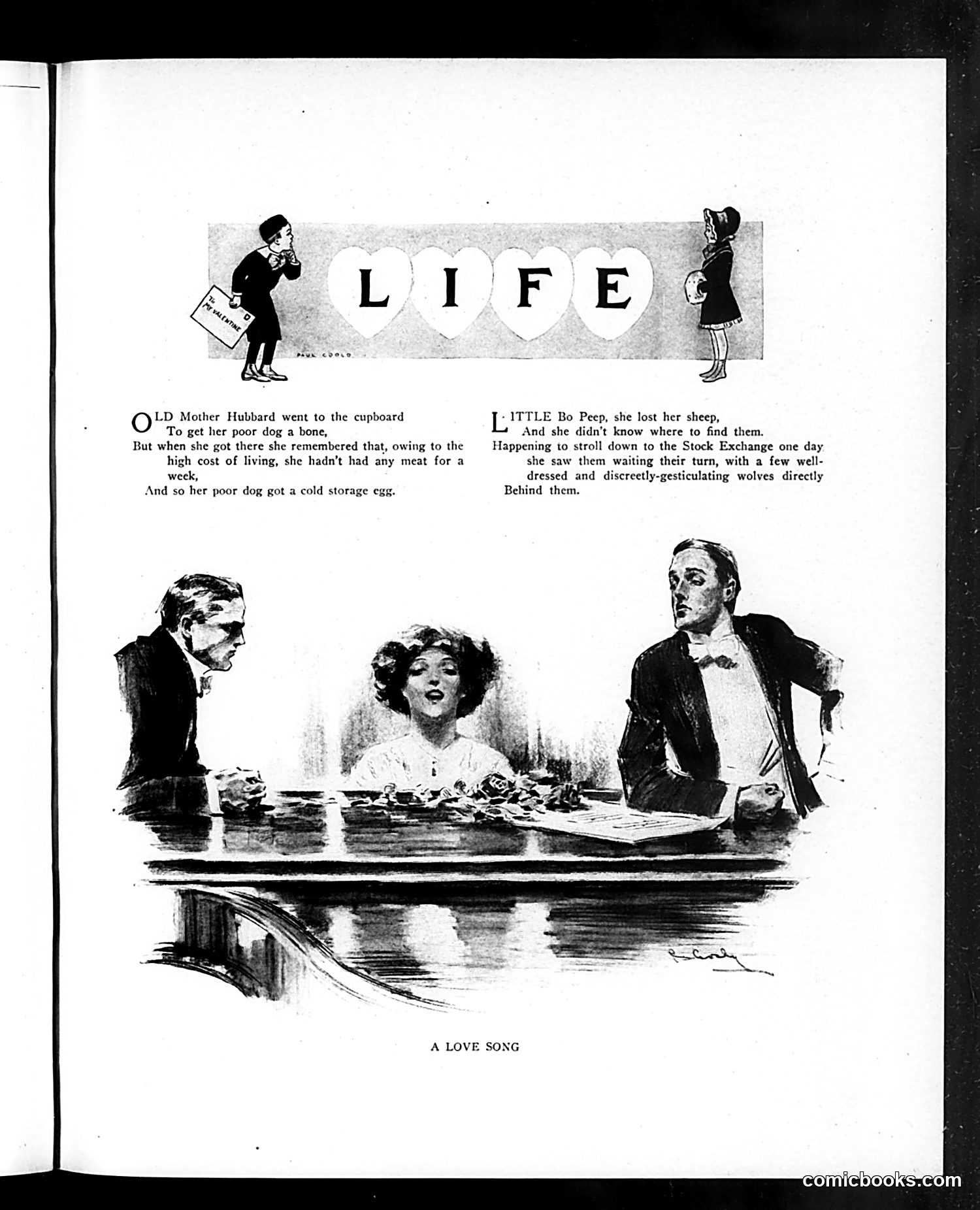
This page contains two satirical vignettes about economic hardship, likely from the early 20th century based on the style. **Top section ("LIFE" header):** Two contrasting stories about poverty during expensive times. Old Mother Hubbard couldn't afford meat for her dog due to high living costs. Little Bo Peep lost her sheep and found them at the Stock Exchange, "dressed and discreetly-gesticulating wolves"—suggesting financial predators exploiting the poor. **Bottom illustration ("A Love Song"):** A woman sits between two men at what appears to be a dining table, apparently discussing financial matters (papers visible). The caption's title suggests romantic interest, but the scene depicts economic negotiation instead—satirizing how financial desperation corrupts relationships and romance during economically difficult times. The satire critiques inequality and financial exploitation.
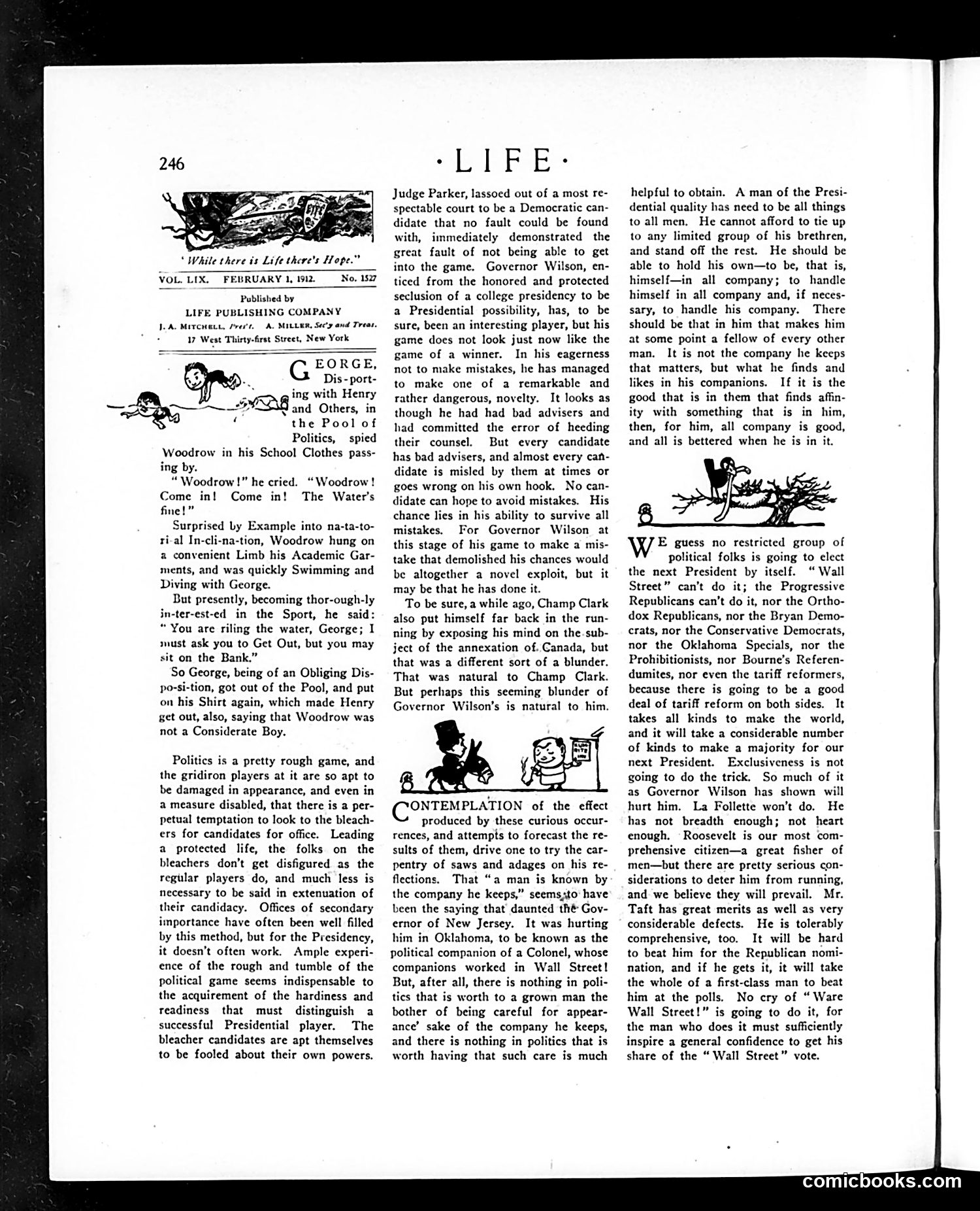
This Life magazine page satirizes the 1912 presidential race, focusing on candidate **Governor Wilson**. The text criticizes Wilson for making political mistakes while claiming to be a reformer, comparing him unfavorably to **Champ Clark** (likely his Democratic rival) and referencing **Judge Parker** as a previous failed Democratic candidate. The central argument: successful presidential candidates need strong character and judgment, not just good intentions. The article warns that political inexperience makes candidates vulnerable to bad advisers and public misjudgment. The cartoon at top appears to illustrate "Woodrow" (Wilson) in a school setting with "Henry and Others," satirizing his naïveté about practical politics versus academic idealism—a common critique of Wilson before his 1912 nomination.
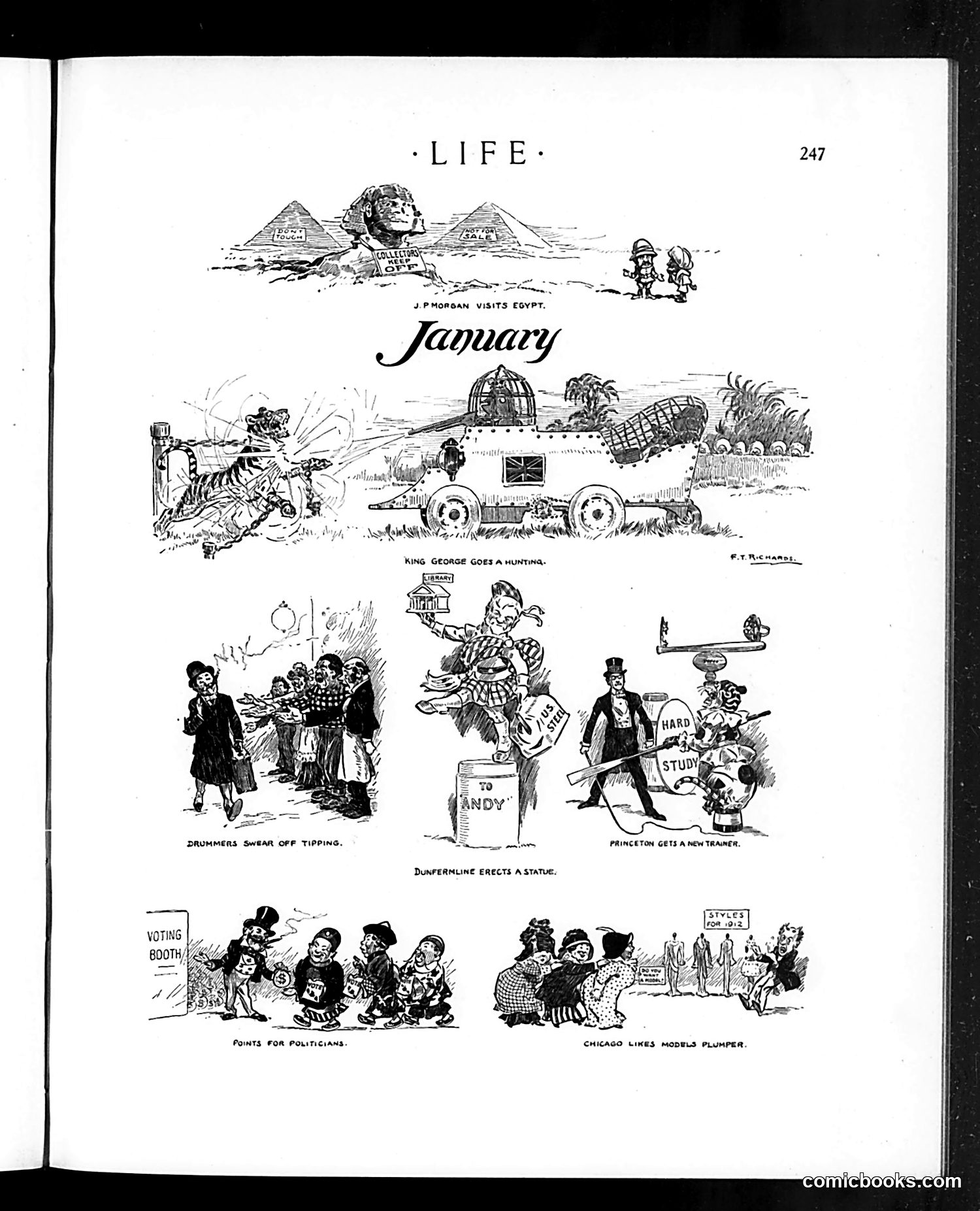
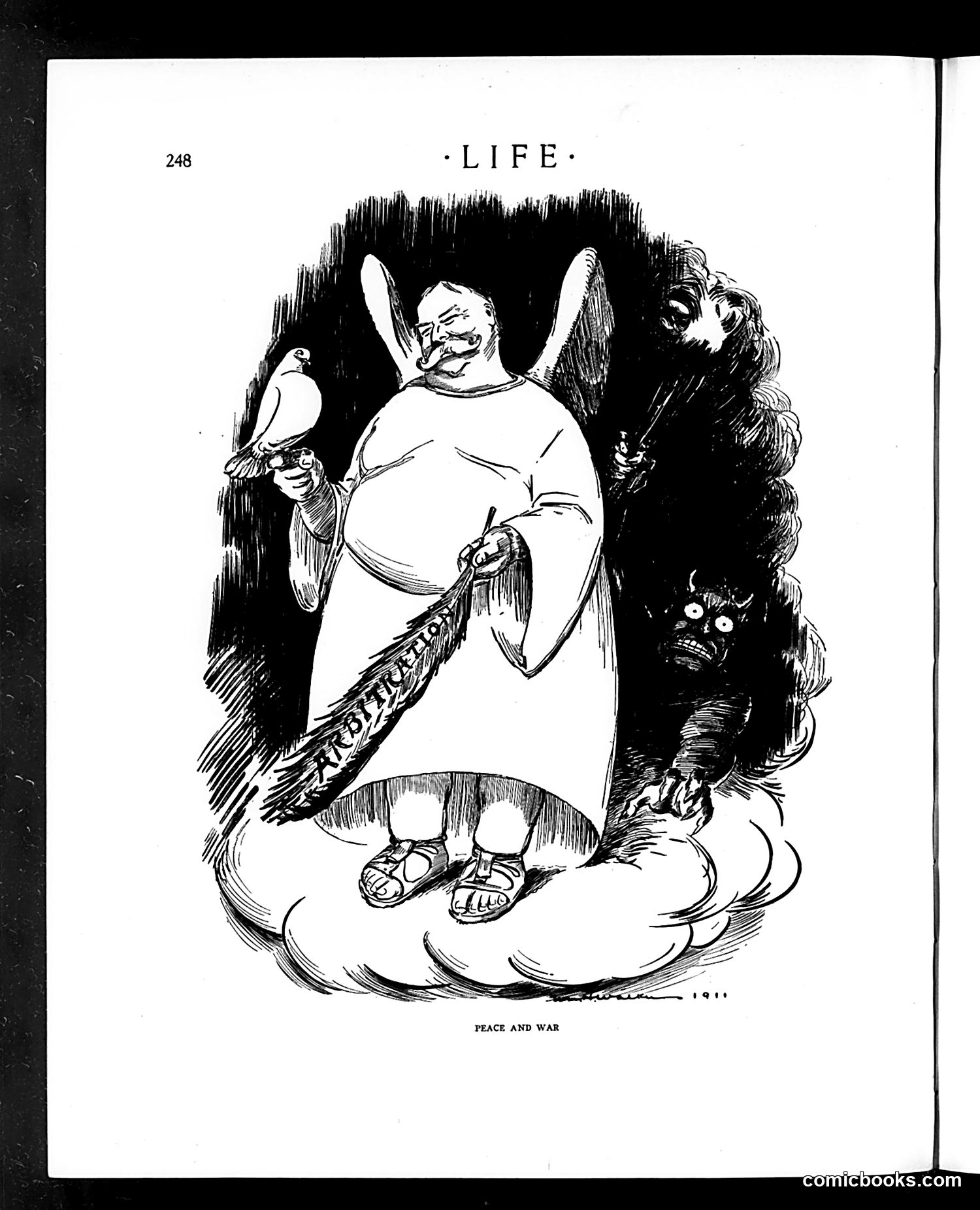
This political cartoon depicts a rotund, jovial figure standing on a cloud, representing **Peace or Prosperity**. The figure holds a bird (symbolizing peace) in one hand and what appears to be a rifle or weapon in the other—a visual contradiction expressing anxiety about maintaining peace while remaining militarily prepared. Flanking the central figure are ominous, demonic or animalistic faces representing **War or conflict**, suggesting these forces lurk threateningly in the background of any peaceful moment. The cartoon satirizes the precarious balance nations must maintain: enjoying peacetime prosperity while staying armed against potential enemies. It reflects early 20th-century anxieties about international tensions and the ever-present threat of war. The title "Peace and War" makes this duality explicit.
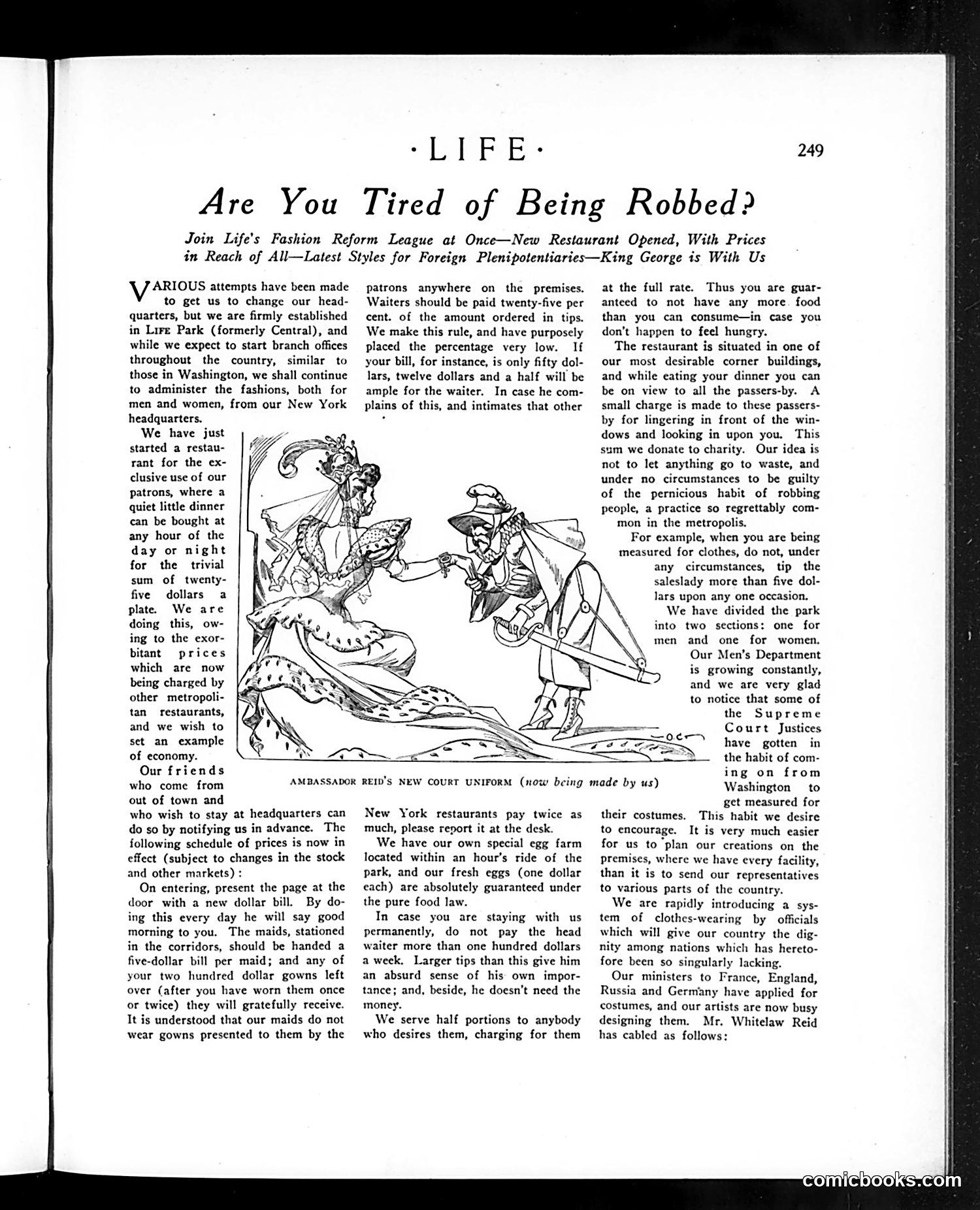
This page satirizes two social issues of the era: **The Cartoon**: Titled "Ambassador Reid's New Court Uniform," it depicts a figure being measured or fitted, likely mocking Whitelaw Reid (mentioned in the text). The satire targets the absurdity of American diplomats adopting elaborate foreign court dress—shown as an overwrought, impractical costume. This ridicules the pretension of American officials adopting European aristocratic formality. **The Text**: The main article, "Are You Tired of Being Robbed?", attacks the tipping custom in American restaurants. It proposes Life's "Fashion Reform League," advocating against excessive tips and suggesting modest, standardized tipping rates (25 cents on bills, five dollars maximum per week for service staff). The satire mocks how prevalent tipping has become—customers feel obligated to over-tip to avoid embarrassment, effectively subsidizing waiters' wages.
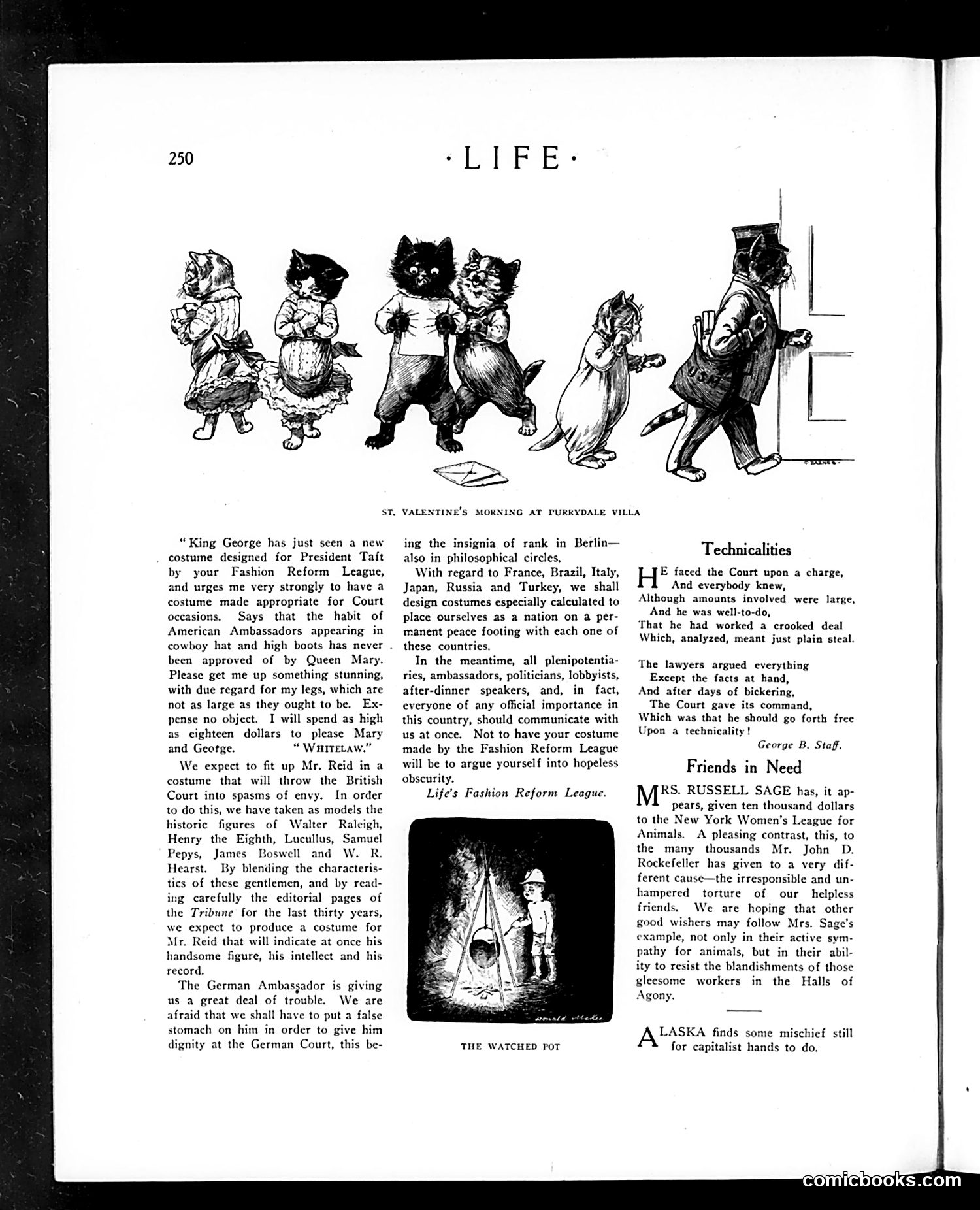
**Top Cartoon: "St. Valentine's Morning at Purkeydale Villa"** This anthropomorphic cartoon depicts cats in human clothing and situations. The caption and accompanying text reference King George viewing a new costume designed for President Taft by the "Parisian Reform League." The satire mocks diplomatic costume design and international fashion politics, suggesting absurdity in formal state dress codes. The cats appear to represent various national figures engaged in morning routines, likely satirizing European diplomatic pretensions. **Right Column Content:** The remaining text discusses legal/political matters ("Technicalities"), a philanthropic donation from Mrs. Russell Sage to the Women's League for Animals, and commentary on capitalism. The overall page blends whimsical animal illustration with contemporary political and social commentary typical of early 20th-century satirical magazines.
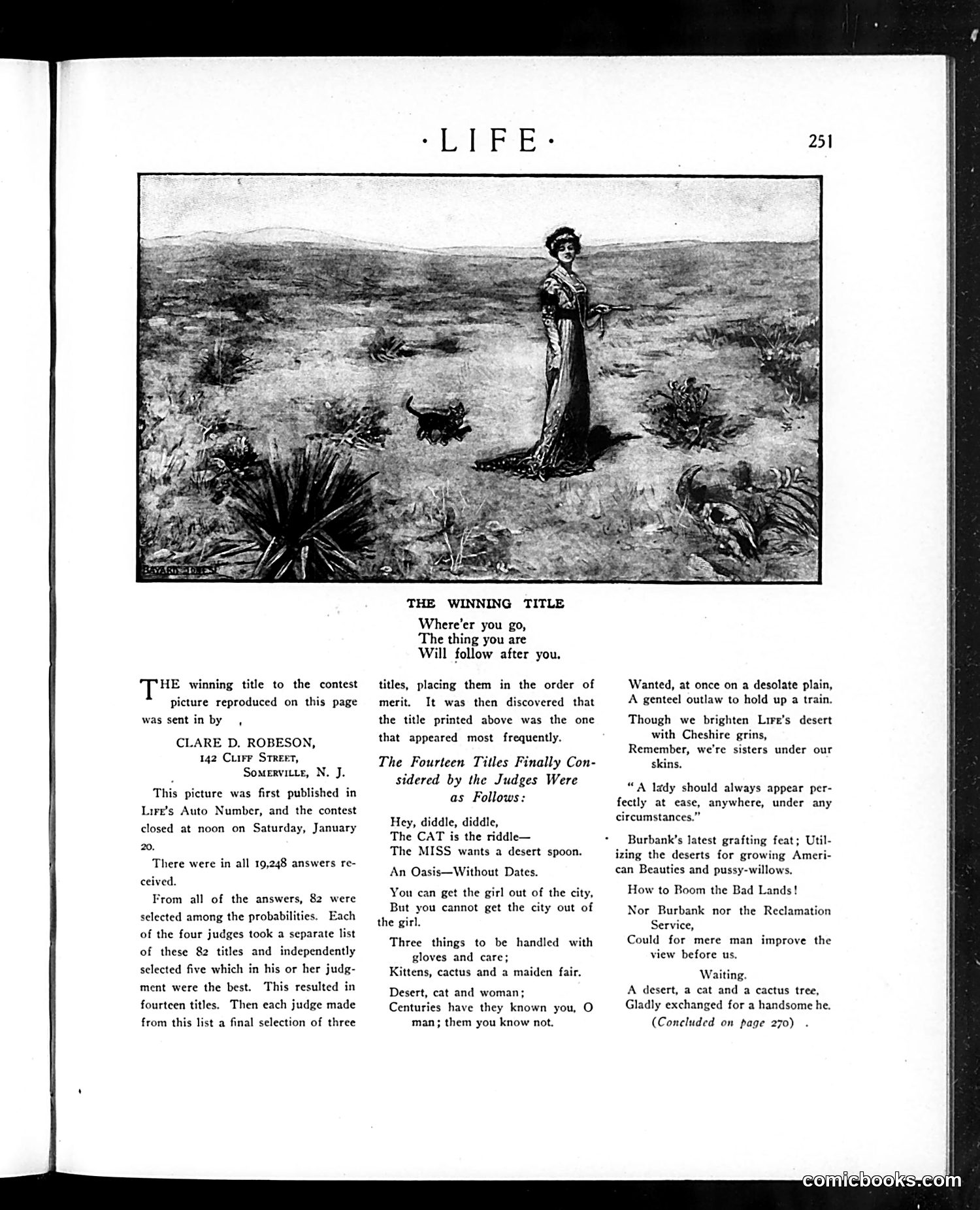
This page documents *Life* magazine's contest to caption a picture (visible above the text). The winning caption—"Where'er you go, / The thing you are / Will follow after you"—was submitted by Clare D. Robeson of New Jersey. The image shows a fashionably dressed woman standing alone in a desert landscape with sparse vegetation. The contest received nearly 20,000 entries; judges narrowed these to 14 finalists, then selected three top choices. The fourteen alternative titles reveal the intended joke: they play on the contrast between the woman's refined, urban sophistication and the harsh desert setting. Titles reference Luther Burbank's desert agricultural experiments, reclamation projects, and the cultural observation that city refinement cannot be shed—even in desolate wilderness. The satire gently mocks both the woman's pretension and early-20th-century assumptions about gender, civilization, and nature.
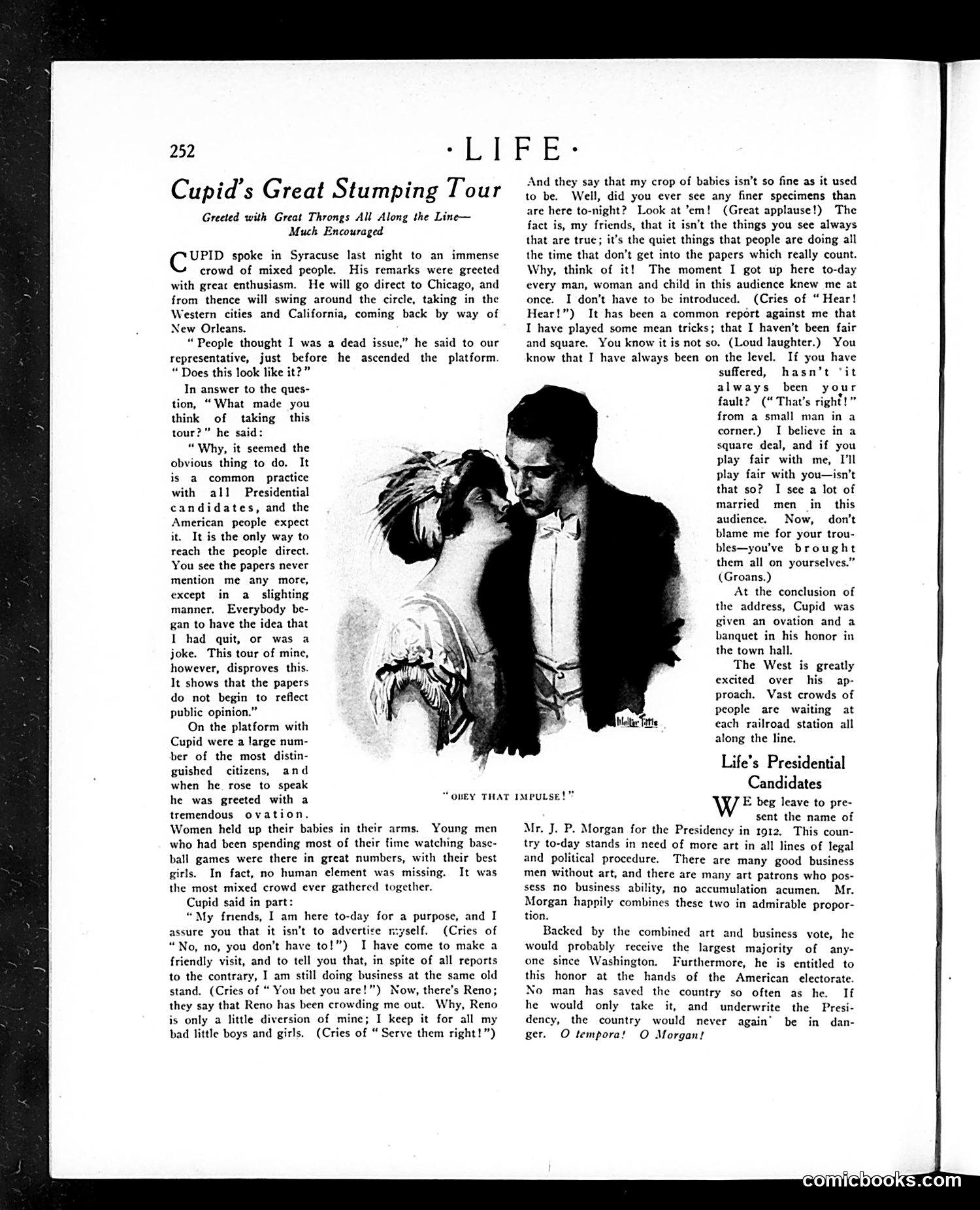
This is political satire personifying Cupid (the Roman god of love) as a presidential candidate conducting a campaign tour. The joke mocks how candidates travel the country making speeches to regain public attention—Cupid claims he's been forgotten and needs to prove he's "still doing business." The satire works on multiple levels: Cupid's complaints (that newspapers ignore him, that Reno "crowds him out," that his babies aren't as fine) are absurd metaphors for lost political relevance. His defensive speech—insisting he plays fair and that people shouldn't blame him for their troubles—parodies typical campaign rhetoric deflecting criticism. The accompanying section "Life's Presidential Candidates" sarcastically nominates J.P. Morgan (the famous banker) for president in 1912, arguing the country needs more "art in all lines of legal and political procedure." Together, these pieces mock both the absurdity of constant campaigning and the idea that wealthy businessmen make suitable presidential candidates.
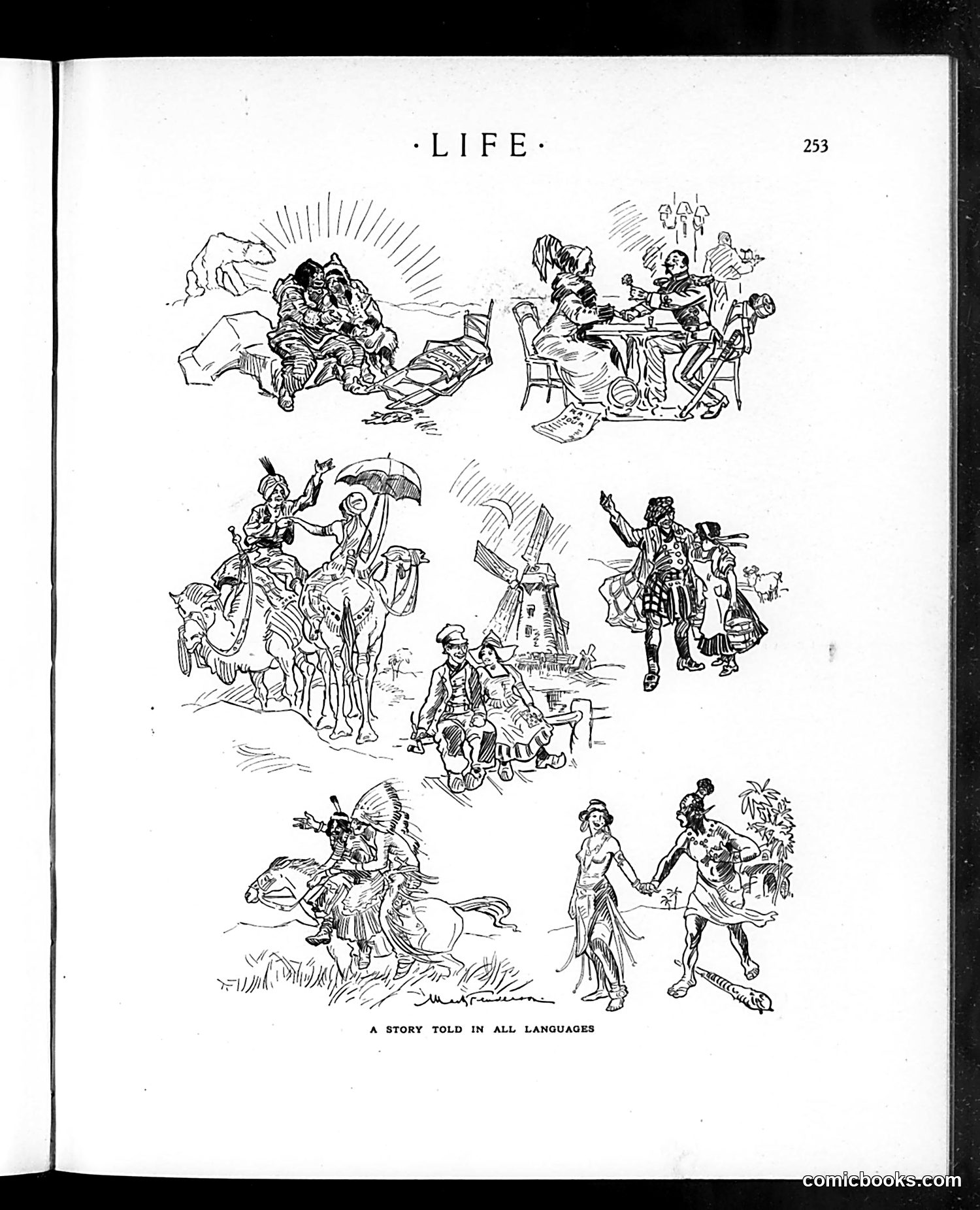
This page presents a series of six satirical sketches illustrating "A Story Told in All Languages" — a visual narrative that communicates through universal human situations rather than words. The scenes depict recognizable character types and scenarios: wealthy figures in comfort (top left), romantic encounters, travelers or adventurers on horseback and camels (referencing exotic lands), maritime/colonial settings, and what appears to be flirtation or courtship (bottom right). The satire suggests that certain human experiences — desire for wealth, romance, adventure, trade, and attraction — transcend language and cultural boundaries. By presenting archetypal situations without dialogue, the cartoonist implies these universal human drives operate identically across all civilizations and languages, a commentary on shared human nature beneath surface cultural differences.
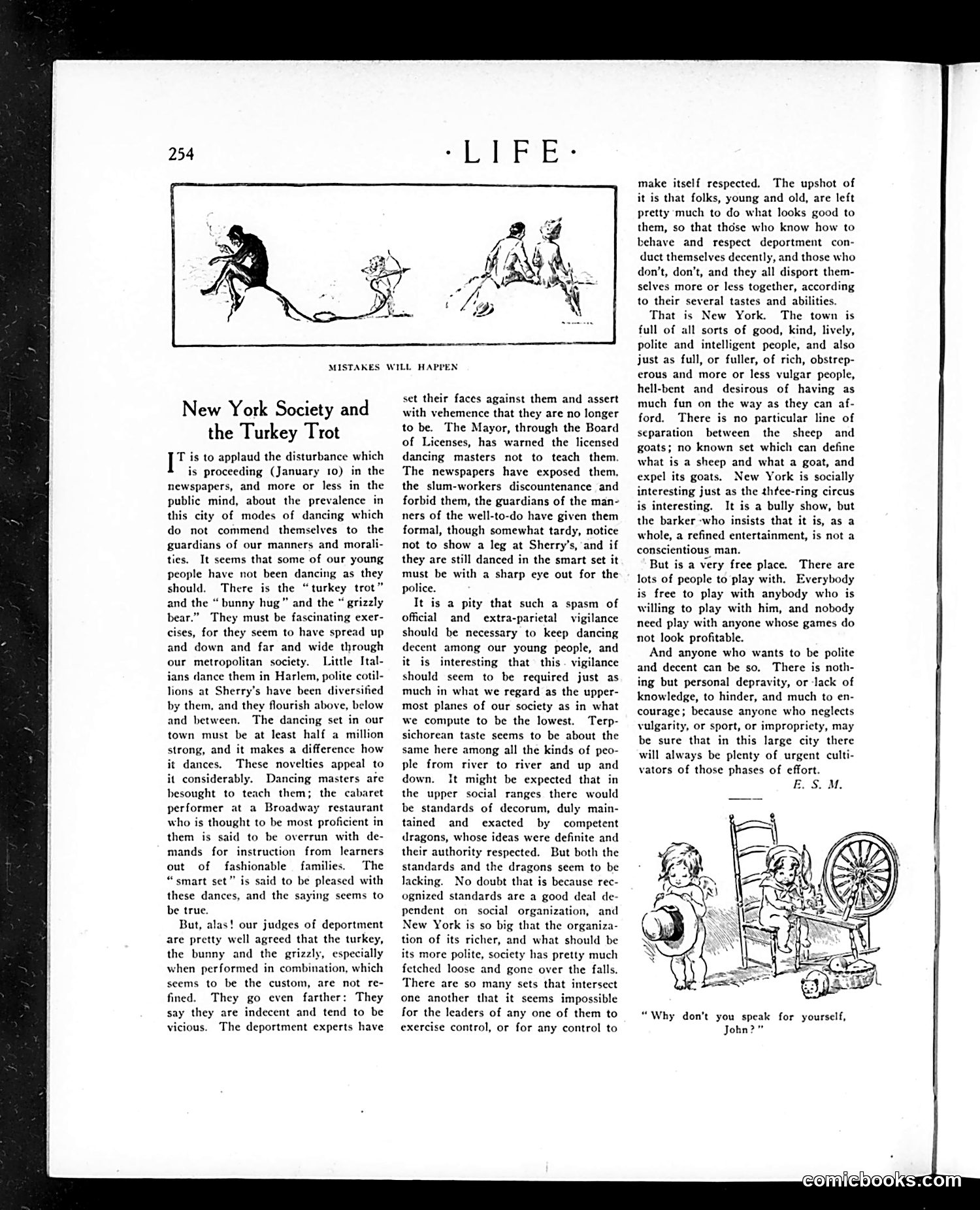
This article satirizes the moral panic over new dance crazes—the "turkey trot," "bunny hug," and "grizzly bear"—that swept through 1910s New York City. **The Social Context:** The dances originated in working-class venues (Harlem, cabarets) but spread to high society (Sherry's restaurant). Authorities—the Mayor, newspapers, and moral guardians—condemned them as indecent and "vicious," even warning dance instructors not to teach them. **The Satire's Point:** Life mocks the hypocrisy and ineffectiveness of this moral policing. The author notes that despite official disapproval, the dances flourished across *all* social classes. The piece ironically observes that New York's wealthy elite lacks the unified social authority to enforce "standards of decorum"—the city is too fragmented for anyone to control behavior. **The Cartoon (top):** Sketch-style figures depicting the energetic, undignified movements of these dances. The overall message: moral outrage about dance reveals not actual impropriety, but rather the breakdown of class-based social control in modern urban America.
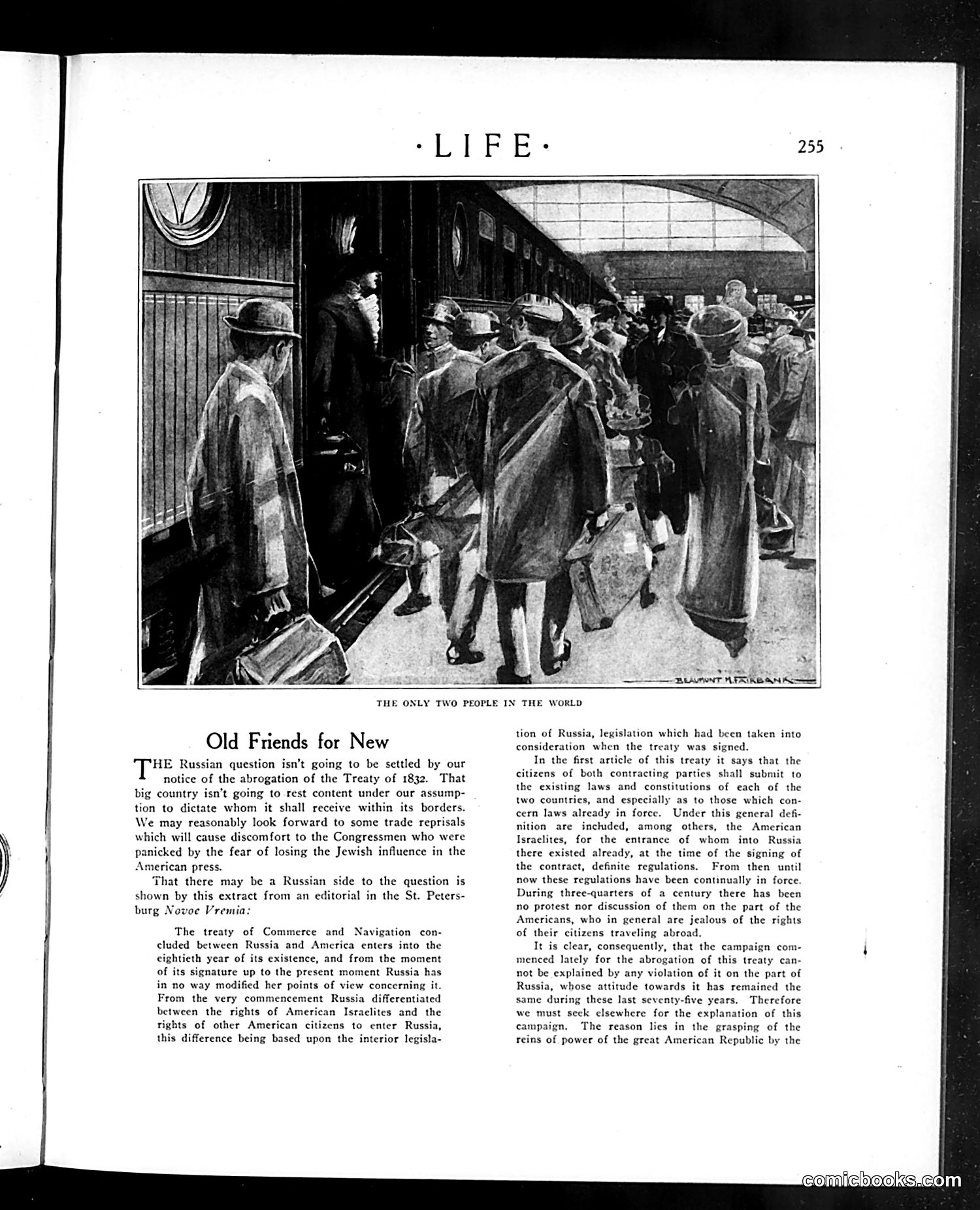
This page discusses the 1911 abrogation of the 1832 U.S.-Russia Treaty of Commerce and Navigation. The cartoon caption, "The Only Two People in the World," appears to depict a customs or immigration checkpoint scene—likely representing the moment of treaty termination. The article criticizes American pressure to end the treaty, attributing it to Jewish-American political influence ("losing the Jewish influence in the American press"). Russia's position, quoted from a Russian newspaper, defends its long-standing restrictions on Jewish citizens entering Russia, arguing these were known when the treaty was signed and consistently enforced. The satire's point: American politicians abandoned an eighty-year trade agreement due to domestic pressure over Russia's discriminatory Jewish immigration policies—a move the author suggests was economically foolish and based on special-interest lobbying rather than principled diplomacy. **Context for moderns:** This reflects pre-WWI tensions over Jewish rights and immigration, showing how religious discrimination shaped international relations.
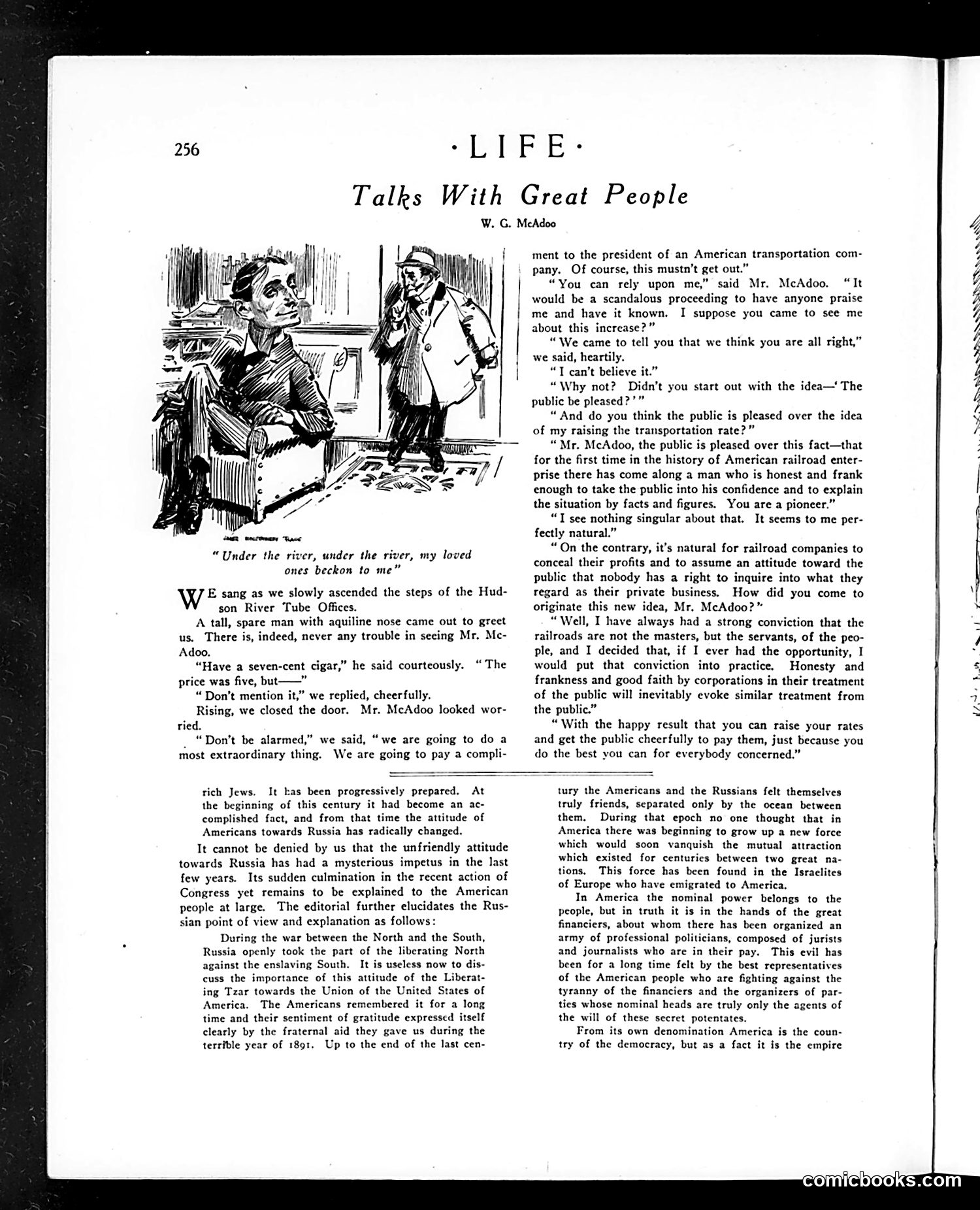
This satirical piece interviews **William G. McAdoo**, who appears to be a railroad executive. The cartoon depicts him as unusually honest—a rarity that Life finds amusing enough to mock. The satire's point: McAdoo has raised transportation rates but justified this transparently by explaining his costs and reasoning to the public with "facts and figures." Life ironically praises this as pioneering honesty, since railroad companies typically concealed profits and treated inquiries about their business as impertinent. The joke works on two levels: McAdoo is lauded for basic transparency (implying this was shockingly uncommon), and the implication that people will happily pay higher rates if a corporation simply treats them honestly and respectfully. The accompanying text discusses Russia-America relations, suggesting this issue of Life addressed broader corporate accountability debates of the era.
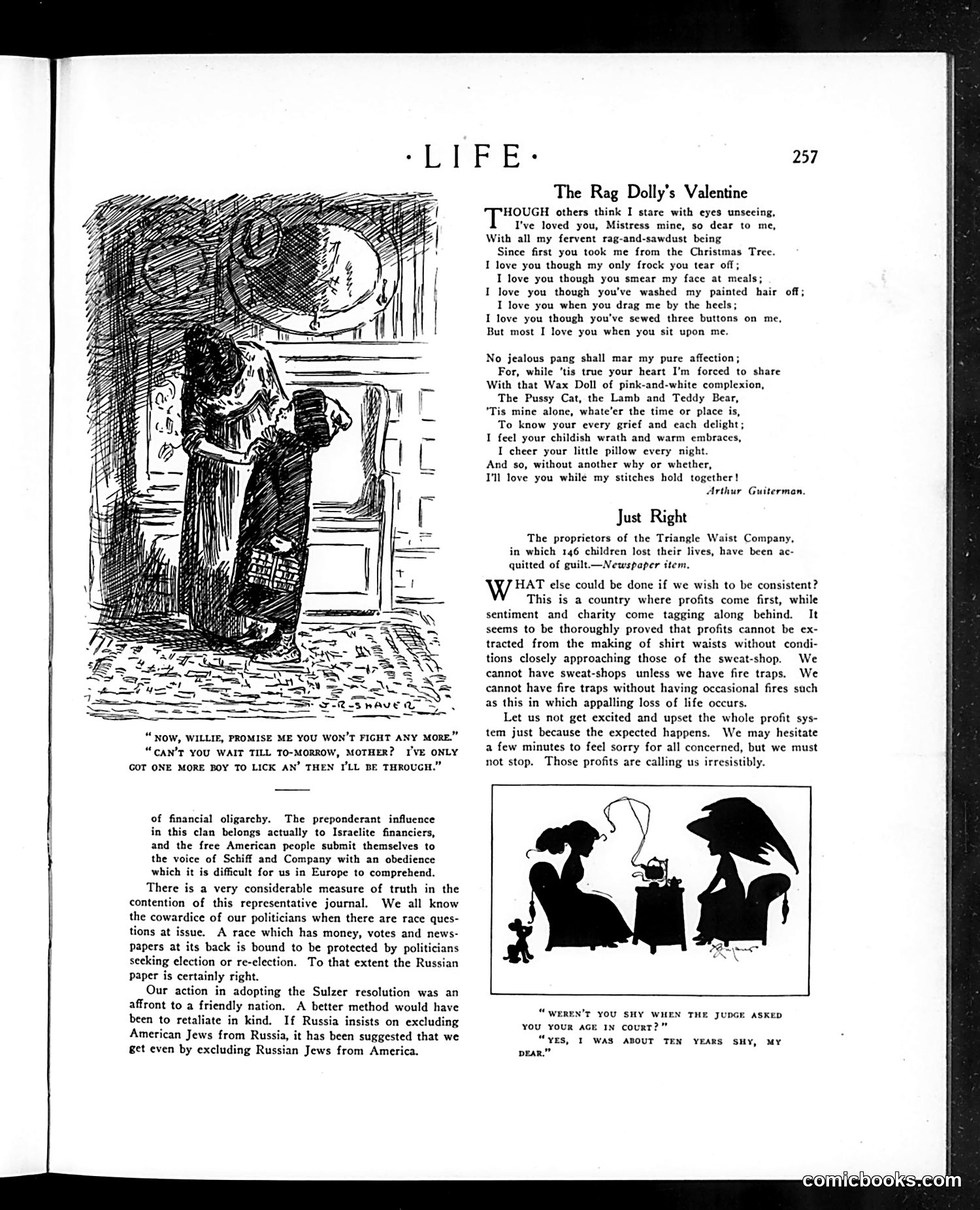
This page contains sharp social satire responding to the Triangle Waist Factory fire (1911), in which 146 workers, mostly young immigrant women, died—and the owners were acquitted. **"Just Right"** is the primary satire. It sarcastically argues that the acquittal is logically consistent with American capitalism: if profits come first, then sweatshop conditions (which maximize profits) are inevitable, and occasional fatal fires are simply the cost of doing business. The piece mocks the hypocrisy of expressing sympathy while defending a profit system that necessitates these tragedies. The biting conclusion—"Those profits are calling us irresistibly"—exposes how financial interests override human life. The bottom cartoon uses a pun about courtroom shyness to comment on the acquittal's absurdity. The "Rag Dolly's Valentine" is sentimental verse celebrating a child's worn doll—contrasting sharply with the page's harsh critique of how working children were treated in factories. The longer political text criticizes Jewish financiers and advocates excluding Russian Jews from America—reflecting the page's conflicted editorial perspective.
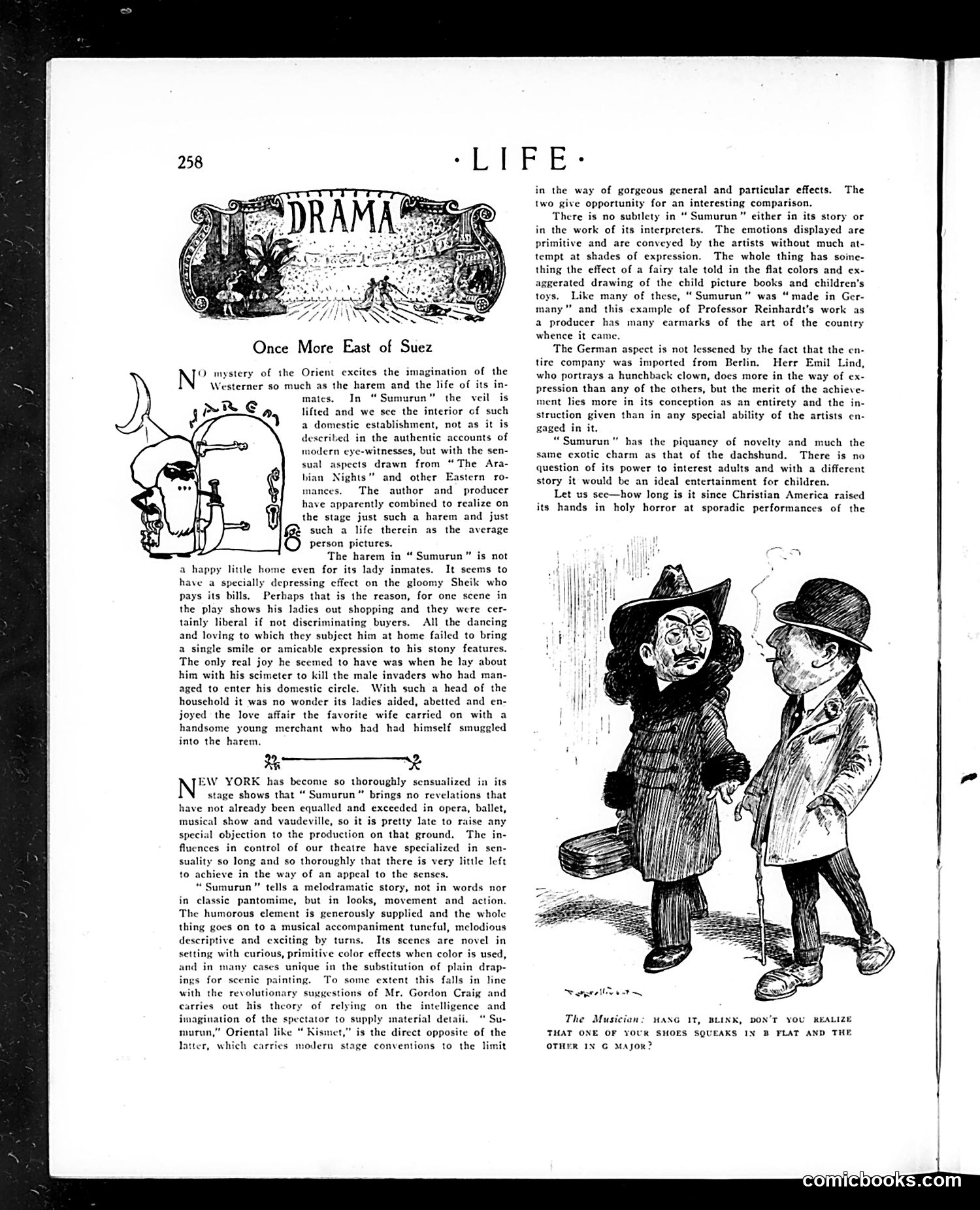
This page reviews "Sumurun," a German theatrical production imported from Berlin by director Max Reinhardt. The review examines how the play dramatizes Western fantasies about harems and Oriental life, drawing on imagery from *Arabian Nights* rather than authentic accounts. The accompanying cartoon depicts two figures—likely a hunchbacked character and another performer from the production—illustrating the show's exaggerated, cartoonish style. The caption's reference to "shoes squeaks" and "flat major" suggests physical comedy. The critic notes that New York audiences have become so desensitized to sensuality in theater that "Sumurun" offers nothing shocking. The production is criticized as melodramatic and unsophisticated, with "primitive" emotions conveyed through movement rather than subtle performance. The reviewer dismisses it as resembling children's picture books—flat, exaggerated, and deliberately simple—while acknowledging its artistic novelty in staging and design choices.
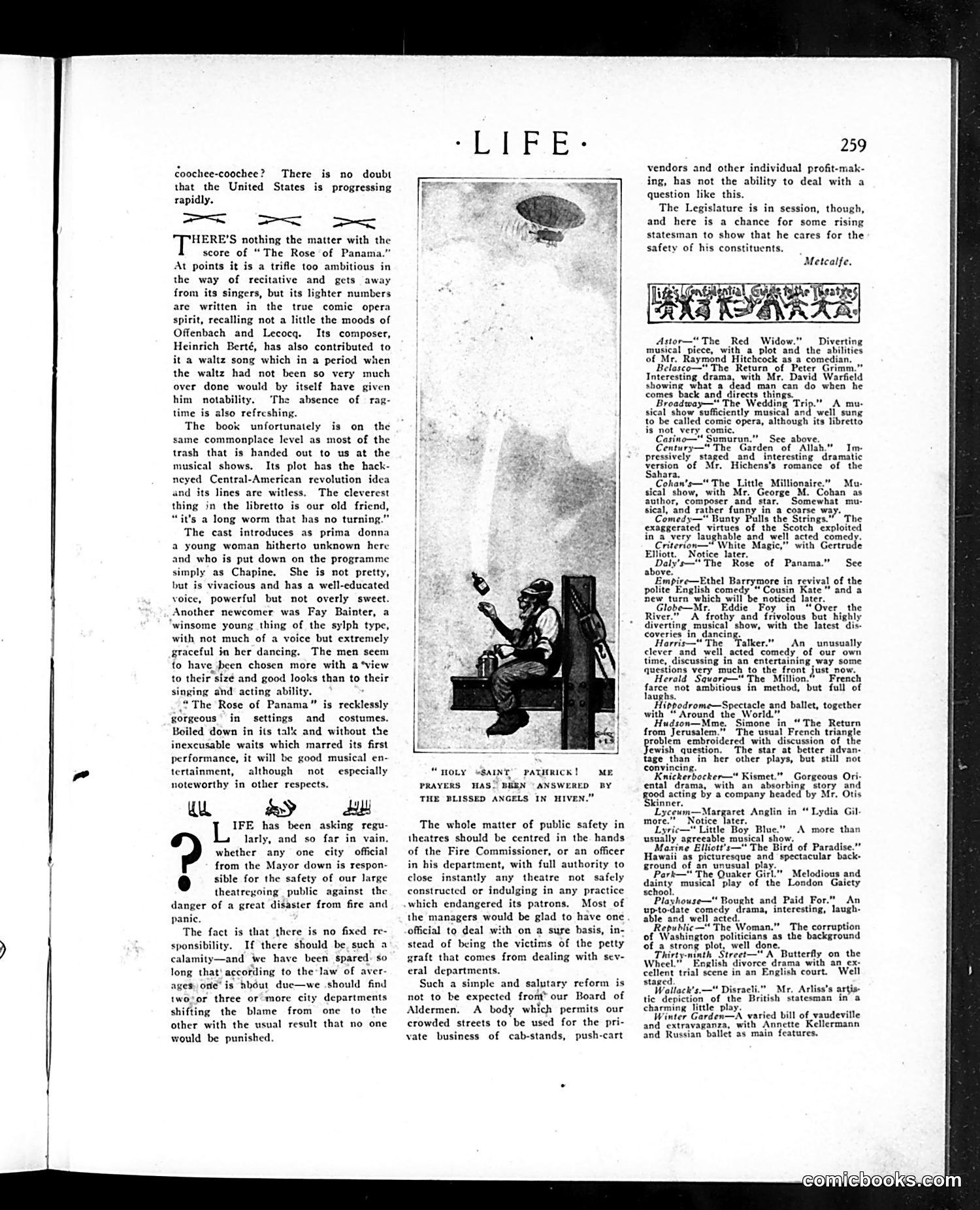
This page contains two distinct elements: a theatrical review and a political cartoon about public safety. The cartoon depicts an Irish character (identifiable by the caption "Holy Saint Patrick!") praying, with the caption indicating his prayers have been answered by "the blessed angels in heaven." The humor is satirical—he's likely depicted as a cab driver or street vendor, referencing the text's complaint that New York's Board of Aldermen permits crowded streets to be monopolized by private cab-stands and push-cart vendors for profit. The accompanying editorial by Metcalfe criticizes the lack of unified responsibility for theater safety in New York City. He argues that multiple city departments avoid accountability for fire hazards, and blames the Board of Aldermen for being too corrupt (dealing in "petty graft") to fix the problem. He appeals to the state Legislature to intervene and establish a single official authority—the Fire Commissioner—to enforce theater safety standards. The satire mocks both municipal negligence and the powerlessness of ordinary citizens against institutional dysfunction.
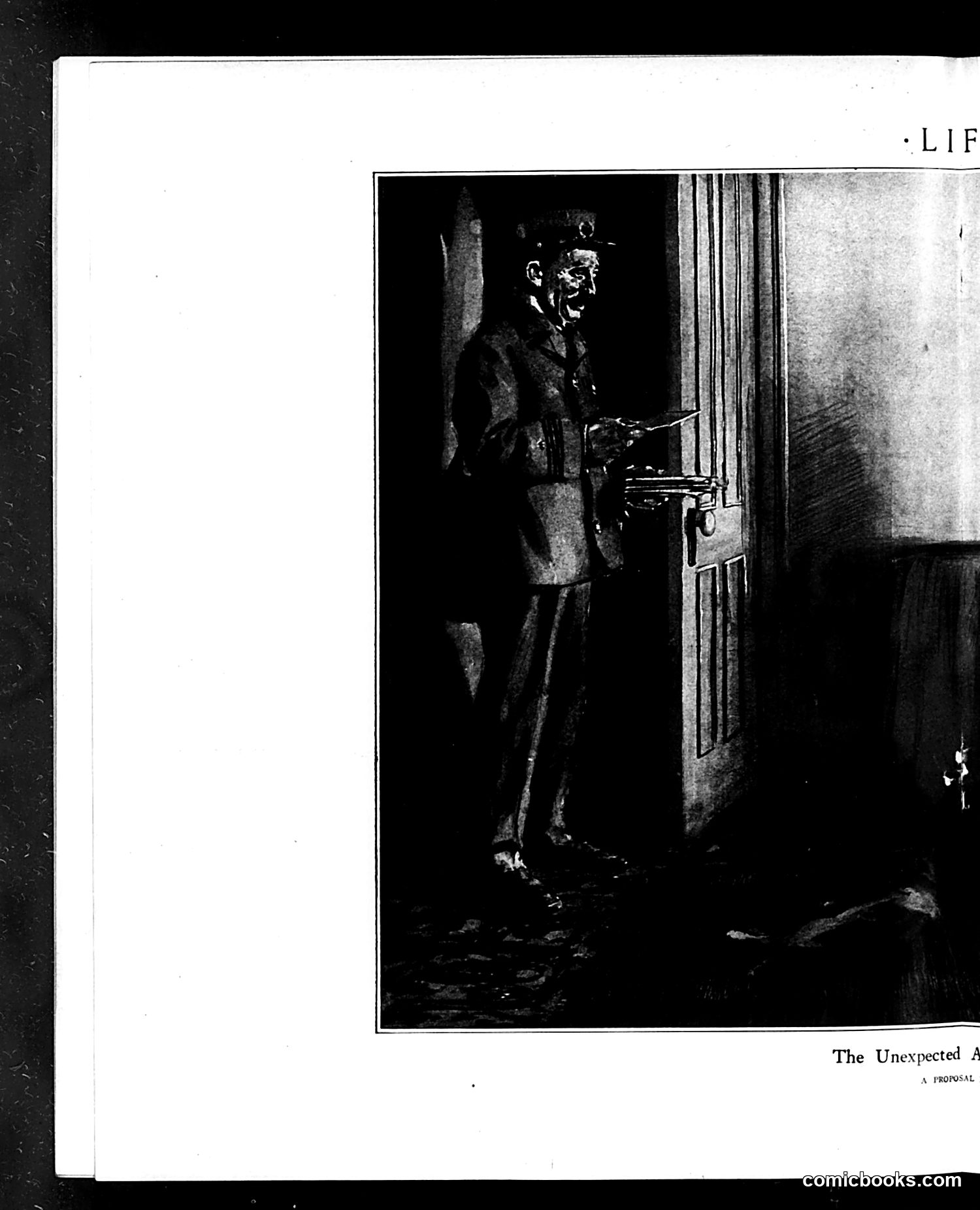
This page shows a dramatic black-and-white illustration titled "The Unexpected A Proposal." The image depicts a skeleton or death figure in formal attire standing in a doorway at night, apparently making a romantic proposal to someone inside (partially visible). The satire appears to be a dark humor piece about unwanted or shocking romantic advances—literally depicting Death as an unexpected suitor. The formal dress and doorway setting suggest a conventional courtship scenario, but the skeleton figure subverts this with macabre irony. Without additional context or visible date information, the specific historical or political reference remains unclear, though the memento mori imagery was common in early 20th-century satirical humor to comment on human folly and social pretension.
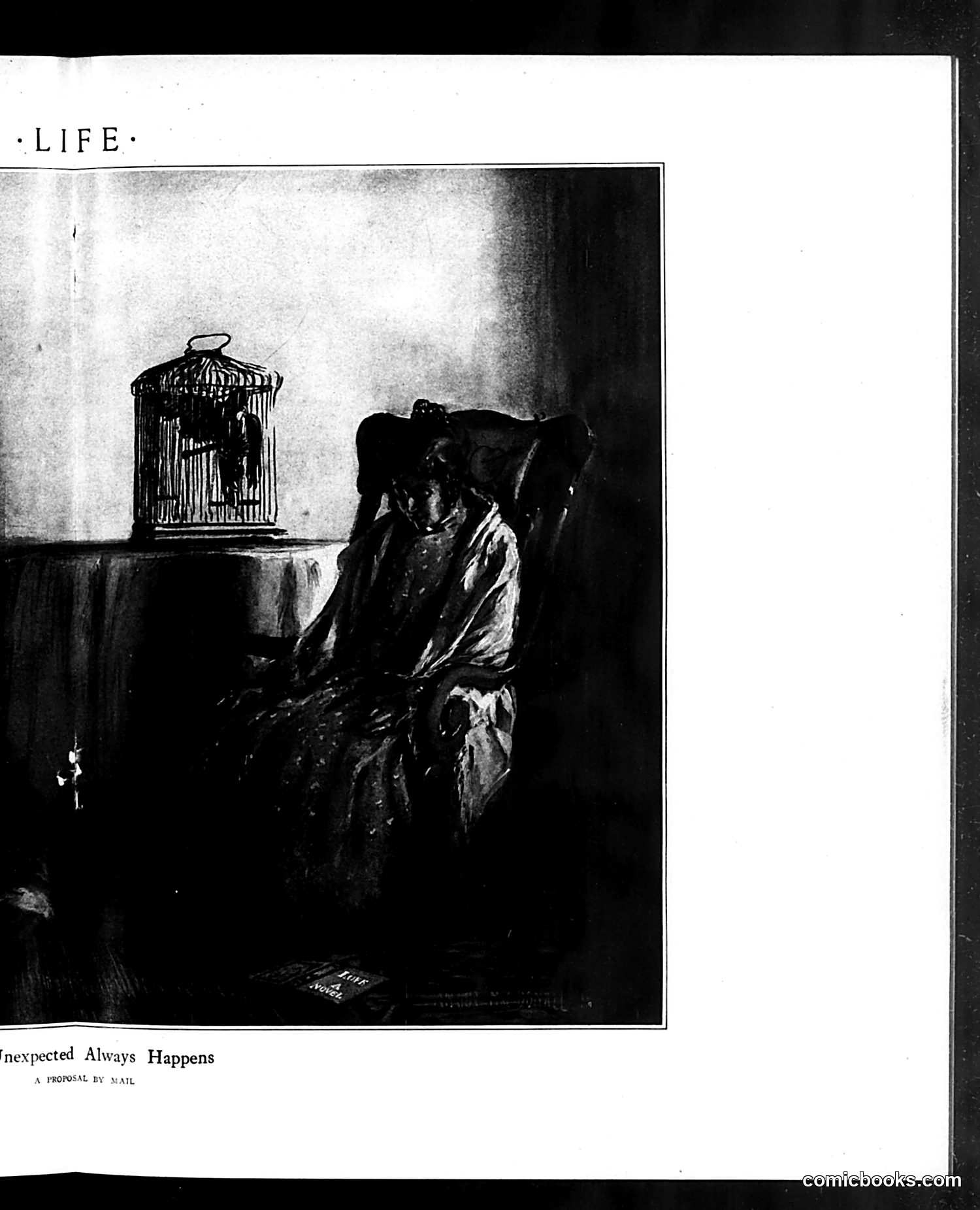
This cartoon depicts a domestic scene where a man in formal attire sits beside a woman in an interior setting. An empty birdcage sits on a table behind them. The title suggests the joke concerns romantic or marital proposals—specifically that something unexpected occurs during such moments. The satire likely plays on the conventional Victorian expectation that proposals follow predictable, formal patterns. The birdcage may symbolize trapped domesticity or loss of freedom, or it could suggest the woman has "flown the coop" metaphorically. The dramatic lighting and composition emphasize the tension or awkwardness of the moment. Without additional context about Life magazine's specific satirical targets in this period, the precise nature of the "unexpected" element remains unclear.
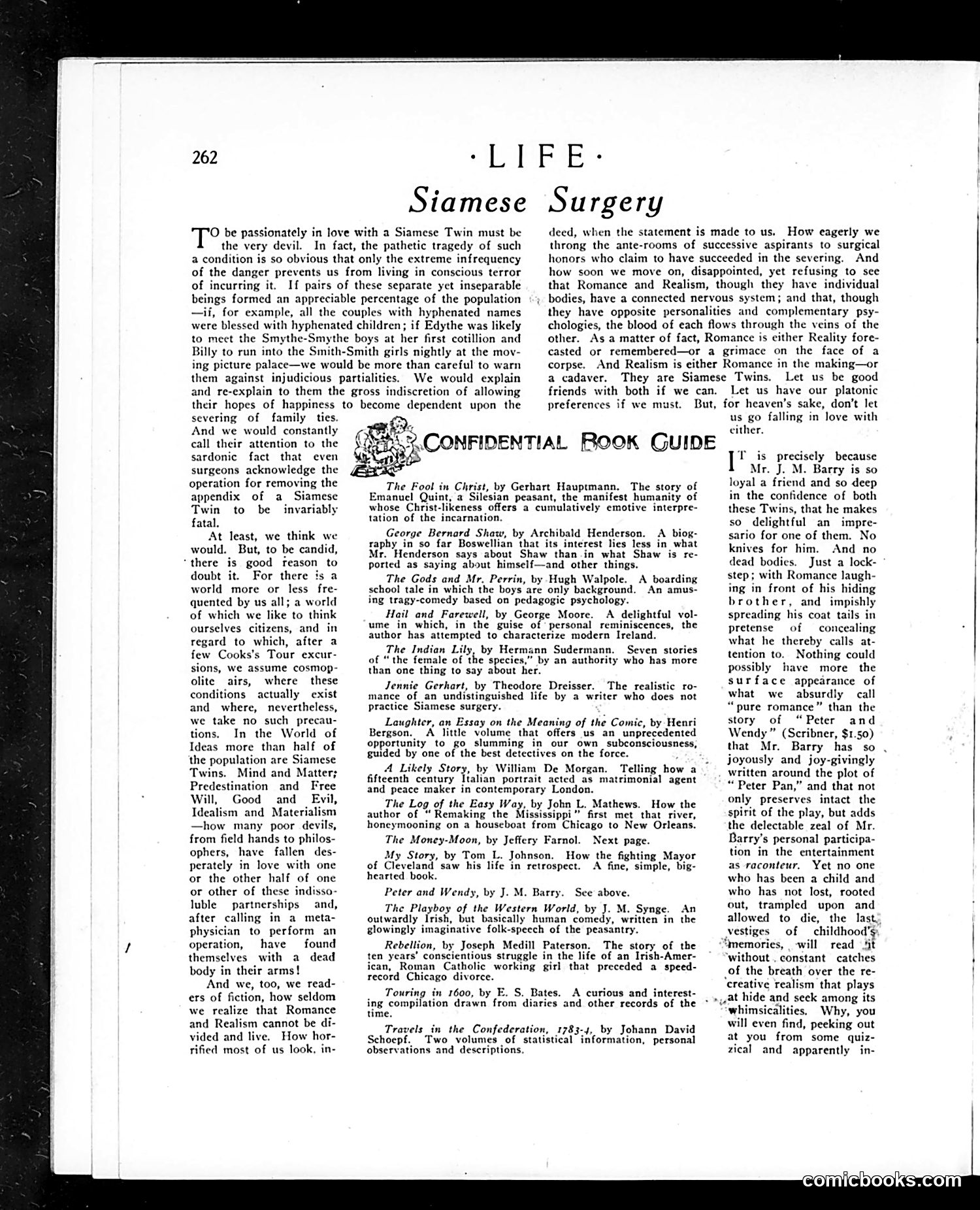
This page contains an extended satirical essay (not a cartoon) titled "Siamese Surgery," using Siamese twins as a metaphor for the inseparable relationship between **Romance and Realism** in literature and life. The author argues that falling in love while hoping to "sever" one aspect of human experience from another is as tragic and impossible as separating conjoined twins. The piece warns against trying to choose between romantic idealism and realistic worldview—they're interconnected, sharing "the same nervous system" and "blood." The text then shifts to a "Confidential Book Guide" reviewing contemporary literary works, including titles by Hauptmann, Shaw, Walpole, and Moore. The essay's central point: you cannot live by romance alone or realism alone; both are essential to human experience, and attempting to surgically separate them is folly. It's a sophisticated literary-philosophical commentary typical of Life's satirical approach to culture and ideas.
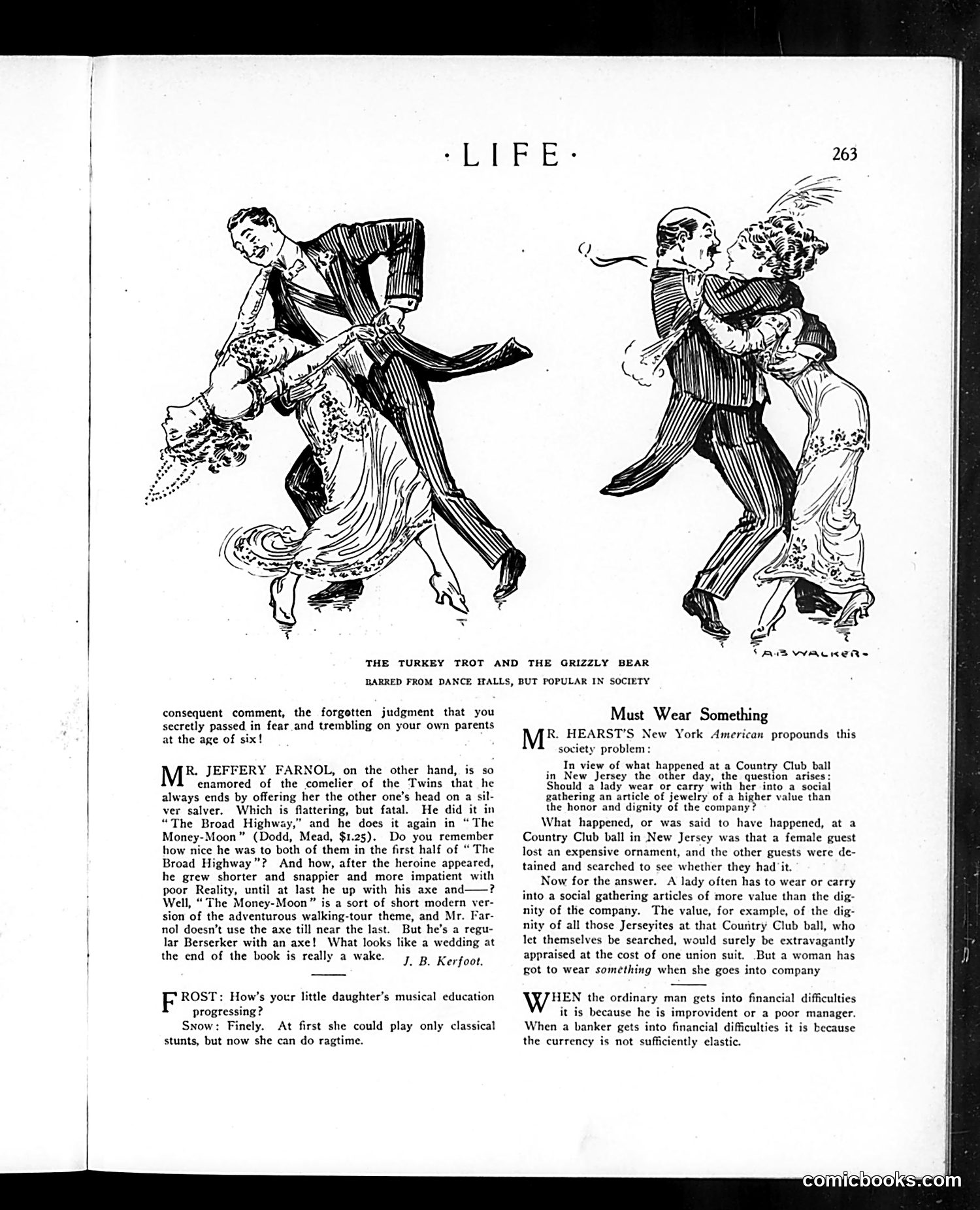
**The Cartoons:** The top illustration, titled "The Turkey Trot and the Grizzly Bear," depicts couples performing these newly popular dances. The caption notes these dances were "barred from dance halls, but popular in society"—satirizing the contradiction between official disapproval and actual high-society adoption of these energetic, somewhat scandalous modern dances. **The Satire:** The page mocks social hypocrisy. The "Must Wear Something" section ridicules a New Jersey Country Club incident where guests were searched for a lost expensive ornament. Life sardonically argues that women must wear jewelry into social situations—even when the "dignity" of the gathered company is worth less than a union suit. This critiques the pretentiousness and moral emptiness of wealthy society. The closing quip contrasts ordinary men's financial failures (blamed on improvidence) with bankers' failures (blamed on currency issues)—exposing how the wealthy excuse their problems differently than the poor.
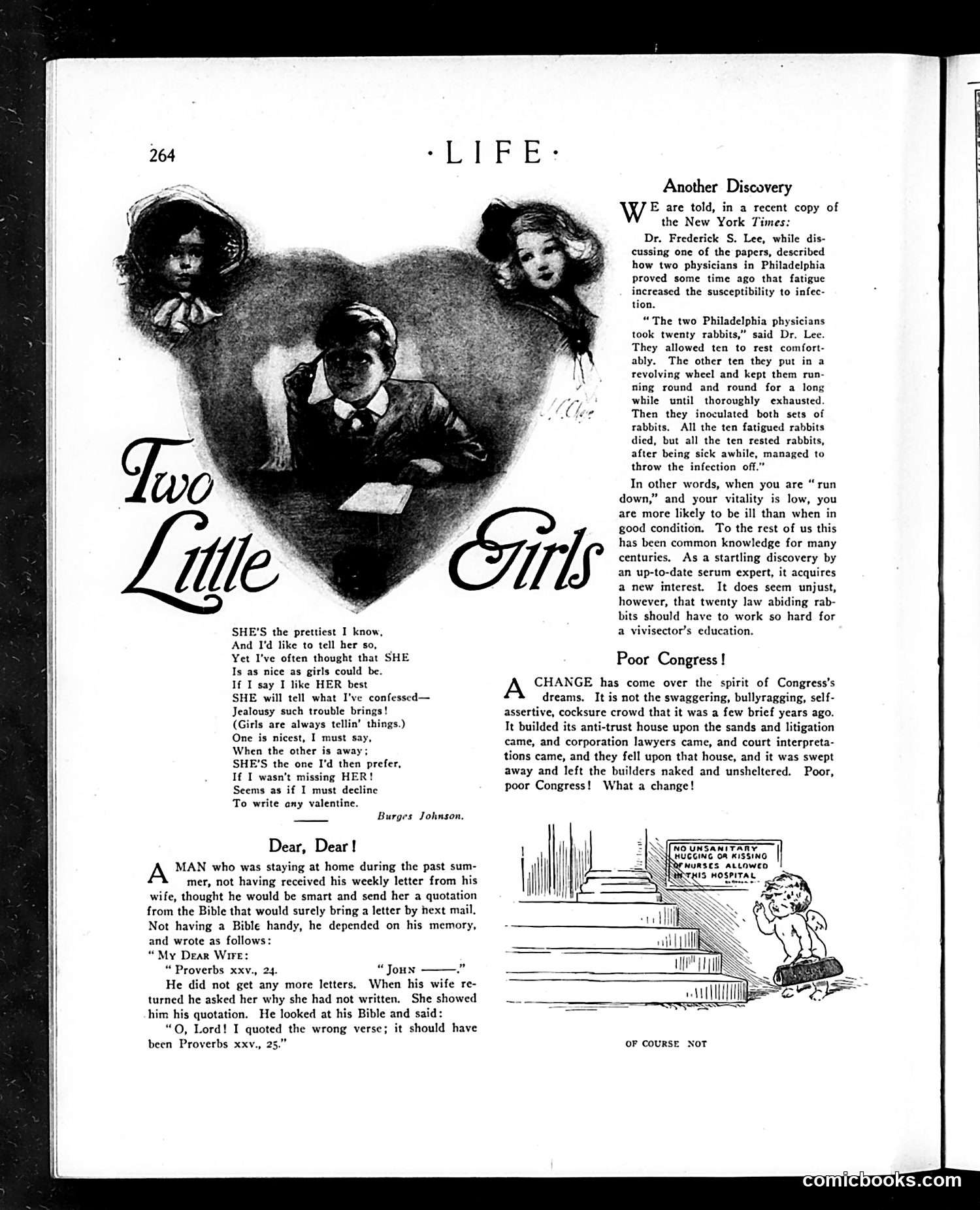
This page contains three satirical pieces reflecting early-20th-century social attitudes: **"Two Little Girls"** (top): A poem about romantic indecision—a young man cannot choose between two girls without creating jealousy, so he avoids writing valentines to either. The accompanying illustration shows three figures in period dress. The humor lies in depicting the social awkwardness of courtship conventions. **"Dear, Dear!"** (middle): A humorous anecdote where a husband, wanting to prompt his wife to write, sends her a Bible verse reference (Proverbs 25:24) without checking it. The joke implies he misquoted a verse about wives—suggesting marital tension. His wife returns it, and he realizes he cited the "wrong" verse, implying the correct one was even more critical of wives. The satire targets husbands' careless assumptions and marital discord. **"Poor Congress!"** (right): Political commentary lamenting Congress's weakened position after anti-trust litigation. The metaphor of a house built on sand suggests Congress's authority has crumbled under legal challenges from corporations. This reflects Progressive-era debates about corporate power versus government regulation.
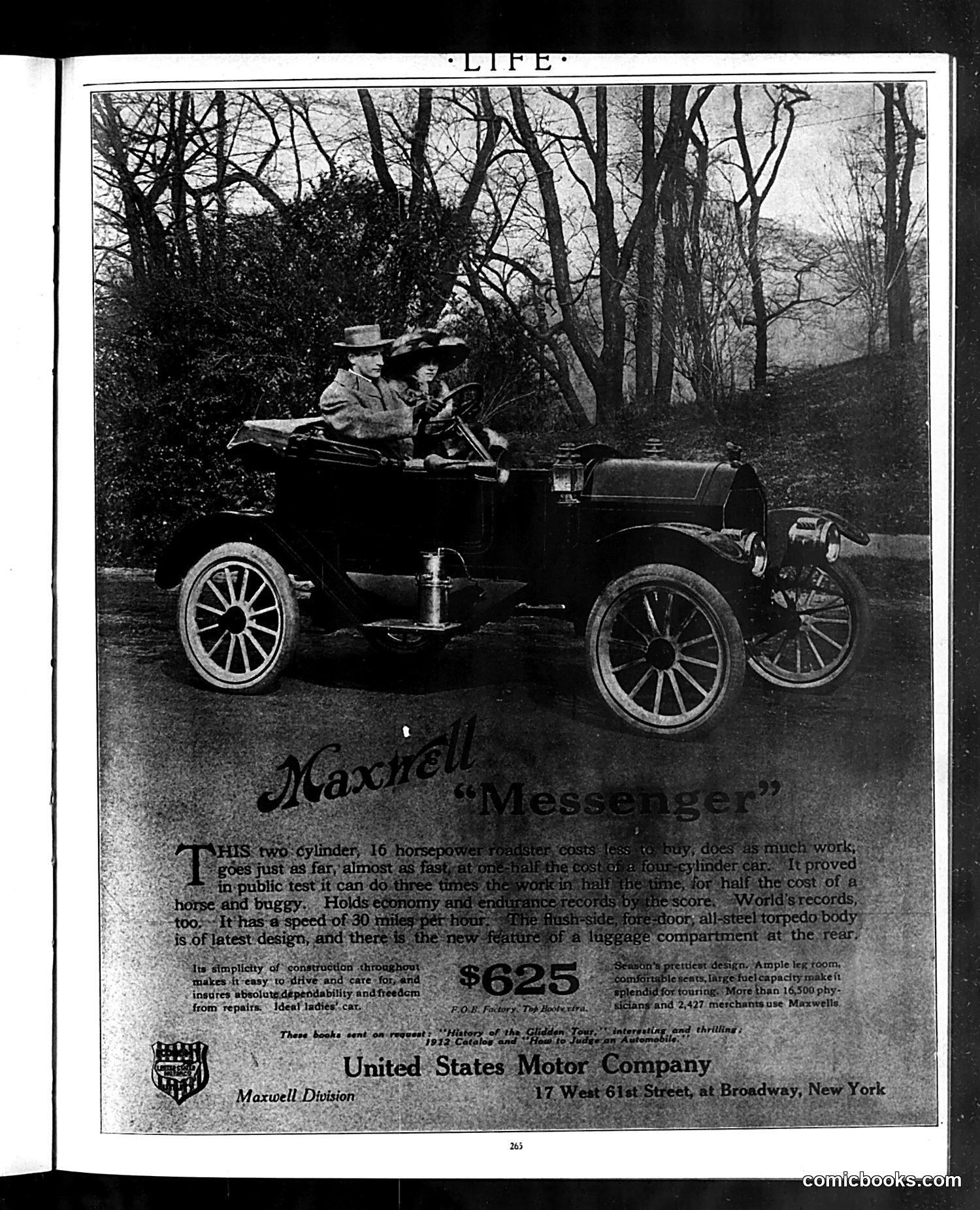
This is primarily a **product advertisement**, not political satire. It promotes the Maxwell "Messenger," a two-cylinder, 16-horsepower roadster manufactured by the United States Motor Company (Maxwell Division) in New York. The ad emphasizes the car's practical virtues: it costs less than comparable four-cylinder vehicles while performing similarly, offers good fuel economy, and boasts durability records. The photograph shows two well-dressed passengers in the open-air vehicle, positioned among bare winter trees—likely meant to suggest the car's reliability in all seasons. The $625 price point anchors the sales pitch. This is straightforward early automotive marketing, not editorial commentary. The "Life" magazine context suggests it appeared among other advertisements in this publication's commercial pages.
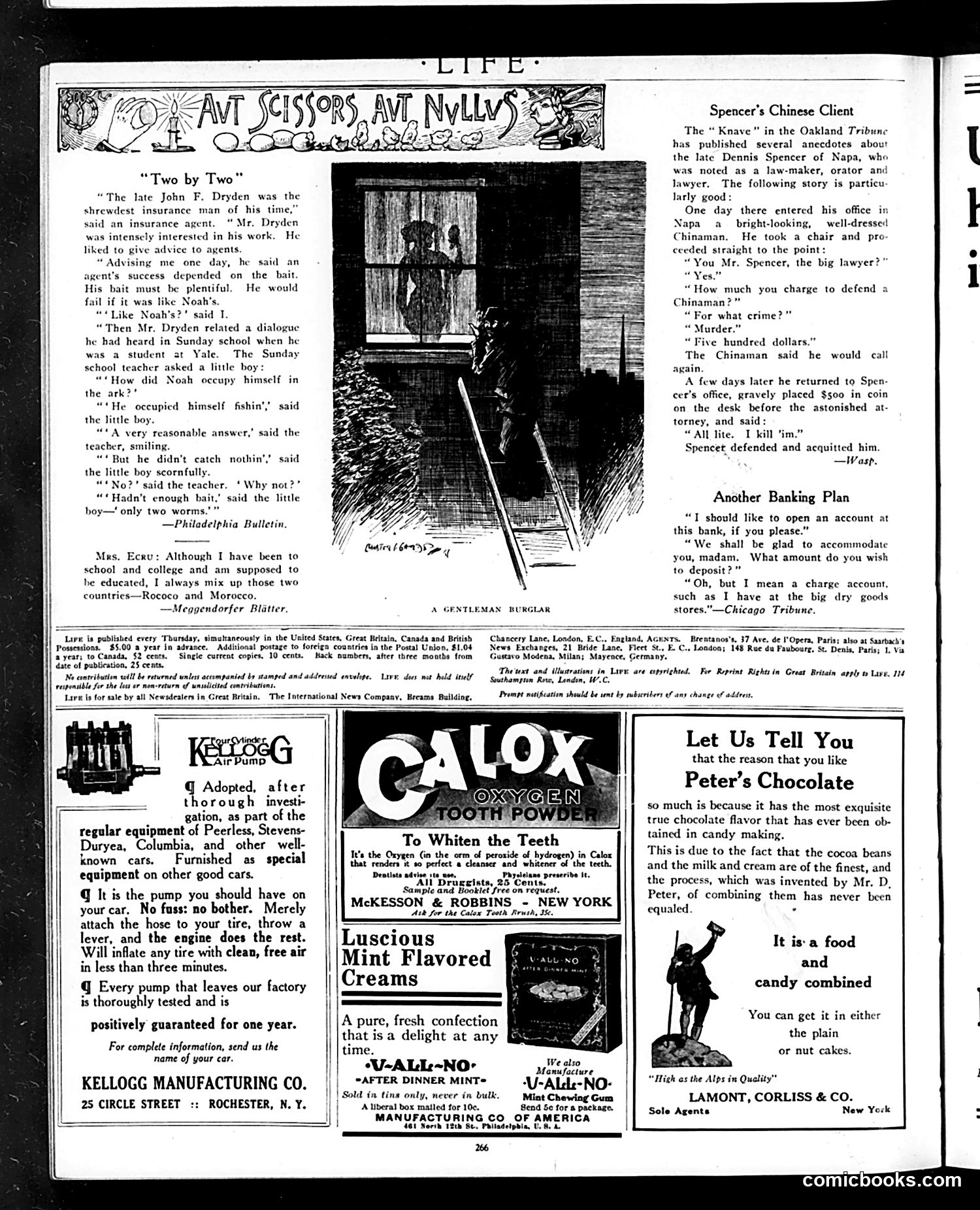
This page contains three distinct humor pieces: **"Two by Two"** (top left): A anecdote about insurance sales technique. An agent recalls John F. Dryden's advice that success requires "plentiful bait"—illustrated through a Sunday school joke about Noah's Ark. A boy correctly notes Noah could catch no fish because he only had "two worms" as bait. The satire targets insurance agents' reliance on inadequate inducements. **"Spencer's Chinese Client"** (right): A brief anecdote about lawyer Dennis Spencer of Napa. A well-dressed Chinese man hires Spencer to defend him for murder, paying $500. Spencer successfully acquits him. The humor appears to rest on the Chinaman's direct, business-like approach and apparent satisfaction with the outcome—though the joke's exact point is somewhat opaque to modern readers. **"Another Banking Plan"** (lower right): A woman seeks to open a charge account (like those available at department stores) at a bank rather than a traditional savings account—suggesting confusion about financial institutions or satirizing gendered consumer habits. The page is primarily **advertising** for pumps, tooth powder, chocolates, and other products.
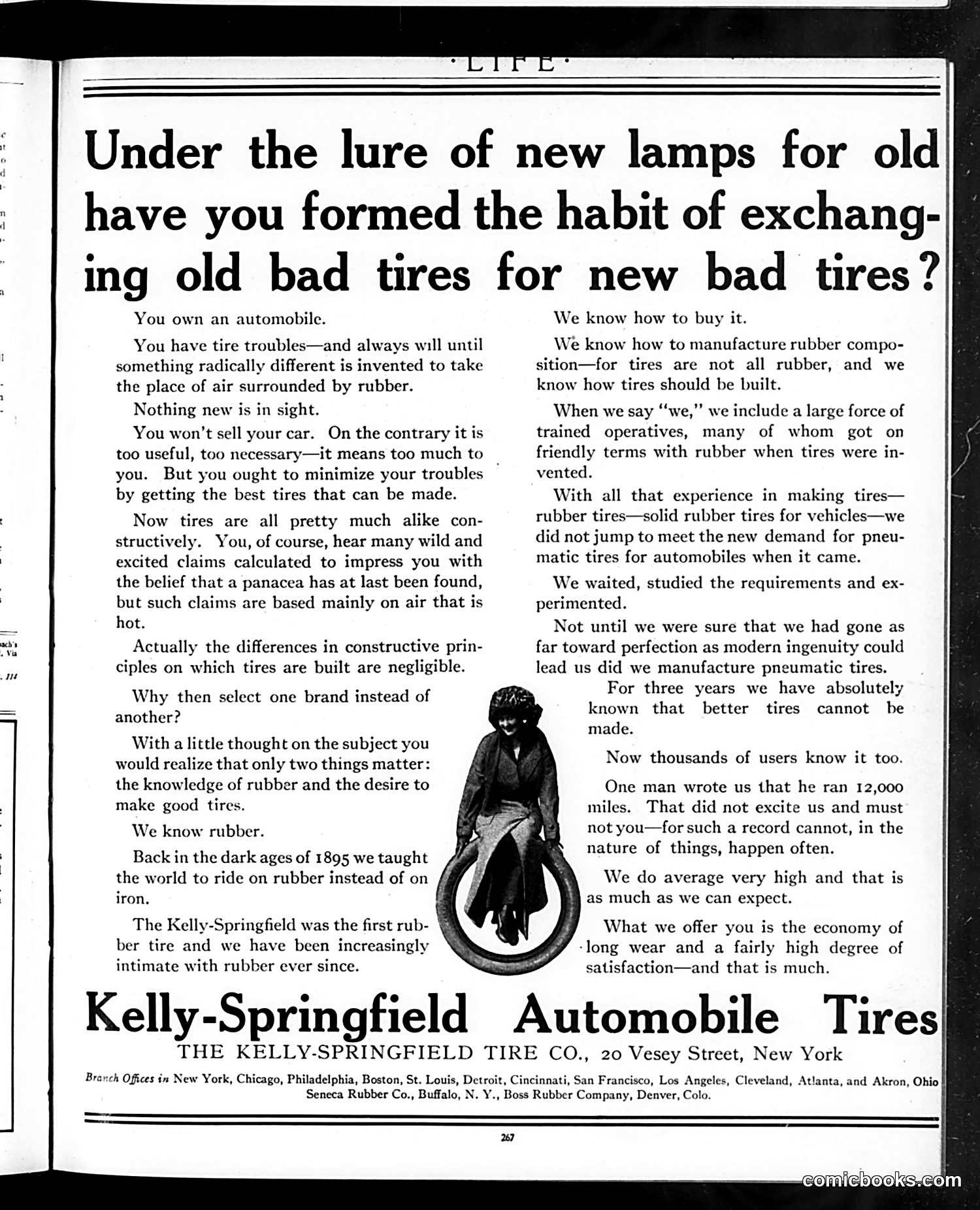
This is primarily a **tire company advertisement**, not satire. The headline's rhetorical question mimics the famous "new lamps for old" fairy tale reference (Aladdin), sarcastically asking if consumers habitually swap worn tires for equally poor replacements. The actual message is sincere corporate boasting: Kelly-Springfield claims superiority based on their rubber expertise dating to 1895 and their cautious approach to pneumatic tire technology. They waited three years before manufacturing pneumatic tires, claiming this deliberation proves their quality. The illustration shows a **woman in a tire** (visual pun on the product). The text argues that tire selection should depend on manufacturer knowledge and craftsmanship rather than marketing hype—ironic, since this *is* marketing hype. The tone is patronizing toward consumers, dismissing competitors' claims as "air that is hot" while positioning Kelly-Springfield as the rational, experienced choice. No specific competitors are named or caricatured.
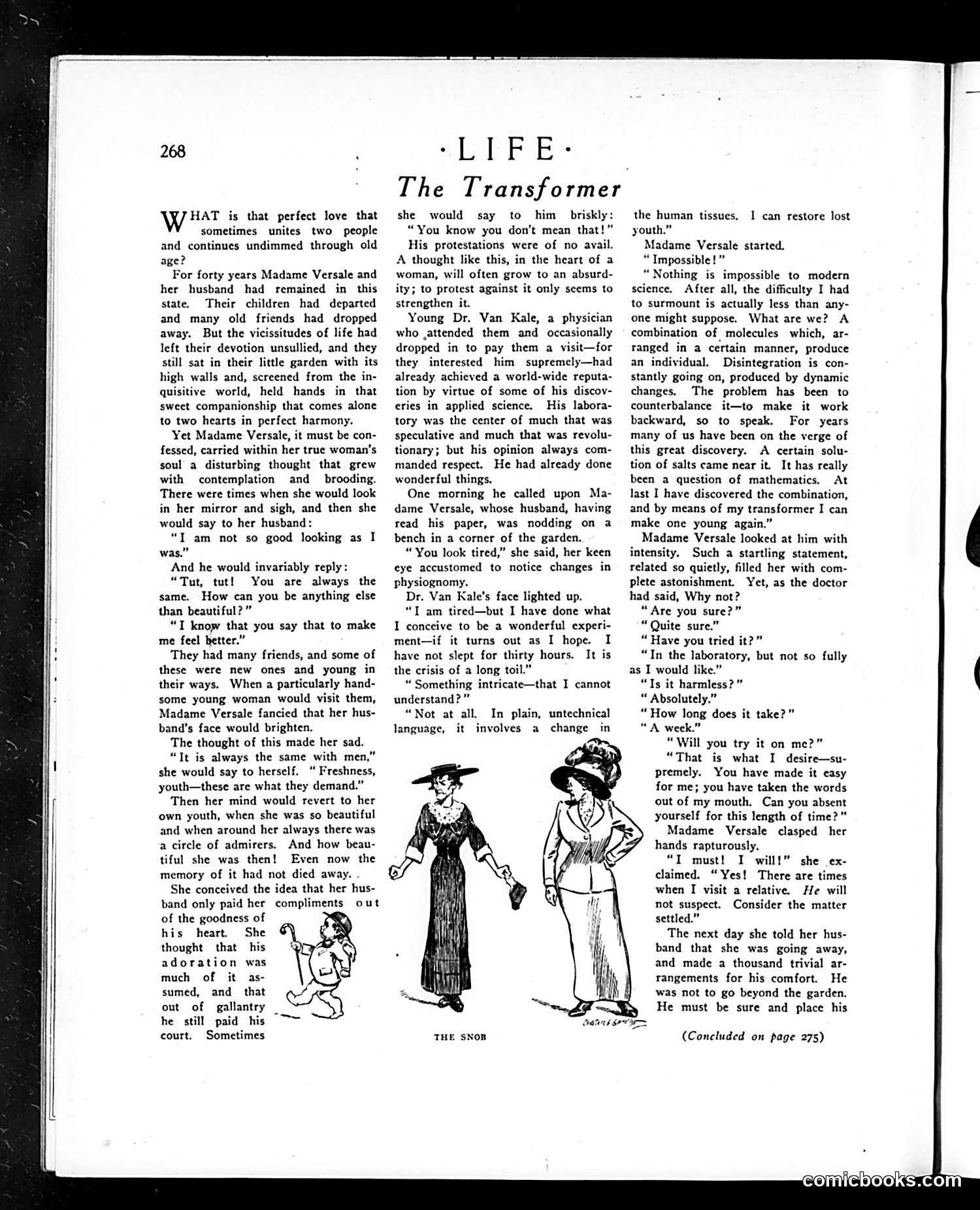
This page presents a serialized story (continuing page 275) about a marital dynamic and scientific breakthrough. The narrative centers on **Madame Versale**, a 40-year-married woman plagued by insecurity about aging. Though her husband reassures her constantly, she believes his compliments are merely gallant obligation rather than genuine affection. The turning point arrives when **Dr. Van Kale**, a celebrated physician-scientist, visits and reveals he's achieved a revolutionary discovery: he can restore human youth by reversing cellular degeneration through molecular manipulation. **The satire targets**: feminine vanity and anxiety about aging beauty, the gullibility of wealthy leisure-class women, and contemporary scientific hubris—the period's optimistic belief that modern science could solve any problem, even mortality and aging. The illustrations show fashionably-dressed Edwardian-era figures. The story explores whether Madame Versale will pursue this "cure," questioning whether artificial youth restoration can save her marriage.
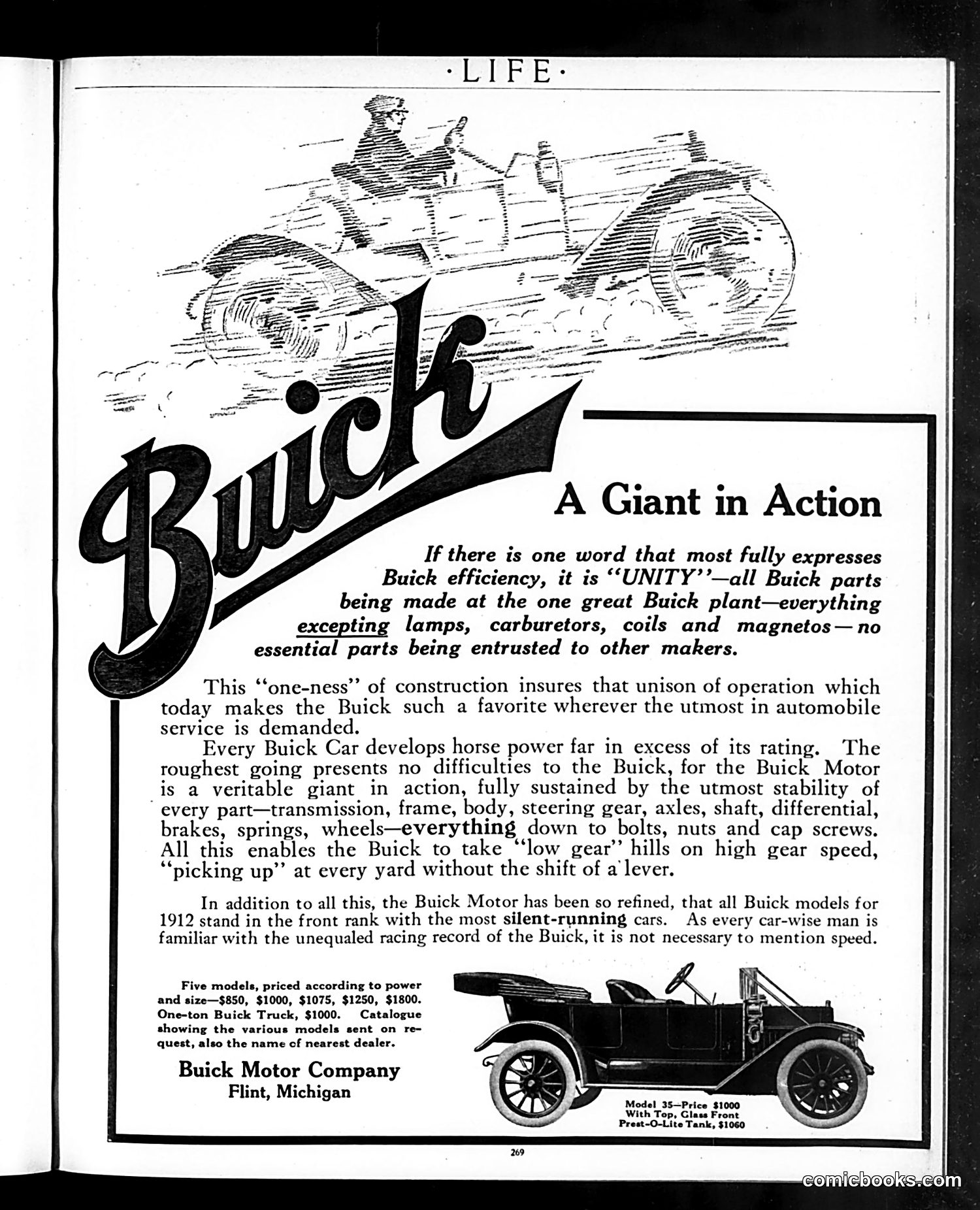
This is a **1912 Buick automobile advertisement**, not political satire. The page features promotional copy and an illustration of a early motorcar. The "Giant in Action" headline uses hyperbolic language typical of early automotive advertising, claiming the Buick's superiority through "UNITY"—manufacturing most components in-house rather than outsourcing. The text emphasizes reliability, power, and silent operation as selling points to early 20th-century buyers unfamiliar with automobiles. The illustration shows a man operating the vehicle on rough terrain, visually reinforcing claims about durability and performance. Pricing ranges from $850-$1800 (substantial sums in 1912), with a truck model at $1000. This represents standard commercial advertising rather than satirical commentary. Life magazine at this period mixed editorial cartoons with paid advertisements. This page is purely commercial promotion from Buick Motor Company in Flint, Michigan.
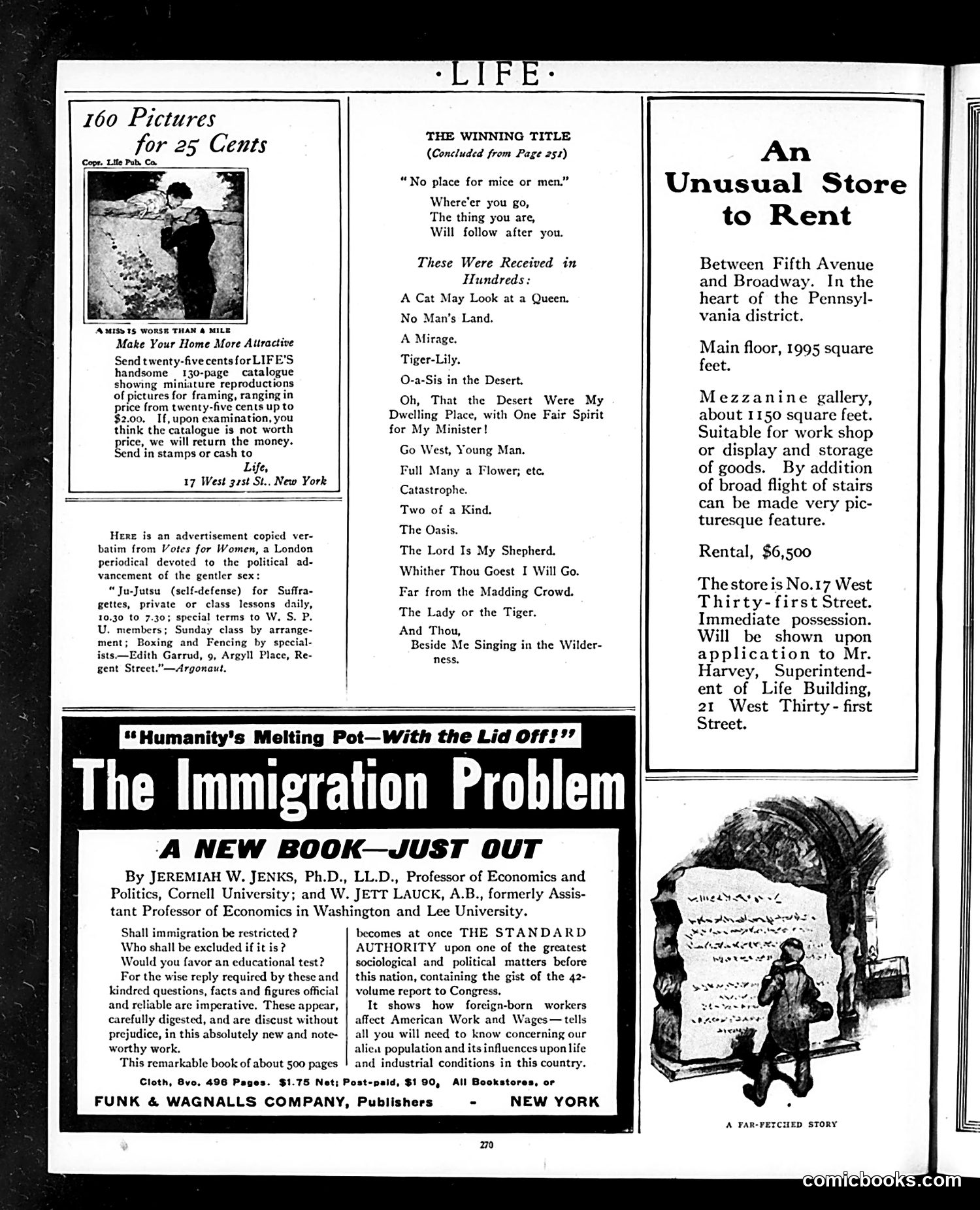
This page from *Life* magazine contains advertising and notices rather than political satire. The main advertisements include: 1. **A catalog offer** (top left) selling reproductions of pictures for home framing at 25 cents 2. **A real estate listing** (right) for an unusual store rental in New York between Fifth and Broadway, described humorously for potential tenants 3. **The Immigration Problem book** (bottom, large advertisement) by two economics professors, marketed as the authoritative source on immigration policy—presented as essential for understanding the heated contemporary debate over whether immigration should be restricted and who should be excluded The page also includes a note about *Votes for Women*, a London suffragette publication, mentioning self-defense training for women activists—indicating *Life*'s awareness of the parallel women's rights movement of the era. This is primarily a commercial page rather than satirical content.
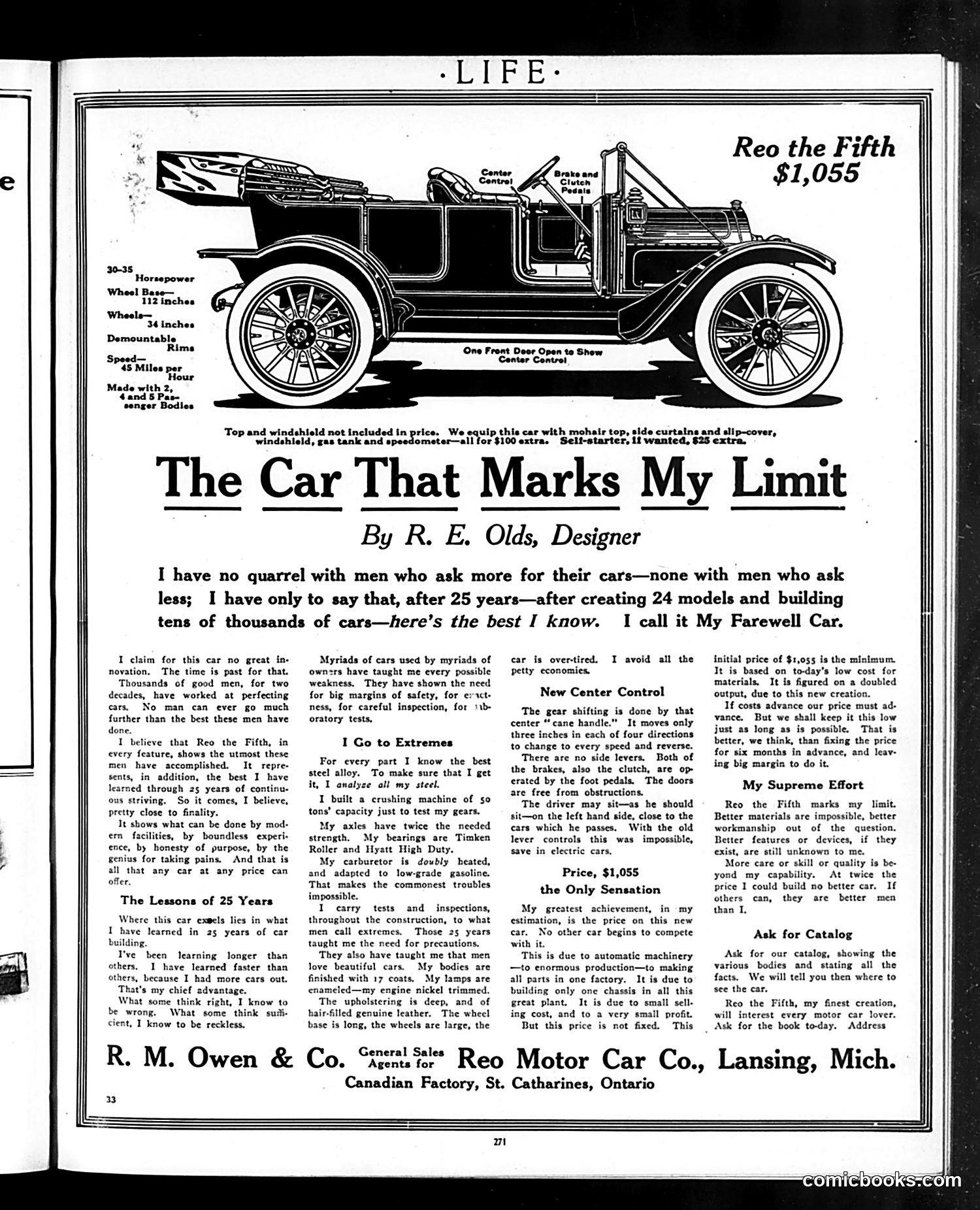
This page is a **straightforward advertisement**, not political satire or a cartoon. It features R.E. Olds, the actual founder of the Reo Motor Car Company, promoting the "Reo the Fifth" automobile at $1,055. Olds uses a first-person testimonial claiming 25 years of car-building experience has taught him what constitutes the "best" automobile. He emphasizes engineering rigor (testing gears with a crushing machine, analyzing steel alloys, 17-coat paint finishes) and innovation (the center "cane handle" gear shift, foot-operated brakes). The appeal targets middle-class buyers seeking quality assurance: Olds positions the Reo Fifth as achieving perfect balance—neither over-engineered nor cost-cutting. The low price supposedly results from volume production and single-chassis manufacturing, not compromised quality. This is 1910s-era automotive marketing rhetoric, with no satirical critique visible.
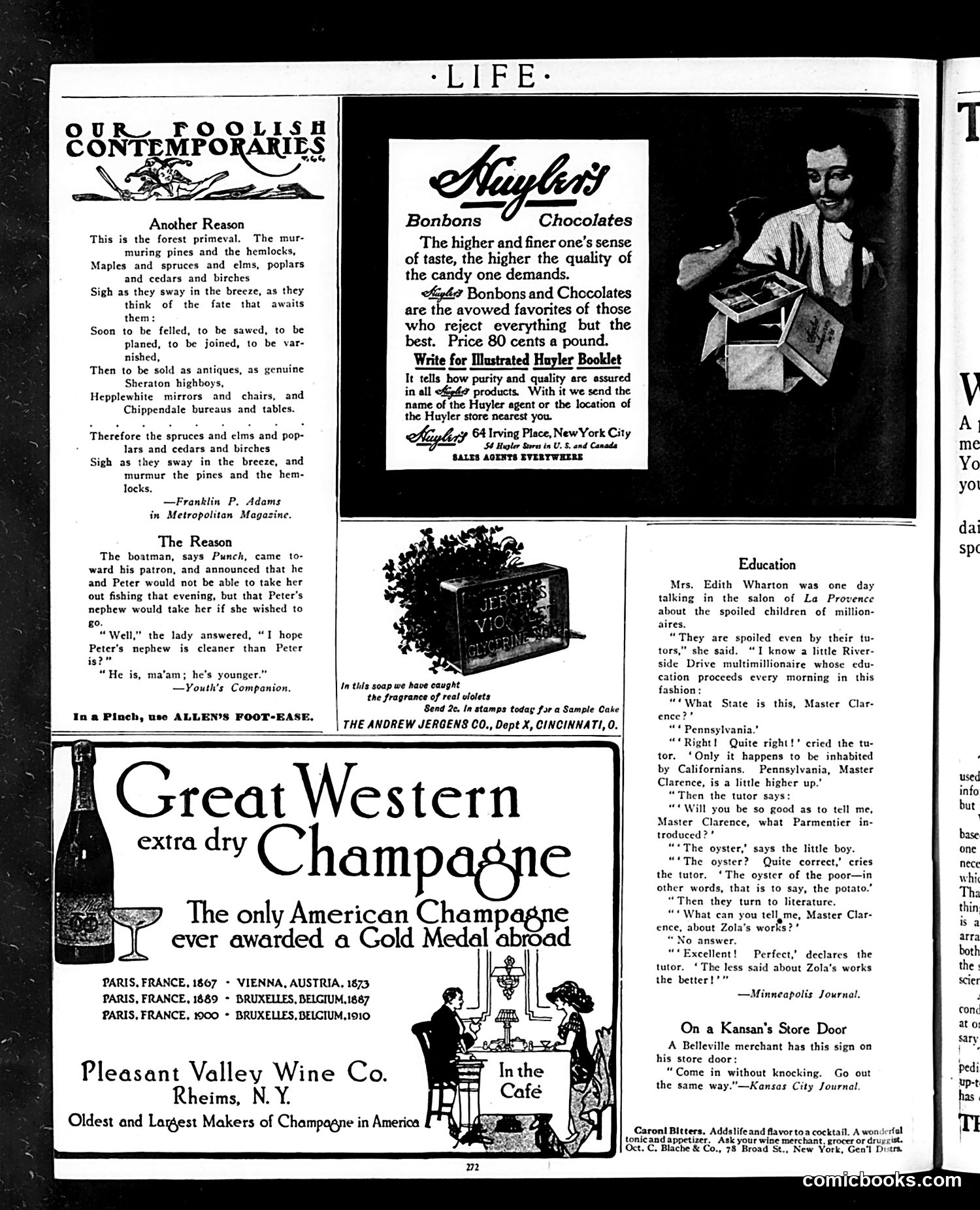
This page is primarily **advertisements** interspersed with short humor pieces typical of Life's satirical format. The cartoons/jokes include: 1. **"Our Foolish Contemporaries"** — A verse by Franklin P. Adams satirizing American materialism: forest trees "sigh" knowing they'll be felled, sawed, and sold as fake antique furniture (Sheraton, Hepplewhite, Chippendale reproductions). The joke mocks both the disposal of old-growth forests and wealthy Americans' obsession with appearing cultured through period furniture. 2. **"The Reason"** — A brief joke about a boatman's nephew being "cleaner" because he's younger, implying the original boatman was dirty. It's gentle humor about class and hygiene. 3. **"Education"** — An anecdote featuring writer Edith Wharton mocking wealthy New York families ("Riverside Drive multimillionaires"). Their tutors teach absurdly wrong answers (oysters = potatoes; Zola = nothing worth discussing), satirizing how money doesn't ensure actual education. These pieces reflect early-20th-century anxieties about wealth, authenticity, and cultural pretension among the American upper classes.
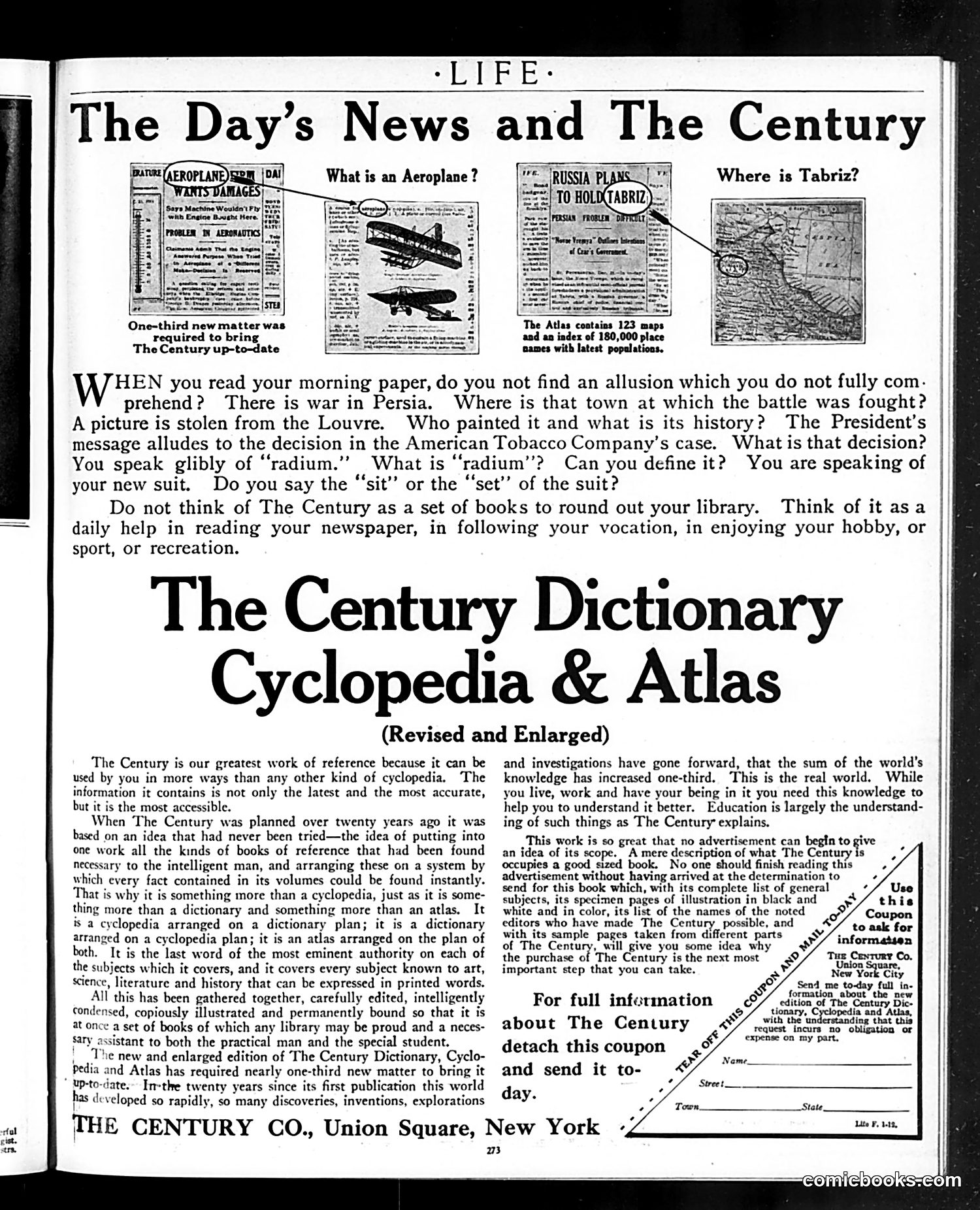
This is primarily **advertising content**, not satire or political cartoon. The page promotes *The Century Dictionary, Cyclopedia & Atlas* (a revised edition). The opening section uses a rhetorical strategy: it poses questions a newspaper reader might encounter—references to war in Persia, a Louvre painting theft, the American Tobacco Company case, the term "radium," and clothing terminology—to argue that readers lack necessary reference materials to fully understand current events. The advertisement's pitch is that *The Century* serves as a practical daily reference tool, not merely a library decoration. It emphasizes the work required a "one-third" content overhaul since its original publication "twenty years ago" to keep pace with scientific and world developments. There is **no political satire** here—just marketing that leverages readers' intellectual insecurity about understanding the news, positioning the encyclopedia as essential for an educated person following contemporary events and pursuing professional or personal interests.
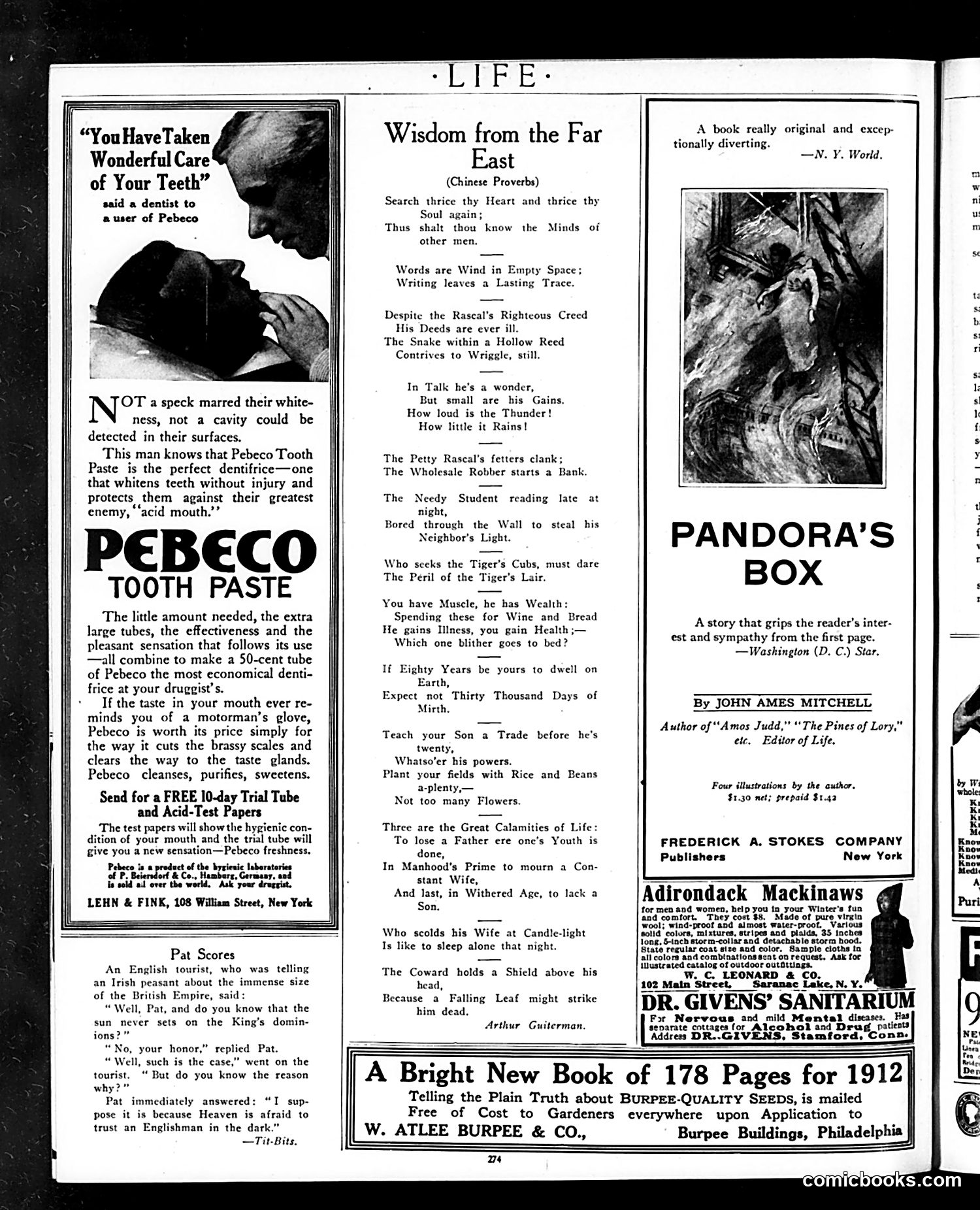
This page consists primarily of **advertisements and light satirical content**, not political cartoons. The main ad features **Pebeco Tooth Paste**, using a testimonial from a dentist praising a patient's teeth. The pitch emphasizes whiteness and protection against "acid mouth"—a marketing concern of the era. Below is "**Pat Scores**," a brief ethnic joke contrasting an English tourist's imperial boasting with Irish peasant wit. The humor relies on period stereotypes: the English as arrogant colonizers, the Irish as clever underdogs who deflate pretension through folk wisdom. The center section reprints **Chinese proverbs** attributed to "Wisdom from the Far East," presenting moralistic observations on wealth, virtue, and family. These appear genuine or period-authentic translations rather than satirical inventions. The remaining space advertises books ("Pandora's Box," "Amos Judd") and regional products (Adirondack coats, Burpee seeds). **Overall**: This is primarily a vehicle for period advertising with filler content—no substantive political satire.
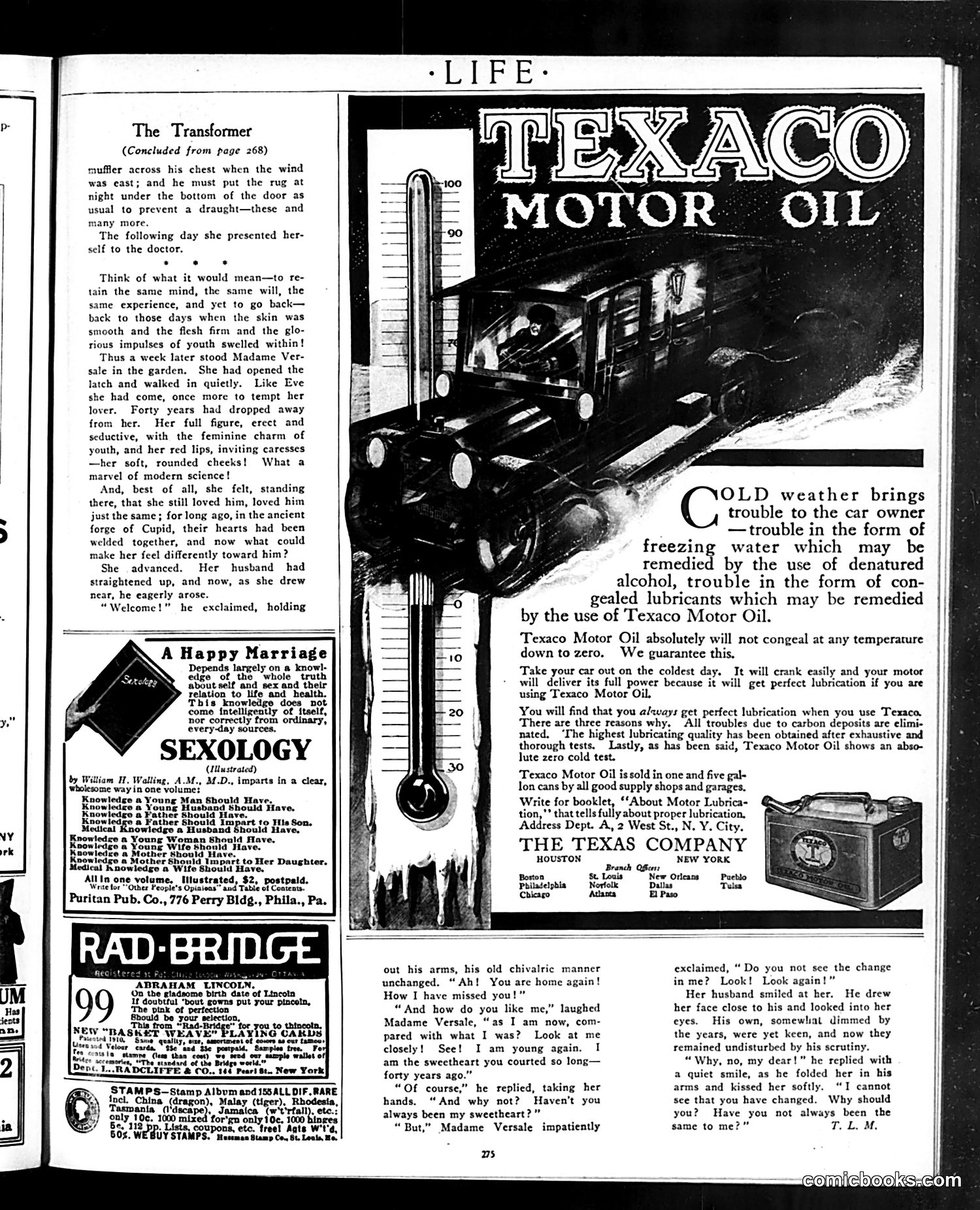
This page mixes fiction and advertising typical of early 20th-century Life magazine. **"The Transformer" (fiction):** A serialized story about a woman who undergoes a miraculous medical transformation, regaining her youth's physical beauty after 40 years. The narrative explores romantic rekindling—she returns to seduce her husband with her restored appearance, testing whether he still loves her despite aging. It's a fantastical exploration of beauty, desire, and marriage's endurance. **Advertisements:** The page features period product ads: - A "Sexology" book promoting marital knowledge - A Texaco Motor Oil ad emphasizing cold-weather engine performance (winter was a genuine automotive concern then) - An Abraham Lincoln commemorative stamp offer - A Radcliffe & Co. book advertisement The juxtaposition is characteristic: serious romantic fiction adjacent to practical consumer goods and self-improvement literature—all targeting middle-class readers seeking both entertainment and solutions to everyday problems.
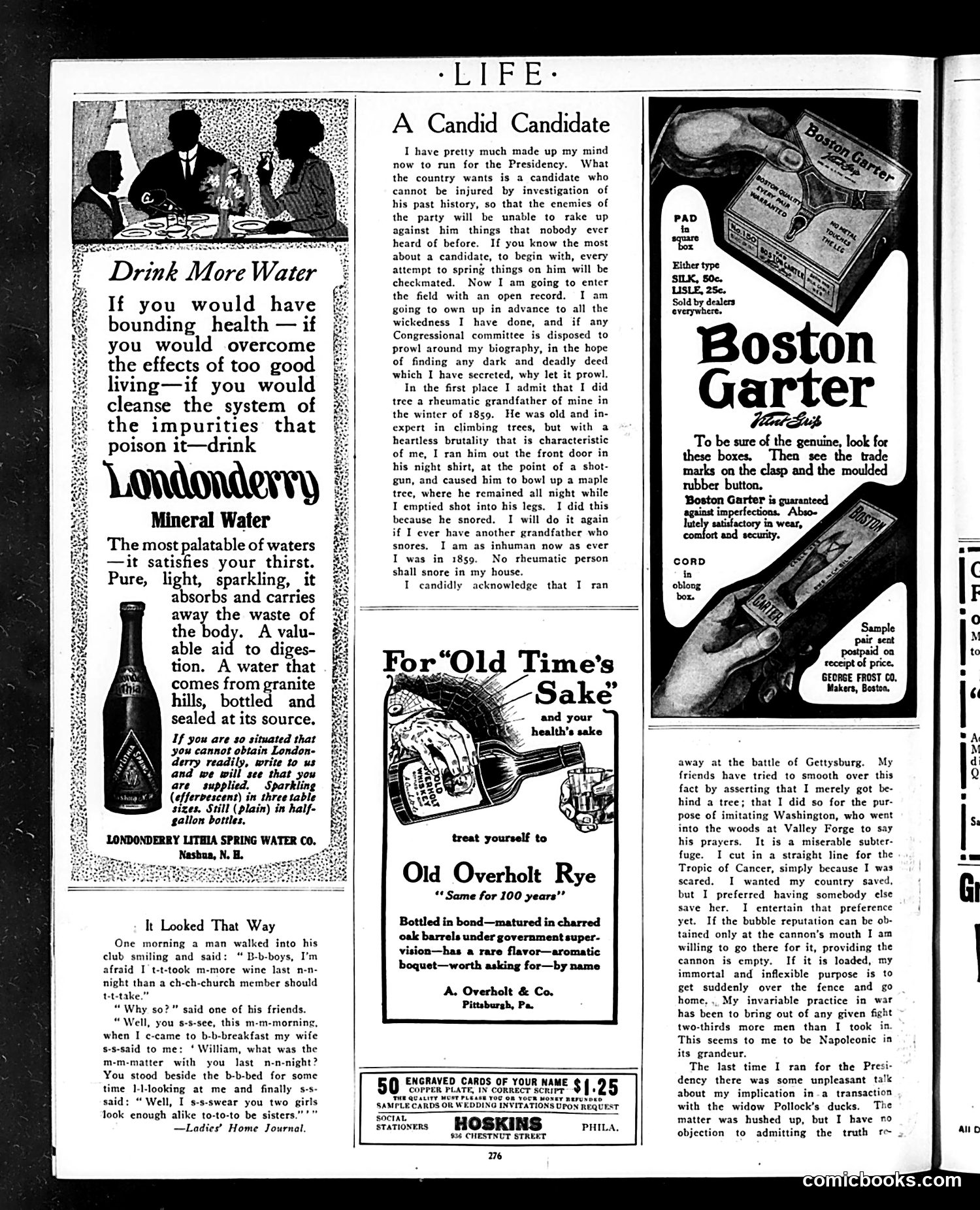
This page contains primarily **advertisements** (mineral water, whiskey, garters, engraved cards) interspersed with humor pieces typical of early 20th-century *Life* magazine's satirical content. The main satirical piece, "A Candid Candidate," mocks political hypocrisy through absurdist confession. A fictional presidential candidate claims transparency by pre-emptively admitting ridiculous "crimes"—shooting his grandfather for snoring, cowardly behavior at Gettysburg—thereby making genuine scandals unprosecutable. The satire targets how politicians attempt damage control and the absurdity of competitive character assassination in campaigns. The candidate's mock-earnest admission of minor moral failings ("I am as inhuman now as ever I was in 1859") ridicules political posturing. The shorter joke, "It Looked That Way," employs stuttering humor (common then, now considered offensive) about a drunk man mistaking his wife for another woman after excessive drinking—suggesting impaired perception from overindulgence. Both pieces reflect contemporary anxieties about political integrity and alcohol consumption, themes reinforced by the surrounding temperance-adjacent advertising for mineral water.
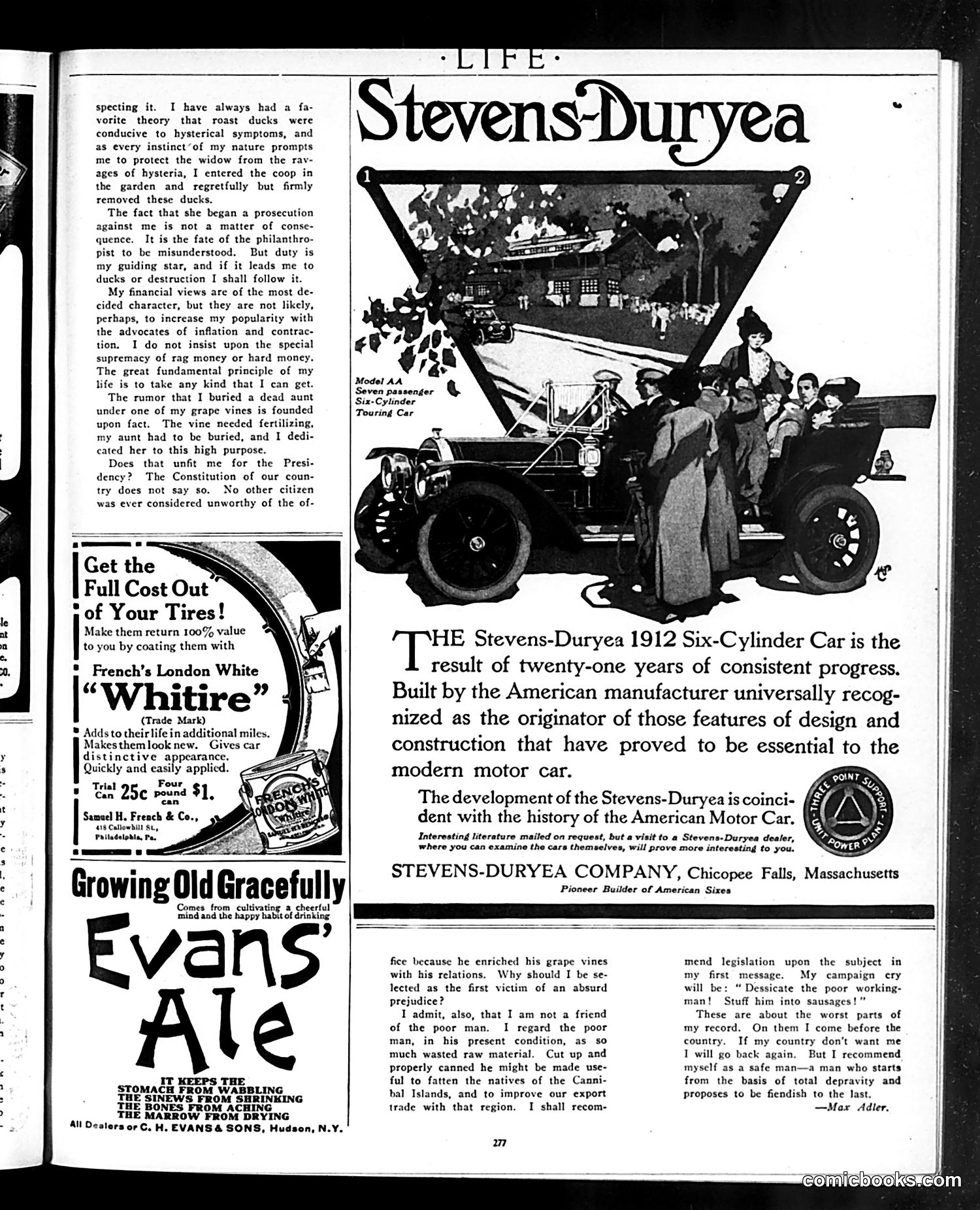
This page is primarily **advertising**, featuring a Stevens-Duryea automobile advertisement alongside period ads for tire coating and ale. The left column contains **satirical political commentary** (likely by Max Adler, based on the byline). The unnamed narrator presents himself as a presidential candidate with grotesquely amoral positions: he stole a widow's ducks claiming philanthropy, buried his aunt under grape vines for fertilizer, despises poor people, and proposes turning impoverished workers into "sausages" for export trade. **The satire's target**: This appears to be mockery of actual political candidates or philosophies current to Life magazine's 1912 publication period—likely critiquing robber-baron capitalism, social Darwinism, or specific politicians who publicly held callous views toward the poor. The exaggeration is intentional; by pushing these attitudes to absurd extremes (cannibalism, grave desecration), the author exposes the moral bankruptcy of such positions. The humor relies on readers recognizing which contemporary figures or ideologies are being lampooned.
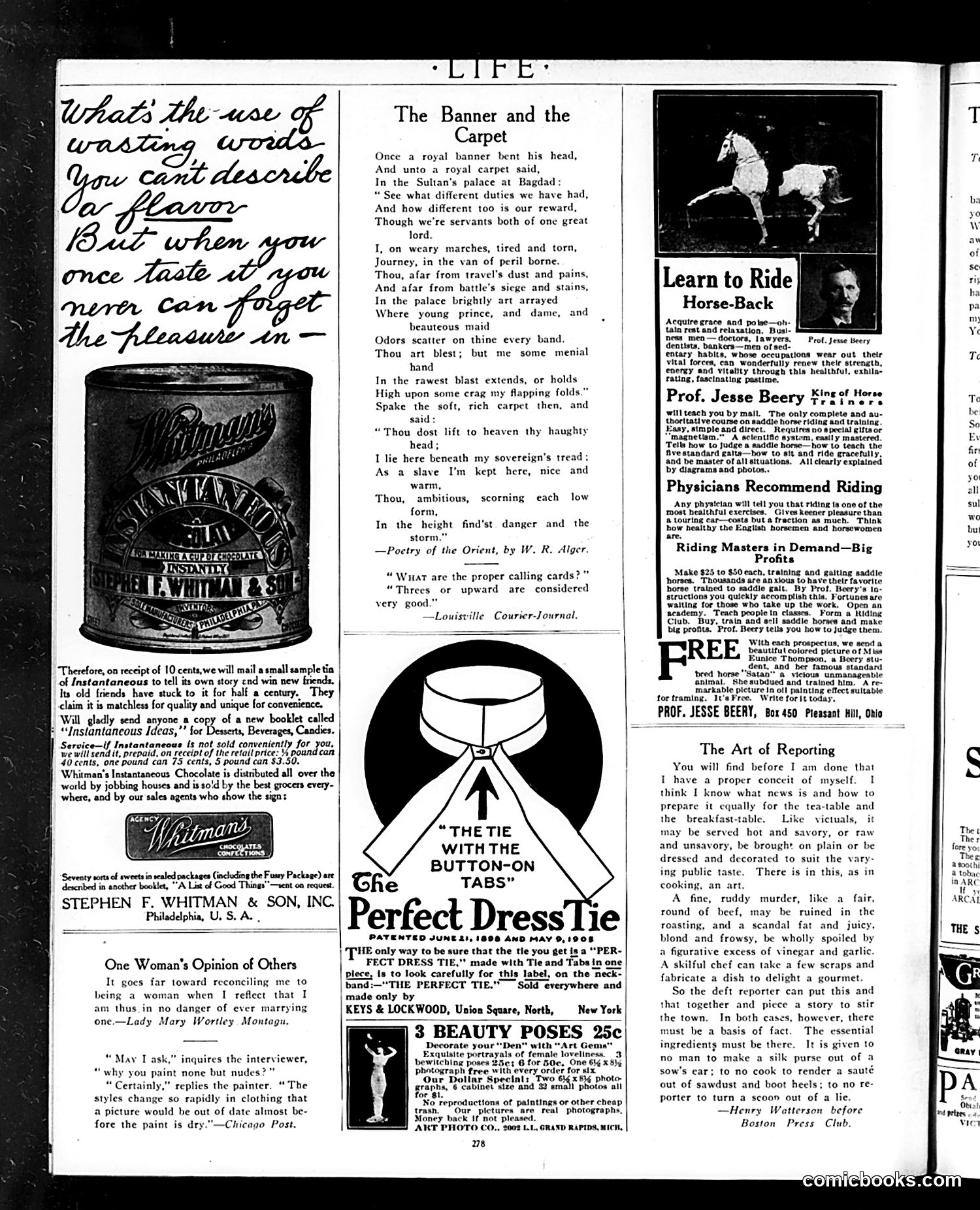
This page is primarily **advertising and light social commentary**, not political satire. **Main Content:** The dominant feature is an ad for "The Perfect Dress Tie" with button-on tabs—a practical innovation for formal wear. Other advertisements include Whitman's chocolate, horseback riding instruction from Prof. Jesse Beery, and "Art Gems" photographs (likely pin-up images). **Literary/Humor Content:** A poem titled "The Banner and the Carpet" retells an Oriental fable comparing two servants—one active/honored (the banner), one passive/comfortable (the carpet)—about the value of different roles. Brief jokes about calling cards and why painters paint nudes (to avoid outdated fashions) offer gentle social observation rather than political critique. **Context for Modern Readers:** This reflects early 1900s consumer culture: practical innovations (snap-on tie tabs), lifestyle marketing (horseback riding for stressed businessmen), and period attitudes toward female representation. The page shows how advertising and entertainment merged in magazines of this era.
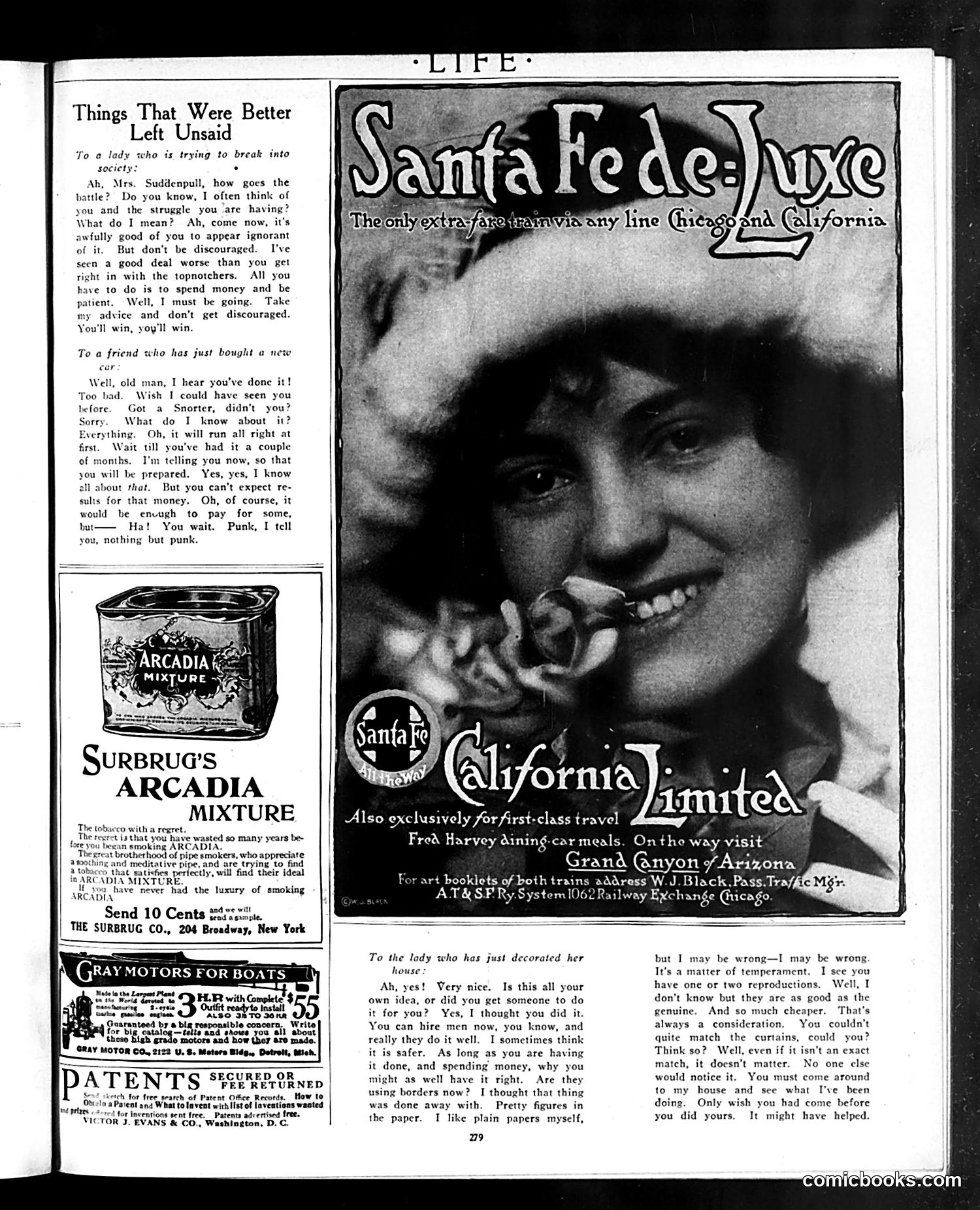
This page from *Life* magazine is primarily **advertising with satirical commentary**. The main content is two humorous advice columns titled "Things That Were Better Left Unsaid"—social satire mocking insincere, backhanded compliments. The first column addresses a woman ("Mrs. Suddenpull") trying to enter high society, with condescending "advice" that she needs only money and patience. The second mocks a friend who bought a car, with fake sympathy predicting it will fail after a couple months—calling it "punk." A third section satirizes someone decorating her house, questioning whether she designed it herself and subtly insulting her taste and reproductions. **The satire's point**: These columns expose how supposedly helpful social comments are actually passive-aggressive insults—the speaker pretends friendliness while implying the recipient is foolish, tasteless, or will fail. It's social commentary on shallow upper-class rudeness masked as politeness. The page also contains period advertisements (tobacco, automobiles, trains) typical of early 20th-century magazine layouts.
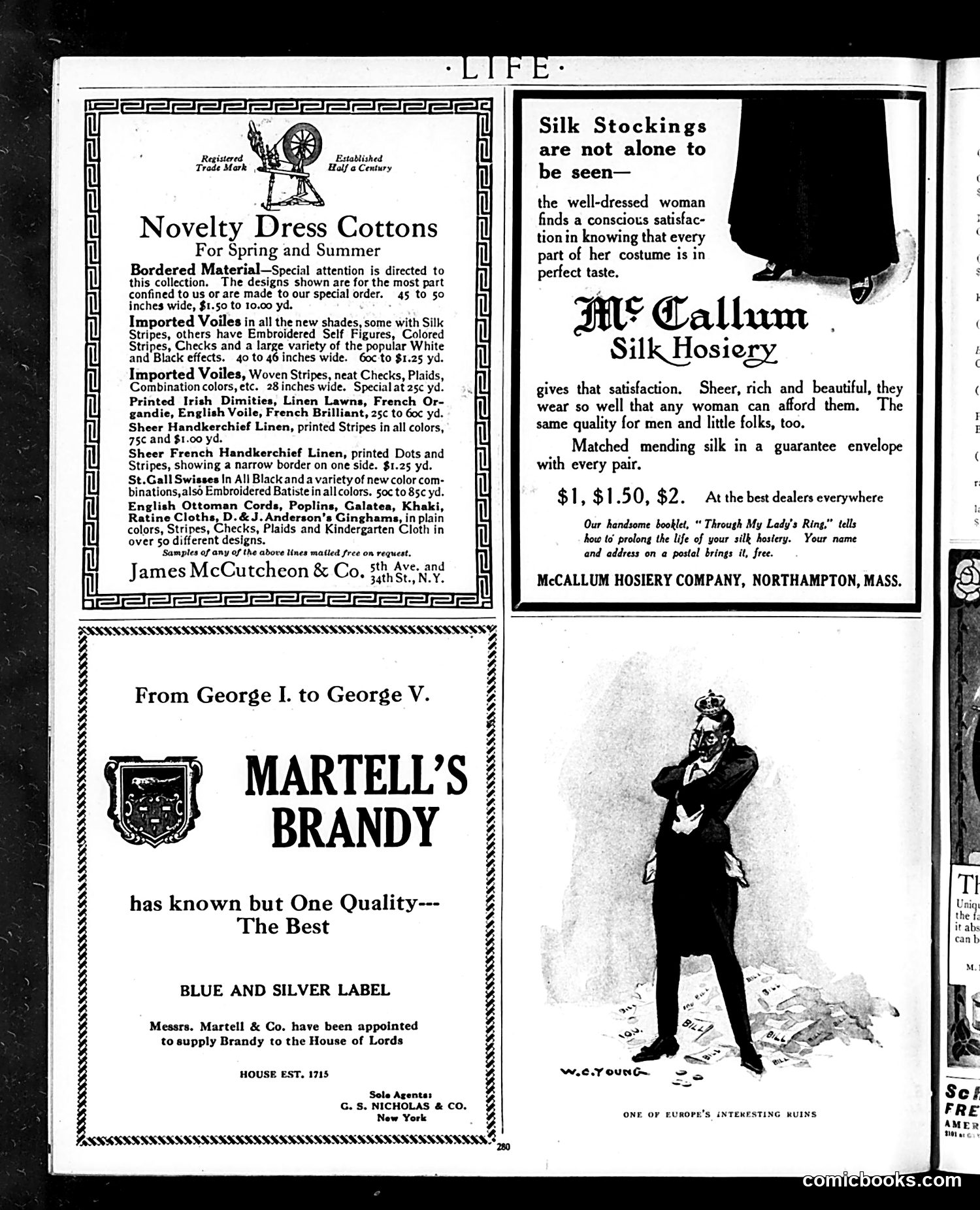
This is primarily an **advertising page** rather than editorial content or political satire. It contains four distinct ads: 1. **James McCutcheon & Co.** (top left): Fabric retailer advertising novelty dress cottons for spring/summer wear, with detailed product descriptions and pricing. 2. **McCallum Silk Hosiery** (top right): Advertises women's silk stockings, emphasizing that quality hosiery is essential to a well-dressed woman's appearance—"every part of her costume is in perfect taste." 3. **Martell's Brandy** (bottom left): Highlights the brandy's prestige by noting it has supplied "the House of Lords" since 1715, spanning from King George I to George V. 4. **Illustration** (bottom right): An untitled sketch labeled "One of Europe's Interesting Ruins"—unclear without additional context. The page reflects early 20th-century consumer culture, emphasizing quality goods and social respectability through product association with British institutions and upper-class standards.
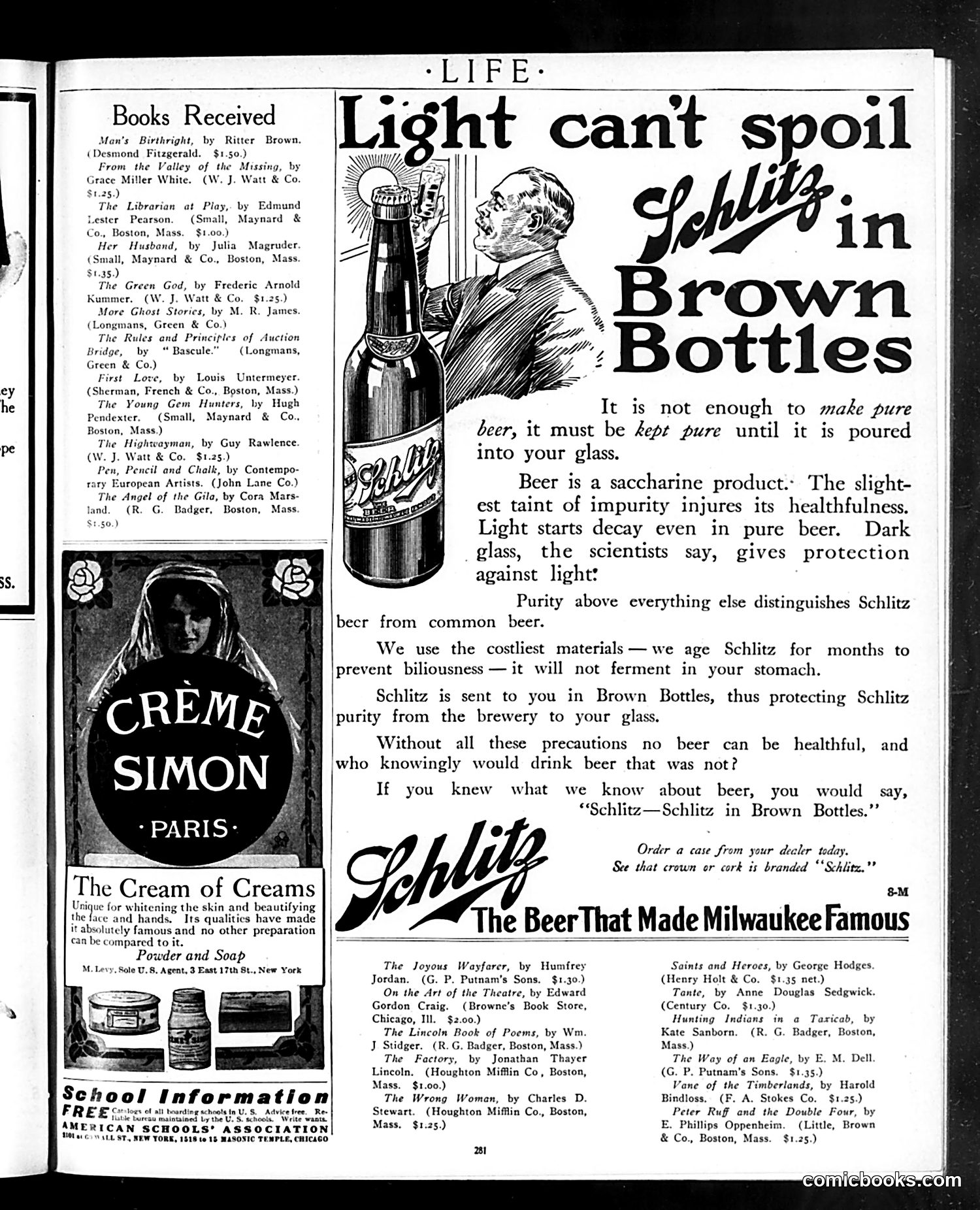
This page is primarily a **Schlitz beer advertisement** from the early 20th century, not satire. The large central ad features a man holding a brown bottle, promoting Schlitz as "The Beer That Made Milwaukee Famous." The ad's argument centers on **purity and protection**: Schlitz claims superiority because beer degrades under light exposure, so brown bottles protect the product. The copy emphasizes scientific reasoning—dark glass "gives protection against light"—to position Schlitz as the healthful choice over competitors in clear bottles. This reflects **pre-Prohibition era marketing** (likely 1910s), when beer companies still advertised openly and competed on quality claims. The appeal to scientific authority and purity was common in early 20th-century advertising. The page also contains a **Crème Simon beauty cream advertisement** (left side) and a "Books Received" section typical of *Life* magazine's literary coverage. There is no political cartoon or satire on this particular page.
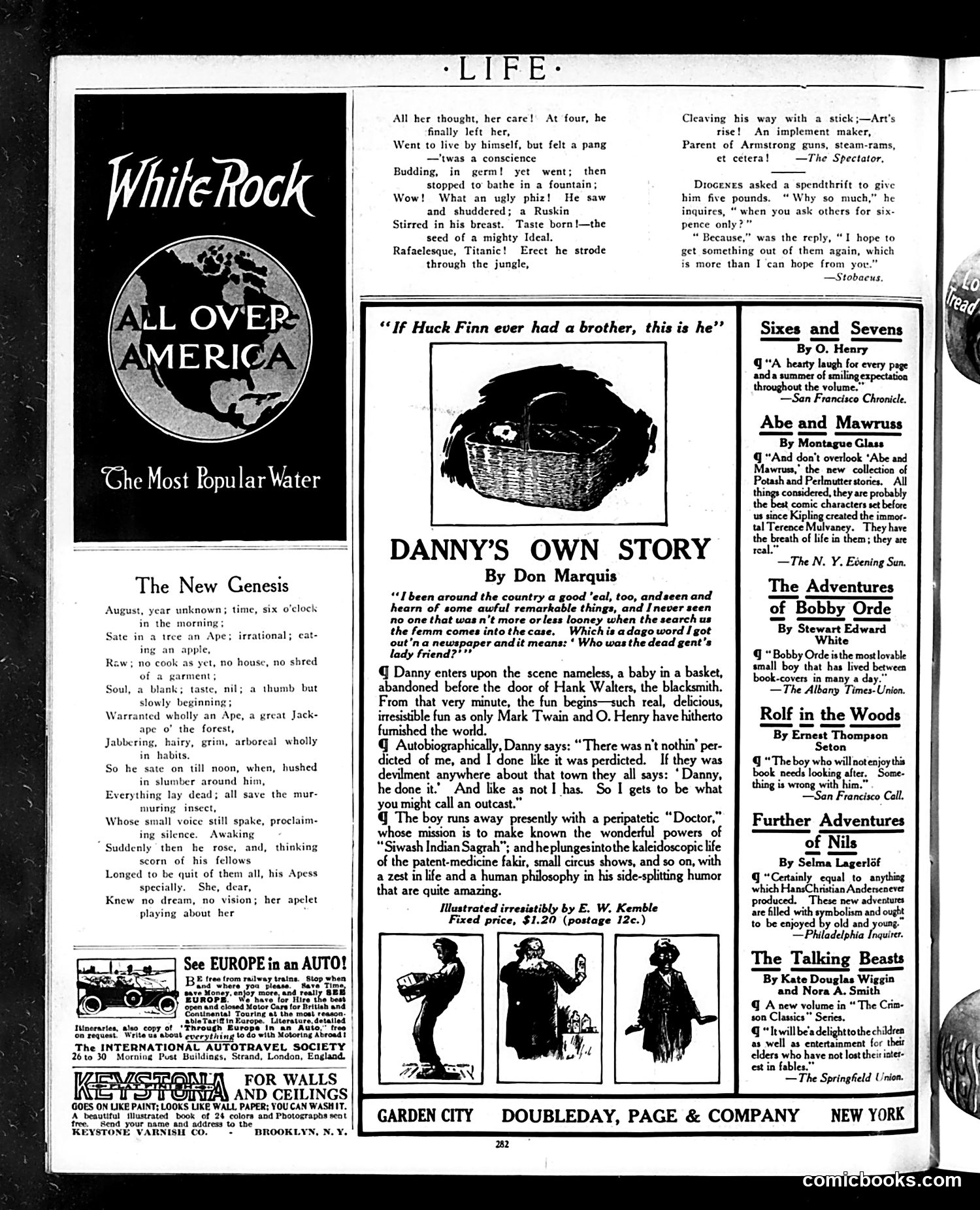
This poem satirizes evolutionary theory, specifically Darwin's ideas about human development from apes. The narrative traces an ape's gradual awakening to consciousness and civilization: he develops aesthetic taste (inspired by seeing his reflection), creates tools and art, and eventually invents technology ("Armstrong guns, steam-rams"). The satire mocks the notion that humanity's "progress"—from animal instinct through artistic sensibility to industrial warfare—represents genuine advancement. The ape abandons his mate out of newfound conscience, then admires his own reflection like a vain aesthete, before becoming an "implement maker" whose inventions are weapons of destruction. The piece appears to critique both Darwinian evolution and Victorian assumptions about civilization's superiority, suggesting that human "development" merely masks our base animal nature with a veneer of art and technology—ultimately producing only better tools for killing.
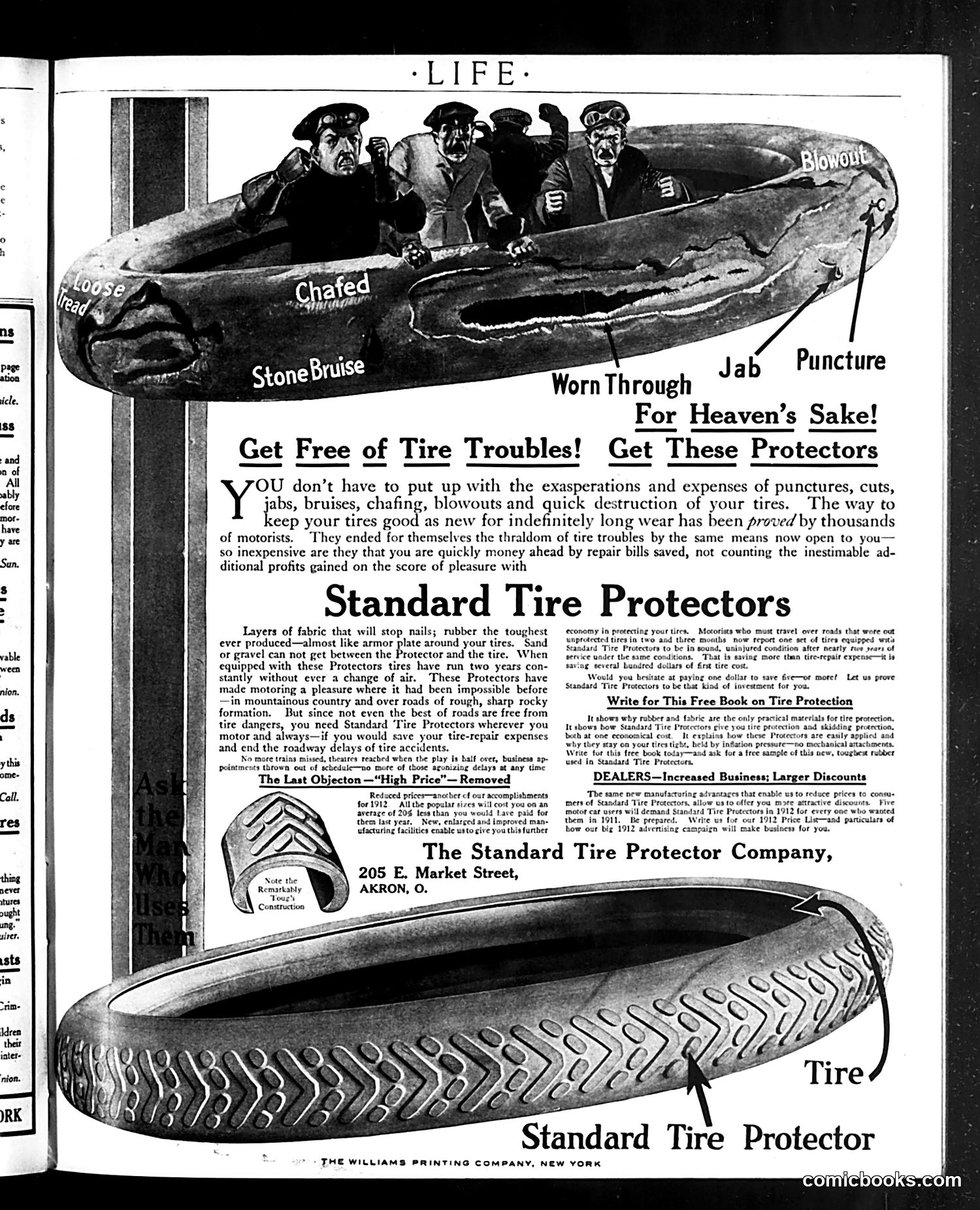
This is primarily a **tire protection product advertisement**, not a political cartoon. The humorous visual element is the exaggerated illustration at top: a damaged tire depicted as a battered, suffering patient being carried by four men, labeled with various tire injuries—"Stone Bruise," "Chafed," "Worn Through," "Jab," "Puncture," and "Blowout." The joke relies on depicting tire damage as human suffering ("For Heaven's Sake!"), creating dark humor to grab readers' attention. The advertisement for Standard Tire Protectors then positions their product as the solution to these "troubles." This reflects **early 1910s automobile culture**, when tire durability was a genuine consumer concern and purchasing protective accessories was noteworthy enough to warrant substantial advertising. The ad emphasizes cost savings, reduced downtime (missed theater appointments, business delays), and new manufacturing economies allowing price reductions—selling reliability and convenience to the growing motorist market. The page contains no political commentary or satirical editorial content.
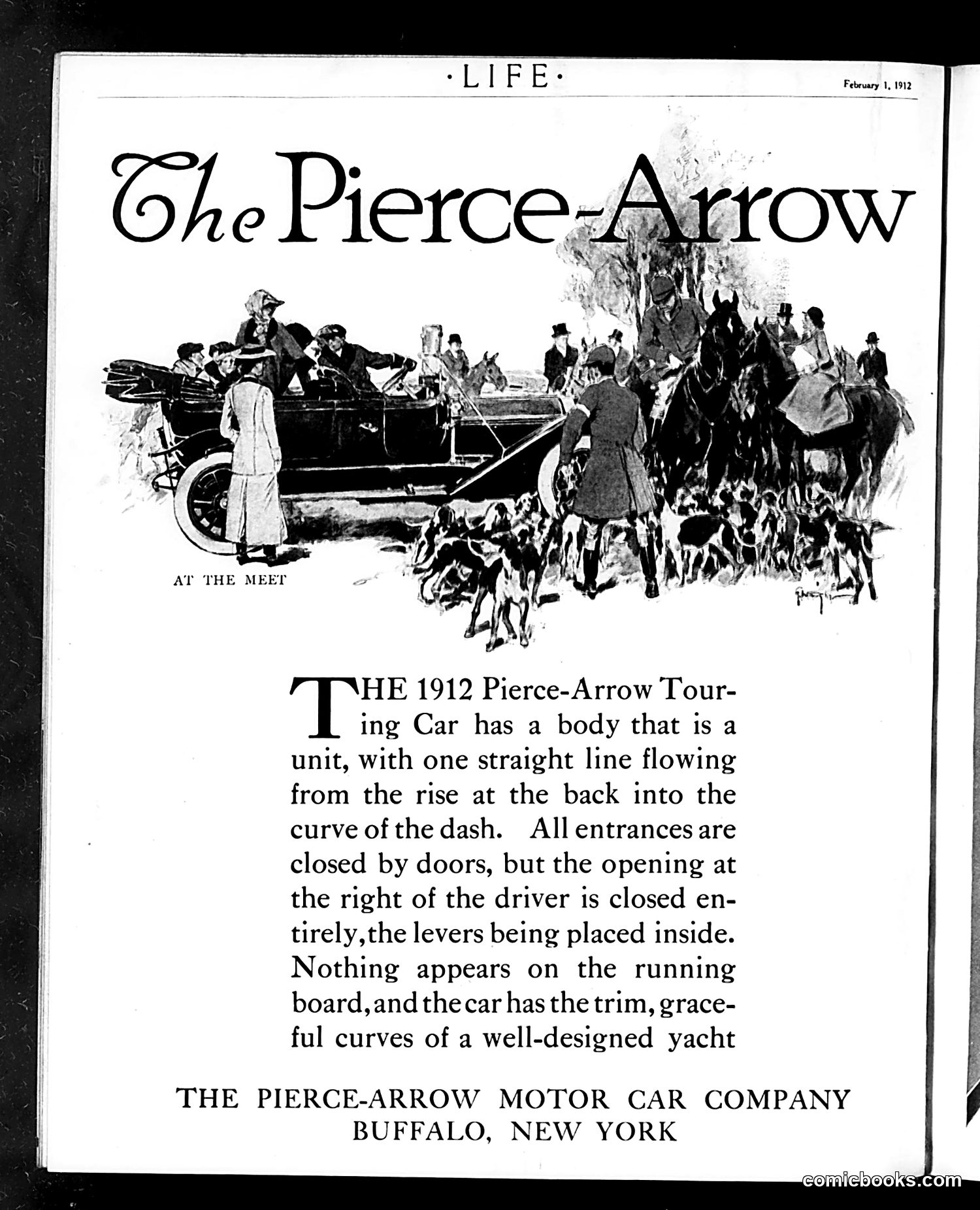
This is primarily **automobile advertising**, not political satire. The page features an advertisement for the 1912 Pierce-Arrow Touring Car from Buffalo, New York. The illustration labeled "AT THE MEET" depicts an affluent social scene—likely a fox hunt or similar upper-class outdoor gathering—with well-dressed people, horses, and the featured automobile. This wasn't coincidental: the ad strategically associates the Pierce-Arrow with wealth and social prestige. The descriptive text emphasizes design features appealing to luxury buyers: unified body construction, integrated controls, clean lines, and styling compared to a "well-designed yacht"—all markers of high-end craftsmanship. For 1912 readers, this evoked exclusivity and status. For modern readers, it's notable as early automotive advertising that sold lifestyle rather than specifications, and as evidence of the automobile's rapid transition from novelty to status symbol among the wealthy.