
Life, 1912-02-01 · page 22 of 48
Life — February 1, 1912 — page 22: what you’re looking at
What you’re looking at
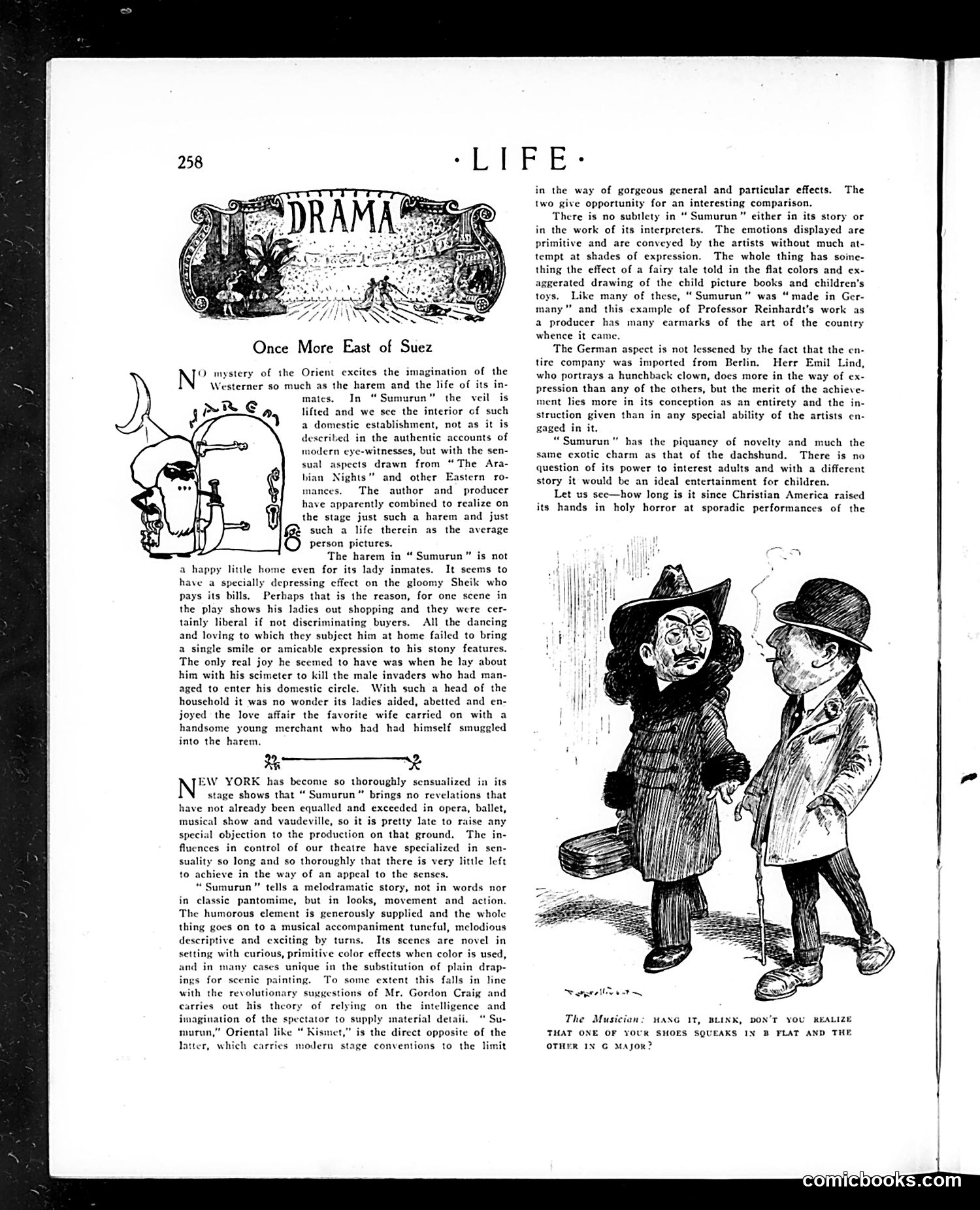
This page reviews "Sumurun," a German theatrical production imported from Berlin by director Max Reinhardt. The review examines how the play dramatizes Western fantasies about harems and Oriental life, drawing on imagery from *Arabian Nights* rather than authentic accounts. The accompanying cartoon depicts two figures—likely a hunchbacked character and another performer from the production—illustrating the show's exaggerated, cartoonish style. The caption's reference to "shoes squeaks" and "flat major" suggests physical comedy. The critic notes that New York audiences have become so desensitized to sensuality in theater that "Sumurun" offers nothing shocking. The production is criticized as melodramatic and unsophisticated, with "primitive" emotions conveyed through movement rather than subtle performance. The reviewer dismisses it as resembling children's picture books—flat, exaggerated, and deliberately simple—while acknowledging its artistic novelty in staging and design choices.
📄 Transcribed text from this page (OCR, searchable)
Machine-transcribed from the original scan — historical spelling and the odd misread are preserved.
“LTPE- Once More East of Suez O mystery of the Orient excites the imagination of the Westerner so much as the harem and the life of its in- mates. In “Sumurun” the veil is lifted and we sce the interior of such a domestic establishment, not as it is described in the authentic accounts of modern eye-witnesses, but with the sen- sual aspects drawn from “The Ara- bian Nights” and other Eastern ro- mances. The author and producer have apparently combined to realize on the stage just such a harem and just such a life therein as the average person pictures. The harem in “ Sumurun” is not a happy little home even for its lady inmates. It scems to have a specially depressing effect on the gloomy Sheik who pays its bills. Perhaps that is the reason, for one scene in the play shows his ladies out shopping and they were cer- tainly liberal if not discriminating buyers. All the dancing and loving to which they subject him at home failed to bring a single smile or amicable expression to his stony features. The only real joy he seemed to have was when he lay about him with his scimeter to kill the male invaders who had man- aged to enter his domestic circle. With such a head of the household it was no wonder its ladies aided, abetted and en- joyed the love affair the favorite wife carried on with a handsome young merchant who had had himself smuggled into the harem. -—-— EW YORK has become so thoroughly sensualized in its stage shows that “ Sumurun” brings no revelations that have not already been equalled and exceeded in opera, ballet, musical show and vaudeville, so it is pretty late to raise any special objection to the production on that ground. The in- fluences in control of our theatre have specialized in sen- suality so long and so thoroughly that there is very little left to achieve in the way of an appeal to the senses. “ Sumurun” tells a melodramatic story, not in words nor in classic pantomime, but in looks, movement and action. The humorous clement is generously supplied and the whole thing gocs on to a musical accompaniment tuncful, melodious descriptive and exciting by turns. Its scenes are novel in setting with curious, primitive color effects when color is used, and in many cases unique in the substitution of plain drap- ings for scenic painting. To some extent this falls in line with the revolutionary suggestions of Mr. Gordon Craig and carries out his theory of relying on the intelligence and imagination of the spectator to supply iaterial detaii, " Su- murun,” Oriental like “ Kismet,” is the direct opposite of the latter, which carries modern stage conventions to the limit in the way of gorgcous general and particular effects. The two give opportunity for an interesting comparison. There is no subtlety in “ Sumurun” either in its story or in the work of its interpreters. The emotions displayed are primitive and are conveyed by the artists without much at- tempt at shades of expression. The whole thing has soie- thing the effect of a fairy tale told in the flat colors and ex- aggerated drawing of the child picture books and children's toys. Like many of these, “ Sumurun” was “made in Ger- many” and this example of Professor Reinhardt’s work as a producer has many earmarks of the art of the country whence it came. The German aspect is not lessened by the fact that the en- tire company was imported from Berlin, Herr Emil Lind, who portrays a hunchback clown, docs more in the way of ex- pression than any of the others, but the merit of the achieve- ment lies more in its conception as an entirety and the in- struction given than in any special ability of the artists en- gaged in it. “Sumurun" has the piquancy of novelty and ich the same exotic charm as that of the dachshund. There is no question of its power to interest adults and with a different story it would be an ideal entertainment for children. Let us sec—how long is it since Christian America raised its hands in holy horror at sporadic performances of the oe The Musician: MaNG 11, BLINK, DON’T YOU REALIZE THAT ONE OF YOUR SHOES SQUEAKS IN B FLAT AND THE OTHER IN G Major?