
Life, 1912-02-01 · page 26 of 48
Life — February 1, 1912 — page 26: what you’re looking at
What you’re looking at
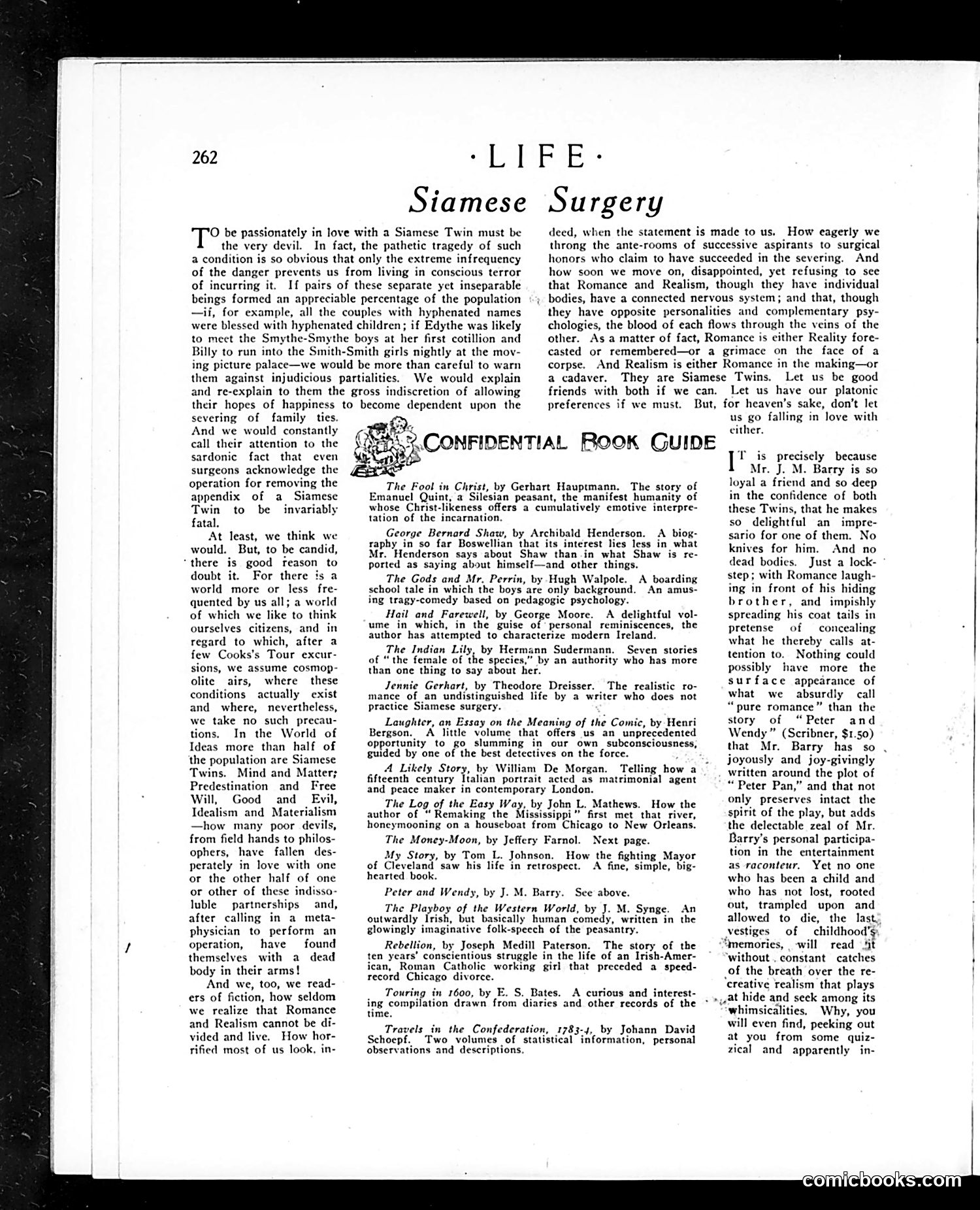
This page contains an extended satirical essay (not a cartoon) titled "Siamese Surgery," using Siamese twins as a metaphor for the inseparable relationship between **Romance and Realism** in literature and life. The author argues that falling in love while hoping to "sever" one aspect of human experience from another is as tragic and impossible as separating conjoined twins. The piece warns against trying to choose between romantic idealism and realistic worldview—they're interconnected, sharing "the same nervous system" and "blood." The text then shifts to a "Confidential Book Guide" reviewing contemporary literary works, including titles by Hauptmann, Shaw, Walpole, and Moore. The essay's central point: you cannot live by romance alone or realism alone; both are essential to human experience, and attempting to surgically separate them is folly. It's a sophisticated literary-philosophical commentary typical of Life's satirical approach to culture and ideas.
📄 Transcribed text from this page (OCR, searchable)
Machine-transcribed from the original scan — historical spelling and the odd misread are preserved.
Siamese 'O be passionately in love with a Siamese Twin must be the very devil. In fact, the pathetic tragedy of such a condition is so obvious that only the extreme infrequency of the danger prevents us from living in conscious terror of incurring it. If pairs of these separate yet inseparable beings formed an appreciable percentage of the population if, for example, all the couples with hyphenated names were blessed with hyphenated children; if Edythe was likely to meet the Smythe-Smythe boys at her first cotillion and Billy to run into the Smith-Smith girls nightly at the mov- ing picture palace—we would be more than careful to warn them against injudicious partialities. We would explain and re-explain to them the gross indiscretion of allowing their hopes of happiness to become dependent upon the severing of family ties. And we would constantly call their attention to the sardonic fact that even surgeons acknowledge the operation for removing the regard to which, after a CONFIDENTIAL Book Gul The Fool in Christ, by Gerhart Hauptmann. The story of author has attempted to characterize modern Ireland. Surgery deed, when the statement is made to us. How eagerly we throng the ante-rooms of successive aspirants to surgical honors who claim to have succeeded in the severing. And how soon we move on, disappointed, yet refusing to see that Romance and Realism, though they have individual bodies, have a connected nervous system; and that, though they have opposite personalities and complementary psy- chologies, the blood of each flows through the veins of the other. Asa matter of fact, Romance is either Reality fore- casted or remembered—or a grimace on the face of a corpse. And Realism is either Romance in the making—or a cadaver, They are Siamese Twins. Let us be good friends with both if we can. Let us have our platonic preferences if we must. But, for heaven’s sake, don’t let us go falling in love with cither. I" is precisely because Mr. J. M. Barry is so loyal a friend and so deep appendix of a Siamese Emanuel Quint, 2 Silesian peasant, the manifest humanity of in the confidence of both Twin to be invariably whose Christ-likeness offers a cumulatively emotive interpre- these Twins, that he makes fatal. pe et : so delightful an impre- At least, we think we Gecree, Bernors, bor by Archibald Headerace A Bie. sario for one of them. No ‘i ; raphy in so far Boswellian that its interest lies less in what el ea? would. But, to be candid, Mfr." Henderson says about Shaw than in what Shaw is re- Knives for him. And no “there is good reason to ported as saying about himself—and other things. dead bodies. Just a lock- doubt it. For there is a The Gods and Mr. Perrin, by Hugh Walpole. A boarding step; with Romance laugh- world more or less fre- school tale in which the boys are only background. An amus- ing in front of his hiding quented by us all; a world ing tragy-comedy based on pedagogic psychology. brother, and impishly of which we like to think Hail and Farewell, by George Moore. A delightful vol- spreading his coat tails in Gurselvesr citizens) and in ume in which, in the guise of personal reminiscences, the pretense of concealing what he thereby calls at- Sav The Indian Lily, by Hermann Sudermann. Seven stories i Tothtng few Cooks’s Tour excur: of “the female of the species,” by an authority who has more tention to. Nothing could sions, we assume cosmop- than one thing to say about her. possibly have more the olite: Zaire, where these Jennie Gerhart, by Theodore Dreisser, The realistic ro- SUT face appearance of conditions actually exist mance of an undistinguished life by a writer who does not what we absurdly call and where, nevertheless, practice Siamese surgery. “pure romance” than the we take no such precau- Laughter, an Essay on the Meaning of the Comic, by Henri story of “Peter and tions, In the World of Bergson. A Tittle volume that ‘offers us ‘an unpiecedented Wendy” (Scribner, $1.50) . 3 opportunity to go slumming in our own subconsciousness, r Mr. Ideas more than half of guided by cue of Whe best detectives ob the forwe. that Mr. Barry has so . the population are Siamese joyously and joy-givingly dn S; A Likely Story, by William De Morgan. Telling how a a Twins. Mind and Matter: grrcenth century fialian portrait acted as matrimonial agent’ ::. YTitten around the plot of Predestination and Free and peace maker in contemporary London. Peter Pan,” and that not Will, Good and Evil, The Log of the Easy Way, by John L. Mathews. How the only preserves intact the Idealism and Materialism author of “Remaking the Mississippi’ first met that river, spirit of the play, but adds —how many poor devils, honeymooning on a houseboat from Chicago to New Orleans. the delectable zeal of Mr. from field hands to philos- ophers, have fallen des- The Money-Moon, by Jeffery Farnol. Next page. My Story, by Tom L. Johnson. How the fighting Mayor Barry's personal participa- tion in the entertainment perately in love with one of Cleveland saw his life in retrospect. A fine, simple, big- as raconteur, Yet no one or the other half of one hearted book. who has been a child and or other of these indisso- Peter and Wendy, by J. M. Barry. See above. who has not lost, rooted luble partnerships _ and, The Playboy of the Western World, by J. M. Synge. An out, trampled upon and after calling in a meta- outwardly Irish, but basically human comedy, written in the allowed to die, the last, physician to perform an glowingly imaginative folk-speech of the peasantry. vestiges of —childhood’¢ operation, have found Rebellion, by Joseph Medill Paterson. The story of the ‘memories, will read fit themselves with a dead ten years’ conscientious struggle in the life of an Irish-Amer- without . constant catches body in their arms! And we, too, we read- ers of fiction, how seldom ing compilation /d we realize that Romance time. and Realism cannot be di- record Chicago divorce. ican, Roman Catholic working girl that preceded a speed- Touring in 1600, by E. S. Bates. A curious and interest- n from diaries and other records of the Travels_in the Confederation, 1783-4, by Johann David of the breath over the re- creative realism that plays at hide and seck among its whimsicalities. Why, you will even find, peeking out vided and live. How hor- Schoepf. Two volumes of statistical information, personal at you from some quiz- tified most of us look, in- observations and descriptions. zical and apparently in-