
Life, 1912-02-01 · page 23 of 48
Life — February 1, 1912 — page 23: what you’re looking at
What you’re looking at
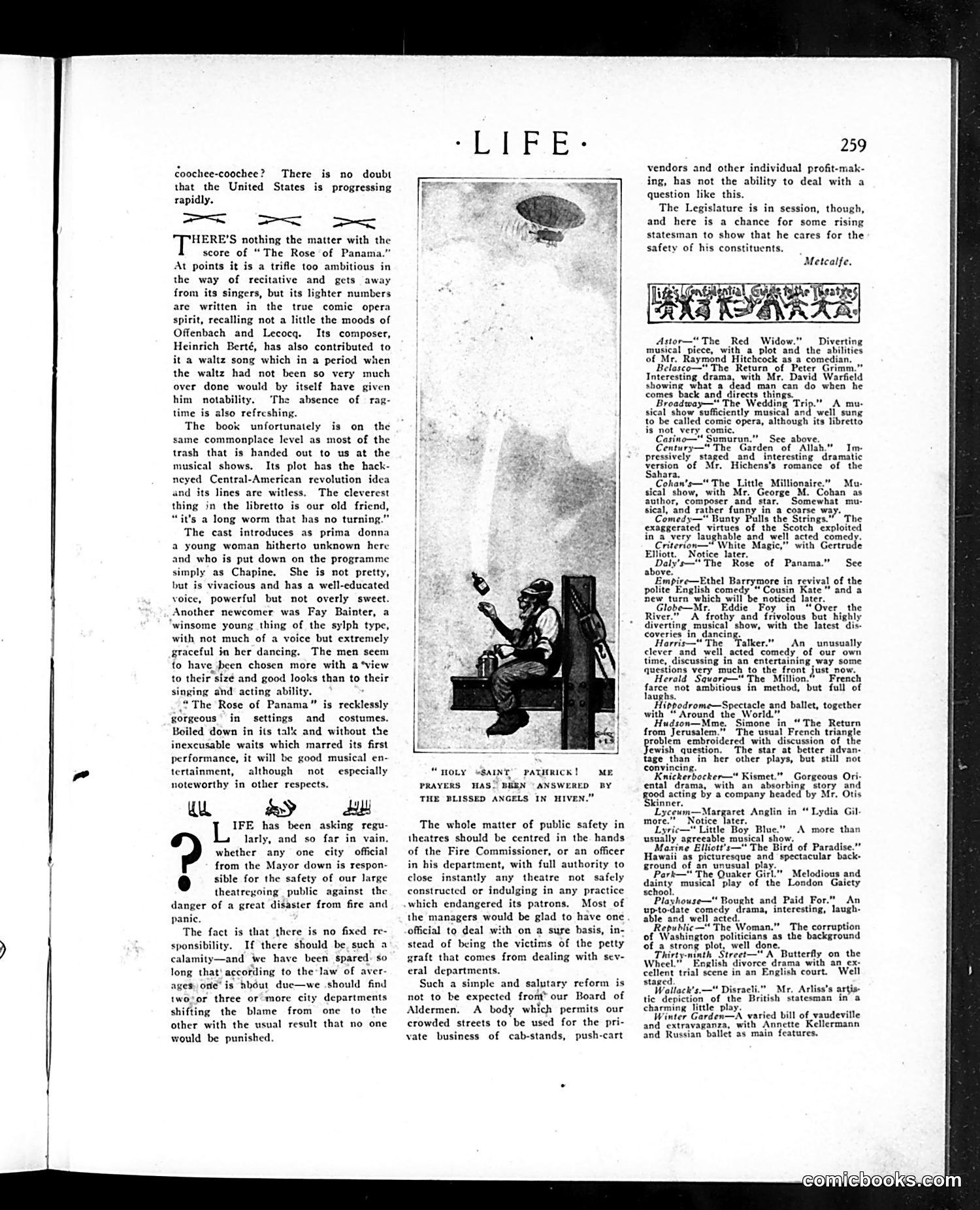
This page contains two distinct elements: a theatrical review and a political cartoon about public safety. The cartoon depicts an Irish character (identifiable by the caption "Holy Saint Patrick!") praying, with the caption indicating his prayers have been answered by "the blessed angels in heaven." The humor is satirical—he's likely depicted as a cab driver or street vendor, referencing the text's complaint that New York's Board of Aldermen permits crowded streets to be monopolized by private cab-stands and push-cart vendors for profit. The accompanying editorial by Metcalfe criticizes the lack of unified responsibility for theater safety in New York City. He argues that multiple city departments avoid accountability for fire hazards, and blames the Board of Aldermen for being too corrupt (dealing in "petty graft") to fix the problem. He appeals to the state Legislature to intervene and establish a single official authority—the Fire Commissioner—to enforce theater safety standards. The satire mocks both municipal negligence and the powerlessness of ordinary citizens against institutional dysfunction.
📄 Transcribed text from this page (OCR, searchable)
Machine-transcribed from the original scan — historical spelling and the odd misread are preserved.
Coochee-coochee? There is no doubt that the United States is progressing rapidly. os a wd HERE'S nothing the matter with the score of “The Rose of Panama. At points it is a trifle too ambitious in the way of recitative and gets away from its singers, but its lighter numbers are written in the true comic opera spirit, recalling not a little the moods of Offenbach and Lecocq. Its composer, Heinrich Berté, has also contributed to it a waltz song which in a period when the waltz had not been so very much over done would by itself have given him notability. The absence of rag- time is also refreshin; The book unfortunately is on the same commonplace level as most of the trash that is handed out to us at the musical shows. Its plot has the hack- neyed Central-American revolution idea and its lines are witless. The cleverest thing in the libretto is our old friend, “it’s a long worm that has no turning.’ The cast introduces as prima donna a young woman hitherto unknown here and who is put down on the programme simply as Chapine. She is not pretty, but is vivacious and has a well-educated voice, powerful but not overly sweet. Another newcomer was Fay Bainter, a ‘winsome young thing of the sylph type, with not much of a voice but extremely graceful in her dancing. The men seem to have een chosen more with a ‘view to their sizé and good looks than to their singing and acting ability. “The Rose of Panama” is recklessly gorgeous’ in settings and costumes. Boiled down in its talk and without the inexcusable waits which marred its first performance, it will be good musical en- tertainment, although not especially noteworthy in other respects. ue ay aus IFE has been asking regu- larly, and so far in vain, whether any one city official from the Mayor down is respon- e@ sible for the safety of our large theatregoing public against the danger of a great disaster from fire and panic. The fact is that there is no fixed re- sponsibility. If there should be such a calamity—and Wwe have been spared. so long that! according to the law of aver- ages ore’ is About due—we .should find two/or three or more city departments shifting the blame from one to the other with the usual result that no one would be punished, Hoty “SAINT PATRICK! ME PRAYERS HAS! BEEN “ANSWERED BY THE DLISSED ANGELS IN HIVEN The whole matter of public safety in theatres should be centred in the hands of the Fire Commissioner, or an officer in his department, with full authority to close instantly any theatre not safely constructed or indulging in any practice which endangered its patrons. Most of the managers would be glad to have one official to deal with on a sure basis, in- stead of being the victims of the petty graft that comes from dealing with sev- eral departments. Such a simple and salutary reform is not to be expected front’ our Board of Aldermen. A body which permits our crowded streets to be used for the pri- vate business of cab-stands, push-cart 259 vendors and other individual profit-mak- ing, has not the ability to deal with a question like this, The Legislature is in session, though, and here is a chance for some rising statesman to show that he cares for the safety of his constituents. Metcalfe. Astor—"The Red Widow.” Diverting musical piece, with a plot and the abilities of Mr. Raymond Hitchcock as a comedian. Belasco—" The Return of Peter Grimm.” Interesting drama, with Mr. David Warfield showing what a dead man can do when he comes back and directs things, Broadway" The Wedding Trip.” A mu- sical show sufficiently musical and well sung to be called comic opera, although its libretto is not, very, comic. Casino—" Sumurun.” See above. Century—* The Garden of Allah.” Im- pressively staged and interesting dramatic version of Mr. Hichens’s romance of the Sahara. Cohan's—" The Little Millionaire.” Mu- sical show, with Mr, George M. Cohan as author, composer and star. Somewhat mu- sical, and rather funny in a coarse way. Comedy—" Bunty Pulls the Strings.” "The exaggerated virtues of the Scotch exploited in a very laughable and well acted comedy. Criterion—* White Magic,” with Gertrude Elliott. Notice later. Daly's—"The Rose of Panama.” See above. Empire—Ethel Barrymore in revival of the polite English comedy “Cousin Kate” and a new turn which will be noticed later. Globe—Mr. Eddie Foy in “Over. the River.” A frothy and frivolous but highly diverting musical show, with the latest dis- coveries in. dancing. Harris—"The Talker.” An unusually clever and well acted comedy of our own time, discussing in an entertaining way some questions very much to the front j Herald Sqvare—" The Million farce not ambitious in method, but full of laughs. Hipfodrome—Spectacle and ballet, together with “Around the World.” Hudson—Mme, Simone in “The Return from Jerusalem.” The usual French triangle roblem embroidered with discussion of the jewish question. The star at better advan- tage than in her other plays, but still not conyincing. Knickerbocker— Kismet.” Gorgeous Ori- ental drama, with an absorbing story and good acting by a company headed by Mr. Otis Skinner. vimn—Margaret Anglin in “Lydia Gil more.” Notice later. Lyrie—" Little Boy Blu usually agreeable musical show Maxine Elliott’s—" The Bird of Paradis: Hawaii as picturesque and spectacular back- ground of an unusual play. Park—" The Quaker Girl.” Melodious and dainty musical play of the London Gaiety school. : Plaxyhouse—" Bought and Paid For.” An up-to-date comedy drama, interesting, laugh- able and well acted. . Republic—" The Woman.” The corruption of Washington politicians as the background ofa strong plot, well done. Thirty-ninth Street—" A Butterfly on the Wheel.” English divorce drama with an ex. cellent trial scene in an English court. Well stage¢ A more than racli.” Mr, Arliss’s artis: of the British statesman in a charming little play. : Winter Garden—A varied bill of vaudeville and extravaganza, with Annette Kellermann and Russian ballet as main features.