
Life, 1912-02-01 · page 19 of 48
Life — February 1, 1912 — page 19: what you’re looking at
What you’re looking at
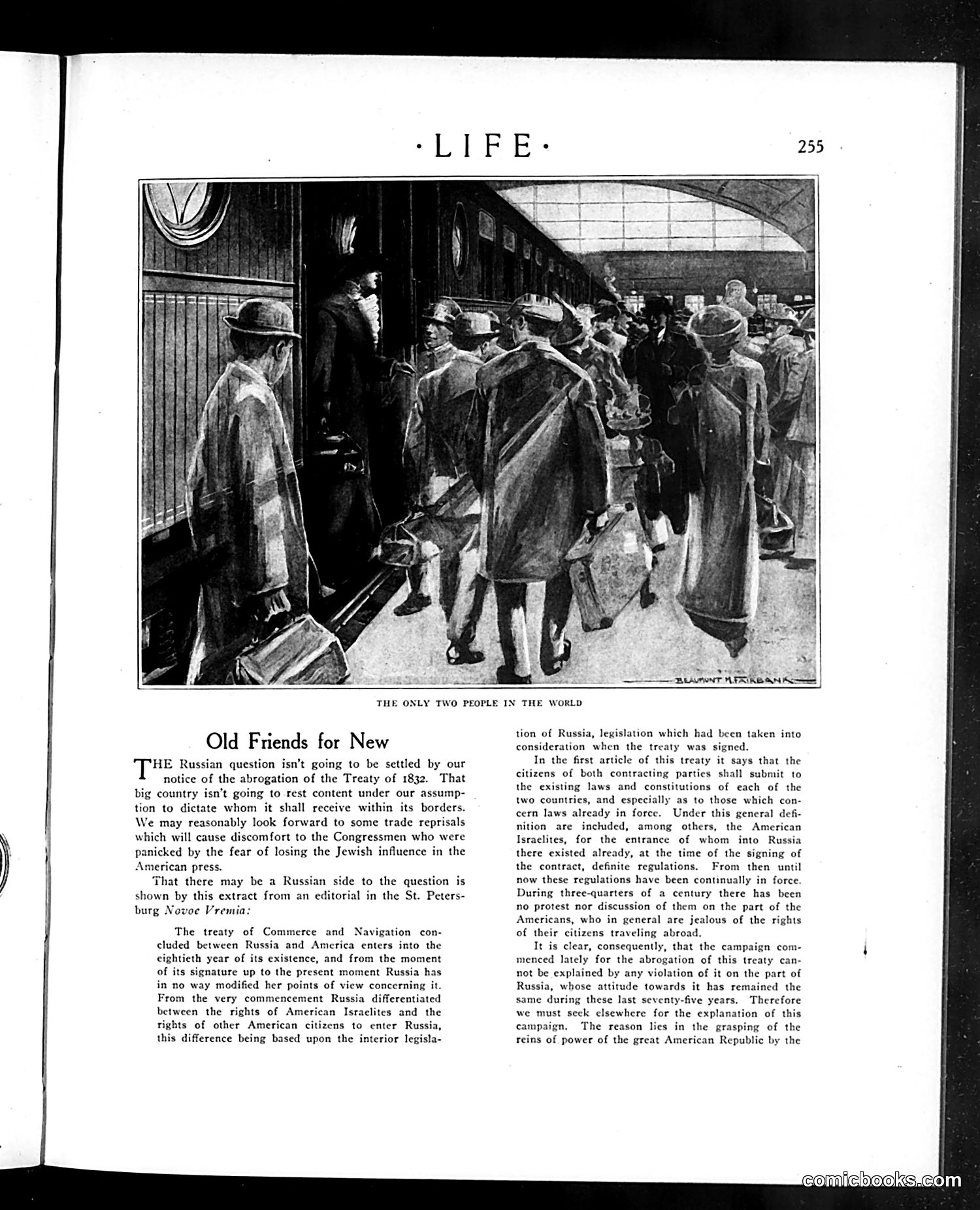
This page discusses the 1911 abrogation of the 1832 U.S.-Russia Treaty of Commerce and Navigation. The cartoon caption, "The Only Two People in the World," appears to depict a customs or immigration checkpoint scene—likely representing the moment of treaty termination. The article criticizes American pressure to end the treaty, attributing it to Jewish-American political influence ("losing the Jewish influence in the American press"). Russia's position, quoted from a Russian newspaper, defends its long-standing restrictions on Jewish citizens entering Russia, arguing these were known when the treaty was signed and consistently enforced. The satire's point: American politicians abandoned an eighty-year trade agreement due to domestic pressure over Russia's discriminatory Jewish immigration policies—a move the author suggests was economically foolish and based on special-interest lobbying rather than principled diplomacy. **Context for moderns:** This reflects pre-WWI tensions over Jewish rights and immigration, showing how religious discrimination shaped international relations.
📄 Transcribed text from this page (OCR, searchable)
Machine-transcribed from the original scan — historical spelling and the odd misread are preserved.
BUAONT MERIRB QIN Koes | THE ONLY TWO PEOPLE IN THE WORLD Old Friends for New HE Russian question isn’t going to be settled by our notice of the abrogation of the Treaty of 1832. That big country isn’t going to rest content under our assump- tion to dictate whom it shall receive within its borders. We may reasonably look forward to some trade reprisals which will cause discomfort to the Congressmen who were panicked by the fear of losing the Jewish influence in the American press. That there may be a Russian side to the question is shown by this extract from an editorial in the St. Peters- burg Novoe Vremia: The treaty of Commerce and Navigation con- cluded between Russia and America enters into the eightieth year of its existence, and from the moment of its signature up to the present moment Russia has in no way modified her points of w concerning it. From the very commencement Russia differentiated between the rights of American Israclites and the rights of other American citizens to enter Russia, this difference being based upon the interior legisla- tion of Russia, legislation which had been taken into consideration when the treaty was signed. In the first article of this treaty it says that the citizens of both contracting parties shall submit to the existing laws and constitutions of each of the two countries, and especially as to those which con- cern laws already in force. Under this general defi- nition are inchided, among others, the American Israelites, for the entrance of whom into Russia there existed already, at the time of the signing of the contract, definite regulations. From then until now these regulations have been continually in force. During three-quarters of a century there has been no protest nor discussion of them on the part of the Americans, who in general are jealous of the rights of their citizens traveling abroad. It is clear, consequently, that the campaign com- menced lately for the abrogation of this treaty can- not be explained by any violation of it on the part of Russia, whose attitude towards it has remained the same during these last seventy-five years. Therefore we must seck elsewhere for the explanation of this campaign, The reason lies in the grasping of the reins of power of the great American Republic by the