
Life, 1912-02-01 · page 28 of 48
Life — February 1, 1912 — page 28: what you’re looking at
What you’re looking at
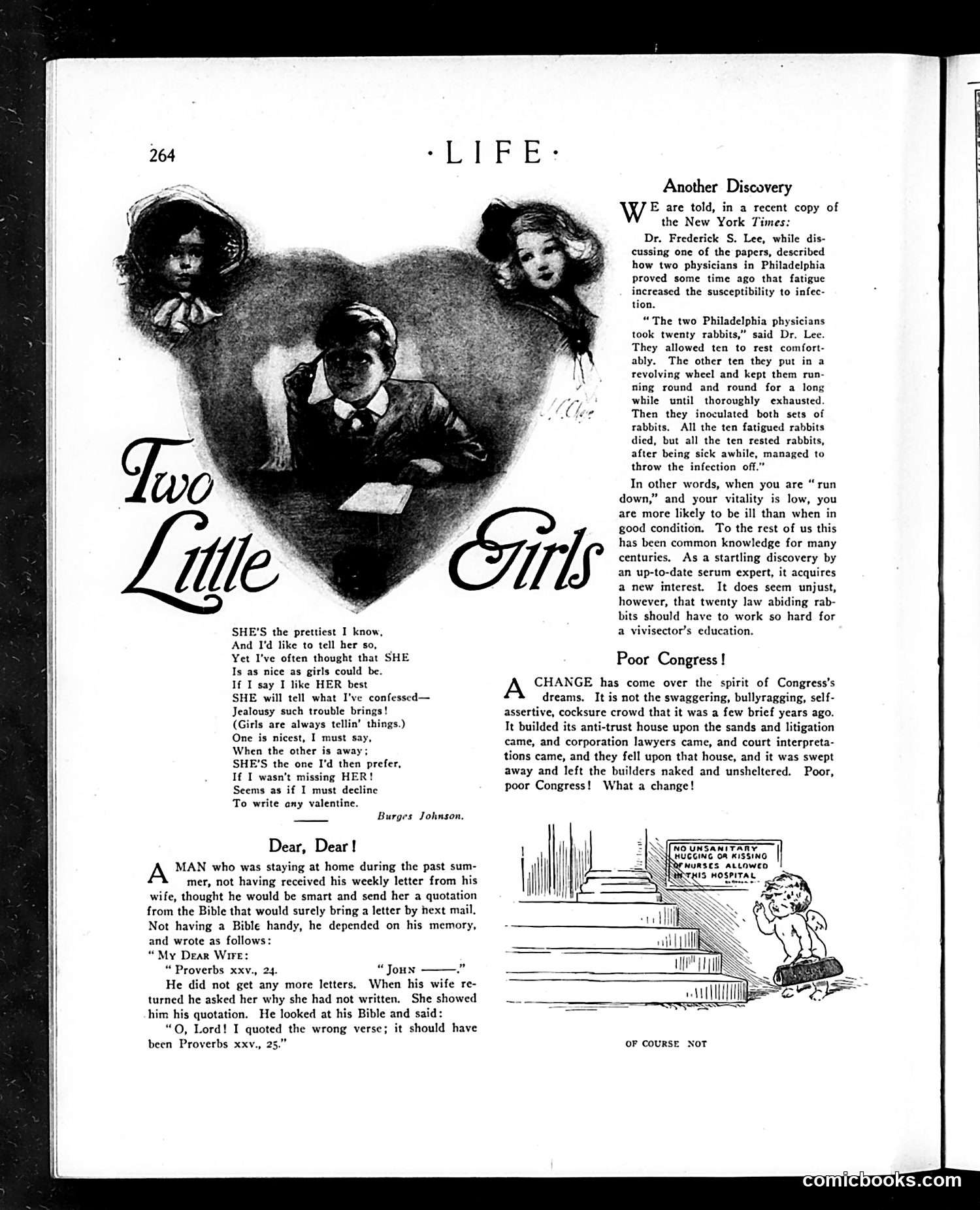
This page contains three satirical pieces reflecting early-20th-century social attitudes: **"Two Little Girls"** (top): A poem about romantic indecision—a young man cannot choose between two girls without creating jealousy, so he avoids writing valentines to either. The accompanying illustration shows three figures in period dress. The humor lies in depicting the social awkwardness of courtship conventions. **"Dear, Dear!"** (middle): A humorous anecdote where a husband, wanting to prompt his wife to write, sends her a Bible verse reference (Proverbs 25:24) without checking it. The joke implies he misquoted a verse about wives—suggesting marital tension. His wife returns it, and he realizes he cited the "wrong" verse, implying the correct one was even more critical of wives. The satire targets husbands' careless assumptions and marital discord. **"Poor Congress!"** (right): Political commentary lamenting Congress's weakened position after anti-trust litigation. The metaphor of a house built on sand suggests Congress's authority has crumbled under legal challenges from corporations. This reflects Progressive-era debates about corporate power versus government regulation.
📄 Transcribed text from this page (OCR, searchable)
Machine-transcribed from the original scan — historical spelling and the odd misread are preserved.
SHE'S the prettiest I know, And I'd like to tell her so, Yet I've often thought that SHE Is as nice as girls could be. If I say I like HER best SHE will tell what I've confessed— Jealousy such trouble brings! (Girls are always tellin’ things.) One is nicest, I must say, When the other is away; SHE'S the one I'd then prefer, If I wasn’t missing HER! Seems as if I must decline To write any valentine. Burges Johnson. Dear, Dear! MAN who was staying at home during the past sum- mer, not having received his weekly letter from his wife, thought he would be smart and send her a quotation from the Bible that would surely bring a letter by hext mail, Not having a Bible handy, he depended on his memory, and wrote as follows: “My Dear Wire: “Proverbs xxv., 24. “Joun 2 Another Discovery E are told, in a recent copy of the New York Times: Dr. Frederick S. Lee, while dis- cussing one of the papers, described how two physicians in Philadelphia Proved some time ago that fatigue increased the susceptibility to infec- tion, “The two Philadelphia physicians took twenty rabbits,” said Dr, Lee. They allowed ten to rest comfort- ably. The other ten they put in a revolving wheel and kept them run- ning round and round for a long while until thoroughly exhausted. Then they inoculated both sets of rabbits. All the ten fatigued rabbits died, but all the ten rested rabbits, after being sick awhile, managed to throw the infection off.” In other words, when you are “run down,” and your vitality is low, you are more likely to be ill than when in good condition. To the rest of us this has been common knowledge for many centuries, As a startling discovery by an up-to-date serum expert, it acquires a new interest. It does seem unjust, however, that twenty law abiding rab- bits should have to work so hard for a vivisector’s education. Poor Congress ! A CHANGE has come over the spirit of Congress's dreams. It is not the swaggering, bullyragging, self- assertive, cocksure crowd that it was a few brief years ago. It builded its anti-trust house upon the sands and litigation came, and corporation lawyers came, and court interpreta- tions came, and they fell upon that house, and it was swept away and left the builders naked and unsheltered. Poor, poor Congress! What a change! He did not get any more letters. When his wife re- turned he asked her why she had not written. She showed him his quotation. He looked at his Bible and said: “O, Lord! I quoted the wrong verse; it should have been Proverbs xxv., 25.” OF COURSE NOT Ccomicbooks.com