
Life, 1912-02-01 · page 20 of 48
Life — February 1, 1912 — page 20: what you’re looking at
What you’re looking at
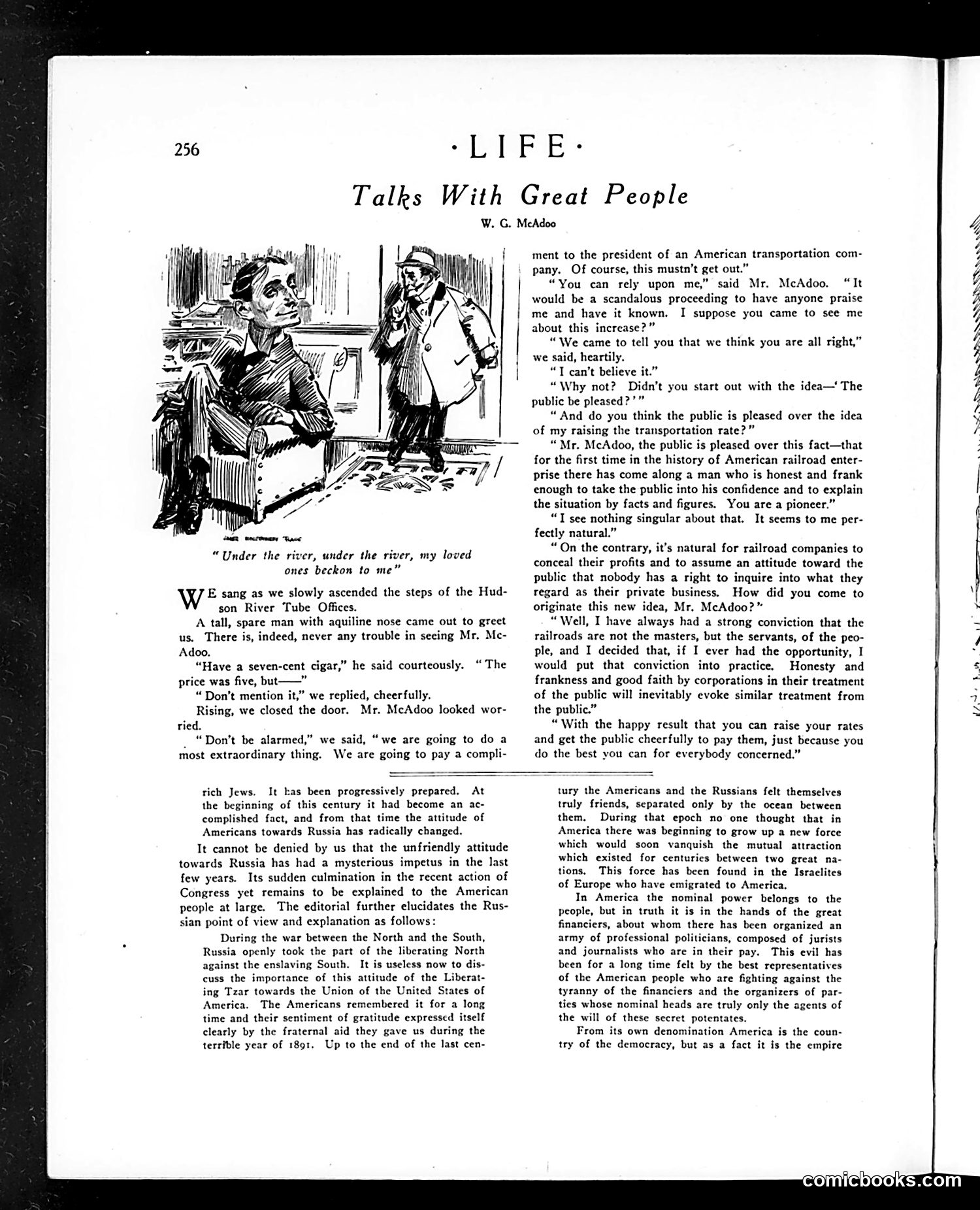
This satirical piece interviews **William G. McAdoo**, who appears to be a railroad executive. The cartoon depicts him as unusually honest—a rarity that Life finds amusing enough to mock. The satire's point: McAdoo has raised transportation rates but justified this transparently by explaining his costs and reasoning to the public with "facts and figures." Life ironically praises this as pioneering honesty, since railroad companies typically concealed profits and treated inquiries about their business as impertinent. The joke works on two levels: McAdoo is lauded for basic transparency (implying this was shockingly uncommon), and the implication that people will happily pay higher rates if a corporation simply treats them honestly and respectfully. The accompanying text discusses Russia-America relations, suggesting this issue of Life addressed broader corporate accountability debates of the era.
📄 Transcribed text from this page (OCR, searchable)
Machine-transcribed from the original scan — historical spelling and the odd misread are preserved.
“[RIRENE « Talks With Great People W. G. McAdoo “Under the river, under the river, my loved ones beckon to me” WF sang as we slowly ascended the steps of the Hud- son River Tube Offices. A tall, spare man with aquiline nose came out to greet us, There is, indeed, never any trouble in secing Mr. Mc- Adoo. “Have a seven-cent cigar,” he said courteously. “The price was five, but——” “Don’t mention it,” we replied, cheerfully. Rising, we closed the door. Mr. McAdoo looked wor- ried. _ “Don’t be alarmed,” we said, “we are going to do a most extraordinary thing. We are going to pay a compli- ment to the president of an American transportation com- pany. Of course, this mustn’t get out.” “You can rely upon me,” said Mr. McAdoo. “It would be a scandalous proceeding to have anyone praise me and have it known. I suppose you came to see me about this increase?” “We came to tell you that we think you are all right,” we said, heartily. “T can’t believe it “Why not? Didn't you start out with the idea— The public be pleased?’” “And do you think the public is pleased over the idea of my raising the transportation rate?” “Mr. McAdoo, the public is pleased over this fact—that for the first time in the history of American railroad enter- prise there has come along a man who is honest and frank enough to take the public into his confidence and to explain the situation by facts and figures. You are a pioneer.” “T see nothing singular about that. It seems to me per- fectly natural.” “On the contrary, it’s natural for railroad companies to conceal their profits and to assume an attitude toward the public that nobody has a right to inquire into what they regard as their private business. How did you come to originate this new idea, Mr. McAdoo?” “Well, I have always had a strong conviction that the railroads are not the masters, but the servants, of the peo- ple, and I decided that, if I ever had the opportunity, I would put that conviction into practice. Honesty and frankness and good faith by corporations in their treatment of the public will inevitably evoke similar treatment from the public.” “With the happy result that you can raise your rates and get the public cheerfully to pay them, just because you do the best you can for everybody concerned.” rich Jews. It kas been progressively prepared. At the beginning of this century it had become an ac- complished fact, and from that time the attitude of Americans towards Russia has radically changed. It cannot be denied by us that the unfriendly attitude towards Russia has had a mysterious impetus in the last few years. Its sudden culmination in the recent action of Congress yet remains to be explained to the American people at large. The editorial further elucidates the Rus- sian point of view and explanation as follows: During the war between the North and the South, Russia openly took the part of the liberating North against the enslaving South. It is useless now to dis- cuss the importance of this attitude of the Liberat- ing Tzar towards the Union of the United States of America. The Americans remembered it for a long time and their sentiment of gratitude expressed itself clearly by the fraternal aid they gave us during the terrible year of 1891. Up to the end of the last cen- tury the Americans and the Russians felt themselves truly friends, separated only by the ocean between them. During that epoch no one thought that in America there was beginning to grow up a new force which would soon vanquish the mutual attraction which existed for centuries between two great na- tions, This force has been found in the Israclites of Europe who have emigrated to America. In America the nominal power belongs to the people, but in truth it is in the hands of the great financiers, about whom there has been organized an army of professional politicians, composed of jurists and journalists who are in their pay. This evil has been for a long time felt by the best representatives of the American people who are fighting against the tyranny of the financiers and the organizers of par- ties whose nominal heads are truly only the agents of the will of these secret potentates. From its own denomination America is the coun- try of the democracy, but as a fact it is the empire ee ee ee ae