
Life, 1912-02-01 · page 46 of 48
Life — February 1, 1912 — page 46: what you’re looking at
What you’re looking at
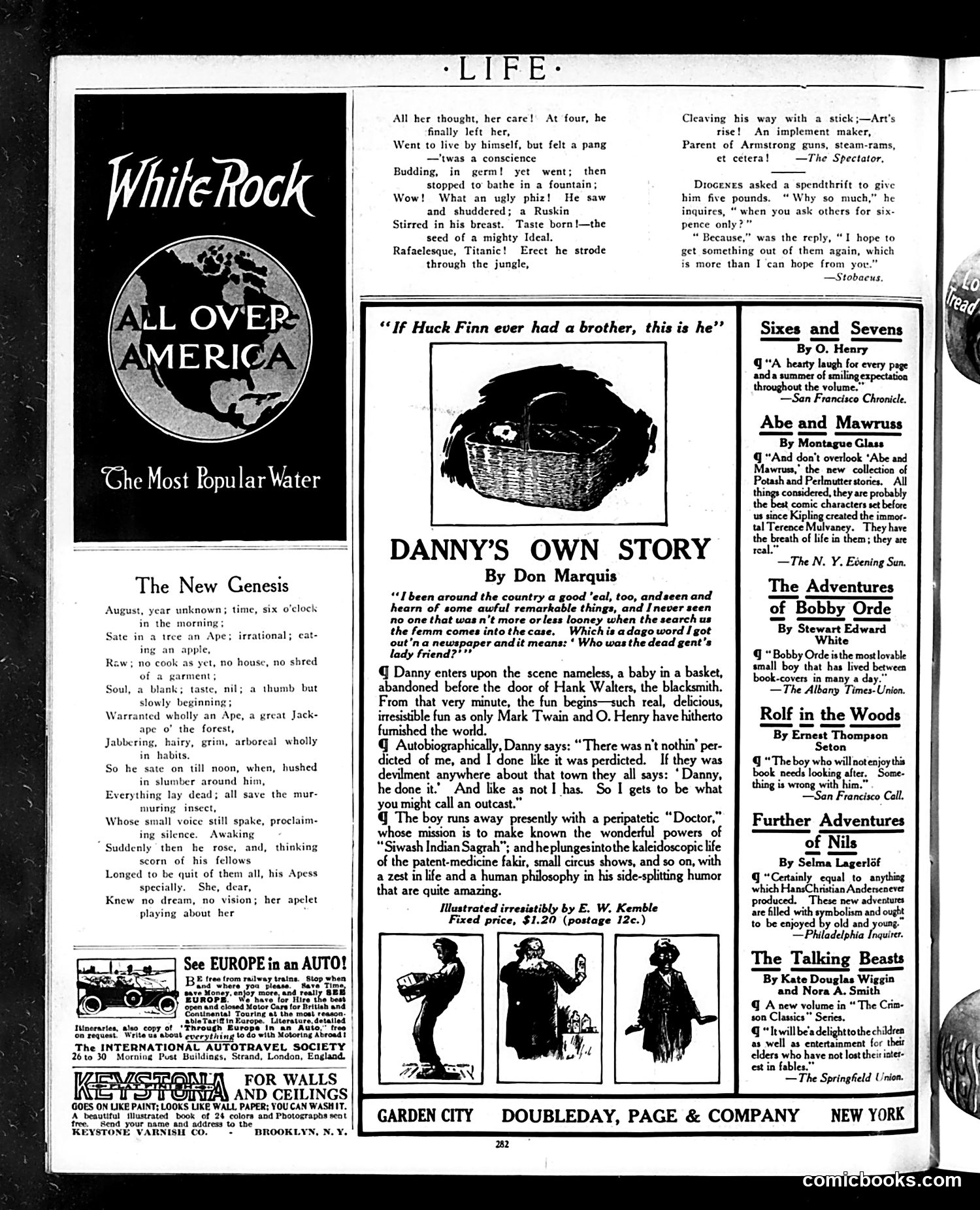
This poem satirizes evolutionary theory, specifically Darwin's ideas about human development from apes. The narrative traces an ape's gradual awakening to consciousness and civilization: he develops aesthetic taste (inspired by seeing his reflection), creates tools and art, and eventually invents technology ("Armstrong guns, steam-rams"). The satire mocks the notion that humanity's "progress"—from animal instinct through artistic sensibility to industrial warfare—represents genuine advancement. The ape abandons his mate out of newfound conscience, then admires his own reflection like a vain aesthete, before becoming an "implement maker" whose inventions are weapons of destruction. The piece appears to critique both Darwinian evolution and Victorian assumptions about civilization's superiority, suggesting that human "development" merely masks our base animal nature with a veneer of art and technology—ultimately producing only better tools for killing.
📄 Transcribed text from this page (OCR, searchable)
Machine-transcribed from the original scan — historical spelling and the odd misread are preserved.
CTE The New Genesis August, year unknown; time, six o'clock in the morning; Sate in a tree an Ape; irrational; eat- ing an appl Raw; no cook as yet, no house, no shred of a garment Soul, a blank; taste slowly beginning Warranted wholly an Ape, a great Jack- ape o' the forest, Jabbering, hairy, grim, arboreal wholly in habits. So he sate on till noon, when, hushed in slumber around him, Everything lay dead; all save the mur- muring insect, Whose small voice still spake, proclaim- ing silence. Awaking “Suddenly then he rose, and, thinking scorn of his fellows Longed to be quit of them all, his Apess specially. She, dear, Knew no dream, no vision; her apelet playing about her a thumb but See EUROPE in in an in an AUTO! v0 Time, njor mor co, and really SE Je nave. lor Hire the best gpenand closed Motor’ tor Cars tor British and inental Touring at the moat reason. Literature detailed | Itineraries, also copy of a> Europe tm an Aut Salrequast, Write cc aboal ever iring vo dormith Motoring beoudt | The INTERNATIONAL AUTOTRAVEL SOCIETY 26 to 30 Morning Pust Buildings, Strand, London, England. feua\W/AColaTel a NIE Ai=aW il FOR WALLS pe} iS f 2 t OTWA\ AND CEILINGS GOES ON LIKE PAINT; LOOKS LIKE WALL PAPER; YOU CAN WASH IT. A beautiful illustrated book of 26 colors and Photographs seat free, Send your name and address to the KEYSTONE VARNISH CO. - BROOKLYN, N.Y. All her thought, her care! At four, he finally left her, Went to live by himself, but felt a pang —'twas a conscience Budding, in germ! yet went; then stopped to bathe in a fountain; Wow! What an ugly phiz! He saw and shuddered; a Ruskin Stirred in his breast. Taste born !—the seed of a mighty Ideal. Rafaelesque, Titanic! Erect he strode through the jungle, Cleaving his way with a stick ;—Art's rise! An implement maker, Parent of Armstrong guns, steam-rams, et cetera! = —The Spectator, Diocexes asked a spendthrift to give him five pounds. “Why so much,” he inquires, “ when you ask others for six- was the reply, “I hope to get something out of them again, which is more than I ‘can hope from you.” —Stobaeus. Sixes and Sevens By O. Henry GA hearty laugh for every page anda summer of smiling expectation throughout the volume.” —San Francisco Chronicle. Abe and Mawruss By Montague Glass G “And don't overlook ‘Abe and Mawruss,” the new collection of Potash and Perlmttersons, All considered, they are probably ‘comic characters set before us since Kipling created the immor- tal Terence Mulvaney. They have DANNY’S OWN STORY | 8" By Don Marquis “I been around the country a good 'eal, too, andseen and hearn of some awful remarkable things, and I never seen no one that was n't more orless looney when the searc the femm comes into the case. Whichis adagoword I got The Adventures of Bobby Orde By Stewart Edward out'n a newspaper and it means: ‘ Who was the dead gent’s White lady friend?’ Danny enters upon the scene nameless, a baby in a basket, abandoned before the door of Hank Walters, the blacksmith. g “Bobby Orde isthe most lovable small boy that has lived between covers in many a day.” —The Albany Times. "Union. From that very minute, the fun begins—such real, delicious, irresistible fun as only Mark Twain and O. Henry have hitherto fumished the world. Rolf in the Woods By Ernest Thompson Autobiographically, Danny says: “There was n't nothin’ per- Seton dicted of me, and I done like it was perdicted. devilment anywhere about that town they all says: he done it.’ And like as not I has. So I gets to be what you might call an outcast.” @ The boy runs away presently with a peripatetic “Doctor,” whose mission is to make known the wonderful powers of of the patent-medicine fakir, small circus that are quite amazing. Mlustrated irresistibly by E. W. Kemble Fixed price, $1.20 (postage 12c.) GARDEN CITY DOUBLEDAY, PAGE & COMPANY If they was ‘Danny, book needs looking after, Some- shows, and so on, wil a zest in life and a human philosophy in his side-splitting humor Q “The boy who will notenjoy this thing is wrong with him.” —San Francisco Call. Further Adventures “Siwash Indian Sagrah”; and heplungesintothe kaleidoscopic life of Nils By Sena Lagertaf “Certainly equal to anything which HansChritian Andenenevet produced. ‘These new adveoturs Ere filled with symboliam and ought 16 be eoheved by old and yome: ’Philadelphta Inquire. The Talking Beasts By Kate Douglas Wiggin and Nora A. Smith g Anew relume in “ The Crim- son Classics g G “Iewill be'a delighttothe children as well as entertainment for 1 elders who have not lost their inter- est in fables.” —The Springfield Union. NEW YORK comicbooks.com