
Life, 1912-02-01 · page 41 of 48
Life — February 1, 1912 — page 41: what you’re looking at
What you’re looking at
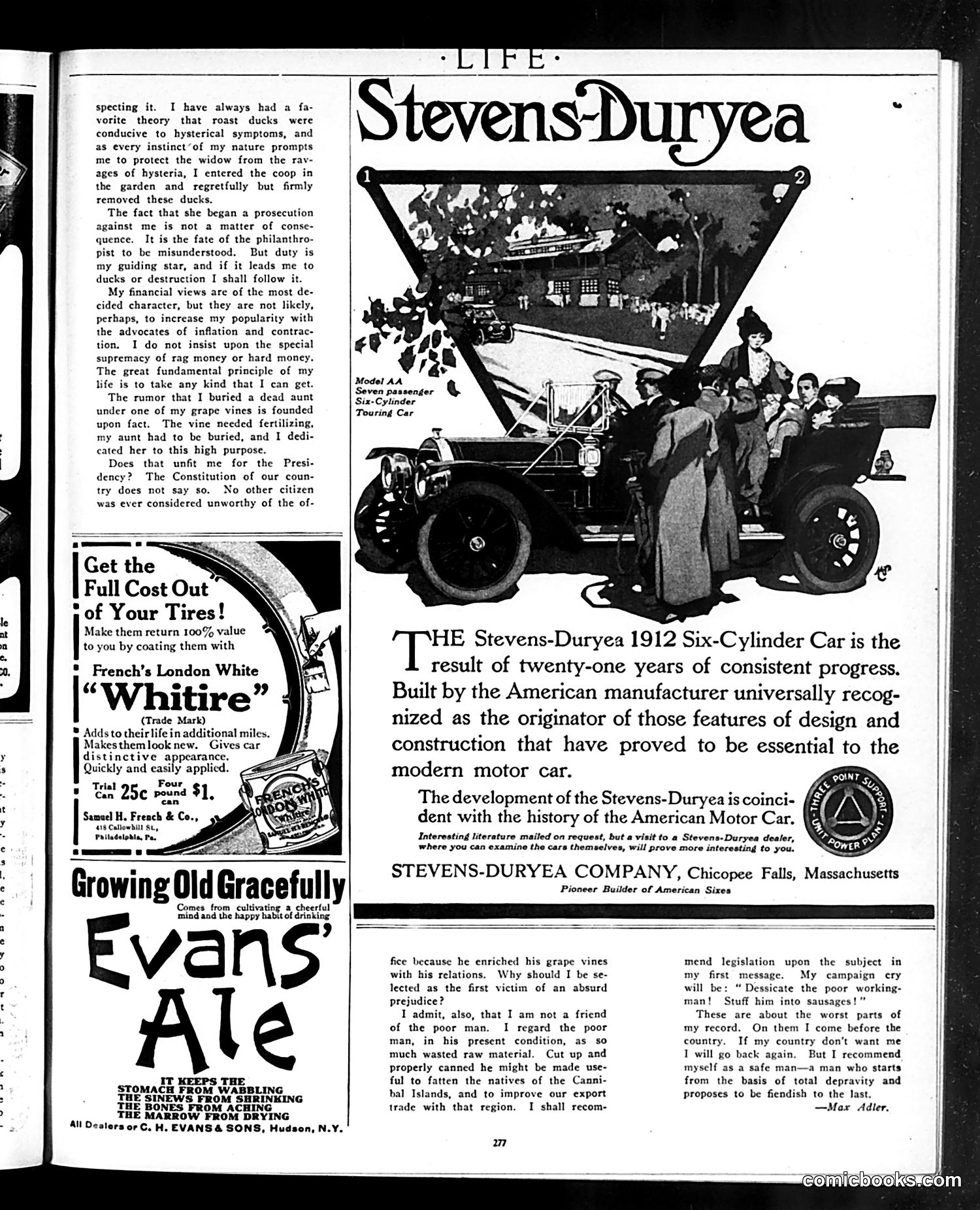
This page is primarily **advertising**, featuring a Stevens-Duryea automobile advertisement alongside period ads for tire coating and ale. The left column contains **satirical political commentary** (likely by Max Adler, based on the byline). The unnamed narrator presents himself as a presidential candidate with grotesquely amoral positions: he stole a widow's ducks claiming philanthropy, buried his aunt under grape vines for fertilizer, despises poor people, and proposes turning impoverished workers into "sausages" for export trade. **The satire's target**: This appears to be mockery of actual political candidates or philosophies current to Life magazine's 1912 publication period—likely critiquing robber-baron capitalism, social Darwinism, or specific politicians who publicly held callous views toward the poor. The exaggeration is intentional; by pushing these attitudes to absurd extremes (cannibalism, grave desecration), the author exposes the moral bankruptcy of such positions. The humor relies on readers recognizing which contemporary figures or ideologies are being lampooned.
📄 Transcribed text from this page (OCR, searchable)
Machine-transcribed from the original scan — historical spelling and the odd misread are preserved.
specting it. I have always had a fa- vorite theory that roast ducks were conducive to hysterical symptoms, and as every instinct’of my nature prompts me to protect the widow from the rav- ages of hysteria, I entered the coop in the garden and regretfully but firmly removed these ducks. The fact that she began a prosecution against me is not a matter of conse- quence. It is the fate of the philanthro- pist to be misunderstood. But duty is my guiding star, and if it leads me to ducks or destruction I shall follow it. My financial views are of the most de- cided character, but they are not likely, perhaps, to increase my popularity with the advocates of inflation and contrac- tion, I do not insist upon the special supremacy of rag money or hard money. The great fundamental principle of my life is to take any kind that I can get. Model AA The rumor that I buried a dead aunt Sincylindger under one of my grape vines is founded Touring Car upon fact. The vine needed fertilizing, my aunt had to be buried, and I dedi- cated her to this high purpose. Does that unfit me for the Presi- dency? The Constitution of our coun- try does not say so. No other citizen was ever considered unworthy of the of- StevensDuryea Get the Full Cost Out ® 3 of Your Tires! Make them return 100% value to you by coating them with * French’s London White “Whitire” (Trade Mark) HE Stevens-Duryea 1912 Six-Cylinder Car is the result of twenty-one years of consistent progress. Built by the American manufacturer universally recog- nized as the originator of those features of design and ® Adds to theirlife in additional miles. . . Natesthemlooknew. Gives car construction that have proved to be essential to the Quickly and easily applied. 2 ‘ modern motor car. # il 25¢ mound $1, Samuel H. French & Co., 418 Callowbill St, Priladetodia, Pa. Growing OldGracefully Comes from cultivating a cheerful mind and the happy habit of drinking The development of the Stevens-Duryea is coinci- dent with the history of the American Motor Car. Interesting literature mailed on request, but a visit to a Stevens-Duryea dealer, where you can examine the cars themselves, will prove more interesting to you. STEVENS-DURYEA COMPANY, Chicopee Falls, Pioneer Builder of American Sixes IT KEEPS THE STOMACH FROM WABBLIN FROM ‘SHRINKING THE BONES FROM ACHIN THE MARROW FROM DRYING All Dealers or C. H. EVANS & SONS, Hudson, N.Y. fice because he enriched his grape vines with his relations. Why should I be se- lected as the first victim of an absurd prejudice? I admit, also, that I am not a friend of the poor man. I regard the poor man, in his present condition, as so much wasted raw material. Cut up and properly canned he might be made use- ful to fatten the natives of the Canni- bal Islands, and to improve our export trade with that region. I shall recom- am mend legislation upon the subject in my first message. My campaign cry will be: “Dessicate the poor working- man! Stuff him into sausages!” These are about the worst parts of my record. On them I come before the country. If my country don't want me I will go back again. But I recommend myself as a safe man—a man who starts from the basis of total depravity and proposes to be fiendish to the last. —Mar Adler.