
Life, 1912-02-01 · page 32 of 48
Life — February 1, 1912 — page 32: what you’re looking at
What you’re looking at
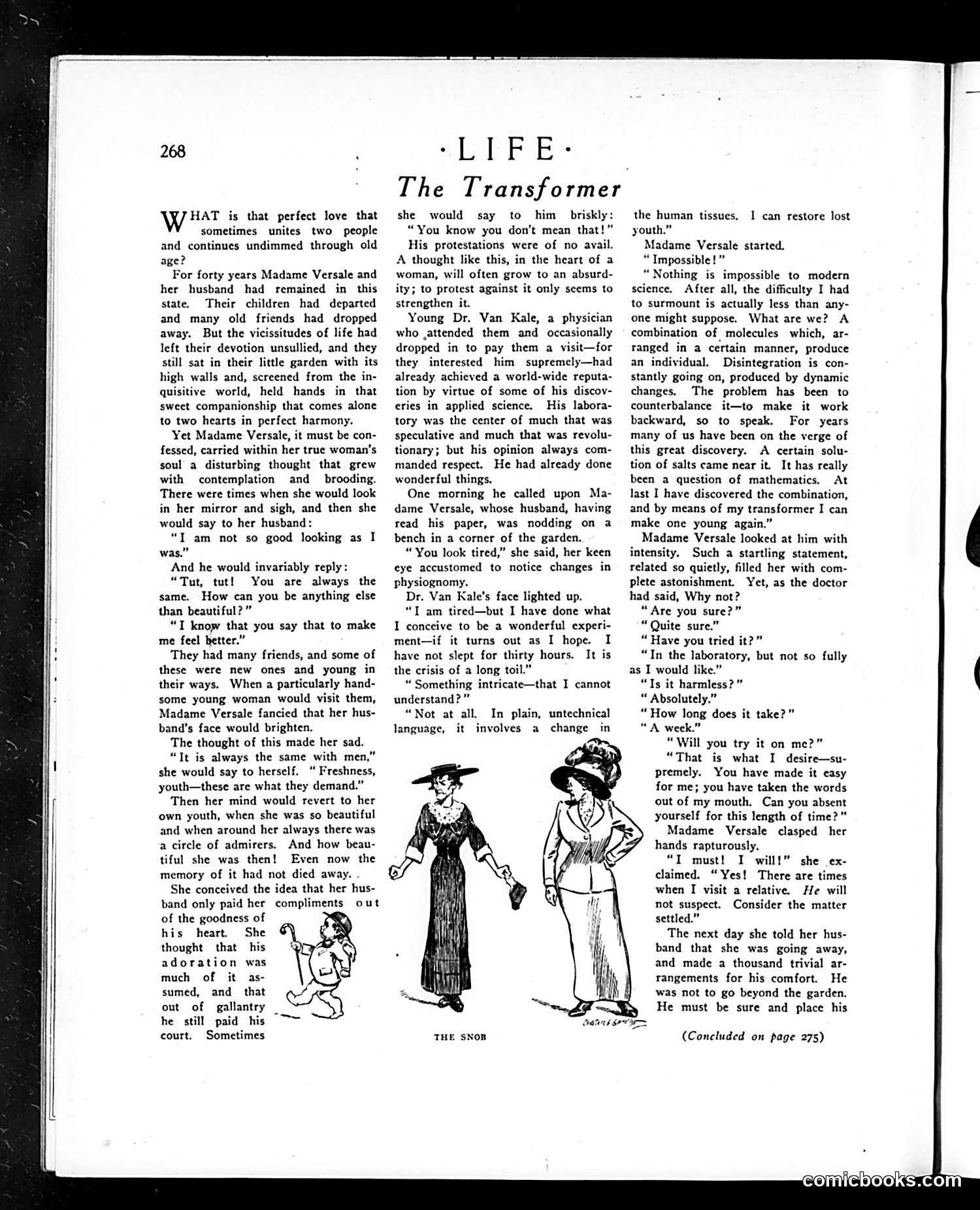
This page presents a serialized story (continuing page 275) about a marital dynamic and scientific breakthrough. The narrative centers on **Madame Versale**, a 40-year-married woman plagued by insecurity about aging. Though her husband reassures her constantly, she believes his compliments are merely gallant obligation rather than genuine affection. The turning point arrives when **Dr. Van Kale**, a celebrated physician-scientist, visits and reveals he's achieved a revolutionary discovery: he can restore human youth by reversing cellular degeneration through molecular manipulation. **The satire targets**: feminine vanity and anxiety about aging beauty, the gullibility of wealthy leisure-class women, and contemporary scientific hubris—the period's optimistic belief that modern science could solve any problem, even mortality and aging. The illustrations show fashionably-dressed Edwardian-era figures. The story explores whether Madame Versale will pursue this "cure," questioning whether artificial youth restoration can save her marriage.
📄 Transcribed text from this page (OCR, searchable)
Machine-transcribed from the original scan — historical spelling and the odd misread are preserved.
WHat is that perfect love that sometimes unites two people and continues undimmed through old age? For forty years Madame Versale and her husband had remained in this state. Their children had departed and many old friends had dropped away. But the vicissitudes of life had left their devotion unsullied, and they still sat in their little garden with its high walls and, screened from the in- quisitive world, held hands in that sweet companionship that comes alone to two hearts in perfect harmony. Yet Madame Versale, it must be con- fessed, carried within her true woman’s soul a disturbing thought that grew with contemplation and brooding. There were times when she would look in her mirror and sigh, and then she would say to her husband: “I am not so good looking as I was.” And he would invariably reply: “Tut, tut! You are always the same. How can you be anything else than beautiful?” “T know that you say that to make me feel better.” They had many friends, and some of these were new ones and young in their ways. When a particularly hand- some young woman would visit them, Madame Versale fancied that her hus- band’s face would brighten. The thought of this made her sad. “Tt is always the same with men,” she would say to herself. “ Freshness, youth—these are what they demand.” Then her mind would revert to her own youth, when she was so beautiful and when around her always there was a circle of admirers. And how beau- tiful she was then! Even now the memory of it had not died away. She conceived the idea that her hus- band only paid her compliments out of the goodness of his heart. She thought that his adoration was much of it as- sumed, and that out of gallantry he still paid his court. Sometimes el Ey a) cil oi The Transformer she would say to him briskly: “You know you don’t mean that! His protestations were of no avail. A thought like this, in the heart of a woman, will often grow to an absurd- ity; to protest against it only scems to strengthen it. Young Dr. Van Kale, a physician who ,attended them and occasionally dropped in to pay them a visit—for they interested him supremely—had already achieved a world-wide reputa- tion by virtue of some of his discov- eries in applied science. His labora- tory was the center of much that was speculative and much that was revolu- tionary; but his opinion always com- manded respect. He had already done wonderful things. One morning he called upon Ma- dame Versale, whose husband, having read his paper, was nodding on a bench in a corner of the garden. “You look tired,” she said, her keen eye accustomed to notice changes in physiognomy. Dr. Van Kale’s face lighted up. “I am tired—but I have done what I conceive to be a wonderful experi- ment—if it turns out as I hope. I have not slept for thirty hours. It is the crisis of a long toil.” “ Something intricate—that I cannot understand?” “Not at all. language, it In plain, untechnical involves a change in THE SNOB the human tissues. I can restore lost youth.” Madame Versale started. “Impossible!” “Nothing is impossible to modern science. After all, the difficulty I had to surmount is actually less than any- one might suppose. What are we? A combination of molecules which, ar- ranged in a certain manner, produce an individual. Disintegration is con- stantly going on, produced by dynamic changes. The problem has been to counterbalance it—to make it work backward, so to speak. For years many of us have been on the verge of this great discovery. A certain solu- tion of salts came near it. It has really been a question of mathematics. At last I have discovered the combination, and by means of my transformer I can make one young again.” Madame Versale looked at him with intensity. Such a startling statement, related so quietly, filled her with com- plete astonishment. Yet, as the doctor had said, Why not? “Are you sure?” “Quite sure.” “ Have you tried it?” “In the laboratory, but not so fully as I would like.” “Is it harmless?” “ Absolutely.” “ How long does it take?” “A week.” “Will you try it on me?” “That is what I desire—su- premely. You have made it easy for me; you have taken the words out of my mouth. Can you absent yourself for this length of time?” Madame Versale clasped her hands rapturously. “T must! I will!” she ex- claimed. “Yes! There are times when I visit a relative. He will not suspect. Consider the matter settled.” The next day she told her hus- band that she was going away, and made a thousand trivial ar- rangements for his comfort. He was not to go beyond the garden. He must be sure and place his (Concluded on page 275)