
Life, 1912-02-01 · page 31 of 48
Life — February 1, 1912 — page 31: what you’re looking at
What you’re looking at
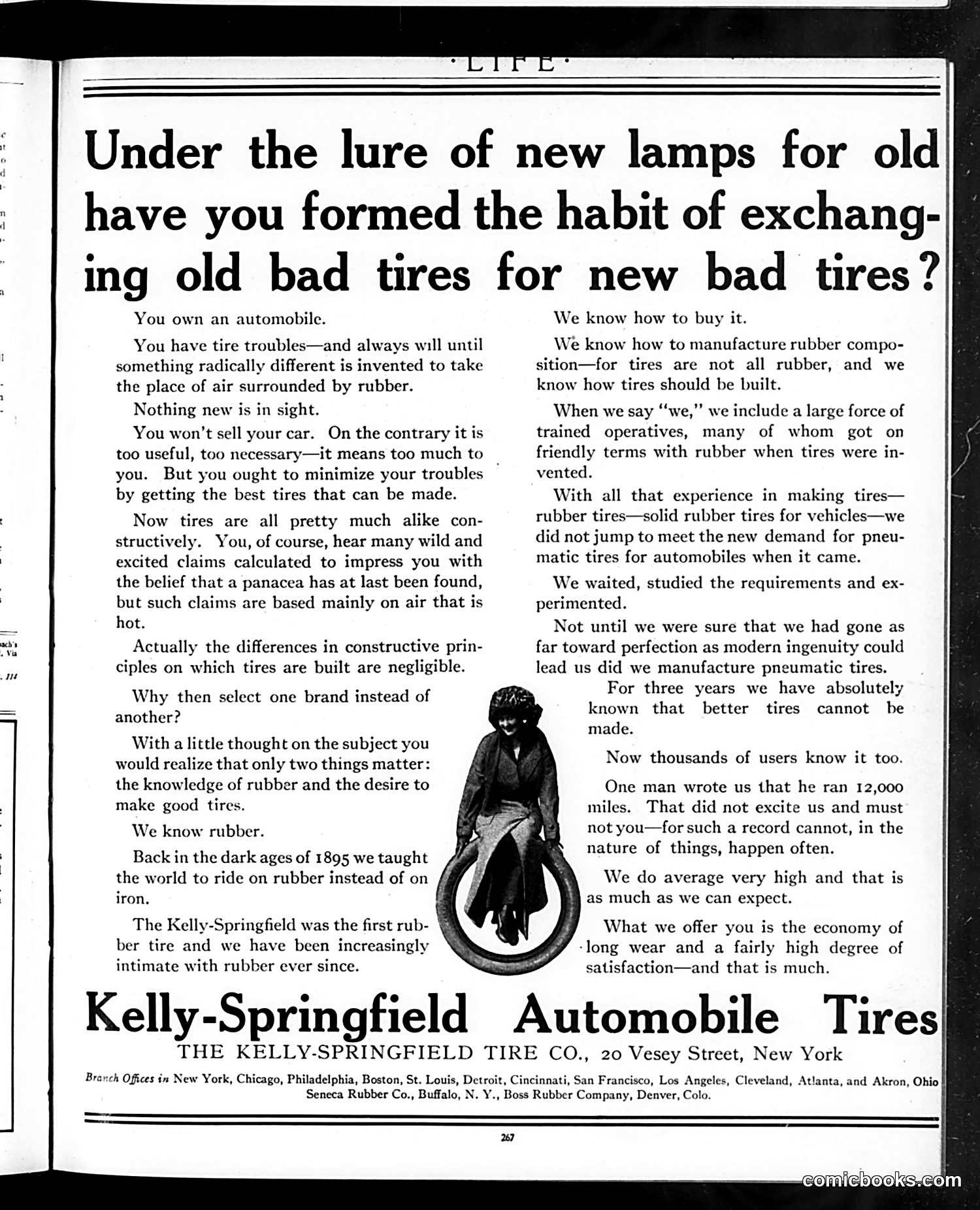
This is primarily a **tire company advertisement**, not satire. The headline's rhetorical question mimics the famous "new lamps for old" fairy tale reference (Aladdin), sarcastically asking if consumers habitually swap worn tires for equally poor replacements. The actual message is sincere corporate boasting: Kelly-Springfield claims superiority based on their rubber expertise dating to 1895 and their cautious approach to pneumatic tire technology. They waited three years before manufacturing pneumatic tires, claiming this deliberation proves their quality. The illustration shows a **woman in a tire** (visual pun on the product). The text argues that tire selection should depend on manufacturer knowledge and craftsmanship rather than marketing hype—ironic, since this *is* marketing hype. The tone is patronizing toward consumers, dismissing competitors' claims as "air that is hot" while positioning Kelly-Springfield as the rational, experienced choice. No specific competitors are named or caricatured.
📄 Transcribed text from this page (OCR, searchable)
Machine-transcribed from the original scan — historical spelling and the odd misread are preserved.
Under the lure of new lamps for old have you formed the habit of exchang- ing old bad tires for new bad tires? You own an automobile. You have tire troubles—and always will until something radically different is invented to take the place of air surrounded by rubber. Nothing new is in sight. You won’t sell your car. On the contrary it is too useful, too necessary—it means too much to you. But you ought to minimize your troubles by getting the best tires that can be made. Now tires are all pretty much alike con- structively. You, of course, hear many wild and excited claims calculated to impress you with the belief that a panacea has at last been found, but such claims are based mainly on air that is hot. Actually the differences in constructive prin- ciples on which tires are built are negligible. Why then select one brand instead of another? With a little thought on the subject you would realize that only two things matter: the knowledge of rubber and the desire to make good tires. We know rubber. Back in the dark ages of 1895 we taught the world to ride on rubber instead of on iron. The Kelly-Springfield was the first rub- ber tire and we have been increasingly intimate with rubber ever since. Kelly-Springfield Automobile We know how to buy it. We know how to manufacture rubber compo- sition—for tires are not all rubber, and we know how tires should be built. When we say “we,”’ we include a large force of trained operatives, many of whom got on friendly terms with rubber when tires were in- vented. With all that experience in making tires— rubber tires—solid rubber tires for vehicles—we did not jump to meet the new demand for pneu- matic tires for automobiles when it came. We waited, studied the requirements and ex- perimented. Not until we were sure that we had gone as far toward perfection as modern ingenuity could lead us did we manufacture pneumatic tires. For three years we have absolutely known that better tires cannot be made. Now thousands of users know it too. One man wrote us that he ran 12,000 miles. That did not excite us and must not you—for such a record cannot, in the nature of things, happen often. We do average very high and that is as much as we can expect. What we offer you is the economy of -long wear and a fairly high degree of satisfaction—and that is much. Tires yn pi de TIRE CO., 20 Vesey Street, New York Seneca Rubber Co., Buffalo, N. Y., Bronch Offices in New York, Chicago, Philadelphia, Boston, St. Louis, Detroit, Cincinnati, San Francisco, Los Angeles, Cleveland, Atlanta, and Akron, Ohio Boss Rubber Company, Denver, Colo.