
Life, 1912-02-01 · page 18 of 48
Life — February 1, 1912 — page 18: what you’re looking at
What you’re looking at
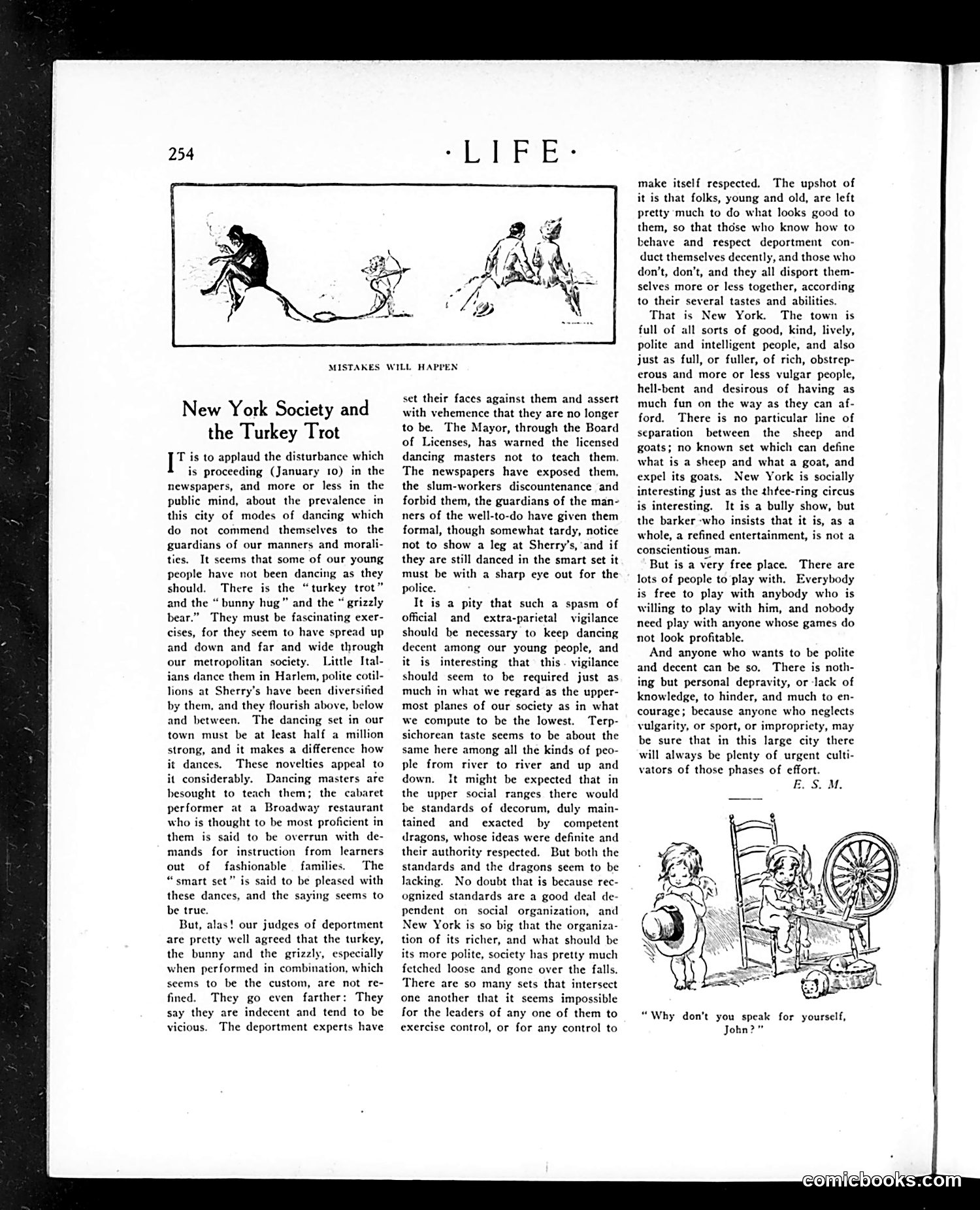
This article satirizes the moral panic over new dance crazes—the "turkey trot," "bunny hug," and "grizzly bear"—that swept through 1910s New York City. **The Social Context:** The dances originated in working-class venues (Harlem, cabarets) but spread to high society (Sherry's restaurant). Authorities—the Mayor, newspapers, and moral guardians—condemned them as indecent and "vicious," even warning dance instructors not to teach them. **The Satire's Point:** Life mocks the hypocrisy and ineffectiveness of this moral policing. The author notes that despite official disapproval, the dances flourished across *all* social classes. The piece ironically observes that New York's wealthy elite lacks the unified social authority to enforce "standards of decorum"—the city is too fragmented for anyone to control behavior. **The Cartoon (top):** Sketch-style figures depicting the energetic, undignified movements of these dances. The overall message: moral outrage about dance reveals not actual impropriety, but rather the breakdown of class-based social control in modern urban America.
📄 Transcribed text from this page (OCR, searchable)
Machine-transcribed from the original scan — historical spelling and the odd misread are preserved.
MISTAKES WILL HAPPEN New York Society and the Turkey Trot I" is to applaud the disturbance which is proceeding (January to) in the newspapers, and more or less in the public mind, about the prevalence in this city of modes of dancing which do not commend themselves to the guardians of our manners and morali- ties. It seems that some of our young people have not been dancing as they should. There is the “turkey trot” and the “ bunny hug” and the “ grizzly bear.” They must be fascinating exer- cises, for they seem to have spread up and down and far and wide through our metropolitan society. Little Ital ians dance them in Harlem, polite cot lions at Sherry’s have been diversified by them, and they flourish above, below and between. The dancing set in our town must be at least half a million strong, and it makes a difference how it dances. These novelties appeal to it considerably. Dancing masters are hesought to teach them; the cabaret performer at a Broadway restaurant who is thought to be most proficient in them is said to be overrun with de- mands for instruction from learners out of fashionable families. The “smart set” is said to be pleased with these dances, and the saying seems to be true. But, alas! our judges of deportment are pretty well agreed that the turkey, the bunny and the grizzly, especially when performed in combination, which seems to be the custom, are not re- fined. They go even farther: They say they are indecent and tend to be vicious. The deportment experts have set their faces against them and assert with vehemence that they are no longer to be. The Mayor, through the Board of Licenses, has warned the licensed dancing masters not to teach them. The newspapers have exposed them, the slum-workers discountenance and forbid them, the guardians of the man- ners of the well-to-do have given them formal, though somewhat tardy, notice not to show a leg at Sherry’s, and if they are still danced in the smart set it must be with a sharp eye out for the police. It is a pity that such a spasm of official and extra-parietal vigilance should be necessary to keep dancing decent among our young people, and it is interesting that this. vigilance should seem to be required just as much in what we regard as the upper- most planes of our society as in what we compute to be the lowest. Terp- sichorean taste seems to be about the same here among all the kinds of peo- ple from river to river and up and down. It might be expected that in the upper social ranges there would be standards of decorum, duly main- tained and exacted by competent dragons, whose ideas were definite and their authority respected. But both the standards and the dragons seem to be lacking. No doubt that is because rec- ognized standards are a good deal de- pendent on social organization, and New York is so big that the organiza- tion of its richer, and what should be its more polite, society has pretty much fetched loose and gone over the falls. There are so many sets that intersect one another that it seems impossible for the leaders of any one of them to exercise control, or for any control to make itself respected. The upshot of it is that folks, young and old, are left pretty much to do what looks good to them, so that those who know how to behave and respect deportment con- duct themselves decently, and those who don’t, don’t, and they all disport them- selves more or less together, according to their several tastes and abilities. That is New York. The town is full of all sorts of good, kind, lively, polite and intelligent people, and also just as full, or fuller, of rich, obstrep- erous and more or less vulgar people, hell-bent and desirous of having as much fun on the way as they can af- ford. There is no particular line of separation between the sheep and goats; no known set which can define what is a sheep and what a goat, and expel its goats. New York is socially interesting just as the thfee-ring circus is interesting. It is a bully show, but the barker -who insists that it is, as a whole, a refined entertainment, is not a conscientious man. But is a very free place. There are lots of people to play with. Everybody is free to play with anybody who is willing to play with him, and nobody need play with anyone whose games do not look profitable. And anyone who wants to be polite and decent can be so. There is noth- ing but personal depravity, or lack of knowledge, to hinder, and much to en- courage; because anyone who neglects vulgarity, or sport, or impropriety, may be sure that in this large city there will always be plenty of urgent culti- vators of those phases of effort. . AM. “Why don’t you speak for yourself, John?”