
A complete issue · 52 pages · 1911
Life — June 1, 1911
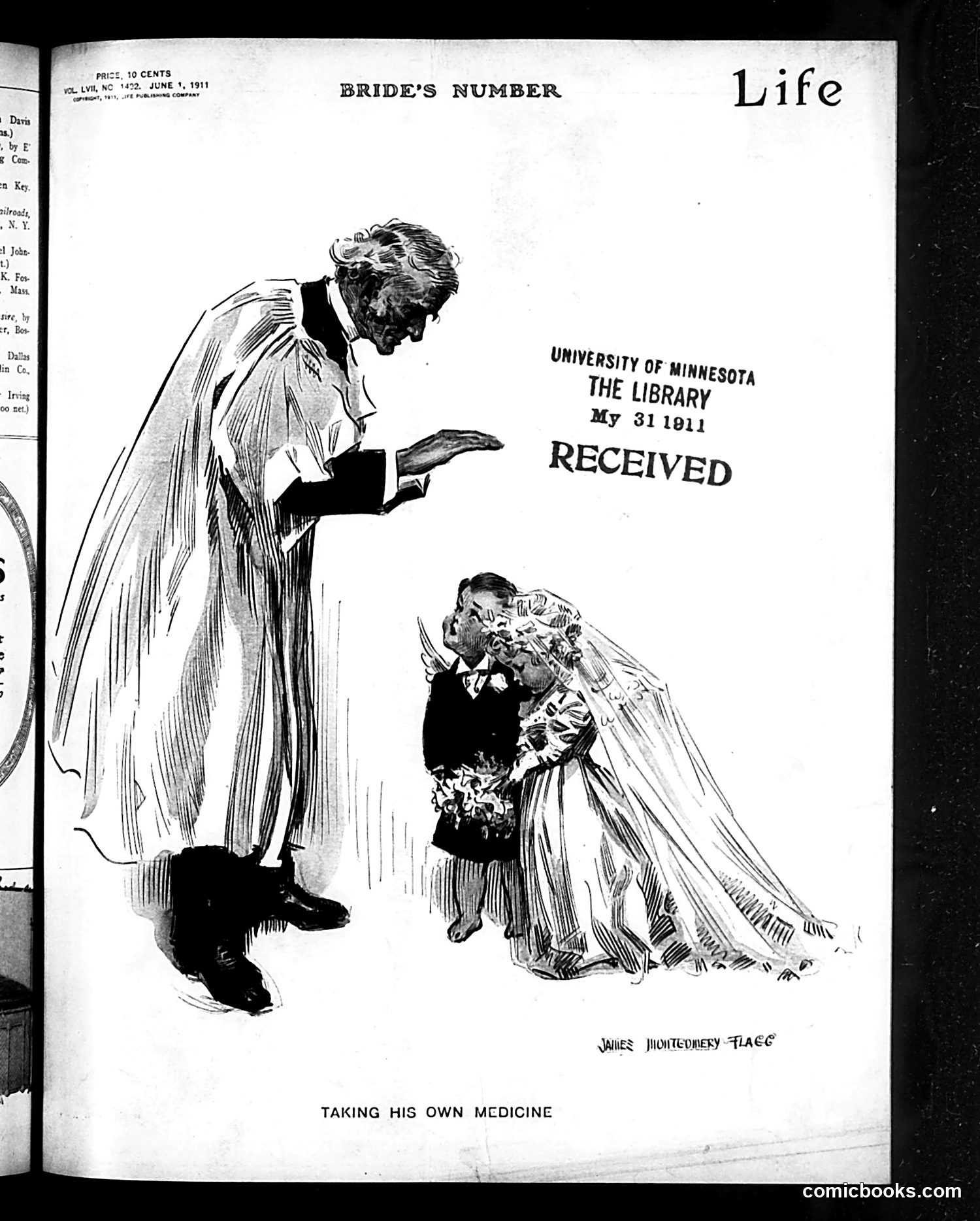
This cartoon satirizes a groom forced to experience the consequences of his own actions. The title suggests the bridegroom is now receiving the same harsh treatment he previously inflicted on others—a common satirical theme of "getting what you deserve." The illustration shows an older woman (likely representing an authority figure or the bride's family) administering some form of punishment or unpleasant remedy to a small, cowering groom, while a young bride in her wedding dress watches. The visual humor relies on role-reversal: the groom, typically in a position of authority in 1911 society, is now diminished and subordinate. The artist is James Montgomery Flagg, a prominent American illustrator of the era.
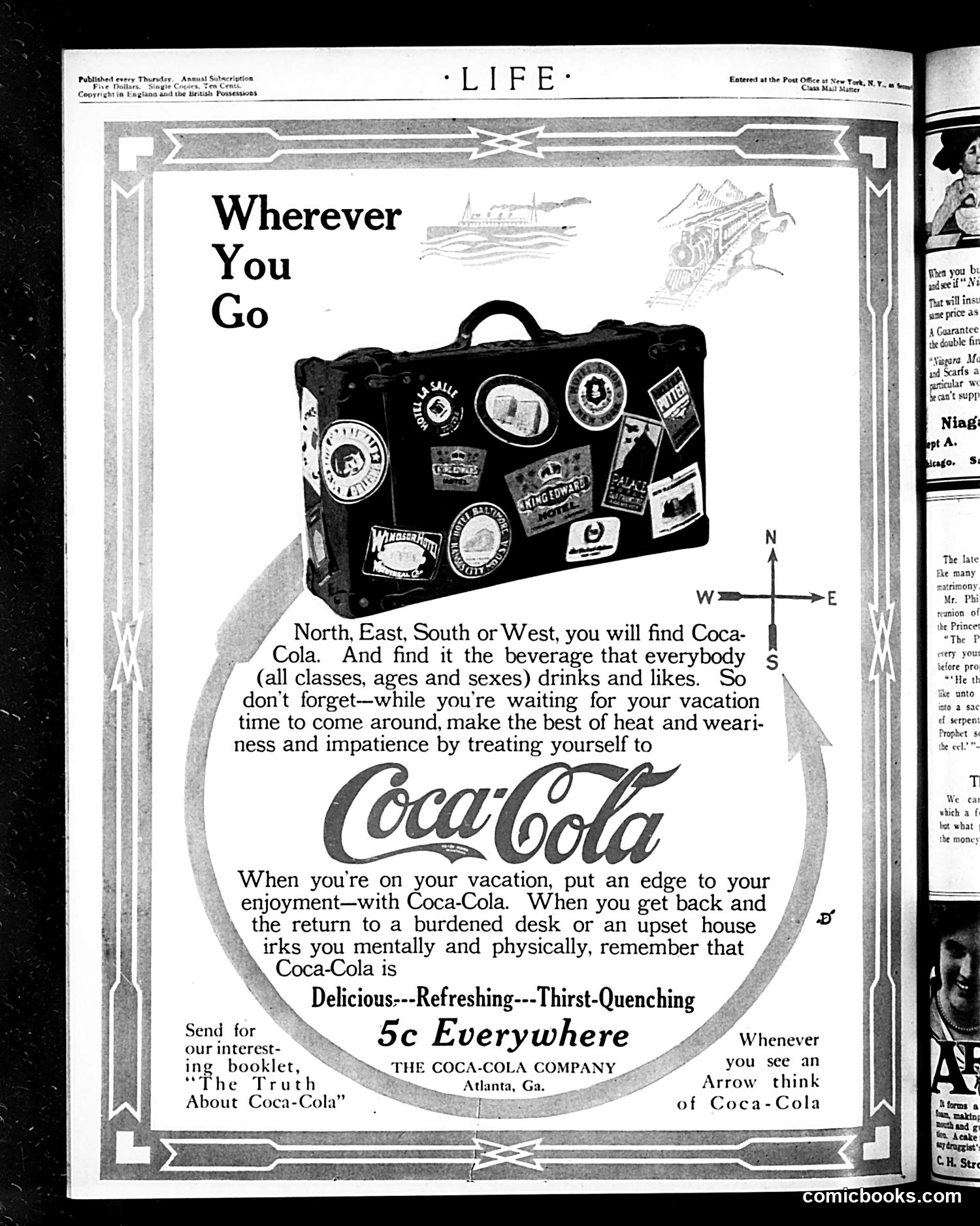
This is **not a cartoon or satire**, but rather a **straightforward commercial advertisement** for Coca-Cola. The page features a vintage suitcase covered with travel stickers and a compass rose, promoting the product's ubiquity during travel. The ad's messaging is entirely earnest: Coca-Cola can be found "North, East, South or West" and appeals to "all classes, ages and sexes." It positions the beverage as a comfort during vacation and upon returning to work stress. The only notable element for modern readers is the **5-cent price point** and the explicit claim that Coca-Cola is universally consumed across all demographics—a marketing assertion rather than satire. This reflects early 20th-century American consumer culture and the brand's expansion strategy.
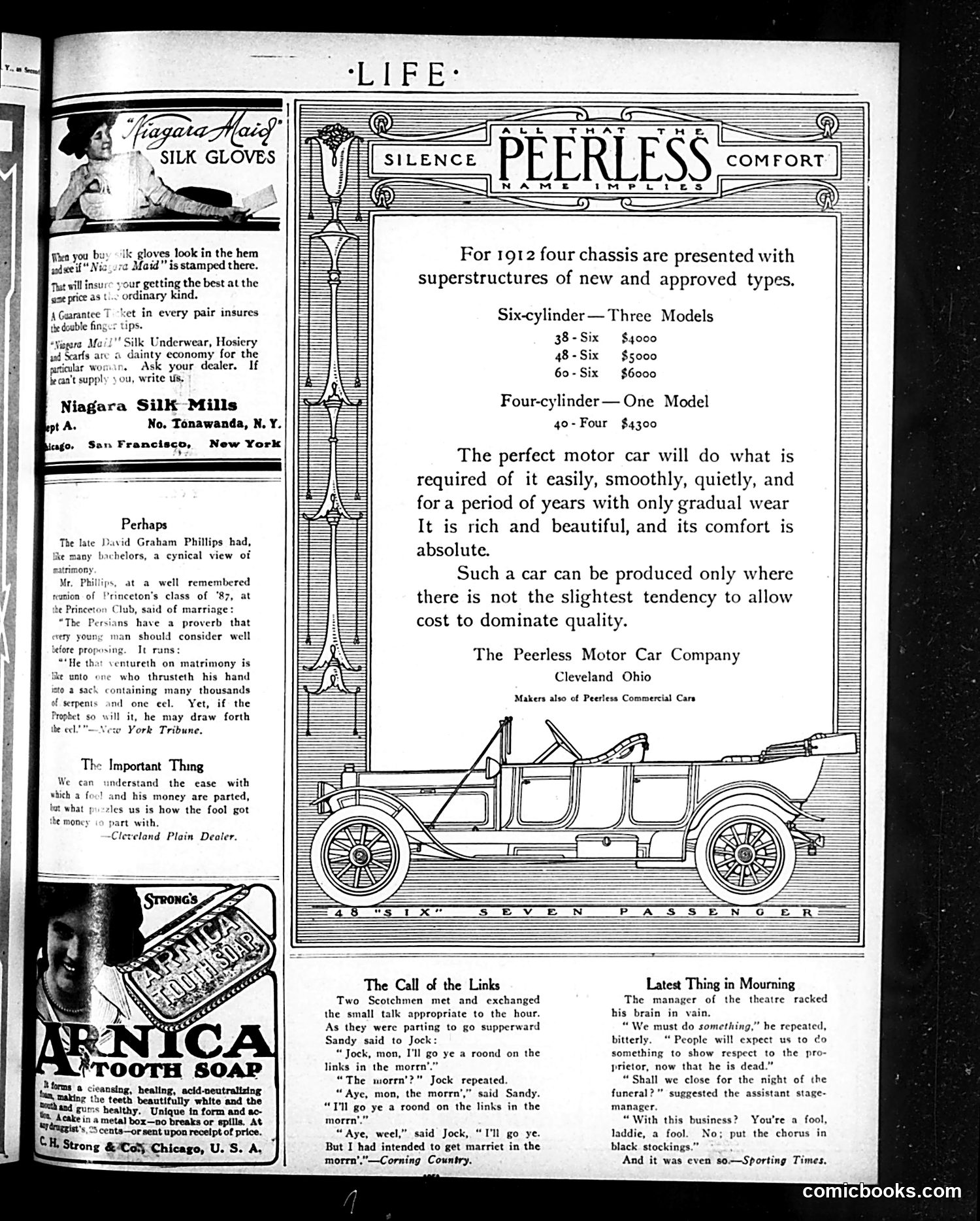
This page is primarily **advertising and commercial content** rather than political satire. The main advertisement features the **Peerless Motor Car Company** (Cleveland, Ohio), showcasing their 1912 automobile models with prices ranging from $4,300 to $6,000. The ad emphasizes quality over cost, claiming their cars deliver "silence," "peerless comfort," and durability through gradual wear rather than defects. Supporting advertisements include: - **Niagara Maid Silk Gloves** (emphasizing quality stitching) - **Strong's Arnica Tooth Soap** (promising whitened teeth) The page also contains two brief humorous anecdotes—"Perhaps" (about David Graham Phillips and Persian marriage customs) and "The Call of the Links" (golfing humor)—but these are entertainment content, not political commentary. This represents typical early 1900s magazine layout combining ads with light humor.
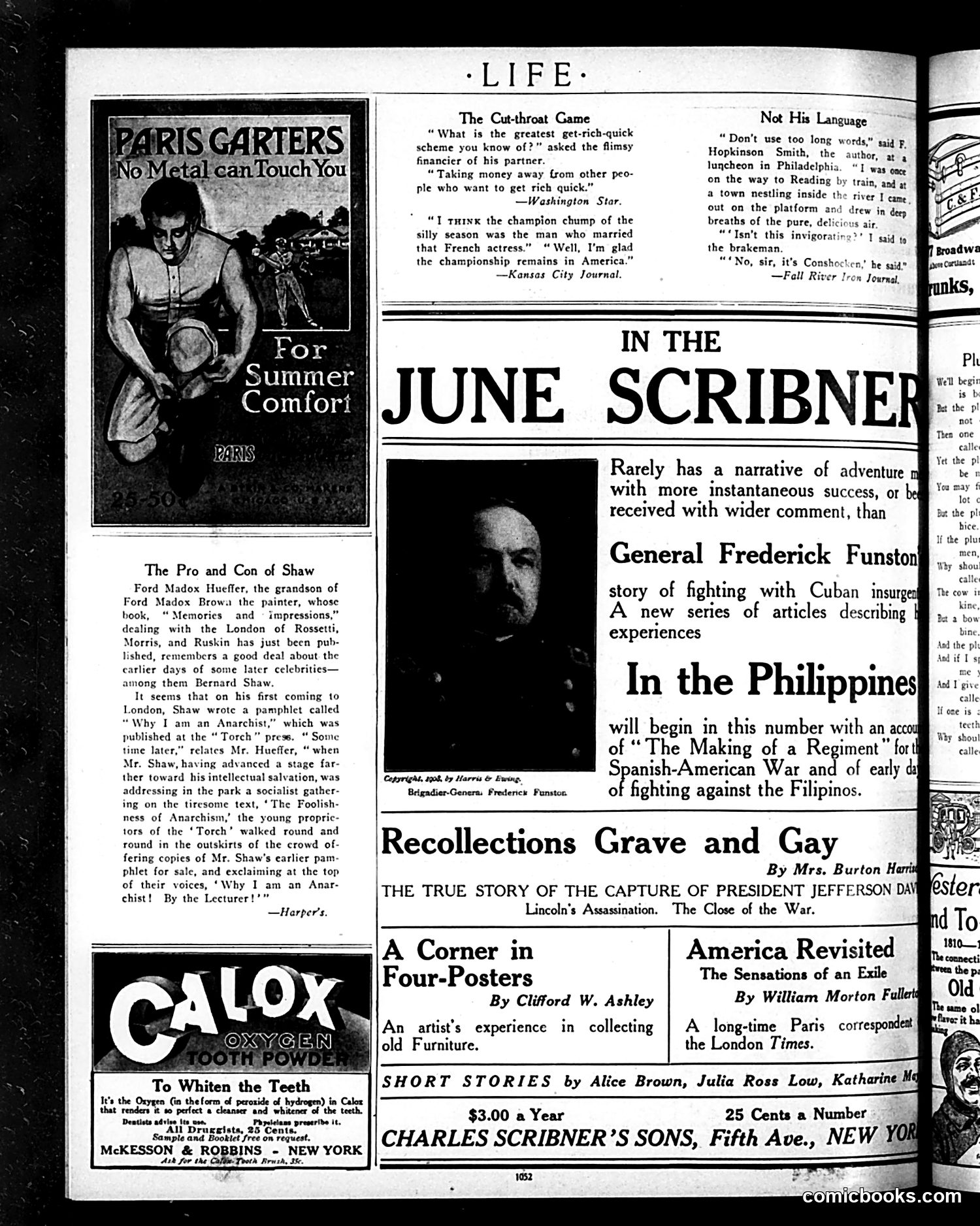
This page is primarily **editorial content and advertising** rather than political satire. The main feature announces an upcoming series by **General Frederick Funston** about fighting in the Philippines—likely referencing the Philippine-American War (early 1900s). Funston was a prominent U.S. military figure of that era. The left sidebar discusses **George Bernard Shaw**, a famous playwright and social critic, noting his early anarchist sympathies and writings. The advertisements include **Paris Garters** (men's accessories) and **Calox Oxygen Toothpowder**—typical period commercial pitches. The page reflects turn-of-century American magazine content: mixing military-imperialist coverage with literary criticism and consumer products. No clear political cartoon satire is evident on this particular page.
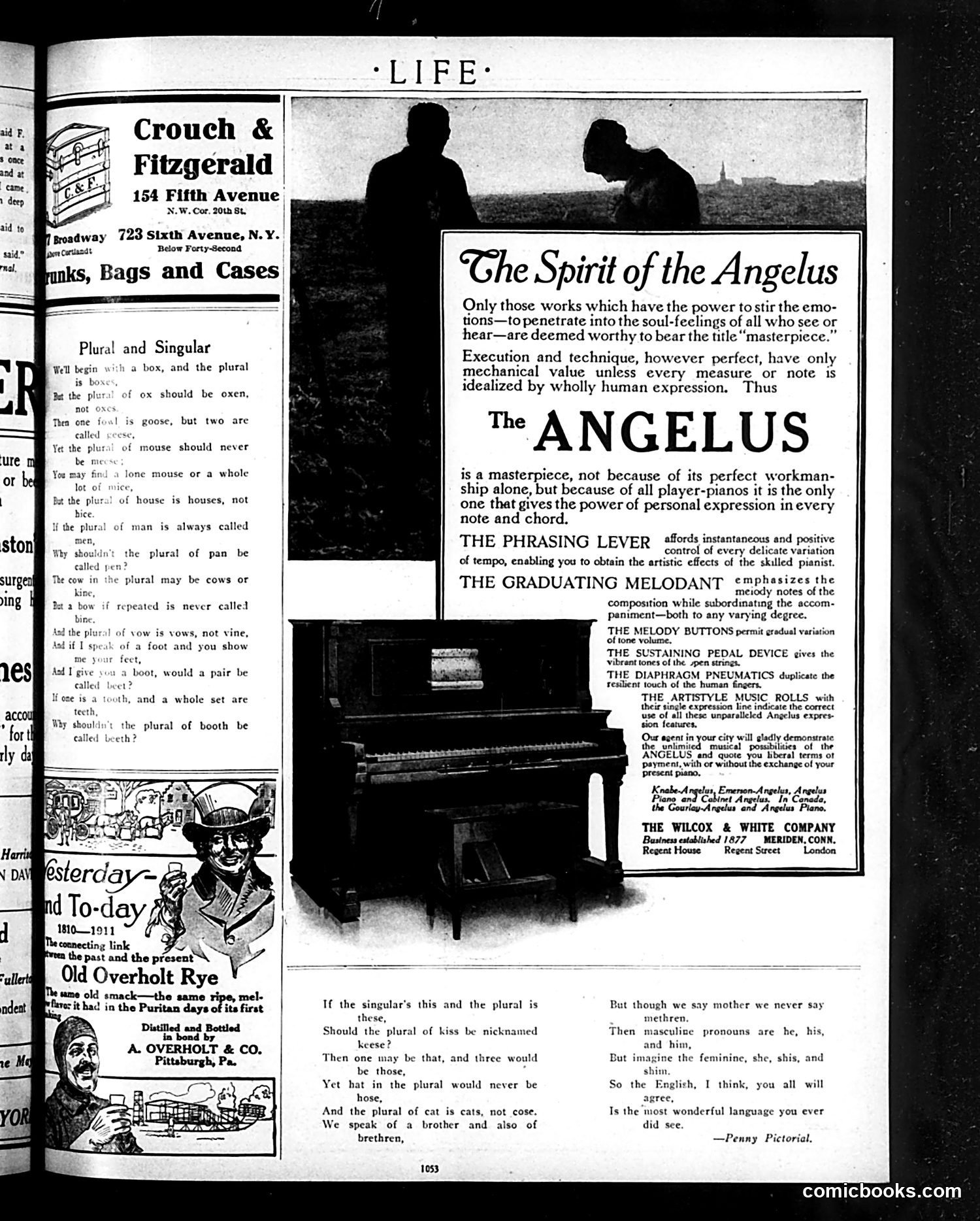
This page is primarily **advertising and educational content** rather than political satire. The dominant feature is a large advertisement for the **Angelus piano** by Wilcox & White Company. The ad emphasizes the piano's mechanical innovations—the phrasing lever, graduating melodant, melody button, sustaining pedal, and diaphragm pneumatics—claiming these features enable "personal expression" and artistic performance beyond mere "mechanical value." The left column contains a grammar lesson on **plural and singular nouns** (discussing plurals like "ox/oxen," "goose/geese," "mouse/mice"). Below are small advertisements including one for **Old Overholt Rye whiskey** and other commercial products. The silhouetted figures at the top appear to be contemplative listeners, reinforcing the Angelus advertisement's emphasis on emotional, artistic piano performance.
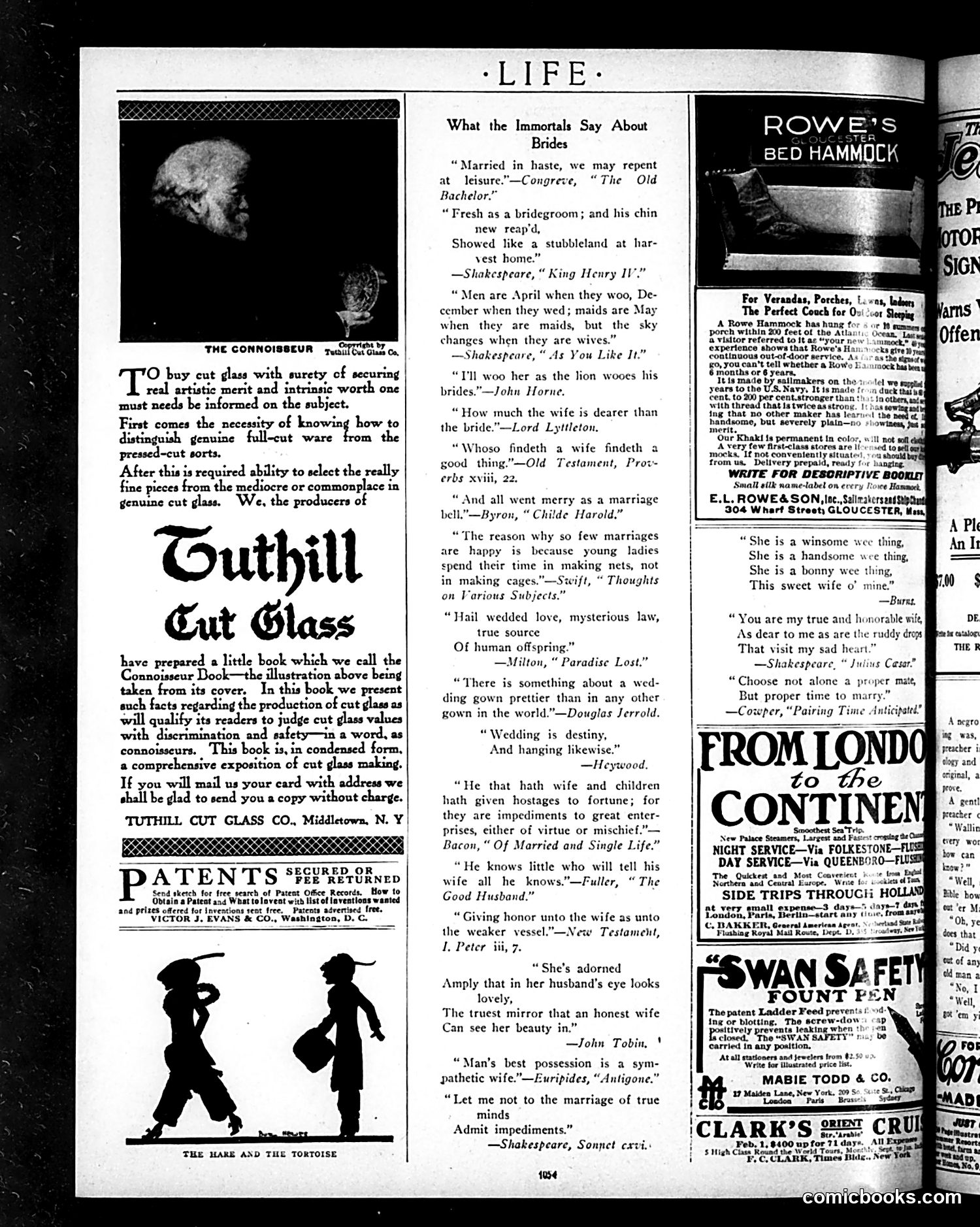
This page is primarily **advertising and editorial content** rather than political satire. The main elements are: 1. **"The Connoisseur"** — A portrait advertisement for Cuthill Cut Glass, emphasizing expertise in selecting quality glassware. The text appeals to refined taste and discrimination. 2. **"What the Immortals Say About Brides"** — A collection of literary quotations about marriage from Shakespeare, Byron, and other classical authors, presented as humorous commentary on wives and weddings. 3. **Lower cartoon** — "The Hare and the Tortoise," a simple silhouette illustration referencing Aesop's fable, likely serving as decorative filler. The page also contains period travel advertisements ("From London to the Continent") and safety product ads. There is no identifiable political satire or contemporary social commentary visible.
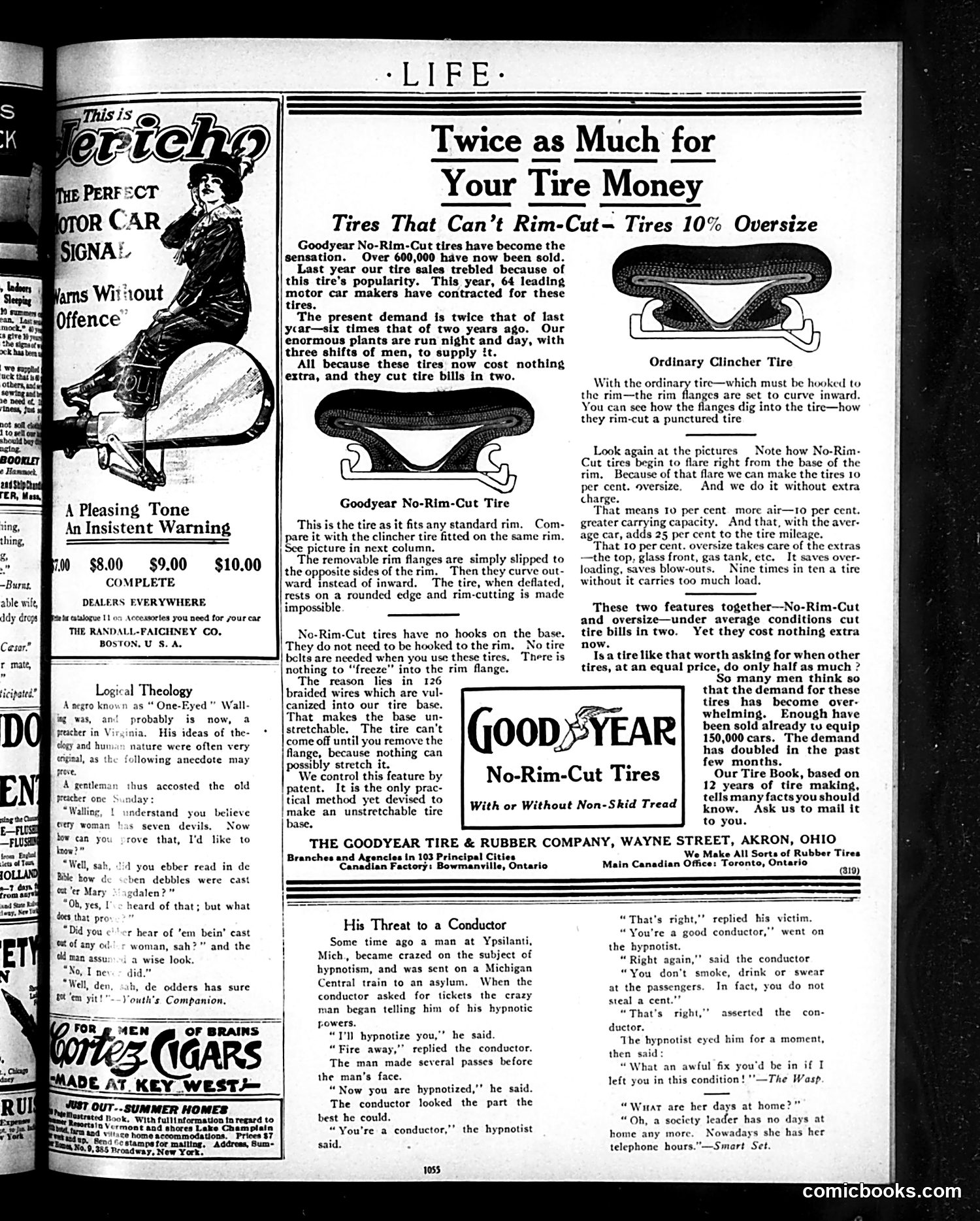
This page is primarily **advertising content**, not satire or political commentary. The main feature is a Goodyear tire advertisement for their "No-Rim-Cut Tires," which claims to offer "Twice as Much for Your Tire Money." The ad uses technical diagrams comparing ordinary clincher tires to Goodyear's design, emphasizing that the tires are oversized by 10%, can't be rim-cut, and therefore last longer and cost less overall. The left side contains unrelated content: a car signal advertisement ("This Is the Perfect Motor Car Signal") and a brief humorous story titled "Logical Theology" about a racial stereotype and religious debate. Below is another advertisement for Cott's Cigars. There is no political cartoon on this page—it's essentially a commercial publication page from the early 20th century.
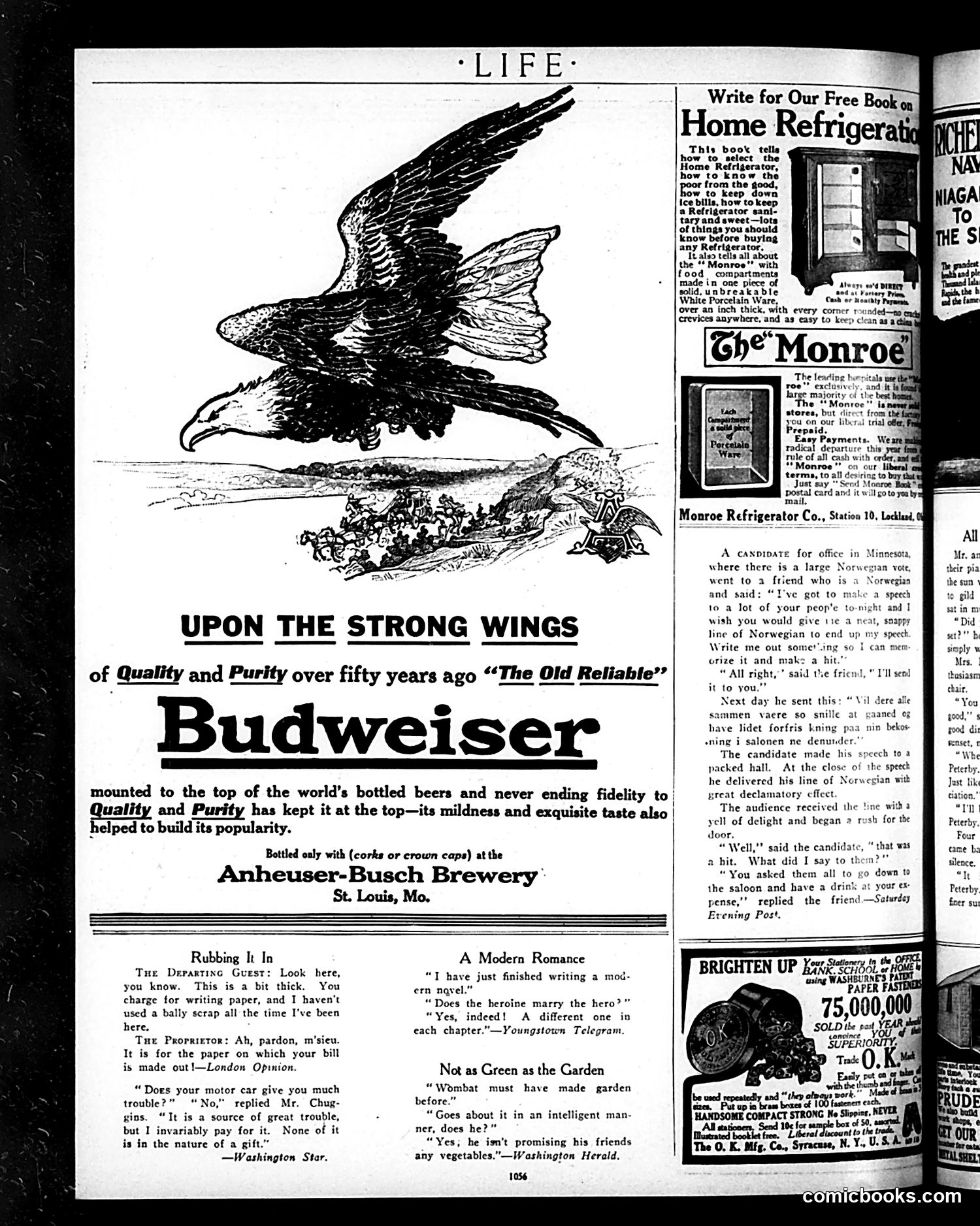
This page is primarily **advertising**, not political satire. The dominant image—an eagle carrying a beer bottle—advertises **Budweiser beer** from the Anheuser-Busch Brewery in St. Louis, Missouri. The eagle symbolizes American strength and patriotism. The ad claims Budweiser has maintained "Quality and Purity over fifty years ago" through "fidelity to Quality and Purity." The rhetoric emphasizes that the beer's "mildness and exquisite taste" built its popularity and kept it "at the top." Below are unrelated satirical short pieces typical of *Life* magazine's humor section: "Rubbing It In," "A Modern Romance," and "Not as Green as the Garden"—light social commentary with no clear political content. The right page contains refrigerator and office supply advertisements.
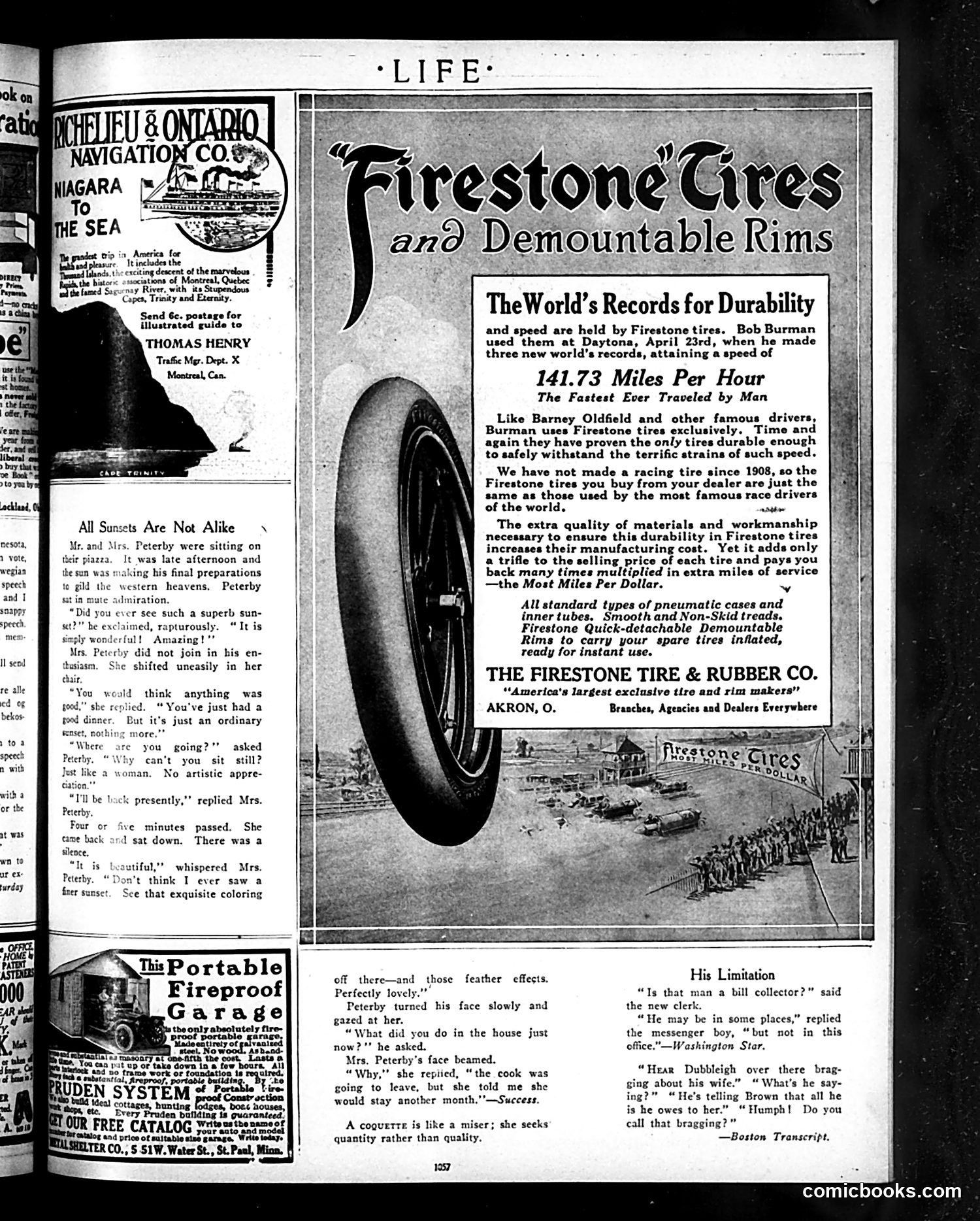
This page is primarily **advertising**, not satire or political commentary. The dominant feature is a large Firestone Tires advertisement highlighting a speed record: Bob Burman drove a vehicle 141.73 miles per hour at Dayton on April 23rd using Firestone tires, claimed as "the fastest ever travelled by man." The left column contains a short domestic humor piece titled "All Sunsets Are Not Alike" about marital banter between Mr. and Mrs. Peterly—a lighthearted joke about perspective and disagreement, with no political content. Below that is a small advertisement for a "Portable Fireproof Garage." The advertisements and humor reflect early automotive-era consumer culture (likely 1910s), with emphasis on new speed records and car-related products as novelties worth marketing.
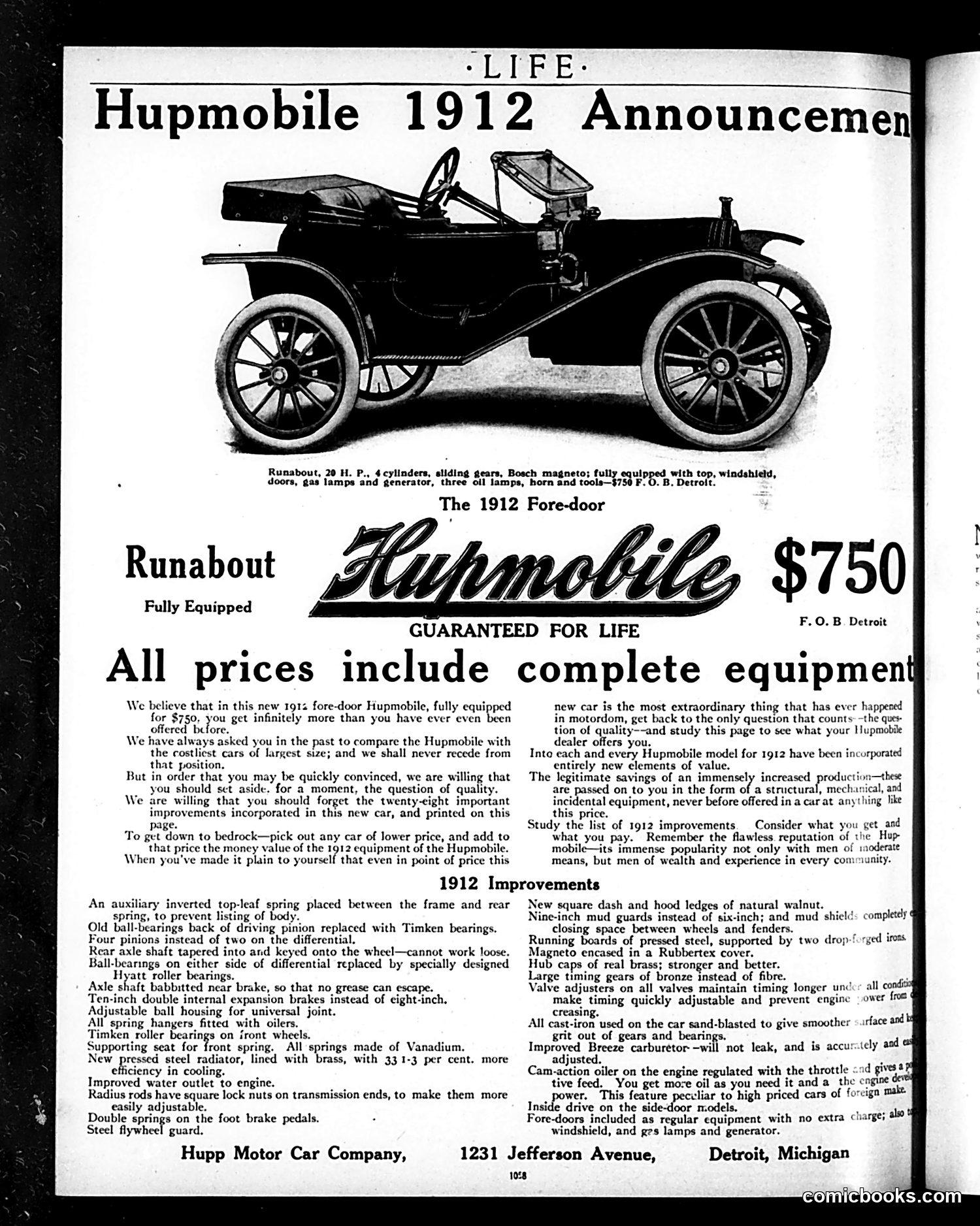
This page is primarily a **1912 automobile advertisement** for the Hupmobile, not political satire or a cartoon. It features a technical drawing of the "1912 Fore-door Runabout" priced at $750 (fully equipped, F.O.B. Detroit). The text emphasizes the car's value proposition—that despite its low price, it includes complete equipment that competitors charged extra for. The advertisement lists twenty-three specific 1912 improvements (ball bearings, springs, transmission upgrades, etc.), positioning the Hupmobile as an affordable yet well-engineered vehicle. The Hupp Motor Car Company's marketing strategy appeals to middle-class buyers by arguing that quality and price needn't be mutually exclusive, a notable claim for early automotive manufacturing.
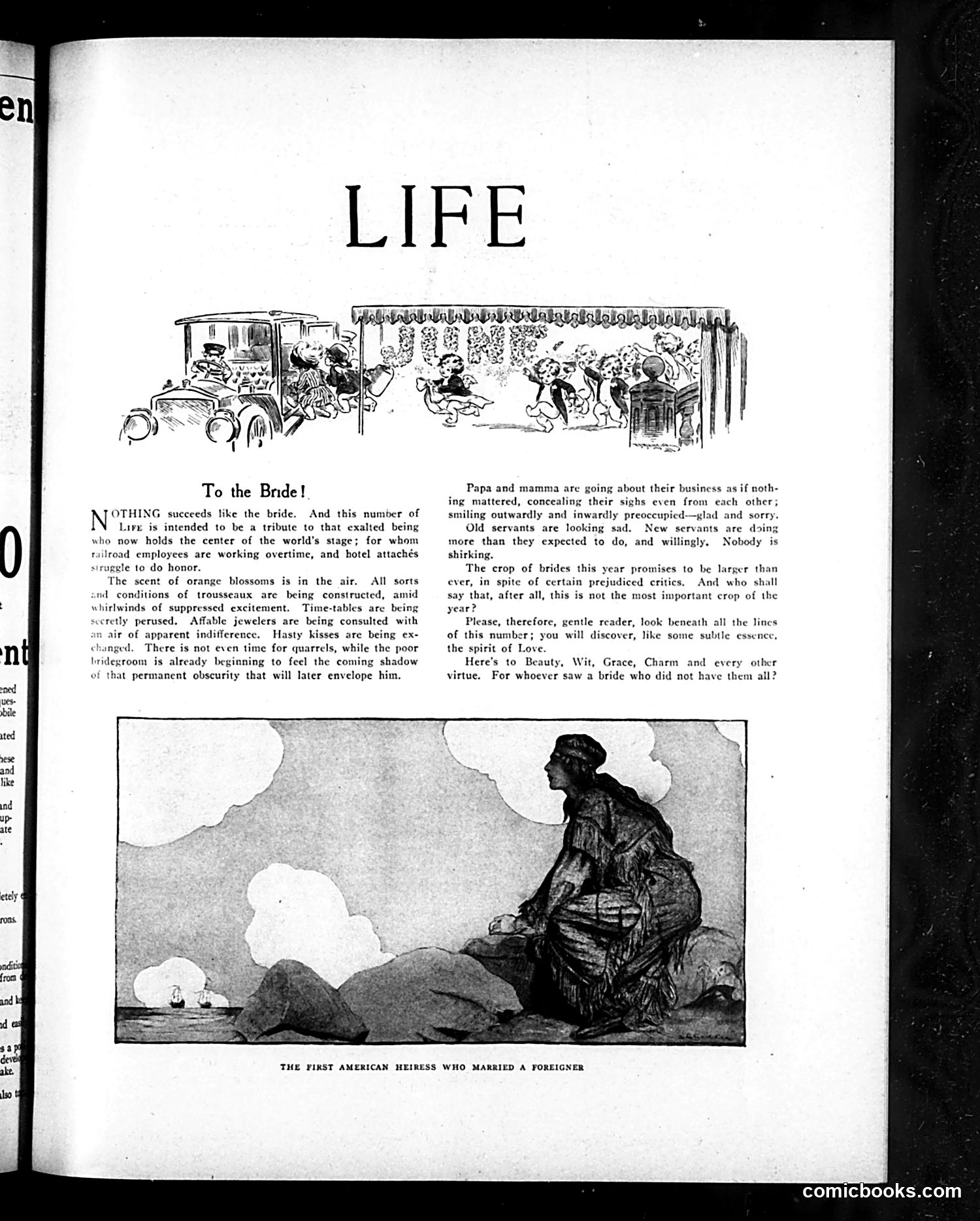
This is a "Life" magazine page titled "To the Bride!" celebrating weddings, specifically American heiresses marrying foreign nobles—a phenomenon of that era. The top illustration shows a wedding procession with an early automobile, depicting the modern spectacle of such marriages. The text ironically celebrates brides as "nothing succeeds like the bride" while satirizing the chaos of wedding preparations and the commercialization around them. The bottom illustration, captioned "THE FIRST AMERICAN HEIRESS WHO MARRIED A FOREIGNER," depicts a figure gazing pensively at ships on the horizon—likely a commentary on wealthy American women marrying European aristocrats. The satire suggests these marriages represent both romance and transatlantic commerce, with undertones about American wealth being "exported" through matrimonial alliances with foreign nobility.
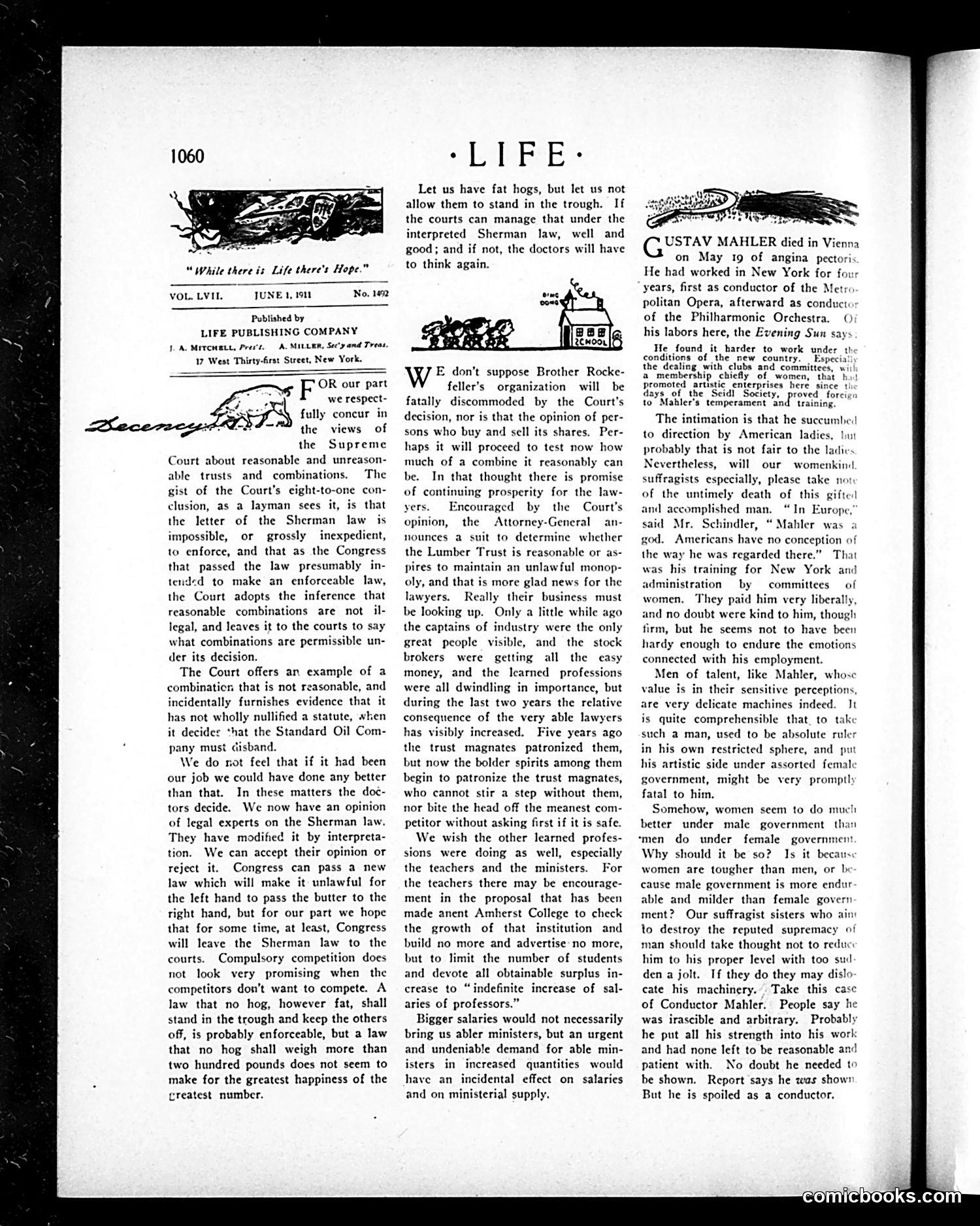
**The Cartoon ("While there is Life there's Hope"):** A small illustration shows a thin pig in a trough, depicting poverty or deprivation. The caption suggests perseverance despite hardship—a visual metaphor for struggling through difficult times. **The Editorial Content:** The main article defends the Supreme Court's decision regarding the Standard Oil Company breakup and trusts/monopolies. It argues the Court properly interpreted Sherman antitrust law, rejecting claims that reasonable combinations are impossible to enforce. The piece also critiques wealthy industries and professions (lawyers, doctors) for declining influence and argues for higher ministerial salaries and limits on university expansion. **Historical Context:** This reflects the Progressive Era's trust-busting debates under Presidents Theodore Roosevelt and William Howard Taft, when monopolies faced legal challenges.
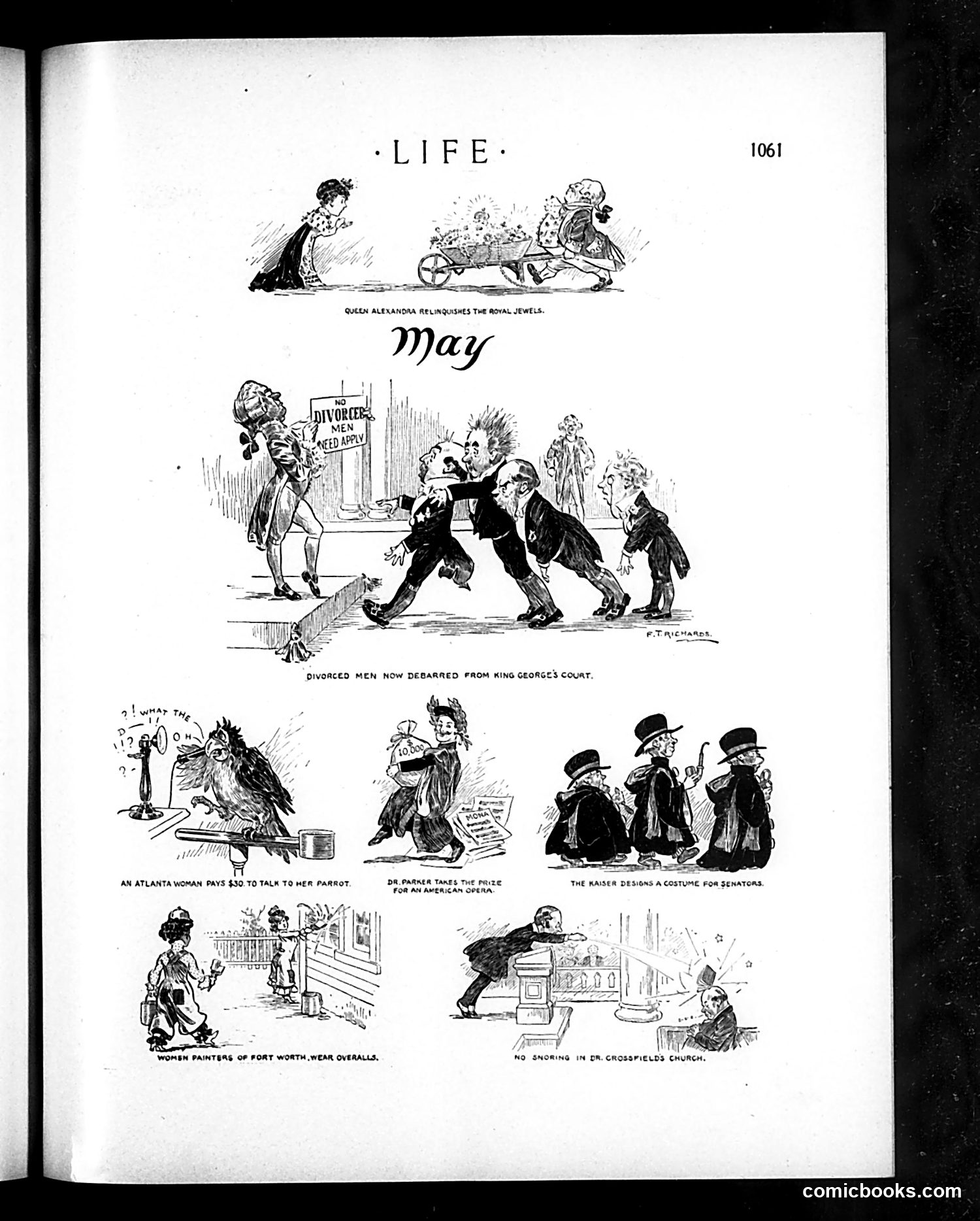
This page contains six satirical sketches about contemporary social issues from May (year unclear from image). **Top cartoon**: Queen Alexandra returning royal jewels—likely referencing a real incident involving the British royal family. **Middle section**: "Divorced men now debarred from King George's court"—mocks a royal court policy excluding divorced men, shown as rejected suitors. **Bottom four panels** satirize various May-related topics: - An Atlanta woman's high phone bill to her parents - Dr. Parker and American opera - The Kaiser designing senate costumes - Church behavior during Dr. Crossfield's sermon The cartoons use exaggerated character types and situations to mock social conventions, court policies, gender relations, and current events of the period. The style is typical early-20th-century Life magazine satirical humor.
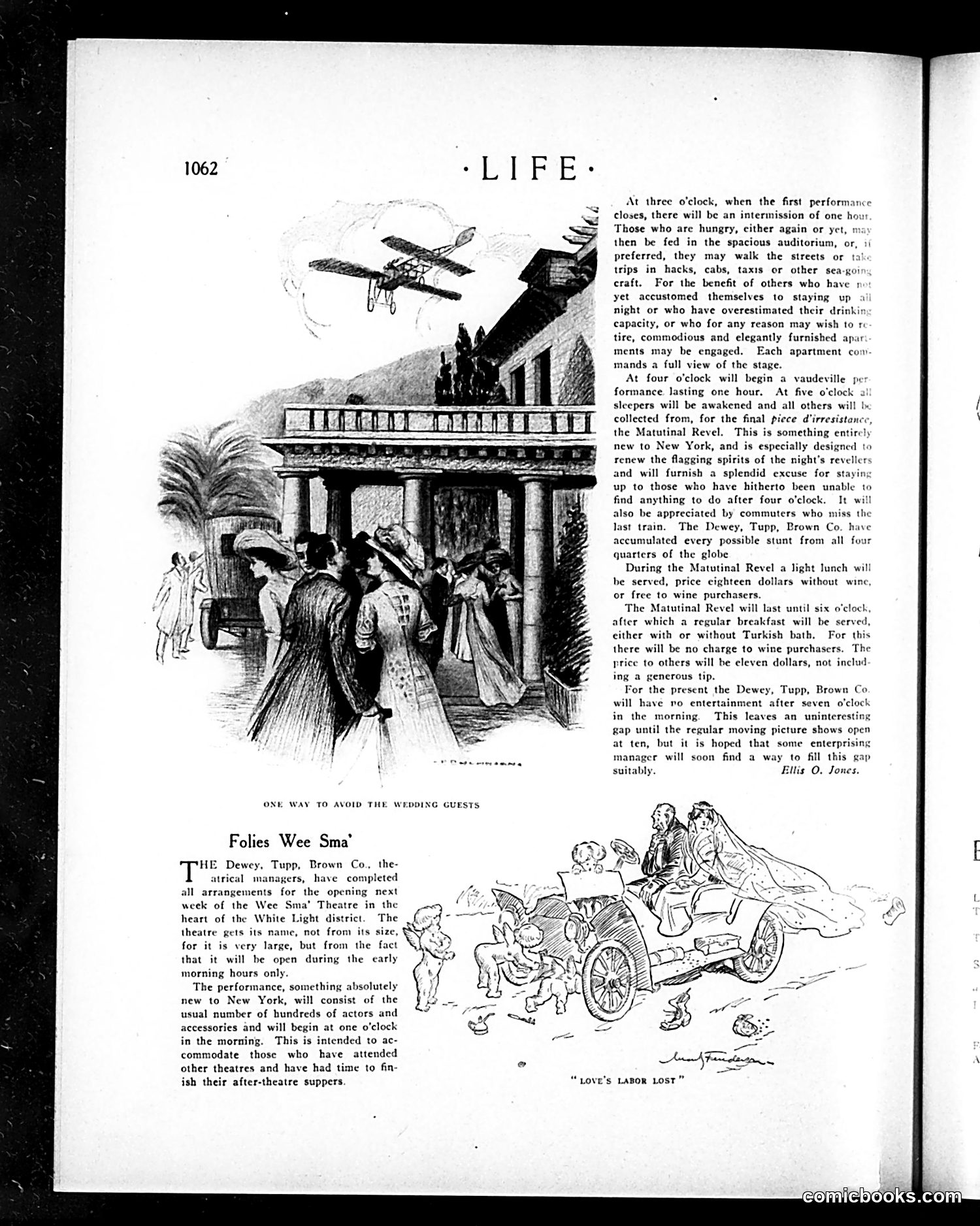
This Life magazine piece satirizes New York's extravagant nightlife culture through a fictional "Wee Sma' Theatre" that operates exclusively during early morning hours (1 a.m. onwards). The satire mocks the wealthy elite's endless pursuit of entertainment and indulgence. The joke targets excess: the theater offers continuous programming from 1 a.m. through breakfast at 6 a.m., with expensive meals ($18 lunch, $11 breakfast), vaudeville, and a "Matutinal Revel" designed for those who've exhausted normal evening activities. The bottom cartoon, titled "Love's Labor Lost," depicts cherubs attempting to move an automobile laden with revelers—suggesting the futility and chaos of such hedonistic pursuits. The subtitle "One Way to Avoid Wedding Guests" implies wealthy New Yorkers would stay out all night rather than attend social obligations, satirizing both their selfishness and society's obsession with entertainment as escape.
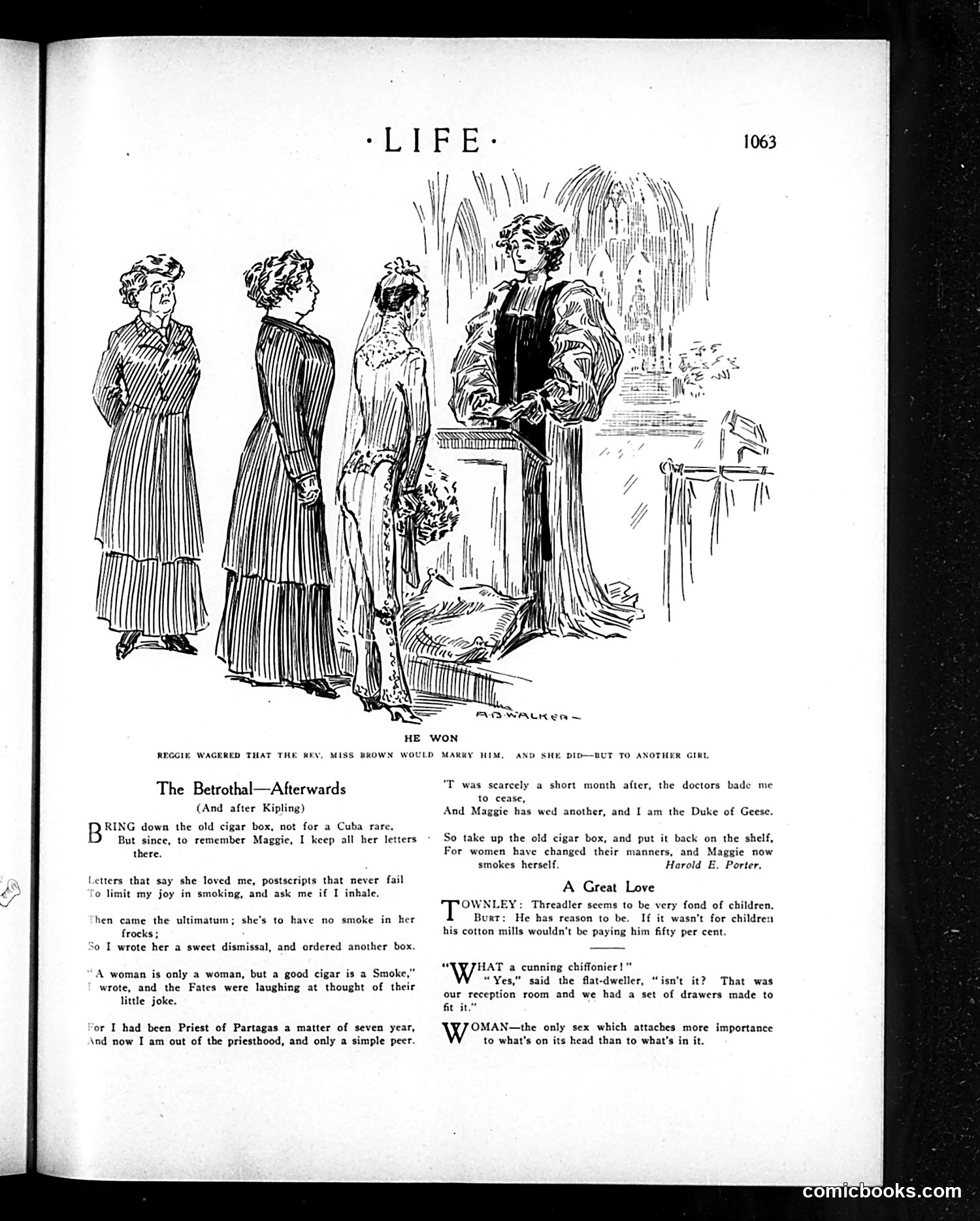
This page contains literary humor pieces rather than political cartoons. The main illustrated piece parodies Rudyard Kipling's jingoistic style ("And after Kipling"), telling of a man who chose cigars over his beloved Maggie. The joke: he lost her anyway—she married another man and now smokes herself, leaving him a "Duke of Geese" (fool). It's satirizing male vanity and the changing social freedoms of women, who increasingly smoked and made independent choices. The smaller text pieces below mock various subjects: a factory owner whose child-labor profits depend on children working mills, a poor flat-dweller creating a fake "reception room" from a drawer unit, and a final quip that women care more about their appearance than intelligence. These snippets reflect early 20th-century attitudes about class, women's emerging independence, and gender stereotypes.
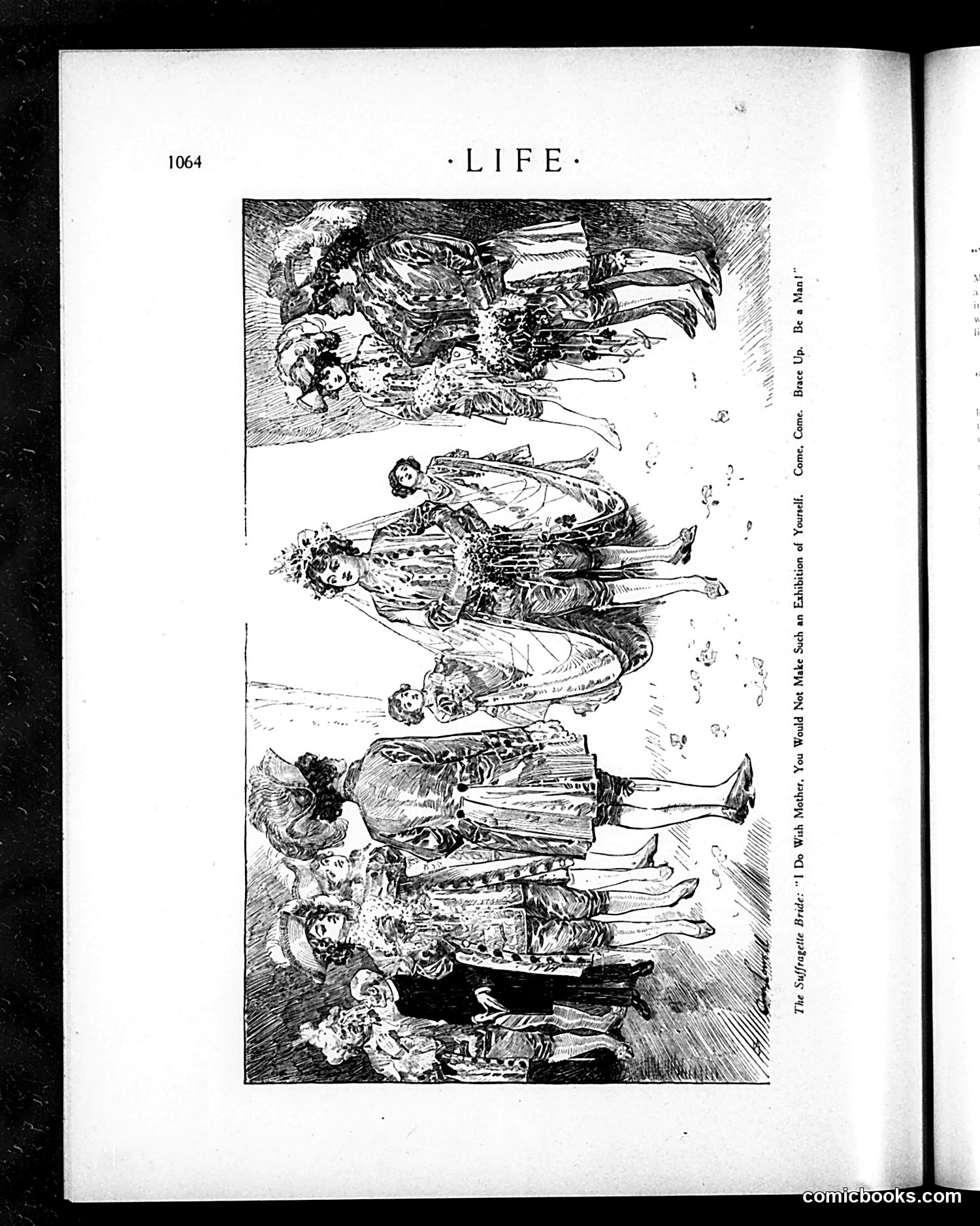
This satirical cartoon mocks women's suffrage activism by depicting a bride at her wedding exhibition. The caption "I Do Wish Mother, You Would Not Make Such an Exhibition of Yourself" suggests the mother (likely a suffragette activist) is behaving embarrassingly or radically at the formal occasion. The humor relies on anti-suffrage sentiment common in early 20th-century Life magazine: portraying suffragettes as unfeminine, disruptive, and socially inappropriate. By showing a "suffragette bride," the cartoon implies that women demanding voting rights neglect traditional domestic roles and feminine propriety. The phrase "Brace Up. Be a Man!" appears to mock suffragettes for adopting "masculine" political ambitions, suggesting they've abandoned proper womanhood. This reflects contemporary anti-feminist arguments that suffragism was unnatural and socially destructive.
This 1910s *Life* magazine piece satirizes the emerging "matrimonial adjustment" business—commercial matchmaking services that were actually proliferating in America. The humor targets both the commodification of marriage and the era's changing attitudes toward women. The con artist "agent" pitches honeymoon packages to a wealthy bachelor named Ashton as a product, complete with "classes" of experiences (country inn, luxury travel, European tours). The satire's edge sharpens when explaining the brides: they're described as accomplished women from good families who support themselves through temporary "honeymoon" arrangements before pursuing careers in art, literature, or politics—a direct jab at the women's movement. The joke operates on multiple levels: it mocks both the commodification of romance and the irony that liberated, ambitious women would need to monetize companionship. The agent's clinical matching ("five feet eight, dark hair... requires a delightful little blonde") further ridicules the mechanical reduction of human connection to transaction. The piece satirizes American commercial culture's tendency to package and sell even intimate experiences.
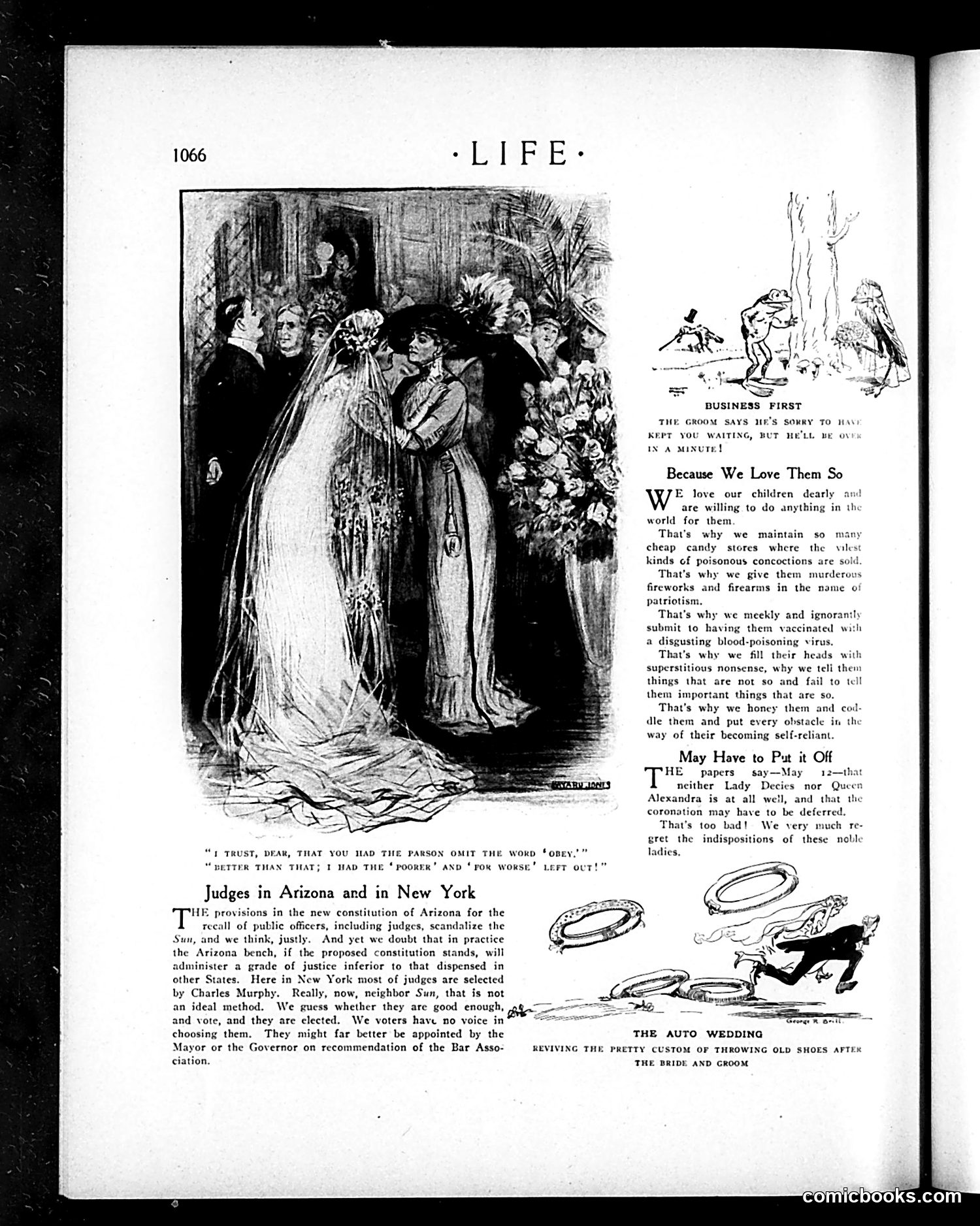
This page contains three satirical pieces from an early 20th-century American humor magazine: **Top cartoon**: A wedding scene where the groom reassures the bride's family that the parson omitted the word "obey" from vows, and removed "poorer" and "worse"—mocking evolving attitudes toward marriage equality and women's rights. **"Because We Love Them So"**: Biting social satire attacking parental hypocrisy. It sarcastically lists how parents harm children "out of love"—permitting poison candy, dangerous fireworks, forced vaccination, and superstition—while preventing self-reliance. This critiques both indulgent parenting and restrictive Victorian child-rearing. **Bottom sections**: Brief commentary on Arizona's judicial recall system (appearing more democratic but potentially problematic) and a cartoon about the "auto wedding" custom of throwing shoes at newlyweds' cars. The page reflects Progressive Era concerns: marriage reform, child welfare, judicial accountability, and modernization's social effects.
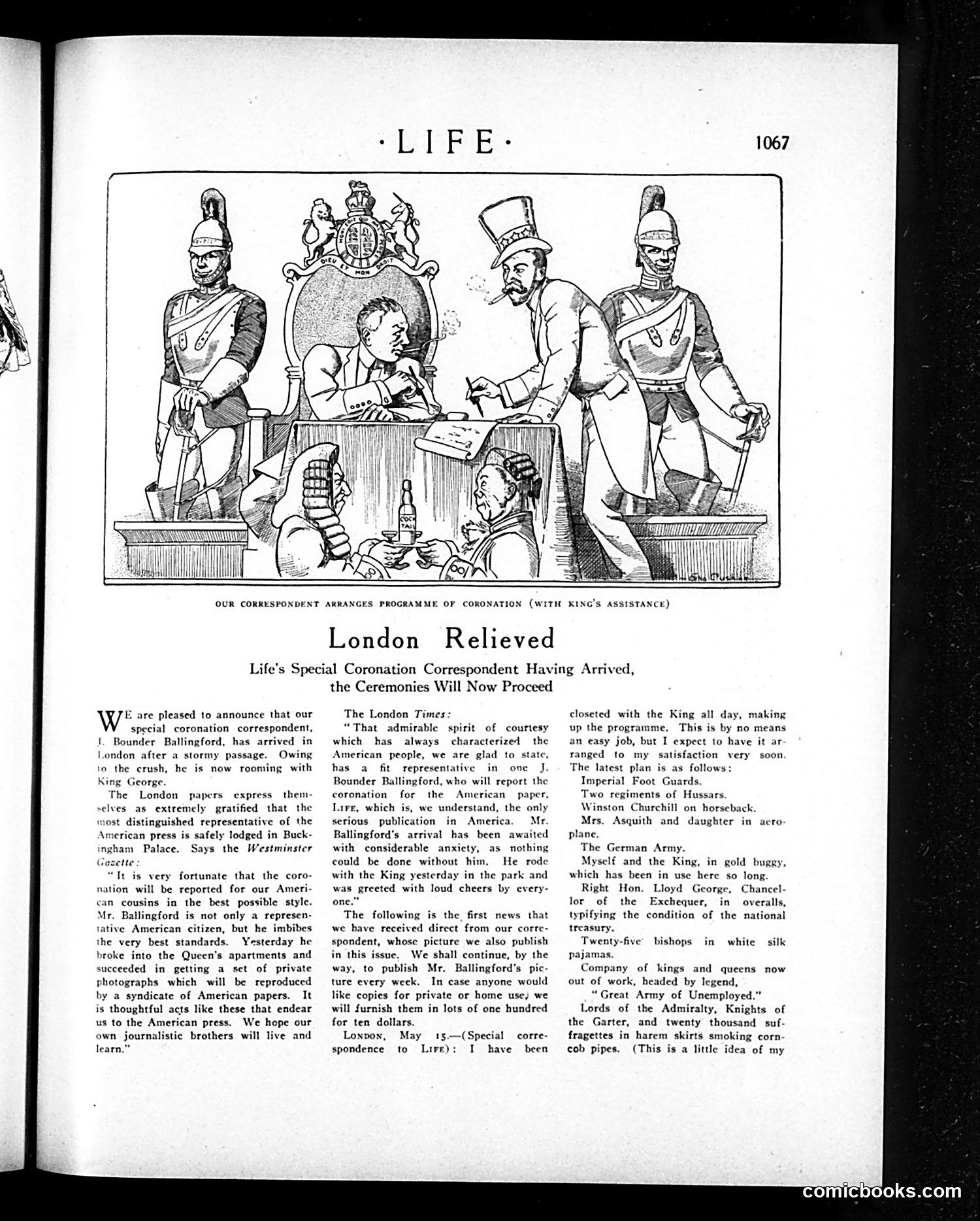
This 1911 Life magazine satirizes American press arrogance during King George V's coronation. The cartoon depicts "J. Bounder Ballingford," Life's fictional correspondent, as so important that he's literally staying with the King and arranging the entire coronation ceremony. The satire mocks several targets: 1. **American journalistic hubris**: British papers fawn over Ballingford as indispensable; one claims Life is "the only serious publication in America"—obvious flattery Life invented itself. 2. **Intrusive American reporters**: The Westminster Gazette's quip about Ballingford breaking into the Queen's apartments for private photographs satirizes aggressive press behavior. 3. **Commercialism**: Selling Ballingford's photo copies for ten dollars per hundred reflects American sensationalism. 4. **The absurd program**: His coronation itinerary (including "Great Army of Unemployed" and suffragettes in "harem skirts") mocks how American papers might trivialize British ceremonies or inject social commentary. The joke: Life portrays its own correspondent as so self-important that Britain's entire coronation revolves around him—exaggerating American press narcissism.
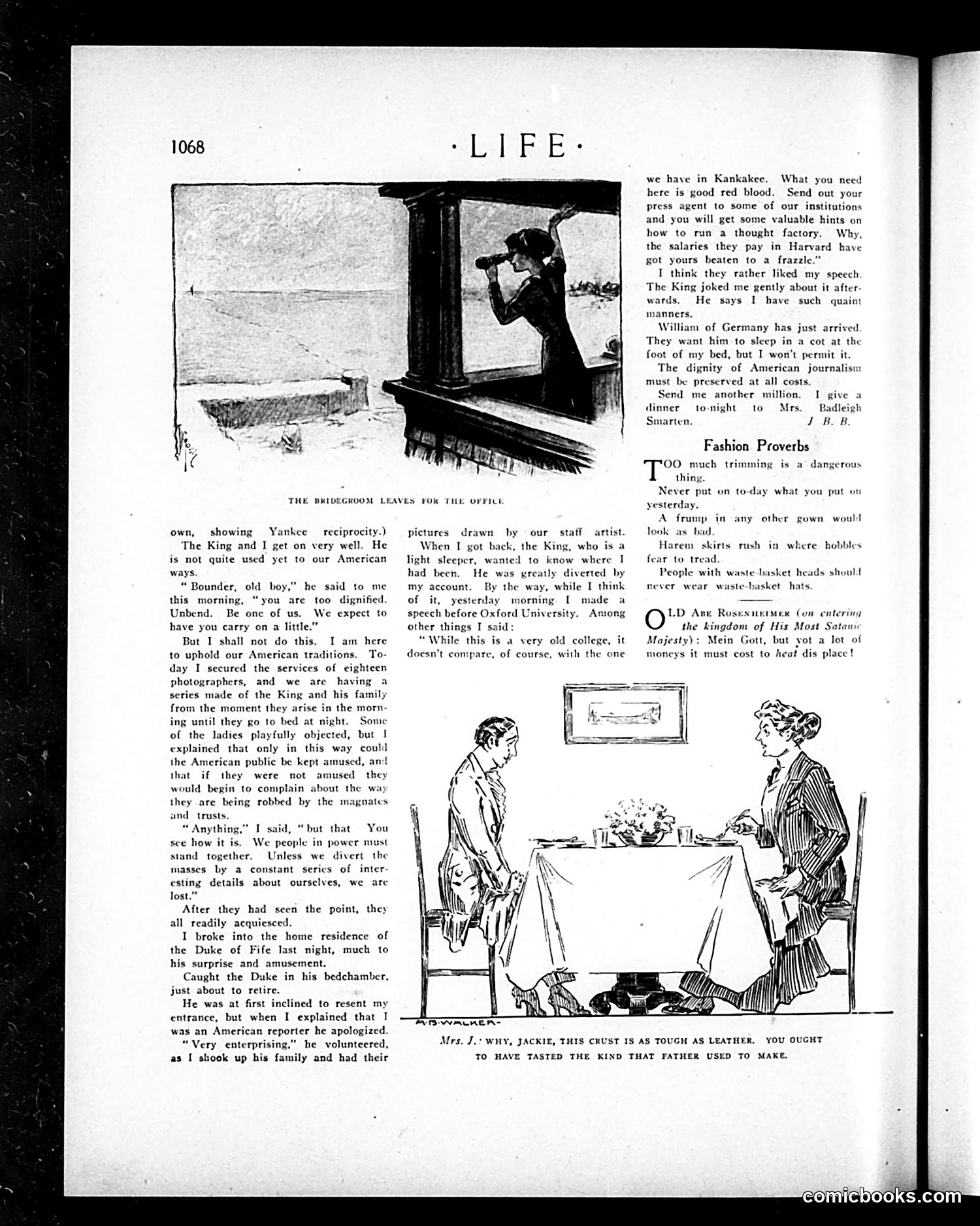
This page satirizes an American journalist's aggressive coverage of a royal visit, likely King Edward VII's 1902 tour. The main narrative mocks American press intrusion and sensationalism: the reporter boasts of photographing the royal family constantly, breaking into private residences (the Duke of Fife's bedroom), and giving unsolicited lectures at Oxford University about American superiority—all to keep the masses entertained and distracted from economic exploitation by "magnates and trusts." The cartoon below depicts a domestic scene where a woman complains about tough bread crust to her husband "Jackie," suggesting nostalgic criticism of modern conveniences replacing homemade quality. The satirical "Fashion Proverbs" and "Old Age Rosenheimer" joke about German materialism mock contemporary social pretensions. The overall target: American journalistic excess, boastfulness abroad, and manipulation of public attention through trivia.
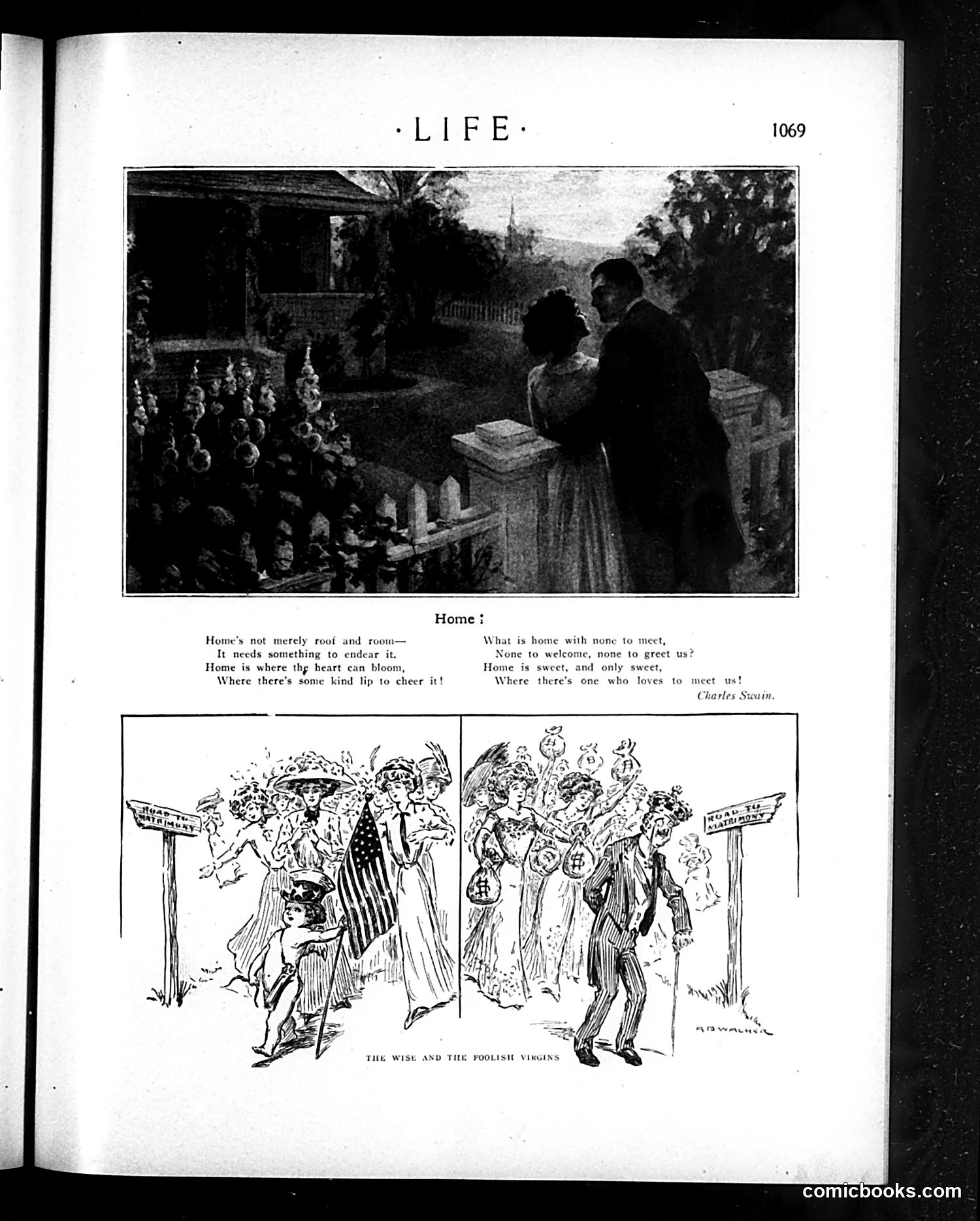
This page presents a sentimental poem about home paired with a Biblical allegory cartoon. The poem emphasizes that a house requires loving inhabitants—family or close companions—to constitute a true "home." The cartoon below illustrates "The Wise and Foolish Virgins," a parable from Matthew 25 about preparedness and readiness. The left panel shows wise virgins with lamps (prepared), while the right shows foolish virgins without lamps (unprepared), apparently turned away at a gate. The satirical application likely critiques social unpreparedness or lack of foresight—possibly regarding domestic life or social obligations—suggesting that wisdom requires proper preparation, just as the biblical virgins needed oil for their lamps. The connection between text and image suggests "home" requires not just presence but thoughtful, prepared love.
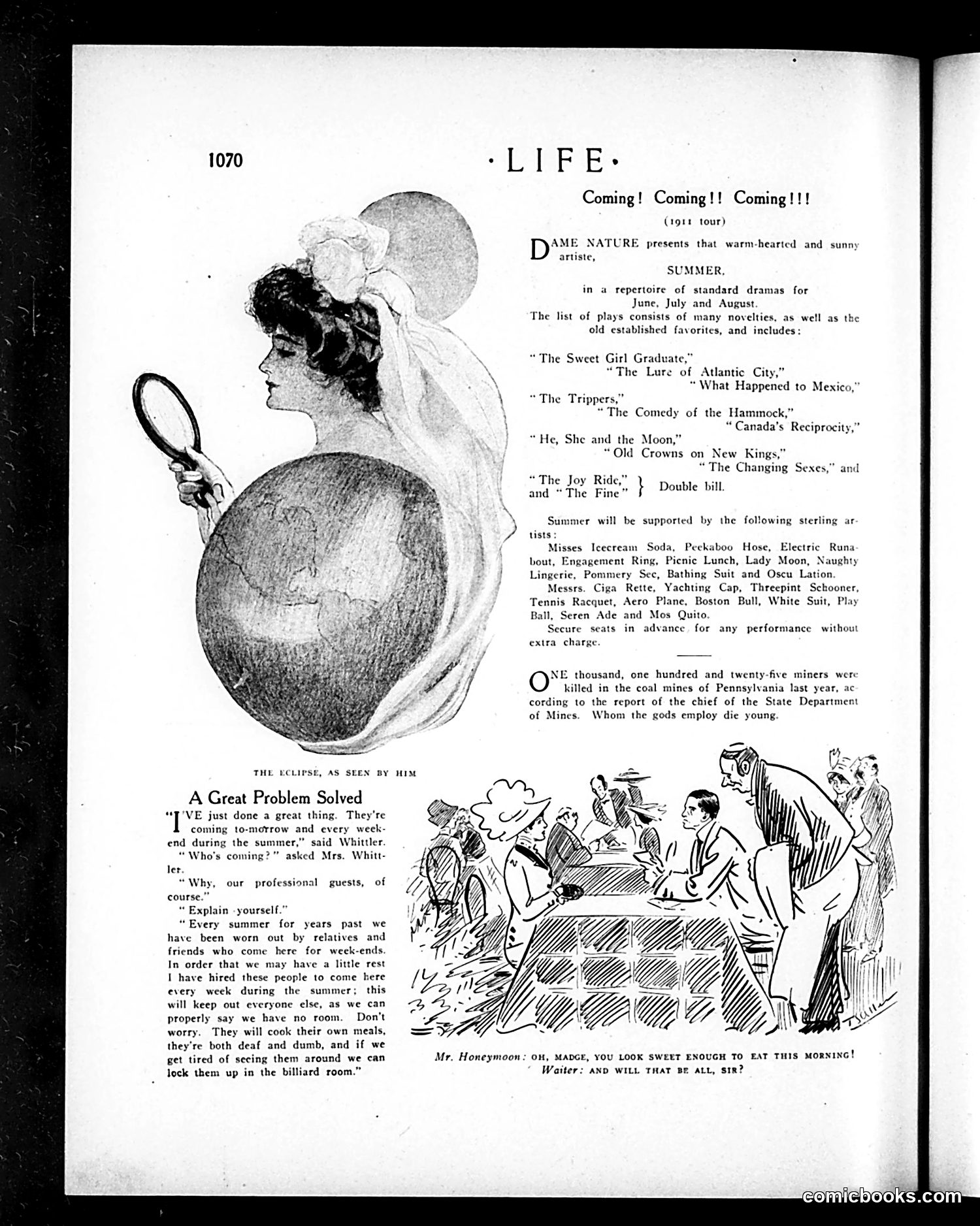
This satirical piece mocks upper-class summer hospitality anxieties. Whittler announces he's "solved" the problem of unwanted houseguests by hiring professional guests—described as deaf and dumb—to occupy his home every weekend. The joke targets the social obligation to host relatives and friends while exposing the absurdity and callousness of his solution: he can confine paid guests to the billiard room when tired of them, preventing "real" visitors from coming. The humor relies on early-20th-century class assumptions about servants and paid help as disposable, controllable, and less deserving of consideration than social equals. It satirizes both the wealthy's desperation to avoid family obligations and their casual dehumanization of working people hired for convenience.
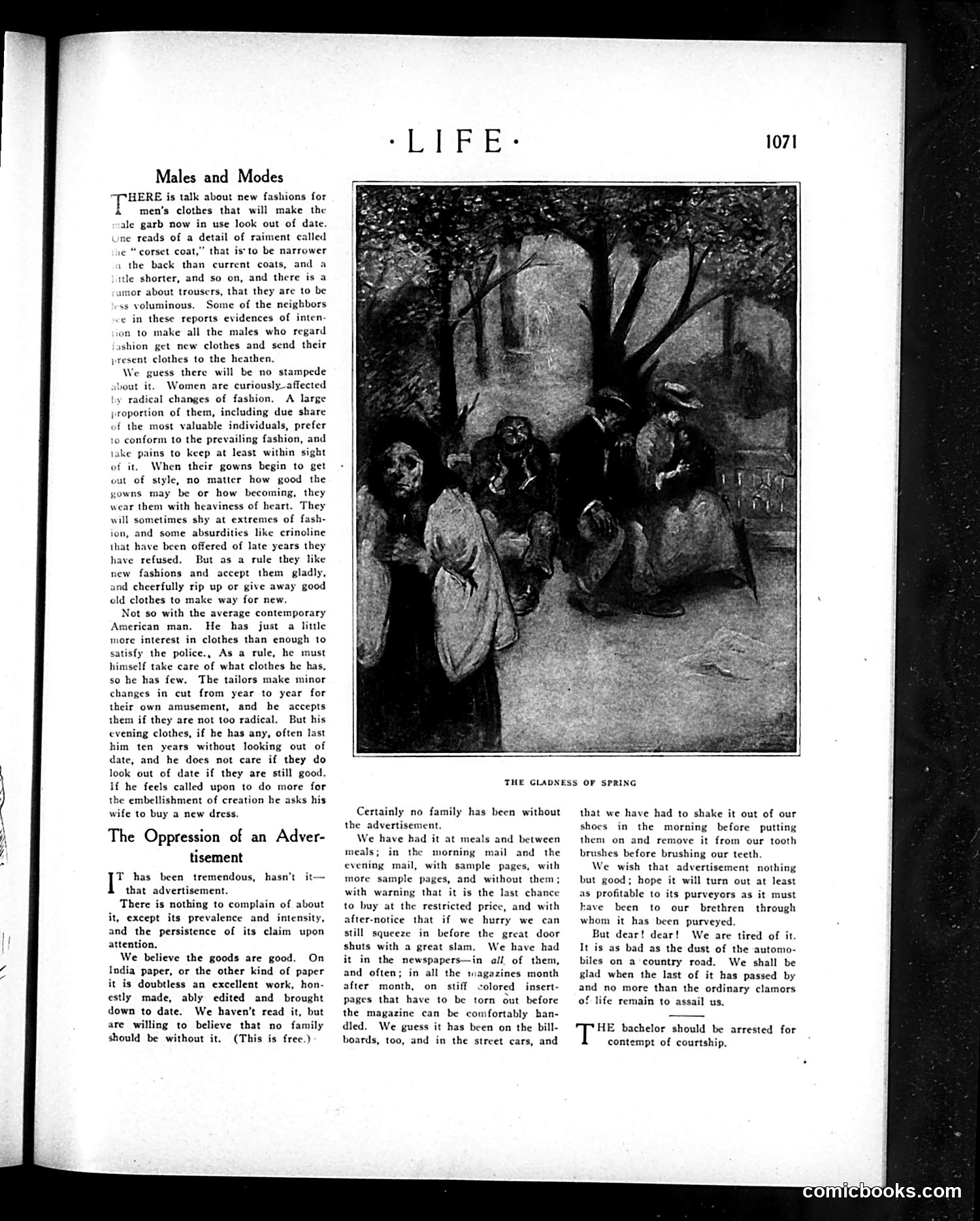
This Life magazine page contains two satirical pieces about American consumer culture. **"Males and Modes"** mocks gender differences in fashion adoption. The article contrasts women—who eagerly embrace new fashions and discard old clothing—with American men, who are indifferent to style changes and wear the same evening clothes for a decade. The humor lies in portraying men as so fashion-oblivious they rely on wives to update wardrobes, while tailors make minor alterations purely for their own amusement since men don't notice anyway. **"The Oppression of an Advertisement"** is satirical complaint about ubiquitous advertising. The author acknowledges the advertised product is likely good quality, but expresses exhaustion at encountering the same ad everywhere: in mail, newspapers, magazines (with intrusive insert pages), billboards, and even street cars. The comparison to dust from automobiles captures how inescapable and irritating pervasive advertising has become—unwanted, unavoidable intrusion into daily life.
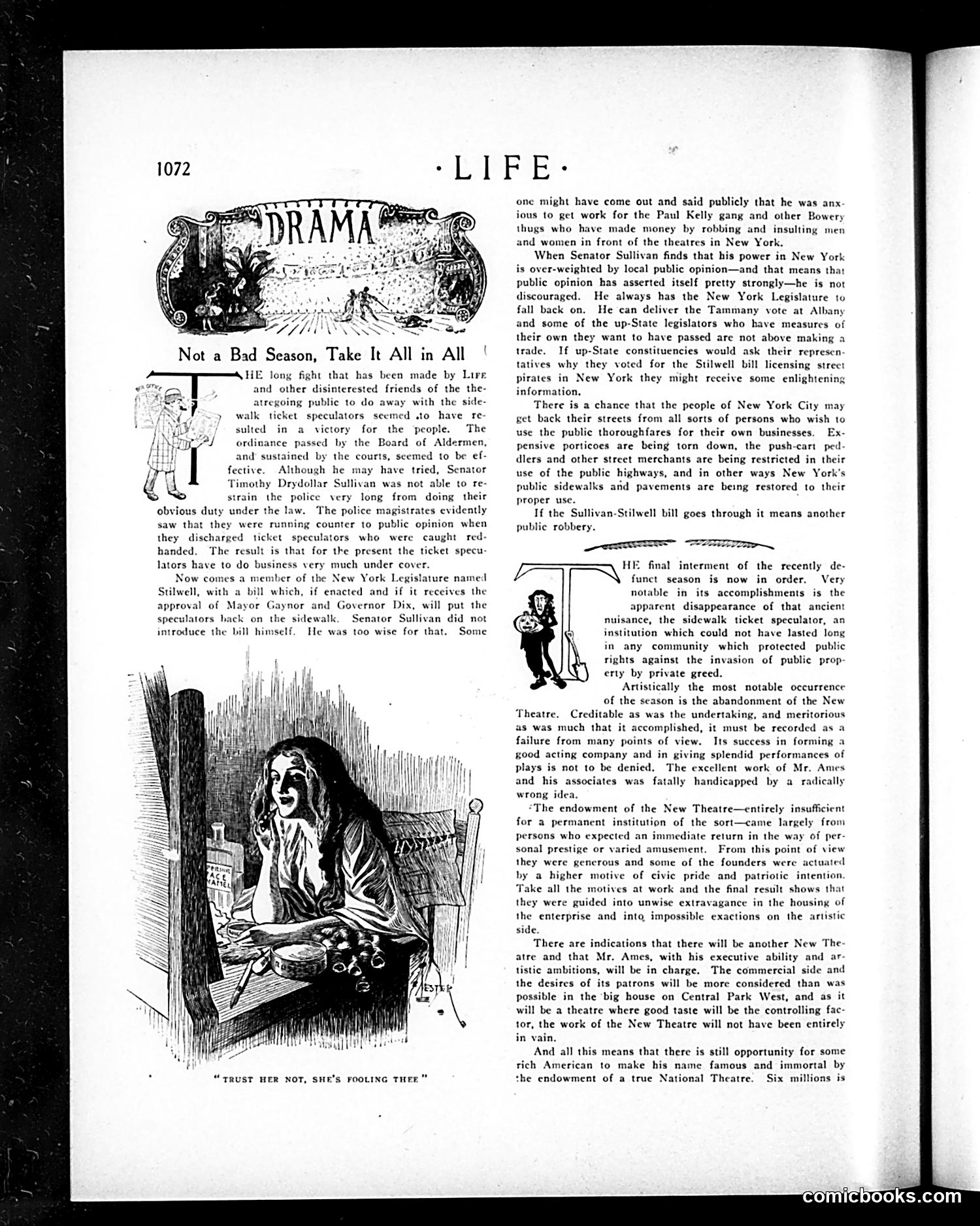
This page critiques corruption in New York theater ticketing. The main cartoon depicts a woman (likely representing the public or theater-goers) being deceived, captioned "Trust Her Not, She's Fooling Thee"—illustrating how citizens are manipulated by crooked operators. The article attacks **Senator Timothy Sullivan** (a real Tammany Hall politician), who allegedly protects sidewalk ticket scalpers operating near theaters. When Mayor Gaynor's administration briefly enforces anti-scalping laws, Sullivan supposedly uses his influence in the state legislature (via legislator Stilwell's proposed bill) to legalize scalping again—enabling Paul Kelly's Bowery gang to profit from intimidating theater patrons. Life argues this represents public corruption: wealthy Tammany politicians and upstate legislators trade votes to overturn city reforms protecting public streets and rights. The satire portrays machine politics as literally selling public space to private criminals.
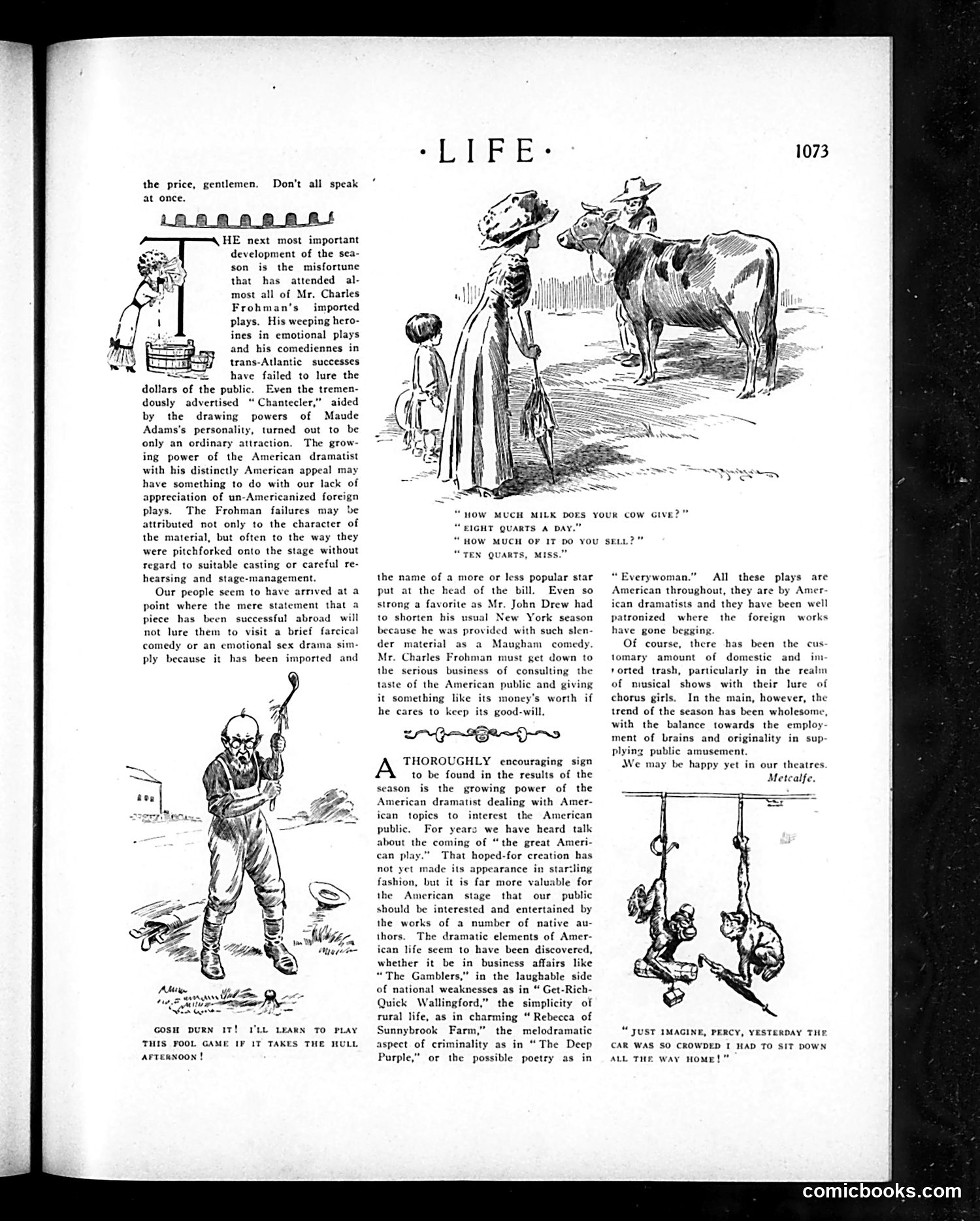
This page critiques the American theater season, specifically attacking impresario Charles Frohman's strategy of importing European plays with star names. The text argues that audiences now prefer American-written plays addressing American themes over foreign imports, even when headlined by famous actors like John Drew. The cartoons illustrate the point satirically: the top sketch shows a woman haggling over milk prices (a "foreign" economic absurdity), while the bottom depicts a determined figure learning to play golf—both suggesting Americans prefer homegrown, practical pursuits. The final cartoon pokes fun at modern inconvenience (crowded cars). The article celebrates emerging American dramatists like those behind "Rebecca of Sunnybrook Farm" and "Get-Rich-Quick Wallingford," arguing native talent better serves American audiences than prestigious but irrelevant foreign material. This reflects early 20th-century cultural nationalism—the belief that American entertainment should reflect American life and values.
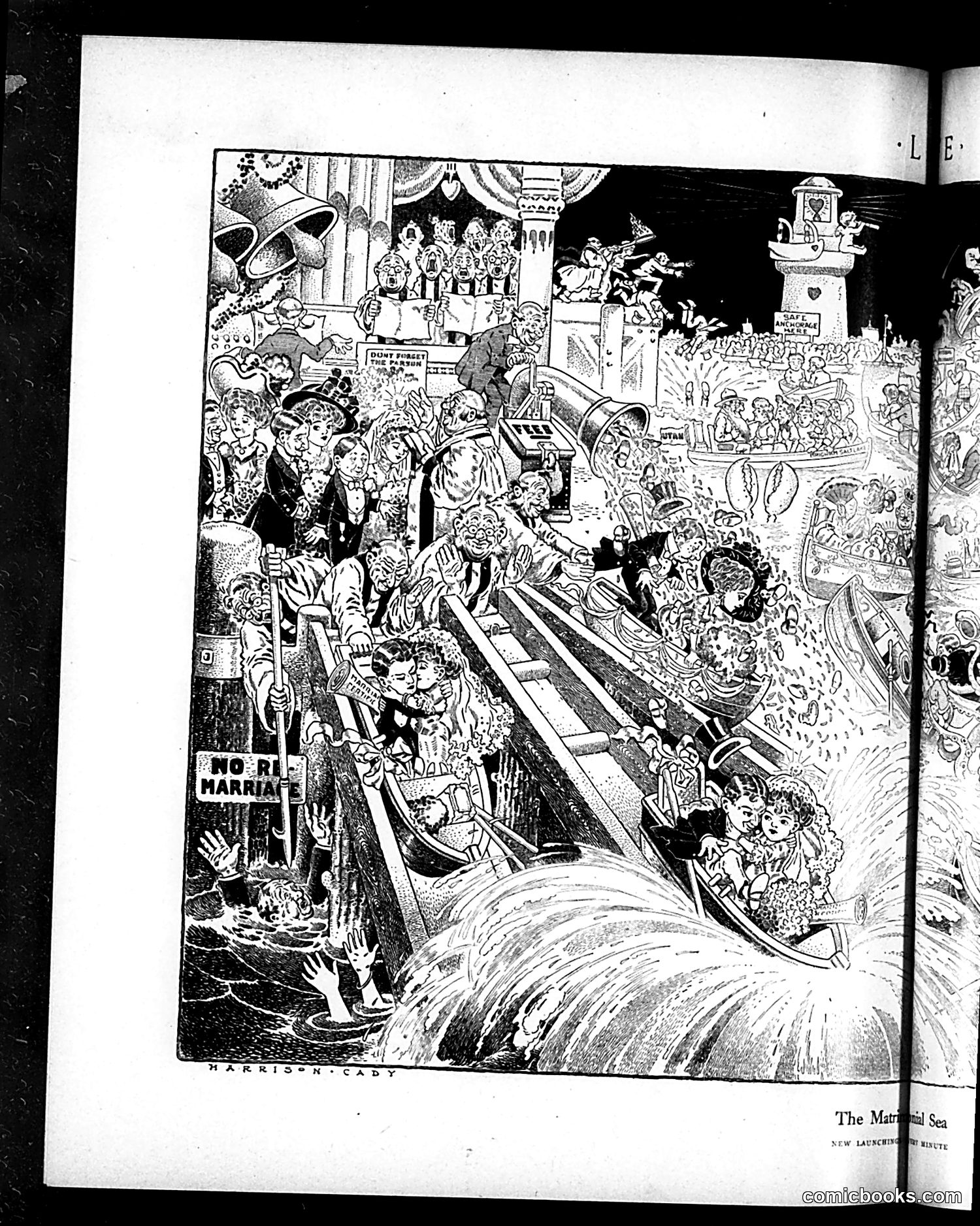
This satirical cartoon depicts an elaborate seaside carnival or amusement park scene crowded with couples and wedding-related imagery. The title "The Matrimonial Sea" suggests commentary on marriage as a chaotic, commercial spectacle. Key visible elements include: - A "No RL Marriage" sign (left side), likely mocking rushed or illegitimate unions - Gondolas and boats suggesting romance, but rendered as crowded, chaotic carnival rides - Numerous figures in formal dress amid spectators and performers - Ornate carnival structures and towers The satire appears to critique how marriage—traditionally sacred—has become a commercialized, entertainment-driven social event. The overwhelming crowds and carnival atmosphere suggest mockery of both the spectacle surrounding matrimony and perhaps changing social attitudes toward marriage in early 20th-century America. The artist is credited as Harrison Cady.
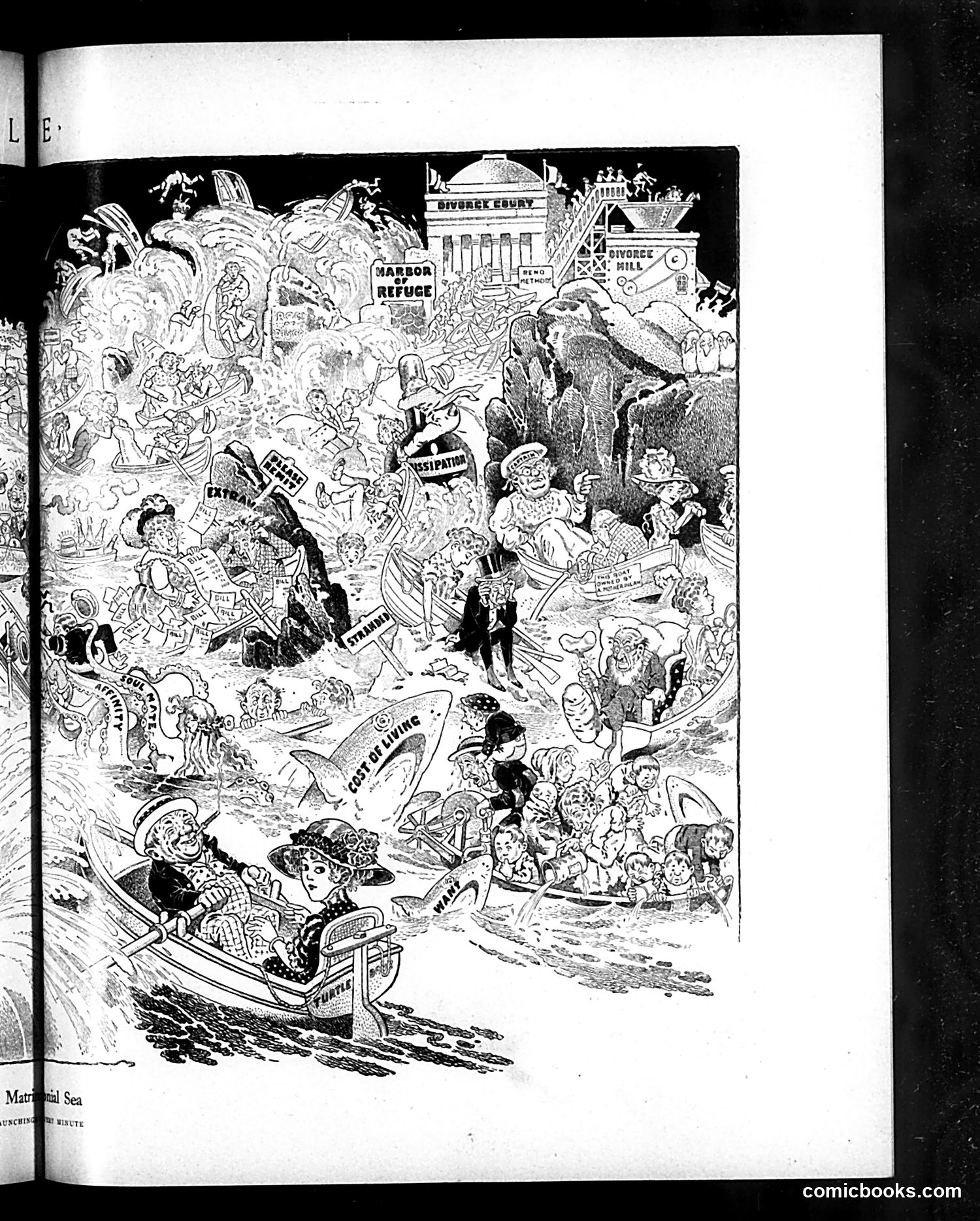
This satirical illustration depicts a chaotic scene at what appears to be a harbor or seaside refuge. Visible signs read "HARBOR OF REFUGE," "DIVORCE COURT," and "DISSIPATION." The cartoon shows numerous figures in a crowded, turbulent setting with boats and architectural elements, suggesting social disorder or moral chaos. The cartoon likely satirizes early 20th-century concerns about urban vice, marital breakdown, and leisure activities viewed as morally corrupting. The "harbor of refuge" concept—ironically juxtaposed with "divorce court" and "dissipation"—suggests the artist critiques how urban centers supposedly encourage moral decline rather than provide genuine refuge. The dense, frenetic composition emphasizes the chaotic nature of modern social problems the cartoonist wished to highlight, though specific individuals aren't clearly identifiable in this reproduction.
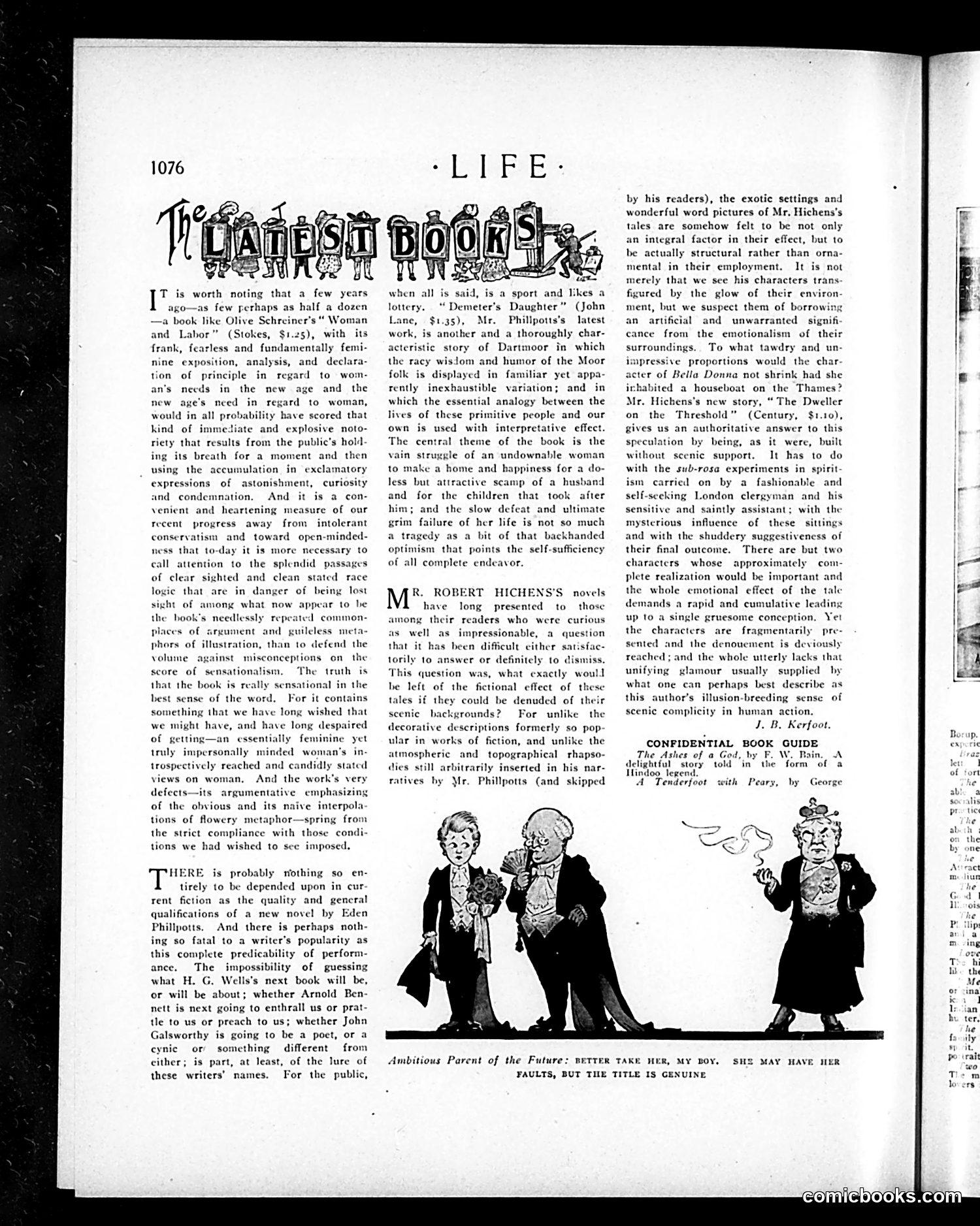
This page reviews three contemporary novels (circa 1910s). The cartoon at bottom depicts "Ambitious Parent of the Future," showing three figures in period dress with the caption: "Better take her, my boy. She may have her faults, but the title is genuine." **The satire:** This mocks anxious parents seeking advantageous marriages for daughters, suggesting they'll accept a woman with personal flaws if she brings a genuine aristocratic title—a critique of class-obsessed matchmaking and the lingering social value placed on nobility over character. **The reviews** discuss works by Eden Phillpotts (about Dartmoor folk) and Robert Hichens, praising their literary merit while debating whether predictability of style affects popularity. The page also references Olive Schreiner's *Woman and Labor*, celebrating it as an important feminist work that finally articulates women's needs candidly. **Context:** The magazine values literary quality and progressive social commentary, particularly regarding women's roles and class pretension.
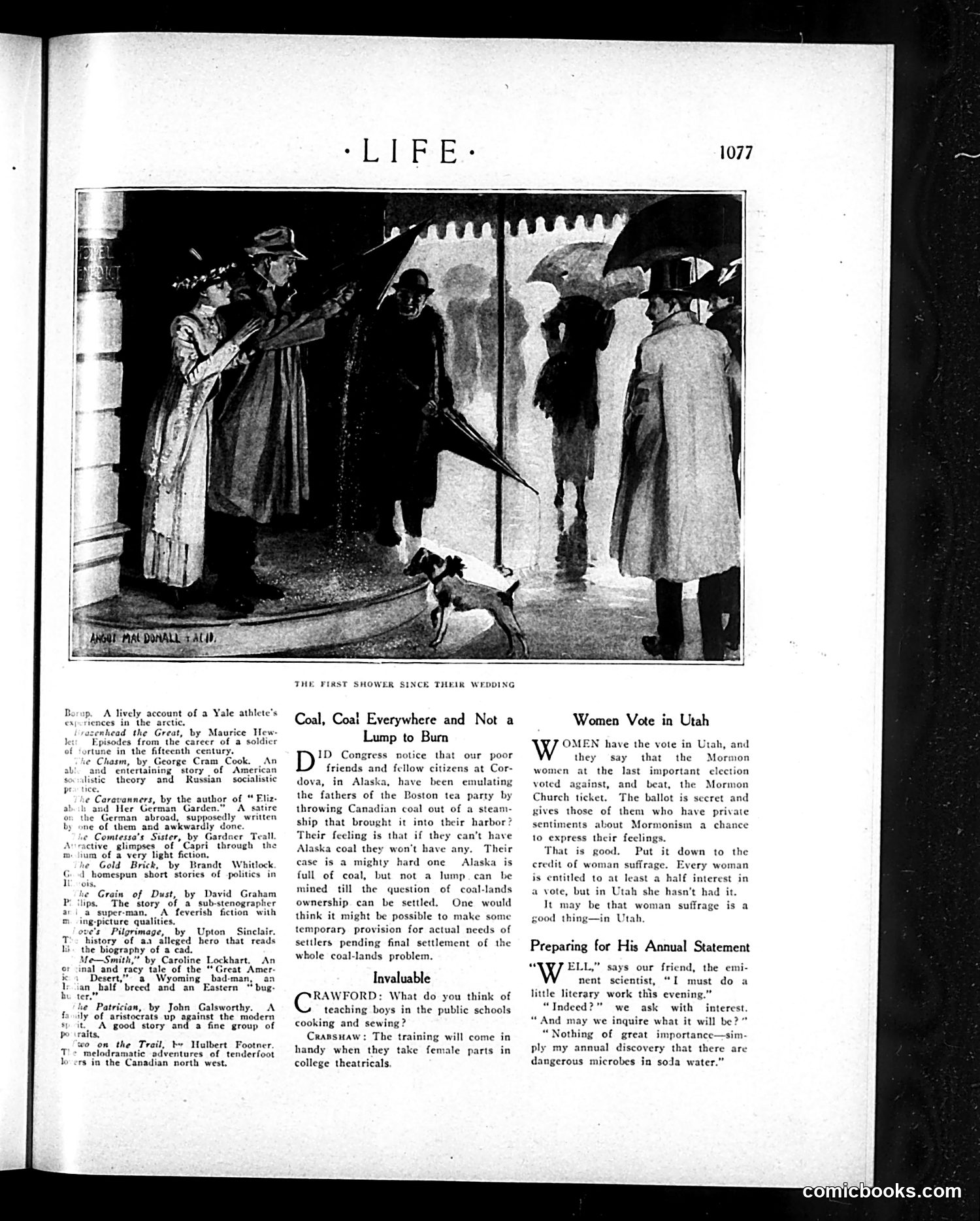
The main cartoon depicts "The First Shower Since Their Wedding"—a scene showing a newly married couple being caught in rain, with onlookers and officials present. The humor lies in the innocent caption contrasting with the formal, somewhat awkward staging of the scene, suggesting marital awkwardness or the couple's inexperience. The three short editorial pieces below use satirical commentary on contemporary issues: 1. **Coal Crisis**: Criticizes Congress's inaction on Alaska's coal shortage—settlers are so desperate they're throwing coal overboard to protest that they can't legally mine it themselves due to unresolved land-ownership disputes. 2. **Women's Suffrage in Utah**: Celebrates that Mormon women voters secretly voted *against* the Mormon Church's political slate, praising voting rights as beneficial. 3. **Annual Statement**: Mocks a scientist who predictably announces "dangerous microbes in soda water" yearly—satirizing both scientific sensationalism and repetitive "discoveries." Each piece employs dry wit to critique social/political inefficiency and hypocrisy.
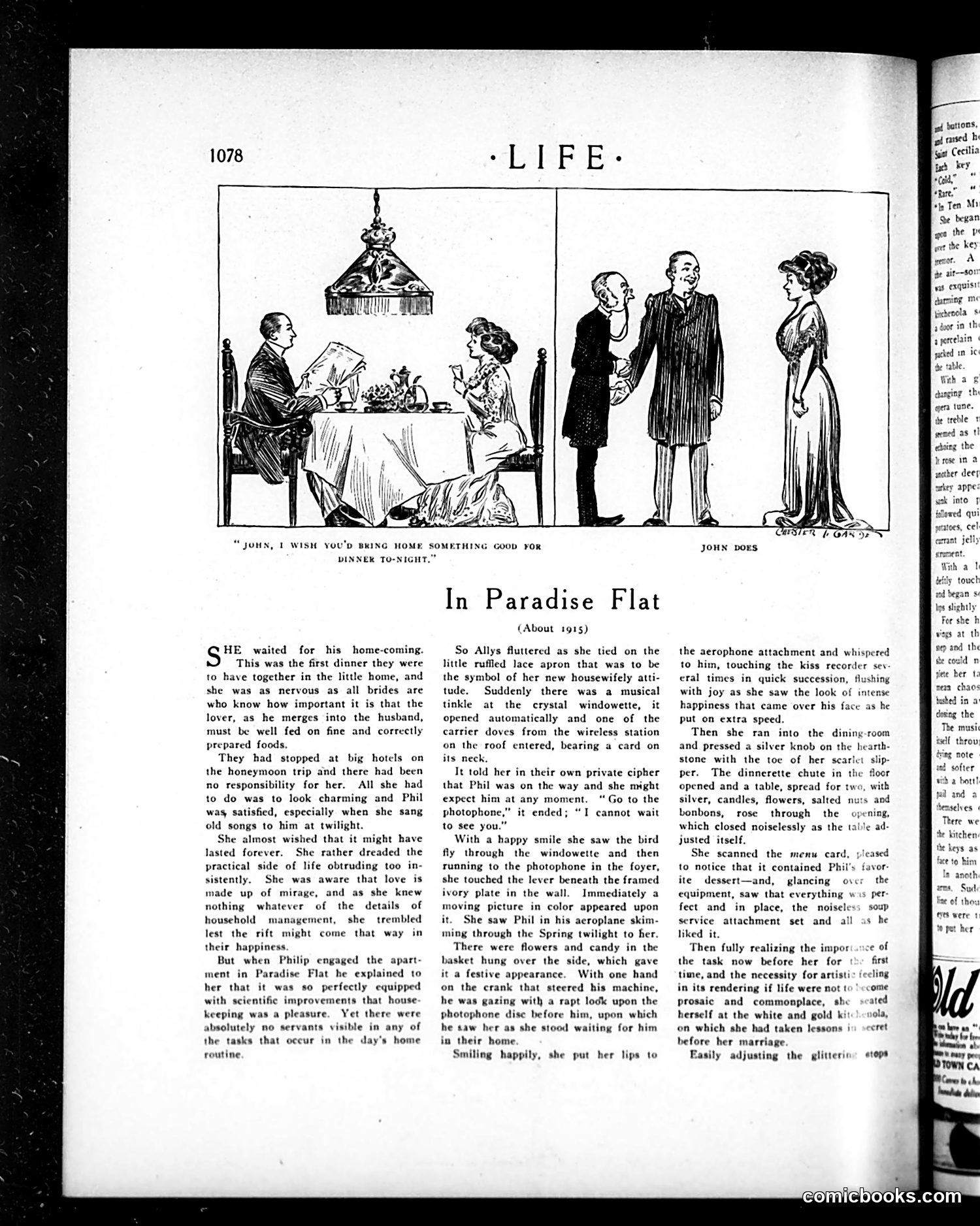
This story-cartoon satirizes the popular "futuristic home" fantasy of early 1900s America. It depicts an automated apartment equipped with impossible technology: carrier doves delivering messages, wireless photophone video calls, automatic windows, and a "dinnerette chute" that produces a fully-prepared dinner from the floor. The satire targets newlywed anxiety—specifically the bride's worry that she must be an excellent homemaker to keep her husband happy. The story presents automation as solving this problem: Allys needs no actual cooking skills because machines do everything. The cartoon's caption shows a husband asking his wife to bring home dinner, highlighting the tension: despite all this imagined technology, the fundamental marital expectation remains unchanged. The joke is that no amount of futuristic gadgetry solves the basic domestic pressure women faced. This reflects early-1900s anxieties about changing gender roles and technology's promises to liberate housewives—promises that largely proved hollow.
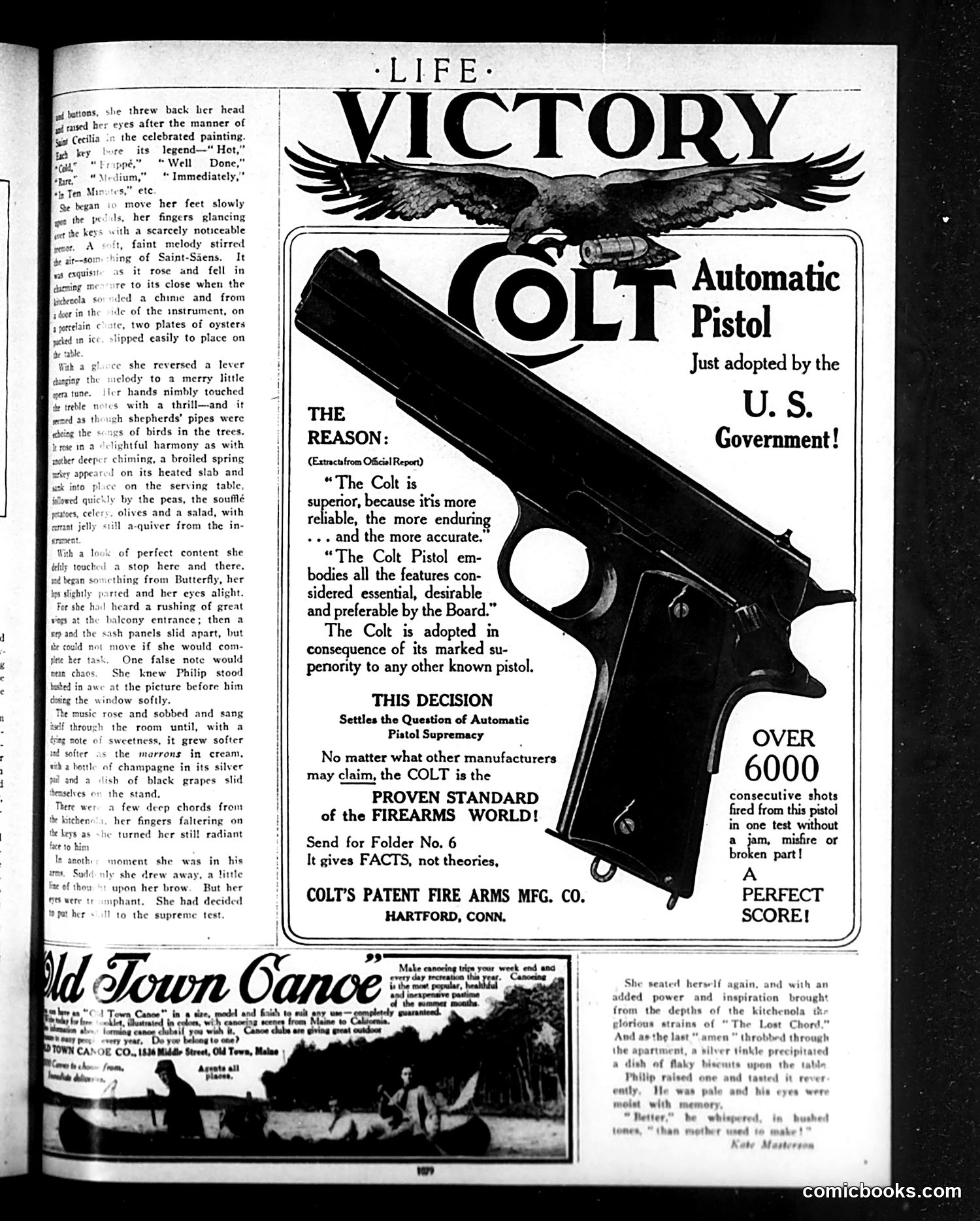
This page is primarily **advertising**, not editorial satire. The dominant content is a full-page ad for **Colt Automatic Pistols**, emphasizing that the U.S. Government has just officially adopted the Colt as its standard military sidearm. The ad's rhetorical strategy exploits government endorsement as proof of superiority, claiming the Colt is "the PROVEN STANDARD of the FIREARMS WORLD" based on official testing reports highlighting reliability, durability, and accuracy. It promises "over 6000 consecutive shots" without jamming—a performance claim designed to appeal to military and civilian buyers. The left column contains fiction text (appears to be a serialized story, unrelated to the advertisement). Below is a smaller ad for "Old Town Canoe." **Historical context**: This likely dates to the early 1900s when the U.S. military was standardizing the .45 caliber Colt 1911 pistol. The ad leverages government authority to market a private commercial product, a common advertising tactic then and now.
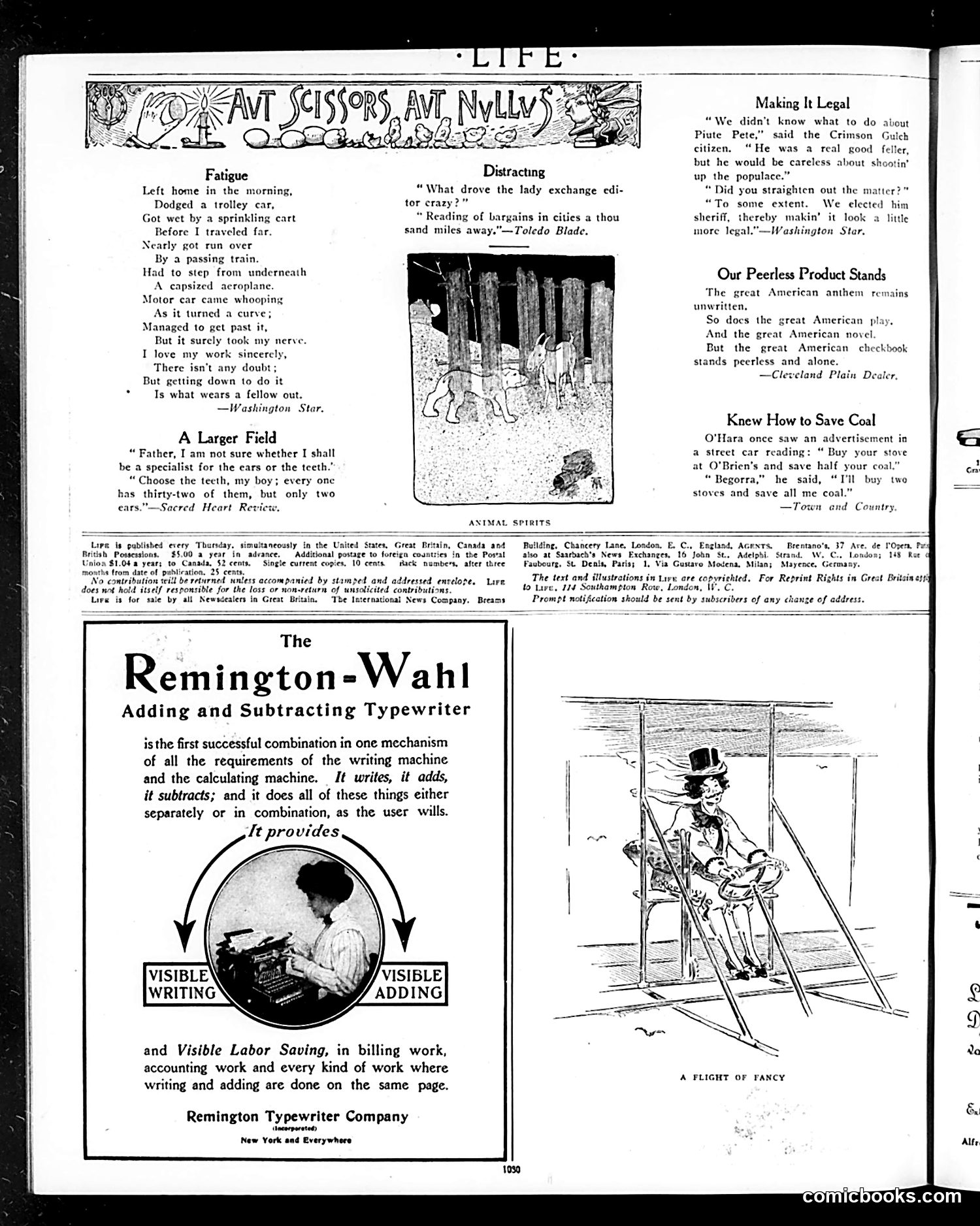
This page contains several short satirical pieces typical of early 20th-century American humor: **"Fatigue"** and **"Distracting"** are brief comic verses about urban modern life's hazards—dodging trolleys, aeroplane accidents, and distracted newspaper reading—a familiar theme for readers navigating increasingly crowded, mechanized cities. **"Making It Legal"** satirizes frontier justice: a town elects a reckless gunslinger ("Piute Pete") as sheriff to legitimize his violent behavior rather than stop it—mocking both Western lawlessness and the absurdity of legalization as a solution. **"A Larger Field"** is a mild joke about career choice: a father advises his son to become a dentist (32 teeth per person) rather than an ear specialist (only 2 ears)—purely numerical reasoning. **"Knew How to Save Coal"** mocks Irish immigrant stereotypes through "O'Hara," who misunderstands an advertisement's promise to "save half your coal," literalizing it to buy two stoves. The page is primarily **advertising** for the Remington-Wahl typewriter, positioned as combining writing and calculating functions.
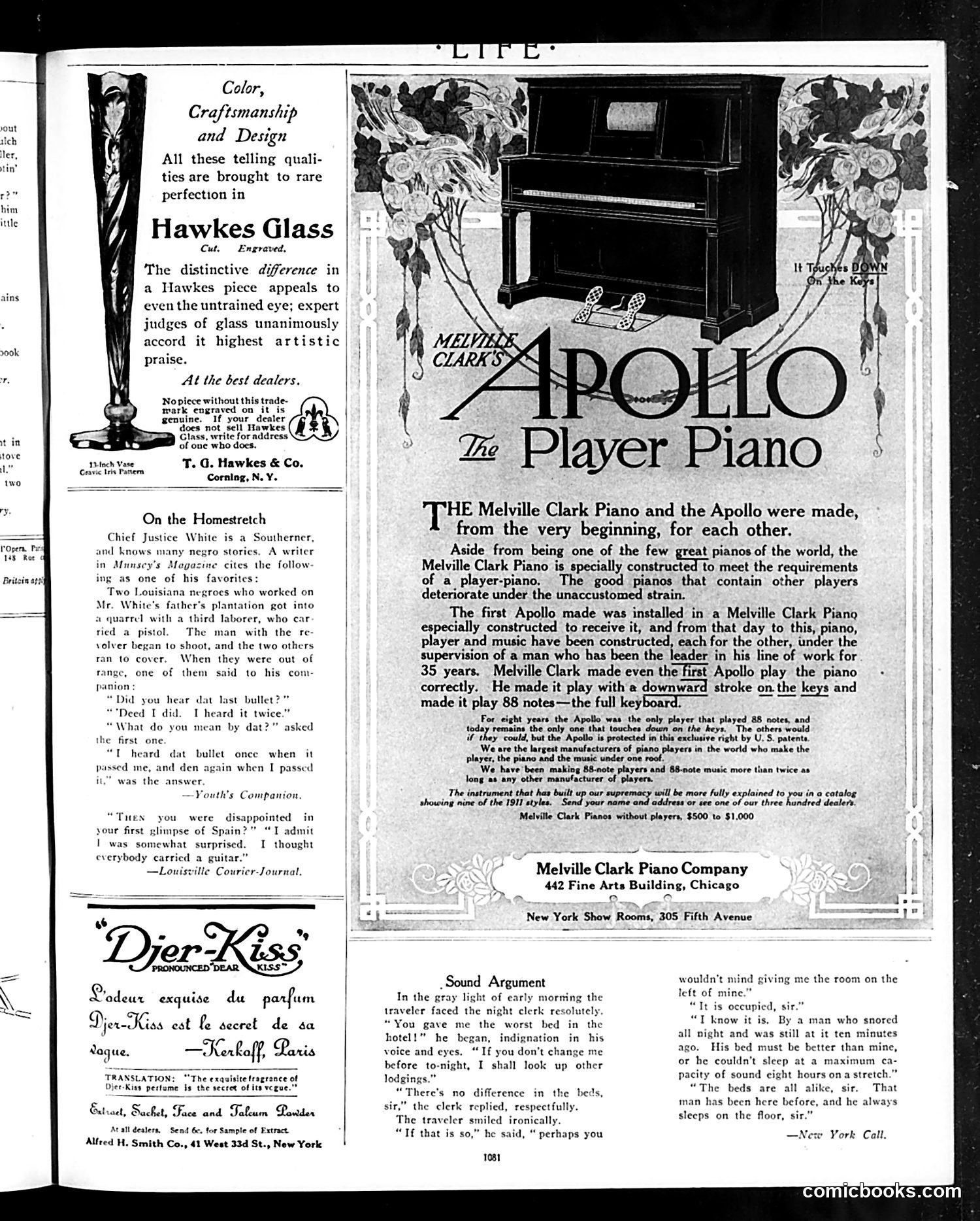
This is primarily an **advertising page** from Life magazine (dated 1921), not a political cartoon. The page contains multiple advertisements and three brief humorous anecdotes. The notable content includes: **Advertisements**: Hawkes Glass (cut glass vessels), Apollo Player Piano, and Djer-Kiss perfume dominate the page visually. **Humor sections** ("On the Homestretch," etc.): Three short joke pieces, including one attributed to Chief Justice White about two enslaved men on a Louisiana plantation discussing a bullet. The jokes reflect early 20th-century American humor conventions—relatively mild, conversational anecdotes rather than pointed satire. **No political cartoons appear** on this page. The humor is domestic and apolitical: misunderstandings between travelers and hotel clerks, wartime disappointments about Spain. The page reflects 1921 consumer culture and entertainment conventions, with advertisements taking precedence over editorial content.
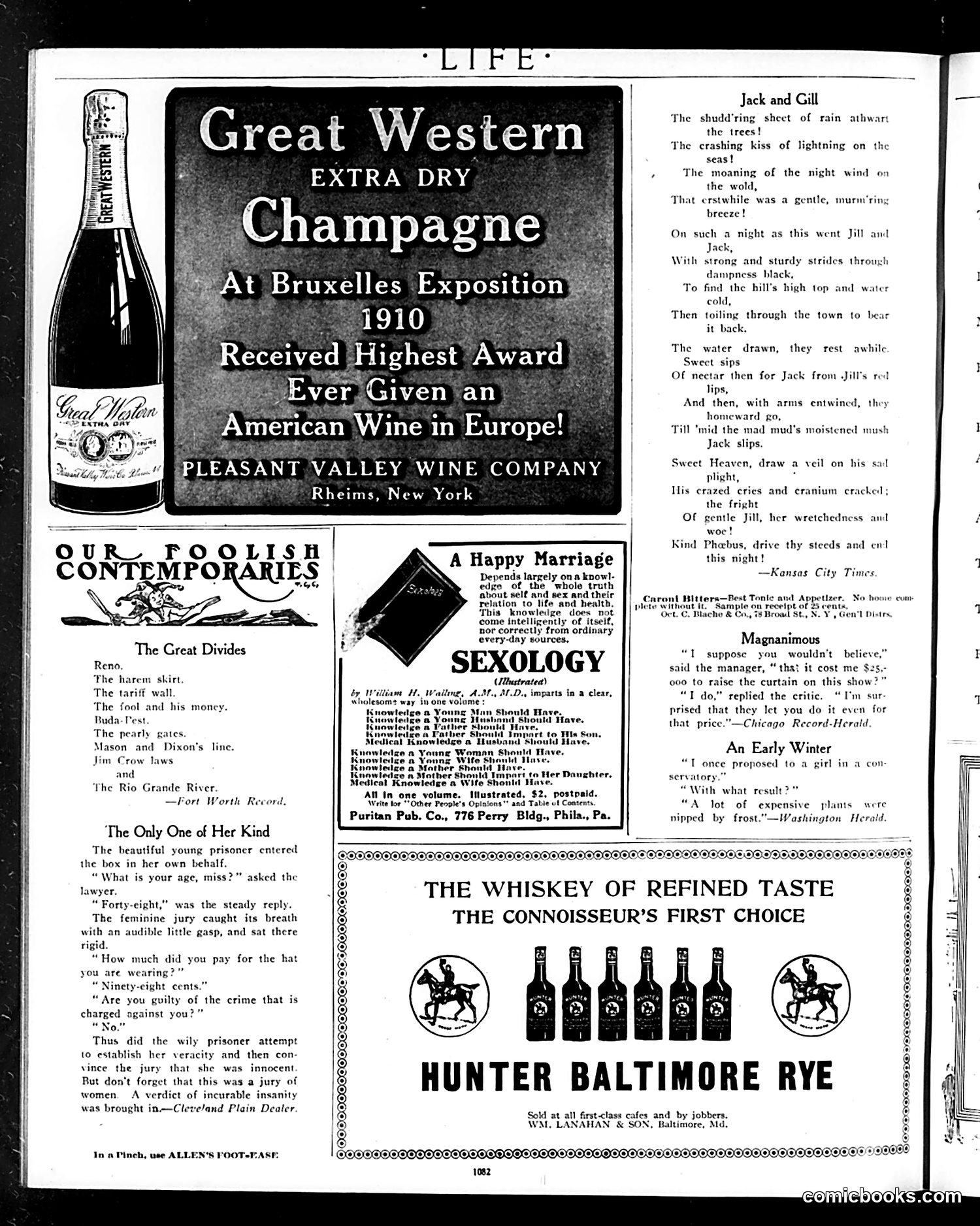
This page is primarily **advertising and light humor content**, not political cartooning. The main items are: **"The Great Divides"** — a brief satirical list contrasting American social divisions: Reno (divorce capital), tariffs, class inequality ("fool and his money"), and Jim Crow laws. It's social commentary on what divided the nation. **"The Only One of Her Kind"** — a courtroom anecdote satirizing women jurors. A female defendant claims to be 48 years old while wearing an expensive hat—an obvious contradiction. The all-female jury responds not with logical skepticism but with emotional reaction ("gasped"), and convicts her of "incurable insanity" rather than the actual crime. The joke mocks women's supposed irrationality. **"Jack and Gill"** — a romantic poem (tongue-in-cheek) about fetching water that ends with Jack slipping in mud—deflating the romantic mood. The remainder consists of advertisements for champagne, sexology books, whiskey, and patent medicines—typical of Life's revenue model.
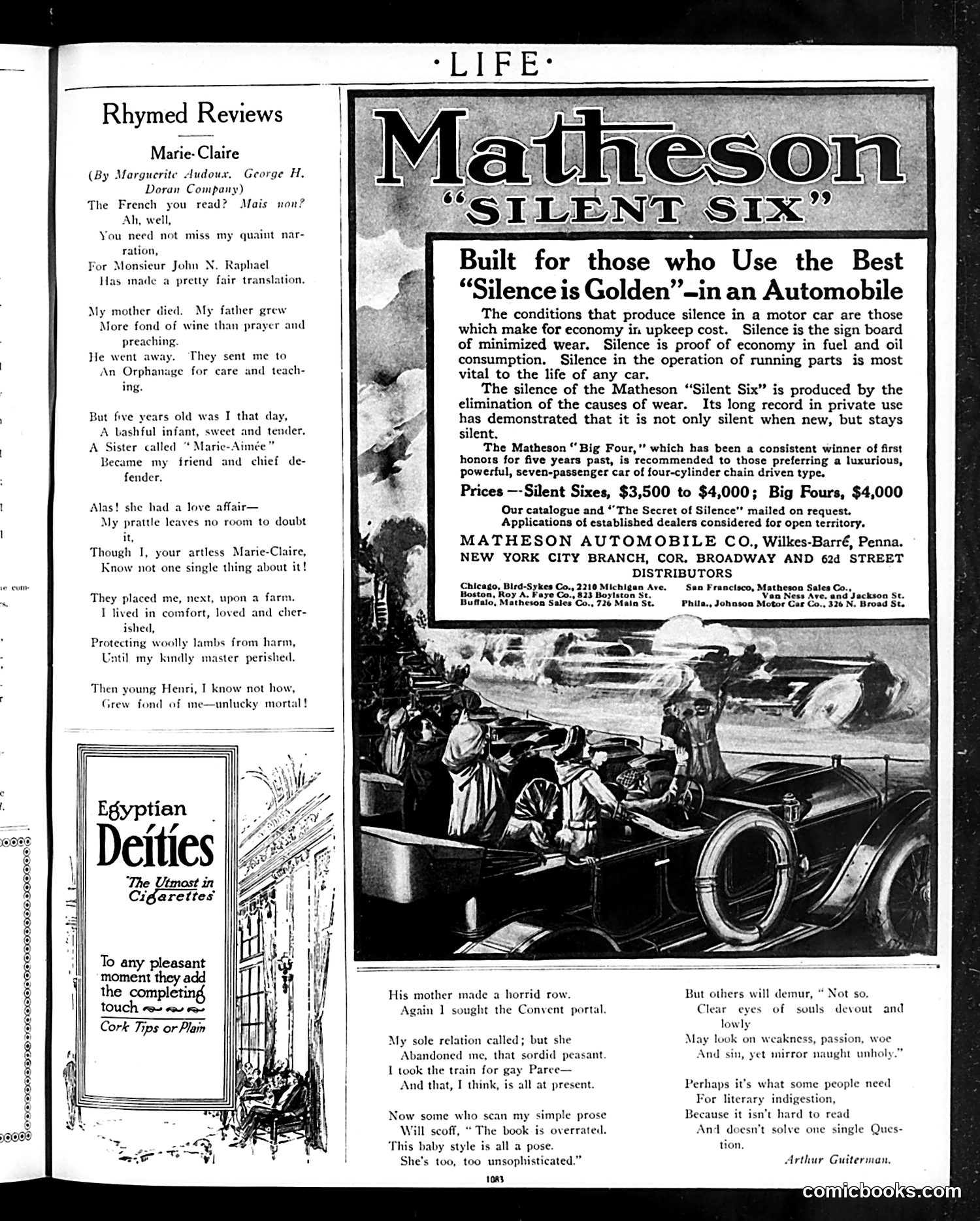
This page combines a book review with automobile advertising, typical of early 20th-century magazines. **Left side:** A "Rhymed Review" of the novel *Marie-Claire* by Marguerite Audoux, translated by John N. Raphael. The reviewer (Arthur Guiterman) summarizes the plot in verse—a French orphan girl's difficult life—while gently mocking both the book's simplicity and readers who dismiss it as "too unsophisticated." The satire suggests literary snobbery: some will scoff at its straightforward style, while others may find it useful precisely because it doesn't demand intellectual effort ("doesn't solve one single Question"). **Right side:** A full-page advertisement for the Matheson automobile's "Silent Six" model, emphasizing mechanical quietness as proof of quality engineering and economy. The accompanying illustration shows an elegant car with well-dressed passengers. The juxtaposition is incidental—both reflect 1920s consumer culture: one mocking middlebrow taste in literature, the other selling luxury automobiles to the same audience.
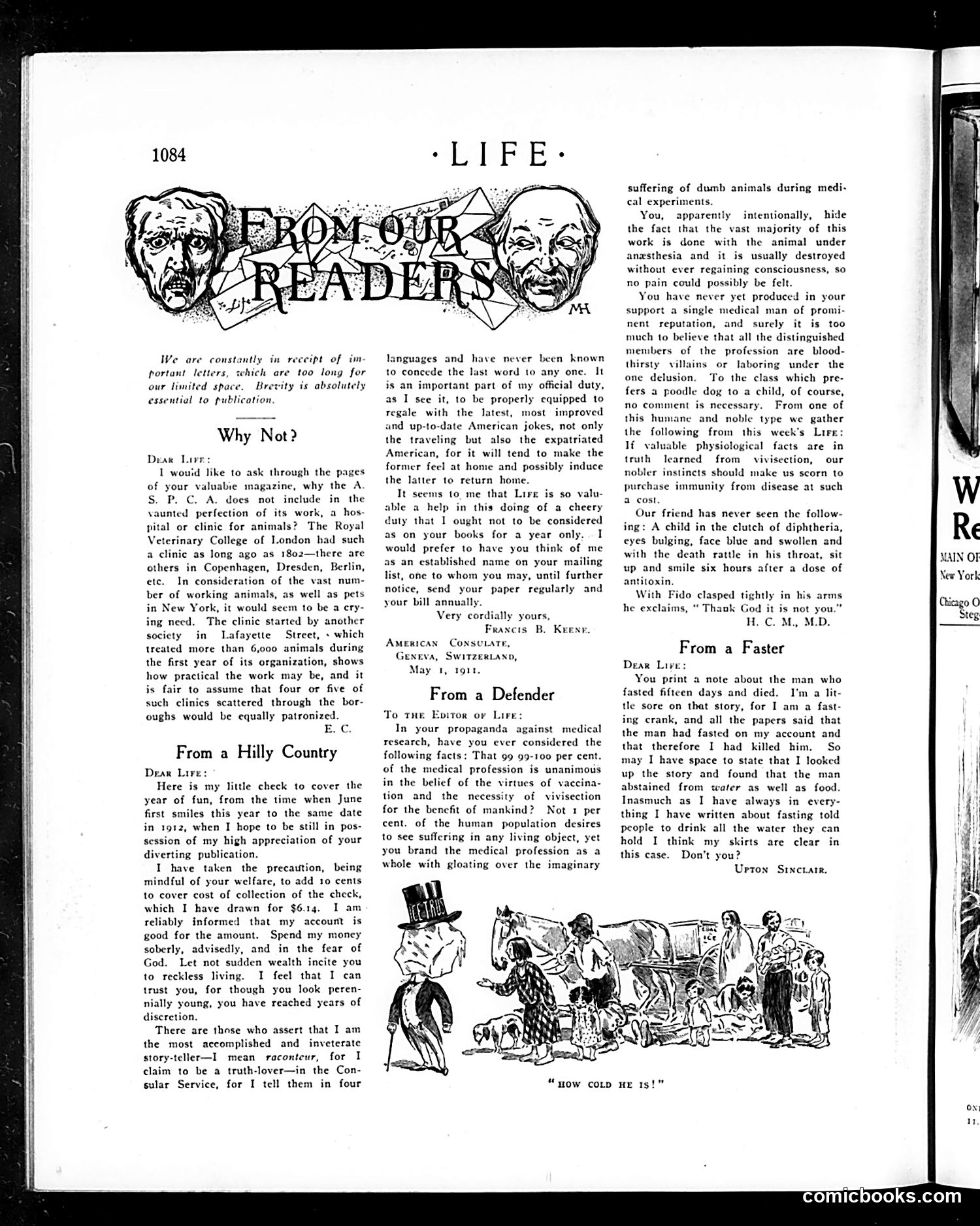
This page from Life magazine contains readers' letters debating animal welfare and medical research—contentious issues in early 1900s America. The **"From Our Readers"** section presents three letters: one requesting the ASPCA establish animal hospitals (citing European precedent); a humorous subscription renewal from a U.S. Consul in Switzerland who positions himself as an accomplished raconteur sharing American jokes abroad; and a **"From a Defender"** letter defending vivisection and medical experimentation on animals. The defender's argument—that 99% of the medical profession supports vivisection, that animals are anesthetized, and that critics lack credible expert support—reveals Life was mediating a fierce contemporary debate. Animal welfare advocates opposed medical experimentation; the medical establishment defended it as necessary progress. The cartoon at page bottom, captioned **"How Cold He Is!"** (unclear without seeing it fully), likely comments satirically on this controversy, though its specific meaning requires clearer visibility of the image itself.
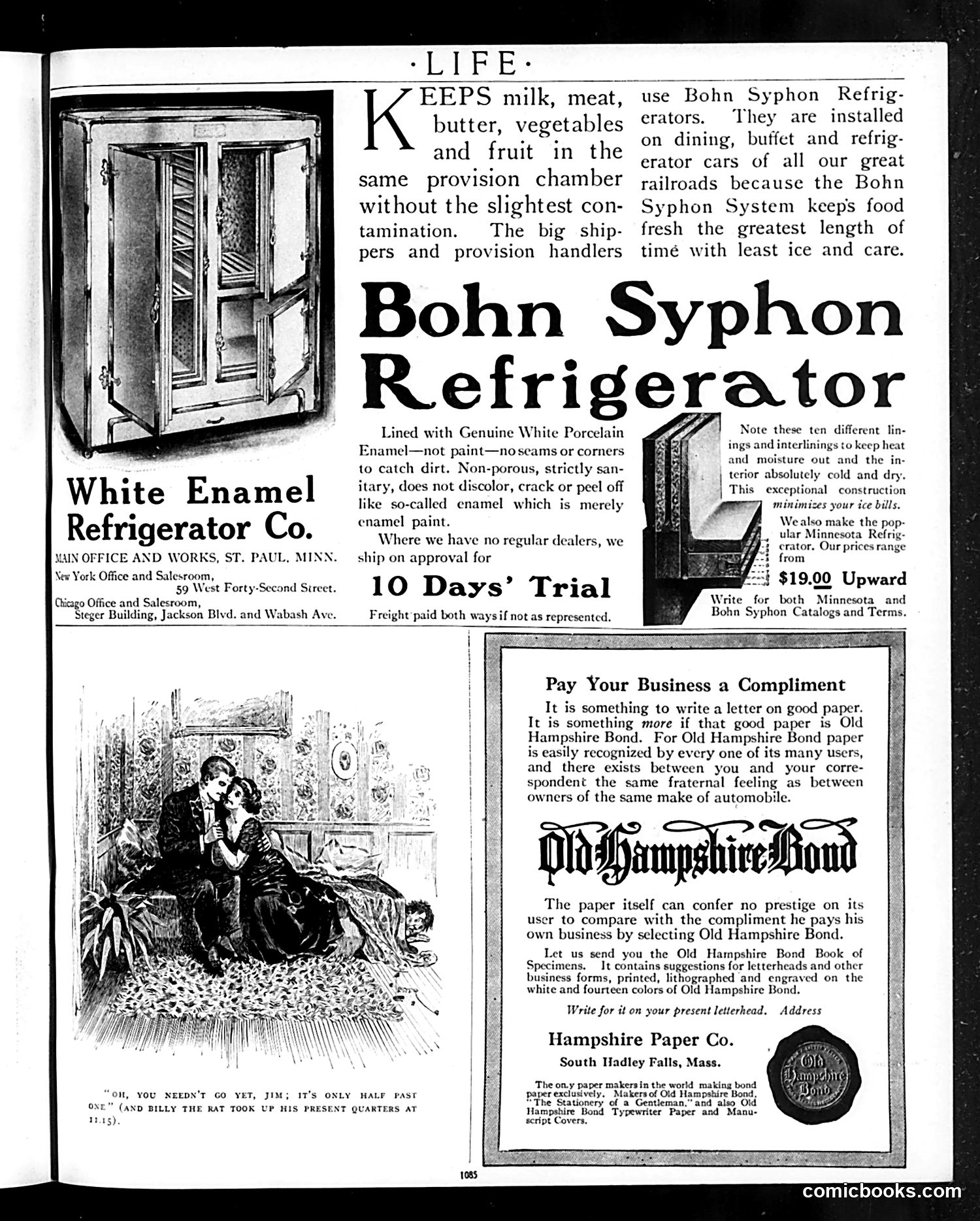
This page is primarily **advertising** rather than satirical content. It contains three product advertisements from the early 20th century: 1. **Bohn Syphon Refrigerator** — promotes an icebox system for railroad dining and refrigerator cars, emphasizing food preservation with minimal ice consumption. 2. **Old Hampshire Bond** — markets premium letter-writing paper, claiming that using quality stationery conveys business respectability and creates "fraternal feeling" between correspondents (a status symbol). 3. **Hampshire Paper Company** — similar paper products advertisement. The **only cartoon** is a small sketch at the bottom showing two men, with one saying "Oh, you needn't go yet, Jim; it's only half one" (half past twelve), as a rat takes his quarters. This appears to be a mild joke about rats infesting premises—likely advertising's acknowledgment that even good paper storage requires protection from pests. The page reflects early industrial-era consumer aspirations: reliable refrigeration for commerce and quality materials for business communication.
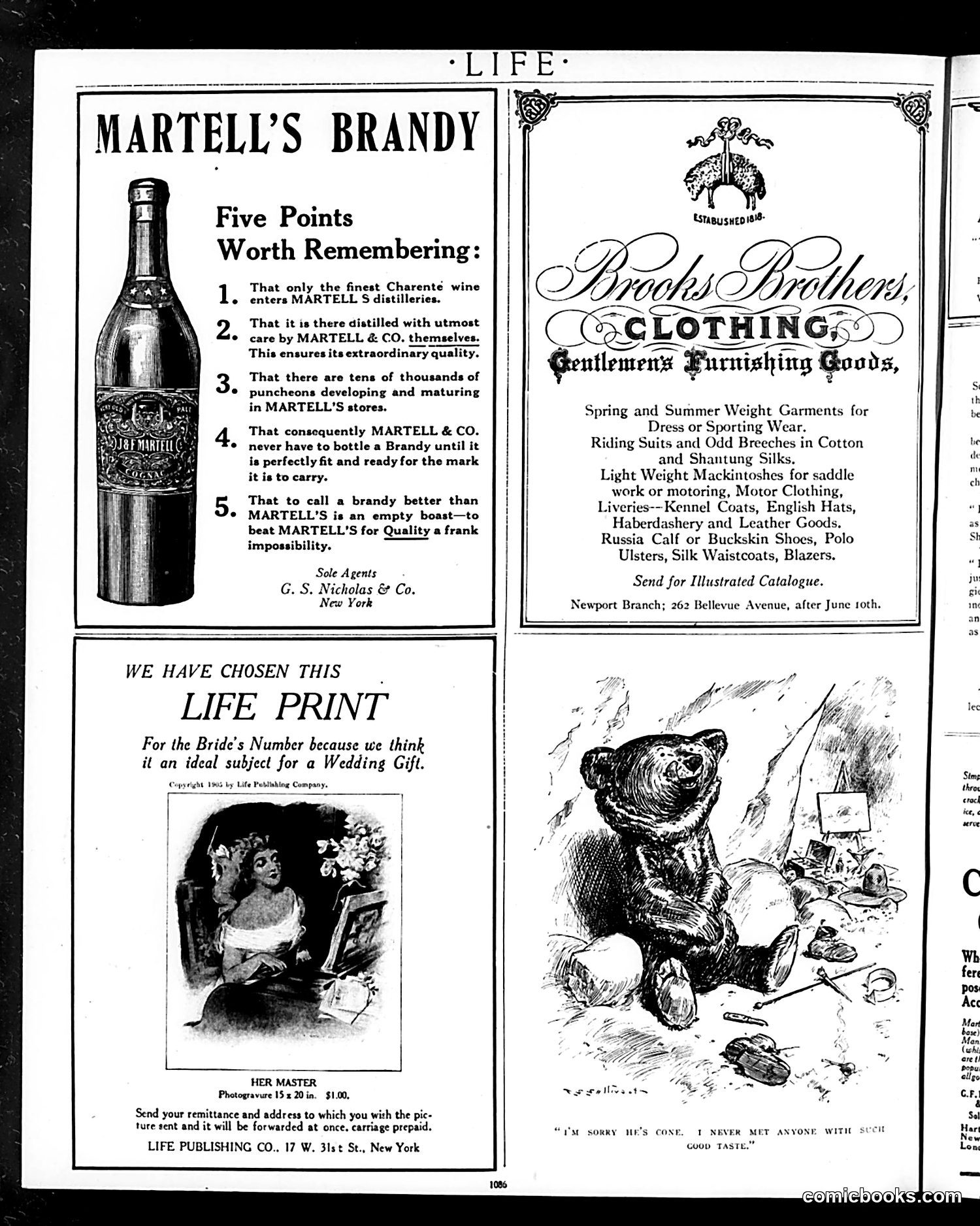
This page is primarily **advertising**, not political satire. It contains three distinct ads: 1. **Martell's Brandy** (top left): A straightforward product advertisement listing five quality claims about French brandy production and distribution. 2. **Brooks Brothers** (top right): A clothing retailer advertising gentlemen's furnishings—riding suits, coats, hats, and leather goods—with a Newport branch address. 3. **Life Publishing's Print Offer** (bottom): A wedding gift promotion for a photogravure titled "Her Master," showing a woman with a portrait, priced at $1.00. 4. **Cartoon** (bottom right): A sketch of a teddy bear in formal dress, with a caption about never meeting anyone with good taste—likely a humorous commentary on contemporary fashions or social pretension, though the specific reference is unclear to modern readers. The page reflects early 1900s luxury consumer culture and magazine monetization through upscale advertising.
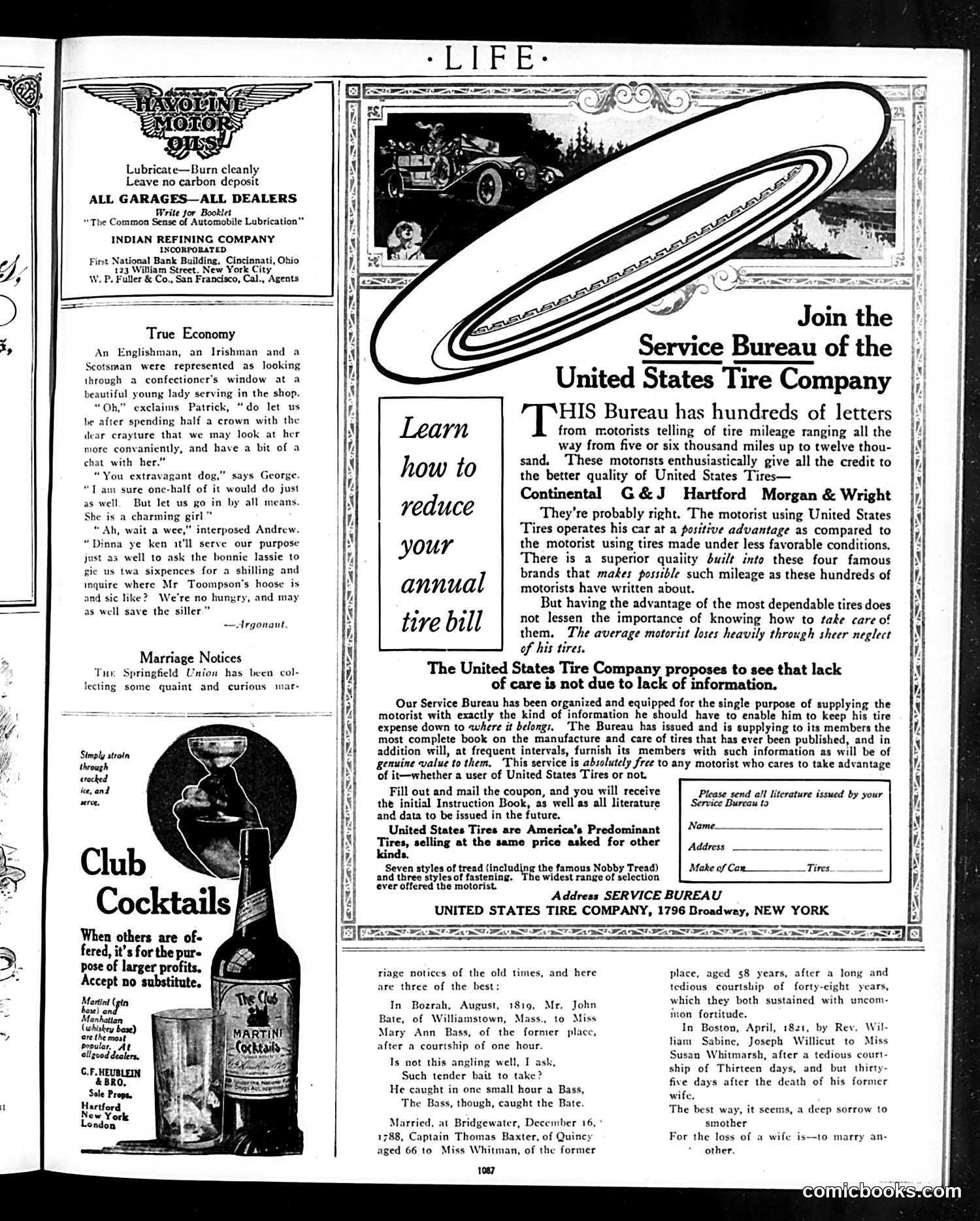
This page is **primarily advertisements** from approximately 1915-1920, with minimal satirical content. The main advertisement promotes the **United States Tire Company's "Service Bureau"**—a customer information program offering free instructional materials on tire care and maintenance. The pitch emphasizes that quality tires (Continental, G&J, Hartford, Morgan & Wright brands) require proper upkeep; the company provides this knowledge at no cost to build customer loyalty. A small section titled **"True Economy"** contains ethnic humor typical of the era: an Englishman, Irishman, and Scotsman debate how to afford looking at an attractive shopkeeper. The Scotsman's solution—asking for change to scout directions nearby—satirizes Scottish frugality stereotypes as the cheapest option. The **"Marriage Notices"** section (incomplete here) references humorous or unusual marriage announcements. There is **no significant political content** on this page. The satire is gentle, consumer-focused, and relies entirely on ethnic and class stereotypes common to early-20th-century American humor.
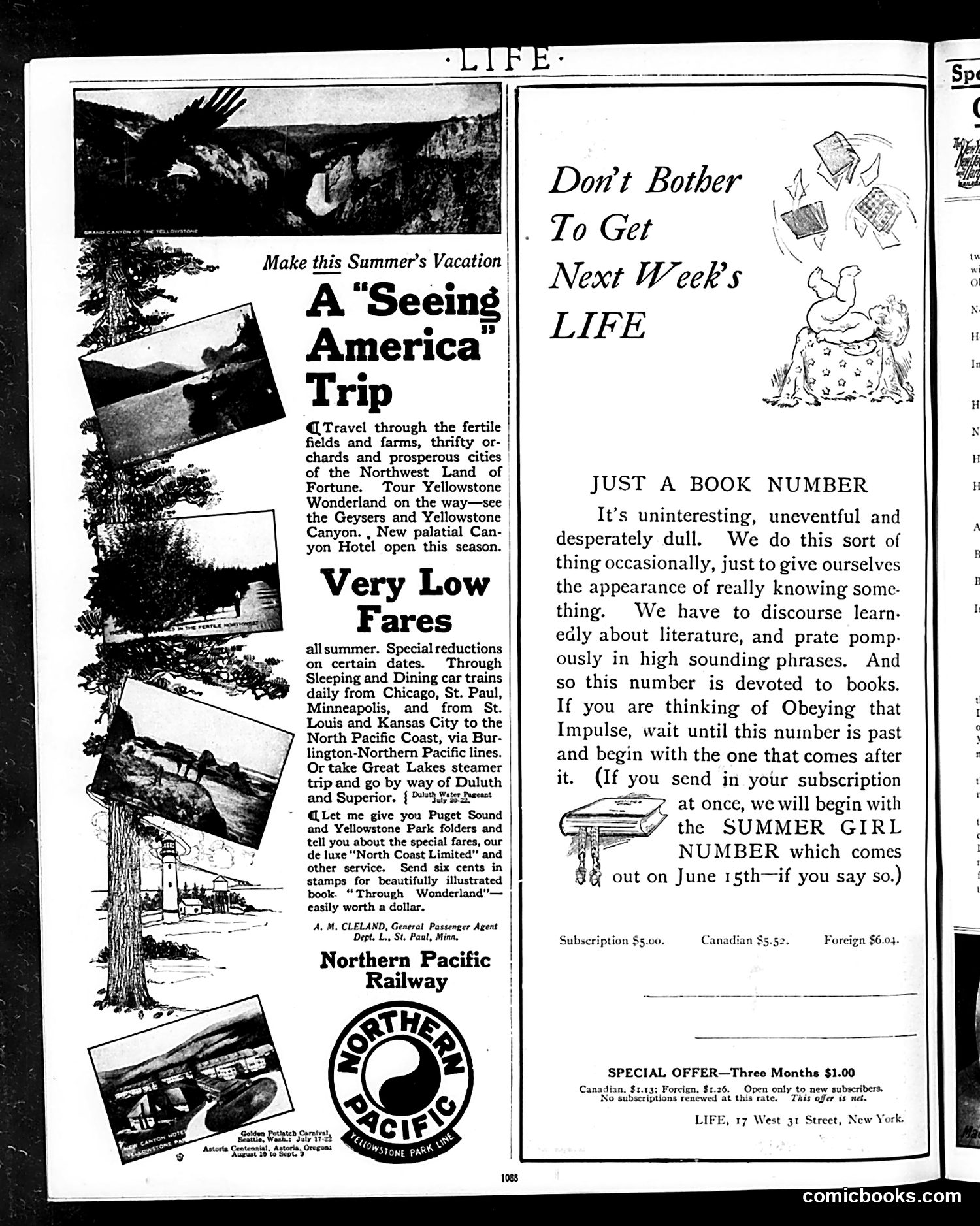
This page contains two distinct elements: a Northern Pacific Railway advertisement and a self-promotional notice from *Life* magazine itself. The **left side** is a travel advertisement encouraging summer vacations through the American Northwest—Yellowstone, the Pacific Coast, and Great Lakes regions—via Northern Pacific Railway lines, emphasizing "very low fares" and luxury train cars. The **right side** is *Life*'s humorous self-deprecation. The magazine admits that next week's book-themed issue will be "uninteresting, uneventful and desperately dull," confessing they publish such issues merely to appear knowledgeable while "prating pompously in high sounding phrases." They sarcastically advise readers to skip it and wait for the "Summer Girl Number" (June 15th) instead. This is satirical self-aware marketing—using honesty about their own mediocrity as a joke to boost subscriptions. The crude illustration shows a bored figure reading.
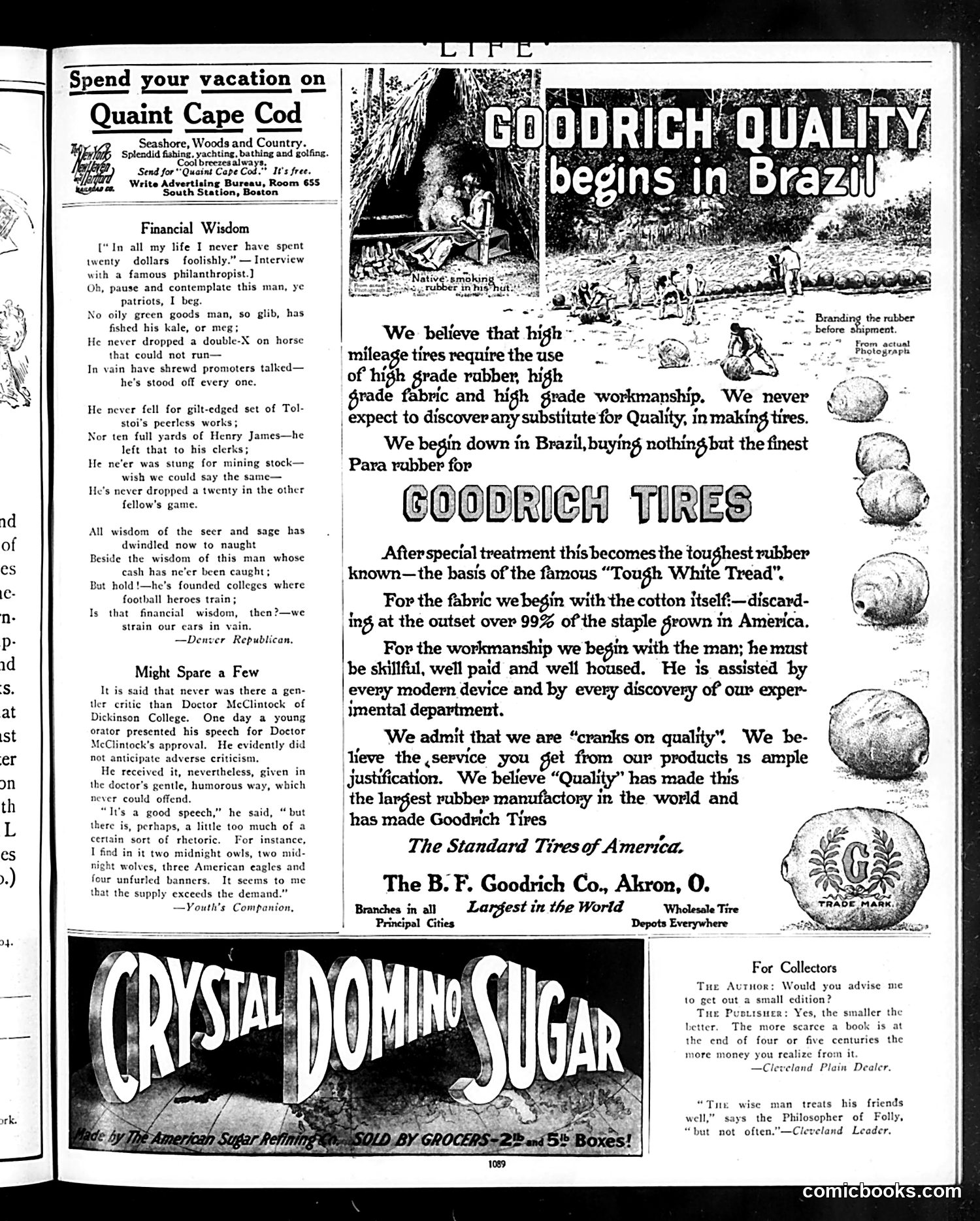
This page combines **satirical commentary with period advertising**. ## The Satire The "Financial Wisdom" section mocks a wealthy philanthropist who claims never to have wasted money, yet has founded colleges for football players—questioning whether wasteful vanity projects qualify as genuine financial wisdom. The joke critiques the self-serving nature of wealthy donors' "charity." The "Might Spare a Few" anecdote humorously illustrates overuse of flowery rhetoric: a professor gently scolds an orator for loading his speech with excessive imagery (midnight owls, wolves, eagles, unfurled banners), suggesting restraint in ornamental language. ## The Advertising The **Goodrich Tires** advertisement occupies significant space, emphasizing quality control and premium materials sourced globally (Brazilian rubber, American cotton). This reflects early 20th-century corporate messaging promoting manufacturing standards. The **Crystal Domino Sugar** and **Cape Cod vacation** advertisements are typical period commerce. Overall, the page balances social commentary with commercial content—characteristic of Life's dual purpose as both satirical publication and advertising vehicle.
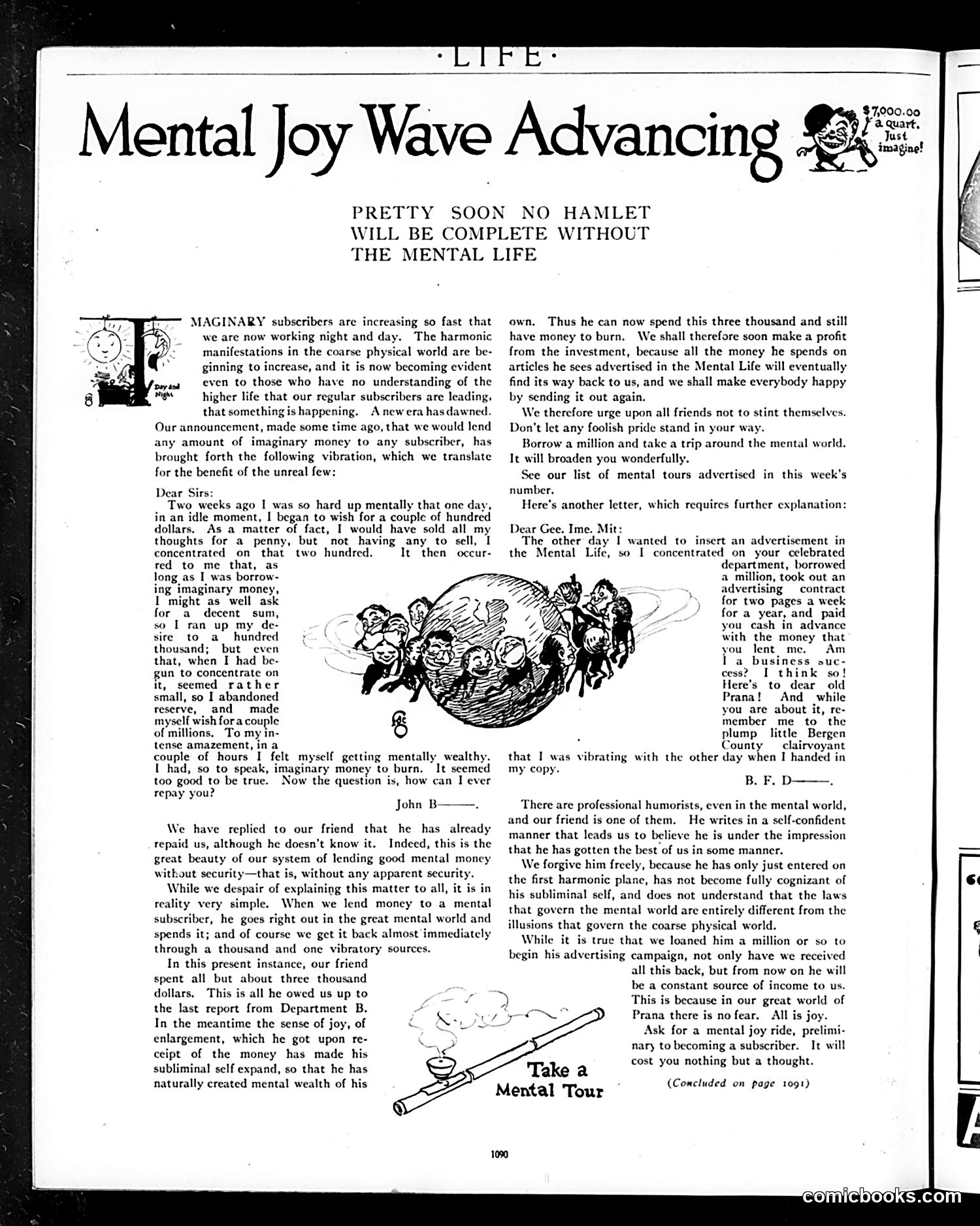
This page satirizes the New Thought movement and pseudo-spiritual "mental science" crazes popular in early 20th-century America. Life mocks believers who thought concentrated thought could manifest real wealth and material goods. The satire centers on a fake service: "Mental Life" magazine lends "imaginary money" to subscribers. Readers write letters describing how they visualized prosperity and felt wealthy—a parody of New Thought manifestation techniques. Life's editors play along, claiming borrowed imaginary money circulates through "vibratory sources" and eventually returns as real profit through magazine advertising. The joke's target is obvious: people spending real money on subscriptions to a magazine promoting imaginary wealth. The final jab is that actual "professional humorists" participate in this delusion, suggesting even clever people fell for New Thought's promises.
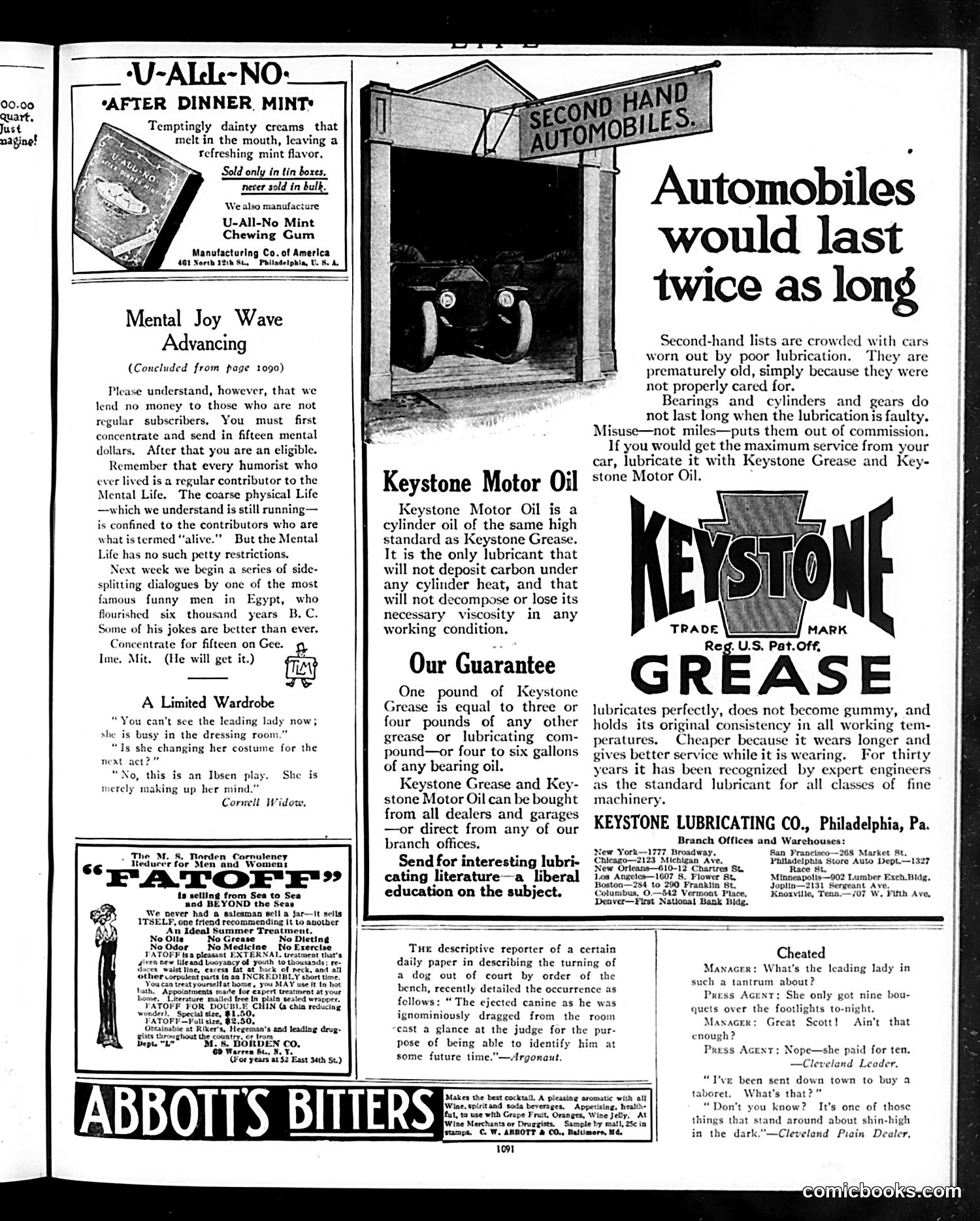
This page is primarily **advertising**, with minimal editorial content. The main substantive piece is a humorous short-form article titled "A Limited Wardrobe," a joke about an actress in an Ibsen play who isn't changing costumes but rather "making up her mind"—a reference to Henrik Ibsen's psychologically introspective theatrical style, where characters' internal deliberation matters more than action. The page also contains a brief satirical piece called "Mental Joy Wave Advancing," mocking a mail-order scheme promising mental/psychological self-improvement to subscribers who send money. The bulk of the page features product advertisements: U-All-No mints, Keystone Motor Oil and Grease (emphasizing proper automobile lubrication), Fatzoff weight-reduction remedy, and Abbott's Bitters. The small boxed item "Cheated" appears to be newspaper filler—a joke about a woman's tangled hair being compared to a "shrimp-high laborer." **No political cartoons appear on this page.**
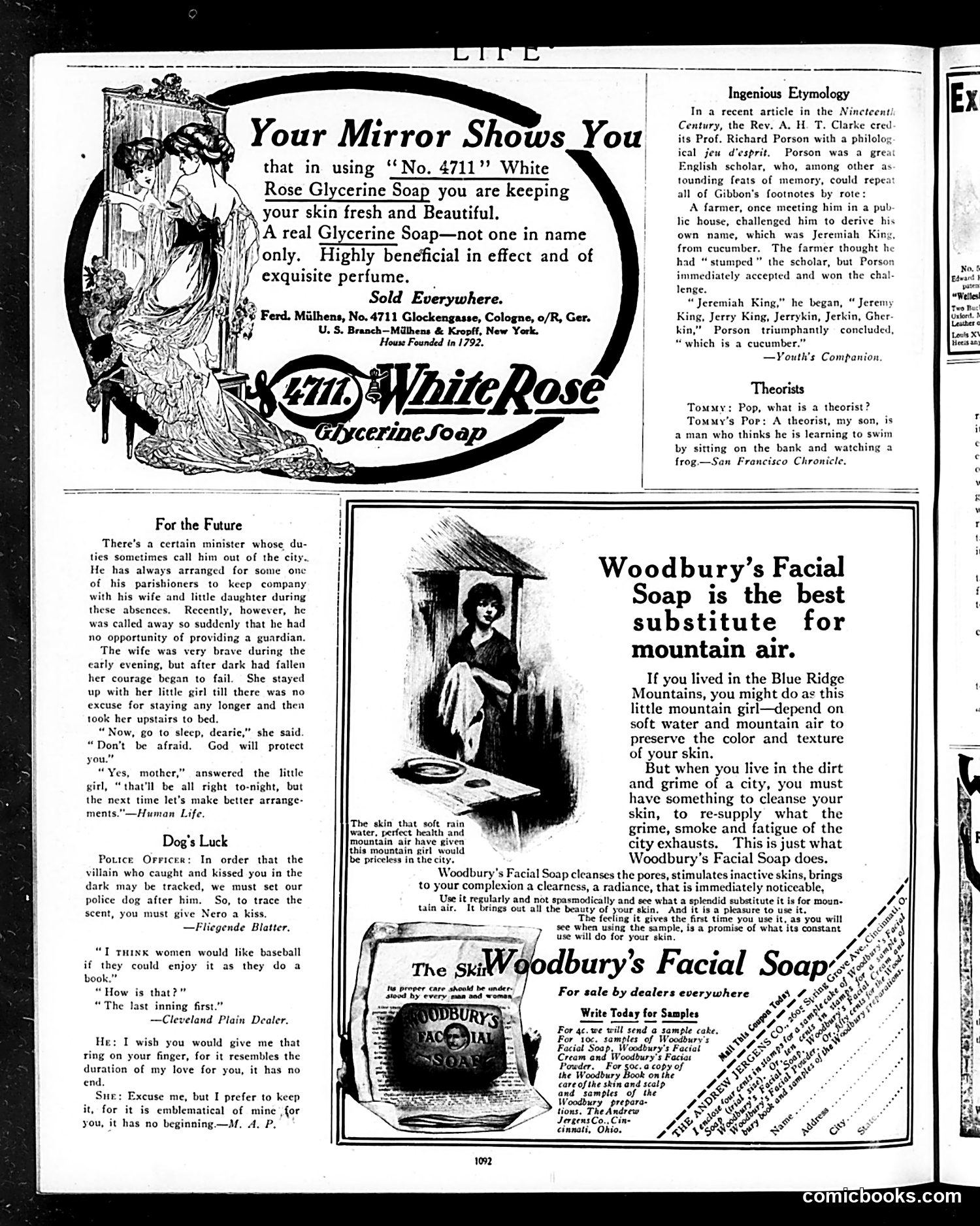
This page consists primarily of **advertisements** rather than satirical cartoons, though it contains some brief humorous anecdotes. The main content includes ads for **No. 4711 White Rose Glycerine Soap** and **Woodbury's Facial Soap**, typical of early 20th-century product marketing that promised skin beautification. The small text pieces ("For the Future," "Dog's Luck," "Theorists") are brief joke columns—a standard Life magazine feature. They employ gentle, domestic humor: a minister's wife needing protection, a police dog tracking a villain by scent, and a child's observation about courage. The "Ingenious Etymology" section recounts an anecdote about Professor Richard Porson (a real classical scholar) who supposedly derived "Jeremiah King" from "cucumber"—wordplay humor that would appeal to educated readers familiar with linguistic games. The page reflects **early 1900s periodical style**: advertising-heavy, mixing short humorous pieces with product promotion, targeting a middle-to-upper-class readership amused by puns, domestic situations, and scholarly references.
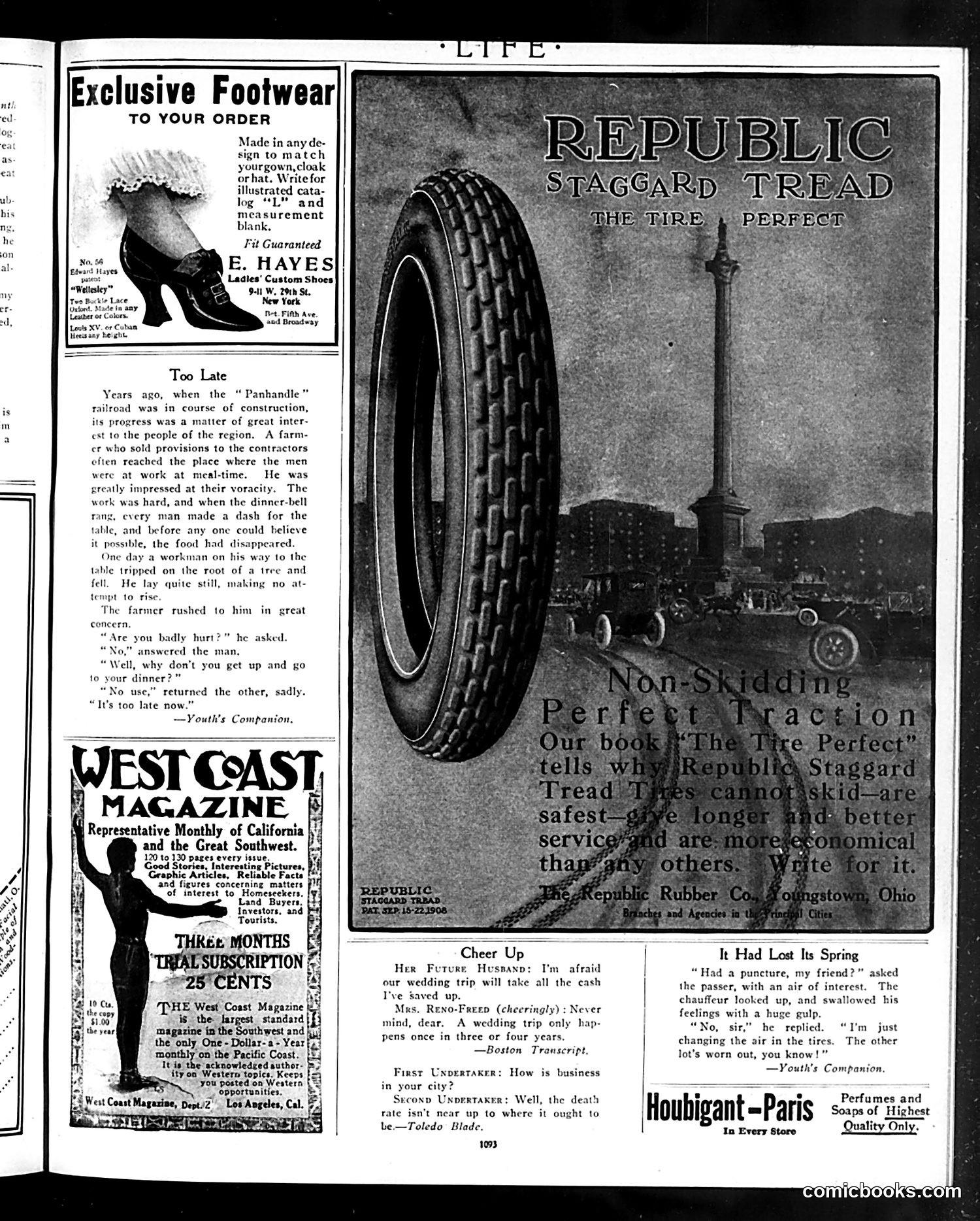
This page is primarily **advertising** with brief humorous anecdotes. The main content includes: **Advertisements:** - E. Hayes custom women's shoes (exclusive footwear to order) - West Coast Magazine (California/Southwest publication) - Republic Staggard Tread tires (emphasizing non-skidding traction) - Houbigant-Paris perfumes and soaps **Three brief humorous pieces** titled "Too Late," "Cheer Up," and "It Had Lost Its Spring"—typical of *Life*'s satirical humor section. These are gentle joke-anecdotes rather than political cartoons: - "Too Late" describes a railroad worker too injured to reach dinner - "Cheer Up" jokes about wedding trip expenses - "It Had Lost Its Spring" is wordplay about a deflated tire The page reflects early-1900s consumer culture and *Life*'s mix of advertising with light social humor. No political figures or significant satire are evident. The tire advertisement's emphasis on safety suggests contemporary automotive concerns during the rapid adoption of motorized vehicles.
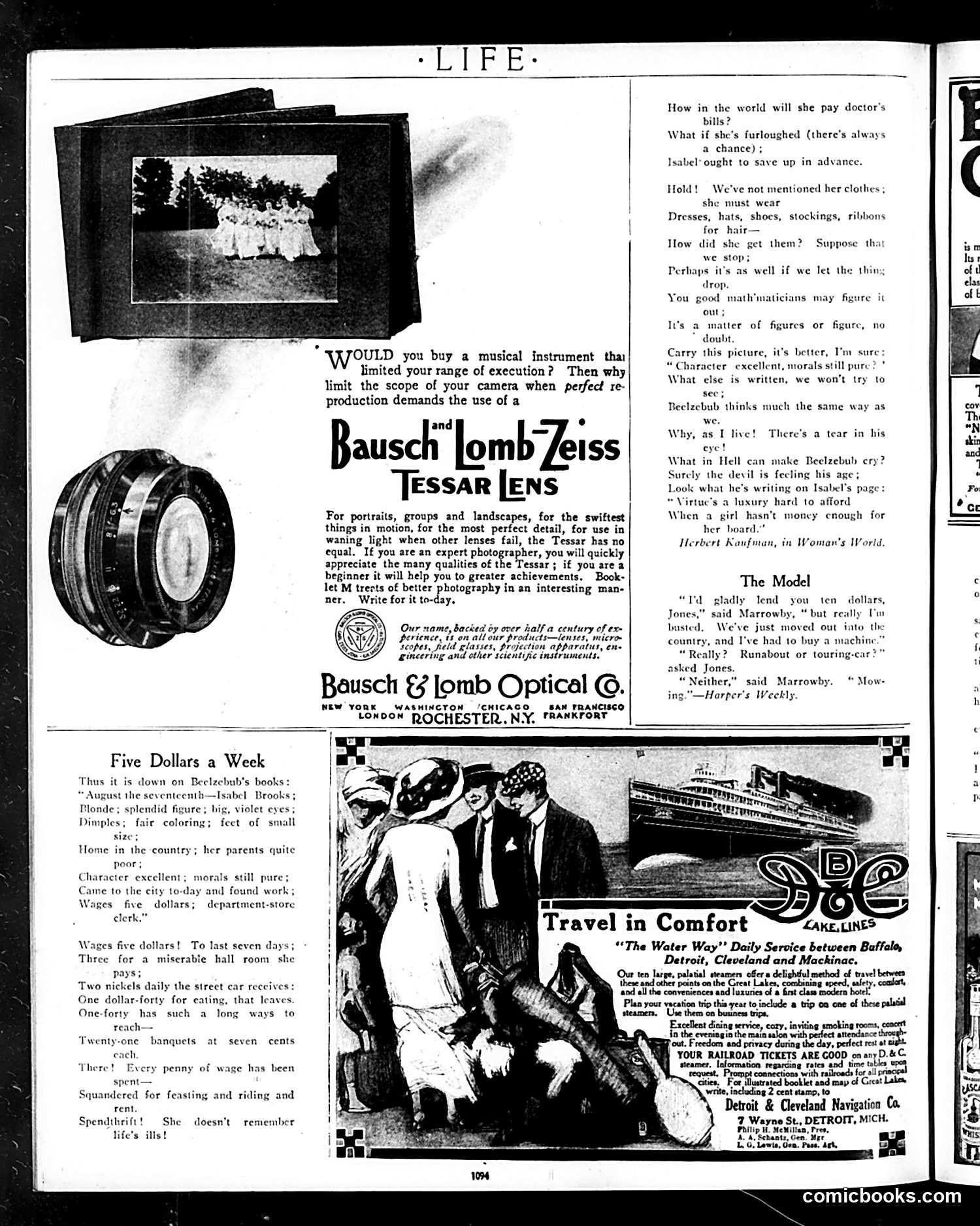
This page contains two distinct satirical pieces about working women's economic precarity in early 20th-century America. **"Five Dollars a Week"** (left column) tells the story of Isabel Brooks, a young woman earning five dollars weekly as a department-store clerk. The narrative sardonically itemizes her expenses—rent, streetcar fare, food—demonstrating that her wages cannot cover basic necessities like clothing and medical care. The satire's target is the economic system forcing virtuous, hardworking women into impossible financial situations. The piece references "Beelzebub's books," implying that the devil himself records how poverty drives women toward moral compromise—a critique of how economic desperation threatens women's virtue. **"The Model"** (right column) humorously depicts a woman trying to impress a friend by claiming she's bought a car, revealing the absurdity of working-class women attempting to maintain appearances of wealth they cannot afford. Both pieces critique the inadequacy of women's wages and the social pressure to maintain respectability on impossible incomes. The page also contains period advertisements for camera lenses and lake steamers.
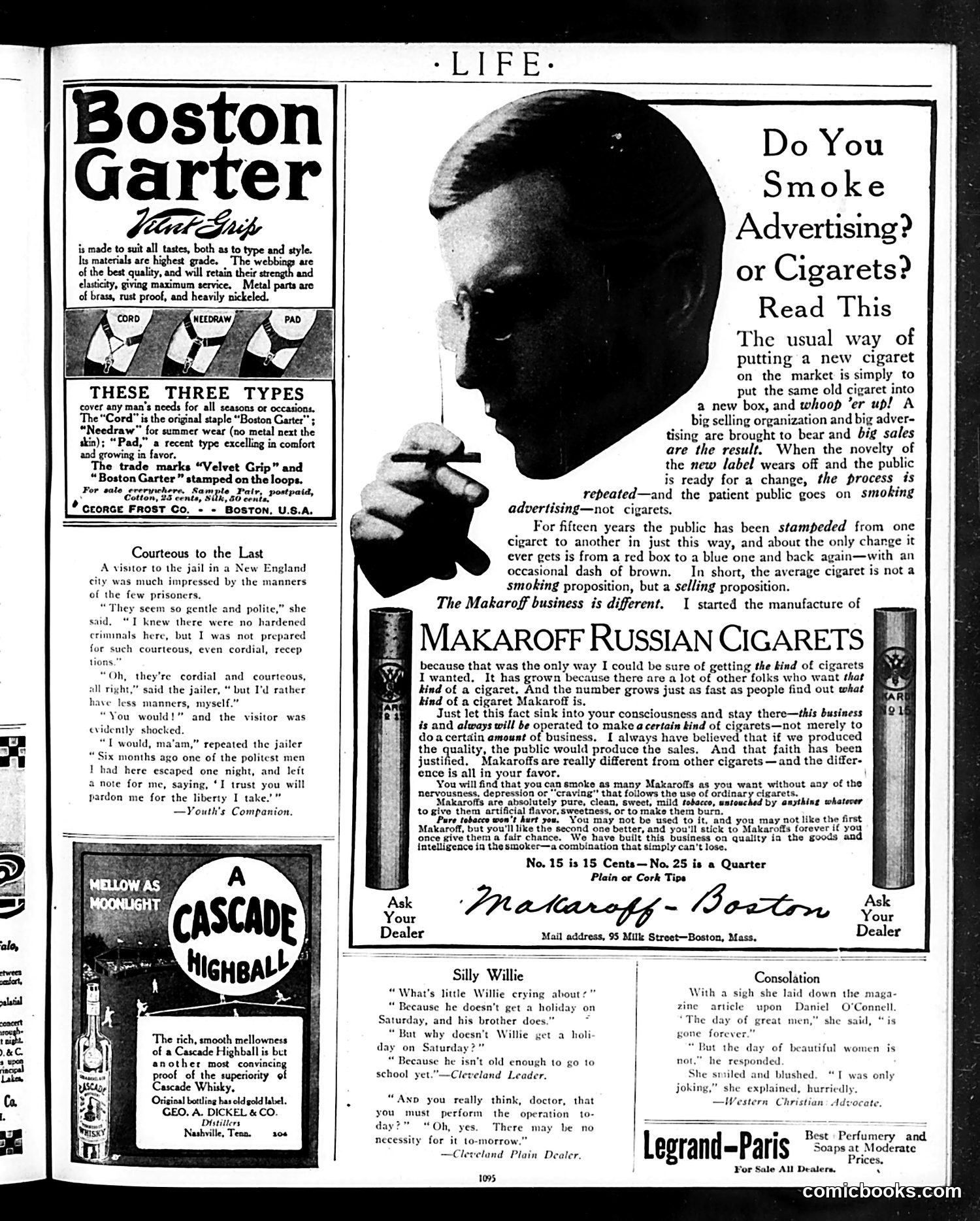
This page combines product advertisements with satirical commentary on cigarette marketing. The **main satire** is the Makaroff Russian Cigarets advertisement, which ironically critiques cigarette marketing practices while promoting its own product. The large illustration shows a man smoking, and the text explicitly mocks how cigarette companies simply repackage identical products in new boxes with aggressive advertising—"the patient public goes on smoking advertising—not cigarets." The advertisement admits the industry relies on novelty and hype rather than actual product differences (red boxes to blue boxes). Makaroff distinguishes itself by claiming to sell *quality* rather than marketing, using "pure" Russian tobacco without artificial additives. This is classic satirical advertising: exposing the industry's dishonesty while positioning oneself as the honest exception. The other content includes a Boston Garter advertisement, a Cascade Highball liquor ad, and humorous anecdotes about polite prisoners. The page reflects early 20th-century consumer skepticism about advertising claims.
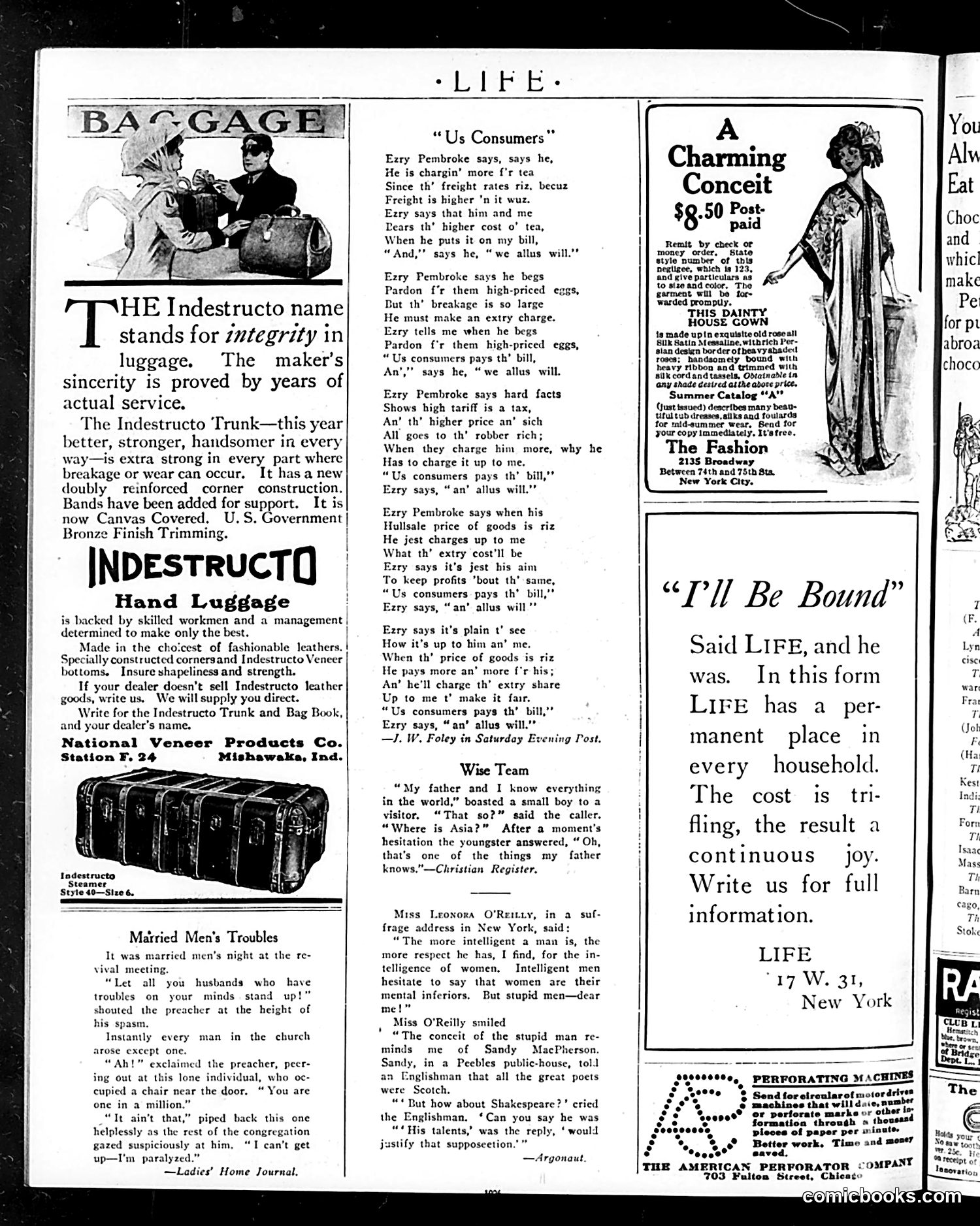
This page is primarily **advertising and humor pieces** rather than political cartoons. The main satirical content is the poem **"Us Consumers"** by W. Foley, which critiques price-gouging by merchants who blame inflation on rising freight rates and wholesale costs. The merchant character "Ezry Pembroke" repeatedly raises prices on tea and eggs, claiming higher input costs, while ultimately passing all expenses to consumers. The satire targets merchants' excuses for profiteering—the poem's refrain "Us consumers pays th' bill, an' allus will" suggests working people inevitably absorb all cost increases regardless of their legitimacy. The other humor pieces are gentle: "Married Men's Troubles" jokes about a paralyzed man at a church meeting, and anecdotes mock pretentiousness (a boy claiming his father knows everything; a Scotsman defending Shakespeare as Scottish). The **Indestructo luggage advertisements** dominate the left side, emphasizing durability and integrity—ironic juxtaposition with the consumer-exploitation poem.
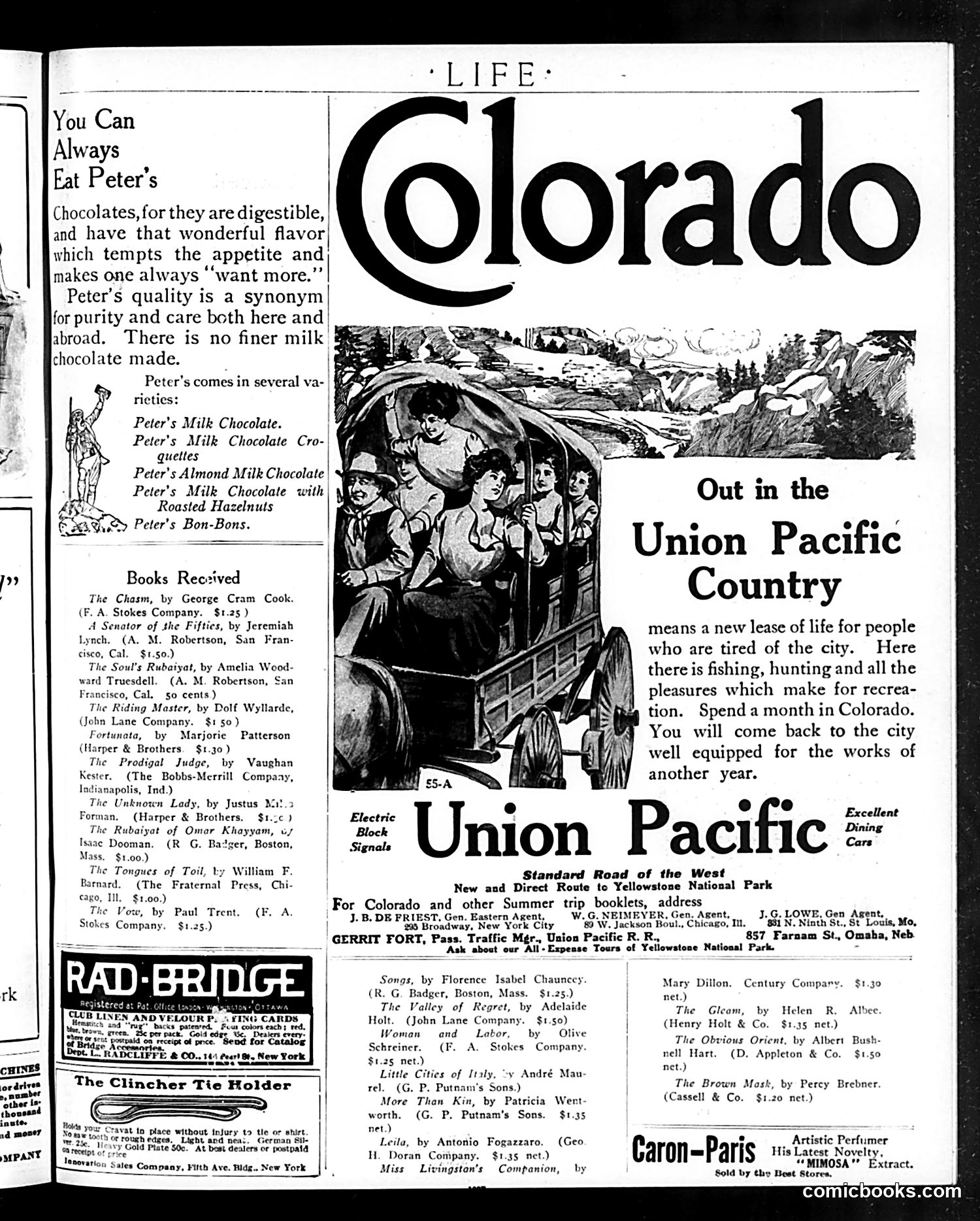
This page is primarily **advertising and book reviews** rather than political satire. It contains: **Main Content:** - Peter's Chocolates advertisement emphasizing digestibility and quality - A Union Pacific Railroad advertisement featuring Colorado tourism, with an illustration of a family in a railcar heading to mountain scenery - Extensive "Books Received" section listing newly published titles - Small product advertisements (Rad-Bridge playing cards, Clincher tie holder, Caron-Paris perfume) **The Colorado/Union Pacific imagery** depicts early 20th-century leisure travel—positioning Colorado mountain recreation as urban workers' escape and rejuvenation. The railroad marketed vacations as necessary rest cures for city workers. **No political cartoons or satire appear on this page.** This is a typical Life magazine interior page from the era, blending editorial book coverage with period advertisements for consumer goods and travel services.
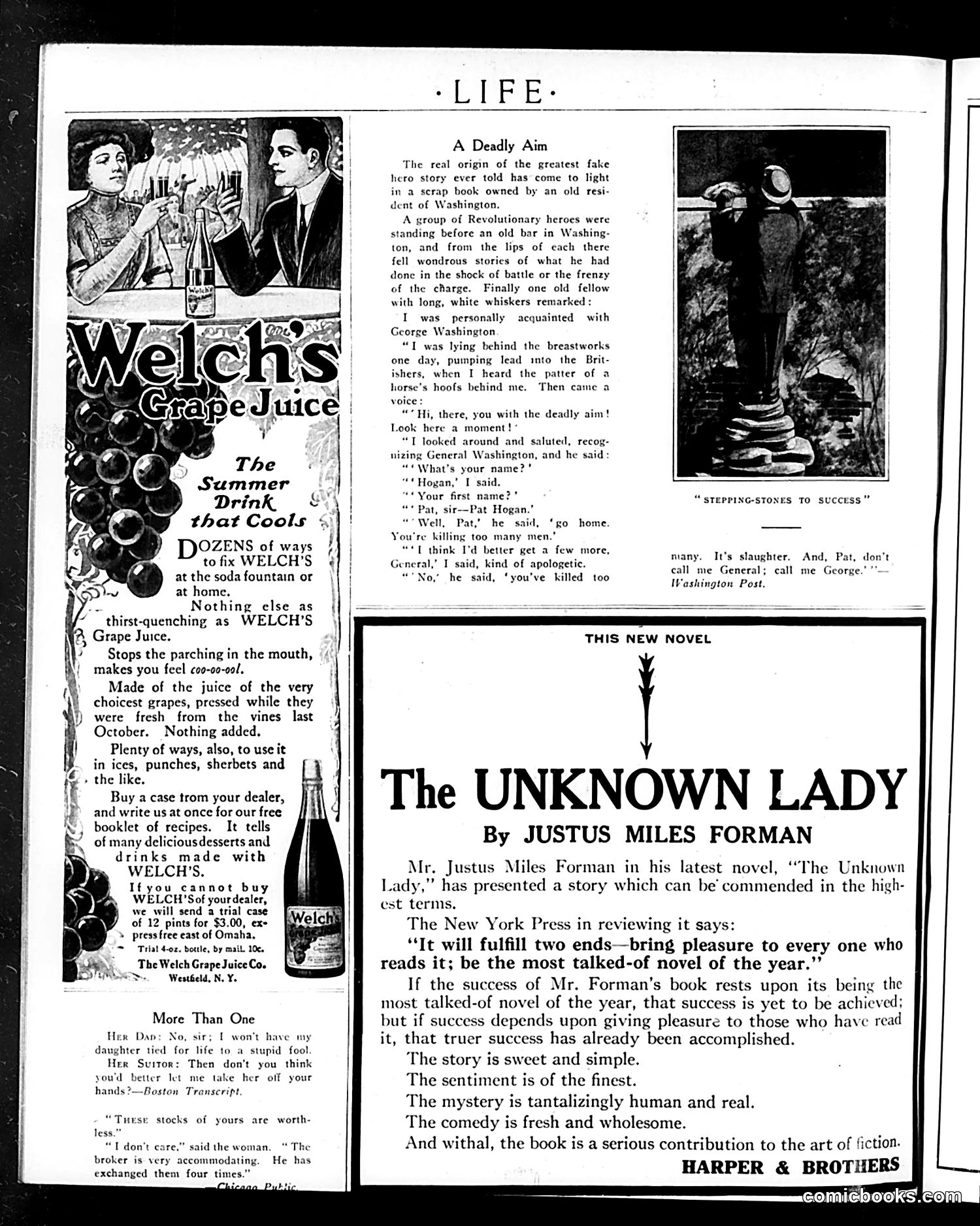
This page contains a humorous anecdote satirizing inflated Revolutionary War heroics and false legends about George Washington. The setup: Revolutionary veterans boast of battlefield exploits at a Washington bar. One claims Washington personally praised his marksmanship, calling him "the deadly aim." Washington allegedly told him to *stop* killing so many British soldiers because it was becoming mere slaughter—and instructed him to call him "George" rather than "General." **The satire**: The joke exposes how apocryphal hero stories circulate about historical figures. The absurd punchline (a general asking a soldier to *reduce* his killing) undercuts the grandiose war narratives. By crediting the "Washington Post" as source, Life suggests even newspapers perpetuate dubious folklore. The surrounding page features a Welch's Grape Juice advertisement and a book announcement for "The Unknown Lady" by Justus Miles Forman.
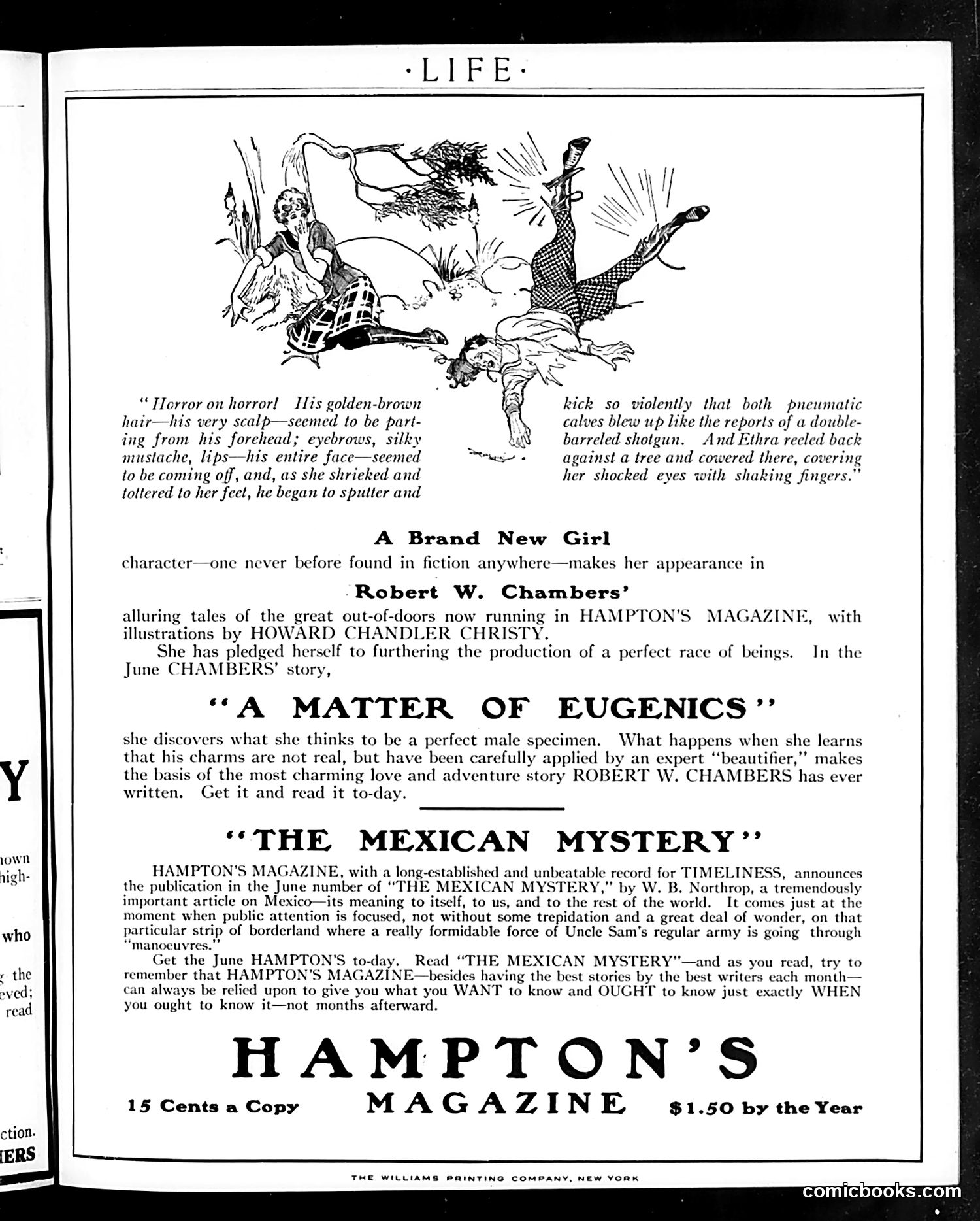
This is primarily an **advertising page** for Hampton's Magazine, featuring promotional copy for three upcoming articles. The crude cartoon at top illustrates a scene from Robert W. Chambers' story "A Matter of Eugenics"—showing a woman's horrified reaction upon discovering a man's physical beauty is artificial, applied by a "beautifier." The **satire targets early 20th-century eugenics pseudoscience**: a woman seeking to breed a "perfect race" is duped by cosmetic deception. The joke mocks both eugenics ideology and masculine vanity—the "perfect specimen" is literally fake. The page also advertises "The Mexican Mystery," capitalizing on contemporary American anxiety about Mexican border instability and U.S. military "manoeuvres" (likely referencing the Mexican Revolution era). The advertisements emphasize Hampton's Magazine's claim to timely, relevant reporting—suggesting readers trust it to deliver important news precisely when they need it.
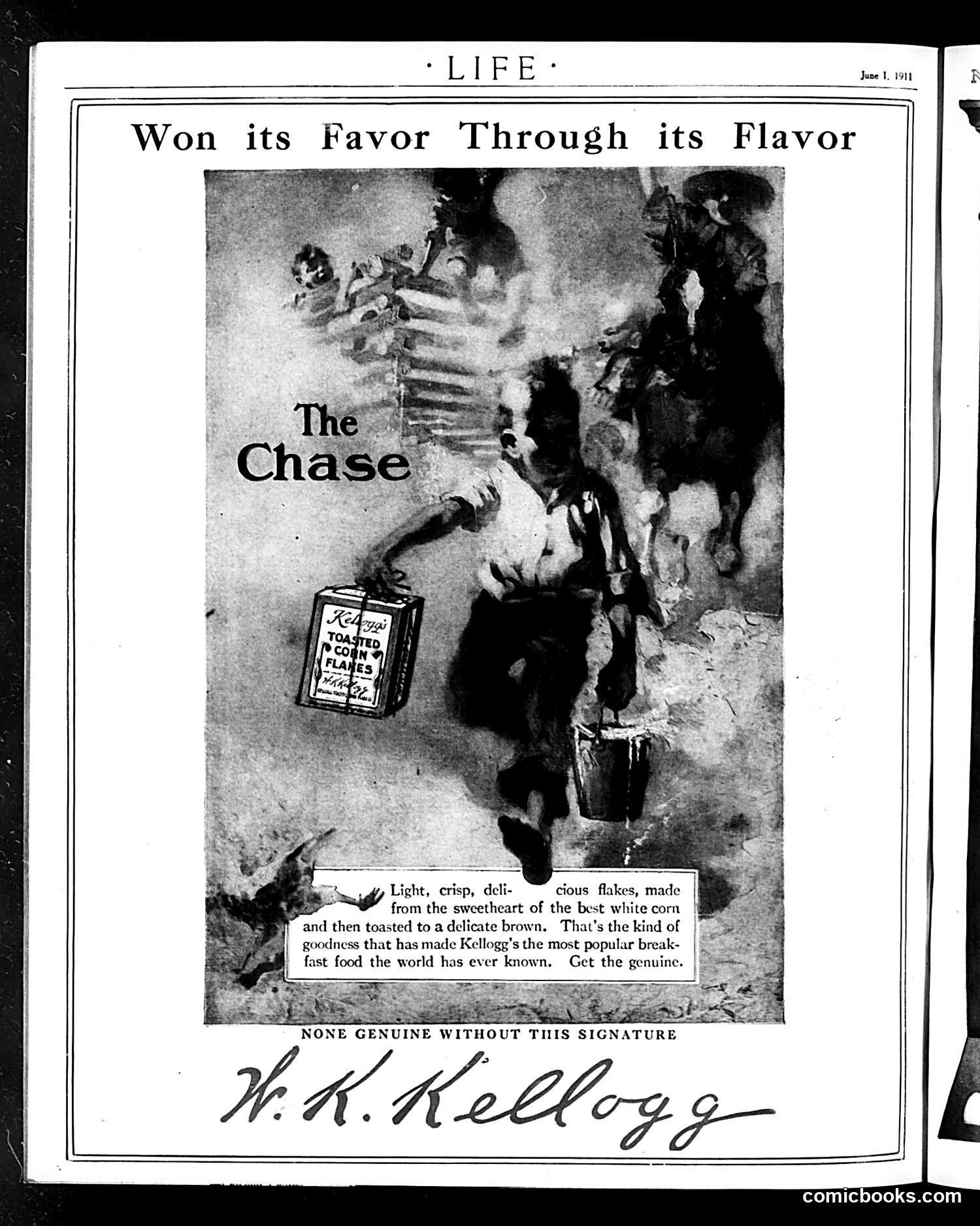
This is a Kellogg's cereal advertisement from Life magazine (June 1, 1911), not political satire. The headline "Won its Favor Through its Flavor" frames "The Chase"—an illustrated scene showing figures pursuing a box of Kellogg's cereal as if it's a prized object worth chasing. The advertisement uses humor to suggest Kellogg's popularity is so compelling that people eagerly pursue it. The descriptive text emphasizes the product's quality: corn flakes toasted to "delicate brown," positioning Kellogg's as the superior, "genuine" breakfast food. The signature authenticates the product against counterfeits. This is purely commercial advertising using playful imagery to create brand appeal, not commentary on contemporary politics or social issues.