
Life, 1911-06-01 · page 24 of 52
Life — June 1, 1911 — page 24: what you’re looking at
What you’re looking at
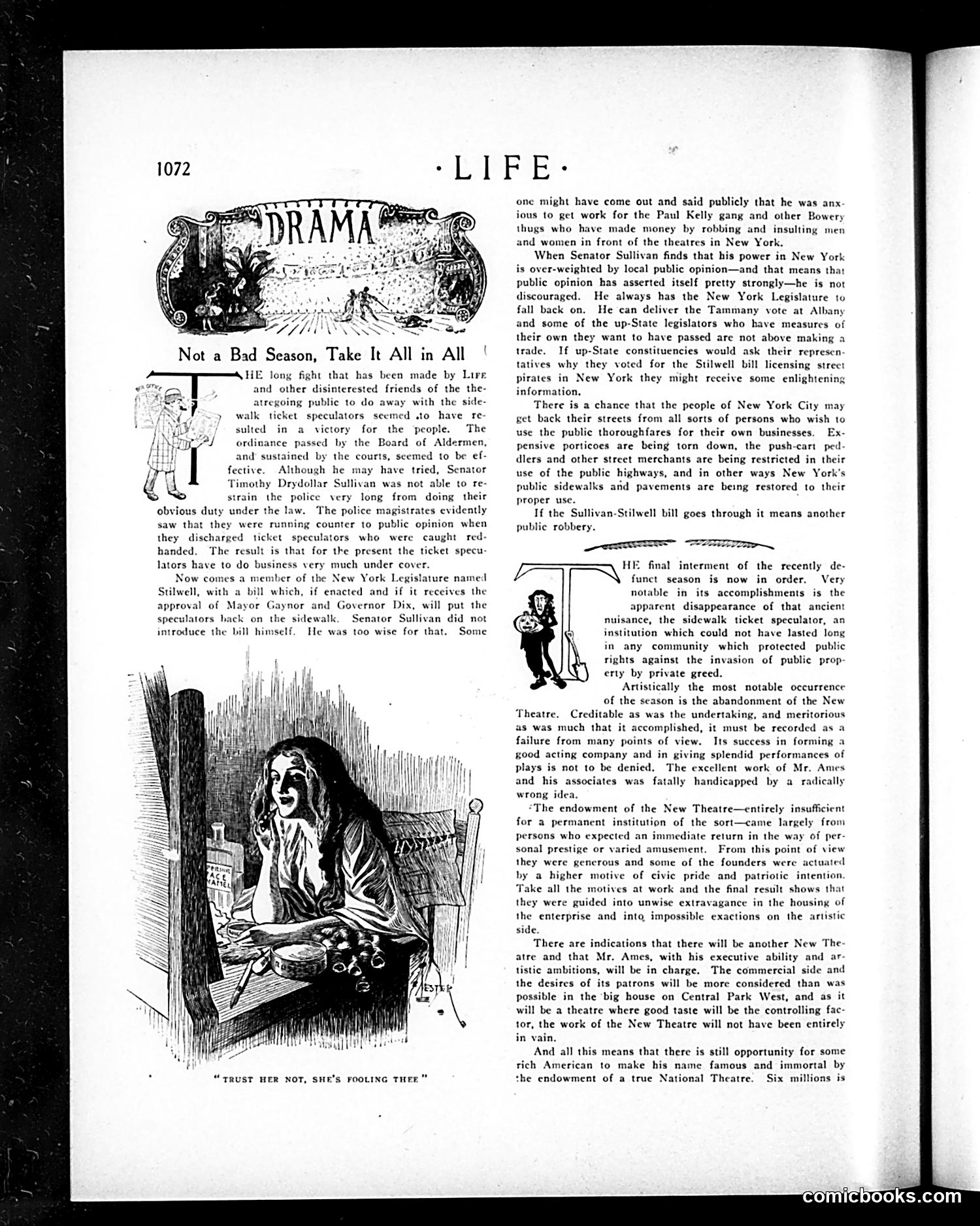
This page critiques corruption in New York theater ticketing. The main cartoon depicts a woman (likely representing the public or theater-goers) being deceived, captioned "Trust Her Not, She's Fooling Thee"—illustrating how citizens are manipulated by crooked operators. The article attacks **Senator Timothy Sullivan** (a real Tammany Hall politician), who allegedly protects sidewalk ticket scalpers operating near theaters. When Mayor Gaynor's administration briefly enforces anti-scalping laws, Sullivan supposedly uses his influence in the state legislature (via legislator Stilwell's proposed bill) to legalize scalping again—enabling Paul Kelly's Bowery gang to profit from intimidating theater patrons. Life argues this represents public corruption: wealthy Tammany politicians and upstate legislators trade votes to overturn city reforms protecting public streets and rights. The satire portrays machine politics as literally selling public space to private criminals.
📄 Transcribed text from this page (OCR, searchable)
Machine-transcribed from the original scan — historical spelling and the odd misread are preserved.
Ba a ade Not a Bad Season, Take It All i in All HE long fight that has been made by Lire and other disinterested friends of the the- atregoing public to do away with the side- walk ticket speculators seemed .to have re sulted in a victory for the people. The ordinance passed by the Board of Aldermen, and’ sustained by the courts, seemed to be ef- fective. Although he may have tried, Senator Timothy Drydollar Sullivan was not able to re- strain the police very long from doing their obvious duty under the law. The police magistrates evidently they were running counter to public opinion when licket eculators who were caught red- The result is that for the present the ticket specu- ave to do business very much under cover. Now comes a member of the New York Legislature named Stilwell, with a bill which, if enacted and if it receives the approval of Mayor Gaynor and Governor Dix, will put the speculators k on the sidewalk. Senator Sullivan did not introduce the bill himself. He was too wise for that. Some “TRUST HER NOT, SHE'S FOOLING THEE” one might have come out and said publicly that he was anx. ious to get work for the Paul Kelly gang and other Bowery thugs who have made money by robbing and insulting men and women in front of the theatres in New York. When Senator Sullivan finds that his power in New York is over-weighted by local public opinion—and that means that public opinion has asserted itself pretty strongly—he is not discouraged. He always has the New York Legislature to fall back on. He can deliver the Tammany vote at Albany and some of the up-State legislators who have measures of their own they want to have passed are not above making a trade. If up-State constituencies would ask their represen: tatives why they voted for the Stilwell bill licensing strect pirates in New York they might receive some enlightening information. There is a chance that the people of New York City may get back their streets from all sorts of persons who wish to use the public thoroughfares for their own businesses. E: pensive porticoes are being torn down, the push-cart ped dlers and other street merchants are being restricted in their use of the public highways, and in other ways New York's public sidewalks and pavements are being restored to their Proper use. If the Sullivan-Stilwell bill goes through it means another public robbery. HE final interment of the recently de- funct season is now in order. Very notable in its accomplishments is the apparent disappearance of that ancient nuisance, the sidewalk ticket speculator, an institution which could not have lasted long in any community which protected public rights against the invasion of public prop- erty by private greed. Artistically the most notable occurrence of the season is the abandonment of the New Theatre. Creditable as was the undertaking, and meritorious as was much that it accomplished, it must be recorded as a failure from many points of view. Its success in forming a good acting company and in giving splendid performances of plays is not to be denied, The excellent work of Mr. Ames and his associates was fatally handicapped by a radically wrong idea. ‘The endowment of the New Theatre—entirely insufficient for a permanent institution of the sori—came largely from persons who expected an immediate return in the way of per- sonal prestige or varied amusement. From this point of view they were generous and some of the founders were actuated by a higher motive of civic pride and patriotic intention Take all the motives at work and the final result shows that they were guided into unwise extravagance in the housing of the enterprise and into, impossible exactions on the artistic side There are indications that there will be another New The atre and that Mr. Ames, with his executive ability and ar tistic ambitions, will be in charge. The commercial side and the desires of its patrons will be more considered than was possible in the ‘big house on Central Park West, and as it will be a theatre where good taste will be the controlling fac- tor, the work of the New Theatre will not have been entirely in vain, And all this means that there is still opportunity for some rich American to make his name famous and immortal by the endowment of a true National Theatre. Six millions is ‘Comicbooks.com