
Life, 1911-06-01 · page 25 of 52
Life — June 1, 1911 — page 25: what you’re looking at
What you’re looking at
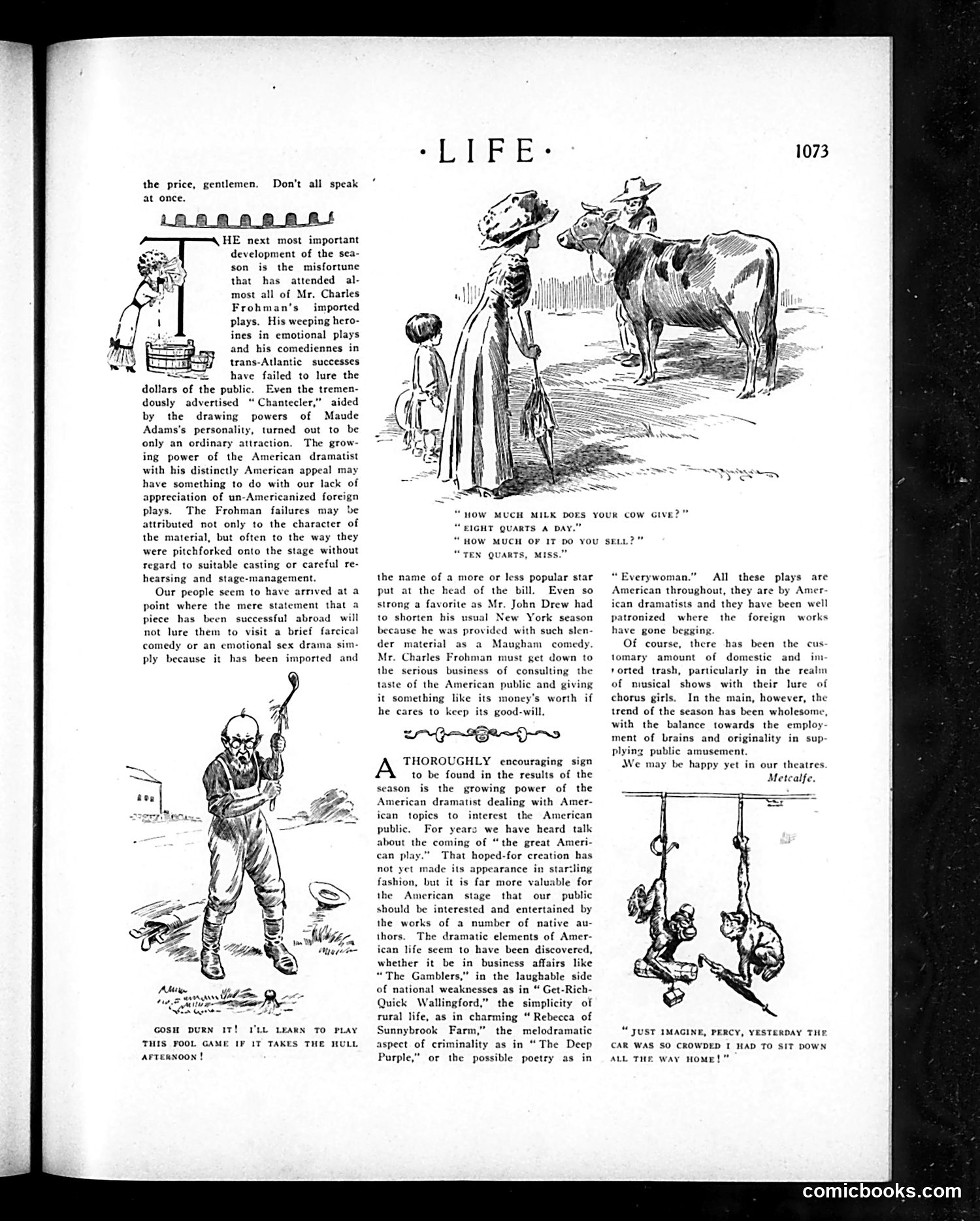
This page critiques the American theater season, specifically attacking impresario Charles Frohman's strategy of importing European plays with star names. The text argues that audiences now prefer American-written plays addressing American themes over foreign imports, even when headlined by famous actors like John Drew. The cartoons illustrate the point satirically: the top sketch shows a woman haggling over milk prices (a "foreign" economic absurdity), while the bottom depicts a determined figure learning to play golf—both suggesting Americans prefer homegrown, practical pursuits. The final cartoon pokes fun at modern inconvenience (crowded cars). The article celebrates emerging American dramatists like those behind "Rebecca of Sunnybrook Farm" and "Get-Rich-Quick Wallingford," arguing native talent better serves American audiences than prestigious but irrelevant foreign material. This reflects early 20th-century cultural nationalism—the belief that American entertainment should reflect American life and values.
📄 Transcribed text from this page (OCR, searchable)
Machine-transcribed from the original scan — historical spelling and the odd misread are preserved.
the price, gentlemen. Don't all speak at once. IA AM OO A AS HE next most important < | development of the sea- = son is the misfortune n\: that has attended al- . most all of Mr. Charles Frohman’s imported plays. His weeping hero- ines in emotional plays ~y and his comediennes in F327 trans-Atlantic successes SSE have failed to lure the dollars of the public. Even the tremen- dously advertised “ Chantecler,” aided by the drawing powers of Maude Adams's personality, turned out to be only an ordinary attraction. The gro ing power of the American dramatist with his distinctly American appeal may have something to do with our lack of appreciation of un-Americanized foreign plays. The Frohman failures may be attributed not only to the character of the material, but often to the way they were pitchforked onto the stage without regard to suitable casting or careful re- hearsing and stage-management. Our people seem to have arrived at a point where the mere statement that a piece has been successful abroad will not lure them to visit a brief farcical comedy or an emotional sex drama sim- ply because it has been imported and Abition 2 enn GOSH DURN IT! I'LL LEARN TO PLAY THIS FOOL GAME IF 1T TAKES THE HULL AFTERNOON ! “MOW MUCH MILK DOES YOUR COW GiV “BIGHT QUARTS A DAY.” “HOW MUCH OF IT DO You SELL?” “TEN QUARTS, MISS.” the name of a more or less popular star put at the head of the bill. Even so strong a favorite as Mr. John Drew had to shorten his usual New York season because he was provided with such slen- der material as a Maugham Mr. Charles Frohman must get down to the serious business of consulting the taste of the American public and giving it something like its money's worth if he cares to keep its good-will. UG G2— THOROUGHLY encouraging sign to be found in the results of the season is the growing power of the American dramatist dealing with Amer- ican topics to interest the American public. For years we have heard talk about the coming of “the great Ameri- can play.” That hoped-for creation has not yet made its appearance in star:ling fashion, but it is far more valuable for the American stage that our public should be interested and entertained by the works of a number of native au- thors. The dramatic elements of Amer- ican life seem to have been discovered, whether it be in business affairs like “The Gamblers,” in the laughable side of national weaknesses as in “ Get-Rich- Quick Wallingford,” the simplicity of rural life, as in charming “ Rebecca of Sunnybrook Farm,” the melodramatic aspect of criminality as in “The Deep Purple,” or the possible poetry as in comedy. “Everywoman.” All these plays are American throughout, they are by Amer ican dramatists and they have been well patronized where the foreign works have gone begging. Of course, there has been the cus tomary amount of domestic and im rorted trash, particularly in the realm of musical shows with their lure of chorus girls. In the main, however, the trend of the season has been wholesome, with the balance towards the employ- ment of brains and originality in sup- plying public amusement. We may be happy yet in our theatres. Metcalfe. “ JUST IMAGINE, PERCY, YESTERDAY THE CAR WAS SO CROWDED I HAD TO SIT DOWN ALL THE WAY NOME comicbooks.com