
Life, 1911-06-01 · page 12 of 52
Life — June 1, 1911 — page 12: what you’re looking at
What you’re looking at
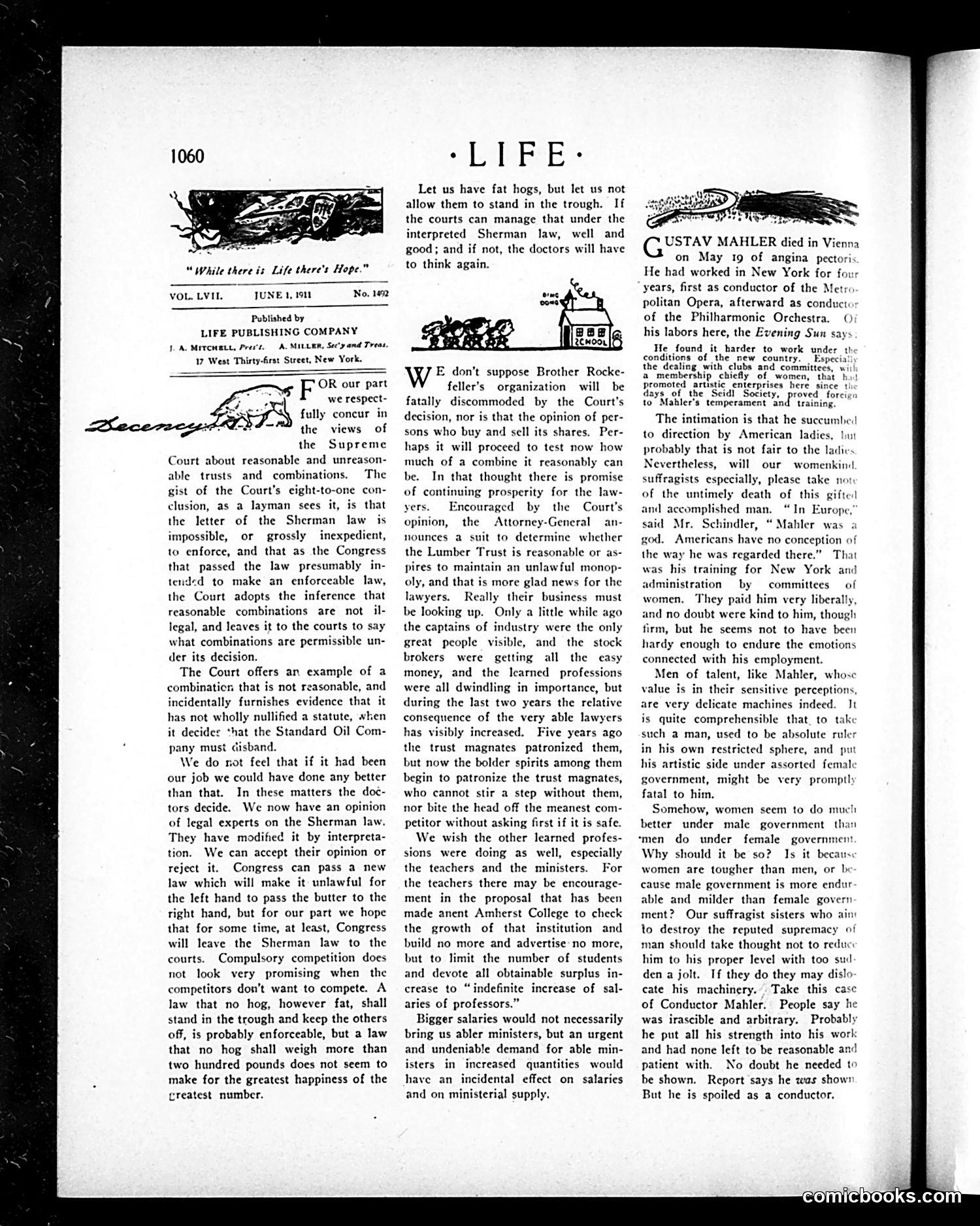
**The Cartoon ("While there is Life there's Hope"):** A small illustration shows a thin pig in a trough, depicting poverty or deprivation. The caption suggests perseverance despite hardship—a visual metaphor for struggling through difficult times. **The Editorial Content:** The main article defends the Supreme Court's decision regarding the Standard Oil Company breakup and trusts/monopolies. It argues the Court properly interpreted Sherman antitrust law, rejecting claims that reasonable combinations are impossible to enforce. The piece also critiques wealthy industries and professions (lawyers, doctors) for declining influence and argues for higher ministerial salaries and limits on university expansion. **Historical Context:** This reflects the Progressive Era's trust-busting debates under Presidents Theodore Roosevelt and William Howard Taft, when monopolies faced legal challenges.
📄 Transcribed text from this page (OCR, searchable)
Machine-transcribed from the original scan — historical spelling and the odd misread are preserved.
“While there is Life there's Hope.” VOL. LVIT. JUNE 1, 1911 Published by LIFE PUBLISHING COMPANY JA. MITCHELL, Pree, A. MILLER, Sec'y and Treas, 17 West Thirty-first Street, New York. OR our part we respect- fully concur in the views of the Supreme Court about reasonable and unreason- able trusts and combinations, The gist of the Court’s cight-to-one con- clusion, as a layman sees it, is that the letter of the Sherman law is impossible, or grossly inexpedient, to enforce, and that as the Congress that passed the law presumably in- tended to make an enforceable law, the Court adopts the inference that reasonable combinations are not il- legal, and leaves it to the courts to say what combinations are permissible un- der its decision. The Court offers an example of a combination that is not reasonable, and incidentally furnishes evidence that it has not wholly nullified a statute, when it decides ‘hat the Standard Oil Com- pany must disband. We do not feel that if it had been our job we could have done any better than that. In these matters the doc- tors decide. We now have an opinion of legal experts on the Sherman law. They have modified it by interpreta- tion. We can accept their opinion or reject it. Congress can pass a new law which will make it unlawful for the left hand to pass the butter to the right hand, but for our part we hope that for some time, at least, Congress will leave the Sherman law to the courts. Compulsory competition does not look very promising when the competitors don’t want to compete. A law that no hog, however fat, shall stand in the trough and keep the others off, is probably enforceable, but a law that no hog shall weigh more than two hundred pounds does not seem to make for the greatest happiness of the createst number. > IRESE Let us have fat hogs, but let us not allow them to stand in the trough. If the courts can manage that under the interpreted Sherman law, well and good; and if not, the doctors will have to think again. W* don’t suppose Brother Rocke- feller’s organization will be fatally discommoded by the Court’s decision, nor is that the opinion of per- sons who buy and sell its shares, Per- haps it will proceed to test now how much of a combine it reasonably can be. In that thought there is promise of continuing prosperity for the law- yers. Encouraged by the Court's the Attorney-General an- nounces a suit to determine whether the Lumber Trust is reasonable or as- pires to maintain an unlawful monop- oly, and that is more glad news for the lawyers. Really their business must be looking up. Only a little while ago the captains of industry were the only great people visible, and the stock brokers were getting all the casy money, and the Icarned professions were all dwindling in importance, but during the last two years the relative consequence of the very able lawyers has visibly increased. Five years ago the trust magnates patronized them, but now the bolder spirits among them begin to patronize the trust magnates, who cannot stir a step without them, nor bite the head off the meanest com- petitor without asking first if it is safe. We wish the other learned profes- sions were doing as well, especially the teachers and the ministers. For the teachers there may be encourage- ment in the proposal that has been made anent Amherst College to check the growth of that institution and build no more and advertise no more, but to limit the number of students and devote all obtainable surplus in- crease to “indefinite increase of sal- aries of professors.” Bigger salaries would not necessarily bring us abler ministers, but an urgent and undeniable demand for able min- isters in increased quantities would have an incidental effect on salaries and on ministerial supply, opinion, USTAV MAHLER died in Vienna on May 19 of angina pect He had worked in New York for fou years, first as conductor of the Met politan Opera, afterward as conduct: of the Philharmonic Orchestra. © his labors here, the Evening Sun says He found it harder to work under th conditions of the new country. Especia!)s the dealing with clubs and committees, wi a membership chiefly of women, that ha! promoted artistic enterprises here since days of the Seidl Society, proved foreivn to Mahler's temperament and training. The intimation is that he succumbei! to direction by American ladies, but probably that is not fair to the ladies Nevertheless, v our womenkind suffragists especially, please take no of the untimely death of this gif and accomplished man. “In Europe, said Mr. Schindler, “ Mahler was a god. Americans have no conception of the way he was regarded there.” That was his training for New York and administration by committees of women, They paid him very liberally, and no doubt were kind to him, though firm, but he seems not to have been hardy enough to endure the emotions connected with his employment. Men of talent, like Mahler, whose value is in their sensitive perceptions, are very delicate machines indeed. It is quite comprehensible that. to take such a man, used to be absolute ru in his own restricted sphere, and put his artistic side under assorted female government, might be very promptly fatal to him. Somehow, women seem to do much better under male government than ‘men do under female government Why should it be so? Is it because women are tougher than men, or by cause male government is more endur able and milder than female govern ment? Our suffragist sisters who ainr to destroy the reputed supremacy of man should take thought not to reduc« him to his proper level with too sud den a jolt. If they do they may dislo cate his machinery. Take this case of Conductor Mahler. People say he was irascible and arbitrary. Probably he put all his strength into his work and had none left to be reasonable and patient with. No doubt he needed to be shown. Report says he was show But he is spoiled as a conductor.