
Life, 1911-06-01 · page 28 of 52
Life — June 1, 1911 — page 28: what you’re looking at
What you’re looking at
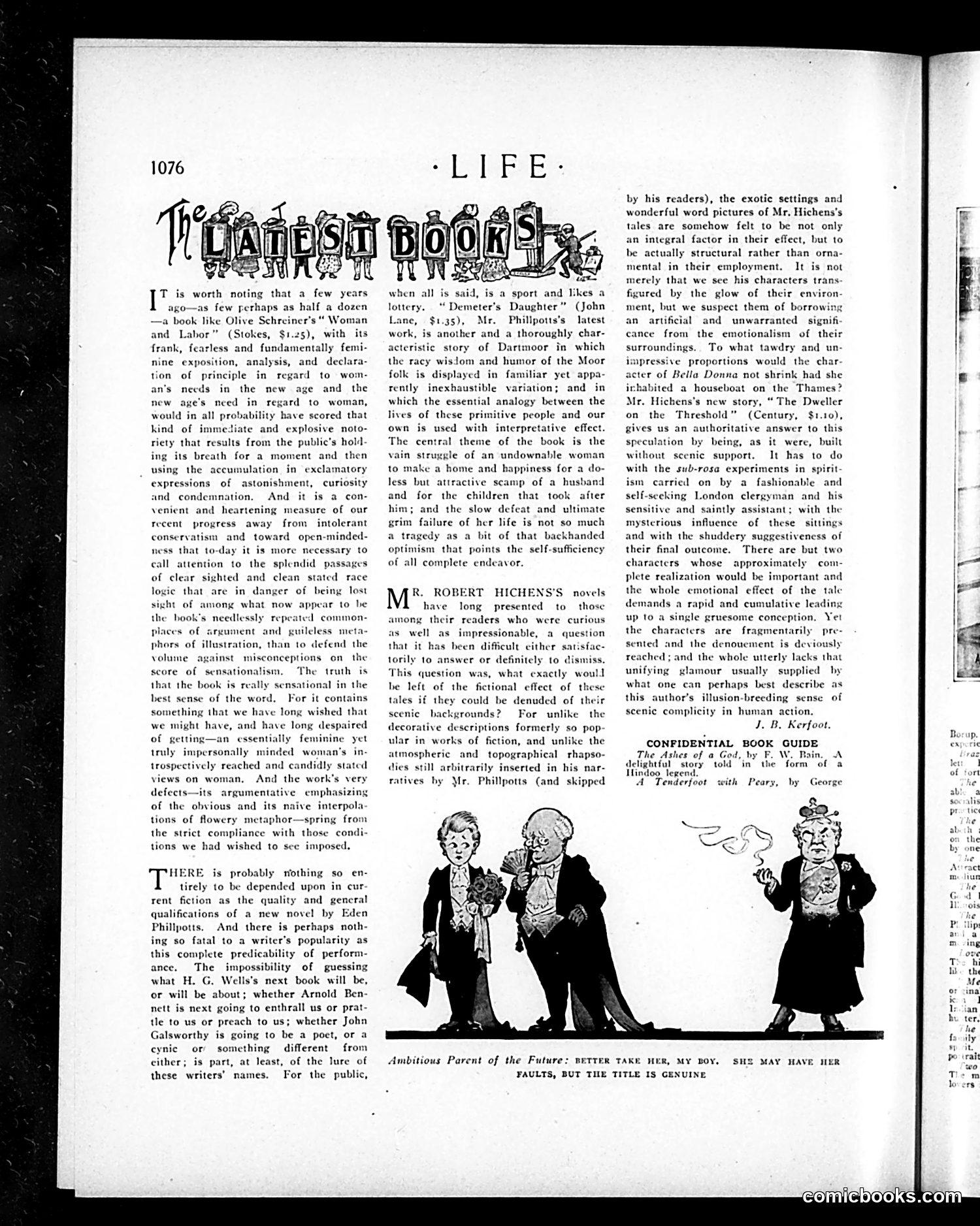
This page reviews three contemporary novels (circa 1910s). The cartoon at bottom depicts "Ambitious Parent of the Future," showing three figures in period dress with the caption: "Better take her, my boy. She may have her faults, but the title is genuine." **The satire:** This mocks anxious parents seeking advantageous marriages for daughters, suggesting they'll accept a woman with personal flaws if she brings a genuine aristocratic title—a critique of class-obsessed matchmaking and the lingering social value placed on nobility over character. **The reviews** discuss works by Eden Phillpotts (about Dartmoor folk) and Robert Hichens, praising their literary merit while debating whether predictability of style affects popularity. The page also references Olive Schreiner's *Woman and Labor*, celebrating it as an important feminist work that finally articulates women's needs candidly. **Context:** The magazine values literary quality and progressive social commentary, particularly regarding women's roles and class pretension.
📄 Transcribed text from this page (OCR, searchable)
Machine-transcribed from the original scan — historical spelling and the odd misread are preserved.
I" is worth noting that a few years ago—as few perhaps as half a dozen —a book like Olive Schreiner’s “ Woman and Labor” (Stokes, $1.25), with its frank, fearless and fundamentally femi- nine exposition, analysis, and dec! ion of principle in regard to wo an’s necds in the new age and the new age’s need in regard to woman, would in all probability have scored that kind of immediate and explosive noto- riety that results from the public's hold- ing its breath for a moment and then using the accumulation in exclamatory expressions of curiosity is a con- astonishment, And it venient and heartening measure of our progress away from intolerant conservatism and toward open-minded- yess that to-day it is 1 call attention to the splendid passages of clear sighted and clean si logic that are in danger of being lost and condemnation. recent necessary to ted race sight of among what now appear to be the book's needlessly repeated common- places of argument and guileless meta phors of illustration, than to defend the misconceptions on the score of sensationalism, ‘The truth is that the book is really sensational in the best sense of the word, For it contains volume against something that we have long wished that we might have, and have long despaired of getting—an essentially feminine yet inuly impersonally + 1 woman's in- trospectively reached and views on woman, And the work's very defects—its argumentative emphasizing of the obvious and its naive interpola tions of flowery metaphor—spring from andidly stated the strict compliance with those condi- tions we had wished to sce imposed. HERE js probably rothing so en- tirely to be depended upon in cur rent fiction as the quality and gencral qualifications of a new novel by Eden Phillpotts. And there is perhaps noth- ing so fatal to a writer's popularity as this complete predicability of perform- ance. The impossibility of guessing what H. G, Wells’s next book will be, or will be about; whether Arnold Ben- nett is next going to enthrall us or prat- tle to us of preach to us; whether John Galsworthy is going to be a poet, or a cynic or something different fron cither; is part, at least, of the lure of these writers’ names. For the public, when all is said, is a sport and Tikes a lottery.“ Demeter’s. Daughter” (John Lane, $1.35), Mr. Phillpotts’s latest work, is another and a thoroughly char- acteristic story of Dartmoor in which the racy wisdom and humor of the Moor folk is displayed in familiar yet appa- rently inexhaustible variation; and in which the essential analogy between the lives of these primitive people and our own is used with interpretative effect. The central theme of the book is the vain struggle of an undownable woman to make a home and happiness for a do- less but attractive scamp of a husband and for the children that took after him; and the slow defeat and ultimate grim failure of her life is not so much a tragedy as a bit of that backhanded optimism that points the self-sufficiency of all complete endeavor. M* ROBERT HICHENS'S novels have long presented to those among their readers who were curious as well as that it h torily to answer or definitely to dismiss. impressionable, a question s heen difficult either satisfac- This question was, what exactly woull he left of the fictional effect of these tales if they could be denuded of their scenic For unlike the decorative descriptions formerly so pop ular in works of fiction, and unlike the atmospheric and topographical rhapso- dies still arbitrarily inserted in his nar- ratives hy Mr. Phillpotts (and skipped backgrounds? by his readers), the exotic settings and wonderful word pictures of Mr. Hichens’s tales are somehow felt to be not only an integral factor in their effect, but to be actually structural rather than orna- mental in their employment. It is not merely that we see his characters trans figured by the glow of their environ- ment, but we suspect them of borrowing an artificial and signifi cance from the emotionalism of their surroundings. To what tawdry and un- apressive proportions would the char. acter of Bella Donna not shrink had she irhabited a houseboat on the Thames? Mr. Hichens’s new stor, The Dweller on the Threshold” (Century, $1.10), gives us an authoritative answer to this speculation by being, as it were, built without scenic support. It has to do with the sub-rosa experiments in spirit- ism carried on by a fashional and self-seeking London clergyman and his sensitive and saintly assistant; with the mysterious influence of these and with the shuddery suggestiveness of their final outcome. There are but two characters whose approximately plete realization would be important and the whole emotional effect of the tale demands a rapid and cumulative leading up to a single gruesome conception, Yet the characters are fragmentarily pre- sented and the denouement is deviously reached; and the whole utterly lacks that unifying glamour supplied by what one can perhaps best describe as this author's illusion-breeding sense of scenic complicity in human action, J. B. Kerfoo! CONFIDENTIAL BOOK GUIDE The Ashes of a God, by F. W. Bain. A delightful story told ‘in’ the form of a Hindoo legend, A Tenderfoot with unwarranted sittings com- usually Peary, by George Ambitious Parent of the Future: wetTER TAKE WER, MY BOY, SHE MAY HAVE HER FAULTS, BUT THE TITLE IS GENUINE