
A complete issue · 45 pages · 1911
Life — March 30, 1911
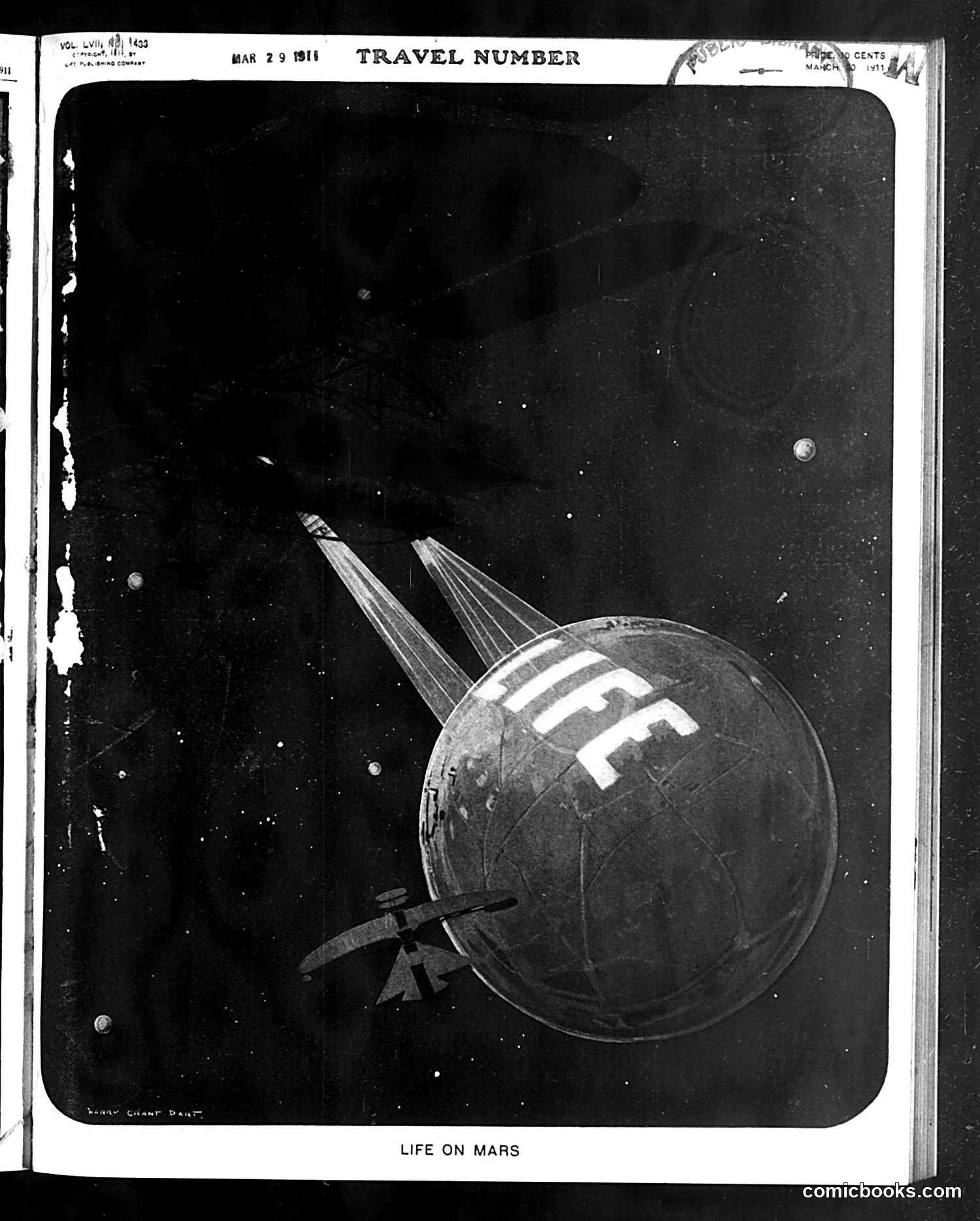
This is a satirical illustration depicting a futuristic spacecraft or vessel labeled with "FF" (possibly indicating a fictional designation). The image shows a spherical craft with parachutes deployed, descending toward Mars, accompanied by what appears to be a smaller propeller-driven vessel. The satire likely mocks contemporary speculation about space travel and extraterrestrial life. In 1911, Mars fascination was at a peak—Percival Lowell's theories about Martian canals had captured public imagination. The cartoon appears to ridicule either the optimism of space-travel advocates or the absurdity of imagining human colonization of Mars. The deliberate crudeness of the spacecraft design and the whimsical presentation suggest *Life* magazine was poking fun at sensationalized scientific speculation of the era.
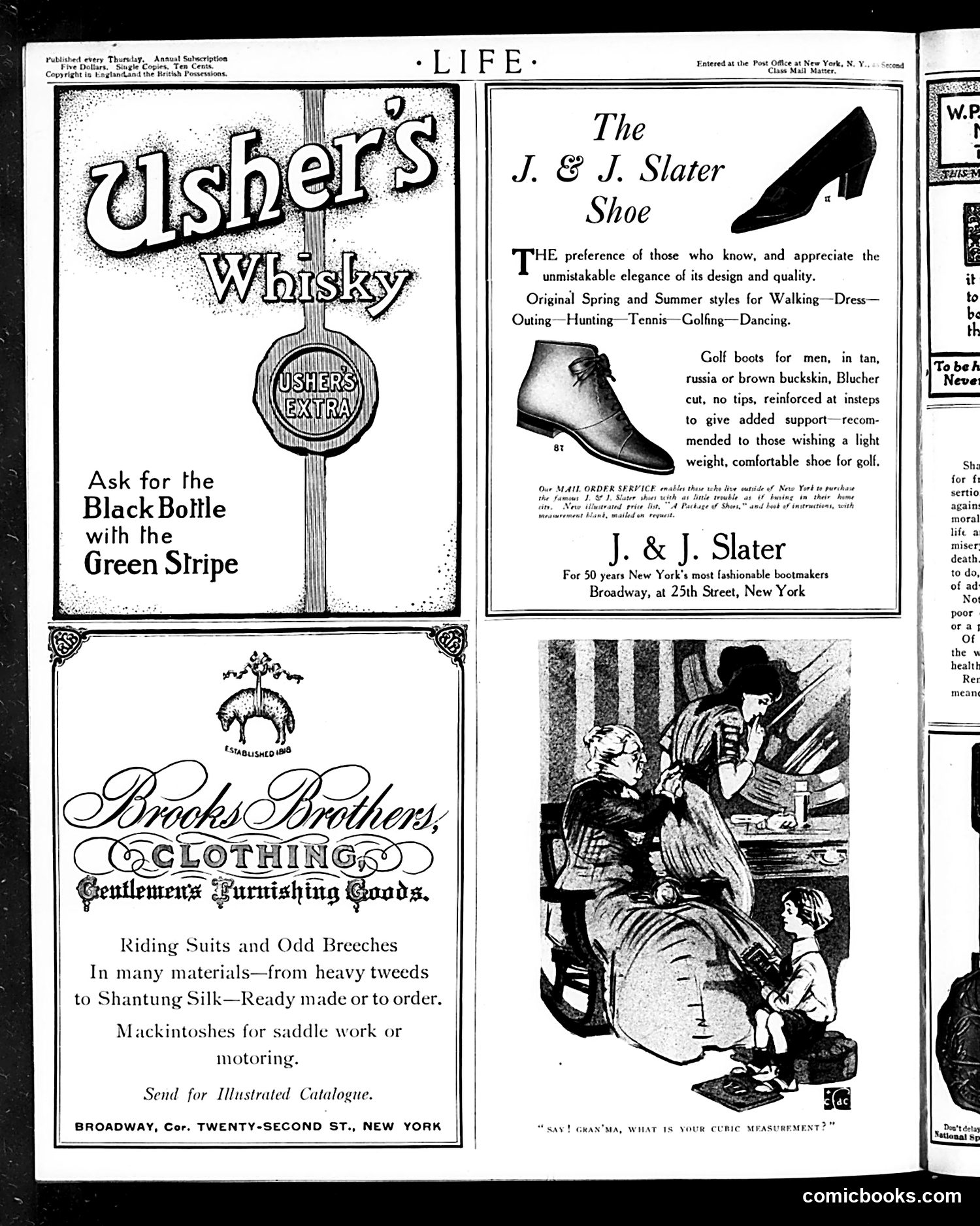
This page is primarily **advertising**, not satirical content. The left side features ads for Usher's Whisky and Brooks Brothers clothing. The right side advertises J. & J. Slater shoes for men. The only cartoon appears at bottom right, captioned "Say! Grandma, What Is Your Cubic Measurement?" It depicts children measuring an adult woman, likely satirizing contemporary fashion obsessions with precise body measurements and the "Gibson Girl" ideal. The joke targets the absurdity of quantifying female beauty through numbers—a common early 1900s preoccupation. The cartoon's humor relies on children innocently asking an immodest question, contrasting youthful directness with adult vanity about measurements.
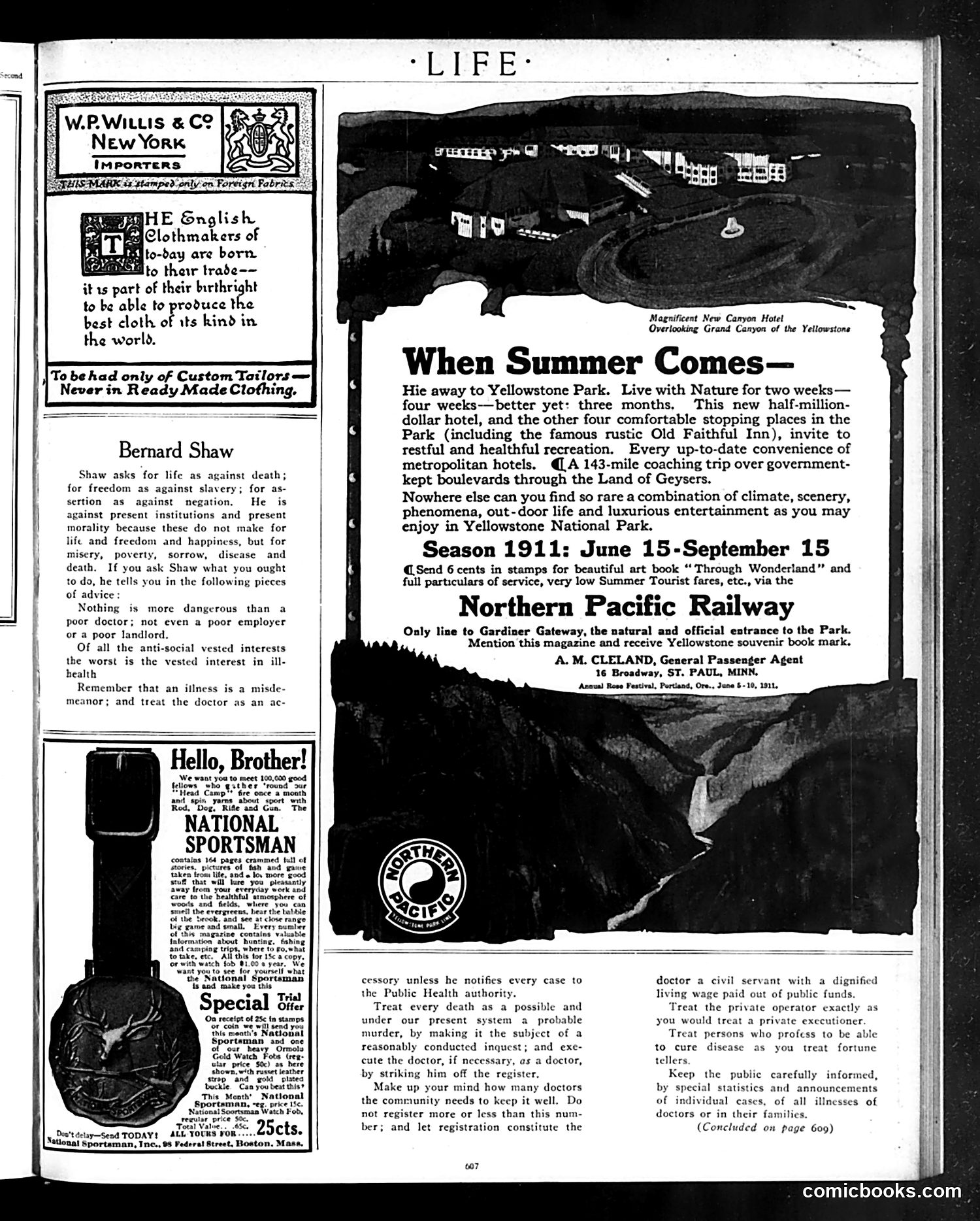
This page is primarily **advertising and travel promotion**, not political satire. The main content features a Northern Pacific Railway advertisement promoting Yellowstone National Park vacations for summer 1911 (June 15–September 15). The ads emphasize luxury hotel accommodations and natural scenery, targeting affluent travelers seeking "restful and healthful recreation." Secondary advertisements include: - **W.P. Willis & Co.** (New York clothmakers) - **National Sportsman** magazine promotion - **Bernard Shaw** essay on social reform and healthcare The page reflects early 20th-century leisure culture: wealthy Americans taking extended vacations to natural wonders, accessible via new railroad infrastructure. No political cartoons or satirical commentary appears present—this is straightforward period advertising typical of *Life* magazine's commercial pages.
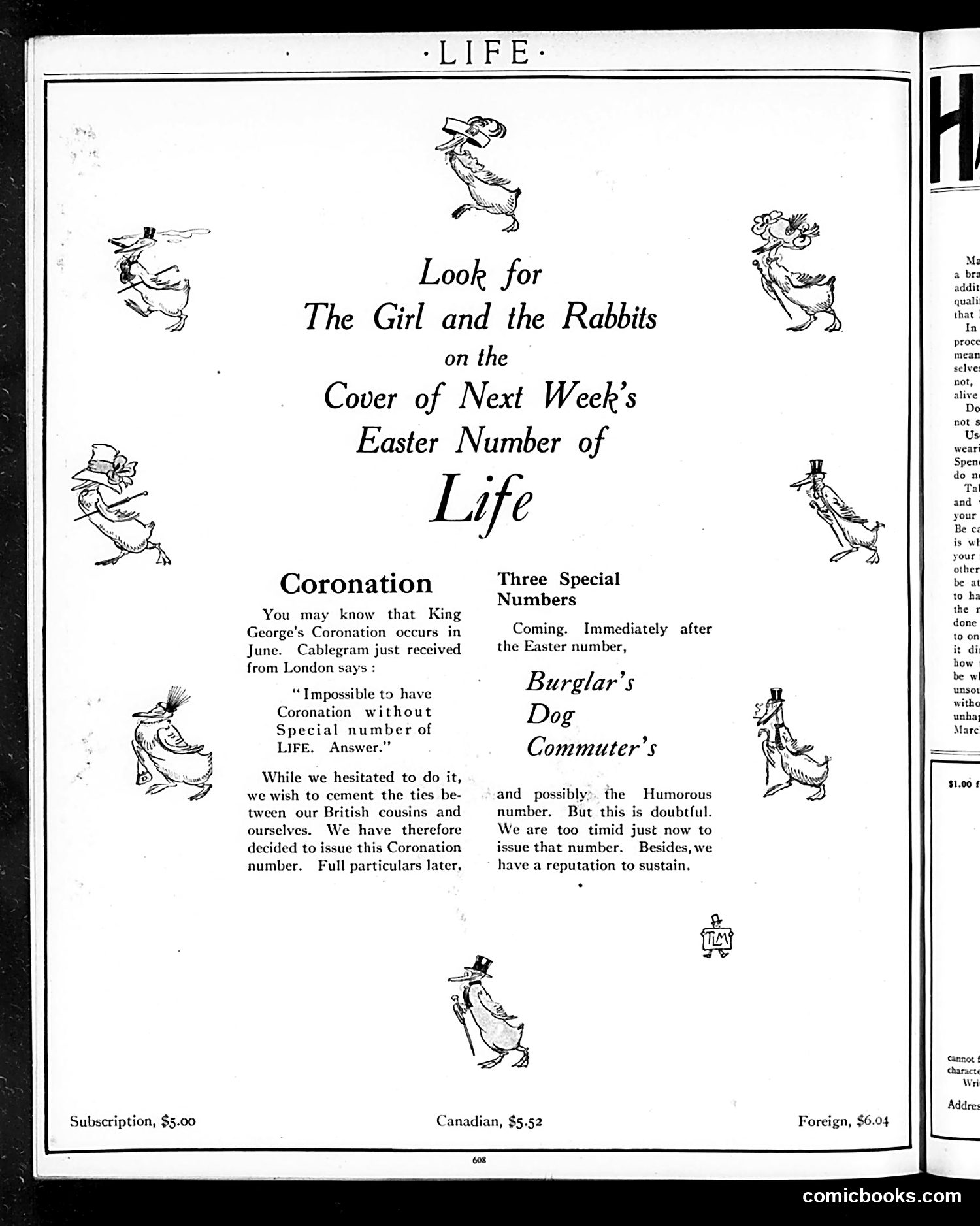
This page is primarily an **advertisement/announcement** for upcoming issues of Life magazine rather than editorial content. It promotes: 1. **Next week's Easter Number** featuring "The Girl and the Rabbits" on the cover 2. **A Coronation Number** — referencing King George's upcoming coronation in June. The text indicates Life will issue a special number to "cement the ties between our British cousins and ourselves," suggesting this is a patriotic gesture toward Britain. 3. **Three upcoming special issues**: "Burglar's Dog," "Commuter's," and possibly a "Humorous number" The decorative rabbit illustrations frame the announcements. The subscription prices listed ($5.00 standard, $5.52 Canadian, $6.04 foreign) indicate this is early 20th-century American publication.
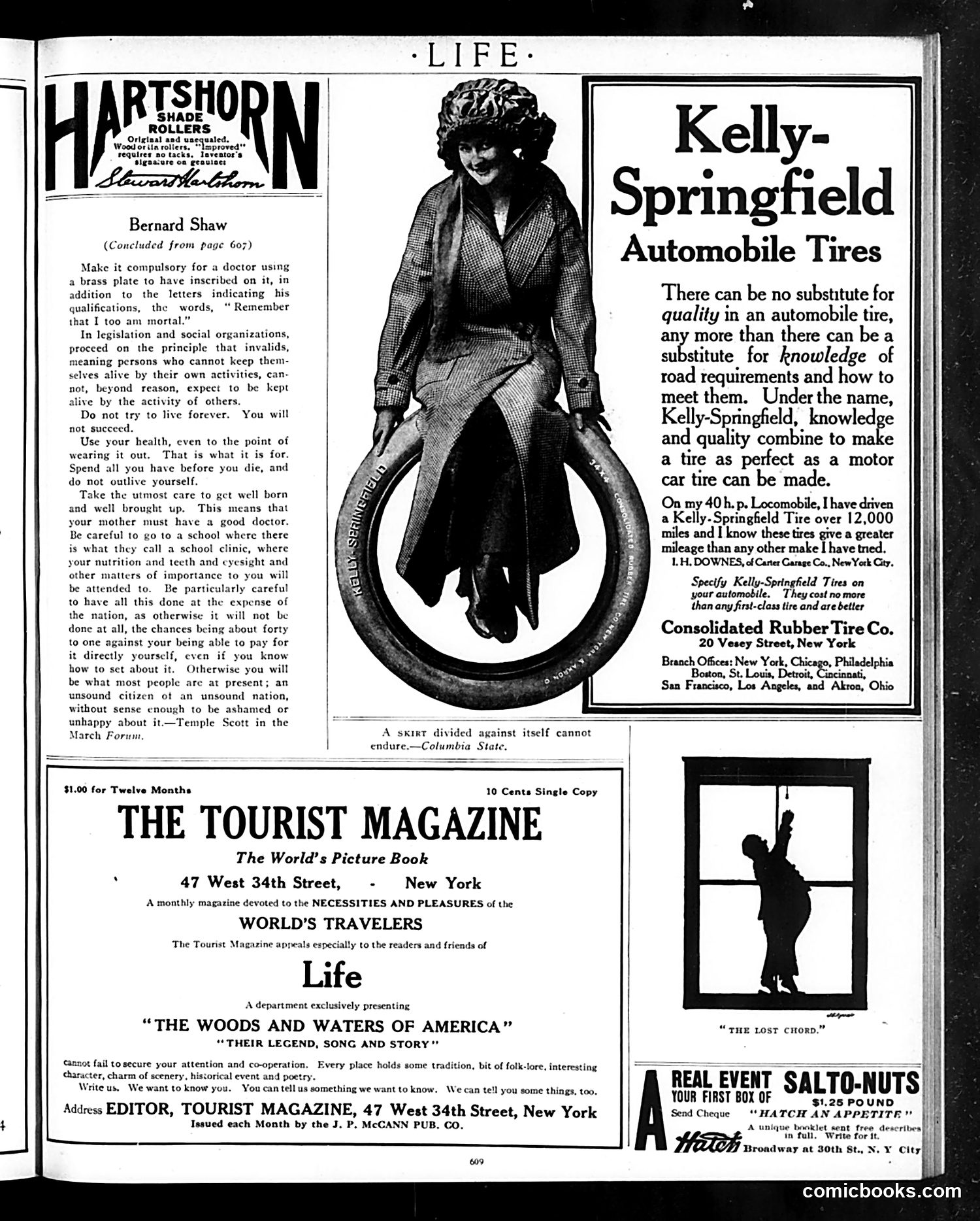
This page is primarily **advertising**, not satirical editorial content. The main items are: 1. **Hartshorn Shade Rollers** ad (top left): A straightforward product advertisement with no satirical element. 2. **Kelly-Springfield Automobile Tires** (center-right): Features a photograph of a woman in a tire, promoting tire quality. No satire—a conventional product ad. 3. **The Tourist Magazine** (bottom-left): Promoting a travel publication, with no political content. 4. **"The Lost Chord"** silhouette (bottom-right): Appears to be theatrical/entertainment advertising. 5. **Salto-Nuts** (bottom): A food product ad. The Bernard Shaw quote (top-left) about mortality and citizenship is editorial text, not cartoon satire. Overall, this is a typical *Life* magazine page emphasizing commercial advertising rather than political or social satire.
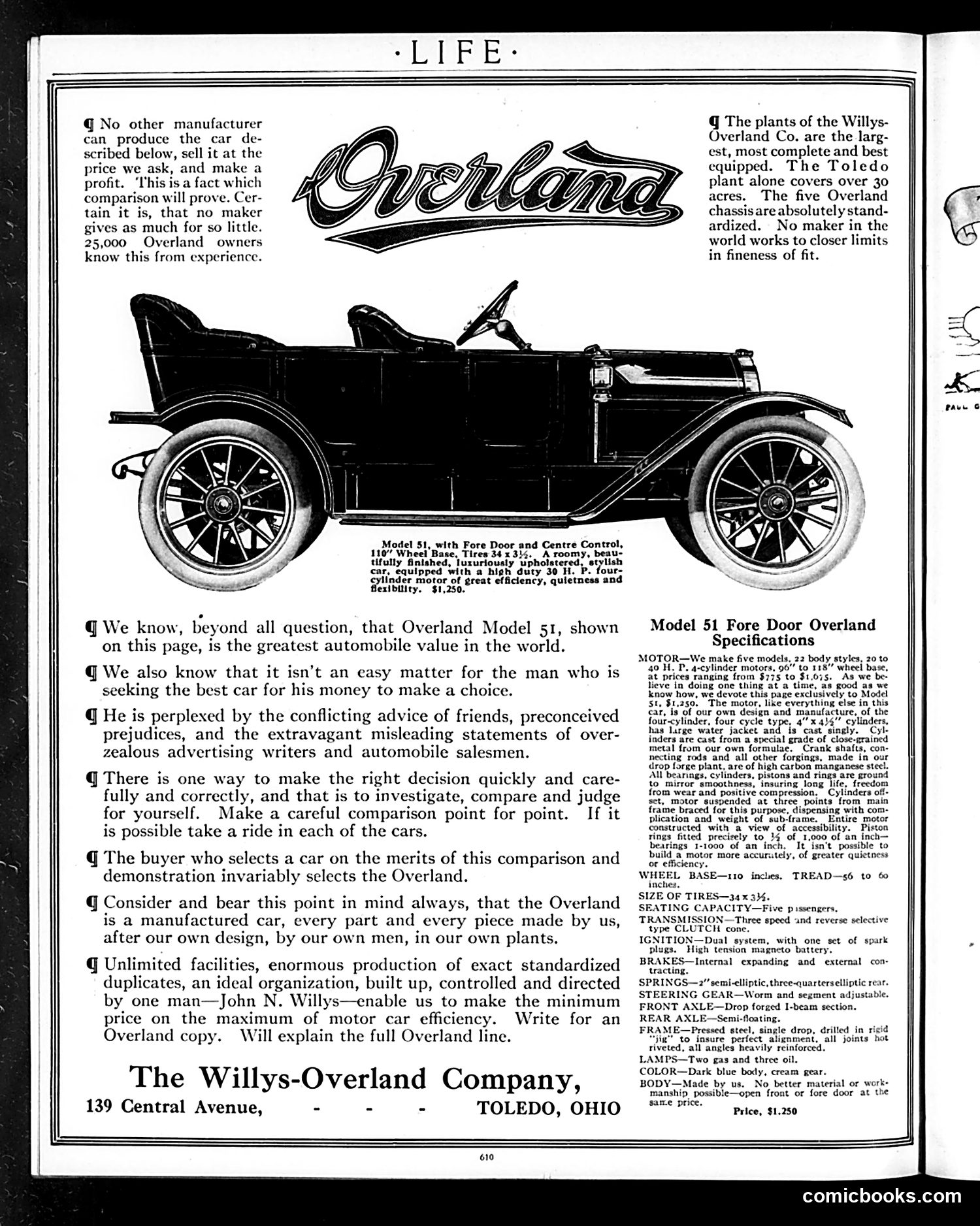
This page is **primarily advertising, not satire or cartoon content**. It features a full-page advertisement for the Overland automobile, manufactured by the Willys-Overland Company in Toledo, Ohio. The ad promotes the Model 51 Overland, displaying a detailed illustration of an open-air touring car. The text makes bold claims about the vehicle's value and quality, asserting it's "the greatest automobile value in the world" and encouraging potential buyers to compare it directly with competitors. The advertising copy emphasizes the car's manufacturing standards, pricing ($1,250), and specifications. There is no political satire, caricature, or social commentary present—this is straightforward early-20th-century automotive marketing aimed at middle-class consumers.
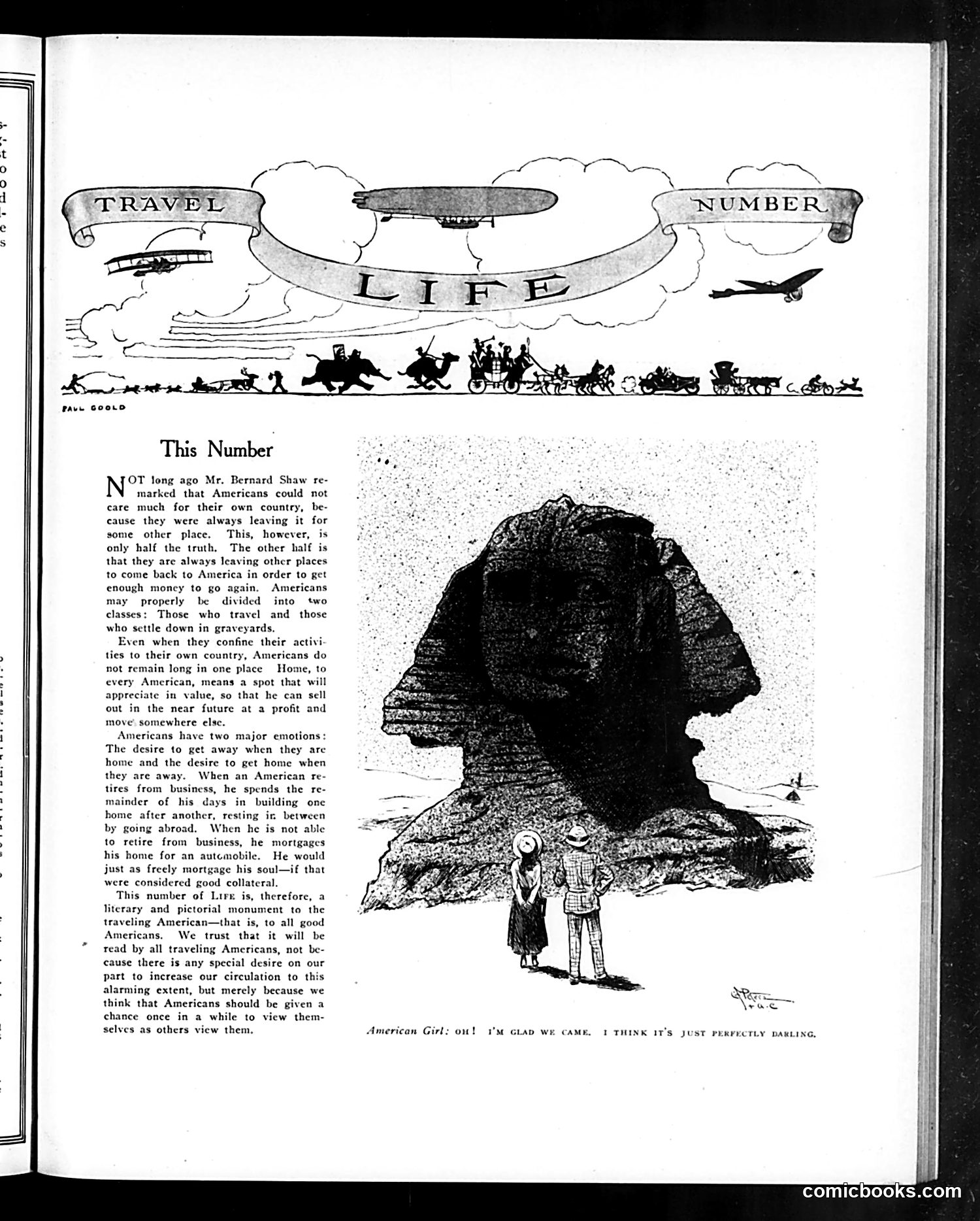
This page from **Life magazine's "Travel Number"** critiques American attitudes toward travel and home ownership. The header decorates the theme with various modes of transportation (planes, dirigibles, cars, horses). The main text, attributed to what appears to be commentary on Bernard Shaw's observation, argues that Americans struggle with conflicting desires: wanderlust versus homeownership. The author suggests Americans divide into two classes—travelers and those who settle in graveyards (die at home). The illustration shows a large profile of a woman's head filled with an English landscape, with two figures below captioned "American Girl: Oh! I'm glad we came. I think it's just perfectly darling." **The satire:** Americans romanticize European travel and aesthetics while ironically remaining emotionally tied to home, never truly committing to either experience.
This page contains editorial commentary about statues and public monuments, particularly discussing whether to erect a statue of General Ben Butler in Boston. The text argues against the proposal, questioning whether Butler deserves such honor despite his active life and "loyal citizen" reputation. The small cartoons show children on swings/seesaws—likely illustrating the playful, lighthearted tone Life magazine typically employed. The main satire criticizes how cities create statues of questionable figures for political reasons rather than genuine merit. The author suggests statues should commemorate truly worthy individuals and proposes New York maintain a "stateful" of removable statues for occasional public instruction instead of permanent installations of mediocre men. The piece represents Progressive-era skepticism toward Gilded Age monument-building and municipal politics.
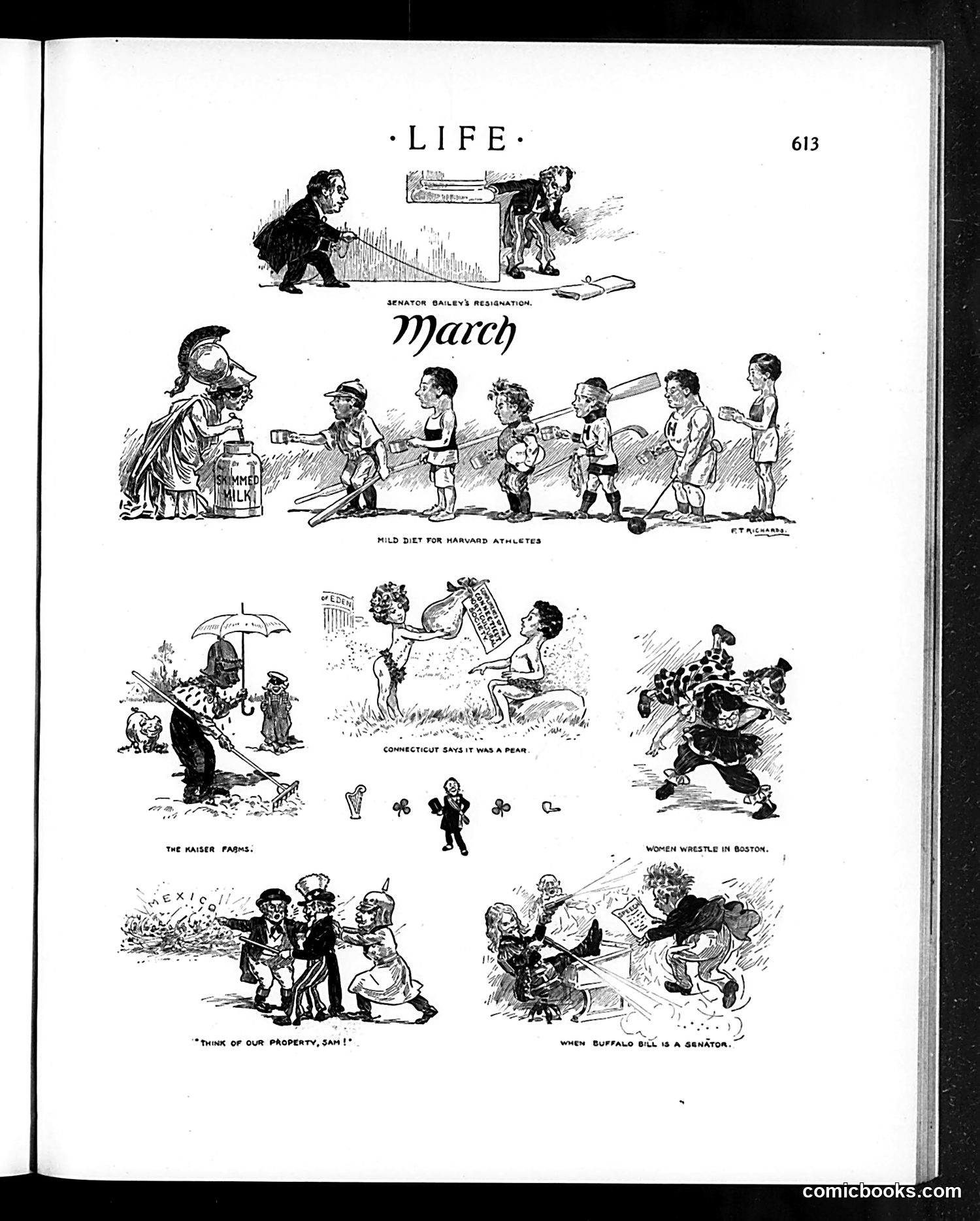
This page collects satirical sketches commenting on current events. The top cartoon shows "Senator Bailey's Resignation"—a political figure departing. The "Mild Diet for Harvard Athletes" depicts young men on a restrictive diet regimen, likely mocking Harvard's athletic program. Other sketches address contemporary issues: "Connecticut Says It Was a Pear" references a disputed produce incident; "The Kaiser Farms" comments on German leadership; "Women Wrestle in Boston" mocks women's athletics; "Think of Our Property, Sam!" appears to reference property concerns; and "When Buffalo Bill Is a Senator" uses the famous Wild West figure satirically. The cartoons employ exaggerated caricature to ridicule political figures, social trends, and institutional practices of the era.
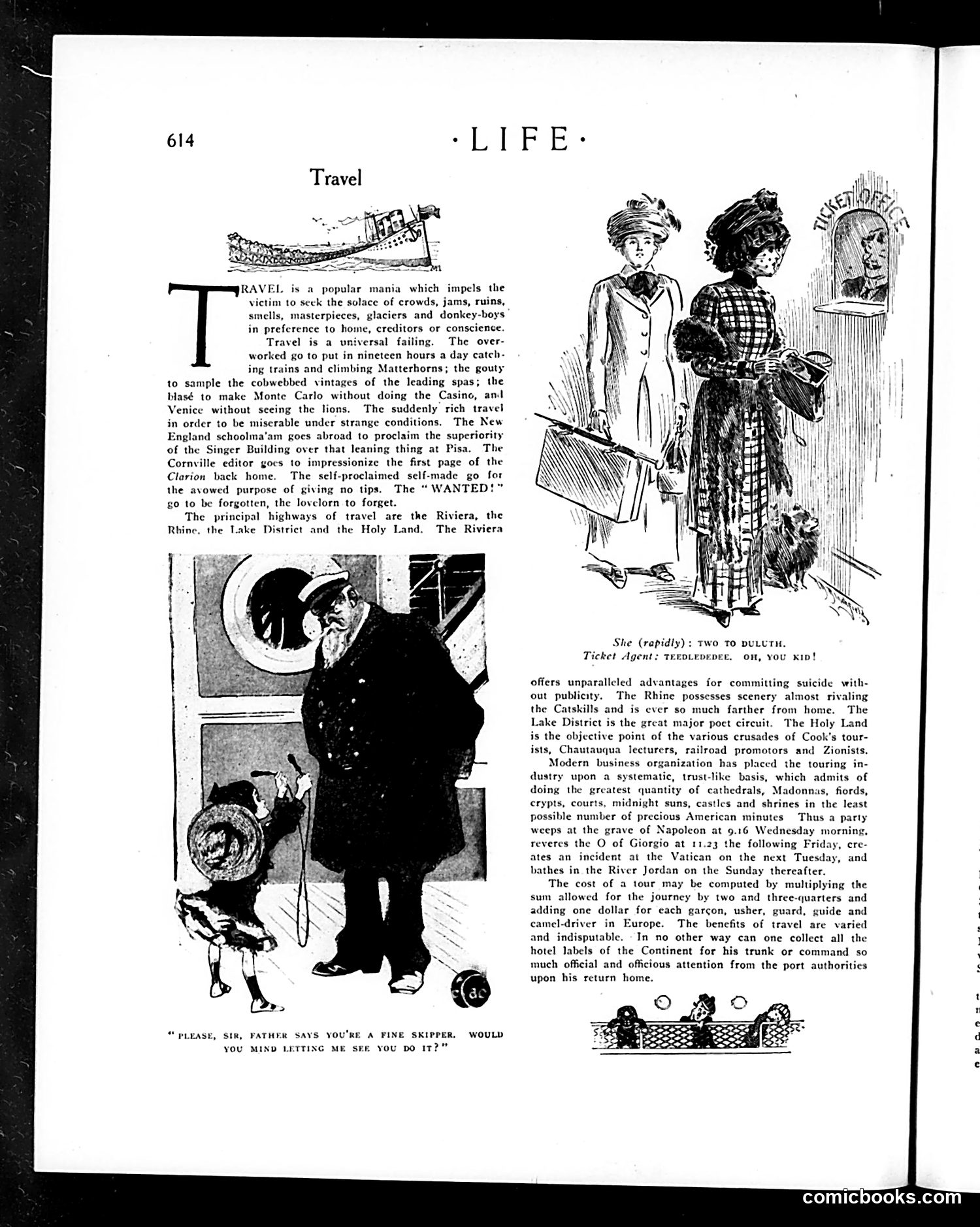
This satirical page mocks the contemporary travel industry's aggressive commercialization. The main text describes travel as a "popular mania" driven by tourists seeking exotic experiences—yet warns that modern tour operators have industrialized sightseeing into a mechanized, exhausting routine, pressuring visitors to cram cathedrals, casinos, and landmarks into impossibly brief itineraries. The left cartoon depicts a porter or tour guide exploiting travelers. The right cartoon shows a ticket agent aggressively hawking tours ("two to Duluth") to a skeptical woman, satirizing aggressive sales tactics. The overall critique: what should be leisurely cultural exploration has become a commercialized assembly line where travelers rush through sites and operators prioritize profit over genuine experience. The satire targets the disconnect between travel's romantic appeal and its mundane reality.
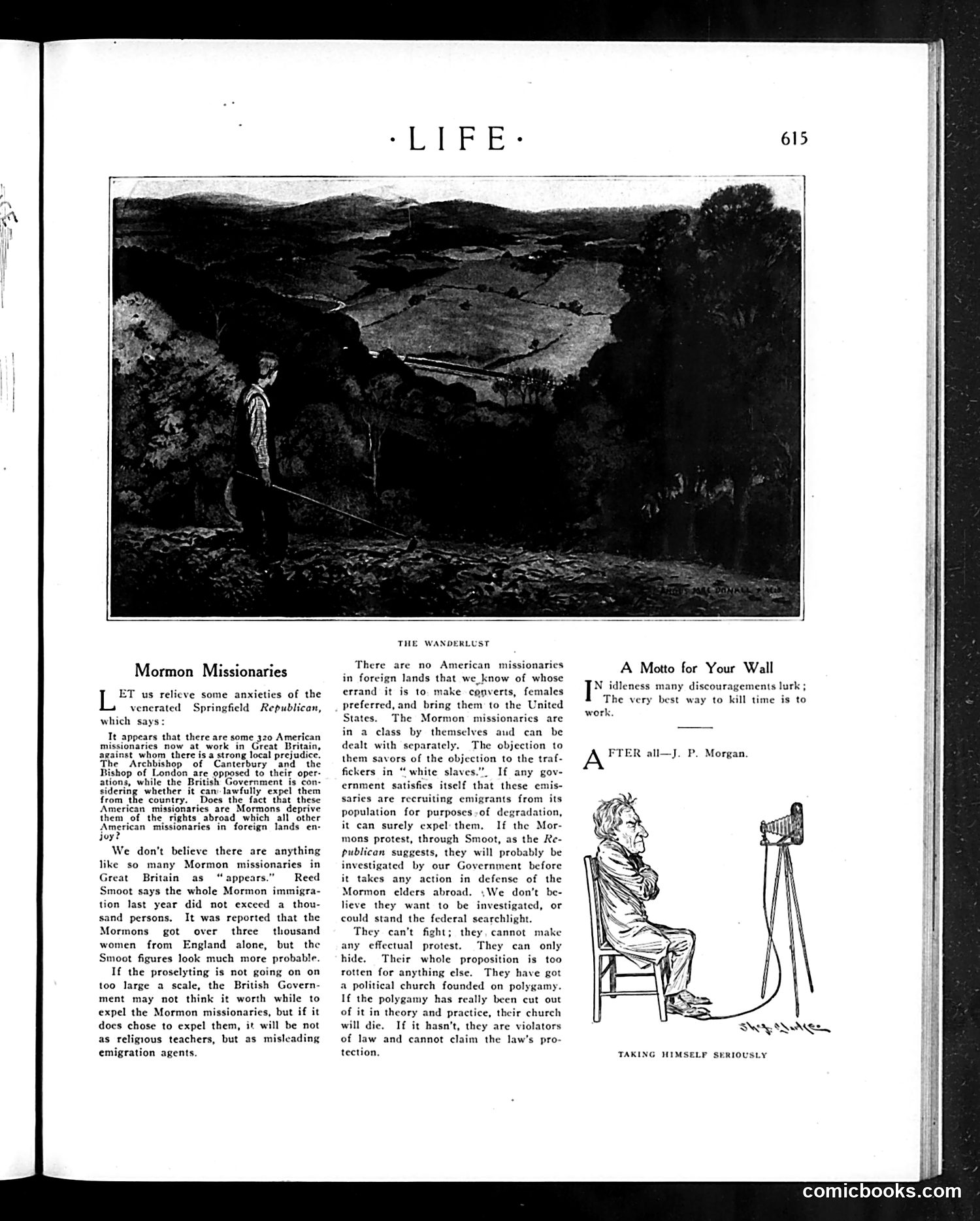
This page from *Life* magazine critiques Mormon missionaries recruiting in Great Britain. The left article sarcastically defends Mormon emigration to America, claiming there are ~320 American missionaries in Britain converting people (especially women) to Mormonism. The writer questions whether these conversions are genuine or if Mormons are exploiting vulnerable populations for "degradation." The piece suggests the British government should expel Mormon missionaries rather than treat them as legitimate religious teachers. The small cartoon on the right ("Taking Himself Seriously") depicts a man with surveying equipment, likely satirizing grandiose pretension—possibly referencing someone associated with Mormon expansion or land claims. The mountain landscape photograph at top appears to illustrate the Mormon-settled frontier regions in America.
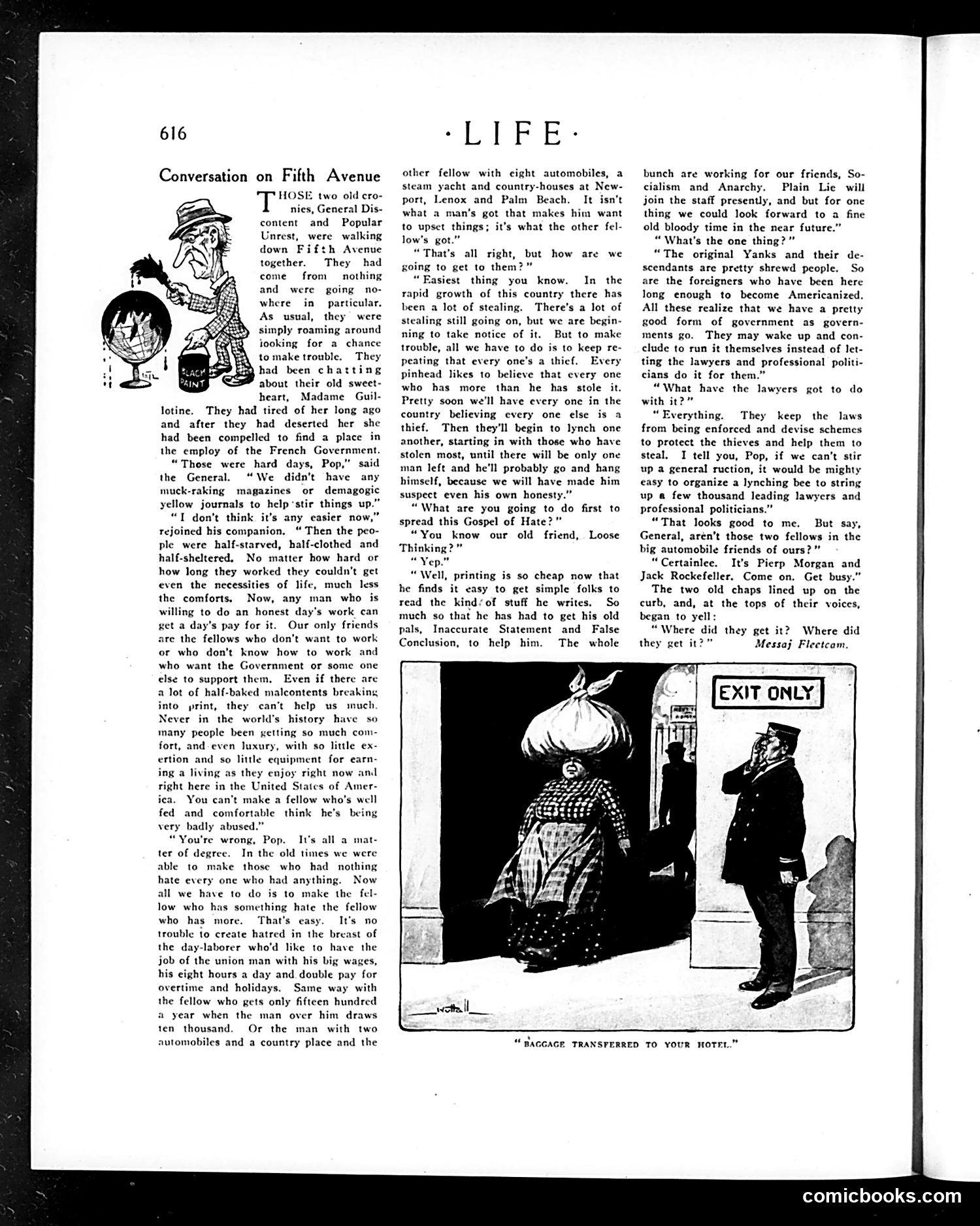
This page satirizes wealth inequality and labor unrest in early 20th-century America. Two elderly wealthy men discuss rising theft and social disorder, attributing it to moral failings rather than economic desperation. One suggests the solution is making theft so common that "every one in the country believing every one else is a thief" — thus normalizing dishonesty rather than addressing root causes. The accompanying cartoon shows a porter with "EXIT ONLY" signage, illustrating the class divisions of the era. The satire mocks wealthy individuals' dismissive attitudes toward working-class struggles and their preference for cynical acceptance of corruption over systemic reform—a commentary on how the privileged avoid responsibility for social problems they help create.
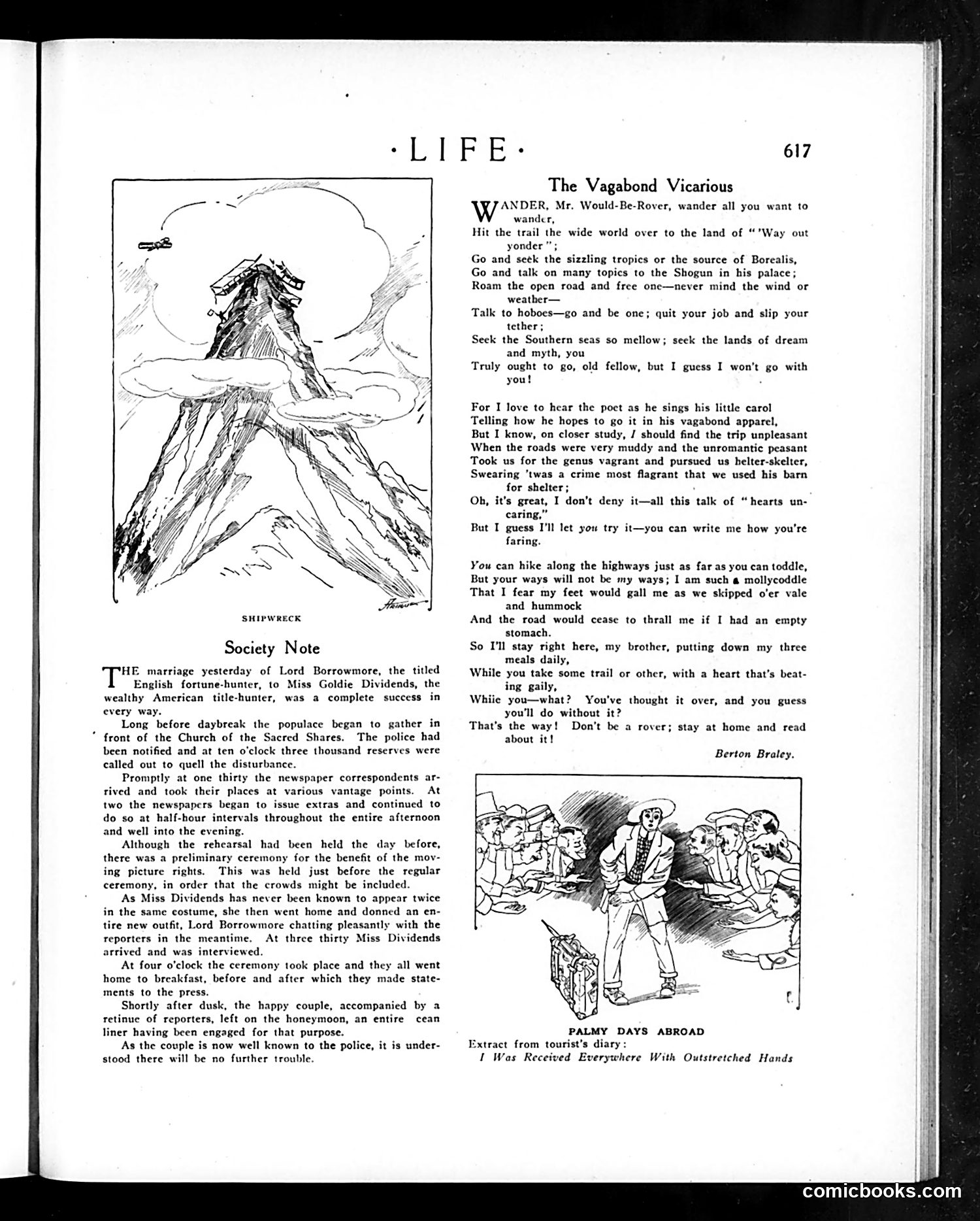
This page contains two distinct pieces: **"The Vagabond Vicarious"** — A poem by Berton Braley addressing a "wanderer" who dreams of traveling. The satire targets the romantic fantasy of vagabondage: the poet acknowledges the appeal of hobo life and exotic travel but argues against actually pursuing it, advocating instead for staying home and reading about adventures. It mocks the gap between wanderlust fantasies and practical reality (muddy roads, empty stomachs, discomfort). **"Palmy Days Abroad"** — A cartoon showing tourists receiving unwanted physical contact ("Outstretched Hands"), likely satirizing the begging or pickpocketing experiences travelers face in foreign destinations. Both pieces humorously deflate romanticized notions of travel and adventure.
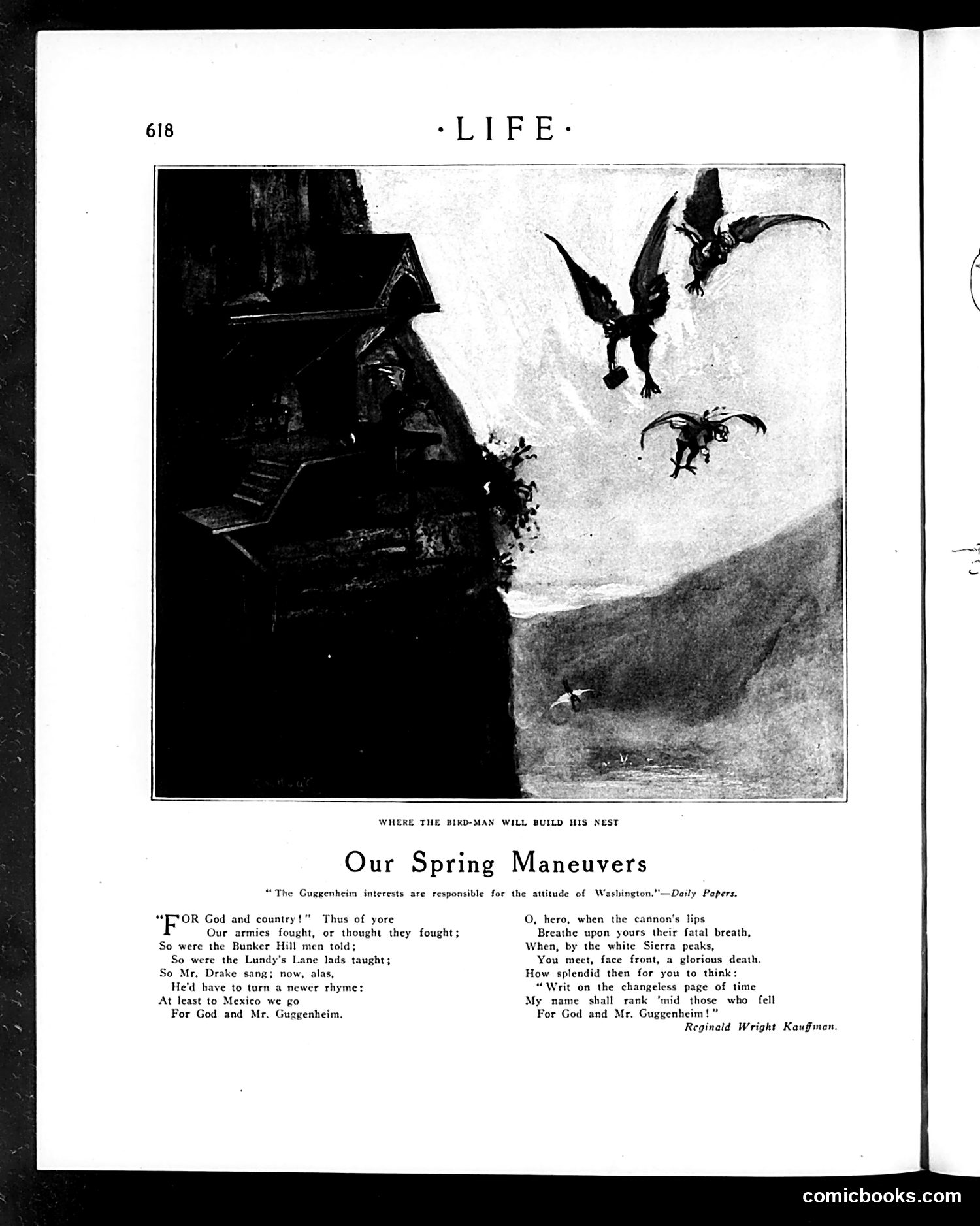
This page satirizes American military adventurism in Mexico, circa the Mexican Revolution era (likely 1910s). The poem by Reginald Wright Kauffman mocks patriotic war rhetoric by repeatedly substituting "Mr. Guggenheim" for "God" in traditional military slogans. The satirical point: wealthy industrialists like the Guggenheim family (mining/business magnates) allegedly influence U.S. foreign policy toward Mexico for corporate profit, not patriotic reasons. The epigraph quotes a newspaper claiming "Guggenheim interests are responsible for the attitude of Washington." The grotesque illustration showing demonic "bird-men" building a nest on a cliff overlooking Mexican terrain visualizes this corruption—predatory capitalists circling Mexico for exploitation. Soldiers are recruited with hollow patriotic language while actually serving private business interests rather than national defense. The satire equates war propaganda with corporate greed, suggesting young men will die not for "God and country" but for Mr. Guggenheim's profits.
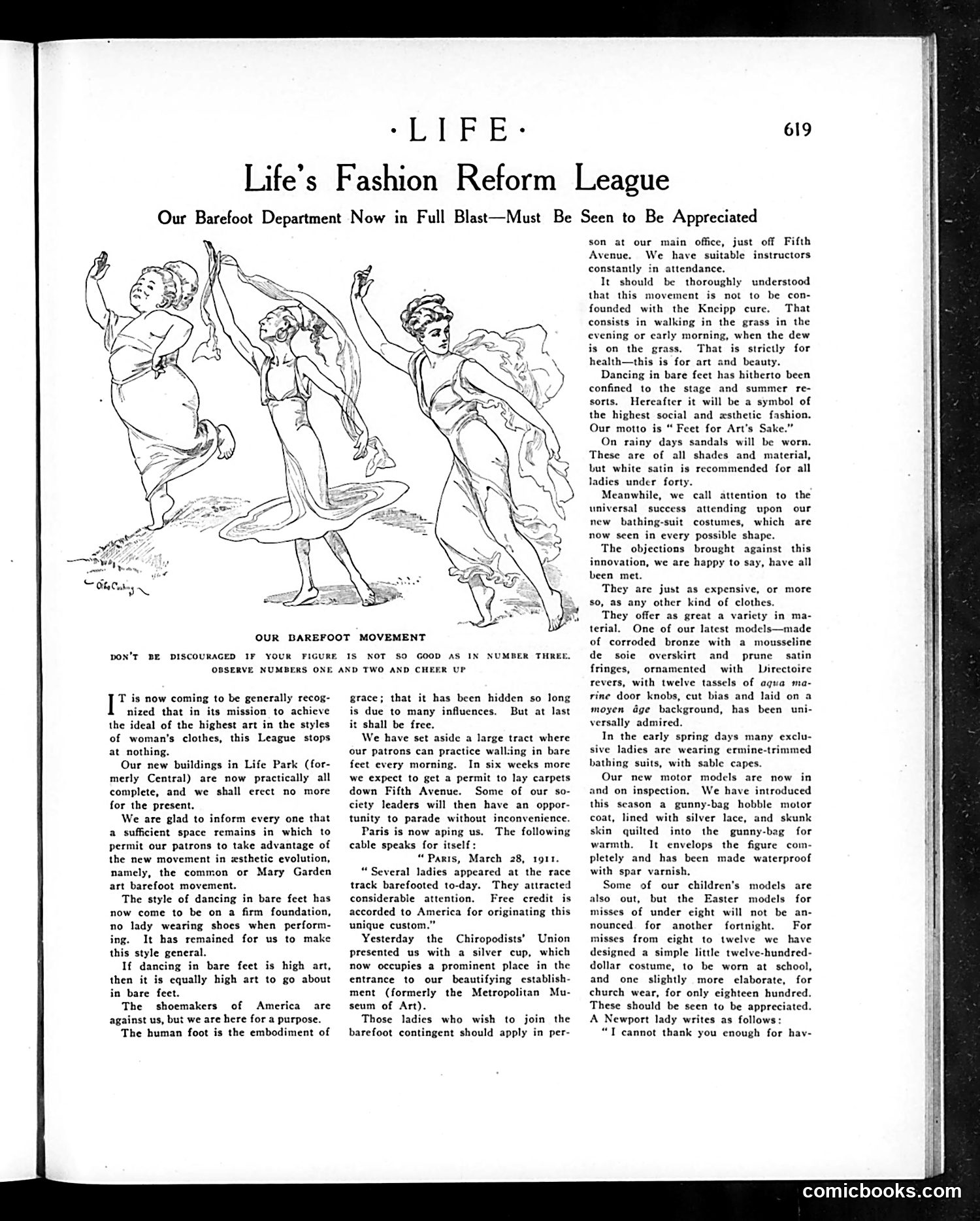
This 1911 *Life* magazine page satirizes the early 20th-century "barefoot movement"—a genuine aesthetic and health reform trend championed by dancer Isadora Duncan and others who saw bare feet as natural, artistic, and liberating. The cartoon depicts women dancing barefoot in exaggerated, undignified poses. The accompanying mock-serious text from "Life's Fashion Reform League" ridicules the movement by treating it as absurdly pretentious: describing bare feet as "high art," claiming Paris is copying America's trend, and announcing expensive new bathing costumes with ridiculous materials like "agua marine door knobs." The satire works by adopting the reformers' own grandiose language while describing genuinely silly applications—insisting people go barefoot everywhere, not just dancing, and inventing absurdly ornate "barefoot-inspired" fashions. The joke mocks both the movement's zealotry and high society's tendency to commercialize and exaggerate any trend into expensive fashion absurdity.
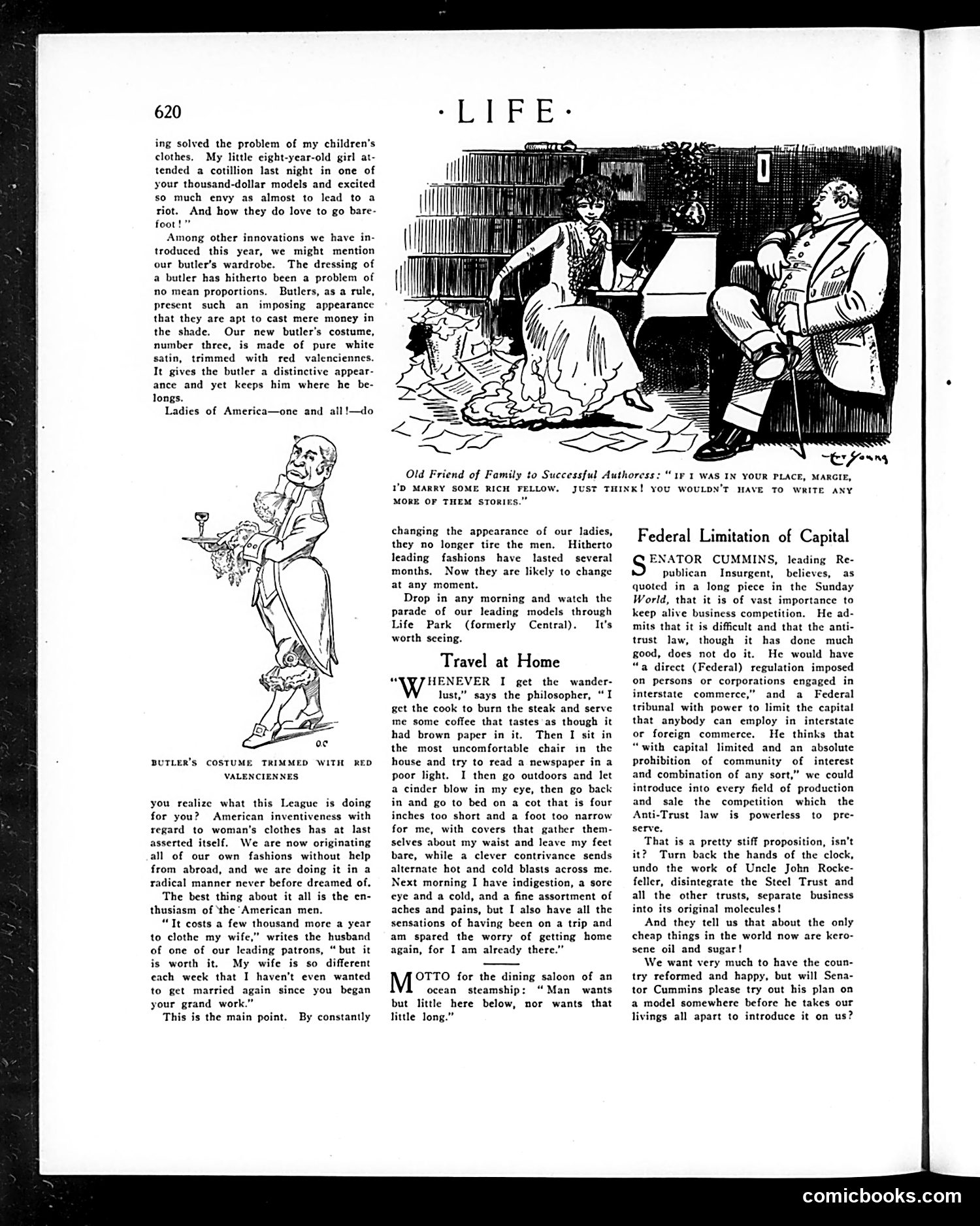
This page contains three distinct satirical pieces typical of Life's humor: **Top cartoon**: Mocks a "League" promoting American-designed women's fashions. The satire targets both conspicuous consumption (thousand-dollar children's dresses) and the absurd notion that constantly changing women's appearances prevents husbands from seeking divorce. The butler's costume detail—white satin with red trim—exemplifies the ridiculous excess being parodied. **Middle section ("Travel at Home")**: A philosopher's humorous essay describing how to simulate vacation hardship at home (burnt steak, uncomfortable furniture, temperature extremes) to experience "travel" without leaving. It's gentle satire on wanderlust and the artificiality of leisure. **Bottom cartoon**: Advises a female author to marry a wealthy man rather than write more stories—satire on women's limited economic options and society's assumptions about female ambition. **Right column**: A serious political piece about Senator Cummins's proposal for federal capital limitations to preserve business competition—a Progressive Era anti-monopoly argument, contrasting sharply with the page's humor.
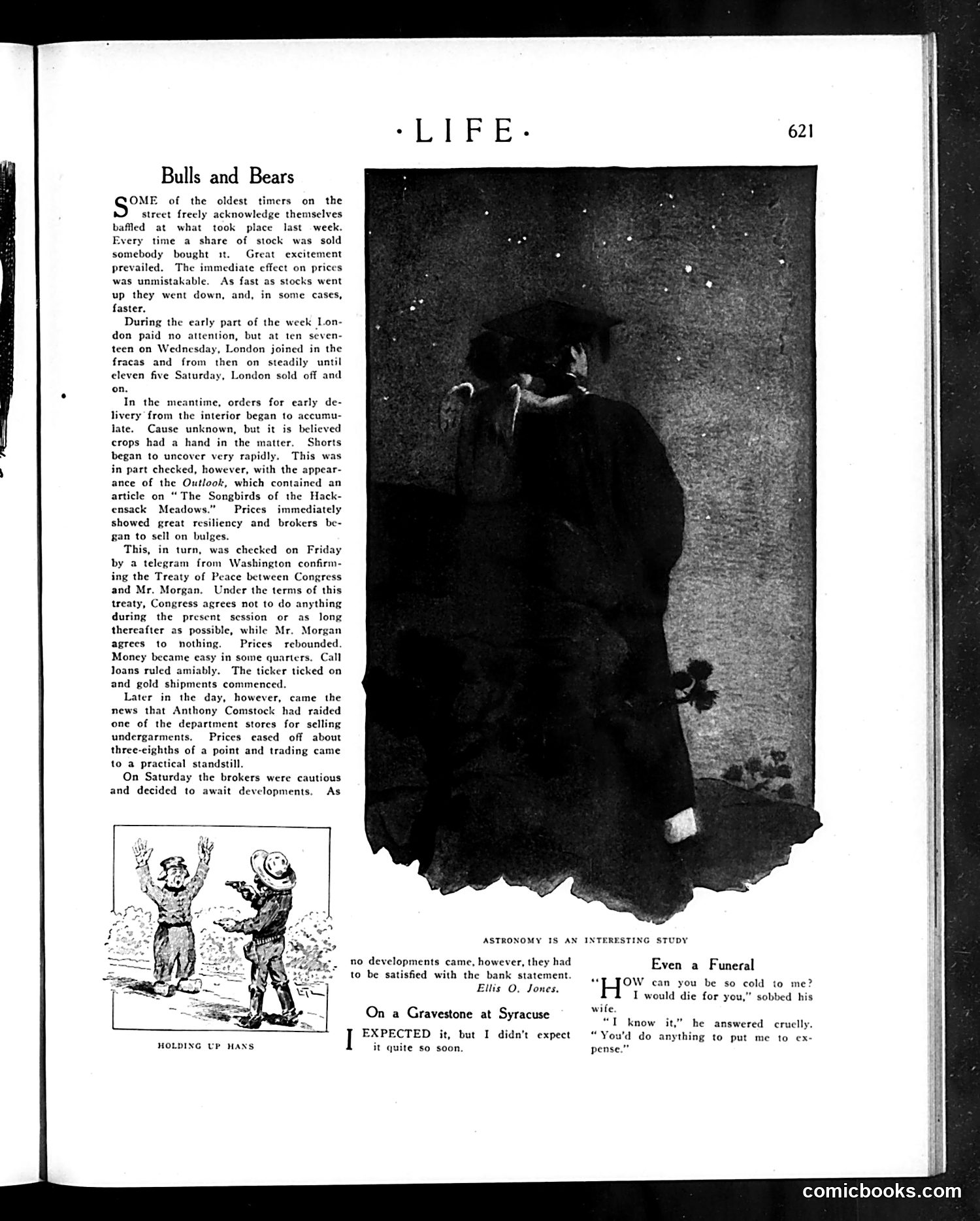
This page satirizes stock market volatility and the absurd reasoning behind price fluctuations. The main article, "Bulls and Bears," mocks financial speculators by listing increasingly ridiculous events that supposedly drove market movements: crop reports, an *Outlook* magazine article about birds in the Hackensack Meadows, and a "Treaty of Peace between Congress and Mr. Morgan" (likely J.P. Morgan, the powerful banker). The satire peaks when Anthony Comstock's raid on a department store for selling undergarments causes stocks to plummet—suggesting the market reacts to trivial social controversies with the same gravity as real economic news. The small cartoon "Holding Up Hans" depicts children playing, likely a reference to the broader theme of economic games and speculation treated as child's play. The other brief items are unrelated jokes, typical of *Life*'s format.
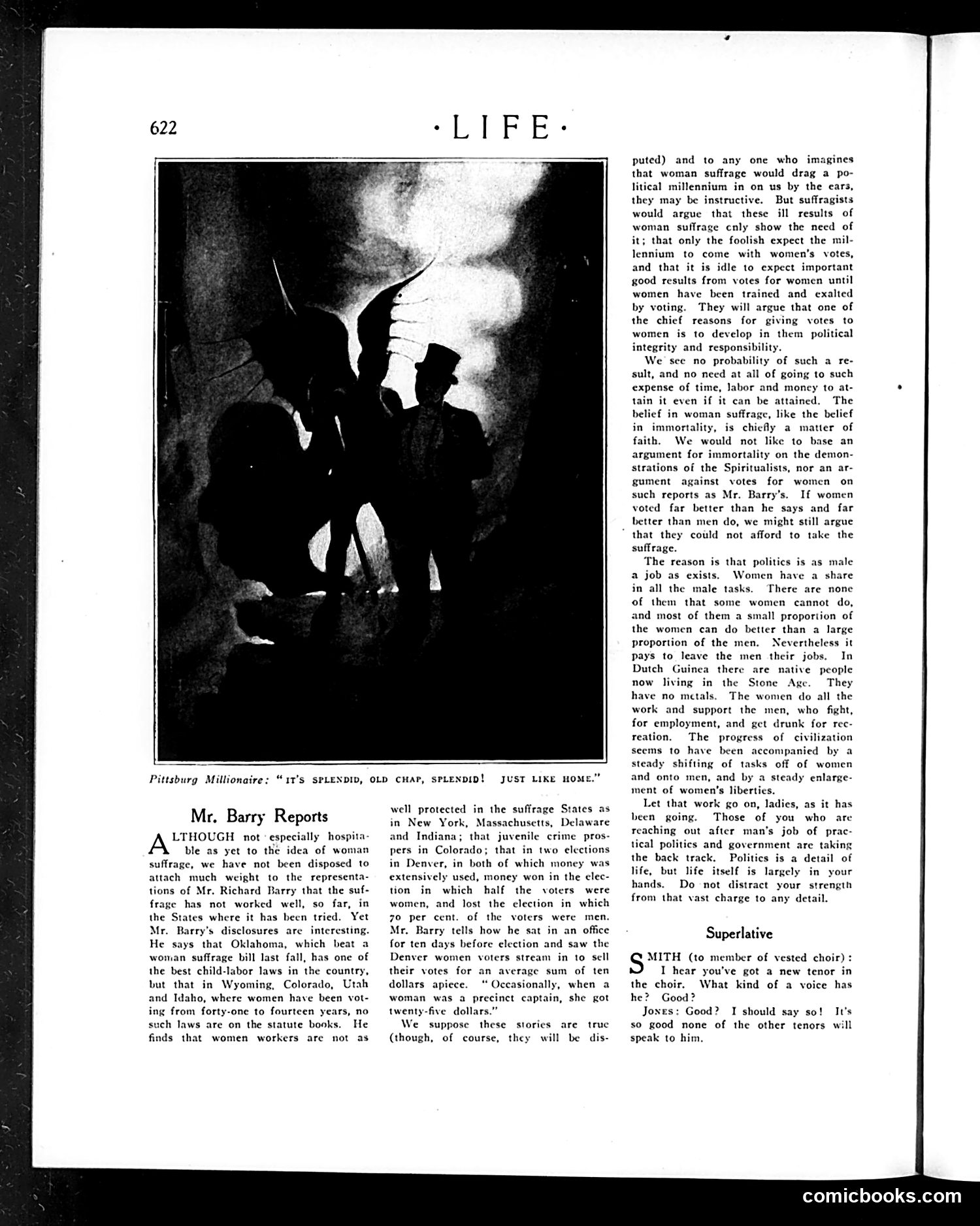
This page debates women's suffrage through an article titled "Mr. Barry Reports." The cartoon at top shows a wealthy Pittsburgh industrialist praising conditions—likely satirizing how the rich benefit from the status quo while workers suffer. The article cites Richard Barry's claims that women's suffrage in western states (Wyoming, Colorado, Utah, Idaho) failed to improve child labor protections or reduce corruption, contrasting these with non-suffrage states' stronger laws. Life's editors respond skeptically: they won't base anti-suffrage arguments on Barry's anecdotes about Denver women allegedly selling votes for $10. However, they argue *against* suffrage on different grounds—that politics is inherently "male work" and women should focus on broader life responsibilities instead of "practical politics." The piece reveals early-1900s paternalism: even skeptics of suffrage opposed it not from evidence but ideology, viewing political participation as unsuitable for women's "proper" domestic sphere.
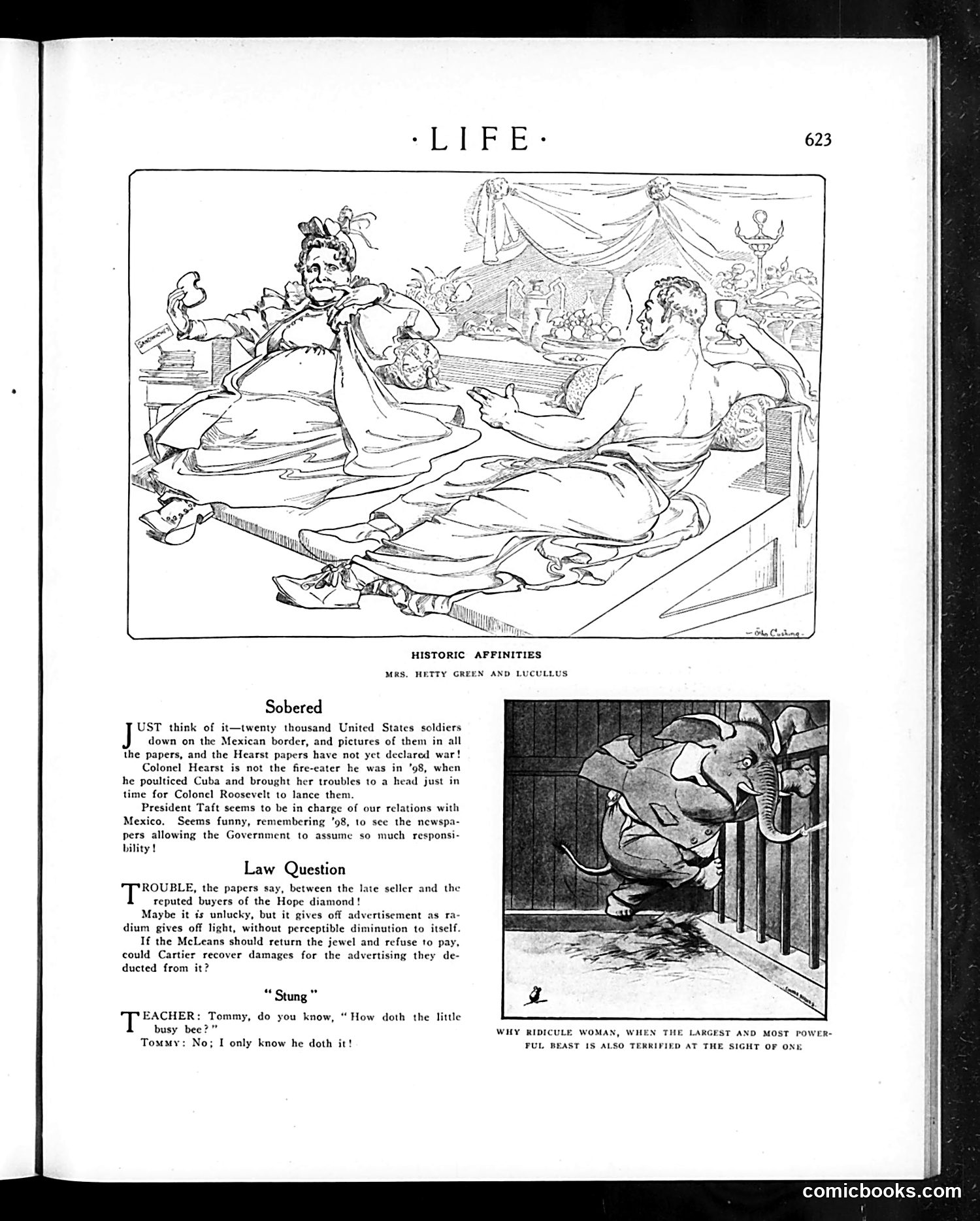
**Top Cartoon ("Historic Affinities"):** Depicts Mrs. Hetty Green (famous wealthy businesswoman) reclining luxuriously like Lucullus (ancient Roman known for extravagant feasting), surrounded by servants and opulence. The "historic affinity" satirizes her reputation for extreme wealth and indulgence. **"Sobered":** Mocks William Randolph Hearst's reduced militarism. In 1898, Hearst's papers aggressively pushed war with Spain over Cuba. Now (circa 1910s), with 20,000 troops on the Mexican border, Hearst remains silent—contrasting his earlier warmongering under Roosevelt with current restraint under President Taft. **"Law Question":** References the Hope Diamond scandal involving the McLeans' purchase from Cartier. Satirizes how the jewelry's notoriety generates free advertising despite its "unlucky" reputation. **"Stung":** Simple joke about a child misunderstanding the poem "How Doth the Little Busy Bee"—he knows what the bee *does* rather than the poem itself. **Right cartoon:** Comments on female fear of mice, noting the irony that even powerful beasts fear them.
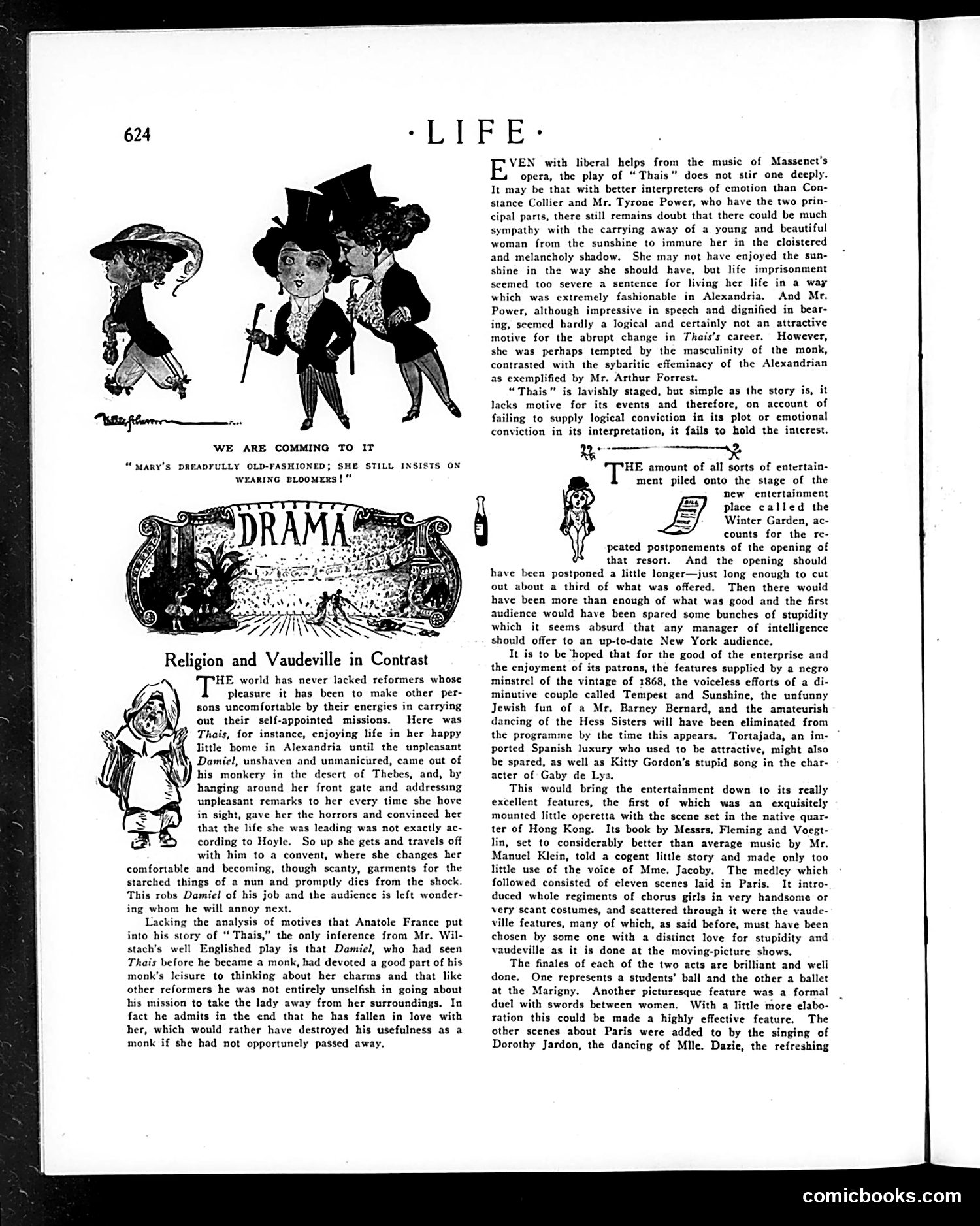
This page contains theater reviews rather than political cartoons. The top cartoon mocks women's fashion reform—specifically the "bloomers" controversy. A character named Mary is criticized for "old-fashioned" insistence on wearing bloomers (loose trousers), suggesting the reformist garment was becoming outdated even among progressives. The main content reviews the play "Thais," adapted from Anatole France's novel. The critic argues the production fails emotionally because the central premise—a monk convincing a woman to abandon her comfortable life for a convent—lacks logical motivation. The reviewer notes the monk is merely selfish and lustful, hardly a compelling reason for the heroine's self-sacrifice. The review also critiques the Winter Garden theater's opening, suggesting it combines too many disparate entertainment acts, including outdated "negro minstrel" material from 1868. The critic implies modern audiences deserve better-curated programming than such hodgepodge offerings.
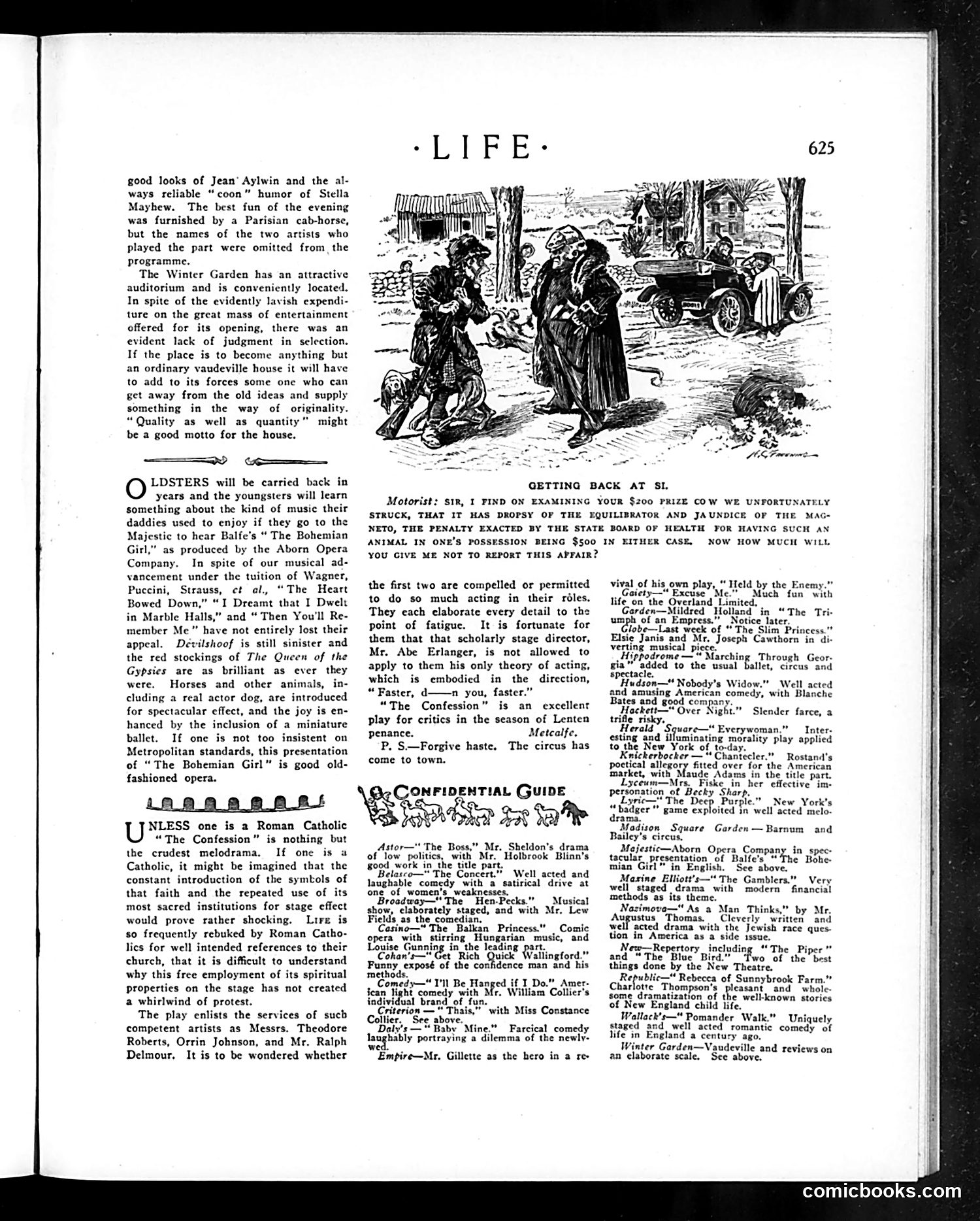
The main cartoon titled "Getting Back at Si" depicts a motorist confronting a farmer after hitting his prize cow. The joke relies on the motorist using absurdly technical automotive jargon—diagnosing the cow's injuries with made-up mechanical terms like "dropsy of the equilibrator" and "jaundice of the magneto"—to avoid paying damages. The humor targets the early 20th-century tension between urban motorists and rural farmers. The motorist essentially reverses the farmer's complaint by threatening to report him to the "State Board of Health" for keeping such a diseased animal, implying regulatory penalties of $500. The satirical point: motorists could be as litigious and obstructive as farmers when accidents occurred. "Si" likely refers to a generic rural character type common in period humor. The cartoon mocks both urban pretension (using incomprehensible jargon) and rural vulnerability to bureaucratic threats—a class commentary on early automobiles disrupting agricultural communities.
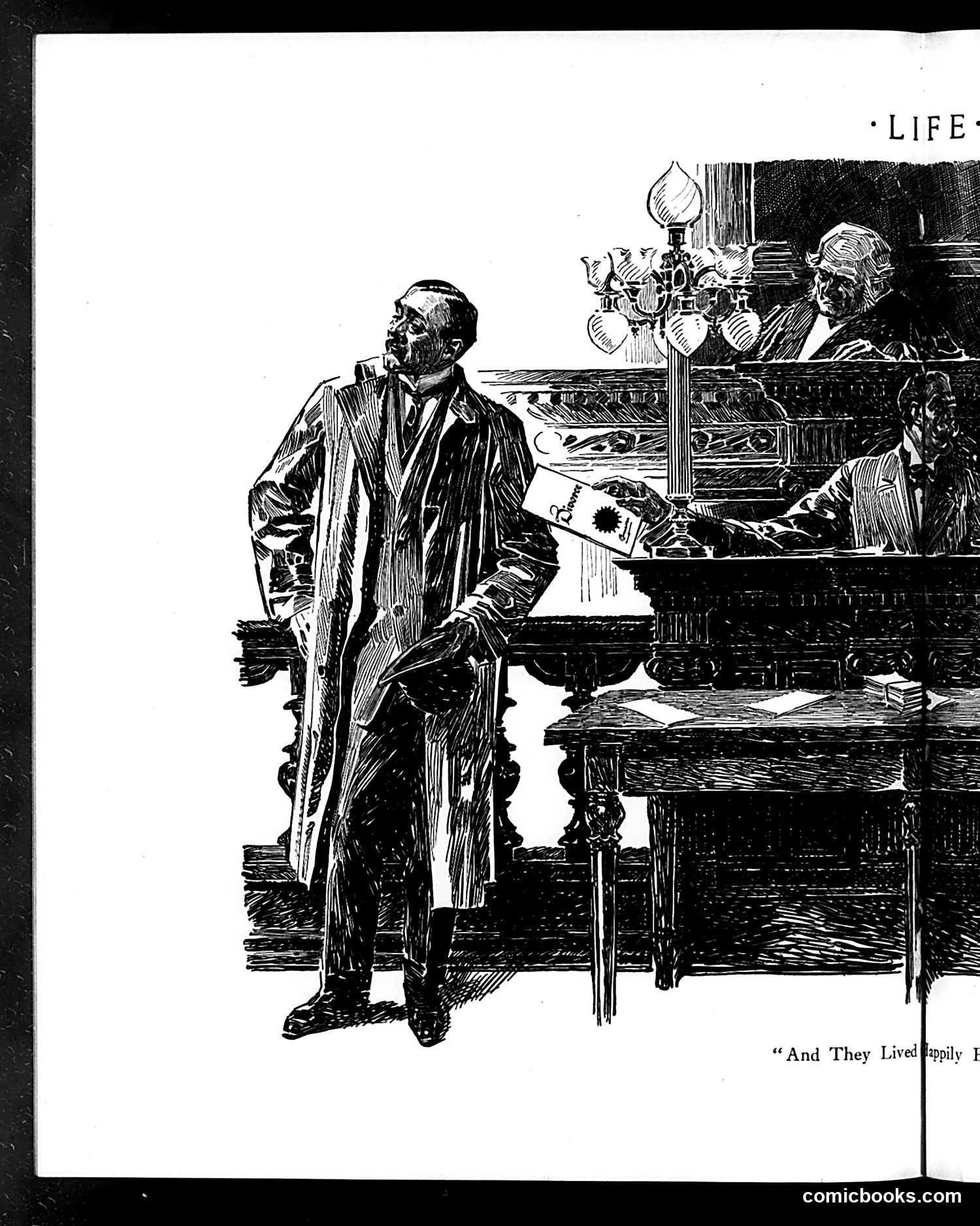
This appears to be an illustration from *Life* magazine showing a business or professional scene. A well-dressed man in a suit stands holding what appears to be a document or contract, positioned near a desk where other figures are seated. The incomplete caption reads "And They Lived...pily" (likely "happily"), suggesting this is a satirical take on a fairy-tale ending or romantic resolution. The satire likely targets either business dealings, marriage for financial gain, or social climbing—common *Life* magazine themes. Without the complete text or caption, the specific reference remains unclear, but the formal setting and the protagonist's stance suggest the cartoon mocks some form of commercial or matrimonial arrangement presented as a happy conclusion. The style and composition are typical of early-20th-century satirical illustration.
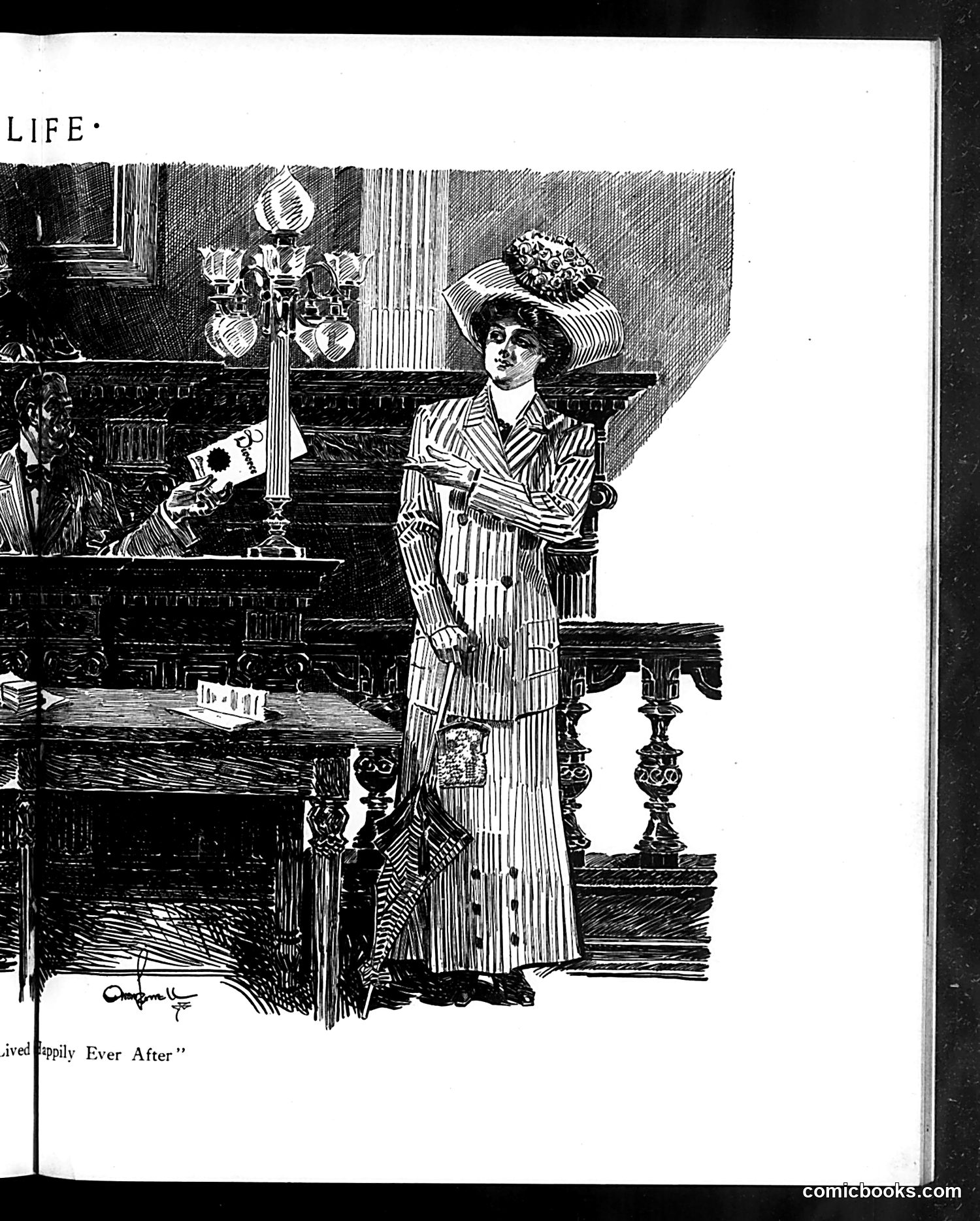
This appears to be a satirical illustration from Life magazine showing a fashionably dressed woman in an ornate interior setting. The incomplete caption at bottom reads "Lived Happily Ever After," suggesting commentary on romantic fairy tales or marriage narratives. The woman's elaborate striped dress, large decorative hat, and poised demeanor suggest she represents an idealized vision of feminine beauty and domesticity—likely satirizing early 20th-century expectations of women. The "happily ever after" reference appears ironic, given her somewhat artificial, posed presentation in this lavish but confining domestic space. The cartoon likely mocks the gap between romantic fantasy and matrimonial reality, a common theme in Life's satirical commentary on contemporary social customs and gender roles. Without the full caption visible, the precise target of the satire remains partially unclear.
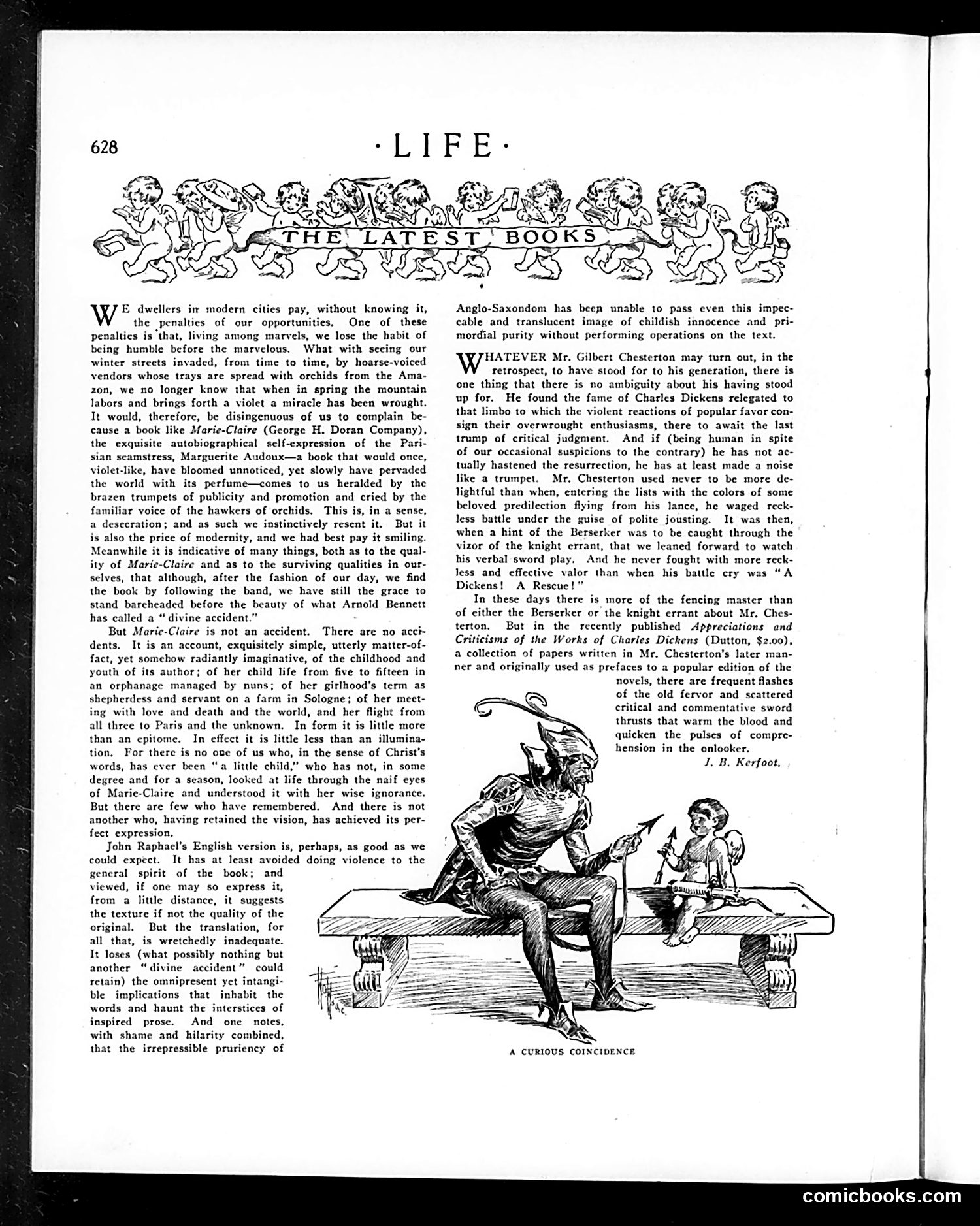
This is a literary review section featuring two book discussions. The left column reviews *Marie-Claire*, a French autobiographical novel by Marguerite Audoux about a seamstress's life. The critic argues that while modern publicity has commercialized this delicate work (comparing it to orchids sold by street vendors), the book itself remains a genuine work of beauty—a "divine accident" capturing authentic human experience through innocent perspective. The right column discusses G.K. Chesterton's writings on Charles Dickens, noting Chesterton's effort to rehabilitate Dickens's reputation after critical dismissal. The illustration labeled "A Curious Coincidence" depicts a figure (likely representing overwrought sentimentality or Dickensian melodrama) in exaggerated pose, with a small child observing—possibly satirizing the gap between Dickens's emotional excess and genuine childhood innocence the *Marie-Claire* review praises.
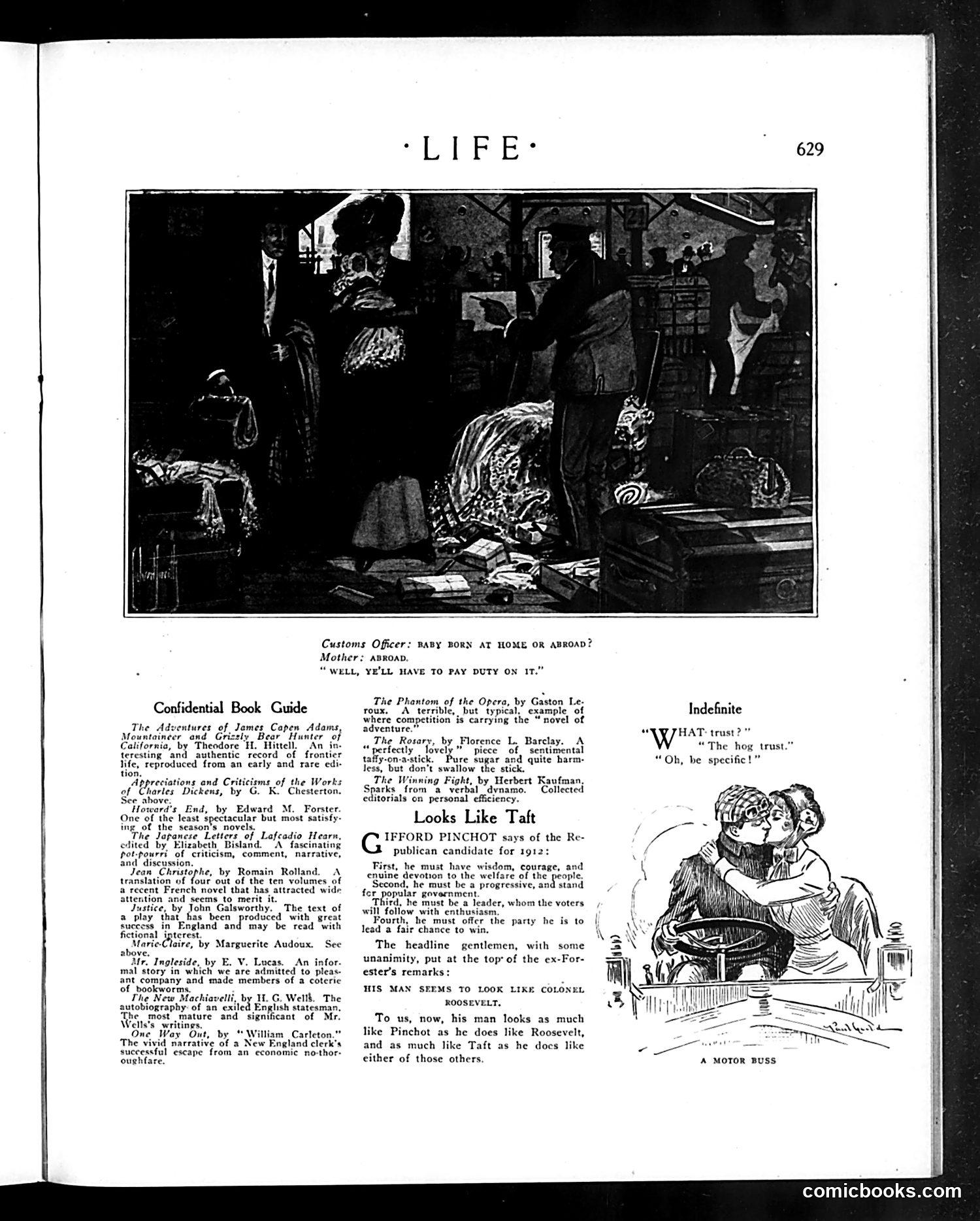
**Top Cartoon**: A customs officer demands duty payment on a baby born abroad, satirizing excessive tariff bureaucracy. The joke mocks how government regulations treat even newborns as taxable imports. **"Looks Like Taft" Section**: This references Gifford Pinchot's 1912 criteria for an ideal Republican presidential candidate. Pinchot, Theodore Roosevelt's former ally, outlined four requirements (wisdom, progressivism, leadership, electoral viability). The article notes these descriptions fit William Howard Taft equally well as Roosevelt—suggesting the criteria are so generic they're meaningless. This satirizes vague political rhetoric and the split between Roosevelt and Taft conservatives within the Republican party during the contentious 1912 election season. **Bottom Cartoon**: Two figures discuss trusts with deliberately unhelpful specificity—one says "hog trust," the other demands clarification. This mocks how vague political accusations about monopolistic "trusts" were, without meaningful definition. Overall, the page criticizes imprecise political and bureaucratic language.
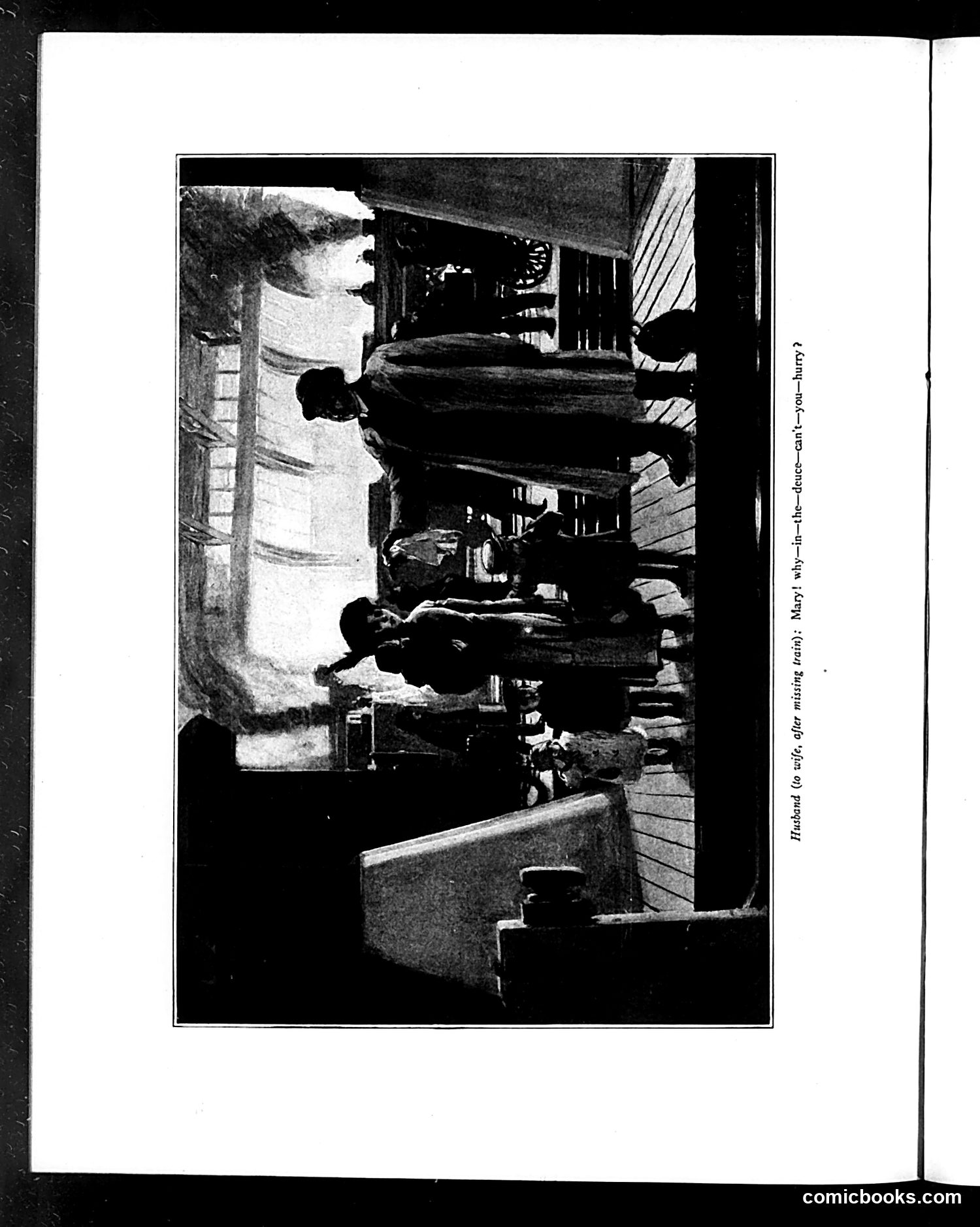
This appears to be a black and white photograph rather than a political cartoon. The image shows what seems to be an interior domestic scene, rotated 90 degrees, depicting people in a home setting with furniture and architectural details visible. The OCR text is corrupted and unreadable, providing no meaningful context. Without legible caption text or clear identifying details in the photograph itself, I cannot reliably determine: - What specific social or political commentary this image was meant to convey - Who the figures are - What the satirical point might have been To properly explain this page's meaning to a modern reader, I would need either a clearer photograph or legible accompanying text from the original Life magazine publication.
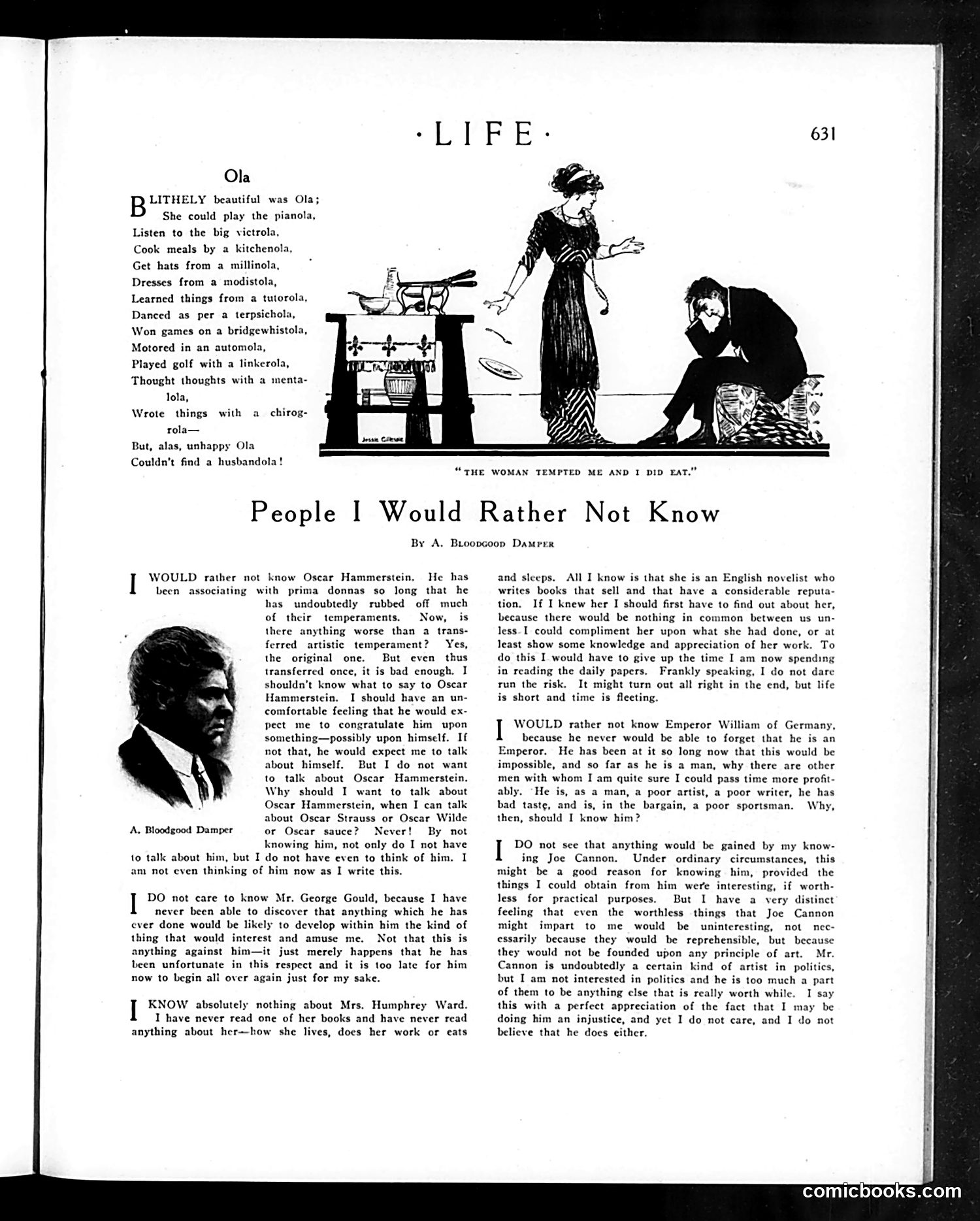
This page contains two distinct satirical pieces from *Life* magazine: **"Ola" (top):** A humorous poem mocking the modern woman of the era who can do everything mechanically—play pianola, use kitchenola, get dresses from modistola—through various "-ola" suffix inventions. The joke: despite all these modern conveniences and accomplishments, poor Ola "couldn't find a husbandola." The cartoon illustrates domestic life; the caption "The woman tempted me and I did eat" references Adam and Eve, suggesting women's traditional role in tempting men. **"People I Would Rather Not Know" (bottom):** A satirical essay by A. Bloodgood Damper listing famous figures he deliberately avoids knowing: Oscar Hammerstein (theatrical impresario), George Gould (wealthy industrialist), Mrs. Humphrey Ward (popular novelist), German Emperor William II, and Joe Cannon (U.S. politician). The satire mocks these celebrities' perceived flaws—artistic temperament, lack of interesting qualities, poor taste—while humorously claiming ignorance as preferable to actual acquaintance. It's early 20th-century celebrity mockery disguised as anti-social philosophy.
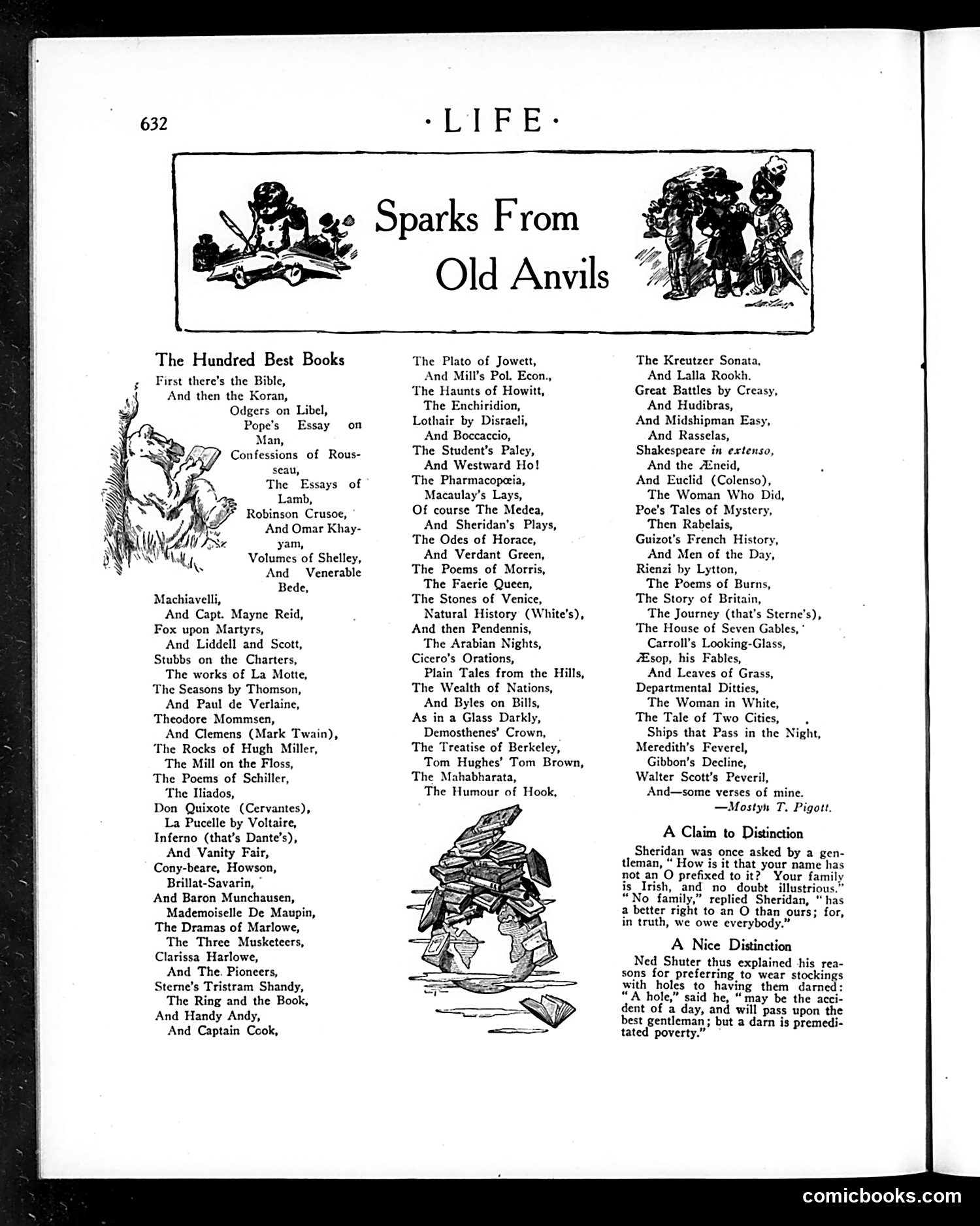
This page presents satirical anecdotes and a humorous list titled "The Hundred Best Books." The main content mocks Victorian-era literary pretension by cataloging an absurdly comprehensive (and somewhat random) collection of classics, philosophical works, and contemporary novels—from the Bible and Plato to Mark Twain and Kipling—suggesting that claiming to have read "the hundred best books" was an aspirational but ultimately ridiculous social claim. The two brief anecdotes below offer cutting social commentary: one jokes about Irish debt (Sheridan's family "owes everybody"), and another satirizes false gentility—a character prefers torn stockings over darned ones because poverty-stricken accidents are more socially acceptable than deliberate, visible mending. The page reflects Life's tradition of deflating Victorian pretension and self-importance through wit and observation.
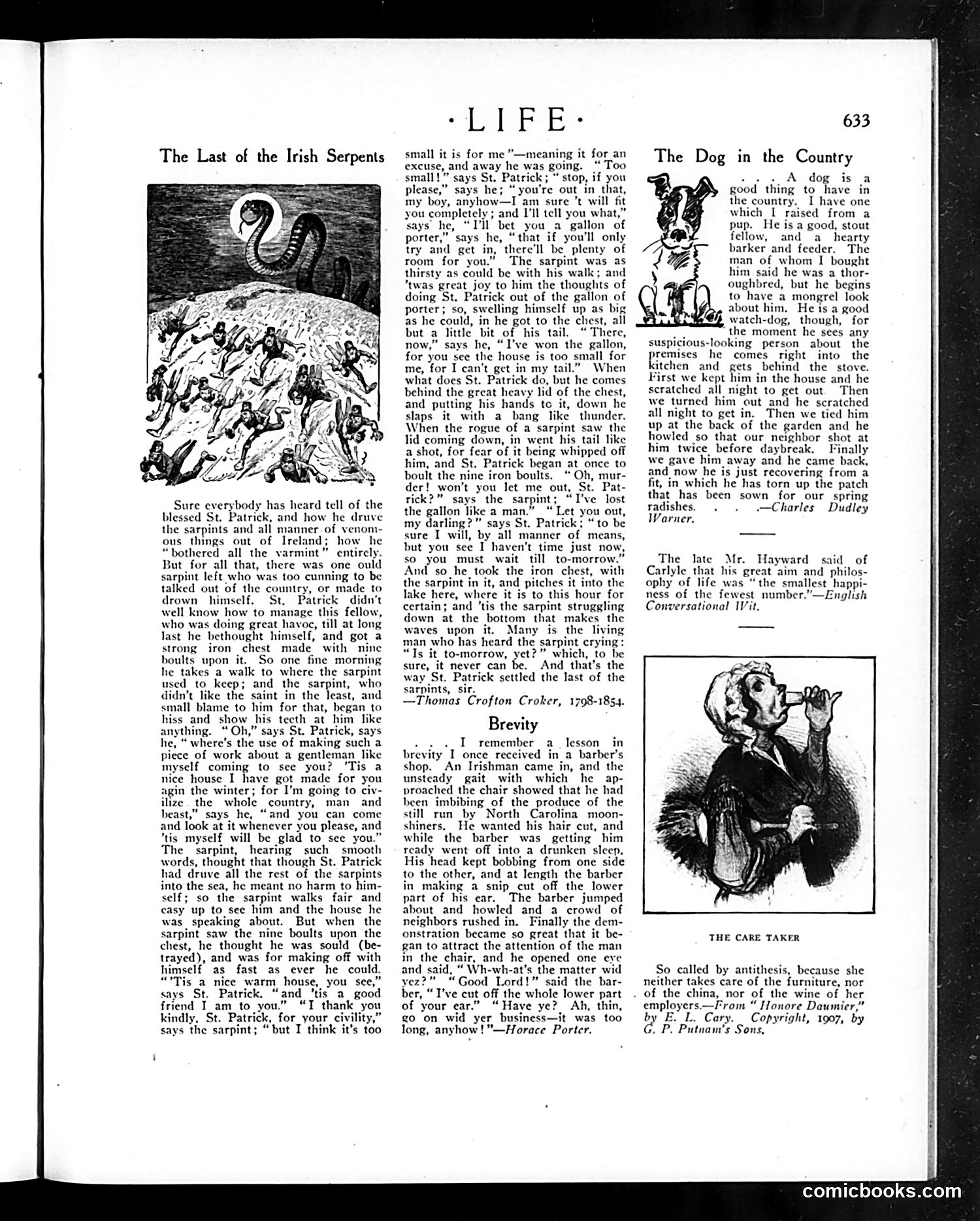
This page contains two distinct pieces: **"The Last of the Irish Serpents"** is a folk tale (not satire), presented as Irish folklore collected by Thomas Crofton Croker. It's a whimsical legend explaining why Ireland has no serpents—St. Patrick tricks the final cunning serpent into an iron chest by wagering a gallon of porter, then seals it in a lake forever. The serpent's thrashing allegedly causes waves. This reflects 19th-century interest in Irish mythology and oral traditions, presented here for entertainment rather than political commentary. **"The Dog in the Country"** is a brief personal anecdote about a country dog's suspicious nature and eventual acceptance. **"Brevity"** appears to be the start of another anecdote about a barbershop lesson (text cuts off). The accompanying illustrations are decorative woodcuts typical of Life magazine's era. There is no political satire on this page—it's primarily folkloric and humorous domestic content.
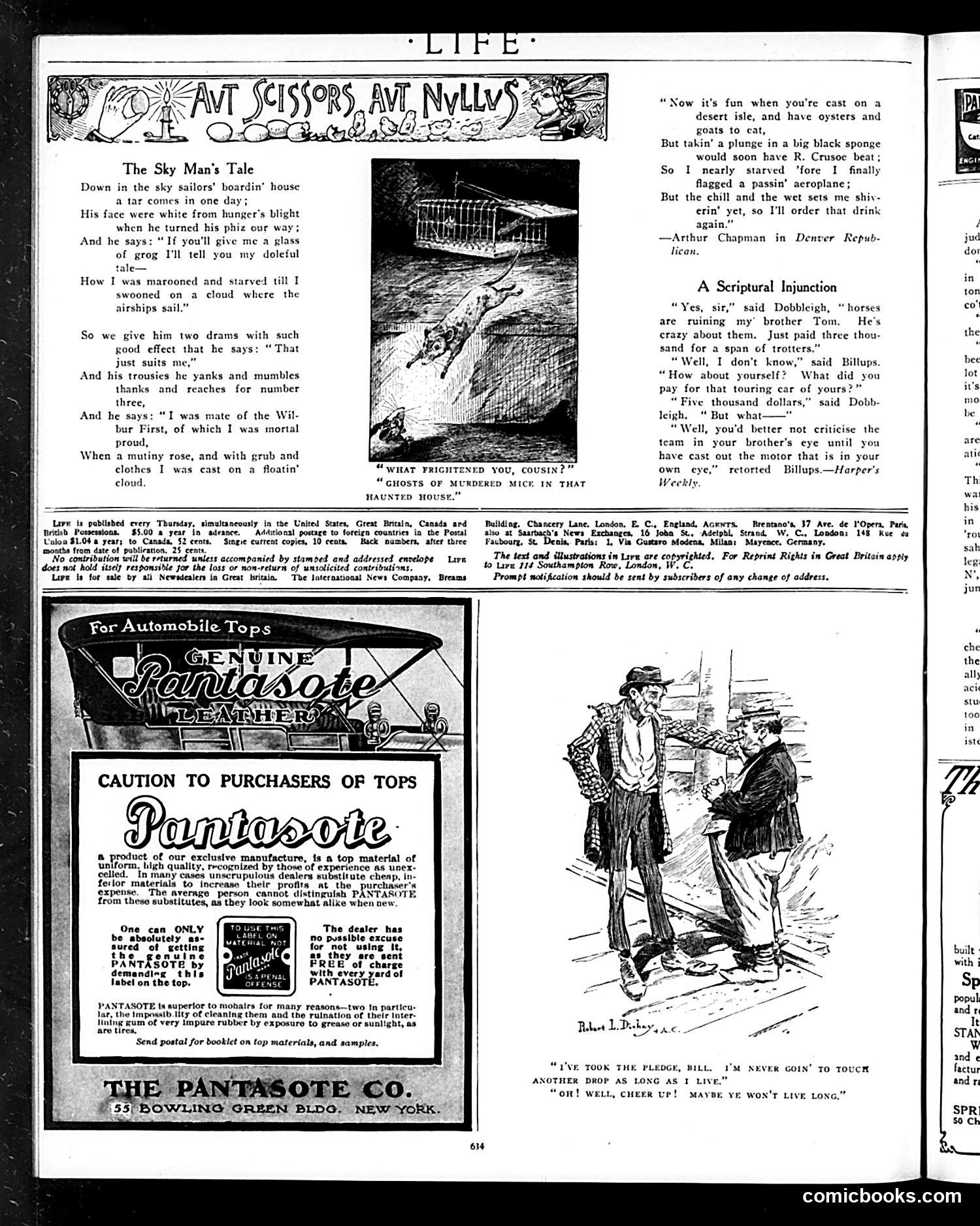
**Main Content:** The page features two distinct items: 1. **"The Sky Man's Tale"** — A narrative poem about a sailor rescued from a desert island who was saved by an airship. The joke plays on the novelty of aviation technology: the sailor endured starvation and shipwreck but celebrates his rescue by modern aircraft, yet complains the experience left him wanting a drink. 2. **"A Scriptural Injunction"** — A brief satirical dialogue where two men (Dobbleigh and Billups) argue about moral hypocrisy. Dobbleigh criticizes his brother for obsessing over horses; Billups points out that Dobbleigh himself spent $5,000 on a touring car—a clear reference to Matthew 7:5 about removing the beam from your own eye before criticizing others'. The satire mocks wealthy men's selective morality regarding luxury purchases. **Historical Context:** Both pieces reflect early-1900s American attitudes toward new technology (automobiles, aircraft) as status symbols and sources of class anxiety. **Advertisements** for Pantasote automobile tops occupy the lower portion—typical of Life's mixed editorial-commercial format.
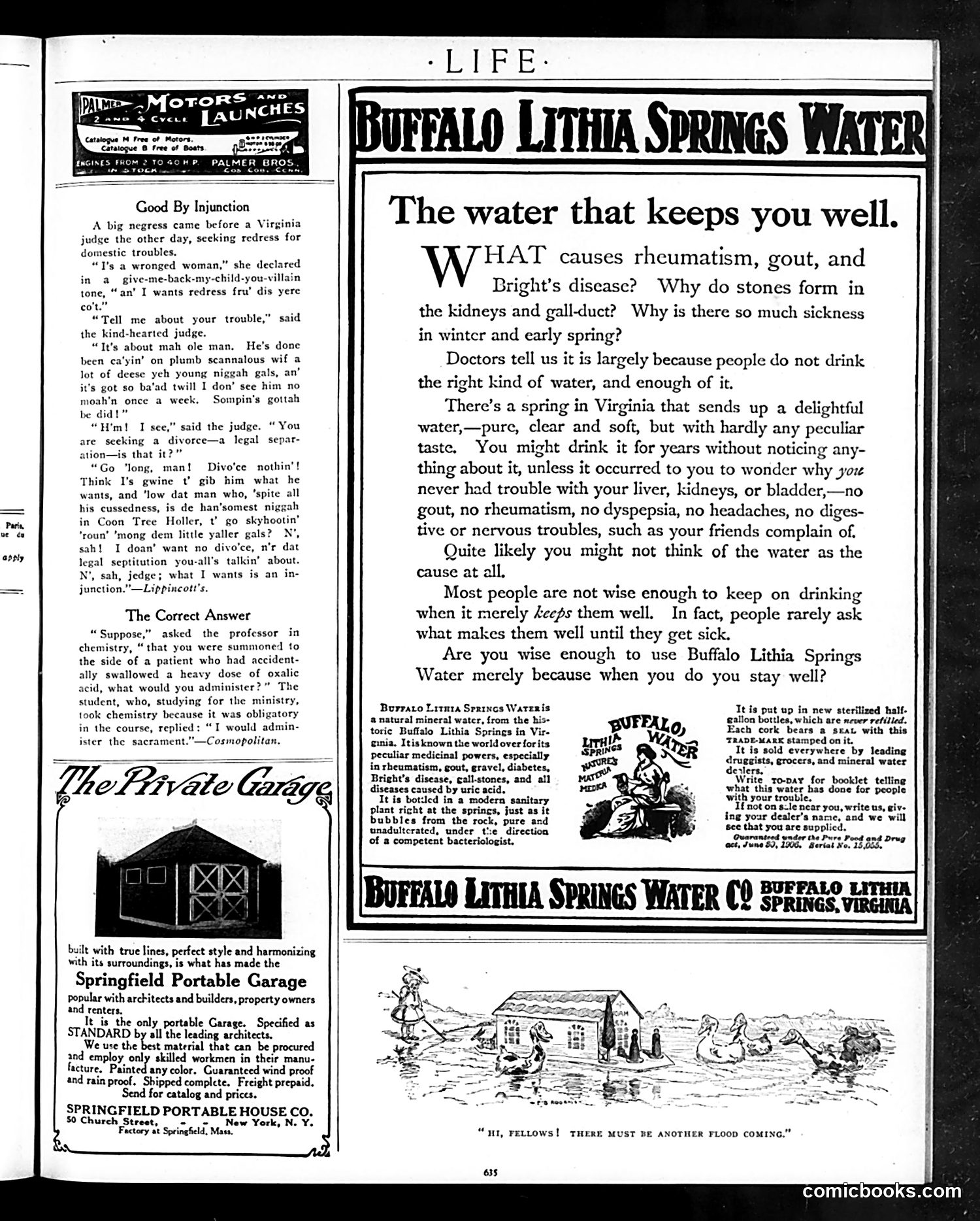
This page combines humor and advertising typical of early 20th-century Life magazine. **"Good By Injunction"** is a dialect humor piece mocking an African American woman seeking a court injunction (rather than divorce) against her unfaithful husband. The satire relies on stereotypical speech patterns and the joke that she wants to keep him while preventing his infidelity—a legal impossibility presented as comical ignorance. **"The Correct Answer"** is a brief joke about a seminary student who, when asked what medicine to give someone who swallowed oxalic acid, absurdly responds "the sacrament"—conflating medical treatment with religious practice. **The advertisements** for Springfield Portable Garage and Buffalo Lithia Springs Water occupy significant space. The latter claims the spring water cures rheumatism, gout, and Bright's disease through its mineral content—typical patent medicine marketing of the era that made unsubstantiated health claims before FDA regulation. The bottom cartoon shows flooding, likely commenting on water-related concerns addressed by the advertisements.
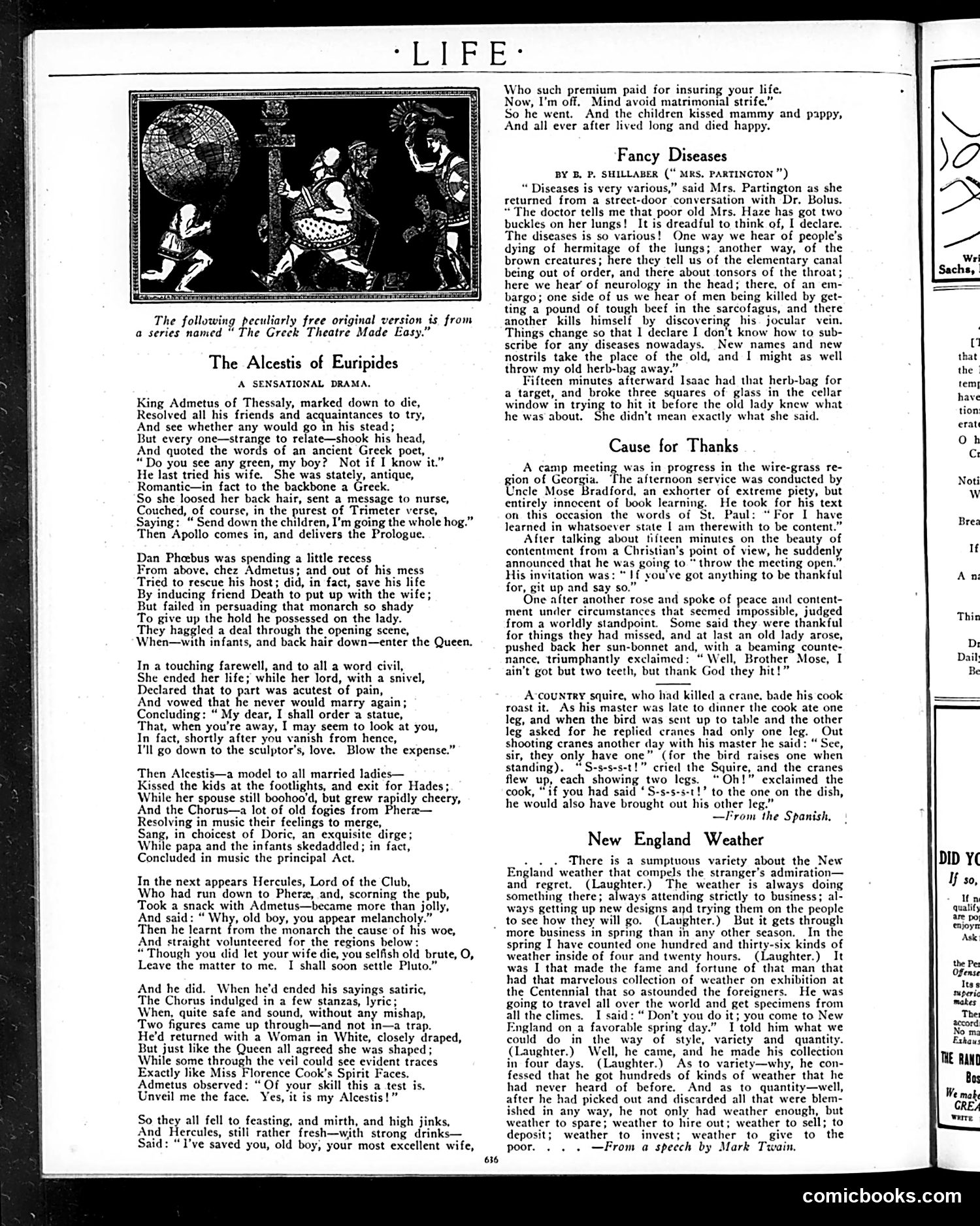
This page contains a satirical retelling of Euripides' classical play *Alcestis* as part of a series called "The Greek Theatre Made Easy." The humor targets both the original Greek drama and Victorian sentimentality. **The Satire:** The piece mocks the play's plot—where a wife sacrifices herself to save her husband's life—by emphasizing the husband Admetus's selfishness and the wife's melodramatic devotion. Specific jabs include: his friends refusing to die for him (quoted as "Do you see any green, my boy? Not if I know it"), his vow never to remarry immediately followed by visiting a sculptor, and the final punchline about "insuring your life" through matrimonial insurance. **The Point:** Life magazine satirizes both classical literature as overly dramatic and stuffy, and contemporary Victorian marriage ideals—particularly the expectation that wives sacrifice themselves for husbands. The "Woman in White" reference and spiritualist humor add period flavor, mocking contemporary fads alongside ancient drama.
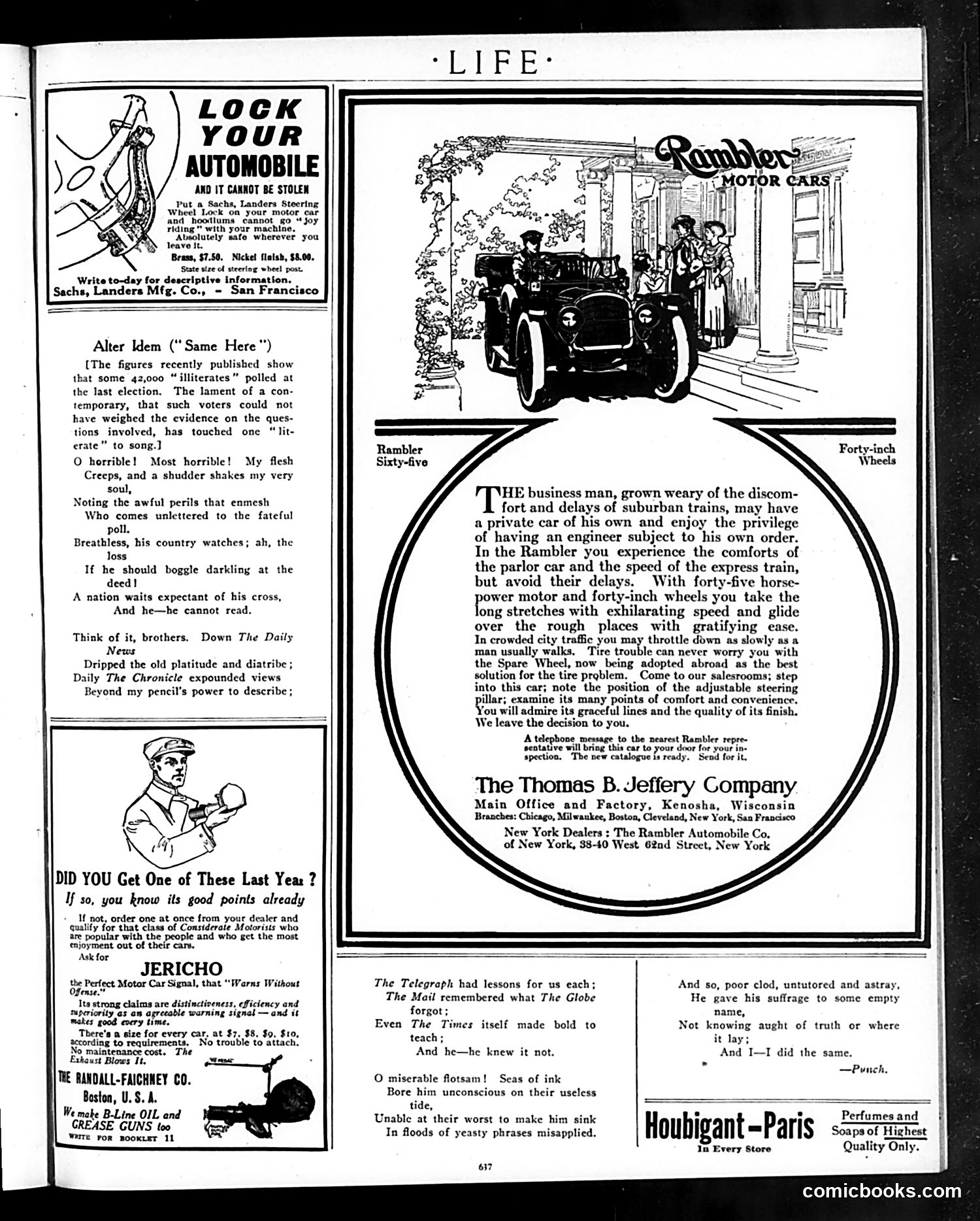
This page combines satirical poetry with period automotive advertising. The main satirical piece, "Alter Idem" ("Same Here"), mocks voter illiteracy revealed in recent election polling. The poem describes an uneducated man—"poor clod, untutored and astray"—who cast his ballot without understanding the issues or candidates, despite newspapers (the Telegraph, Mail, Globe, Times) providing information. The satire critiques both the voter's ignorance and the contemporary debate about whether such voters should participate in elections. The surrounding ads—for automobile locks, steering wheel signals, and Rambler cars—are typical early 1900s product promotions. The page layout interweaves satire with commerce, characteristic of Life's format. The political commentary reflects Progressive Era anxieties about mass suffrage and voter competence, a common theme when immigration and expanding voting rights were transforming American democracy.
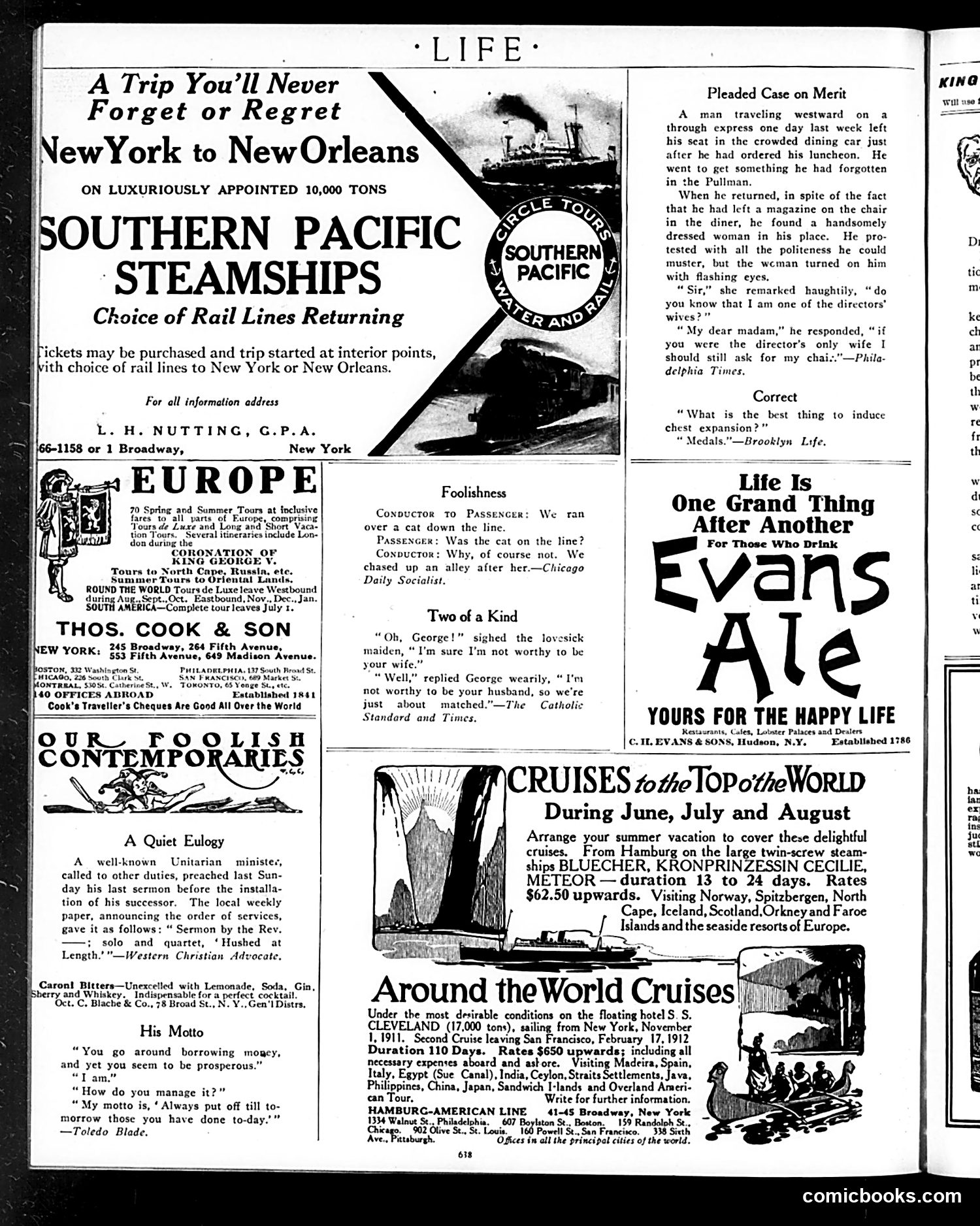
This page is primarily **advertisements and humor jokes**, not political cartoons. The humor pieces are mild social satire typical of early 1900s Life magazine: - **"Pleaded Case on Merit"**: A man reclaims his dining car seat from a director's wife by arguing merit over status—satirizing class pretension. - **"Two of a Kind"**: A couple admits mutual unworthiness for marriage—gentle mockery of romantic idealization. - **"Foolishness"**: A conductor chases a cat after hitting it—absurdist humor about illogical behavior. - **"His Motto"**: A borrower avoids repaying debts by procrastination—satire on financial irresponsibility. - **Evans Ale advertisement**: Uses the phrase "One Grand Thing After Another / For Those Who Drink"—implying alcohol solves life's problems, presented humorously. The rest comprises travel advertisements (steamships, cruises, Thomas Cook tours) typical of the era. There are **no identifiable political figures or specific historical events referenced** on this page.
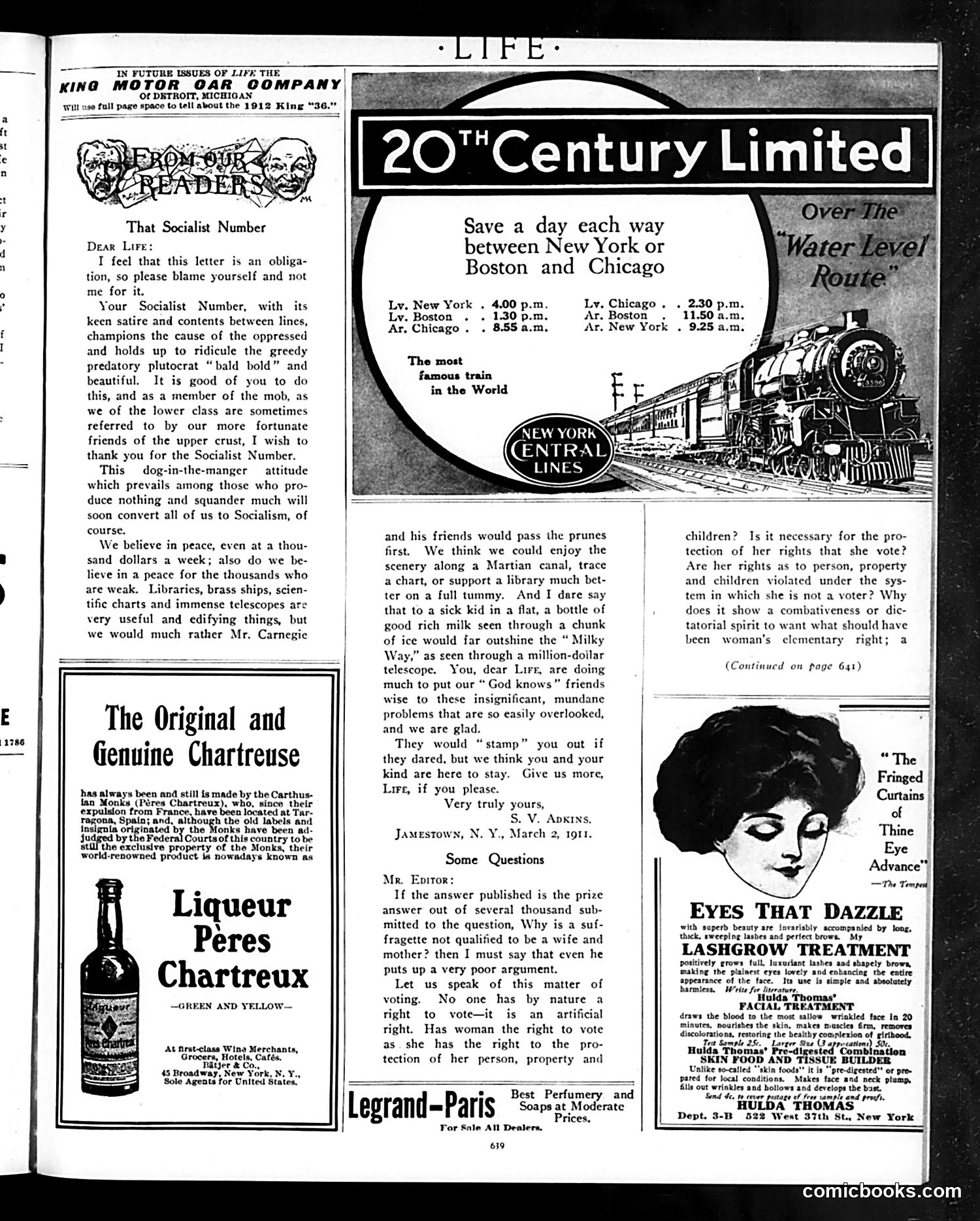
This page contains **mostly advertisements and reader letters**, not political cartoons. The substantive content includes: **"That Socialist Number"** letter: A reader praises *Life* magazine's recent "Socialist Number" issue, which satirized wealthy industrialists ("greedy predatory plutocrats") while championing the poor. The writer, identifying as working-class, ironically thanks the magazine while suggesting the wealthy's exploitation will naturally convert everyone to socialism. The tone is satirical social commentary on class inequality. **"Some Questions"** letter: A reader challenges *Life's* anti-suffrage argument, questioning whether women need voting rights to protect their persons and property. This reflects the 1911 women's suffrage debate—the writer argues logically that if rights protection requires voting power, women should vote. The page also advertises the "20th Century Limited" train, Chartreuse liqueur, and beauty products—typical early 20th-century magazine content reflecting consumer culture alongside political discourse.
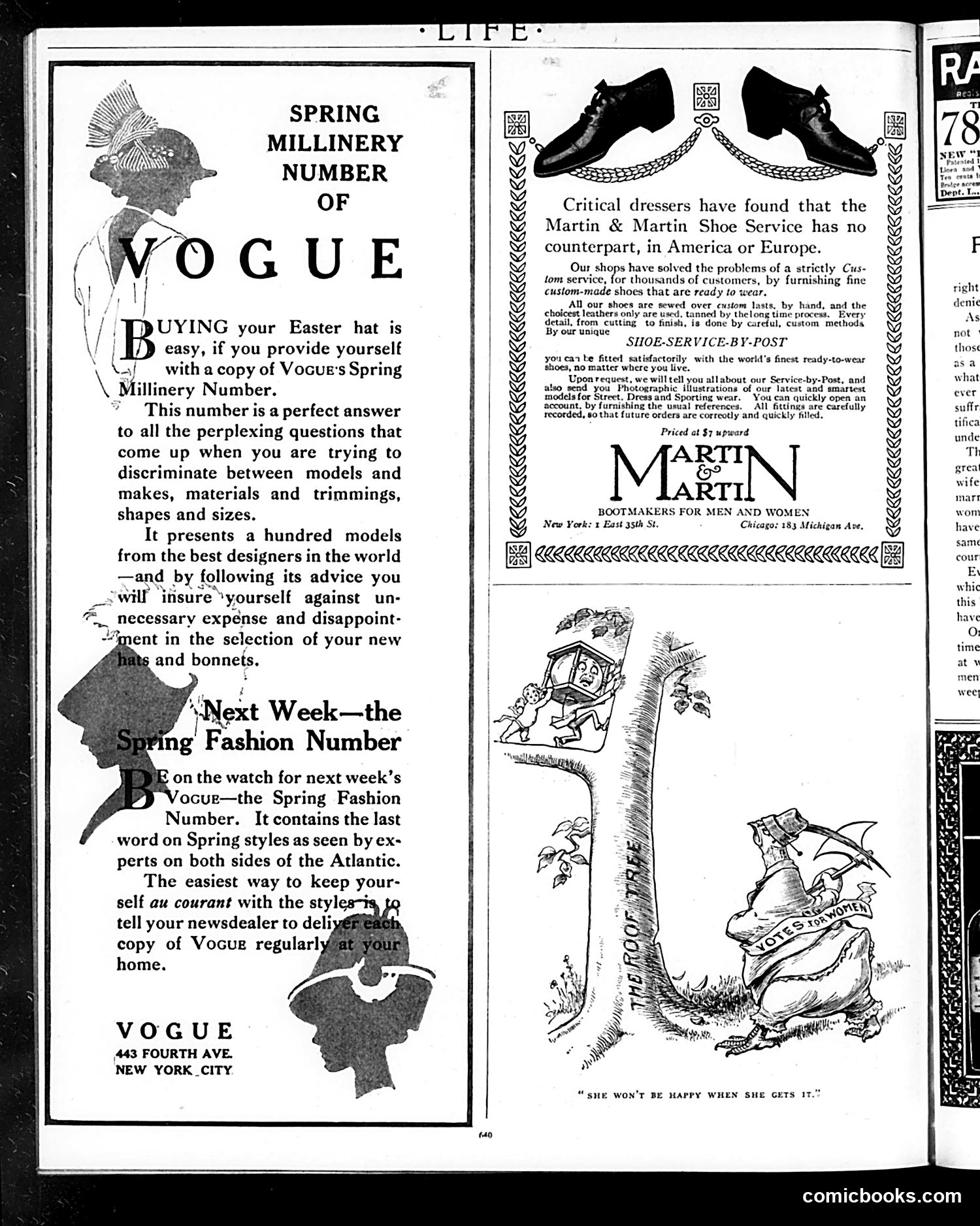
This page consists primarily of **advertisements, not political satire**. The left side promotes Vogue's Spring Millinery Number for Easter hat shopping, targeting women interested in fashion. The right features two ads: one for Martin & Martin Shoe Service (emphasizing custom-made shoes available by mail) and a cartoon advertisement below. The cartoon at the bottom depicts a woman discovering a package at a doorstep, with the caption "She won't be happy when she gets it." This appears to be humorous advertising—likely suggesting a shoe delivery or fashion purchase that will (ironically or genuinely) displease the recipient, playing on domestic comedy tropes of the era. The page reflects early 20th-century consumer culture, mail-order services, and gendered marketing around fashion and shopping. There is no identifiable political content or historical satire here.
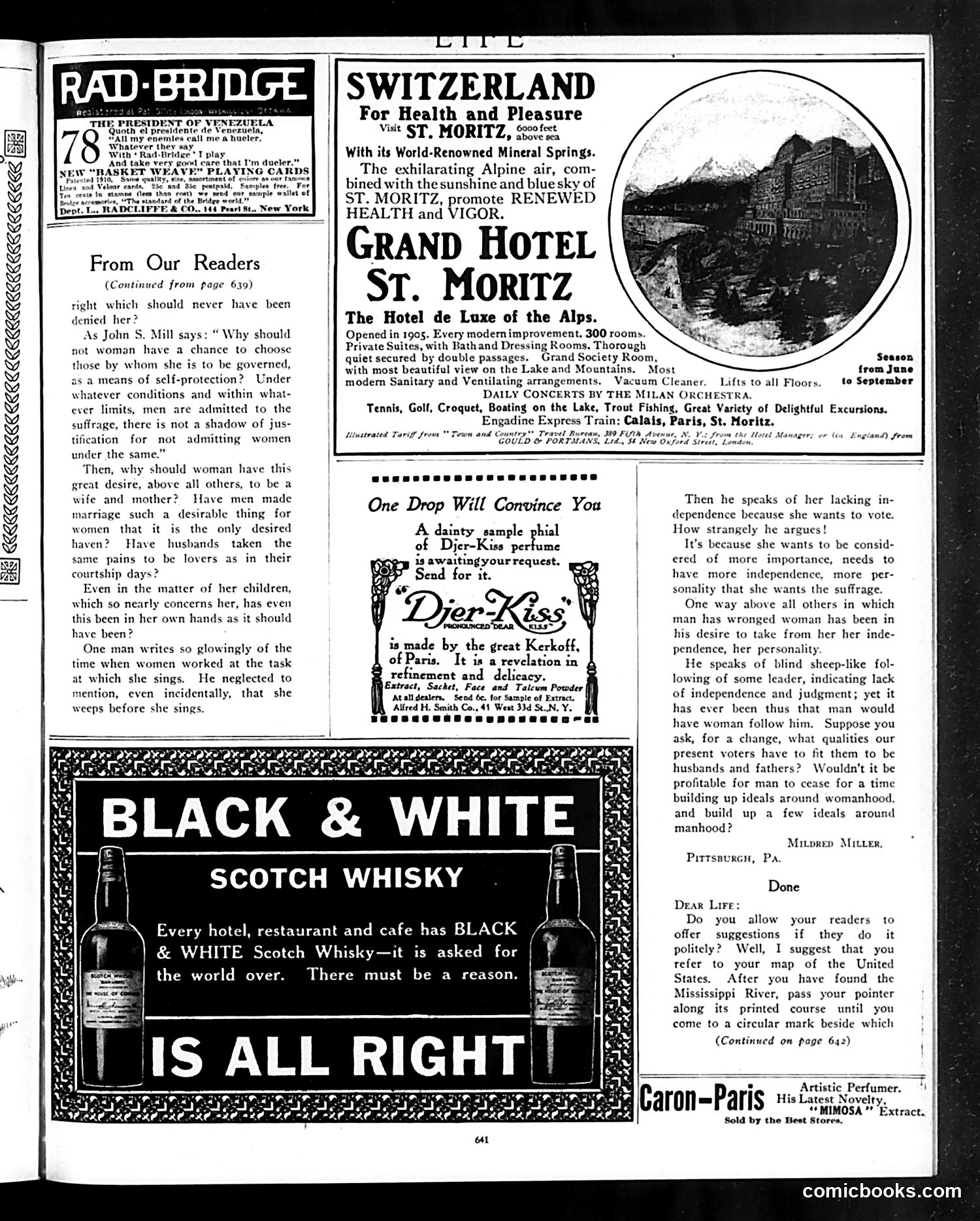
This page is primarily **advertising and reader correspondence**, not political cartoons. The small item at top-left references "The President of Venezuela" in a playful couplet about playing cards, though the text is fragmentary and unclear in purpose. The main content consists of: 1. **"From Our Readers"** — A continued letters section debating **women's suffrage**. Writers argue whether women should have voting rights and independence. One correspondent (Mildred Miller) critiques arguments against female voters, questioning why men with questionable judgment are allowed to vote while women are denied the right. 2. **Commercial advertisements** for Swiss hotels, perfume (Djer-Kiss), and Scotch whisky dominate the page. The suffrage debate reflects early 20th-century arguments: critics claimed women lacked independence or would blindly follow leaders; supporters countered that men's own judgment was questionable and that voting rights were about women's autonomy and dignity.
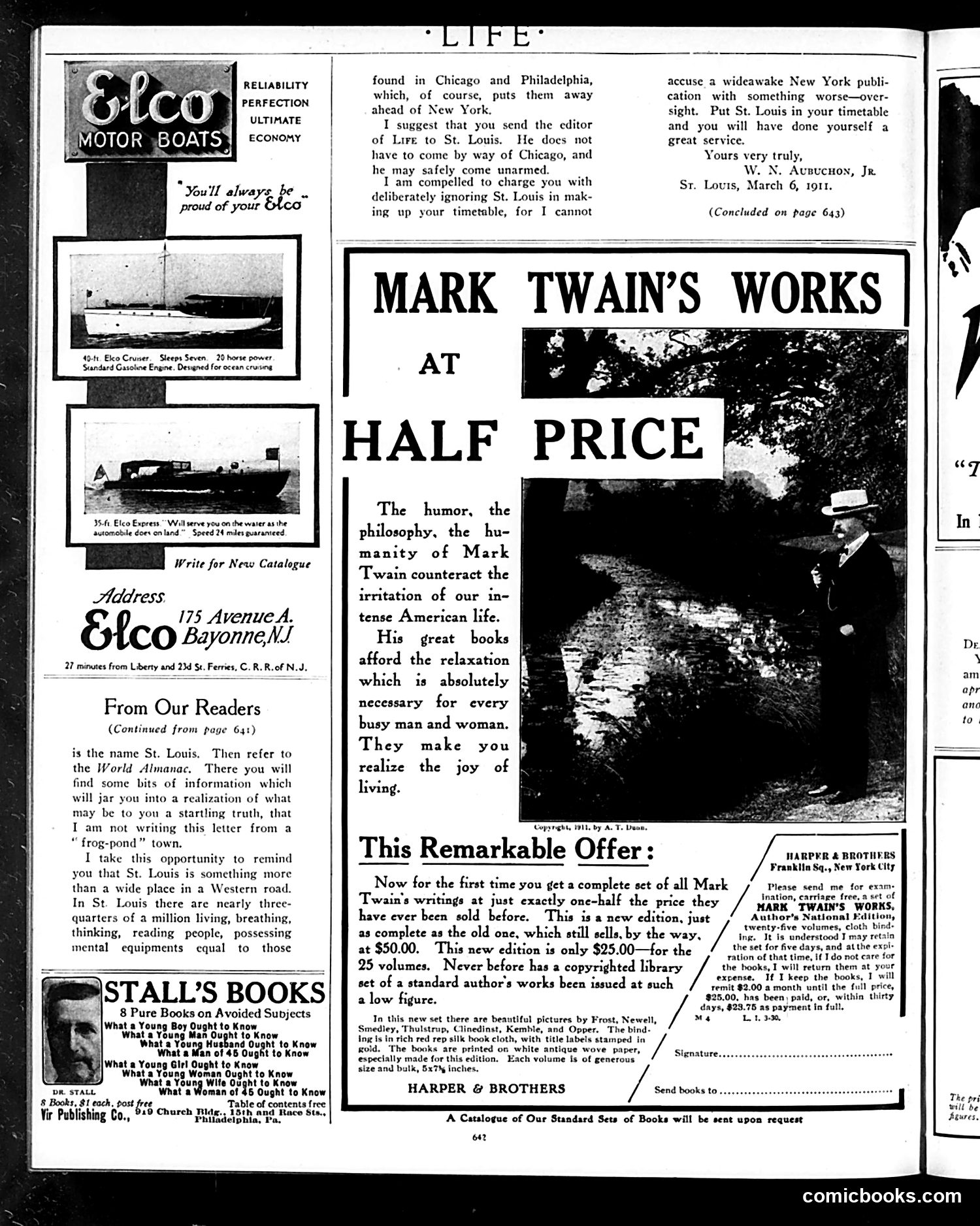
This is primarily an **advertising and reader correspondence page** rather than satirical content. The main elements are: **Reader Letter**: A St. Louis resident complains that Life magazine omitted St. Louis from a travel timetable, despite the city's population of nearly 750,000. The writer humorously suggests sending Life's editor to St. Louis, noting he "may safely come unarmed"—a mild jab suggesting the city is civilized and safe, countering potential East Coast assumptions about the Midwest. **Mark Twain Advertisement**: Harper & Brothers offers a complete 25-volume set of Mark Twain's works at half price ($25 instead of $50), marketed as providing "relaxation" from "intense American life" and helping readers "realize the joy of living." **Other Ads**: Elco motorboats and Stall's Books complete the page. The page reflects early 20th-century American regional tensions—Midwestern cities seeking recognition from Eastern publications—and the era's fascination with self-improvement literature.
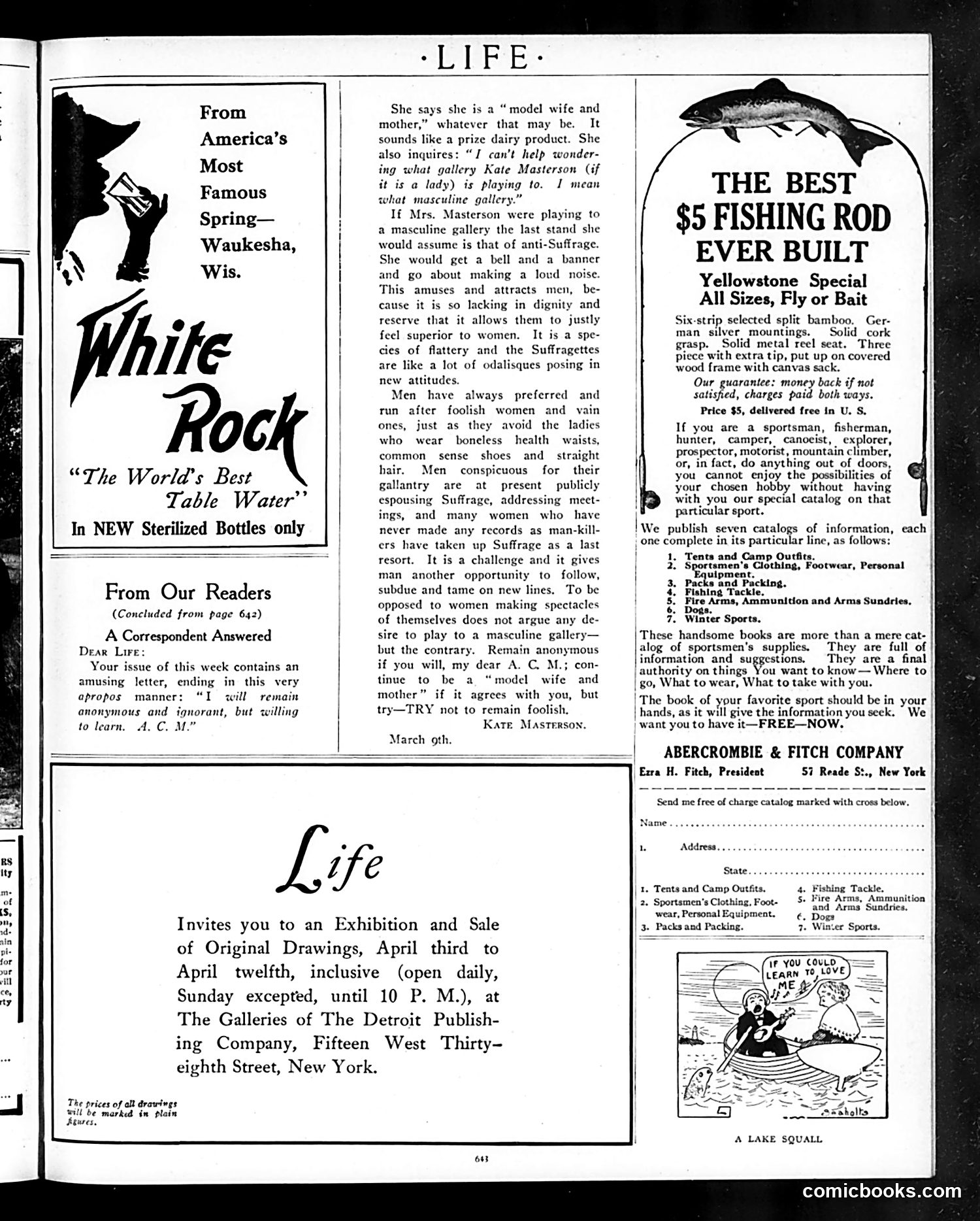
This page contains a **letter-to-editor debate about women's suffrage**, disguised as reader correspondence. A woman signing as "Kate Masterson" attacks female suffragists, particularly one "Kate Masterson" (likely a pseudonym for a real activist), arguing that suffragettes are undignified and merely seeking male attention like "odalisques" (harem dancers). Masterson claims suffragists are not genuinely challenging masculine authority but rather performing spectacle to attract men—ironically, she argues, by adopting the very "foolish" behavior men prefer in women. She defends her own position as a "model wife and mother" who opposes suffrage without being anti-feminist. **The satire**: Life appears to be mocking anti-suffrage arguments by letting this contradictory logic speak for itself—the letter simultaneously claims suffragists are attention-seeking performers *and* that opposing them represents intellectual independence. The rest of the page is **advertising** (White Rock water, fishing rods, sporting catalogs).
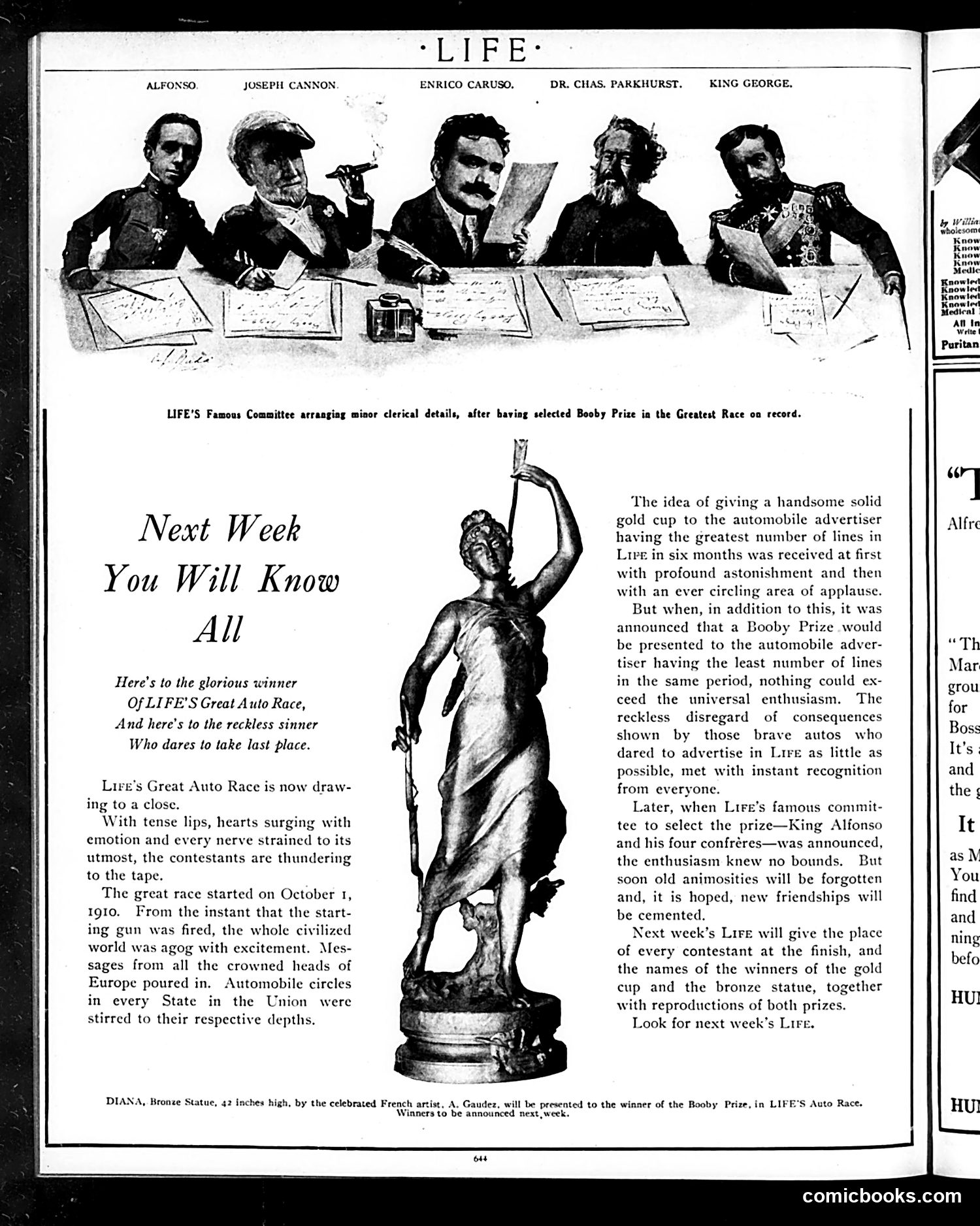
This page announces the conclusion of LIFE's satirical "Great Auto Race"—a 1910 advertising competition where automobile companies competed for lines of ad space in the magazine. The top committee selecting winners includes real figures: King Alfonso (Spanish monarch), Joseph Cannon (U.S. House Speaker), opera singer Enrico Caruso, Dr. Charles Parkhurst (prominent clergyman), and King George (likely George V of Britain). The satire targets automobile advertisers' desperation: companies that advertised *most* win a gold cup; those advertising *least* receive the "Booby Prize"—a bronze Diana statue. The joke mocks both the absurd competition and advertisers' willingness to buy space in LIFE regardless of actual value. The page celebrates how this stunt captured global attention, suggesting the contest itself was LIFE's clever strategy to boost its own advertising revenue while satirizing the automobile industry's competitive excess.
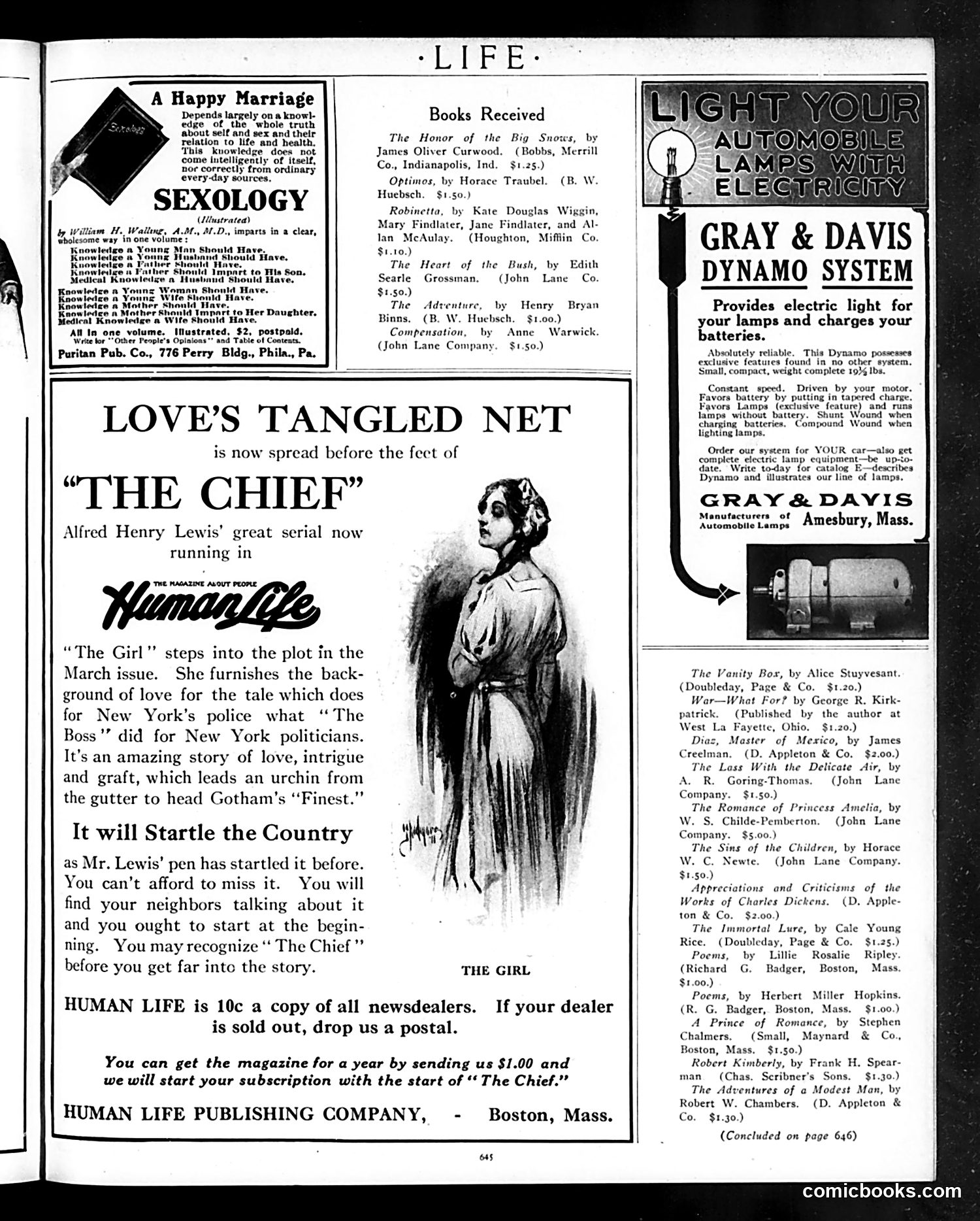
This page combines advertising with promotion for a serialized story. The central advertisement promotes "The Chief," a serial by Alfred Henry Lewis running in *Human Life* magazine. The narrative promises sensational content: a love story involving a police-connected character rising from "the gutter to head Gotham's 'Finest'" (the NYPD). The ad claims the story parallels Lewis's earlier success with "The Boss," which exposed New York political corruption. The surrounding ads—for a sex education book (*Sexology*) and automobile electrical systems—reflect early 1900s concerns. The "Books Received" section lists contemporary literature. The central illustration shows "The Girl," apparently the story's romantic element. The framing suggests melodrama: urban crime, romance, and social climbing. The ad's emphasis on recognizing "The Chief" hints the character may be based on a real figure, though this isn't specified. This is primarily a **commercial page** designed to drive magazine subscriptions through serialized fiction.
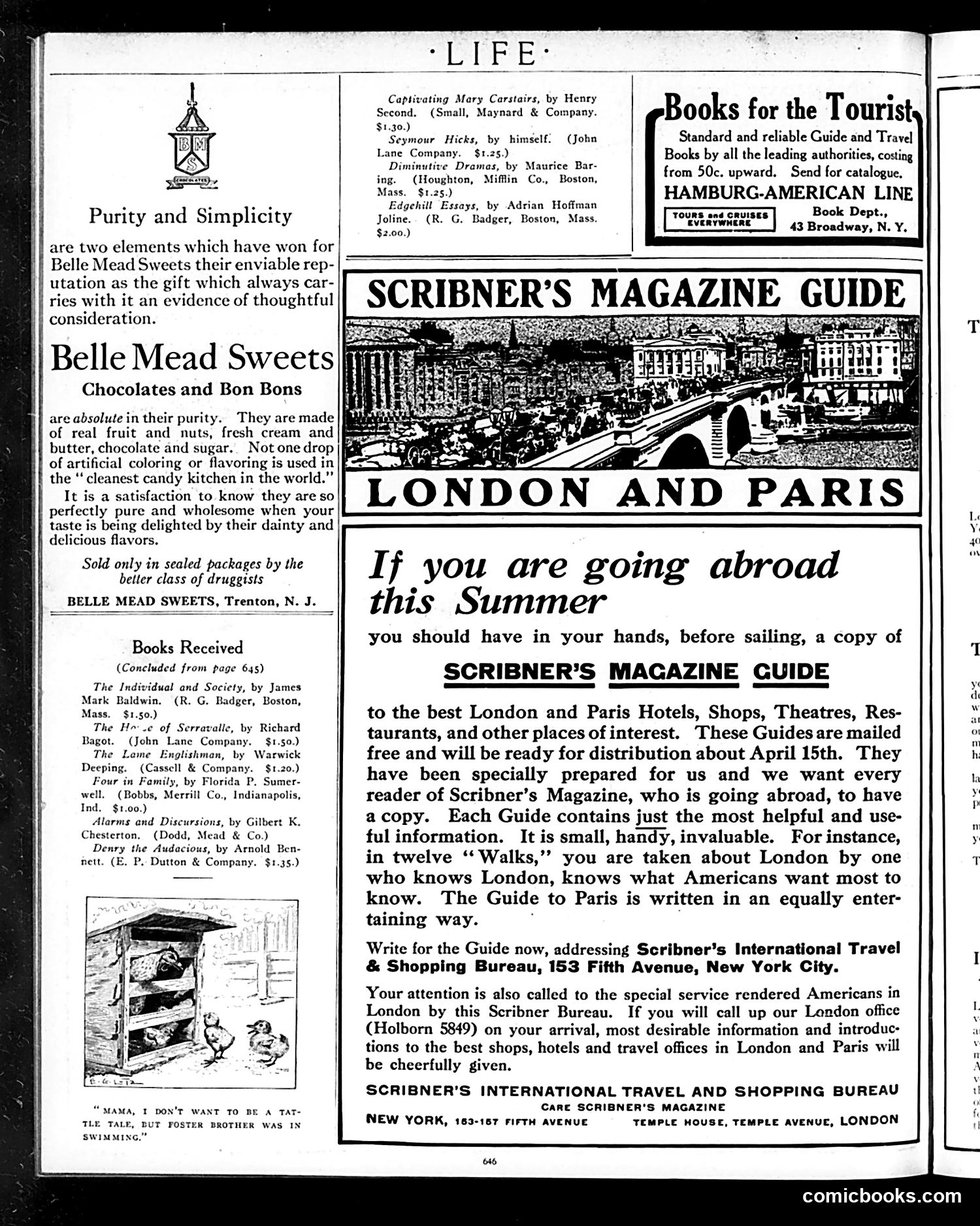
This page is primarily **advertising and book notices**, not political satire. The dominant content includes: **Main Advertisement:** Scribner's Magazine Guide to London and Paris—a travel resource mailed free to readers planning summer abroad trips, with practical information on hotels, shops, theatres, and restaurants. **Small Cartoon:** At bottom left, a single-panel domestic scene shows a child telling their mother: "MAMA, I DON'T WANT TO BE A TATTLE TALE, BUT FOSTER BROTHER WAS IN SWIMMING." The joke is the child's contradiction—they *are* tattling while claiming reluctance to do so. This is gentle humor about childhood behavior, not political commentary. **Other Content:** - Belle Mead Sweets chocolate advertisement emphasizing purity - List of recently published books - Hamburg-American Line travel booking ad The page reflects early-20th-century consumer culture and leisure travel advertising aimed at affluent readers.
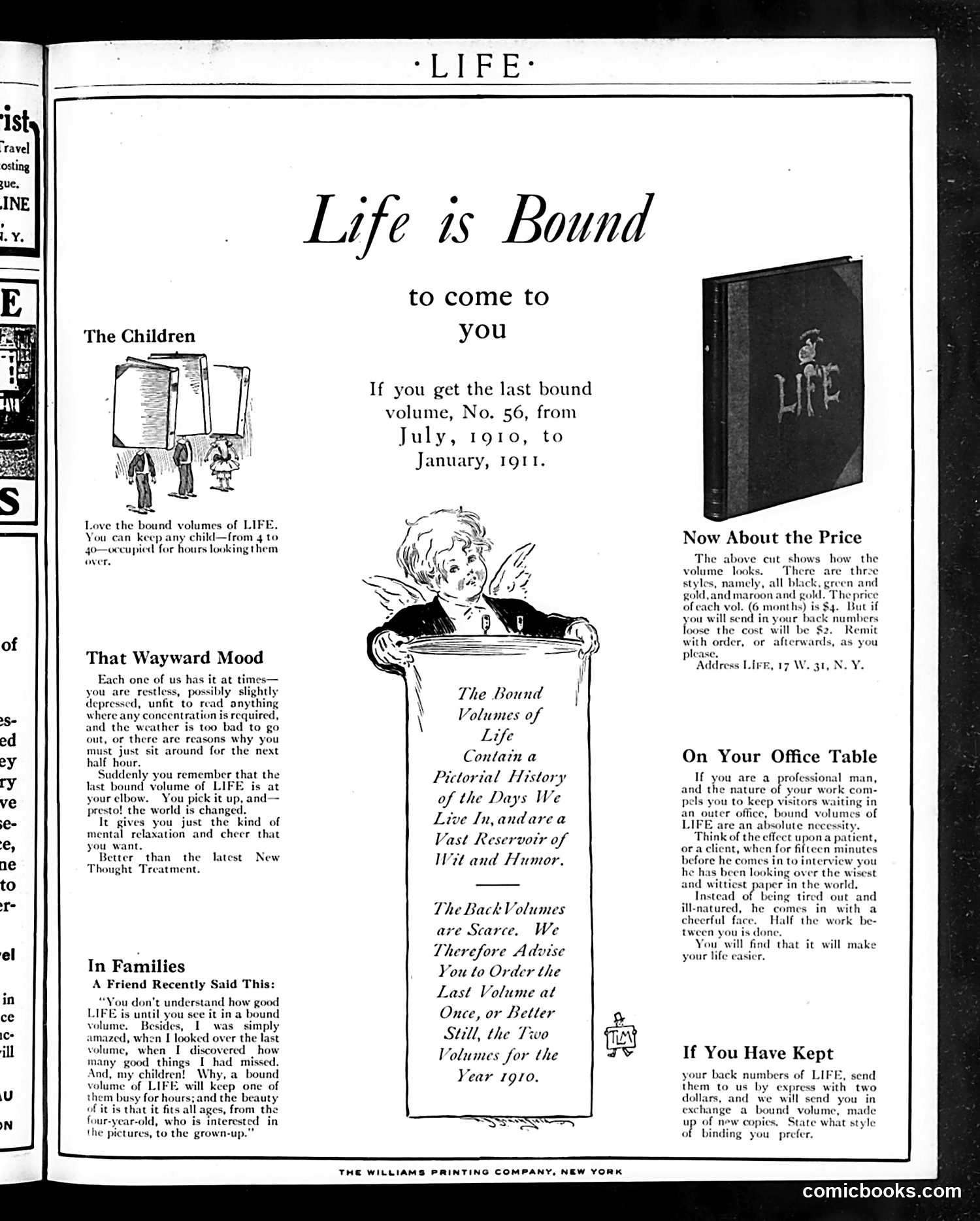
This is primarily an advertisement for *Life* magazine's bound volumes rather than political satire. The page promotes subscribing to bound collections of the satirical weekly, which ran from July 1910 to January 1911 (Volume 56). The marketing pitch emphasizes the volumes' value across audiences: children enjoy the illustrations for hours; adults use them to escape bad moods; families appreciate the pictorial history and humor they contain. A testimonial from "a Friend" claims the bound volumes kept his children entertained and revealed missed content. The practical appeal targets professional men—doctors, lawyers—suggesting that waiting clients will be entertained and arrive cheerful for appointments, making business interactions smoother. Pricing information notes three binding styles at $4 each (or $2 if trading back issues). The advertisement urgently advises ordering quickly, warning that "back volumes are scarce," creating purchase pressure for subscribers wanting complete collections of 1910 issues.
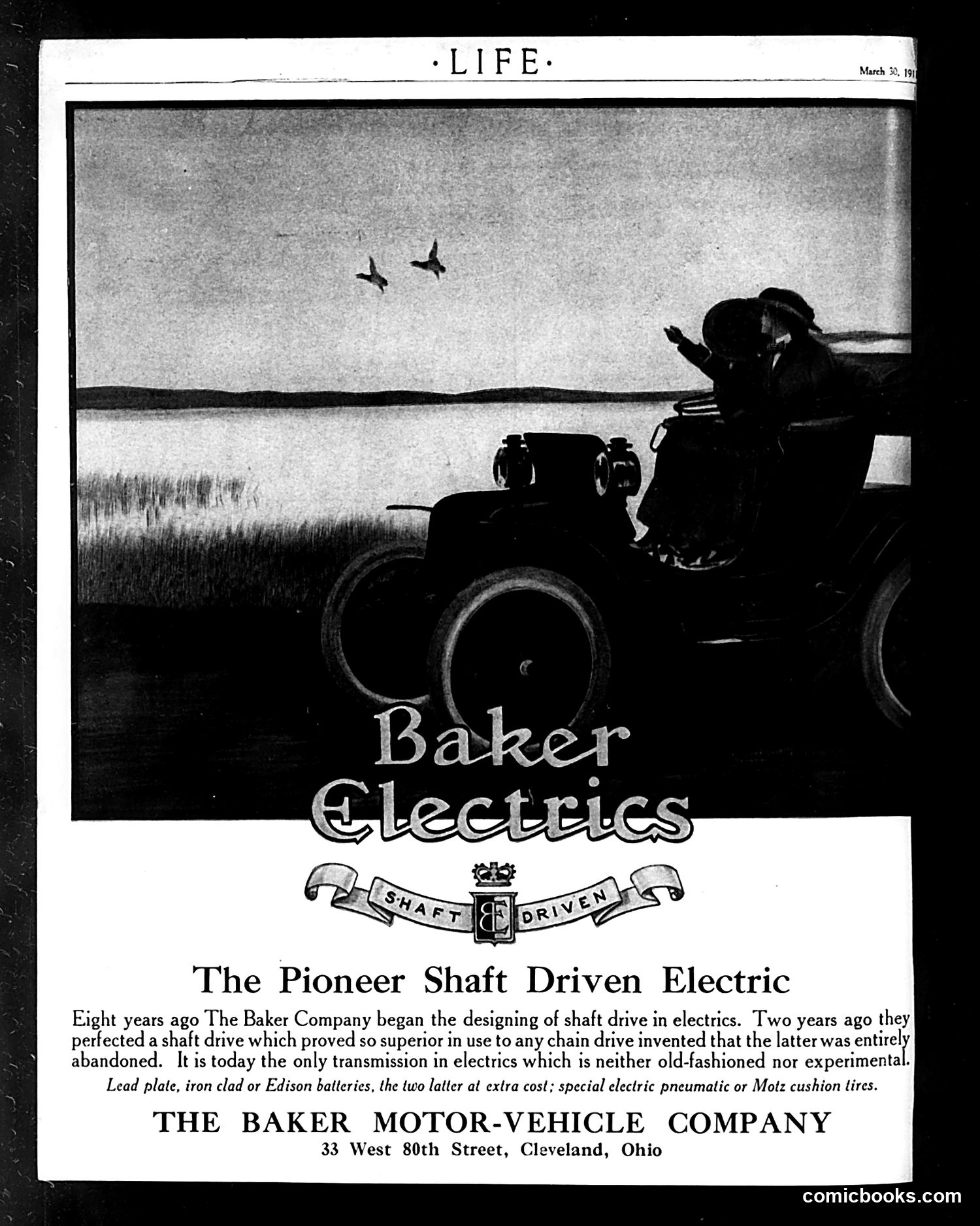
This is primarily a **product advertisement** rather than political satire. It promotes Baker Motor-Vehicle Company's electric automobiles, specifically their "shaft driven" transmission technology. The image depicts a silhouetted driver in an early electric car, pointing upward at birds in flight—a visual metaphor suggesting speed, freedom, or progress. The advertisement emphasizes Baker's innovation: their shaft drive transmission (as opposed to chain drives) for electric vehicles, claiming it's superior, proven, and "neither old-fashioned nor experimental." The historical context: This appears from the early 1910s, when **electric vehicles competed seriously with gasoline cars**. Baker was a real Cleveland manufacturer of luxury electric automobiles. The ad targets affluent buyers by highlighting technological superiority and offering premium battery options (Edison batteries at extra cost). There is no satire here—it's straightforward early automotive marketing emphasizing engineering innovation during the brief era when electrics seemed a viable alternative to internal combustion engines.
I cannot reliably analyze this image. The page is almost entirely black or extremely dark, with only faint watermarks or design elements barely visible on the right side. The partial OCR text at the bottom ("ey," "sly," "al") appears to be fragments insufficient to identify the content. The "comicbooks.com" watermark suggests this may be a comic book page rather than from Life magazine as stated. Without legible visual content or coherent text, I cannot accurately identify any figures, political references, or satirical intent. The image quality or reproduction makes detailed analysis impossible.