
Life, 1911-03-30 · page 8 of 45
Life — March 30, 1911 — page 8: what you’re looking at
What you’re looking at
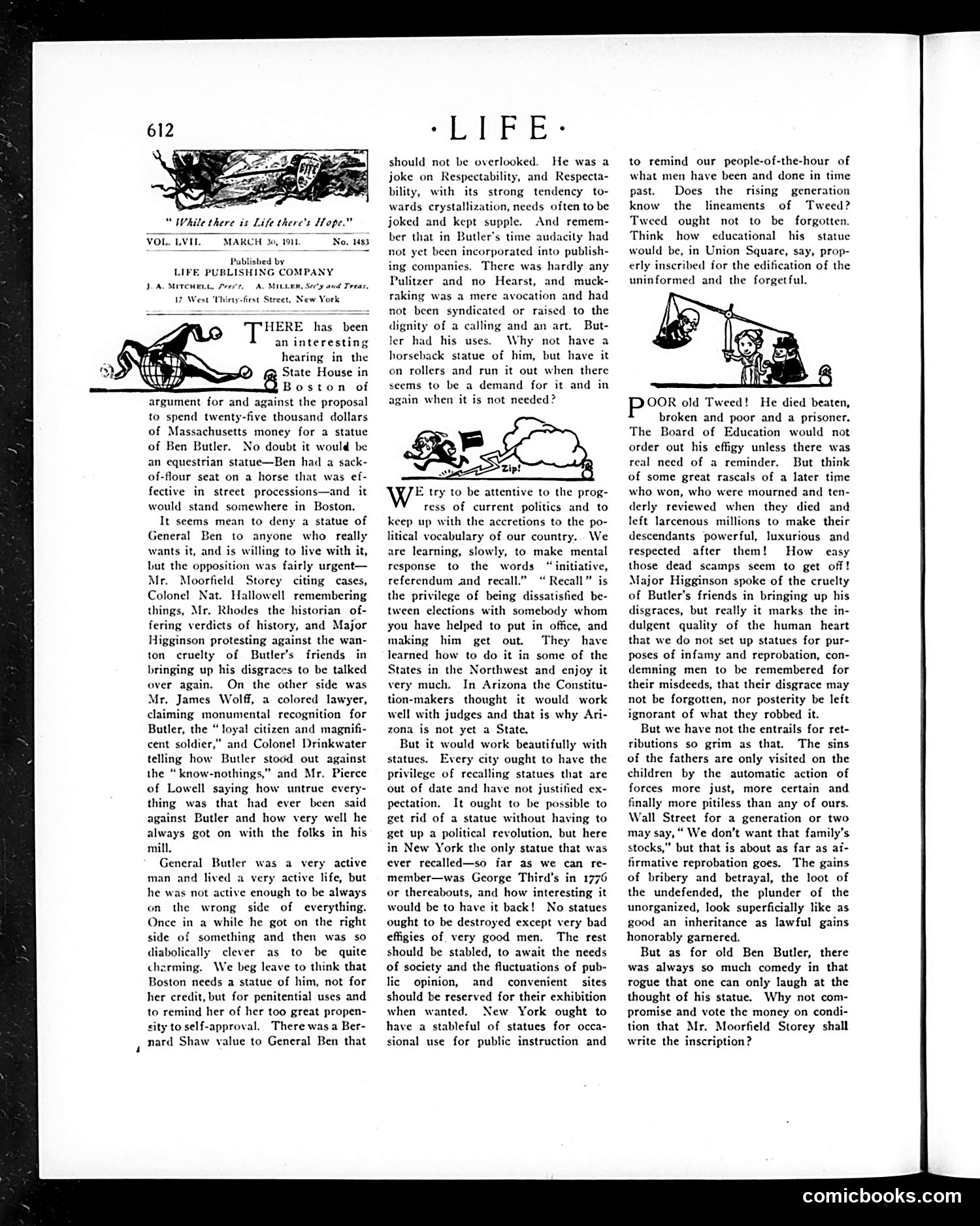
This page contains editorial commentary about statues and public monuments, particularly discussing whether to erect a statue of General Ben Butler in Boston. The text argues against the proposal, questioning whether Butler deserves such honor despite his active life and "loyal citizen" reputation. The small cartoons show children on swings/seesaws—likely illustrating the playful, lighthearted tone Life magazine typically employed. The main satire criticizes how cities create statues of questionable figures for political reasons rather than genuine merit. The author suggests statues should commemorate truly worthy individuals and proposes New York maintain a "stateful" of removable statues for occasional public instruction instead of permanent installations of mediocre men. The piece represents Progressive-era skepticism toward Gilded Age monument-building and municipal politics.
📄 Transcribed text from this page (OCR, searchable)
Machine-transcribed from the original scan — historical spelling and the odd misread are preserved.
Published by LIFE PUBLISHING COMP. JA. MiToMEnt, Pre, 17 West AL MILLI, rty-first § HERE has been an interesting hearing in the GR State House in QBoston of argument for and against the proposal to spend twenty-five thousand dollars of Massachusetts money for a statue of Ben Butler. No doubt it would be an equestrian statue—Ben had a sack- of-flour seat on a horse that was ef- fective in street processions—and it would stand somewhere in Boston. It seems mean to deny a statue of neral Ben to anyone who really wants it, and is willing to live with it, but the opposition was fairly urgent— Mr. Moorfield Storey citing cases, Colonel Nat. Hallowell remembering things, Mr. Rhodes the historian of- fering verdicts of history, and Major Higginson protesting against the wan- ton cruelty of Butler’s friends in bringing up his disgraces to be talked over again. On the other side was Mr. James Wolff, a colored lawyer, claiming monumental recognition for Butler, the “loyal citizen and magnifi- cent soldier,” and Colonel Drinkwater telling how Butler stood out against the “ know-nothings,” and Mr. Pierce of Lowell saying how untrue every- thing was that had ever been said against Butler and how very well he always got on with the folks in his mill, General Butler was a very active man and lived a very active life, but he was not active enough to be always on the wrong side of everything. Once in a while he got on the right side of something and then was so diabolically clever as to be quite charming. We beg leave to think that Boston needs a statue of him, not for her credit, but for penitential uses and to remind her of her too great propen- sity to self-approval. There was a Ber- nard Shaw value to General Ben that a IL na should not be overlooked. He was a joke on Respectability, and Respecta- bility, with its strong tendency to- crystallization, needs often to be joked and kept supple. And remem- ber that in Butler's time audacity had not yet been incorporated into publish- ing companies. There was hardly any Pulitzer and no Hearst, and muck- raking was a mere avocation and had not been syndicated or raised to the dignity of a calling and an art. But- ler had his uses. Why not have a horseback statue of him, but have it on rollers and run it out when there seems to be a demand for it and in again when it is not needed? = try to be attentive to the prog- ress of current politics and to keep up with the accretions to the po- litical vocabulary of our country. We are learning, slowly, to make mental response to the words “initiative, referendum and recall.” “Recall” is the privilege of being dissatisfied be- tween elections with somebody whom you have helped to put in office, and making him get out. They have learned how to do it in some of the States in the Northwest and enjoy it very much. In Arizona the Constitu- tion-makers thought it would work well with judges and that is why Ari- zona is not yet a State. But it would work beautifully with statues. Every city ought to have the privilege of recalling statues that are out of date and have not justified ex- pectation. It ought to be possible to get rid of a statue without having to get up a political revolution, but here in New York the only statue that was ever recalled—so far as we can re- member—was George Third’s in 1776 or thereabouts, and how interesting it would be to have it back! No statues ought to be destroyed except very bad effigies of very good men. The rest should be stabled, to await the needs of society and the fluctuations of pub- lic opinion, and convenient sites should be reserved for their exhibition when wanted. New York ought to have a stableful of statues for occa- sional use for public instruction and to remind our people-of-the-hour of what men have been and done in time past. Does the rising generation know the lineaments of Tweed? Tweed ought not to be forgotten. Think how educational his statue would be, in Union Square, say, prop- erly inscribed for the edification of the uninformed and the forgetful. OOR old Tweed! He died beaten, broken and poor and a prisoner. The Board of Education would not order out his effigy unless there was real need of a reminder. But think of some great rascals of a later time who won, who were mourned and ten- derly reviewed when they died and left larcenous millions to make their descendants powerful, luxurious and respected after them! How easy those dead scamps seem to get off! Major Higginson spoke of the cruelty of Butler’s friends in bringing up his disgraces, but really it marks the in- dulgent quality of the human heart that we do not set up statues for pur- poses of infamy and reprobation, con- demning men to be remembered for their misdeeds, that their disgrace may not be forgotten, nor posterity be left ignorant of what they robbed it. But we have not the entrails for ret- ributions so grim as that. The sins of the fathers are only visited on the children by the automatic action of forces more just, more certain and finally more pitiless than any of ours. Wall Street for a generation or two may say,“ We don’t want that family’s stocks,” but that is about as far as ai- firmative reprobation goes. The gains of bribery and betrayal, the loot of the undefended, the plunder of the unorganized, look superficially like as good an inheritance as lawful gains honorably garnered. But as for old Ben Butler, there was always so much comedy in that rogue that one can only laugh at the thought of his statue. Why not com- promise and vote the money on condi- tion that Mr. Moorfield Storey shall write the inscription? comicbooks.com