
Life, 1911-03-30 · page 24 of 45
Life — March 30, 1911 — page 24: what you’re looking at
What you’re looking at
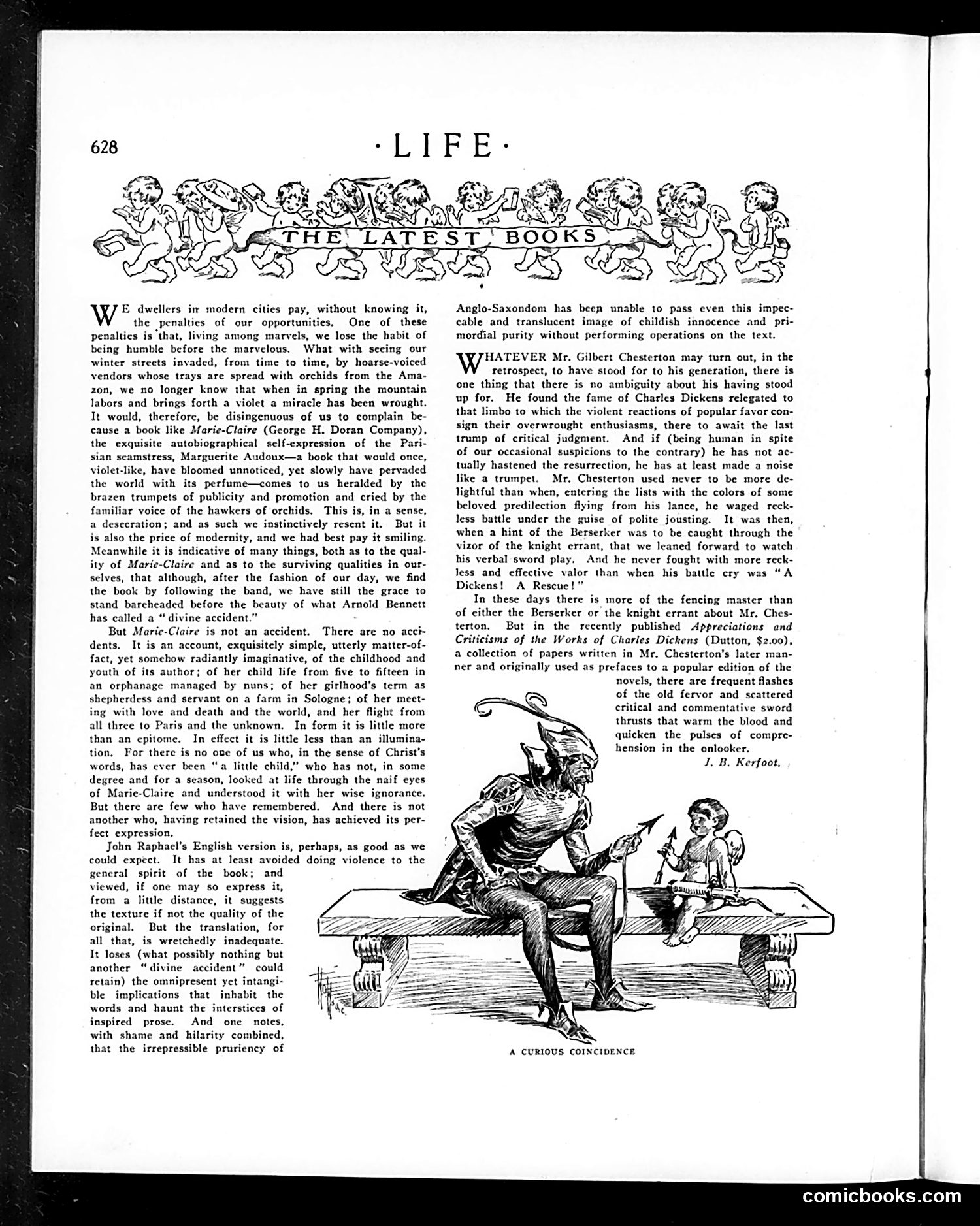
This is a literary review section featuring two book discussions. The left column reviews *Marie-Claire*, a French autobiographical novel by Marguerite Audoux about a seamstress's life. The critic argues that while modern publicity has commercialized this delicate work (comparing it to orchids sold by street vendors), the book itself remains a genuine work of beauty—a "divine accident" capturing authentic human experience through innocent perspective. The right column discusses G.K. Chesterton's writings on Charles Dickens, noting Chesterton's effort to rehabilitate Dickens's reputation after critical dismissal. The illustration labeled "A Curious Coincidence" depicts a figure (likely representing overwrought sentimentality or Dickensian melodrama) in exaggerated pose, with a small child observing—possibly satirizing the gap between Dickens's emotional excess and genuine childhood innocence the *Marie-Claire* review praises.
📄 Transcribed text from this page (OCR, searchable)
Machine-transcribed from the original scan — historical spelling and the odd misread are preserved.
We dwellers i modern cities pay, without knowing it, the penaltics of our opportunities. One of these penalties is ‘that, living among marvels, we lose the habit of being humble before the marvelous. What with seeing our winter streets invaded, from time to time, by hoarse-voiced vendors whose trays are spread with orchids from the Ama- zon, we no longer know that when in spring the mountain labors and brings forth a violet a miracle has been wrought. It would, therefore, be disingenuous of us to complain be- cause a book like Marie-Claire (George H. Doran Company), the exquisite autobiographical self-expression of the Pari- sian seamstress, Marguerite Audoux—a book that would once, violet-like, have bloomed unnoticed, yet slowly have pervaded the world with its perfume—comes to us heralded by the brazen trumpets of publicity and promotion and cried by the familiar voice of the hawkers of orchids. This is, in a sense, a desecration; and as such we instinctively resent it. But it is also the price of modernity, and we had best pay it smiling. Meanwhile it is indicative of many things, both as to the qual- ity of Marie-Claire and as to the surviving qualities in our- selves, that although, after the fashion of our day, we find the book by following the band, we have still the grace to stand bareheaded before the beauty of what Arnold Bennett has called a “ divine accident.” But Maric-Claire is not an accident. There are no acci- dents. It is an account, exquisitely simple, utterly matter-of- fact, yet somehow radiantly imaginative, of the childhood and youth of its author; of her child life from five to fifteen in an orphanage managed by nuns; of her girlhood’s term as shepherdess and servant on a farm in Sologne; of her mect- ing with love and death and the world, and her flight from all three to Paris and the unknown. In form it is little more than an epitome. In effect it is little less than an illumina- tion, For there is no ove of us who, in the sense of Christ’s words, has ever been “a little chil who has not, in some degree and for a season, looked at life through the naif eyes of Marie-Claire and understood it with her wise ignorance. But there are few who have remembered. And there is not another who, having retained the vision, has achieved its per- fect expression, John Raphael's English version is, perhaps, as good as we could expect. It has at least avoided doing violence to the general spirit of the book; and viewed, if one may so express it, from a little distance, it suggests the texture if not the quality of the original. But the translation, for all that, is wretchedly inadequate. It loses (what possibly nothing but another “divine accident” could retain) the omnipresent yet intangi- ble implications that inhabit the words and haunt the interstices of inspired prose. And one notes, with shame and hilarity combined, that the irrepressible pruriency of Anglo-Saxondom has been unable to pass even this impec- cable and translucent image of childish innocence and pri- mordial purity without performing operations on the text. HATEVER Mr. Gilbert Chesterton may turn out, in the retrospect, to have stood for to his generation, there is one thing that there is no ambiguity about his having stood up for, He found the fame of Charles Dickens relegated to that limbo to which the violent reactions of popular favor con- sign their overwrought enthusiasms, there to await the last trump of critical judgment. And if (being human in spite of our occasional suspicions to the contrary) he has not ac- tually hastened the resurrection, he has at least made a noise like a trumpet. Mr. Chesterton used never to be more de- lightful than when, entering the lists with the colors of some beloved predilection flying from his lance, he waged reck- less battle under the guise of polite jousting. It was then, when a hint of the Berserker was to be caught through the vizor of the knight errant, that we leaned forward to watch his verbal sword play. And he never fought with more reck- less and effective valor than when his battle cry was “A Dickens! A Rescue!" In these days there is more of the fencing master than of either the Berserker or the knight errant about Mr. Ches- terton. But in the recently published Appreciations and Criticisms of the Works of Charles Dickens (Dutton, $2.00), a collection of papers written in Mr. Chesterton's later man- ner and originally used as prefaces to a popular edition of the novels, there are frequent flashes of the old fervor and scattered critical and commentative sword thrusts that warm the blood and quicken the pulses of compre- hension in the onlooker. J.B. Kerfoot. <—S A CURIOUS COINCIDENCE comicbooks.com