
Life, 1911-03-30 · page 7 of 45
Life — March 30, 1911 — page 7: what you’re looking at
What you’re looking at
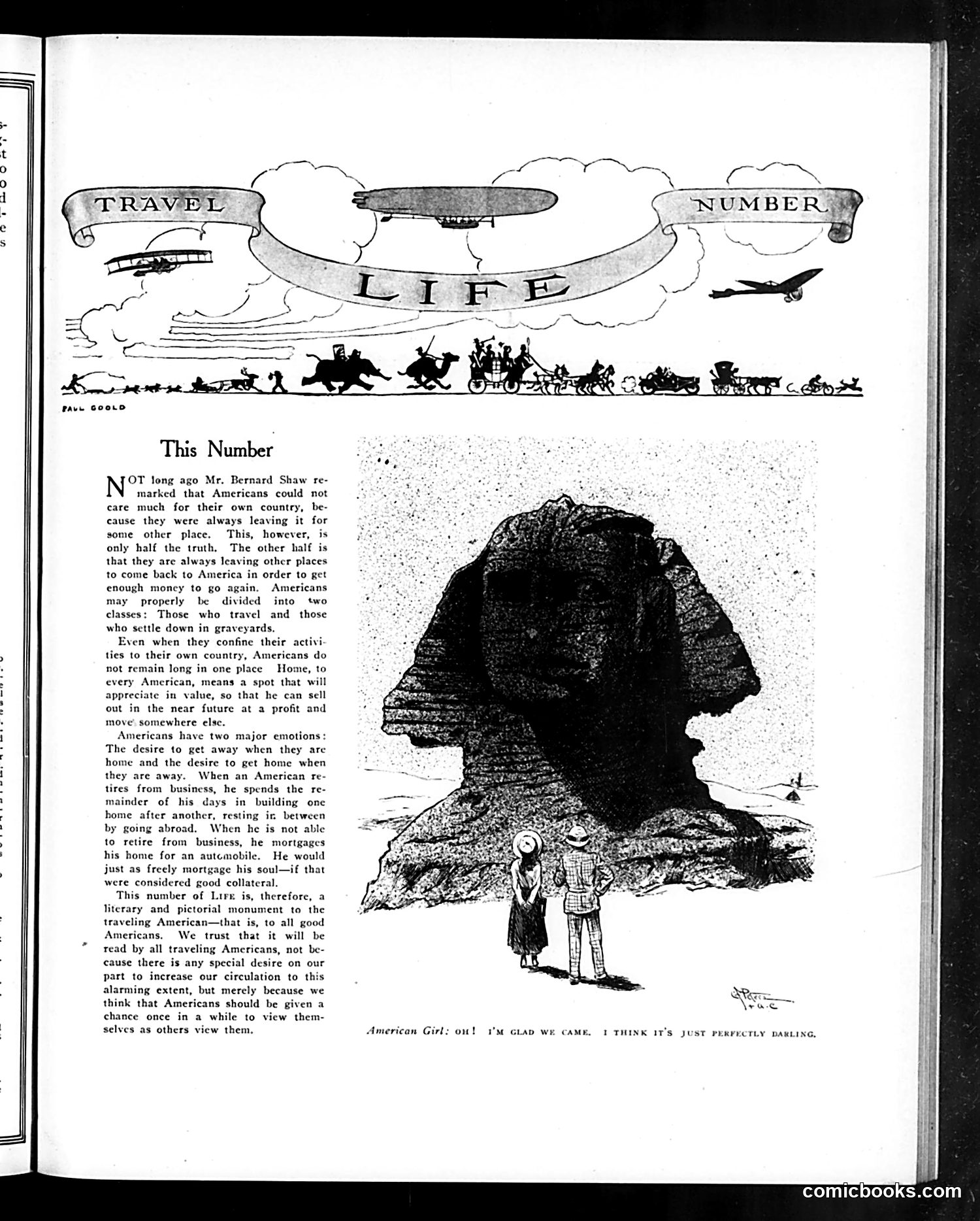
This page from **Life magazine's "Travel Number"** critiques American attitudes toward travel and home ownership. The header decorates the theme with various modes of transportation (planes, dirigibles, cars, horses). The main text, attributed to what appears to be commentary on Bernard Shaw's observation, argues that Americans struggle with conflicting desires: wanderlust versus homeownership. The author suggests Americans divide into two classes—travelers and those who settle in graveyards (die at home). The illustration shows a large profile of a woman's head filled with an English landscape, with two figures below captioned "American Girl: Oh! I'm glad we came. I think it's just perfectly darling." **The satire:** Americans romanticize European travel and aesthetics while ironically remaining emotionally tied to home, never truly committing to either experience.
📄 Transcribed text from this page (OCR, searchable)
Machine-transcribed from the original scan — historical spelling and the odd misread are preserved.
Pave GOOLD This Number OT Jong ago Mr. Bernard Shaw re- marked that Americans could not care much for their own country, be- cause they were always leaving it for some other place, This, however, is only half the truth, The other half is that they are always leaving other places to come back to America in order to get enough moncy to go again. Americans may properly be divided into two classes: Those who travel and those who settle down in graveyards. Even when they confine their activi ties to their own country, Americans do not remain long in one place Home, to every American, means a spot that will appreciate in value, so that he can sell out in the near future at a profit and move: somewhere elsc. Americans have two major emotions: The desire to get away when they are home and the desire to get home when they are away. When an American re- tires from business, he spends the re- mainder of his days in building one home after another, resting in between by going abroad. When he is not able to retire from business, he mortgages his home for an autemobile. He would just as freely mortgage his soul—if that were considered good collateral. This number of Lire is, therefore, a literary and pictorial monument to the traveling American—that is, to all good Americans. We trust that it will be read by all traveling Americans, not be- cause there is any special desire on our part to increase our circulation to this alarming extent, but merely because we Re think that Americans should be given a \e ae chance once in a while to view them- selves as others view them, American Girl: ow! 1'M GLAD We CAME, 1 THINK IT'S JUST PERFECTLY DARLING, comicbooks.com