
Life, 1911-03-30 · page 15 of 45
Life — March 30, 1911 — page 15: what you’re looking at
What you’re looking at
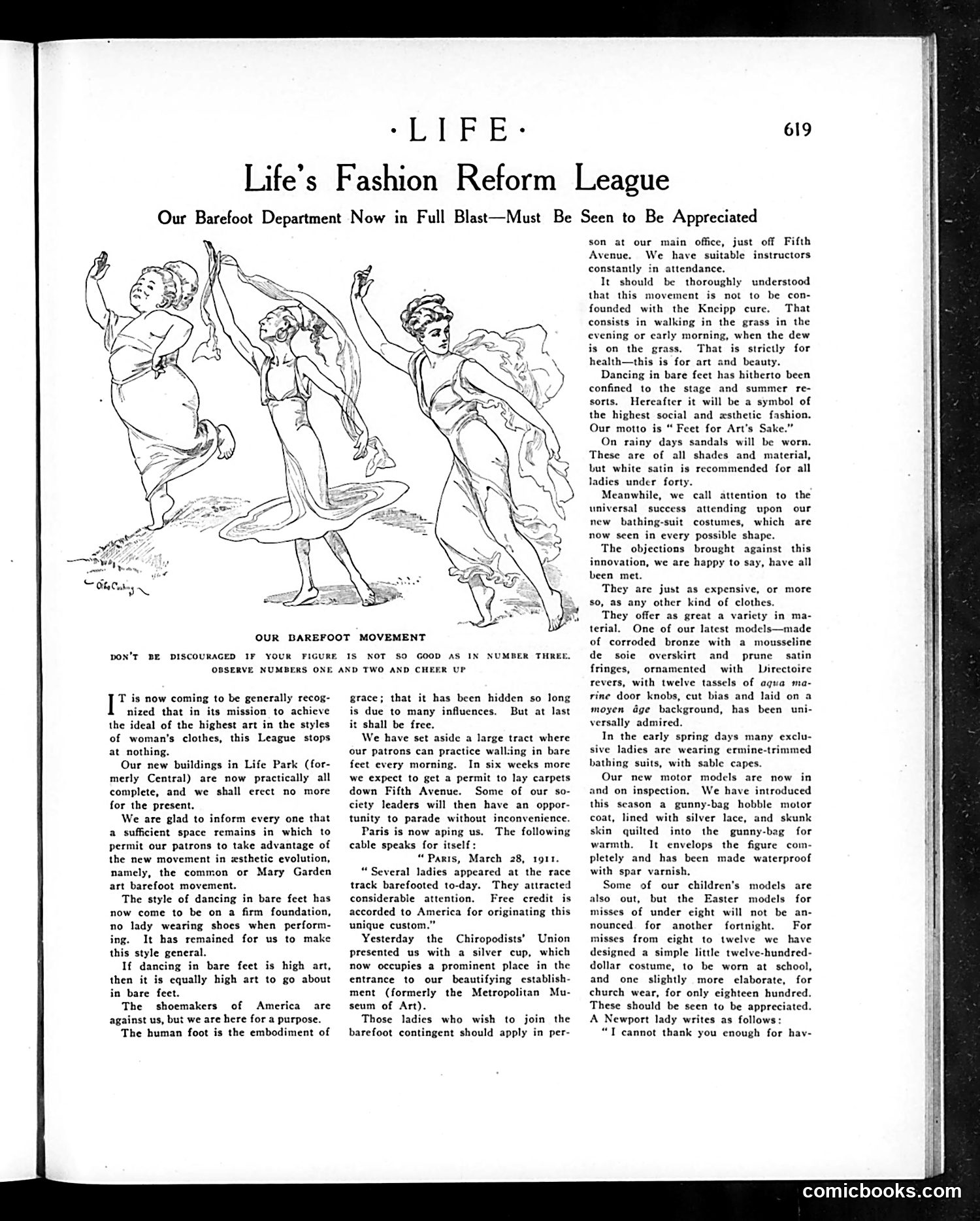
This 1911 *Life* magazine page satirizes the early 20th-century "barefoot movement"—a genuine aesthetic and health reform trend championed by dancer Isadora Duncan and others who saw bare feet as natural, artistic, and liberating. The cartoon depicts women dancing barefoot in exaggerated, undignified poses. The accompanying mock-serious text from "Life's Fashion Reform League" ridicules the movement by treating it as absurdly pretentious: describing bare feet as "high art," claiming Paris is copying America's trend, and announcing expensive new bathing costumes with ridiculous materials like "agua marine door knobs." The satire works by adopting the reformers' own grandiose language while describing genuinely silly applications—insisting people go barefoot everywhere, not just dancing, and inventing absurdly ornate "barefoot-inspired" fashions. The joke mocks both the movement's zealotry and high society's tendency to commercialize and exaggerate any trend into expensive fashion absurdity.
📄 Transcribed text from this page (OCR, searchable)
Machine-transcribed from the original scan — historical spelling and the odd misread are preserved.
oy aU Sa oa Life’s Fashion Reform League Our Barefoot Department Now in Full Blast—Must Be Seen to Be Appreciated OUR BAREFOOT MOVEMENT DON’T BE DISCOURAGED IF YOUR OBSERVE NUM FIGURE T is now coming to be generally recog- nized that in its mission to achieve the ideal of the highest art in the styles of woman's clothes, this League stops at nothing. Our new buildings in Life Park (for- merly Central) are now practically all complete, and we shall erect no more for the present. We are glad to inform every one that a sufficient space remains in which to permit our patrons to take advantage of the new movement in zxsthetic evolution, namely, the common or Mary Garden art barefoot movement. The style of dancing in bare feet has now come to be on a firm foundation, no lady wearing shoes when perform- ing. It has remained for us to make this style general. If dancing in bare feet is high art, then it is equally high art to go about in bare feet. The shoemakers of America are against us, but we are here for a purpose. The human foot is the embodiment of 1S NOT $0 GOOD AS IN NUMBER THREE. S$ ONE AND TWO AND CHEER UP grace; that it has been hidden so long is due to many influences, But at last it shall be free. We have set aside a large tract where our patrons can practice walling in bare feet every morning. In six weeks more we expect to get a permit to lay carpets down Fifth Avenue. Some of our so- ciety leaders will then have an oppor- tunity to parade without inconvenience. Paris is now aping us. The following cable speaks for itself: “Paris, March 28, 1911. “Several ladies appeared at the race track barefooted to-day. They attracted considerable attention, Free credit is accorded to America for originating this unique custom.” Yesterday the Chiropodists’ Union presented us with a silver cup, which now occupies a prominent place in the entrance to our beautifying cstablish- ment (formerly the Metropolitan Mu- seum of Art). Those ladies who wish to join the barefoot contingent should apply in per- son at our main office, just off Fifth Avenue. We have suitable instructors constantly in attendance. It should be thoroughly understood that this movement is not to be con- founded with the Kneipp cure. That consists in walking in the grass in the evening or early morning, when the dew is on the grass, That is strictly for health—this is for art and beauty. Dancing in bare fect has hitherto been confined to the stage and summer re- sorts. Hercafter it will be a symbol of the highest social and asthetic fashion. Our motto is “ Feet for Art's Sake.” On rainy days sandals will be worn. These are of all shades and material, Lut white satin is recommended for all ladies under forty. Meanwhile, we call attention to the universal success attending upon our new bathing-suit costumes, which are now seen in every possible shap: The objections brought against this innovation, we are happy to say, have all been met. They are just as expensive, or more so, as any other kind of clothes. They offer as great a variety in ma- terial. One of our latest models—made of corroded bronze with a mousseline de soie overskirt and prune satin fringes, ornamented with Directoire revers, with twelve tassels of agua ma- rine door knobs, cut bias and laid on a moyen age background, has been uni- versally admired. In the early spring days many exclu- sive ladies are wearing ermine-trimmed bathing suits, with sable capes. Our new motor models are now in and on inspection, We have introduced this season a gunny-bag hobble motor coat, lined with silver lace, and skunk skin quilted into the gunny-bag for warmth. It envelops the figure com- pletely and has been made waterproof with spar varnish, Some of our children's models are also out, but the Easter models for misses of under eight will not be an- nounced for another fortnight. For misses from eight to twelve we have designed a simple little twelve-hundred- dollar costume, to be worn at school, and one slightly more elaborate, for church wear, for only eighteen hundred. These should be seen to be appreciated. A Newport lady writes as follows: “T cannot thank you enough for hav- comicbooks.com