
Life, 1911-03-30 · page 32 of 45
Life — March 30, 1911 — page 32: what you’re looking at
What you’re looking at
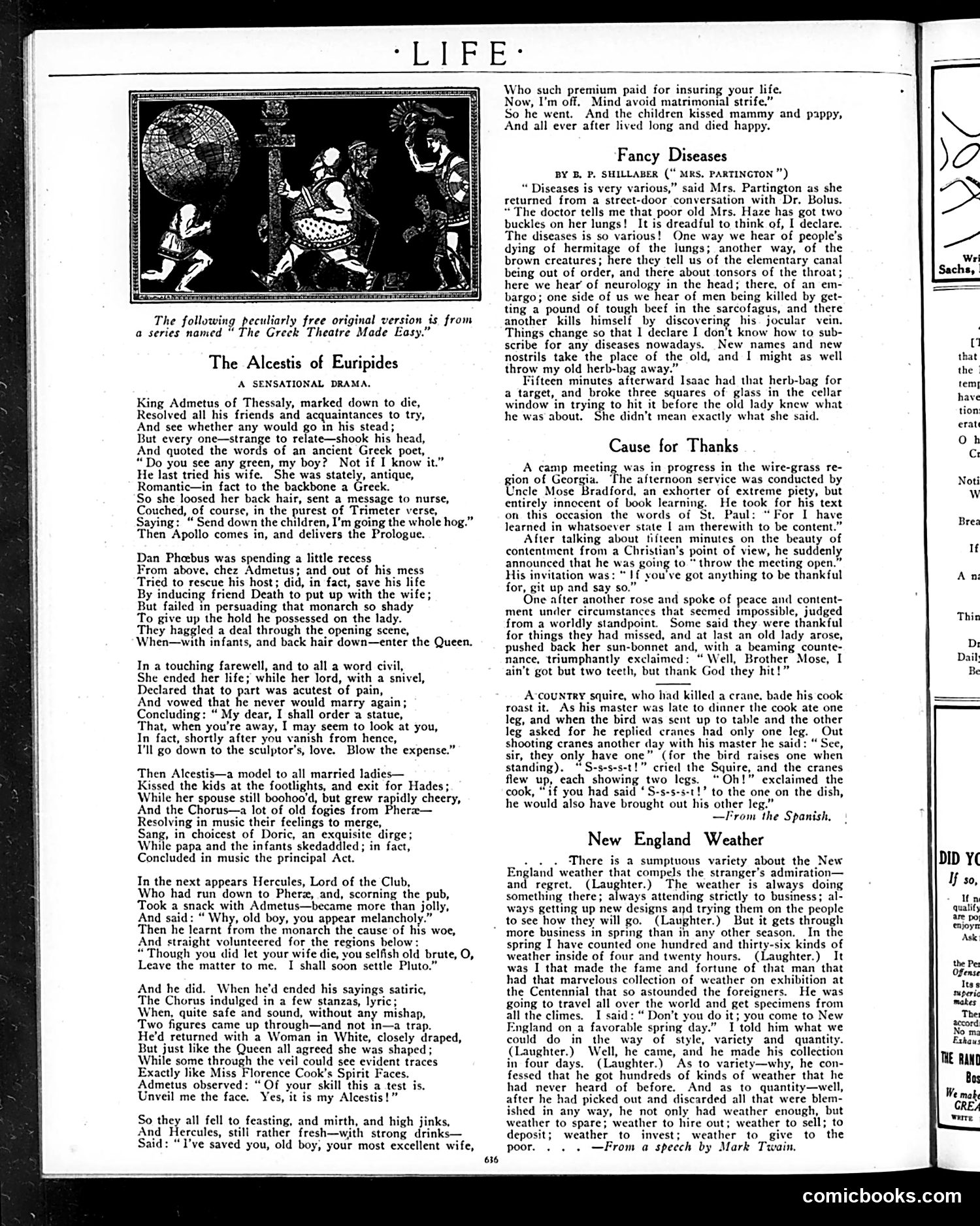
This page contains a satirical retelling of Euripides' classical play *Alcestis* as part of a series called "The Greek Theatre Made Easy." The humor targets both the original Greek drama and Victorian sentimentality. **The Satire:** The piece mocks the play's plot—where a wife sacrifices herself to save her husband's life—by emphasizing the husband Admetus's selfishness and the wife's melodramatic devotion. Specific jabs include: his friends refusing to die for him (quoted as "Do you see any green, my boy? Not if I know it"), his vow never to remarry immediately followed by visiting a sculptor, and the final punchline about "insuring your life" through matrimonial insurance. **The Point:** Life magazine satirizes both classical literature as overly dramatic and stuffy, and contemporary Victorian marriage ideals—particularly the expectation that wives sacrifice themselves for husbands. The "Woman in White" reference and spiritualist humor add period flavor, mocking contemporary fads alongside ancient drama.
📄 Transcribed text from this page (OCR, searchable)
Machine-transcribed from the original scan — historical spelling and the odd misread are preserved.
“ETE: The following peculiarly free original version is from a series named “ The Greck Theatre Made Easy.” The Alcestis of Euripides A SENSATIONAL DRAMA, King Admetus of Thessaly, marked down to die, Resolved all his friends and acquaintances to try, And see whether any would go in his stead; But every one—strange to relate—shook his head, And quoted the words of an ancient Greek poet, “Do you see any green, my boy? Not if I know it.” He last tried his wife. She was stately, antique, Romantic—in fact to the backbone a Greek. So she loosed her back hair, sent a message to nurse, Couched, of course, in the purest of Trimeter verse, Saying: “ Send down the children, I’m going the whole hog.” Then Apollo comes in, and delivers the Prologue. Dan Phoebus was spending a little recess From above, chez Admetus; and out of his mess Tried to rescue his host; did, in fact, save his life By inducing friend Death to put up with the wife; But failed in persuading that monarch so shady To give up the hold he possessed on the lady. They haggled a deal through the opening scene, When—with infants, and back hair down—enter the Queen. In a touching farewell, and to all a word civil, She ended her life; while her lord, with a snivel, Declared that to part was acutest of pain, And vowed that he never would marry again; Concluding: “ My dear, I shall order a statue, That, when you're away, I may seem to look at you, In fact, shortly after you vanish from hence, T'll go down to the sculptor’s, love. Blow the expense.” Then Alcestis—a model to all married ladies— Kissed the kids at the footlights, and exit for Hades; While her spouse still boohoo’d, but grew rapidly cheery, And the Chorus—a lot of old fogies from Phera— Resolving in music their feelings to merge, Sang, in choicest of Doric, an exquisite dirge; While papa and the infants skedaddled; in fact, Concluded in music the principal Act. In the next appears Hercules, Lord of the Club, Who had run down to Pherzx, and, scorning the pub, Took a snack with Admetus—became more than jolly, And said: “ Why, old boy, you appear melancholy.” Then he learnt from the monarch the cause of his woe, And straight volunteered for the regions below: “Though you did let your wife die, you selfish old brute, O, Leave the matter to me, I shall soon settle Pluto.” And he did. When he'd ended his sayings satiric, The Chorus indulged in a few stanzas, lyric; When, quite safe and sound, without any mishap, Two figures came up through—and not in—a trap. He'd returned with a Woman in White, closely draped, But just like the Queen all agreed she was shaped; While some through the veil could see evident traces Exactly like Miss Florence Cook’s Spirit Faces. Admetus observed: “Of your skill this a test is. Unveil me the face. Yes, it is my Alcestis!” So they all fell to feasting, and mirth, and high jinks, And Hercules, still rather fresh—with strong drinks— Said: “I’ve saved you, old boy, your most excellent wife, Who such premium paid for insuring your life. Now, I'm off. Mind avoid matrimonial strife.” So he went. And the children kissed mammy and pappy, And all ever after lived long and died happy. Fancy Diseases BY B, P, SHILLABER (‘‘ MRS. PARTINGTON ”) “ Diseases is very various,” said Mrs. Partington as she returned from a street-door conversation with Dr. Bolus. “ The doctor tells me that poor old Mrs. Haze has got two buckles on her lungs! It is dreadful to think of, I declare. The diseases is so various! One way we hear of people's dying of hermitage of the lungs; another way, of the brown creatures; here they tell us of the elementary canal being out of order, and there about tonsors of the throat; here we hear of neurology in the head; there, of an em- bargo; one side of us we hear of men being killed by get- ting a pound of tough beef in the sarcofagus, and there another kills himself by discovering his jocular vein. Things change so that 1 declare I don’t know how to sub- scribe for any diseases nowadays. New names and new nostrils take the place of the old, and I might as well throw my old herb-bag away.” Fifteen minutes afterward Isaac had that herb-bag for a target, and broke three squares of glass in the cellar window in trying to hit it before the old lady knew what he was about. She didn’t mean exactly what she said. Cause for Thanks A camp meeting was in progress in the wire-grass re- gion of Georgia. ‘the afternoon service was conducted by Uncle Mose Bradford, an exhorter of extreme piety, but entirely innocent of book learning. He took for his text on this occasion the words of St. Paul: “For I have learned in whatsoever state | am therewith to be content.” After talking about fifteen minutes on the beauty of contentment from a Christian’s point of view, he suddenly announced that he was. going to “throw the mecting open.” His invitation was: “If you've got anything to be thankful for, git up and say so.” One after another rose and spoke of peace and content- ment under circumstances that seemed impossible, judged from a worldly standpoint. Some said they were thankful for things they had missed, and at last an old lady arose, pushed back her sun-bonnet and, with a beaming counte- nance, triumphantly exclaimed: “Well, Brother Mose, I ain't got but two teeth, but thank God they hit!” A‘countTRY squire, who had killed a crane. bade his cook roast it. As his master was late to dinner the cook ate one leg, and when the bird was sent up to table and the other leg asked for he replied cranes had only one leg. Out shooting cranes another day with his master he said: “ See, sir, they only have one” (for the bird raises one when standing). “ S-s-s-s-t!” cried the Squire, and the cranes flew up, each showing two legs. “Oh!” exclaimed the cook, “if you had said ‘ S-s-s-s-t!’ to the one on the dish, he would also have brought out his other leg.” —From the Spanish, New England Weather + . . There is a sumptuous variety about the New England weather that compels the stranger's admiration— and regret. (Laughter.) The weather is always doing something there; always attending strictly to business; al- ways getting up new designs and trying them on the people to see how they will go. (Laughter.) But it gets through more business in spring than in any other season. In the spring I have counted one hundred and thirty-six kinds of weather inside of four and twenty hours. (Laughter.) It was I that made the fame and fortune of that man that had that marvelous collection of weather on exhibition at the Centennial that so astounded the foreigners. He was going to travel all over the world and get specimens from all the climes. I said: “ Don’t you do it; you come to New England on a favorable spring day.” I told him what we could do in the way of style, variety and quantity. (Laughter.) Well, he came, and he made his collection in four days. (Laughter.) As to variety—why, he con- fessed that he got hundreds of kinds of weather that he had never heard of before. And as to quantity—well, after he had picked out and discarded all that were blem- ished in any way, he not only had weather enough, but weather to spare; weather to hire out; weather to sell; to deposit; weather to invest; weather to give to the poor. . . . —From a speech by Mark Twain. accord No ma Exhau: We mak GREA wre comicbooks.com