
Life, 1911-03-30 · page 28 of 45
Life — March 30, 1911 — page 28: what you’re looking at
What you’re looking at
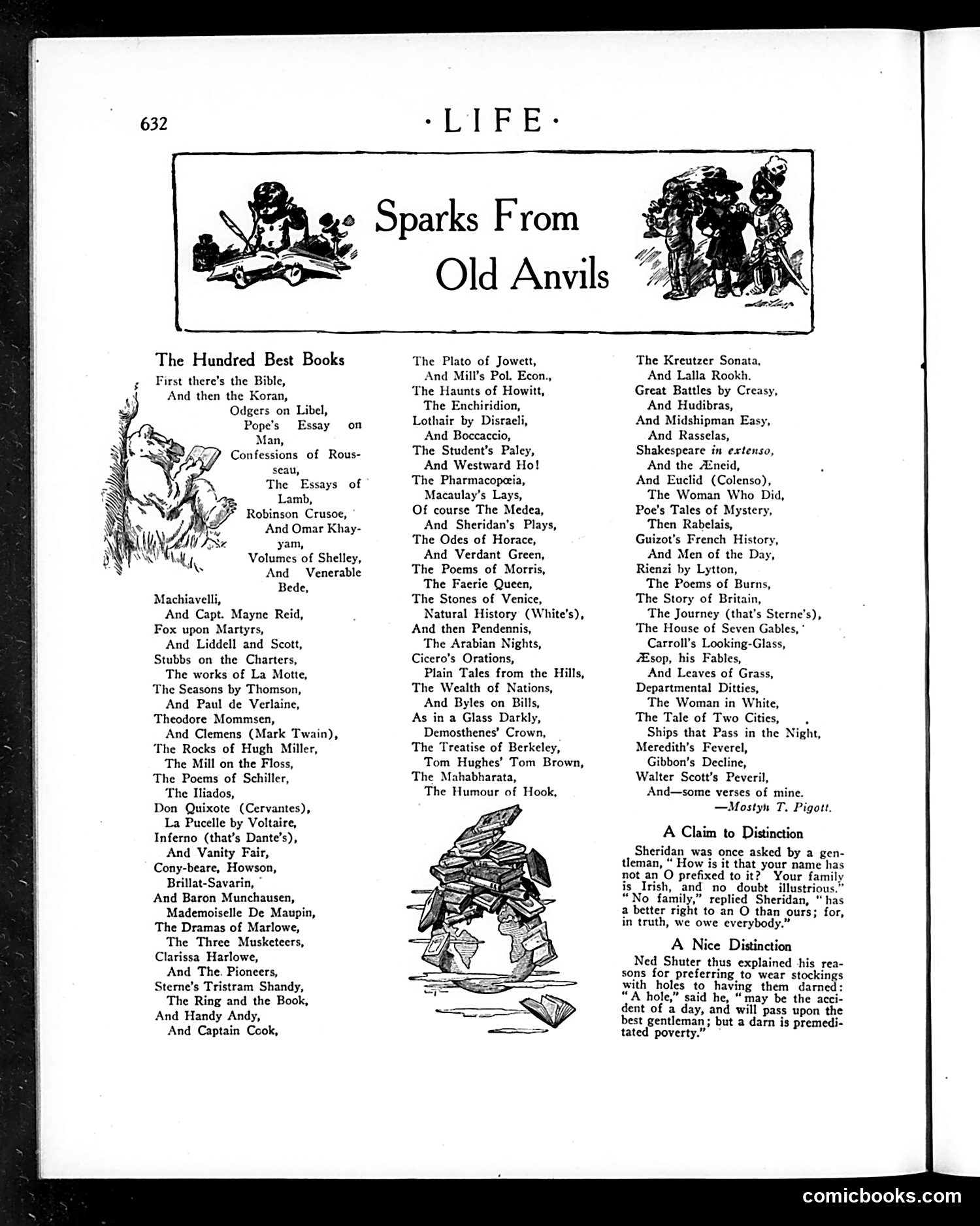
This page presents satirical anecdotes and a humorous list titled "The Hundred Best Books." The main content mocks Victorian-era literary pretension by cataloging an absurdly comprehensive (and somewhat random) collection of classics, philosophical works, and contemporary novels—from the Bible and Plato to Mark Twain and Kipling—suggesting that claiming to have read "the hundred best books" was an aspirational but ultimately ridiculous social claim. The two brief anecdotes below offer cutting social commentary: one jokes about Irish debt (Sheridan's family "owes everybody"), and another satirizes false gentility—a character prefers torn stockings over darned ones because poverty-stricken accidents are more socially acceptable than deliberate, visible mending. The page reflects Life's tradition of deflating Victorian pretension and self-importance through wit and observation.
📄 Transcribed text from this page (OCR, searchable)
Machine-transcribed from the original scan — historical spelling and the odd misread are preserved.
The Hundred Best Books First there’s the Bible, And then the Koran, Odgers on Libel, Pope's Essay on Man, Confessions of Rous- seau, The Essays of : Lamb, SE Robinson Crusoe, And Omar Khay- yam, Volumes of Shelley, And Venerable Bede, Machiavelli, And Capt. Mayne Reid, Fox upon Martyrs, And Liddell and Scott, Stubbs on the Charters, The works of La Motte, The Seasons by Thomson, And Paul de Verlaine, Theodore Mommsen, And Clemens (Mark Twain), The Rocks of Hugh Miller, The Mill on the Floss, The Poems of Schiller, The Iliados, Don Quixote (Cervantes), La Pucelle by Voltaire, Inferno (that’s Dante’s), Sparks From Old Anvils The Plato of Jowett, And Mill’s Pol. Econ., The Haunts of Howitt, The Enchiridion, Lothair by Disraeli, And Boccaccio, The Student’s Paley, And Westward Ho! The Pharmacopaia, Macaulay’s Lays, Of course The Medea, And Sheridan’s Plays, The Odes of Horace, And Verdant Green, The Poems of Morris, The Faerie Queen, The Stones of Venice, Natural History (White's), And then Pendennis, The Arabian Nights, Cicero's Orations, Plain Tales from the Hills, The Wealth of Nations, And Byles on Bills, As in a Glass Darkly, Demosthenes’ Crown, The Treatise of Berkeley, Tom Hughes’ Tom Brown, The Mahabharata, The Humour of Hook, The Kreutzer Sonata, And Lalla Rookh. Great Battles by Creasy, And Hudibras, And Midshipman Easy, And Rasselas, Shakespeare in extenso, And the ZEncid, And Euclid (Colenso), The Woman Who Did, Poe’s Tales of Mystery, Then Rabelais, Guizot’s French History, And Men of the Day, Rienzi by Lytton, The Poems of Burns, The Story of Britain, The Journey (that’s Sterne’s), The House of Seven Gables, * Carroll's Looking-Glass, Zsop, his Fables, And Leaves of Grass, Departmental Ditties, The Woman in White, The Tale of Two Cities, Ships that Pass in the Night, Meredith's Feverel, Gibbon’s Decline, Walter Scott’s Peveril, And—some verses of mine. —Mostyn T. Pigott. A Claim to Distinction Sheridan was once asked by a gen- tleman, “ How is it that_your name has not an O prefixed to it?) Your family is Irish, and no doubt illustrious.” “No family,” replied Sheridan, “ has a better right to an O than ours; for, in truth, we owe everybody.” And Vanity Fair, Cony-beare, Howson, Brillat-Savarin, © And Baron Munchausen, Mademoiselle De Maupin, The Dramas of Marlowe, The Three Musketeers, Clarissa Harlowe, And The. Pioneers, Sterne’s Tristram Shandy, The Ring and the Book, And Handy Andy, And Captain Cook, A Nice Distinction Ned Shuter thus explained his rea- sons for preferring to wear stockings with holes to having them darned: A hole,” said he, “may be the acci- dent of a day, and will pass upon the best gentleman; but a darn is premedi- tated poverty.” comicbooks.com