
Life, 1911-03-30 · page 18 of 45
Life — March 30, 1911 — page 18: what you’re looking at
What you’re looking at
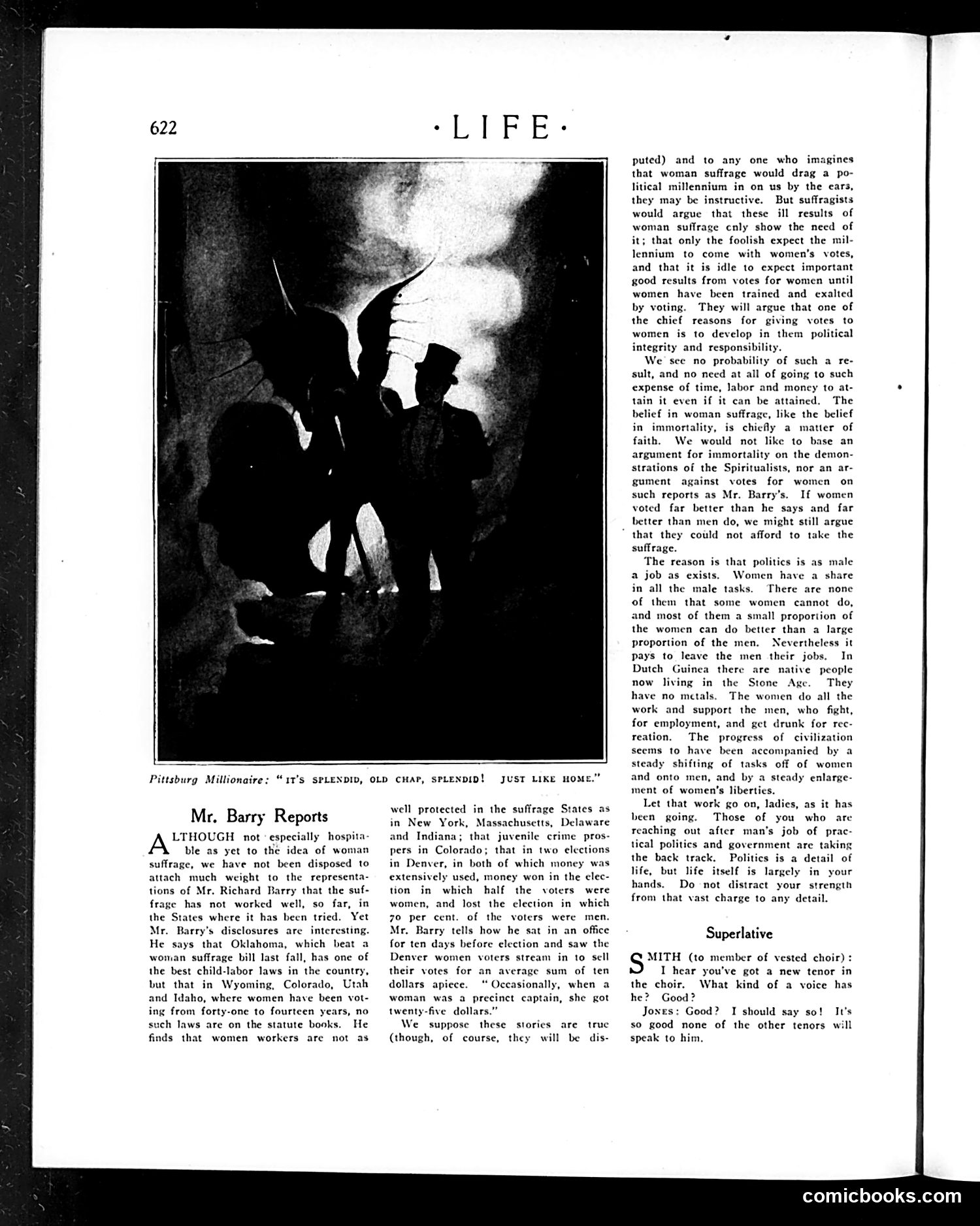
This page debates women's suffrage through an article titled "Mr. Barry Reports." The cartoon at top shows a wealthy Pittsburgh industrialist praising conditions—likely satirizing how the rich benefit from the status quo while workers suffer. The article cites Richard Barry's claims that women's suffrage in western states (Wyoming, Colorado, Utah, Idaho) failed to improve child labor protections or reduce corruption, contrasting these with non-suffrage states' stronger laws. Life's editors respond skeptically: they won't base anti-suffrage arguments on Barry's anecdotes about Denver women allegedly selling votes for $10. However, they argue *against* suffrage on different grounds—that politics is inherently "male work" and women should focus on broader life responsibilities instead of "practical politics." The piece reveals early-1900s paternalism: even skeptics of suffrage opposed it not from evidence but ideology, viewing political participation as unsuitable for women's "proper" domestic sphere.
📄 Transcribed text from this page (OCR, searchable)
Machine-transcribed from the original scan — historical spelling and the odd misread are preserved.
Pittsburg Millionaire: “11's SPLENDID, OLD cHar, SPLENDID! Mr. Barry Reports LTHOUGH not ‘especially hospita ble as yet to the idea of woman suffrage, we have not been disposed to attach much weight to the representa- tions of Mr. Richard Barry that the suf- frage has not worked well, so far, in the States where it has been tried. Yet Mr. Barry's disclosures are interesting. He says that Oklahoma, which beat a woman suffrage bill last fall, has one of the best child-labor laws in the country, but that in Wyoming, Colorado, Utah and Idaho, where women have been vot- ing from forty-one to fourteen years, no such laws are on the statute books. He finds that women workers are not as JUST LIKE HOME.” well protected in the suffrage States as in New York, Massachusetts, Delaware and Indiana; that juvenile crime pros- pers in Colorado; that in two elections in Denver, in both of which money was extensively used, money won in the elec- tion in which half the were women, and lost the election in which 70 per cent. of the Mr. Barry tells how he sat in an office for ten days before election and saw the Denver women voters stream in to sell their votes for an average sum of ten dollars apiece.“ Occasionally, when a woman was a precinct captain, she got twenty-five dollar: We suppose these (though, of course, they will voters voters were men. stories are truce be dis- puted) and to any one who imagines that woman suffrage would drag a po- litical millennium in on us by the cars, they may be instructive. But suffragists would argue that these ill results of woman suffrage cnly show the need of it; that only the foolish expect the mil- lennium to come with women’s votes, and that it is idle to expect important good results from votes for women until women have been trained and exalted by voting. They will argue that one of the chief reasons for giving votes to women is to develop in them political integrity and responsibil: We sce no probability of such a re- sult, and no need at all of going to such expense of time, labor and money to at- tain it even if it can be attained. The belief in woman suffrage, like the belief in immortality, is chiefly a matter of faith. We would not like to base an argument for immortality on the demon- strations of the Spiritualists, nor an ar- gument against votes for women on such reports as Mr. Barry's. If women voted far better than he says and far better than men do, we might still argue that they could not afford to take the suffrage. The reason is that politics is as male a job as exists. Women have a share in all the male tasks. There are none of them that some women cannot do, and most of them a small proportion of the women can do better than a large proportion of the men. Nevertheless it pays to leave the men their jobs. In Dutch Guin there are native people now living in the Stone Age. They have no metals. The women do all the work and support the men, who fight, for employment, and get drunk for ree- reation, The progress of civilization Seems to have been accompanied by a steady shifting of tasks off of women and onto men, and by a steady enlarge- ment of women’s liberties. Let that work go on, ladies, as it has een going. Those of you who are reaching out after man’s job of prac- tical politics and government are taking the back track. Politics is a detail of life, but life itself is largely in your hands. Do not distract your strength from that vast charge to any detail. Superlative MITH (to member of vested choir): I hear you've got a new tenor in the choir, What kind of a voice has he? Good? Joxes: Good? I should say so! It’s so good none of the other tenors will speak to him, comicbooks.com