
Life, 1911-03-30 · page 29 of 45
Life — March 30, 1911 — page 29: what you’re looking at
What you’re looking at
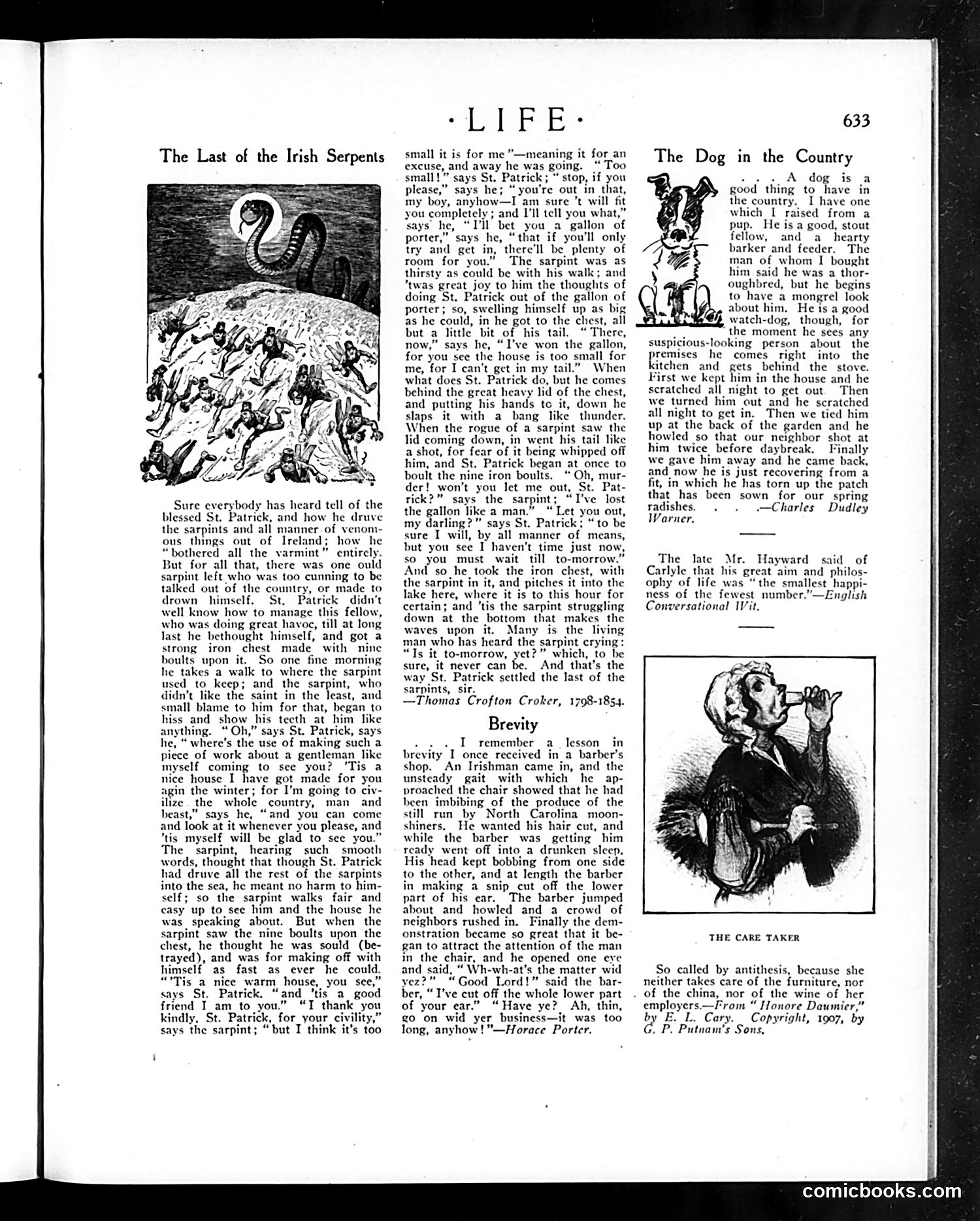
This page contains two distinct pieces: **"The Last of the Irish Serpents"** is a folk tale (not satire), presented as Irish folklore collected by Thomas Crofton Croker. It's a whimsical legend explaining why Ireland has no serpents—St. Patrick tricks the final cunning serpent into an iron chest by wagering a gallon of porter, then seals it in a lake forever. The serpent's thrashing allegedly causes waves. This reflects 19th-century interest in Irish mythology and oral traditions, presented here for entertainment rather than political commentary. **"The Dog in the Country"** is a brief personal anecdote about a country dog's suspicious nature and eventual acceptance. **"Brevity"** appears to be the start of another anecdote about a barbershop lesson (text cuts off). The accompanying illustrations are decorative woodcuts typical of Life magazine's era. There is no political satire on this page—it's primarily folkloric and humorous domestic content.
📄 Transcribed text from this page (OCR, searchable)
Machine-transcribed from the original scan — historical spelling and the odd misread are preserved.
The Last of the Irish Serpents Sure everybody has heard tell of the ed St. Patrick, and how he druve the sarpints and all manner.of venom- ous things out of Ireland; how he “bothered all the varmint” entircly. But for all that, there was one ould sarpint left who was too cunning to be talked out of the country, or made to drown himself. St. Patrick didn’t well know how to manage this fellow, who was doing great havoc, till at long last he bethought himself, and got a strong iron chest made with nine boults upon it. So one fine morning he takes a walk to where the sarpint used to keep; and the sarpint, who didn’t like the saint in the least, and small blame to him for that, began to hiss and show his tecth at him like anything. “Oh,” says St. Patrick, says he, “ where's the use of making such a piece of work about a gentleman like myself coming to sce you? 'Tis a nice house I have got made for you agin the winter; for I’m going to civ- ilize the whole country, man and heast,” says he, “and you can come and look at it whenever you please, and tis myself will be glad to see you.” The sarpint, hearing such smooth words, thought that though St. Patrick had druve all the rest of the sarpints into the sea, he meant no harm to him- self; so the sarpint walks fair and casy up to see him and the house he was speaking about. But when the sarpint saw the nine boults upon the chest, he thought he was sould (be- trayed), and was for making off with himself as fast as ever he could. “Tis a nice warm house, you see,” St. Patrick, “and ‘tis a good friend Iam to you.” “TI thank you kindly, St. Patrick, for your civility,” the sarpint; “but I think it’s too oi OU ciel en small it is for me ”—meaning it for an excuse, and away he was going. “ Too small!” says St. Patrick; “ stop, if you please,” says he; “you're out in that, my boy, anyhow—I'am sure ’t will fit you completely ; and I'll tell you what,” says he, “I'll bet you a gallon of porter,” says he, “that if you'll only try and get in, there'll be plenty of room for you.” The sarpint was as thirsty as could be with his walk; and "twas great joy to him the thoughts of doing St. Patrick out of the gallon of porter; so, swelling himself up as big as he could, in he got to the chest, all but a little bit of his tail. “ There, now,” says he, “I’ve won the gallon, for you see the house is too small for me, for I can’t get in my tail.” When what does St. Patrick do, but he comes behind the great heavy lid of the chest, and putting his hands to it, down he slaps it with a bang like thunder. When the rogue of a sarpint saw the lid coming down, in went his tail like a shot, for fear of it being whipped off him, and St. Patrick began at once to boult the nine iron boults. “° Oh, mur- der! won’t you Iet me out, St. Pat- tick?” says the sarpint; “I've lost the gallon like a man.” _“ Let you out, my darling?” says St. Patrick; “to be sure I will, by all manner of means, but you see I haven't time just now, so you must wait till to-morrow.” And so_he took the iron chest, with the sarpint in it, and pitches it into the lake here, where it is to this hour for certain; and tis the sarpint struggling down at the bottom that makes the waves upon it. Many is the living man who has heard the sarpint crying: “Ts it. to-morrow, yet?” which, to be sure, it never can be. And that’s the way St. Patrick settled the last of the pints, sir, —Thomas Crofton Croker, 1798-1854. Brevity I remember a lesson in I once received in a barber's shop. An Irishman came in, and the unsteady gait with which he ap- proached the chair showed that he had heen imbibing of the produce of the still run by North Carolina moon- shiners. He wanted his hair cut, and while the barber was getting him ready went off into a drunken sleep. His head kept bobbing from one side to the other, and at length the barber in making a snip_cut off the lower part of his ear. The barber jumped about and howled and a crowd of neighbors rushed in. Finally the dem- onstration became so great that it be- gan to attract the attention of the man in the chair, and he opened one and said, “ Wh-wh-at’s the matter wid yez?" “Good Lord!” said the bar- ber, “I’ve cut off the whole lower part of your ear.” “Have ye? Ah, thin, go on wid yer business—it was too long, anyhow! "—Horace Porter. brevity 633 The Dog in the Country — A dog is a good thing to have in the country, I have one which I raised from a pup. He is a good, stout fellow, and a_ hearty barker and feeder. The man of whom I bought him said he was a thor- oughbred, but he begins to have a mongrel look about him. He 1s a good watch-dog, though, for a “the moment he sees any suspicious-looking person about the premises he comes right into the ‘itchen and gets behind the stove. First we kept him in the house and he scratched all night to get out. Then we turned him out and he scratched all night to get in. Then we tied him up at the back of the garden and he howled so that our neighbor shot at him twice before daybreak. Finally we gave him away and he came back, and now he is just recovering from a fit, in which he has torn up the patch that has been sown for our spring radishes. . -—Charles Dudley Warner. The late Mr. Hayward said of Carlyle that his great aim and philos- ophy of life was “the smallest happi- ness of the fewest number.”—English Conversational IVit. THE CARE TAKER So called by antithesis, because she neither takes care of the furniture, nor of the china, nor of the wine of her employers —From “Honore Daumier,” by E. L. Cary. Copyright, 1907, b: G. P. Putnam's Sons, 2 comicbooks.com