
Life, 1911-03-30 · page 20 of 45
Life — March 30, 1911 — page 20: what you’re looking at
What you’re looking at
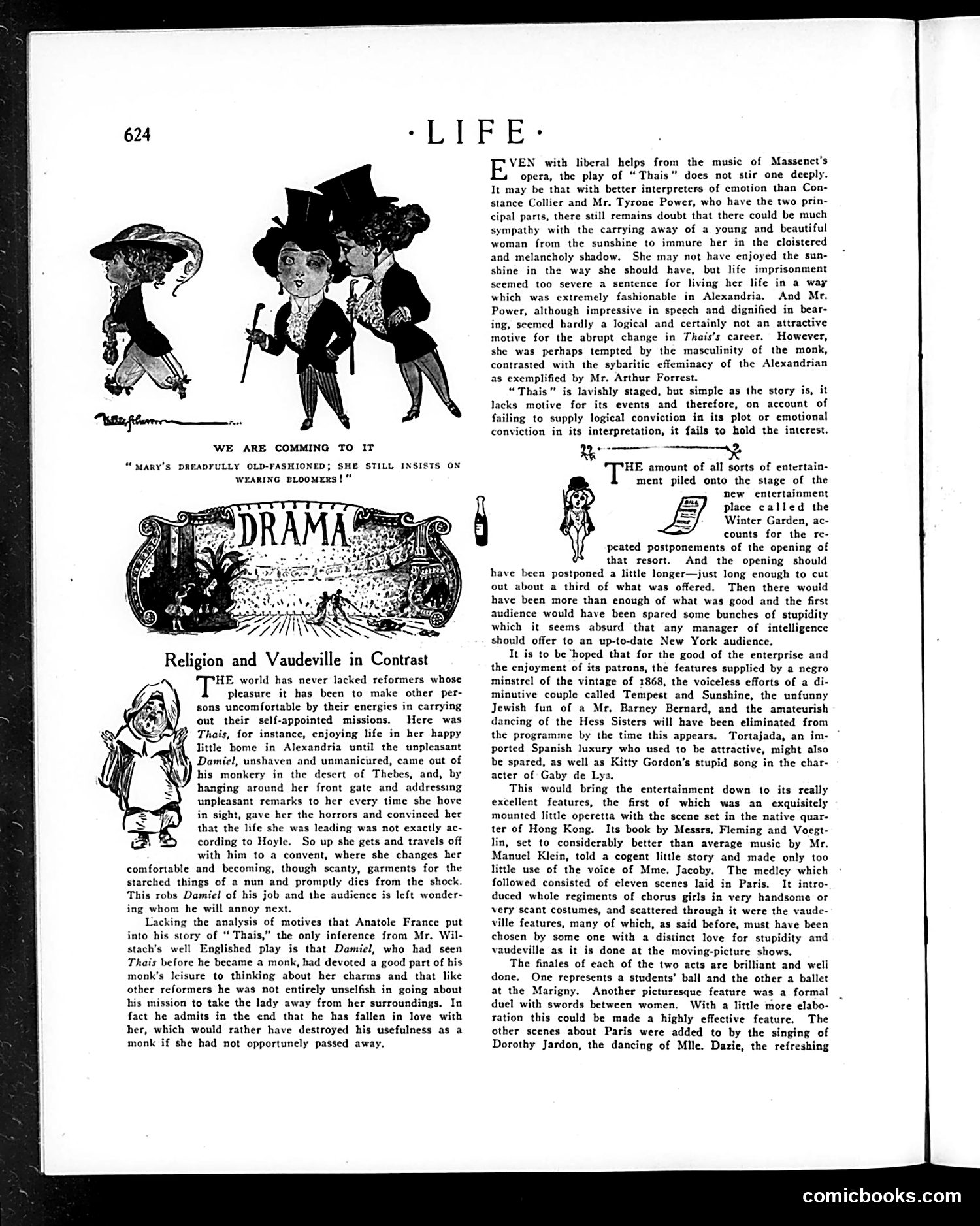
This page contains theater reviews rather than political cartoons. The top cartoon mocks women's fashion reform—specifically the "bloomers" controversy. A character named Mary is criticized for "old-fashioned" insistence on wearing bloomers (loose trousers), suggesting the reformist garment was becoming outdated even among progressives. The main content reviews the play "Thais," adapted from Anatole France's novel. The critic argues the production fails emotionally because the central premise—a monk convincing a woman to abandon her comfortable life for a convent—lacks logical motivation. The reviewer notes the monk is merely selfish and lustful, hardly a compelling reason for the heroine's self-sacrifice. The review also critiques the Winter Garden theater's opening, suggesting it combines too many disparate entertainment acts, including outdated "negro minstrel" material from 1868. The critic implies modern audiences deserve better-curated programming than such hodgepodge offerings.
📄 Transcribed text from this page (OCR, searchable)
Machine-transcribed from the original scan — historical spelling and the odd misread are preserved.
“LIF E* ‘WE ARE COMMING TO IT “ MARY'S DREADFULLY OLD-FASHIONED; SHE STILL INSISTS ON WEARING BLOOMERS!” Religion and Vaudeville in Contrast —\ pe world has never lacked reformers whose hoa pleasure it has been to make other per- sons uncomfortable by their energies in carrying out their self-appointed missions. Here was Thais, for instance, enjoying life in her happy little home in Alexandria until the unpleasant Damicl, unshaven and unmanicured, came out of his monkery in the desert of Thebes, and, by hanging around her front gate and addressing unpleasant remarks to her every time she hove in sight, gave her the horrors and convinced her that the life she was leading was not exactly ac- cording to Hoyle. So up she gets and travels off with him to a convent, where she changes her comfortable and becoming, though scanty, garments for the starched things of a nun and promptly dies from the shock. This robs Damiel of his job and the audience is left wonder- ing whom he will annoy next. Lacking the analysis of motives that Anatole France put into his story of “Thais,” the only inference from Mr. Wil- stach’s well Englished play is that Damiel, who had seen Thais before he became a monk, had devoted a good part of his monk's Icisure to thinking about her charms and that like other reformers he was not entirely unselfish in going about his mission to take the lady away from her surroundings. In fact he admits in the end that he has fallen in love with her, which would rather have destroyed his usefulness as a monk if she had not opportunely passed away. VEN with liberal helps from the music of Massenct’s E opera, the play of “Thais” does not stir one deeply. It may be that with better interpreters of emotion than Con- stance Collier and Mr, Tyrone Power, who have the two prin- cipal parts, there still remains doubt that there could be much sympathy with the carrying away of a young and beautiful woman from the sunshine to immure her in the cloistered and melancholy shadow. She may not have enjoyed the sun- shine in the way she should have, but life imprisonment seemed too severe a sentence for living her life in a way which was extremely fashionable in Alexandria, And Mr. Power, although impressive in speech and dignified in bear- ing, seemed hardly a logical and certainly not an attractive motive for the abrupt change in Thais’s career. However, she was perhaps tempted by the masculinity of the monk, contrasted with the sybaritic effeminacy of the Alexandrian as exemplified by Mr. Arthur Forrest. “Thais” is lavishly staged, but simple as the story is, it lacks motive for its events and therefore, on account of failing to supply logical conviction im its plot or emotional conviction in its interpretation, it fails to hold the interest. me oo HE amount of all sorts of entertain- ment piled onto the stage of the new entertainment place called the Winter Garden, ac- counts for the re- peated postponements of the opening of that resort. And the opening should have been postponed a little longer—just long enough to cut out about a third of what was offered. Then there would have been more than enough of what was good and the first audience would have been spared some bunches of stupidity which it seems absurd that any manager of intelligence should offer to an up-to-date New York audience. It is to be ‘hoped that for the good of the enterprise and the enjoyment of its patrons, the features supplied by a negro minstrel of the vintage of 1868, the voiceless efforts of a di- minutive couple called Tempest and Sunshine, the unfunny Jewish fun of a Mr, Barney Bernard, and the amateurish dancing of the Hess Sisters will have been eliminated from the programme by the time this appears. Tortajada, an im- ported Spanish luxury who used to be attractive, might also be spared, as well as Kitty Gordon’s stupid song in the char- acter of Gaby de Lys. This would bring the entertainment down to its really excellent features, the first of which was an exquisitely mounted little operetta with the scene set in the native quar- ter of Hong Kong. Its book by Messrs. Fleming and Voegt- lin, set to considerably better than average music by Mr. Manuel Klein, told a cogent little story and made only too little use of the voice of Mme. Jacoby. The medley which followed consisted of cleven scenes laid in Paris. It intro- duced whole regiments of chorus girls in very handsome or very scant costumes, and scattered through it were the vaude- ville features, many of which, as said before, must have been chosen by some one with a distinct love for stupidity and vaudeville as it is done at the moving-picture shows. The finales of each of the two acts are brilliant and weli done. One represents a students’ ball and the other a ballet at the Marigny. Another picturesque feature was a formal duel with swords between women. With a little more elabo- ration this could be made a highly effective feature. The other scenes about Paris were added to by the singing of Dorothy Jardon, the dancing of Mlle. Dazie, the refreshing comicbooks.com