
A complete issue · 48 pages · 1910
Life — November 24, 1910
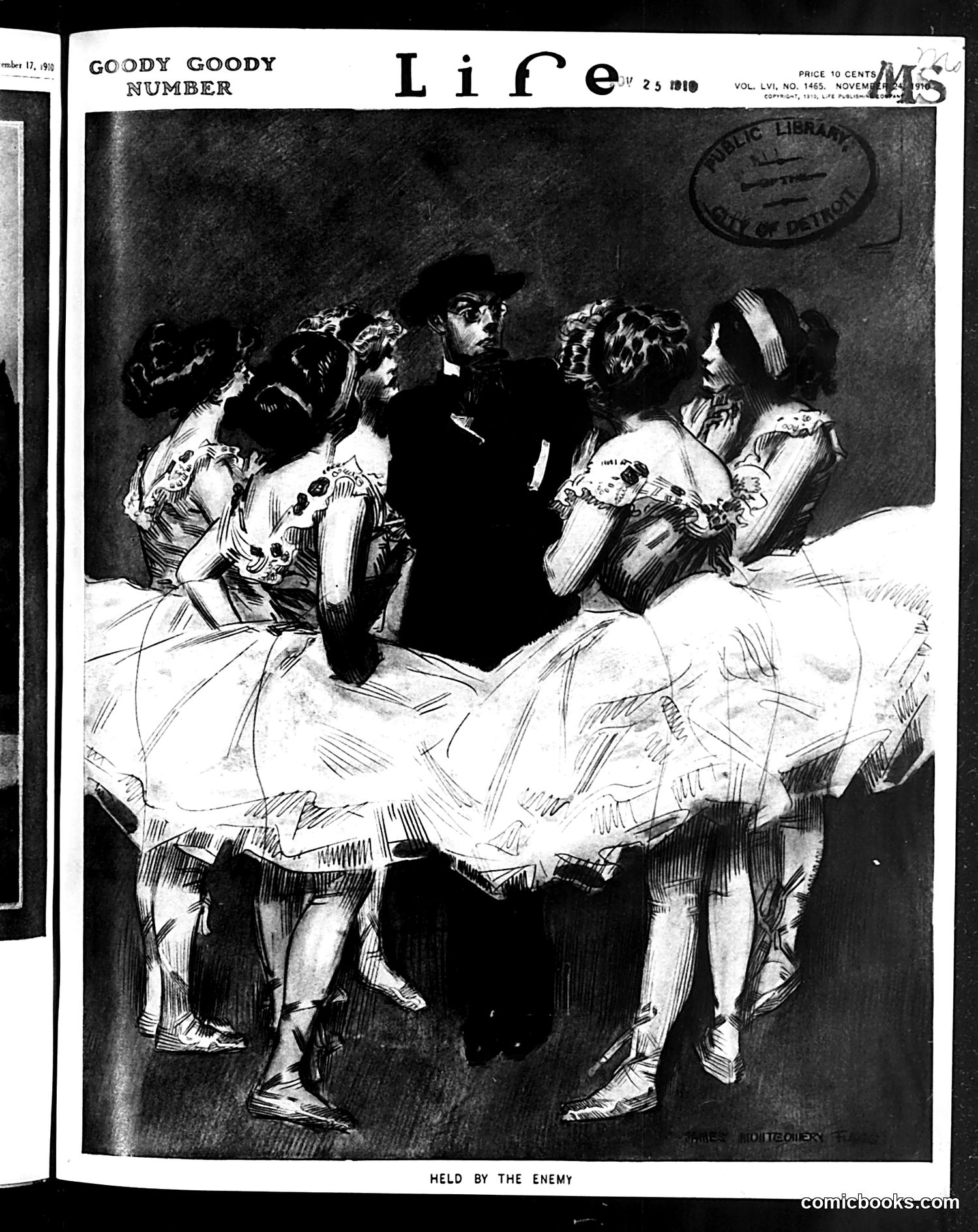
This is the cover illustration for Life magazine's "Goody Goody Number" from November 1910. The satirical cartoon depicts five women in light dresses surrounding a man in dark clothing in the center, with the caption "Held by the Enemy." The image appears to satirize the relationship dynamics or social anxieties of the era regarding women and courtship. The man's dark silhouette contrasts sharply with the women's lighter figures, suggesting he is outnumbered or "trapped" by female attention or demands. The phrase "held by the enemy" humorously frames women as adversaries in romantic or social contexts—reflecting common early-20th-century masculine anxieties about female agency and influence that would have resonated with Life's male readership.
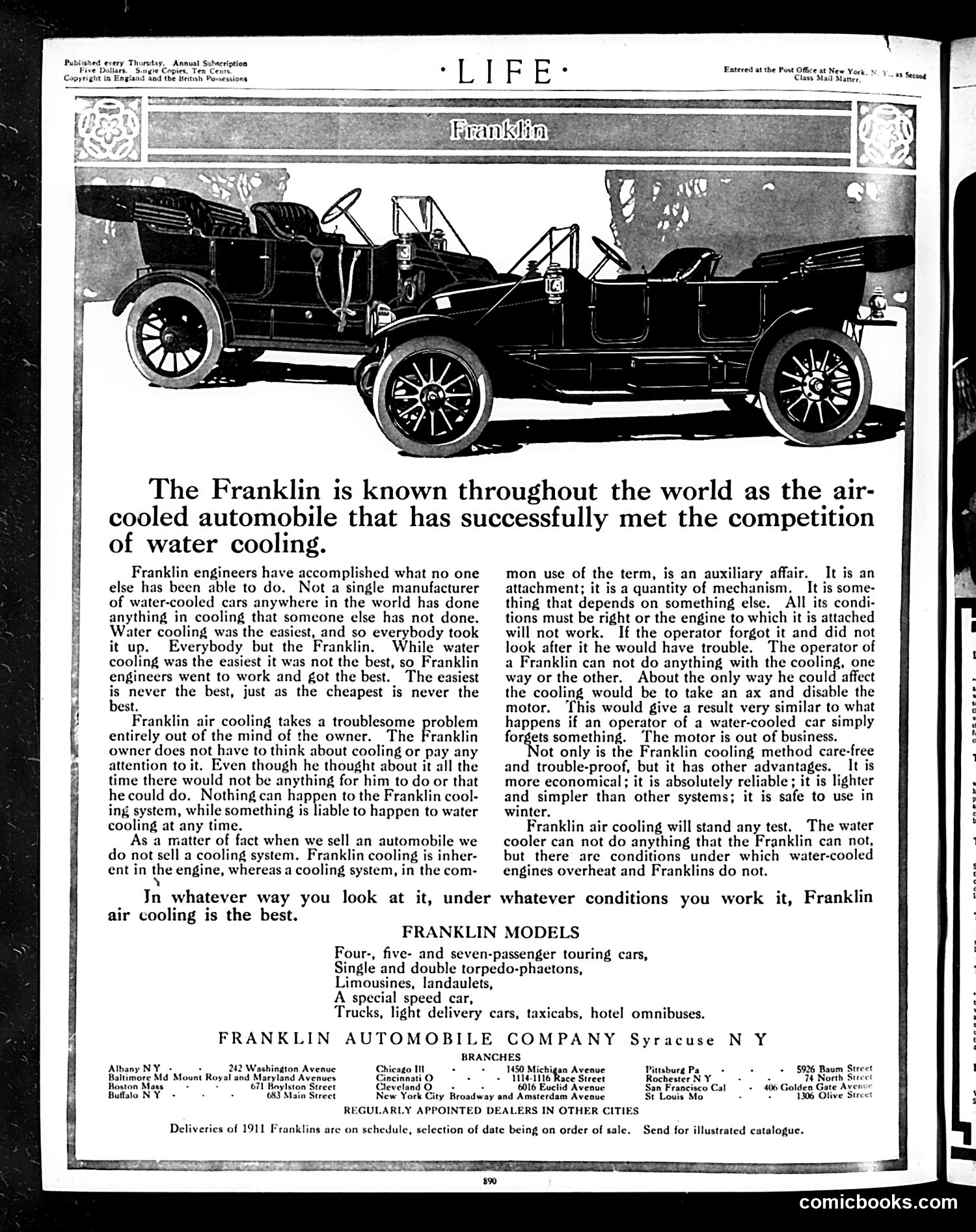
This page is **primarily an automobile advertisement**, not satirical content. It features a Franklin automobile company ad from circa 1911 (based on the vehicle design and typography). The advertisement emphasizes Franklin's signature feature: **air cooling rather than water cooling**—a significant technological distinction of the era. The text argues Franklin's air-cooled engines were superior, requiring less maintenance and operating reliably in various conditions. The only visual element is a **technical illustration of the Franklin touring car itself**, shown in profile to display its design. There is **no political satire or cartoon humor** on this page. Life magazine, while known for satire, also carried conventional advertisements. This represents standard early-20th-century automotive marketing emphasizing technical innovation as a competitive advantage.
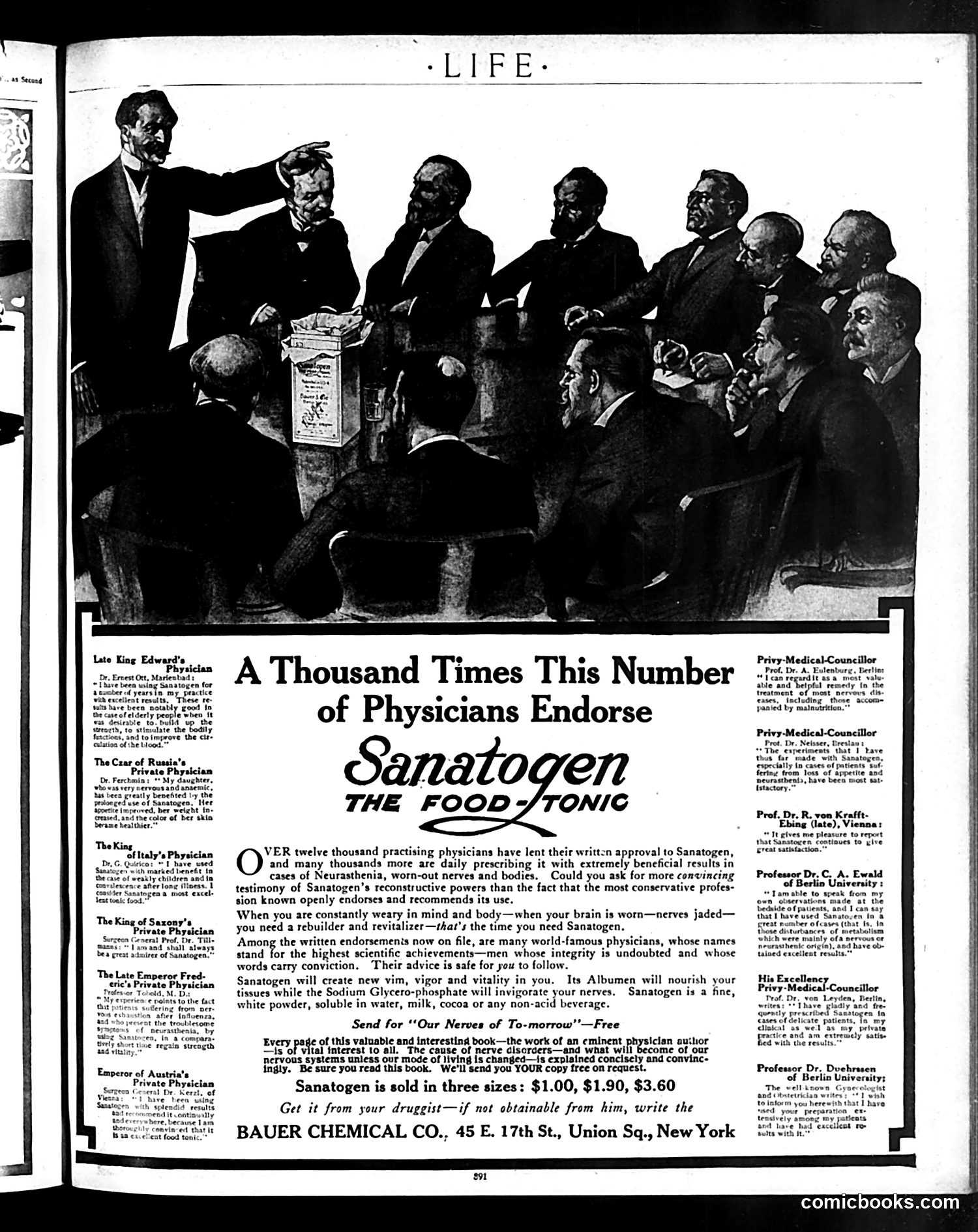
This page is primarily **a medical advertisement**, not satire. It promotes "Sanatogen," a patent medicine (food tonic) claiming endorsement by "a thousand" physicians. The illustration depicts what appears to be **European royalty and dignitaries** in formal dress, with captions identifying figures like "Late King Edward's Physician" and "The Czar of Russia's Physician." These references to royal physicians lend false prestige to the product. This represents **exploitative early-20th-century marketing**: the ad leverages the names and images of famous doctors to sell an unregulated "tonic" for nerve problems and fatigue. The numerous testimonial quotes from physicians are typical of dubious patent medicine advertising of this era, before FDA regulation and advertising standards. The satire likely lies in *Life magazine's* choice to publish such an obviously questionable advertisement, mocking contemporary medical marketing practices.
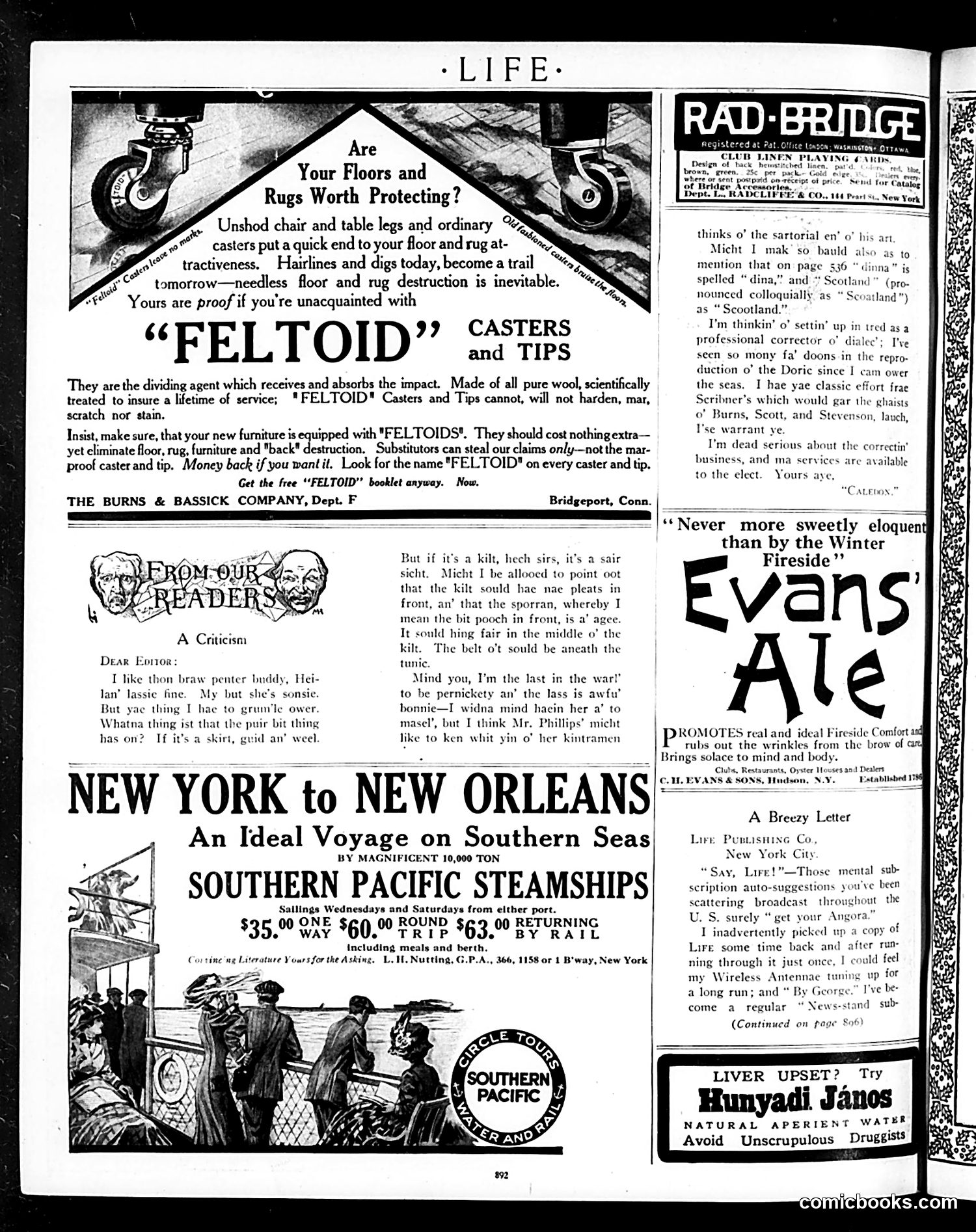
This page is primarily **advertising**, not political commentary. The main advertisements are: 1. **"Feltoid" Casters and Tips** — a product claiming to protect floors and furniture from damage, with the tagline "Money back if you won't like it." 2. **Evans Ale** — a fireside beverage advertisement. 3. **Southern Pacific Steamships** — promoting voyages from New York to New Orleans for $35-$63. 4. **Hunyadi János** — natural aperient water. The only editorial content is a "From Our Readers" section featuring a brief Scottish dialect poem about a kilt, and a letter about wireless antenna reception. The cartoon elements are minimal—mostly decorative illustrations accompanying advertisements rather than satirical commentary.
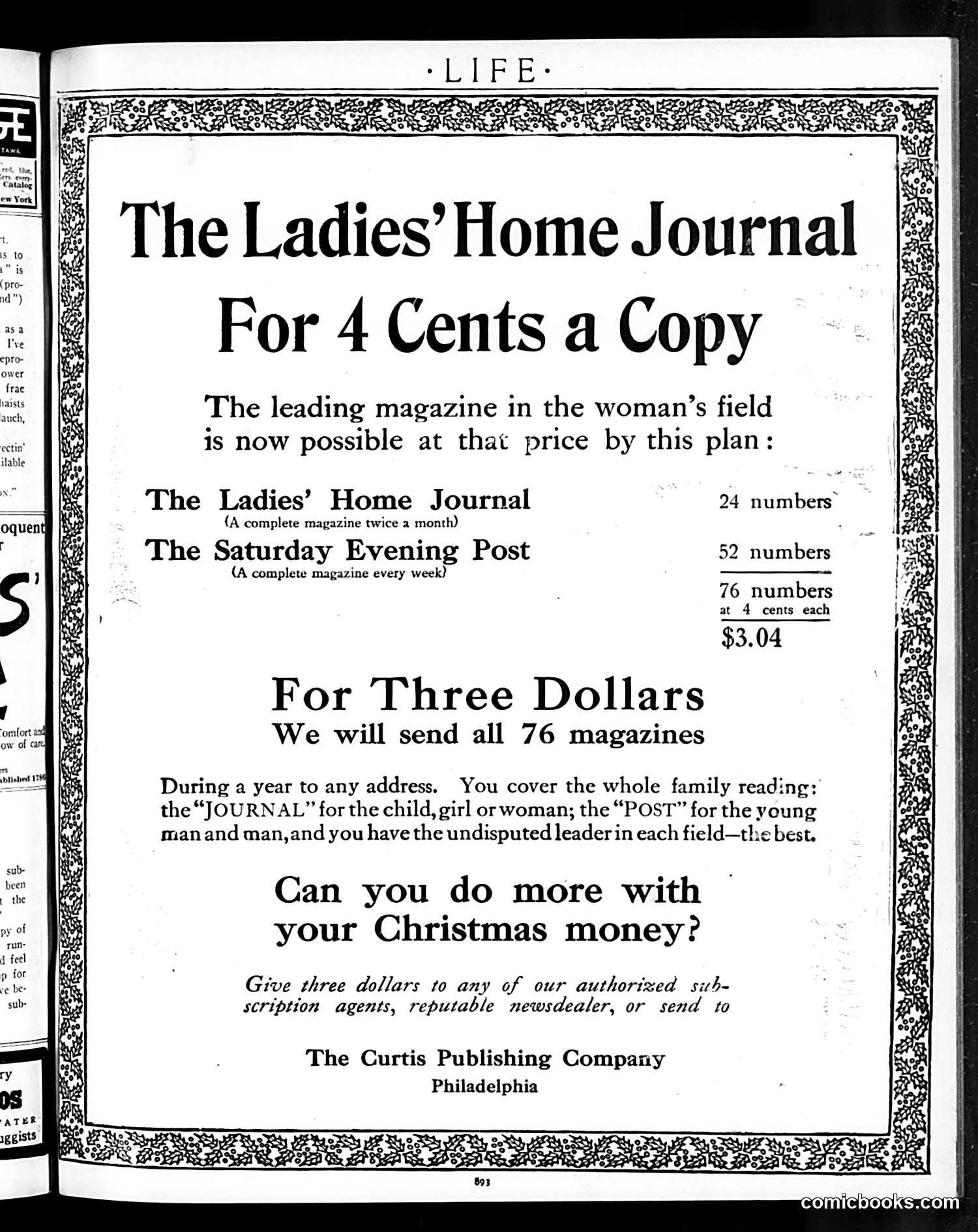
This page contains **no political cartoon or satirical content**. It is purely an **advertisement** for The Curtis Publishing Company of Philadelphia. The ad promotes a subscription bundle offering 76 magazines yearly for $3.04: - 24 issues of *The Ladies' Home Journal* (monthly) - 52 issues of *The Saturday Evening Post* (weekly) The appeal is economical value—positioning this as an ideal Christmas gift that "covers the whole family reading" for children, women, and men. The rhetorical question "Can you do more with your Christmas money?" emphasizes affordability. This reflects early 20th-century magazine distribution and the market for family-oriented publications targeting middle-class households.
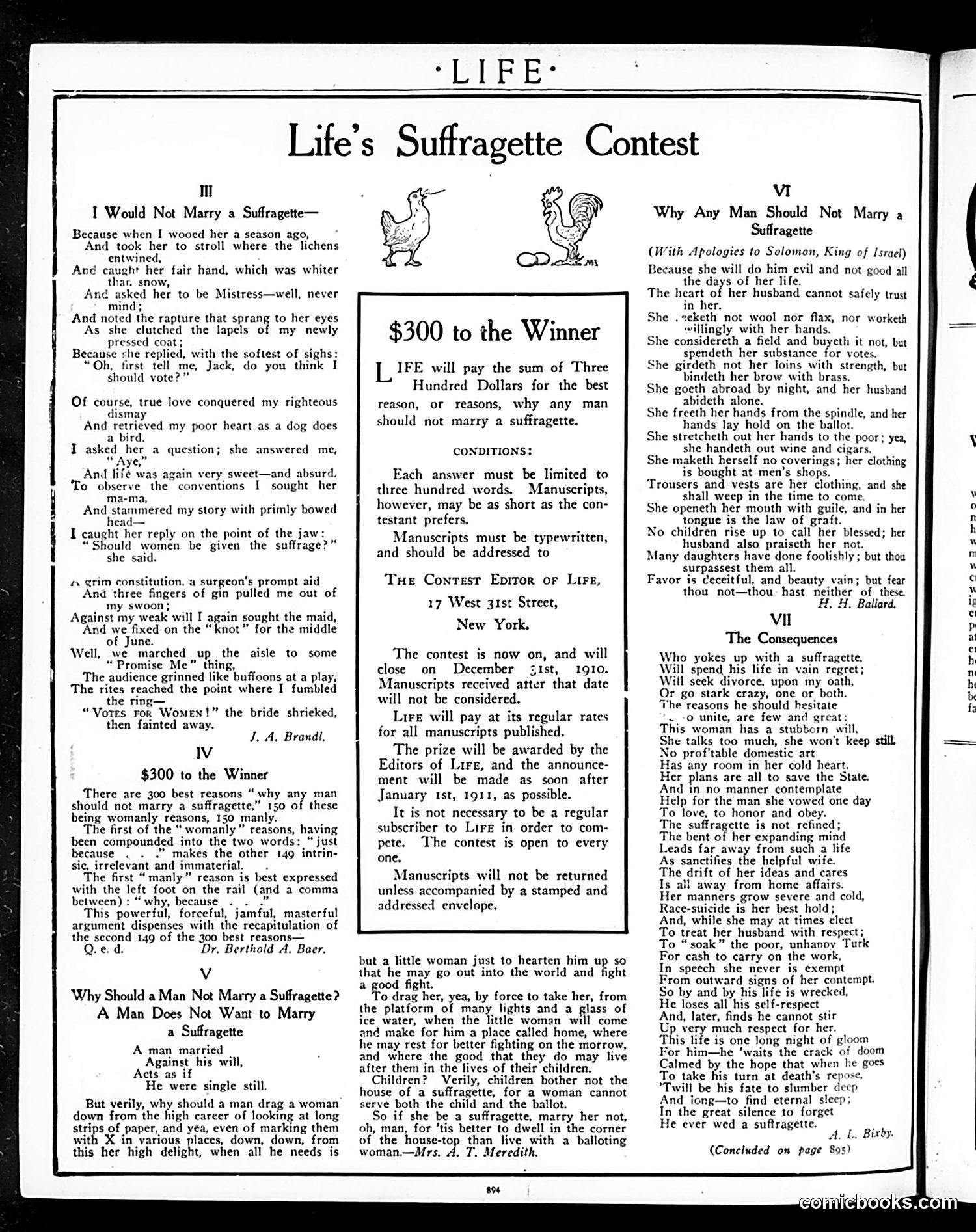
This page documents a satirical 1910-1911 contest where Life magazine invited men to submit reasons why they should not marry suffragettes—women advocating for voting rights. The contest offers $300 to the winner. The left column presents a poem titled "I Would Not Marry a Suffragette," depicting a suffragette as argumentative and neglectful of domestic duties. The right column offers anti-suffrage arguments, including claims that women seeking political rights are unfit for marriage and motherhood. The humor targets suffragettes through exaggerated stereotypes: that political engagement makes women shrewish, unfeminine, and bad wives. This reflects widespread anti-suffrage sentiment of the era, when women's political activism was mocked as threatening to traditional gender roles and family structures. The contest itself was a popular satirical device Life used to generate reader engagement while advancing political viewpoints.
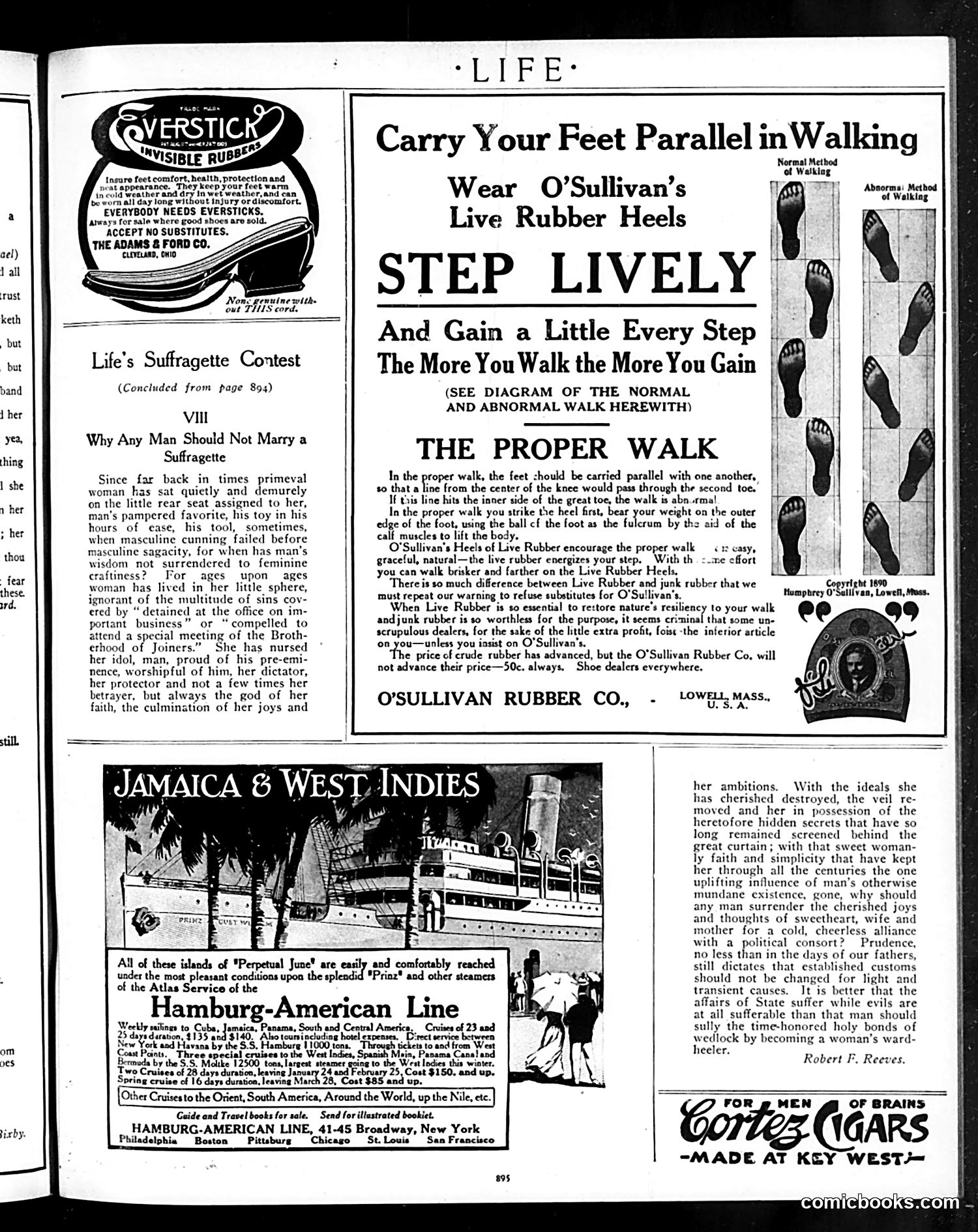
This page is primarily **advertising and commercial content**, not political satire. The main features are: 1. **O'Sullivan Rubber Heels ad** (center): A lengthy advertisement promoting proper walking posture with diagrams showing "normal" vs. "abnormal" foot placement. This reflects early 20th-century health-consciousness about gait and body mechanics. 2. **Overstick Invisible Rubbers ad** (top left): Period footwear advertising. 3. **Hamburg-American Line cruise ad** (lower left): Promoting Caribbean and world voyages. 4. **Cortes Cigars ad** (bottom right): "For Men of Brains." The only editorial content visible is "Life's Suffragette Contest" and an article titled "Why Any Man Should Not Marry a Suffragette"—this represents Life's satirical stance **opposing women's suffrage**, a major political issue of the era (pre-1920). The piece uses humor to mock suffragettes as unsuitable wives.
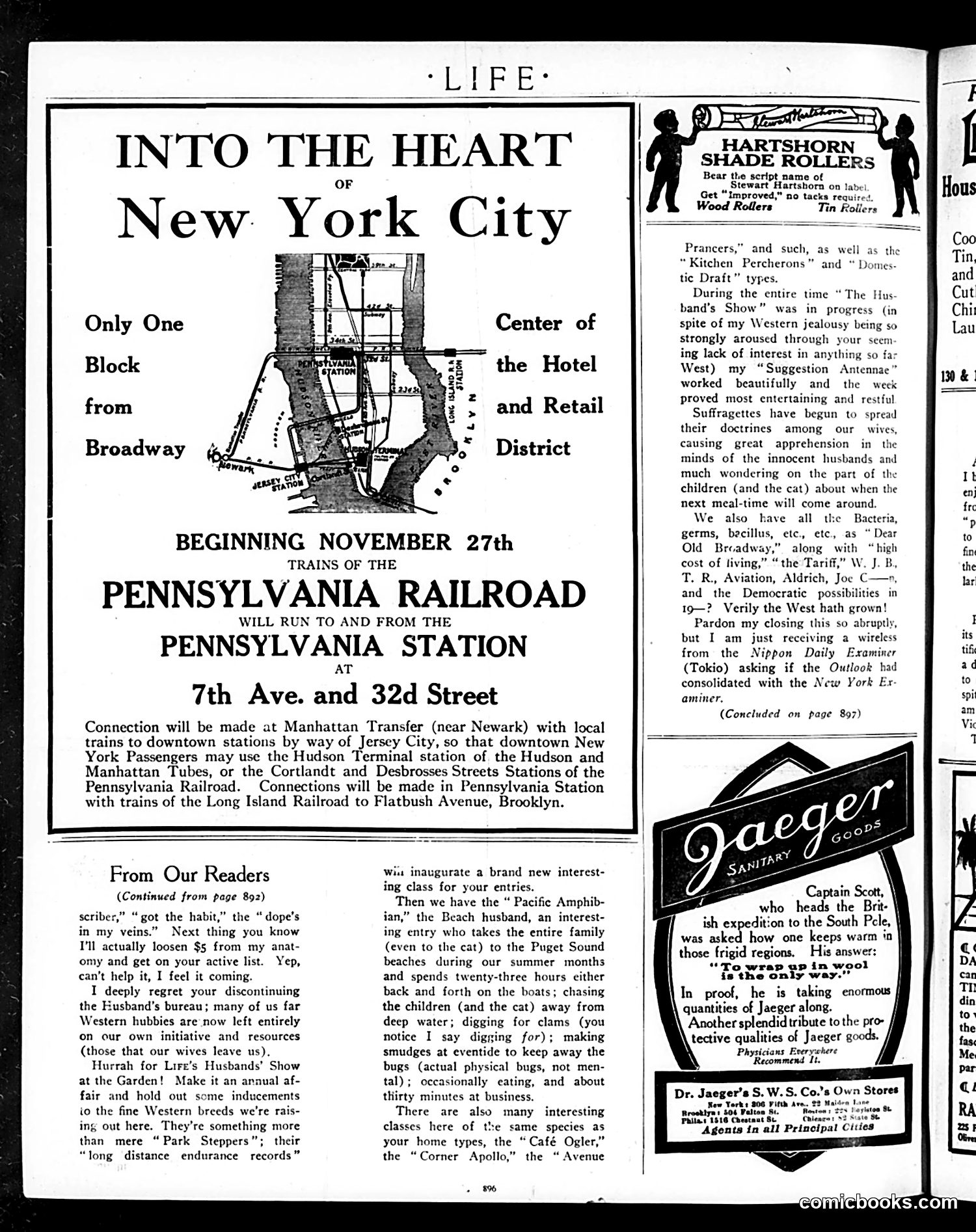
This page is **primarily advertising and editorial content**, not political satire or cartoon humor. The left side features a large advertisement for the Pennsylvania Railroad's new station at 7th Avenue and 32nd Street in Manhattan, beginning November 27th. The map and text describe transportation connections and the station's central location. The right side contains a reader's letter column ("From Our Readers") discussing various topics, followed by an advertisement for Jaeger sanitary goods, featuring Captain Scott's South Pole expedition as a testimonial endorsement. There are no political cartoons or satirical figures on this page. The "Hartshorn Shade Rollers" advertisement in the upper right corner is a straightforward product promotion with no satirical intent.
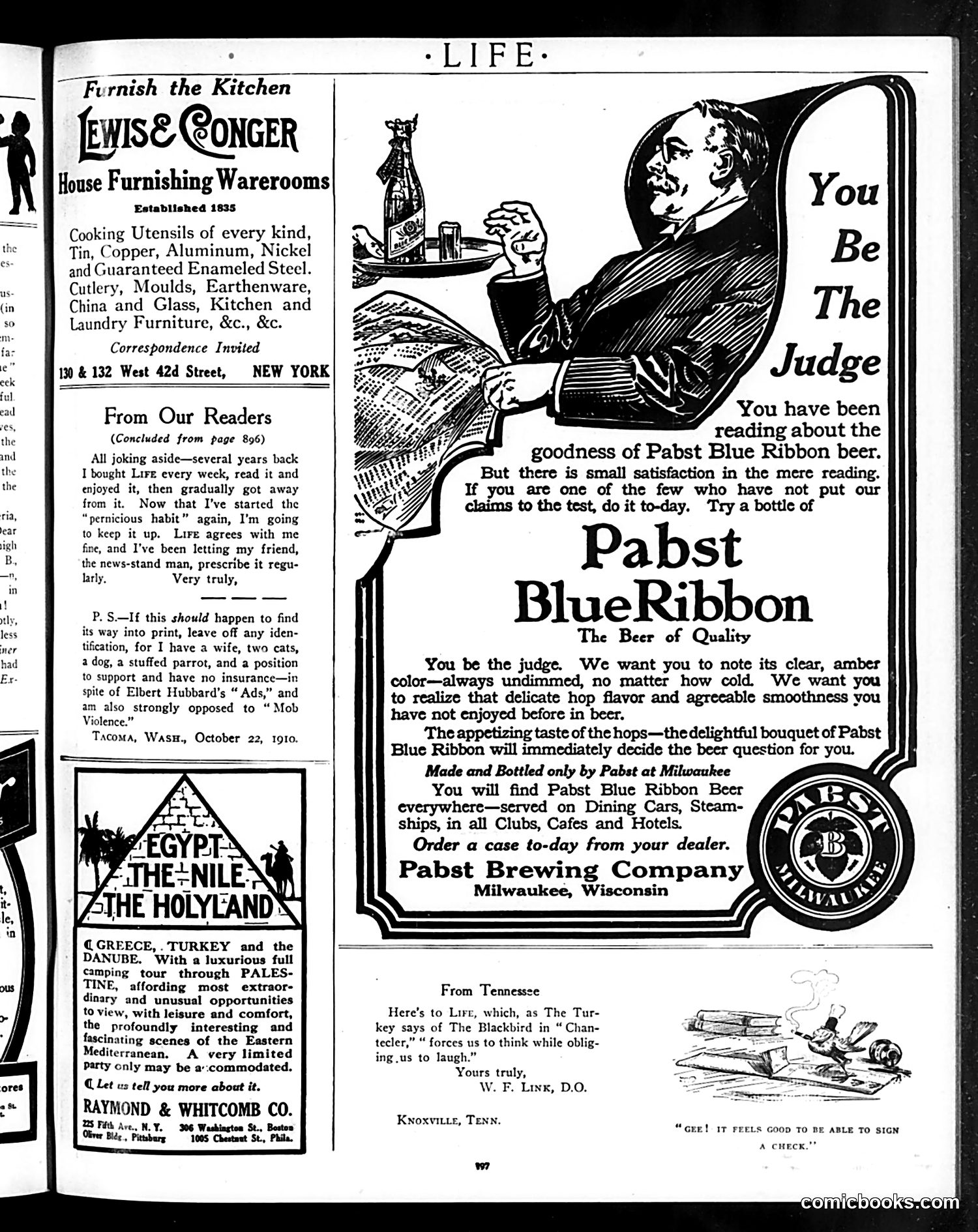
This page is primarily **advertising content** rather than satire or political commentary. The main advertisement features **Pabst Blue Ribbon beer**, using a clever rhetorical device: a man lounges contentedly while the ad invites readers to "be the judge" of the beer's quality by tasting it themselves. The copy emphasizes the beer's "clear, amber color," "delicate hop flavor," and "agreeable smoothness." The page also contains standard commercial ads for **Lewis & Conger kitchen furnishings** and **Raymond & Whitcomb travel tours** to Egypt and the Mediterranean. A brief reader submission from Tennessee references *Life* magazine humorously, and includes a cartoon captioned "Gee! It feels good to be able to sign a check." The page represents typical early-20th-century magazine advertising and reader correspondence rather than political satire.
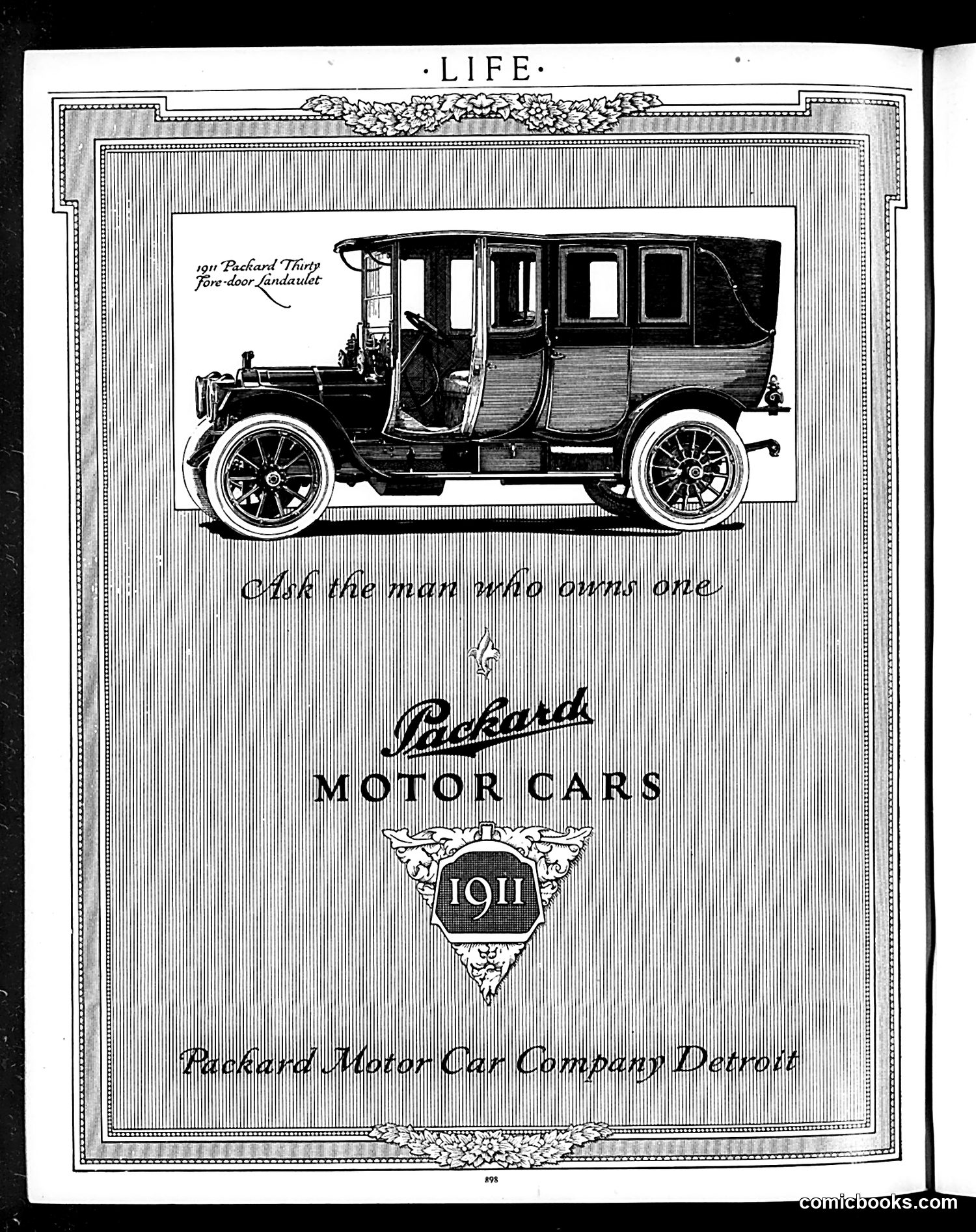
This is an advertisement page from *Life* magazine (1911) for Packard Motor Cars. The central image shows a 1911 Packard Thirty fore-door landaulet automobile in profile. The tagline reads: "Ask the man who owns one"—a famous Packard slogan emphasizing owner satisfaction and word-of-mouth reputation. This was aspirational advertising targeting wealthy consumers, as automobiles were luxury goods in this era. The page itself contains no political satire or cartoon commentary. Rather, it's a straightforward luxury product advertisement placed within the magazine's pages. The decorative border and elegant typography reflect the sophisticated marketing approach used to appeal to *Life*'s affluent readership during the early automotive age.
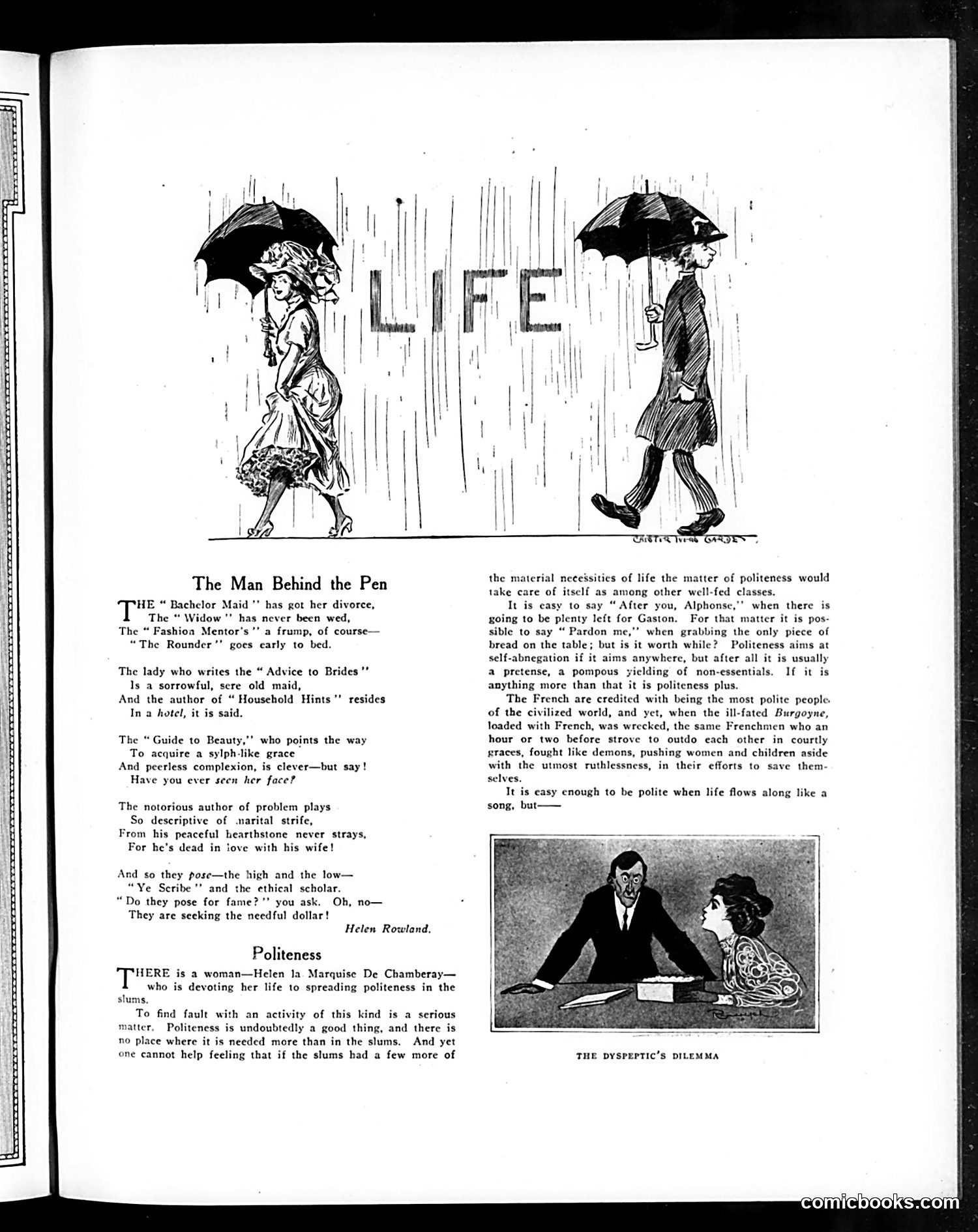
**Main Cartoon ("The Man Behind the Pen"):** This satirical poem by Helen Rowland mocks prolific male writers of popular literature—authors of "Bachelor" stories, "Widow" tales, fashion memoirs, and advice columns. The cartoon shows two figures in the rain labeled "LIFE," suggesting these writers profit from dramatizing romantic and domestic struggles while remaining emotionally detached ("dead in love with his wife"). The satire critiques how male authors monetize sentimentality and domestic advice for female readers. **Lower Section ("Politeness"):** The text discusses Helen La Marquise De Chamberay, who spreads politeness in slums. It argues that while politeness is valuable, it's insufficient as a solution to poverty—a critique of well-meaning but ineffectual charity efforts that address manners rather than material needs. **"The Dyspeptic's Dilemma" illustration** shows a business interaction, likely commenting on social awkwardness in commercial contexts.
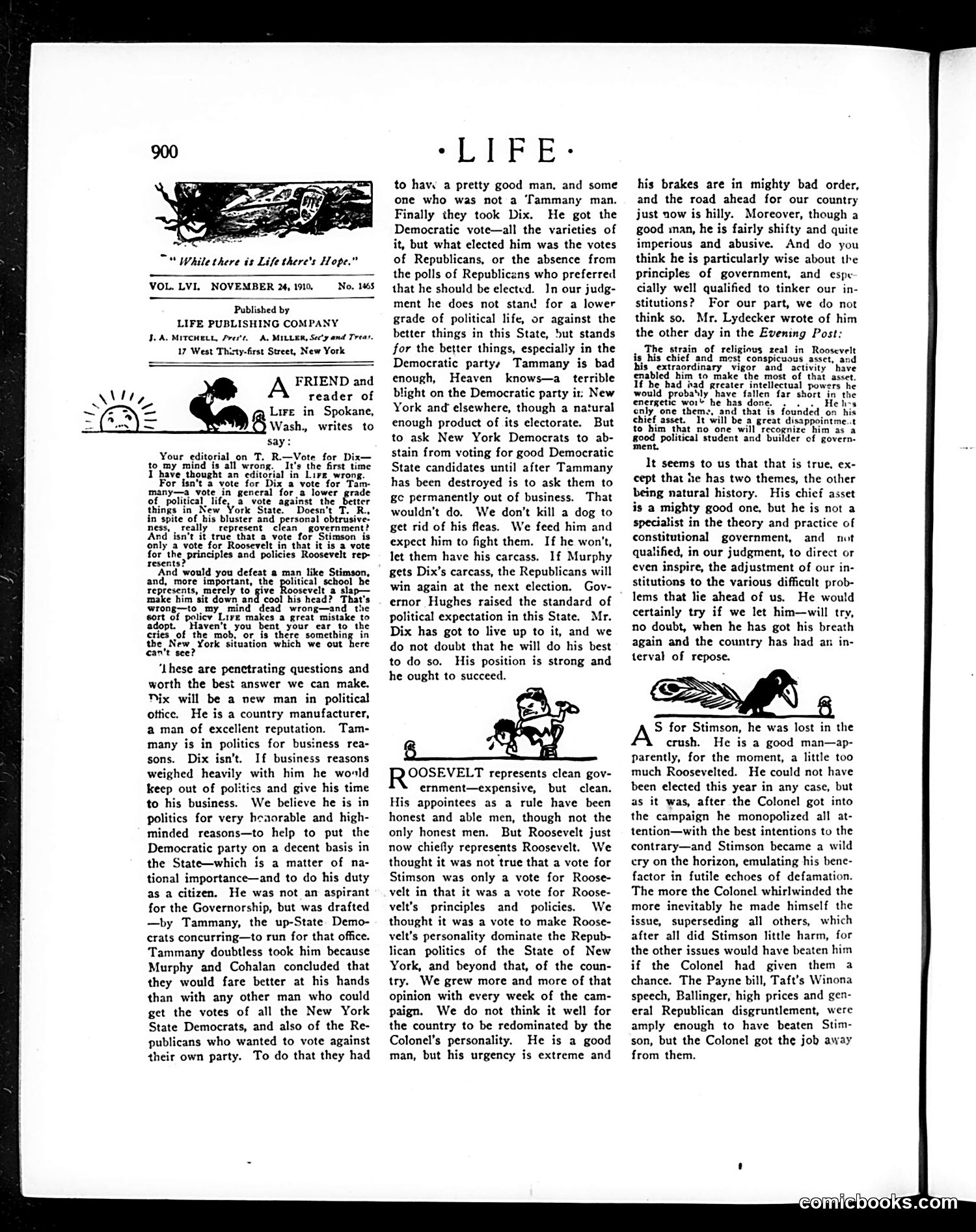
This *Life* magazine page (November 24, 1912) discusses the recent presidential election through letters to the editor. The text criticizes New York Democrats who voted for the Socialist candidate Eugene Debs rather than the Democrat Woodrow Wilson, arguing this split helped elect Republican William Howard Taft. The commentary also mentions **Theodore Roosevelt** (referenced as representing "clean government") and **Colonel Roosevelt's personality dominating Republican politics**. A small illustration labeled "A" depicts a figure labeled "Stinson" (likely the Colonel referenced in text) described as lost in the election's aftermath, portrayed as "a good man" but too aligned with Roosevelt's candidacy. The cartoons and text satirize how personality-driven politics—particularly Roosevelt's outsized influence—damaged traditional party loyalty and outcomes in the 1912 three-way race.
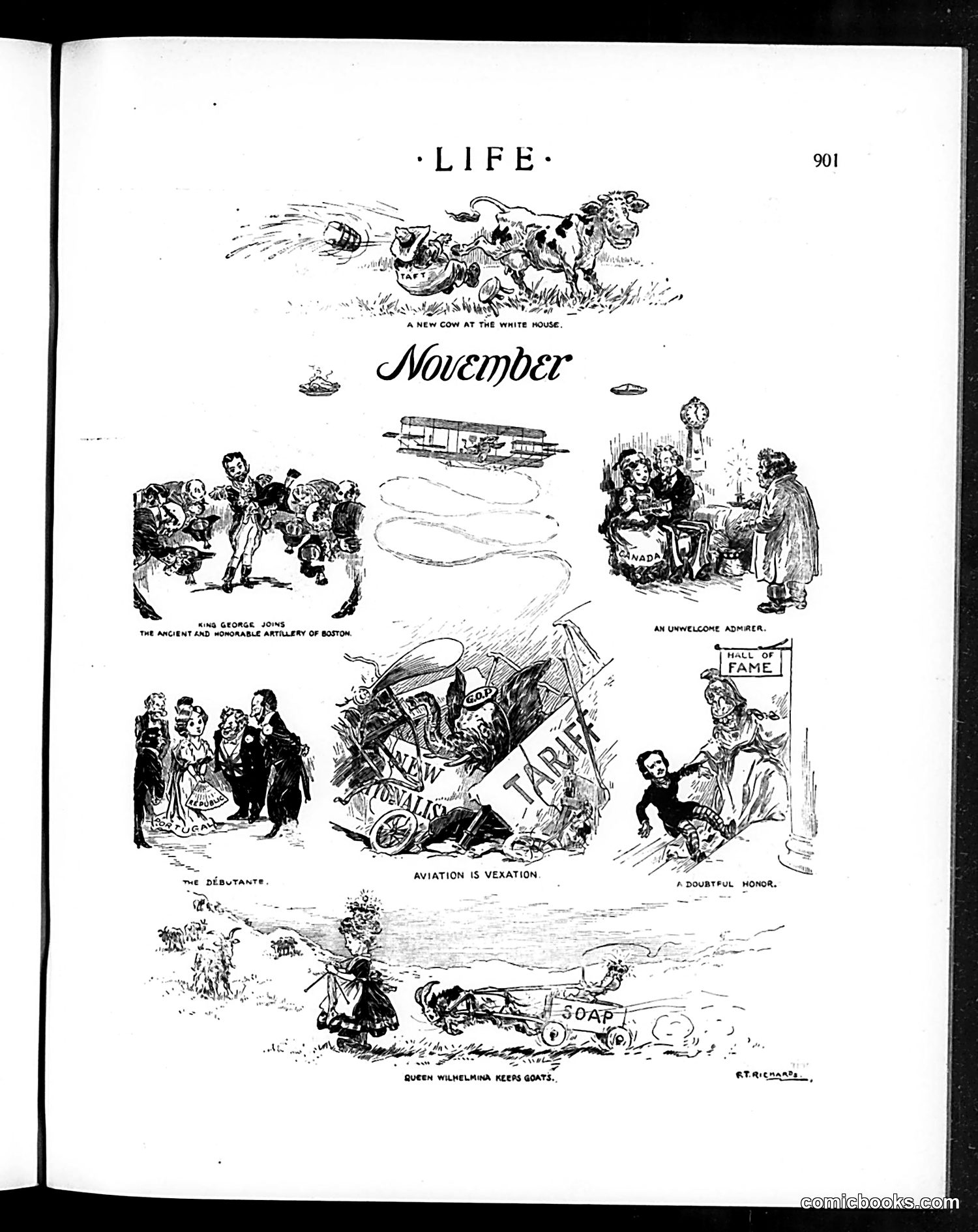
This is a satirical November-themed page from *Life* magazine featuring multiple cartoon vignettes commenting on contemporary society and politics. The sketches include: - **"A New Cow at the White House"** (top): Political commentary on executive affairs - **"King George Joins the Ancient and Honorable Artillery of Boston"**: Historical/patriotic satire - **"Aviation is Vexation"**: Mocking the era's fascination with early aviation disasters - **"An Unwelcome Admirer"** and **"Hall of Fame"**: Social comedy - **"The Debutante"** and **"A Doubtful Honor"**: High-society mockery - **"Queen Wilhelm Keeps Goats"**: Likely European political satire The page's overall tone mocks contemporary institutions—politics, aviation enthusiasm, social pretension, and aristocratic behavior—typical of *Life*'s satirical approach during the early 20th century.
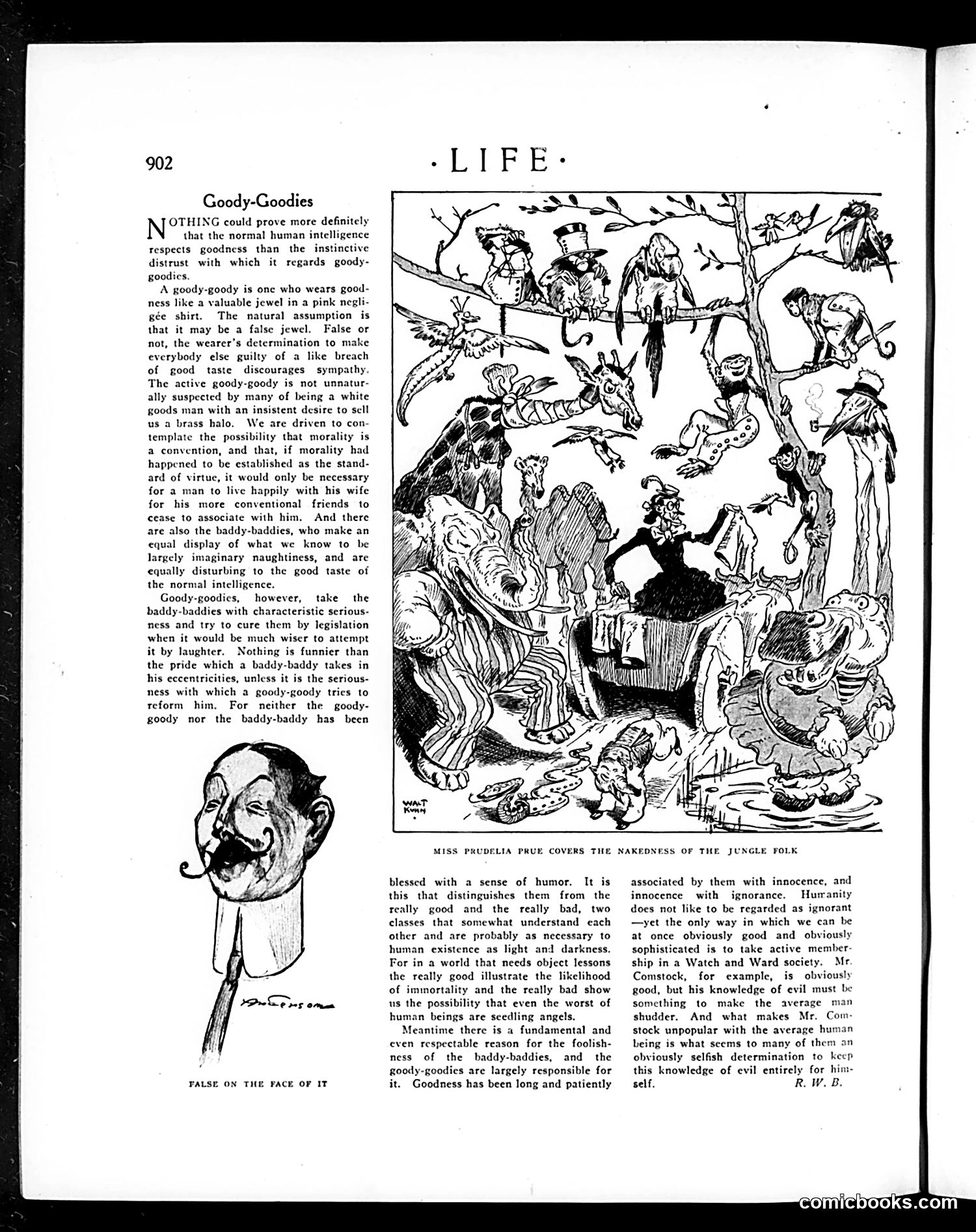
This satirical essay attacks self-righteous moralists ("goody-goodies") who ostentatiously display virtue while attempting to reform others through legislation and judgment rather than humor. The author distinguishes between genuinely good/bad people (who understand each other and lack pretension) versus performative "goody-goodies" and "baddy-baddies" (who lack humor and self-awareness). The essay singles out **Anthony Comstock**, the infamous anti-vice crusader, as exemplifying this hypocrisy: he appears morally pure but possesses extensive knowledge of "evil" he's determined to keep from others—making him unpopular despite obvious goodness. The large illustration shows "Miss Prudelia Prue" covering jungle inhabitants' nudity, satirizing how goody-goodies impose their moral standards on others under guise of propriety. The cartoon mocks this missionary zeal as self-serving rather than genuinely altruistic.
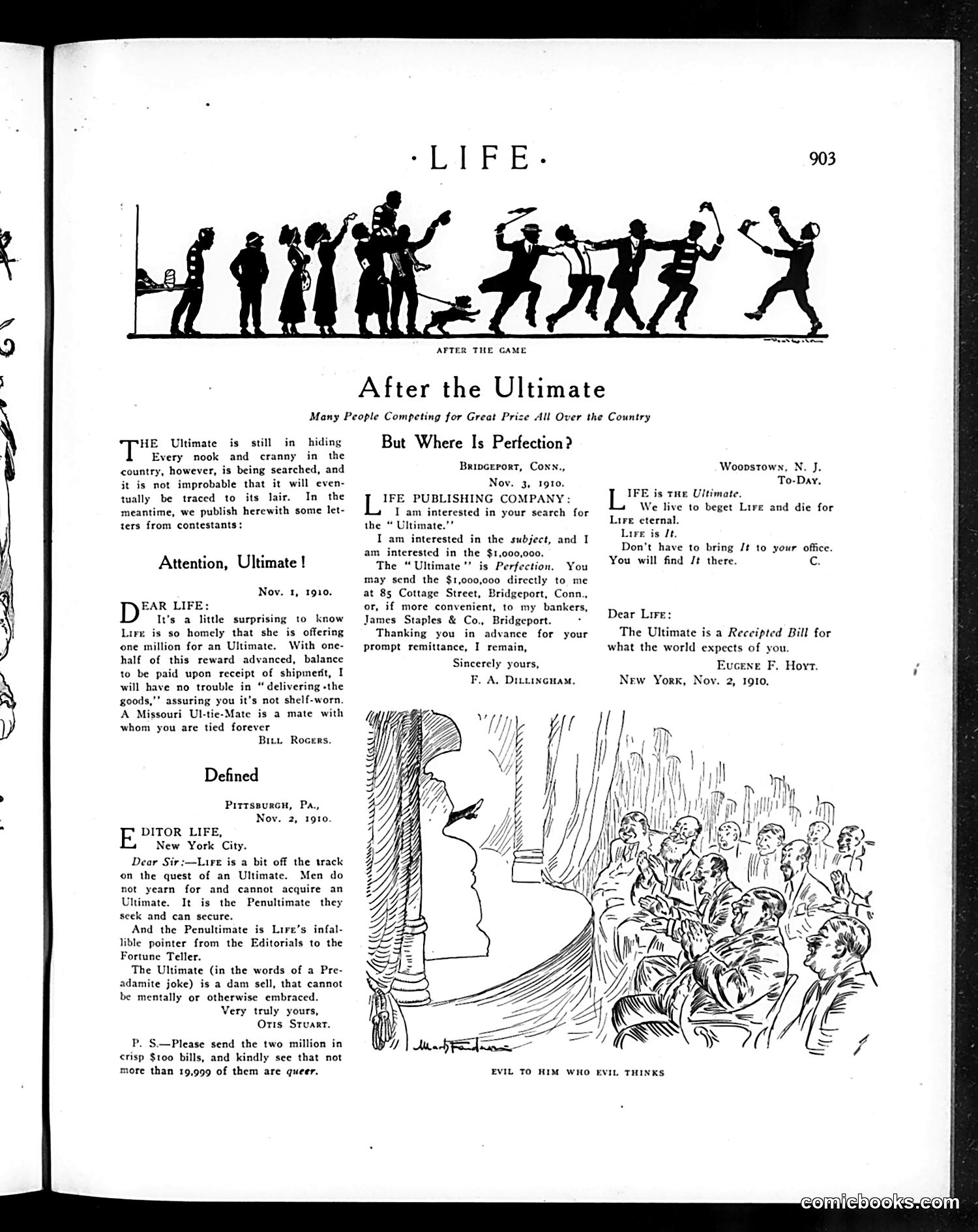
This page satirizes Life magazine's apparent search for "the Ultimate"—likely a publicity stunt or contest. The top illustration shows silhouetted figures in comic chaos, representing the widespread public competition for an undefined prize. The humor lies in the letters' varied, absurd definitions of "the Ultimate." Correspondents offer contradictory answers: one defines it as a spouse you're "tied forever" to; another argues it's actually the "Penultimate" (wordplay on the unattainable); a third claims it's "Perfection" and brazenly requests the $1,000,000 prize; another suggests it's Life magazine itself. The satire mocks both the magazine's vague marketing scheme and the public's gullible enthusiasm. The final illustration shows a giant head dispensing wisdom to crowds below, captioned "Evil to him who evil thinks"—suggesting the whole enterprise is either morally questionable or fundamentally meaningless. The page ridicules early 20th-century consumer culture and frivolous competitions.
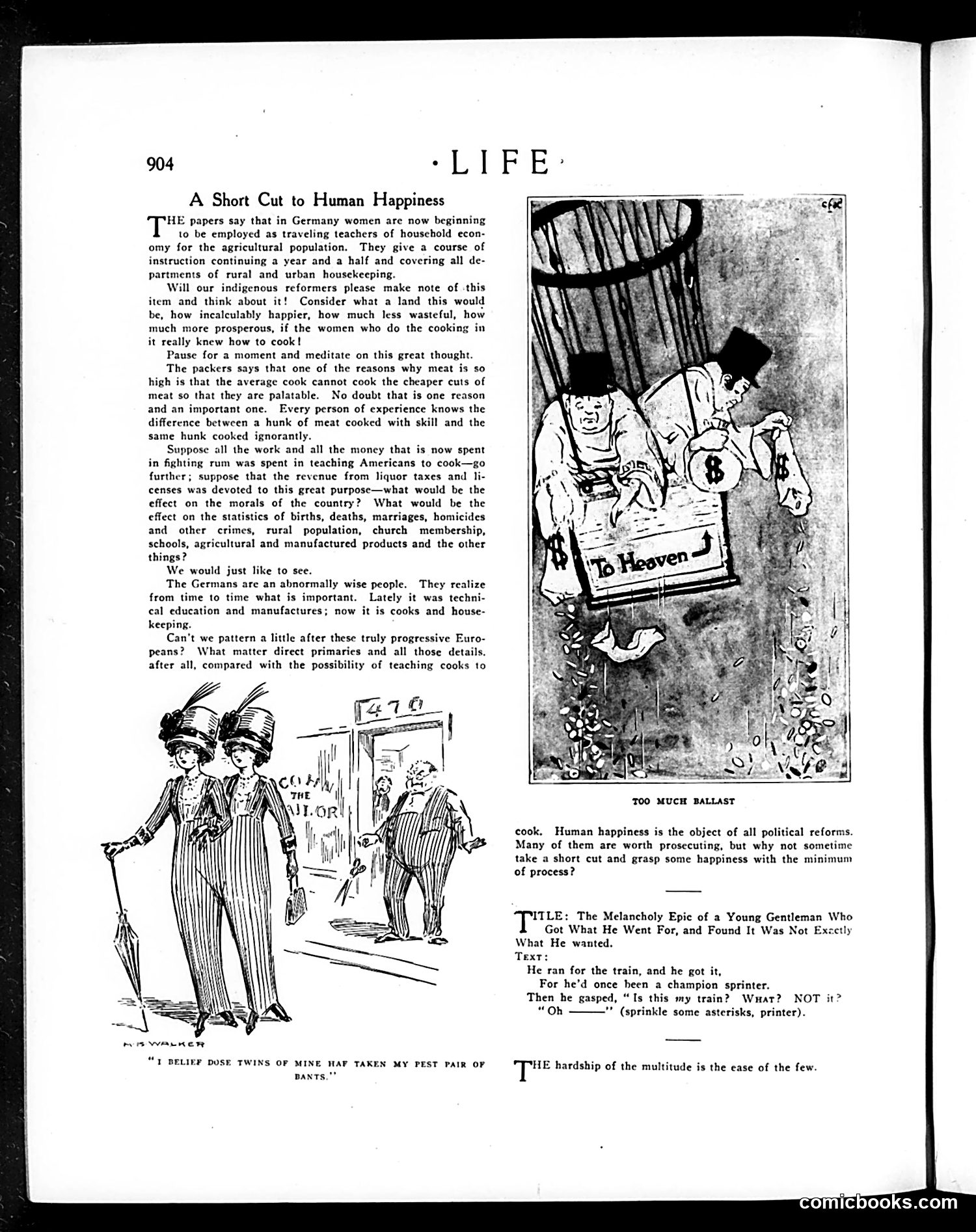
This page contains satirical editorial commentary on American domestic life and reform priorities, illustrated with period cartoons. The main article argues that Germany's progressive approach—training women as traveling teachers of household economics—should be adopted in America. The author contends that teaching American women proper cooking skills would have greater social impact than most political reforms. He suggests that if liquor tax revenues funded cooking instruction instead of temperance campaigns, it would improve public morality, reduce crime, and boost agricultural productivity more effectively than "direct primaries and other details." The cartoons underscore this message: - Upper right: "Too Much Ballast" depicts a woman literally weighed down by excess baggage, symbolizing wasted domestic effort - Lower left: A P.B. Walker cartoon shows two identical figures lamenting stolen "best pair of pants," appearing to mock trivial concerns versus substantive reform The satire suggests American reformers pursue grandiose political schemes while ignoring practical domestic improvements that would genuinely enhance citizens' lives and national prosperity.
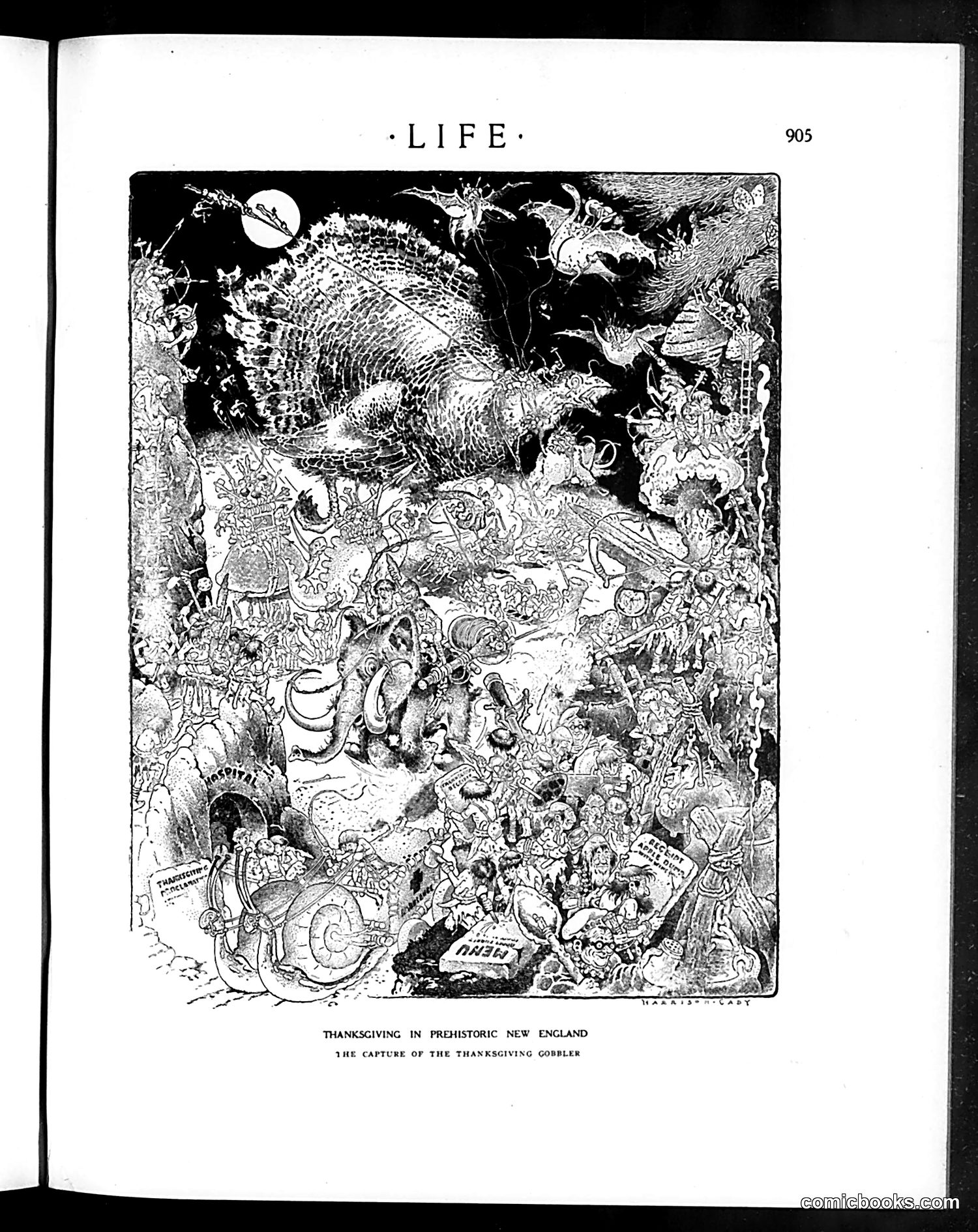
This is a satirical cartoon titled "Thanksgiving in Prehistoric New England: The Capture of the Thanksgiving Gobbler." The image is a densely packed, chaotic illustration in the style of early 20th-century Life magazine humor. The cartoon appears to depict a humorous, absurdist scene mixing prehistoric elements (dinosaurs, cavemen) with Thanksgiving imagery and American colonial references. The "Thanksgiving Gobbler" (a turkey) is apparently being "captured" in this fantastical scenario. The satire seems to play on American Thanksgiving mythology—the popular narrative of pilgrims and Native Americans—by transposing it into an impossible prehistoric setting with dinosaurs and crude figures. This incongruity creates the comedic effect, likely mocking either the romanticized Thanksgiving origin story or simply offering absurdist holiday humor. The OCR text is too garbled to provide additional context about the specific satirical target.
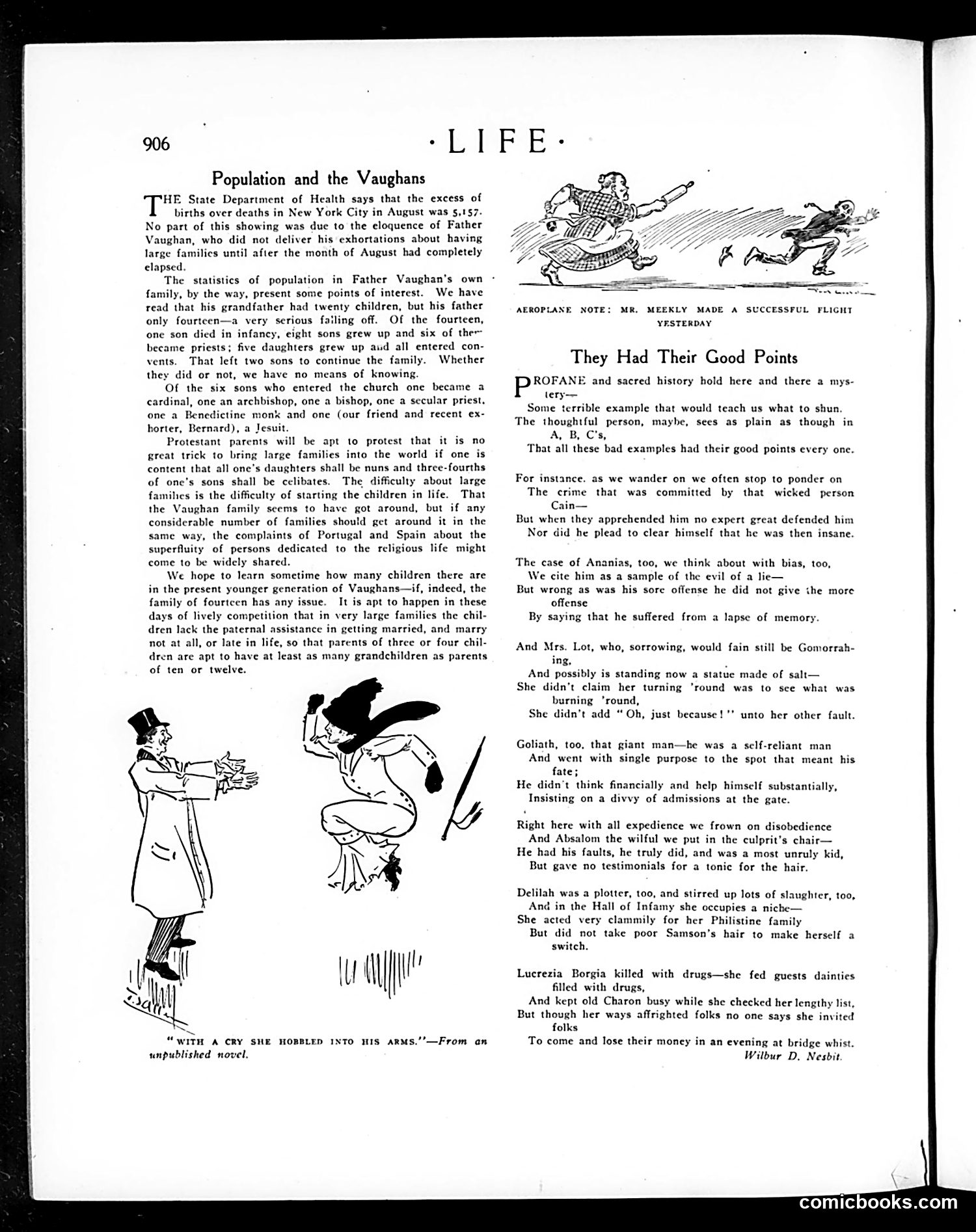
This *Life* magazine page satirizes Father Bernard Vaughan, a Jesuit priest who apparently advocated for large families. The left article notes the irony: Vaughan promoted big families only *after* August's birth statistics were already recorded, so he claimed no credit. It then mocks his own family's approach to population growth—his grandfather had 20 children, but many became priests and nuns (celibate, producing no offspring), making his pro-natalist message hypocritical. The right column is a humorous poem listing biblical and historical "bad examples" who at least took responsibility for their wrongdoing without modern excuses. Cain didn't claim insanity; Ananias didn't blame memory loss; Goliath didn't demand gate receipts. The satire suggests contemporaries are making excuses where historical figures owned their faults—a commentary on modern evasiveness.
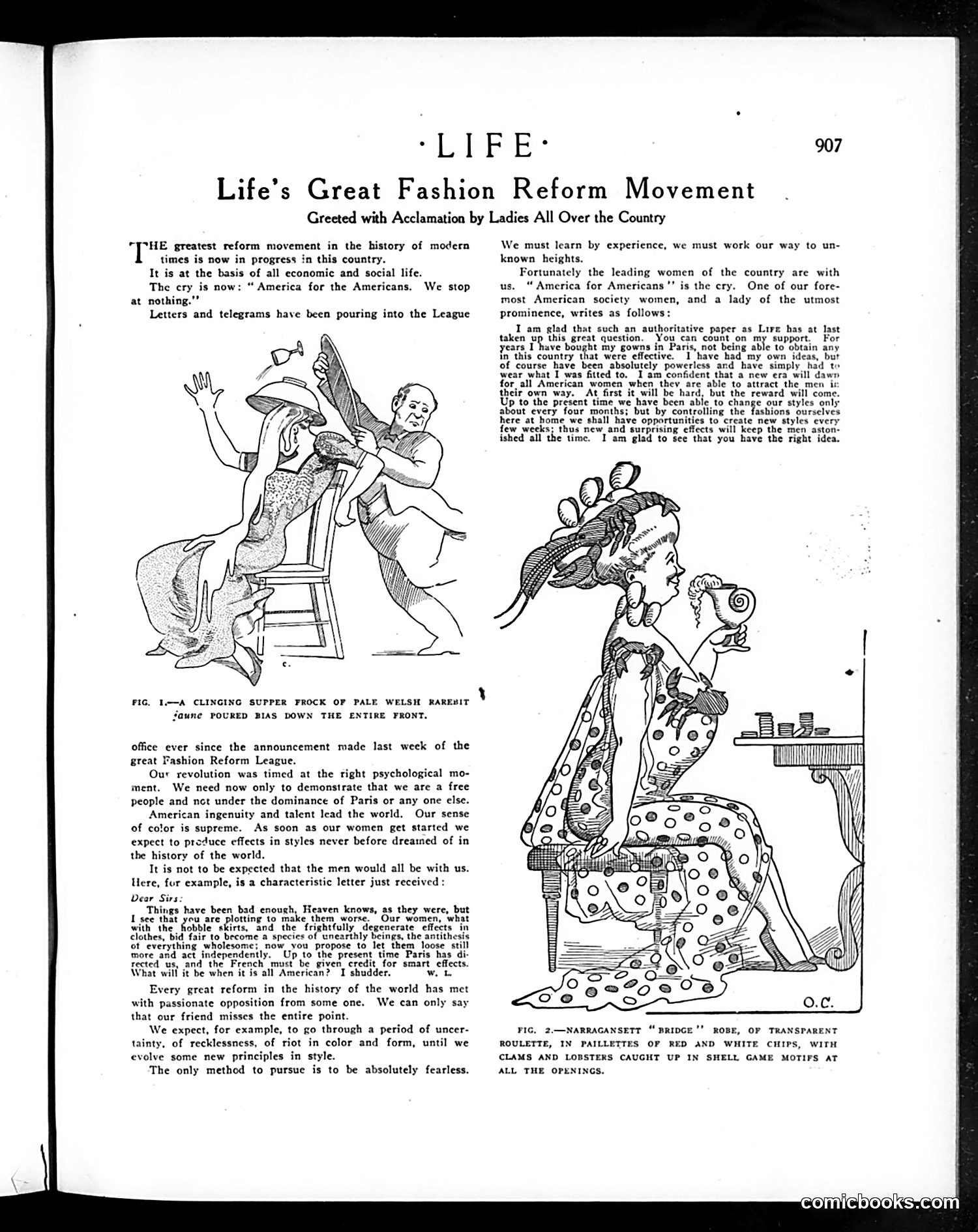
This 1910s satire mocks the "Fashion Reform League," a movement promoting American-designed clothing independent of Paris fashion dominance. The cartoon ridicules both the reform movement and its opponents. **Figure 1** depicts a woman in a absurdly impractical "supper frock" where Welsh rarebit (cheese sauce) is literally poured down the front—a visual pun on the dress's name, satirizing experimental American design excess. **Figure 2** shows an equally ridiculous "Narragansett Bridge" robe decorated with actual seafood (clams, lobsters) and gambling imagery ("shell game motifs," "paillettes of red and white chips"), further mocking nationalist fashion pretensions through regional kitsch. The accompanying text presents dueling letters: a skeptical male correspondent warns that unguided female fashion autonomy will produce chaos, while a society woman praises the movement for allowing American women creative control. **The joke**: Life satirizes American nationalist fervor by suggesting that replacing Paris's refined aesthetic with homegrown design would produce tasteless, nonsensical absurdity. The elaborately ridiculous garments embody fears about what "freedom" in fashion actually meant.
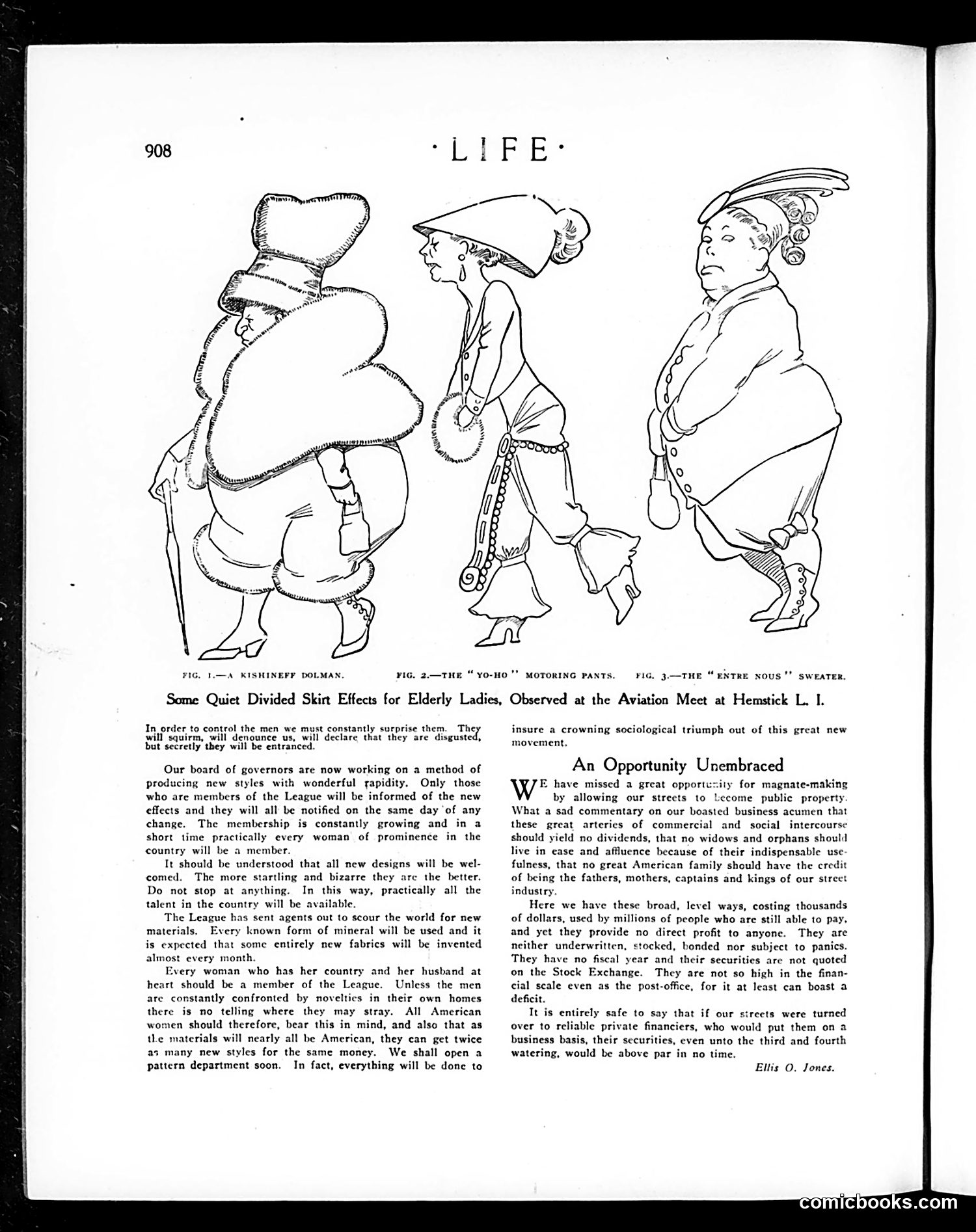
This page contains two satirical pieces mocking early 20th-century fashions and capitalism. **Top illustration**: Three caricatured elderly women in absurdly exaggerated clothing observed at an aviation meet on Long Island. The accompanying text sarcastically describes a "League" controlling women's fashion through surprise and novelty, claiming men need constant domestic surprises to prevent infidelity. The grotesque proportions and ridiculous garment names ("Yo-Ho Motoring Pants," "Entre Nous Sweater") mock both the fashions themselves and the pretentious marketing language surrounding them. **Bottom article**: Ellis O. Jones satirizes American capitalism by proposing that public streets should be privatized and financialized like corporations—complete with stock offerings and "watering" (stock manipulation). He argues that if streets were treated as profit-generating business ventures, they could benefit widows and orphans through dividends. The piece mocks both unchecked capitalism's absurdity and the era's tendency to monetize every public resource. Both pieces employ exaggeration and irony to critique contemporary social and economic trends.
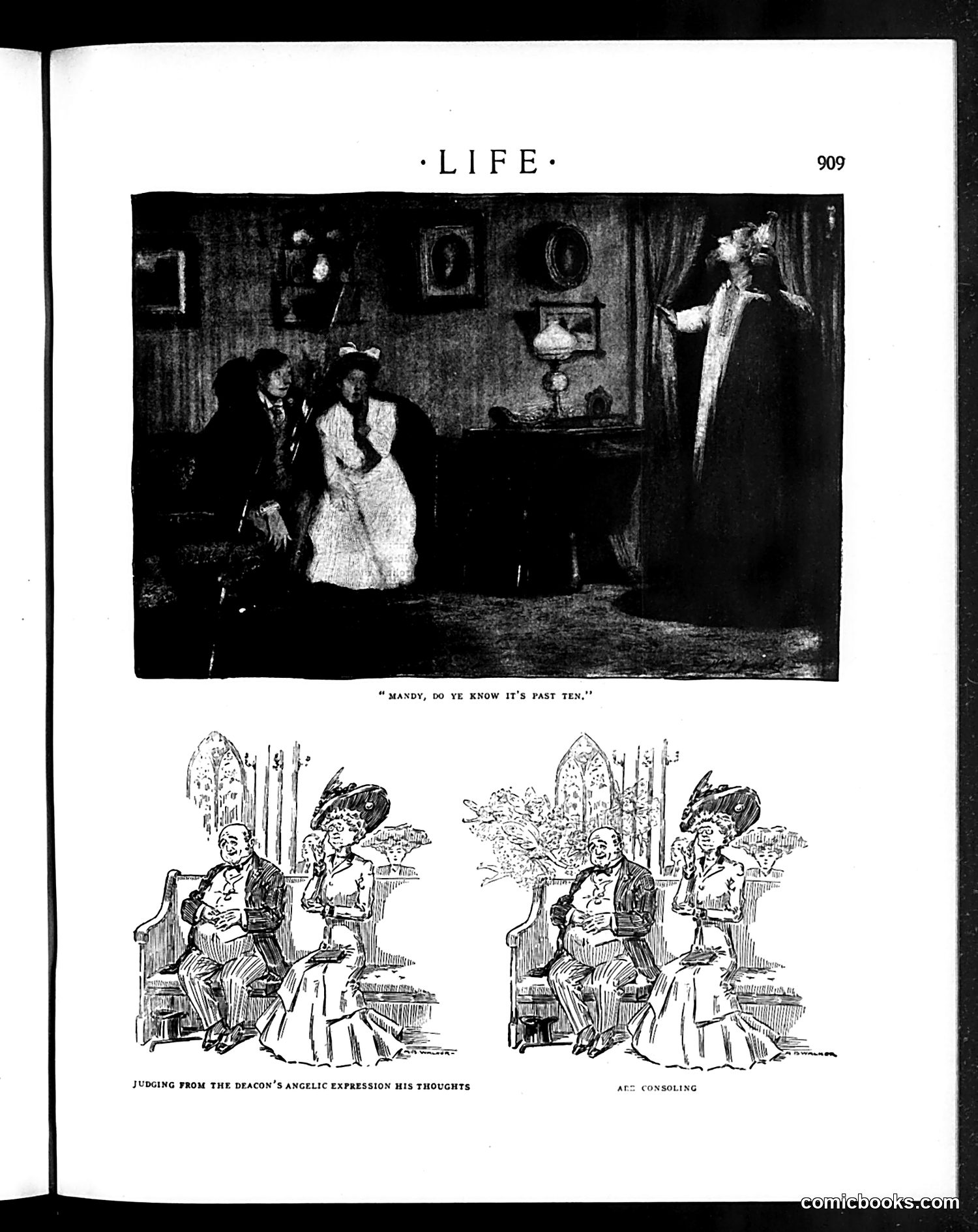
This page from *Life* magazine contains three satirical images mocking religious hypocrisy, particularly regarding a church deacon. The top photograph shows a domestic scene with the caption "MANDY, DO YE KNOW IT'S PAST TEN," suggesting a couple is out late. The two lower cartoons present a "before and after" contrast. They show an identical scene: a deacon and a young woman sitting together in what appears to be a church setting. The left cartoon's caption suggests the deacon maintains an "angelic expression" while harboring less pious thoughts. The right caption, "ALS CONSOLING," implies his comforting gesture toward the woman has questionable intentions. The satire criticizes the gap between the deacon's outward religious respectability and his actual conduct—a common *Life* magazine theme mocking the moral pretenses of authority figures, especially clergy.
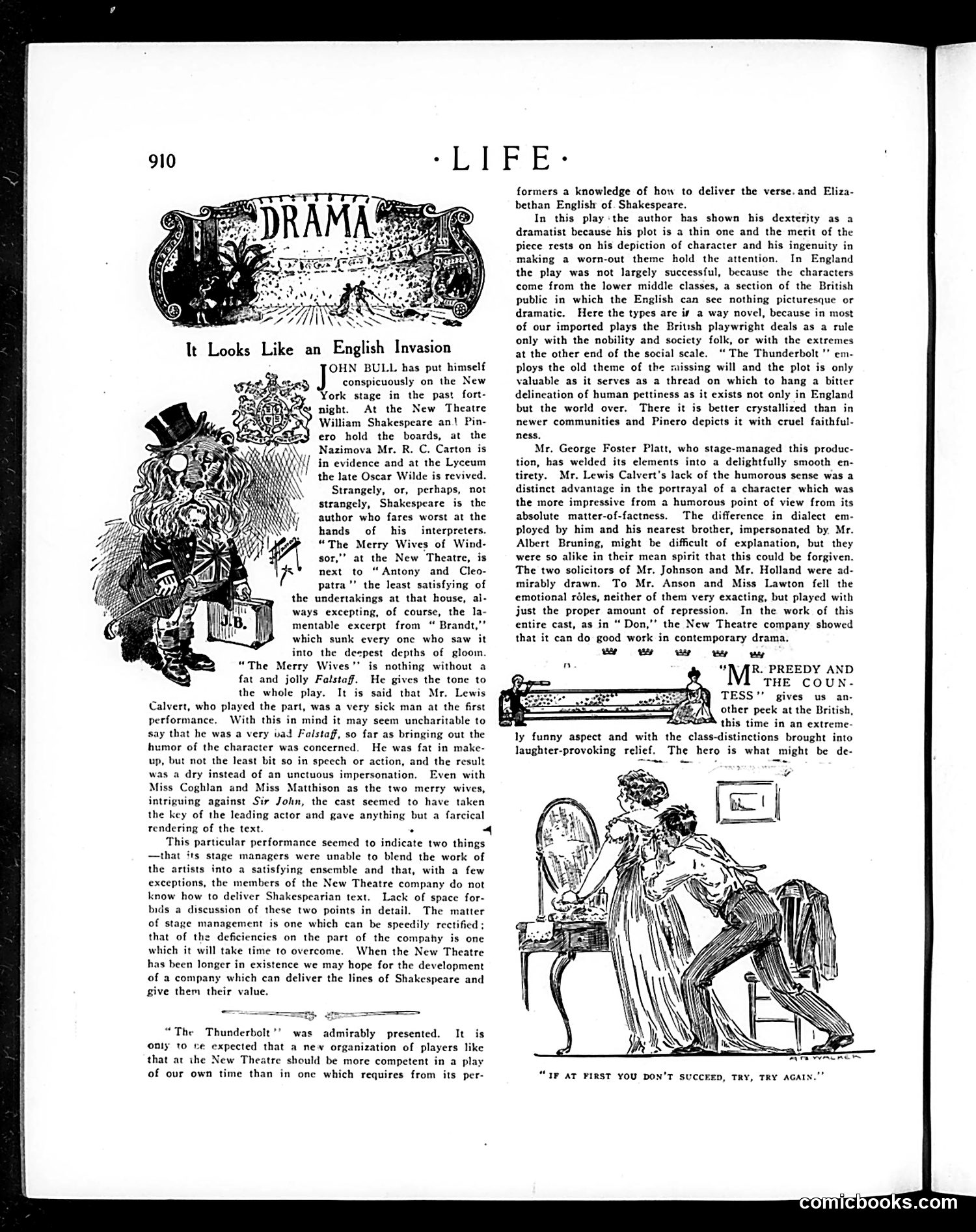
This page reviews recent New York theatrical productions featuring British plays and playwrights. The headline's "invasion" refers to the influx of English dramatic works—Shakespeare, Pinero, and Oscar Wilde—dominating New York stages. The critic argues that while Pinero's contemporary drama "The Thunderbolt" succeeds because it depicts realistic middle-class characters (novel to American audiences accustomed to nobility or extremes in imported plays), Shakespeare's "The Merry Wives of Windsor" fails due to poor ensemble direction and the cast's inability to properly deliver Shakespearean verse and Elizabethan English. The accompanying illustration shows a figure apparently struggling or stumbling, likely satirizing the awkward American attempt to stage British theatrical classics. The point: American companies lack the training to handle Shakespeare effectively, though they manage contemporary realistic drama better.
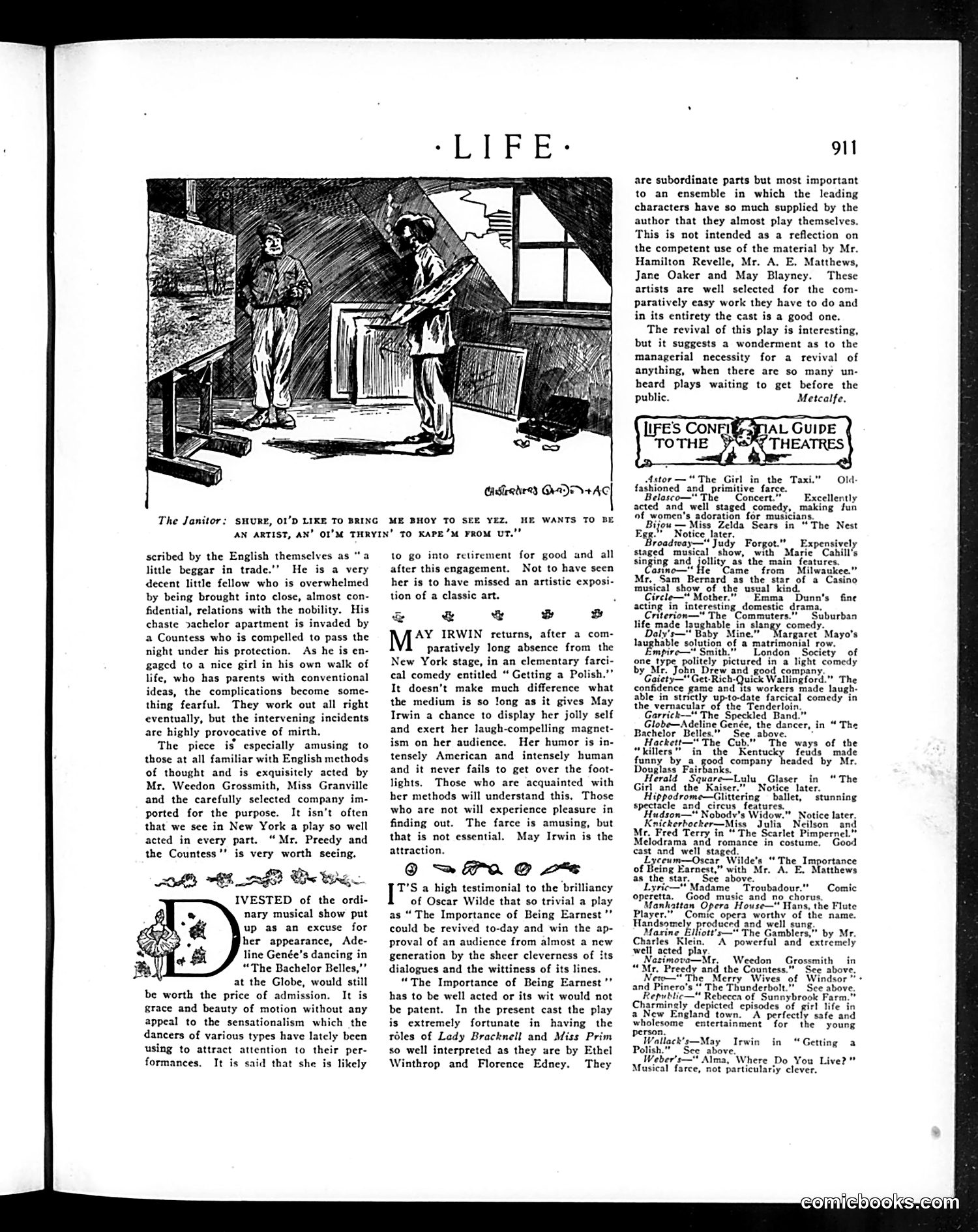
This page from *Life* magazine contains theatrical reviews and a cartoon satirizing class distinctions in early 20th-century America. **The Janitor Cartoon:** An Irish working-class janitor (indicated by his dialect: "SMURY, OI'D LIKE TO BRING ME BHOY") wants his son to become an artist. His employer, apparently a wealthy patron of the arts, discourages this—the boy should stay "from UT" (it). The satire mocks both the rigid class system that confined working-class children to their parents' trades, and the pretension of wealthy aesthetes who appreciated art as a status symbol while opposing genuine social mobility. **The Reviews:** The page discusses theatrical performances, praising classical works (*Oscar Wilde's "The Importance of Being Earnest"*) and performers like dancer Adeline Genée and actress May Irwin. The critical tone emphasizes that good acting and clever writing matter more than spectacle—a position reflecting *Life's* generally intellectual, somewhat snobbish readership. The juxtaposition highlights period anxieties about class, education, and cultural access.
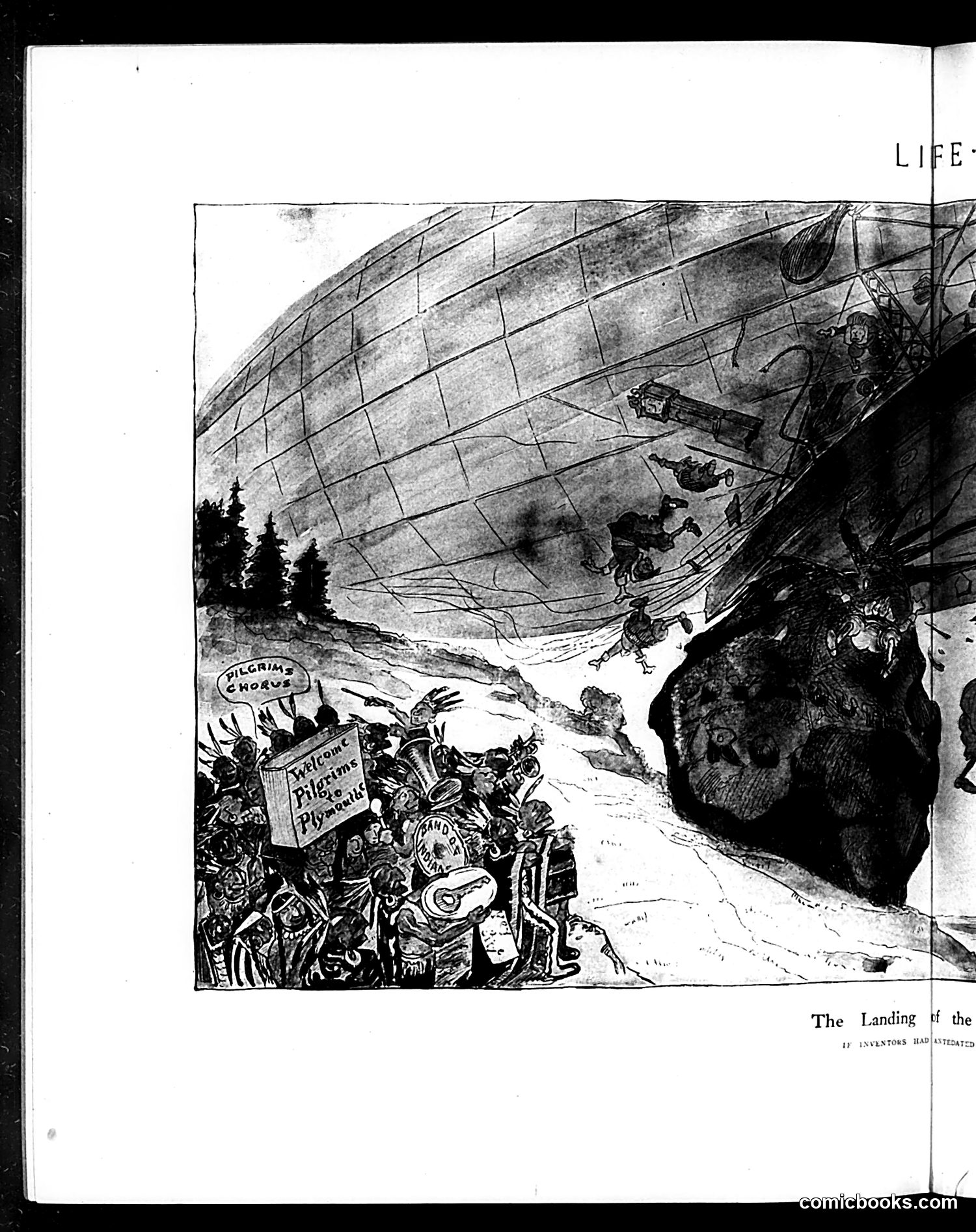
This appears to be a satirical illustration from *Life* magazine depicting what the caption suggests is an arrival or invasion scene. The image shows: - A large airship or dirigible descending from above - Figures in the lower left labeled with text referencing "Pilgrims" and what appears to be "American" themes - A prominent bear or large creature on the right - Crowds of diverse figures below appearing to welcome or react to the arrival The partially visible caption "The Landing of the..." combined with references to "Pilgrims" suggests this satirizes immigration or foreign arrival in America. However, without the complete caption and date, the specific historical event or political target remains unclear. The style suggests early-to-mid 20th century American satire about immigration policy or international relations.
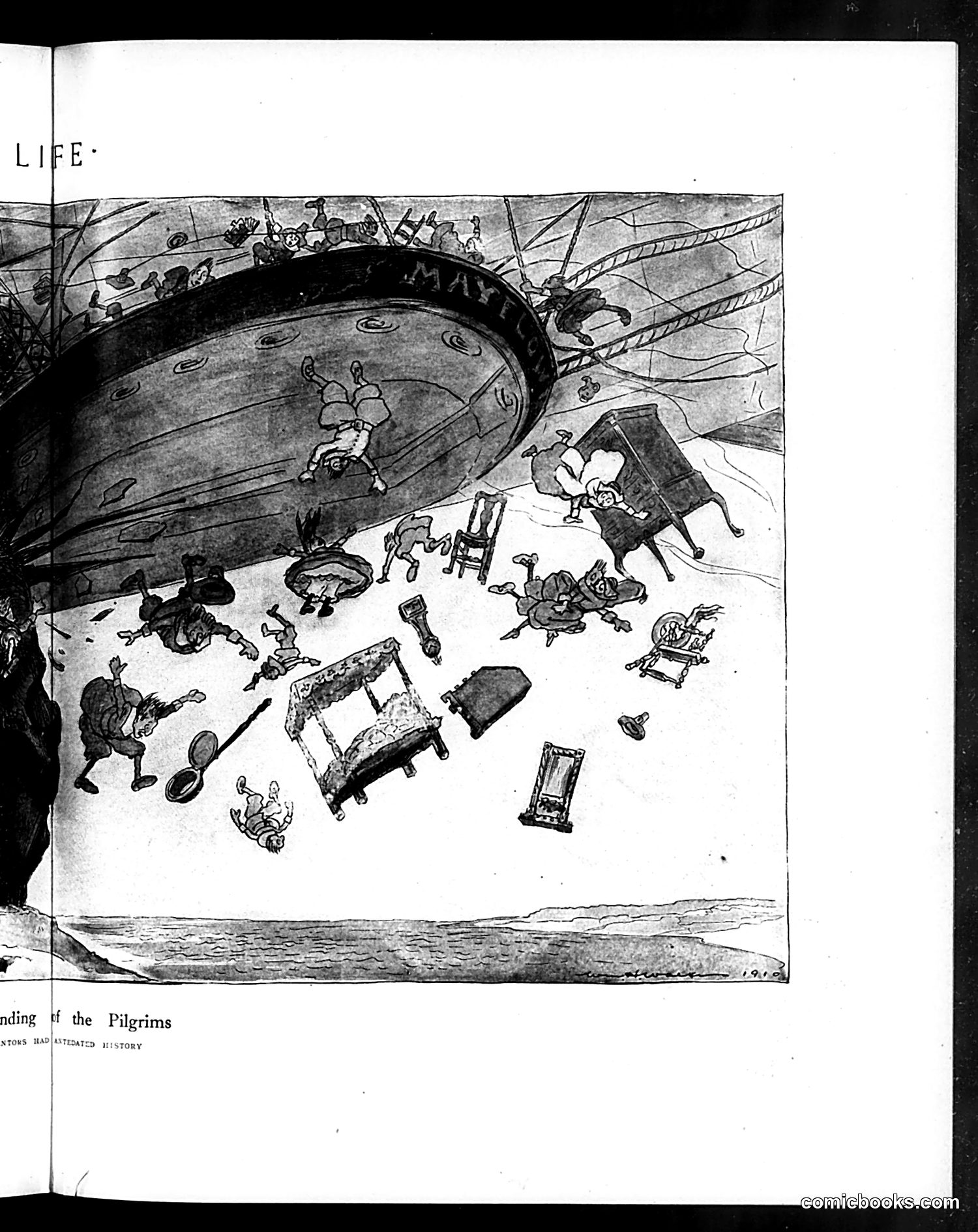
This satirical illustration mocks the Pilgrims' arrival in America by depicting their landing as chaotic and undignified. The large ship disgorges passengers and cargo in disarray onto the shore below, with figures scattered haphazardly among furniture, barrels, and supplies. The satire likely critiques the idealized, heroic narrative of Pilgrim history taught in American schools. Rather than a noble, orderly settlement, Life presents the scene as absurd comedy—people tumbling about, possessions strewn everywhere, the whole enterprise appearing bumbling and confused. This reflects early 20th-century skepticism toward American origin myths and suggests the "Pilgrims" were ordinary people engaged in an ungainly, messy historical moment, not the dignified founders of national mythology.
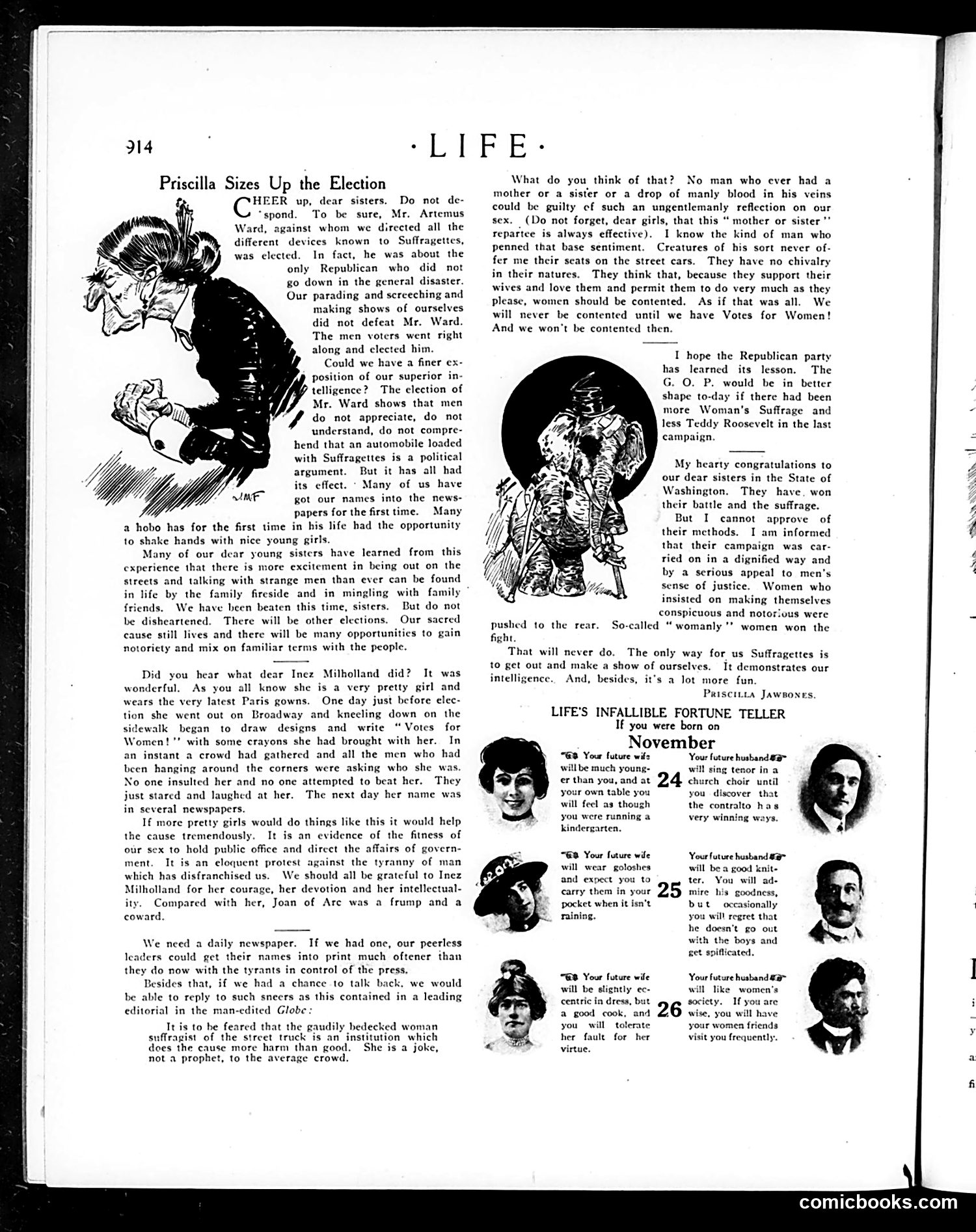
This is a satirical article titled "Priscilla Sizes Up the Election," mocking early 20th-century women's suffrage activists. The narrator, Priscilla, claims suffragettes failed to defeat candidate Artemus Ward despite their efforts—parades, public demonstrations, and street activism. The satire ridicules suffragettes' tactics and motivations, suggesting their real goal is notoriety rather than political change. It mocks Inez Milholland's famous 1912 Broadway kneeling protest as mere attention-seeking, and sarcastically praises suffragettes for gaining newspaper coverage and male attention. The piece also quotes a newspaper editorial dismissing suffragists as jokes, then has Priscilla defend women while simultaneously undermining her own arguments through absurdist logic—essentially proving the critics' point through her own contradictions. The cartoons (left) show exaggerated female figures engaged in chaotic activism, visually reinforcing the text's message that suffragettes appear ridiculous rather than serious.
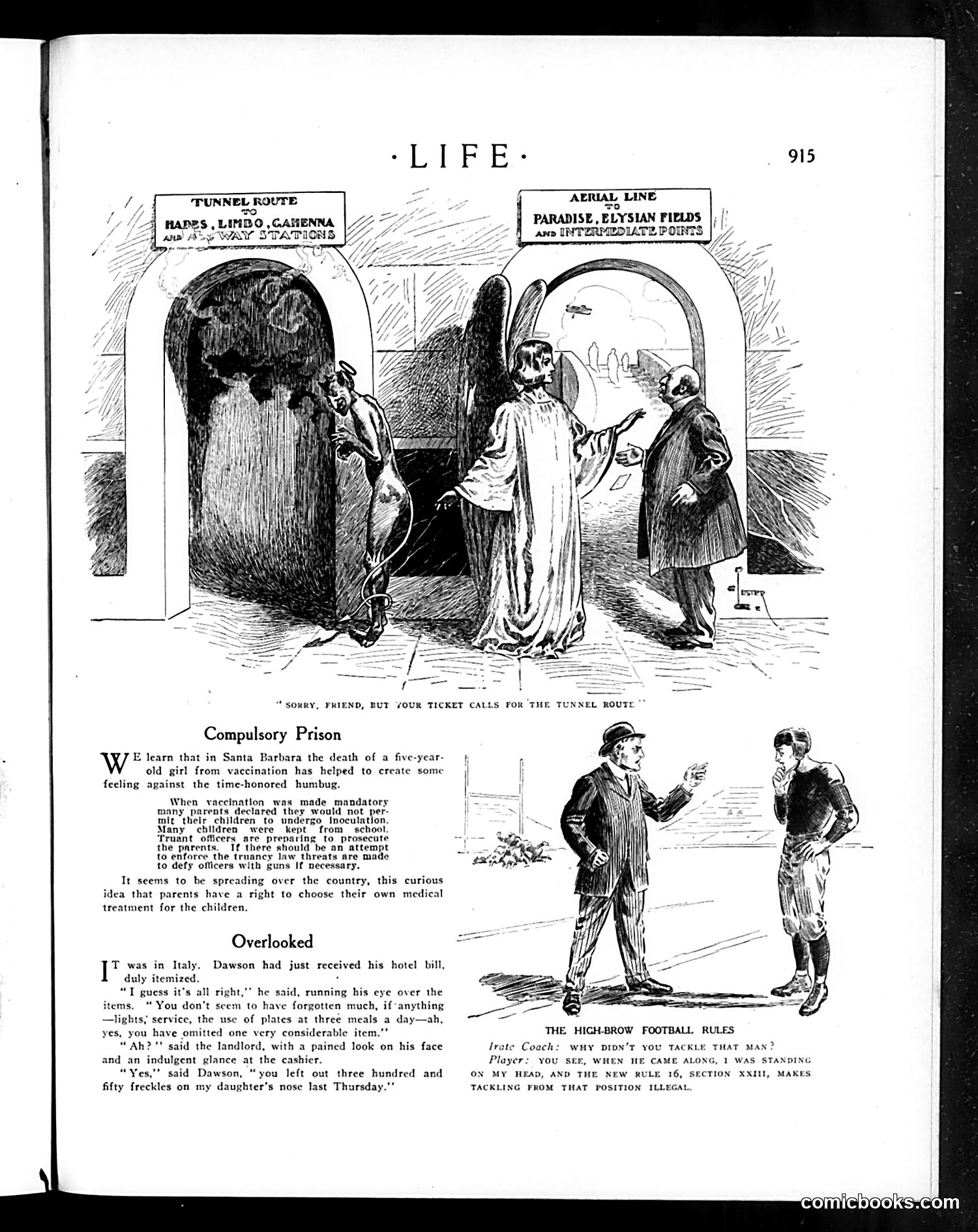
**Top Cartoon:** A satirical afterlife scene shows a figure being directed to the "tunnel route" (Hell) instead of the "aerial line" to Paradise. The joke plays on transportation terminology—the soul expected a pleasant aerial journey but received underground passage instead, a dark humor commentary on moral judgment and unexpected fates. **"Compulsory Prison":** This article satirizes anti-vaccination sentiment in Santa Barbara following a child's death from vaccination. The piece mocks parents' resistance to mandatory vaccination laws, noting they threaten armed defiance against truancy officers. The "humbug" reference suggests the author considers anti-vaccine arguments unfounded, treating parental medical choice as absurdly obstinate. **"Overlooked":** A brief humorous anecdote about a hotel bill. A guest claims the landlord forgot to charge for his daughter's freckles, implying absurdly comprehensive itemization of trivial matters. **"High-Brow Football Rules":** A comic mocking overly complex football regulations. A player defends not tackling an opponent by citing a technicality—standing on his head makes tackling "illegal" under rule 16, section XXIII—poking fun at rules-lawyering and pedantic sports administration.
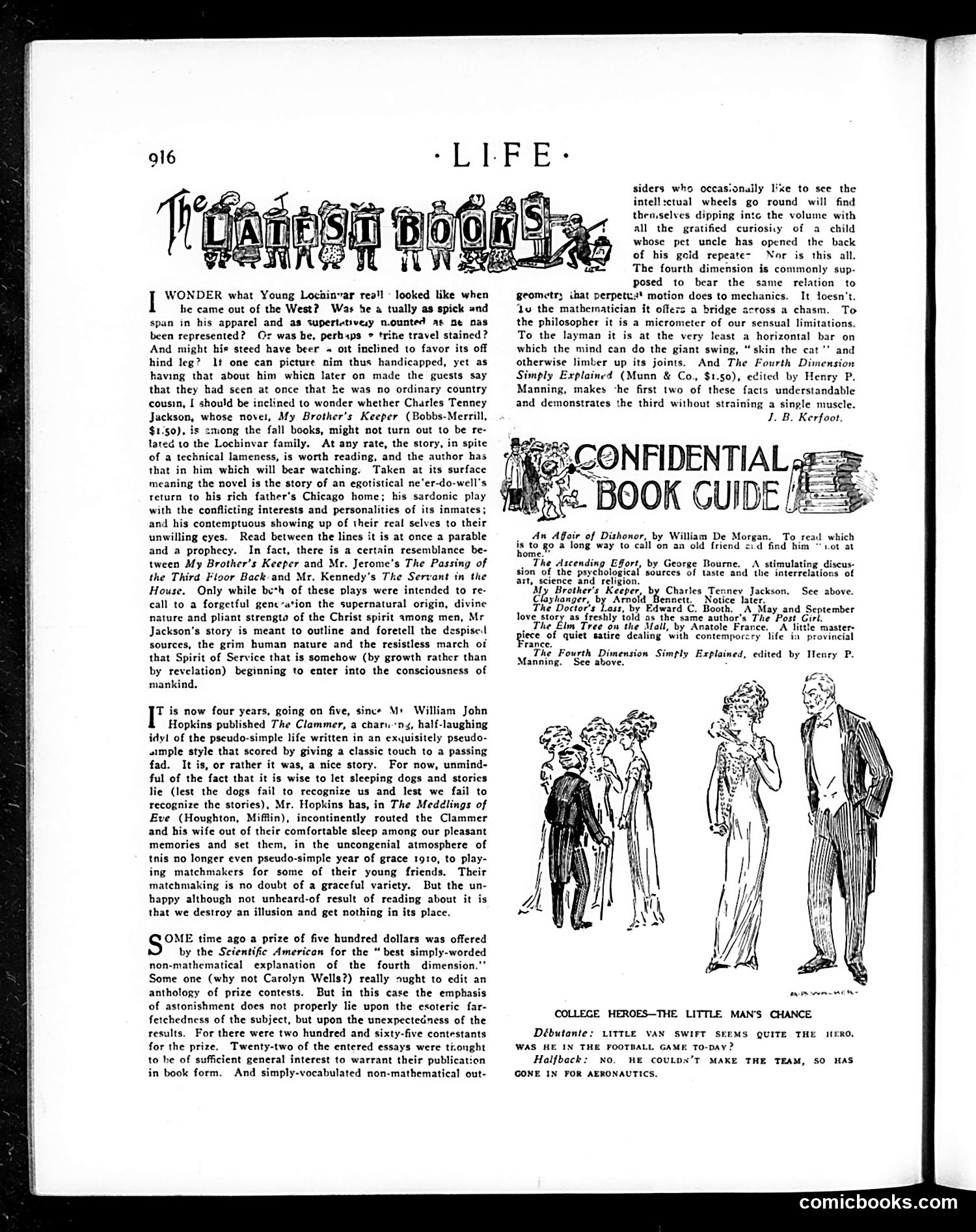
This page contains literary reviews and commentary from Life magazine's "Largest Books" section. The main illustrated feature is a cartoon titled "College Heroes—The Little Man's Chance," depicting what appears to be a young man being introduced to or courted by a woman, with the caption suggesting he missed his chance at football stardom but might find success in aeronautics instead. The reviews discuss contemporary novels including Charles Tenney Jackson's *My Brother's Keeper* and William John Hopkins' *The Meddlings of Eve*. The text also covers a Scientific American contest about explaining the fourth dimension in simple language—which received 265 entries, with 22 deemed worthy of publication. The overall tone reflects early 1900s literary culture and the era's fascination with both traditional romance narratives and emerging scientific concepts.
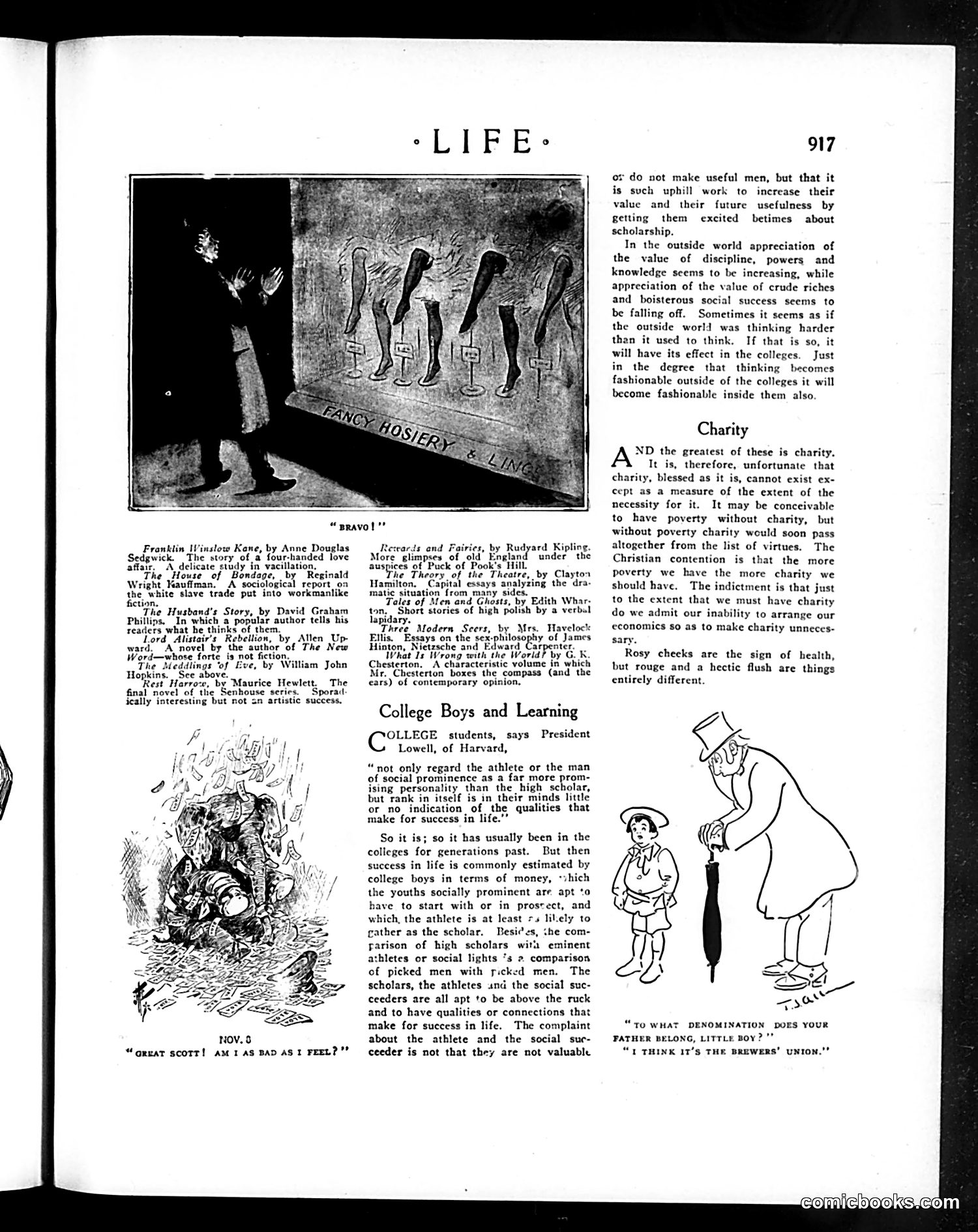
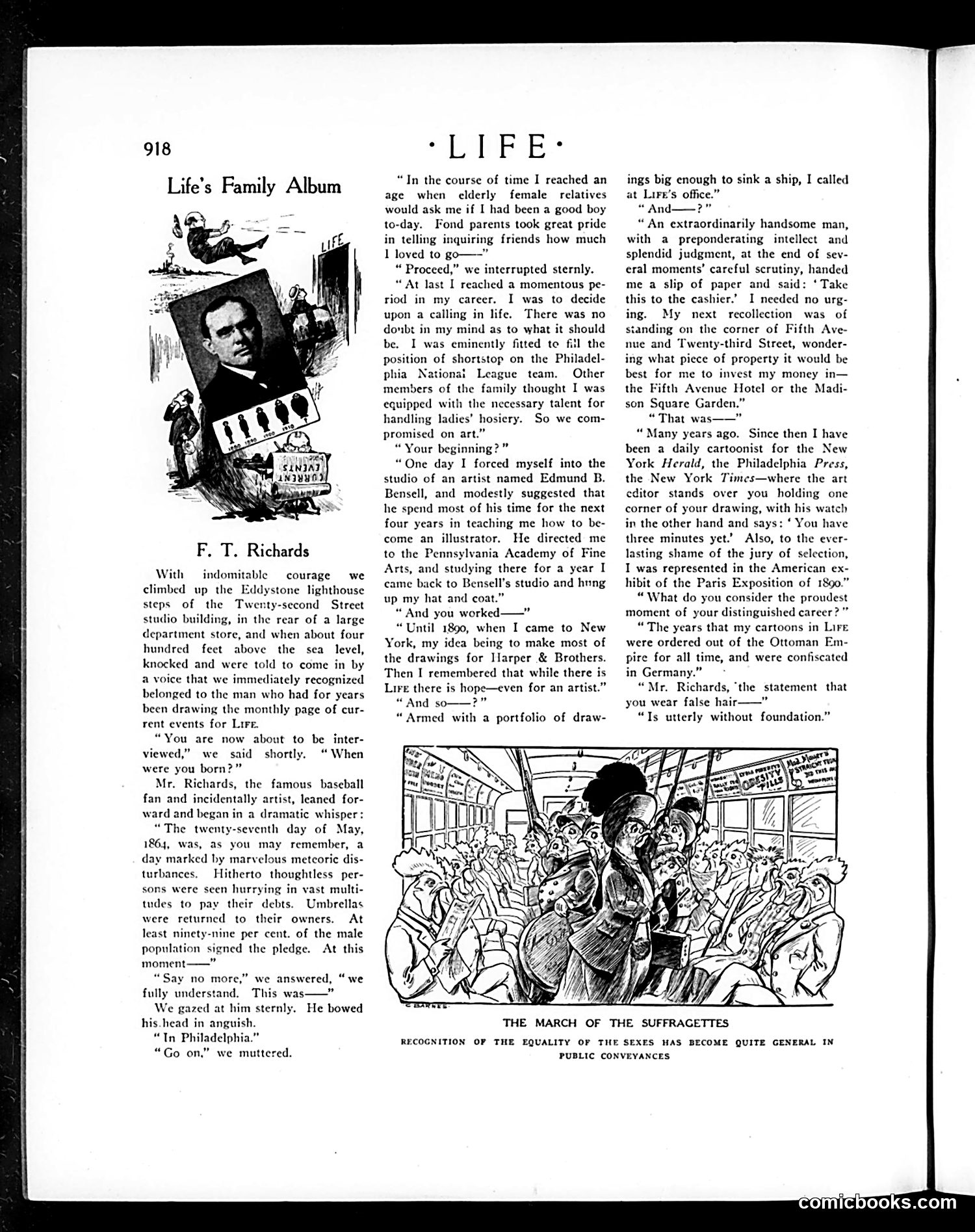
This is a humorous biographical interview with F.T. Richards, a cartoonist and illustrator for *Life* magazine. The text presents Richards's life story in exaggerated, self-aggrandizing fashion—a satirical joke on biographical interviews themselves. The cartoon at bottom, "The March of the Suffragettes," depicts women in a crowded public conveyance, illustrating the caption about gender equality becoming "quite general in public conveyances." This reflects early 20th-century suffrage activism and changing social attitudes toward women's public presence. Richards is presented as a baseball fanatic (born 1864 with theatrical melodrama) who became an artist almost by accident. The satire mocks his grandiose storytelling—he exaggerates minor moments into dramatic turning points. The interview format itself gently ridicules both the subject's self-importance and magazine profile conventions.
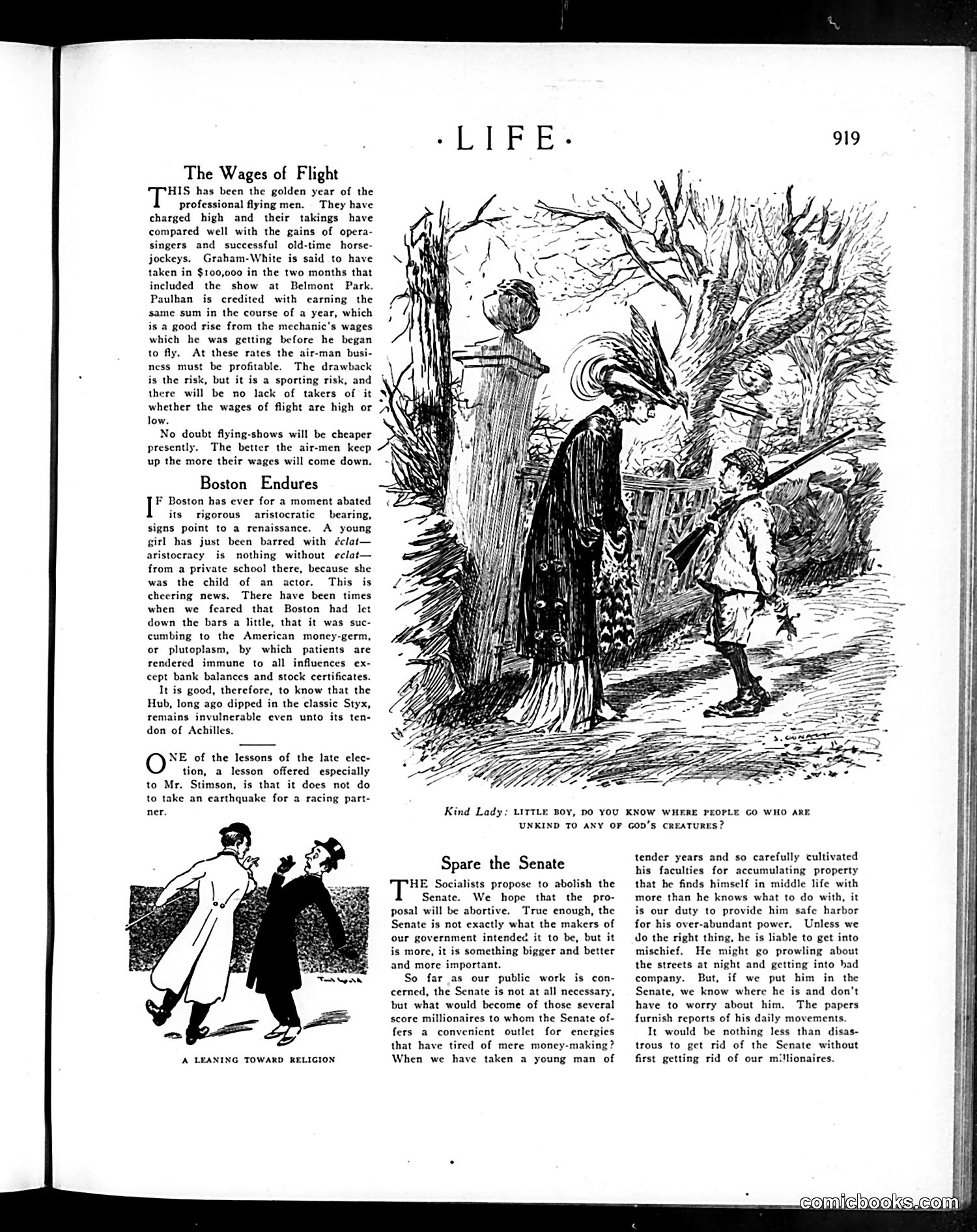
This page contains three distinct satirical pieces: **"The Wages of Flight"** discusses early aviation pioneers (Graham-White and Paulhan are named) earning exceptional incomes—up to $100,000—from flight demonstrations, comparing their earnings to opera singers and jockeys. The satire suggests this lucrative bubble will burst as aviation becomes commonplace. **"Boston Endures"** mocks Boston's aristocratic pretension by celebrating that a young girl was expelled from a private school *because her father was an actor*—treating this as proof Boston maintains its snobbish standards against "the American money-germ" (plutocracy). The satire is ironic: Life ridicules Boston's rigidity. **"Spare the Senate"** sarcastically argues against abolishing the Senate by claiming it serves as a useful containment for wealthy men with "over-abundant power" who might otherwise cause mischief. It's a tongue-in-cheek critique of the Senate as a sinecure for the rich. The cartoons—"A Leaning Toward Religion" and one showing two figures—appear to be unrelated vignettes typical of Life's format.
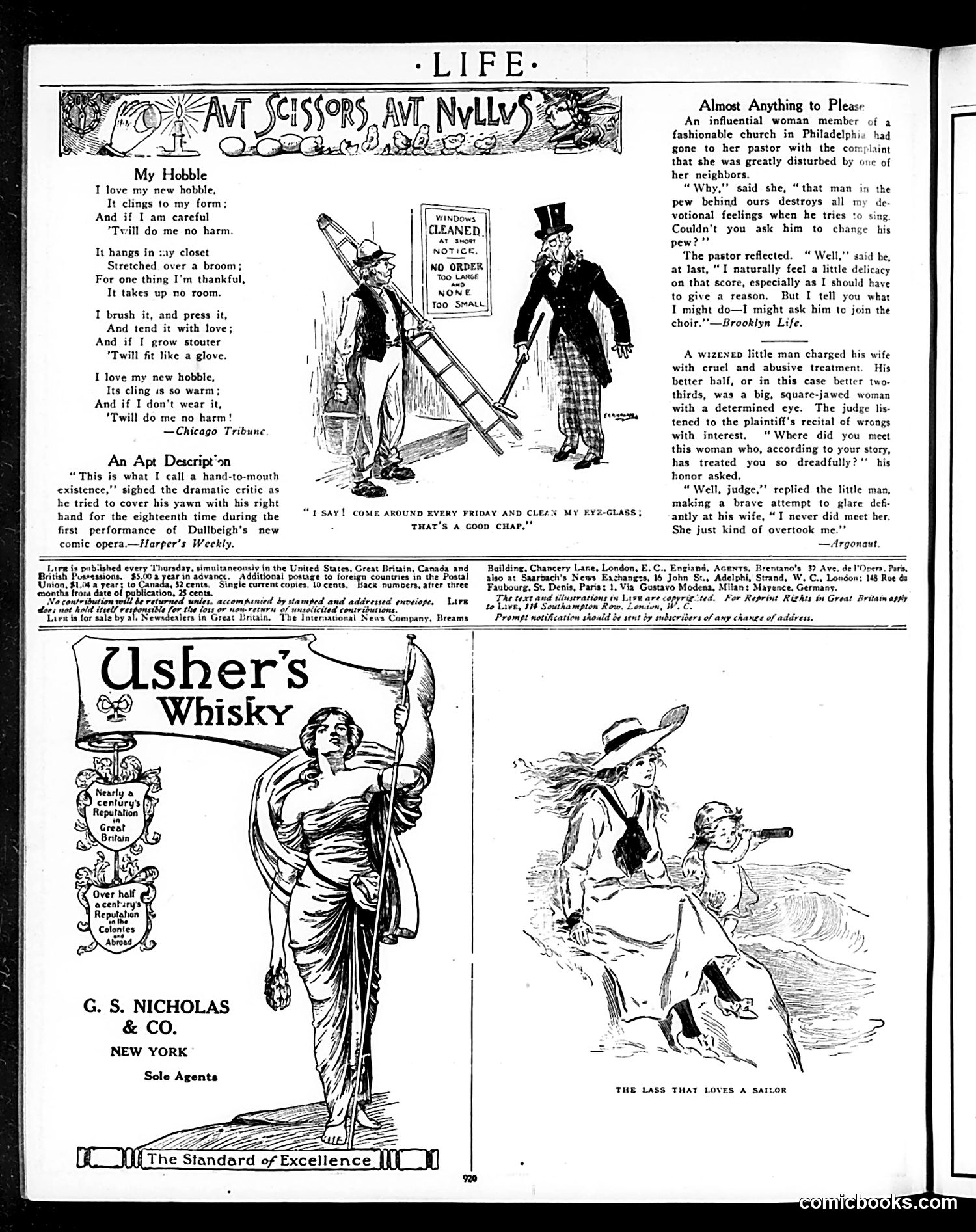
This page contains several satirical pieces reflecting early 20th-century social concerns: **"My Hobble"** mocks the "hobble skirt," a restrictive fashion trend that severely limited women's movement. The poem's irony—claiming the impractical garment "takes up no room" and "do[es] me no harm"—satirizes women's uncritical acceptance of uncomfortable fashion. **"Almost Anything to Please"** anecdotes mock social deference and conflict avoidance. The pastor's solution to redirect the tone-deaf singer to the choir is clever deflection; the divorce case about the "little man" overtaken by his larger wife plays on size disparity humor. **"An Apt Description"** jokes about a theater critic so bored he yawns repeatedly during a "comic opera"—criticism disguised as anecdote. The page also contains **Usher's Whisky advertising** and illustrations including "The Lass That Loves a Sailor." The overall tone reflects Life's satirical commentary on fashion, marriage, social etiquette, and entertainment of the era.
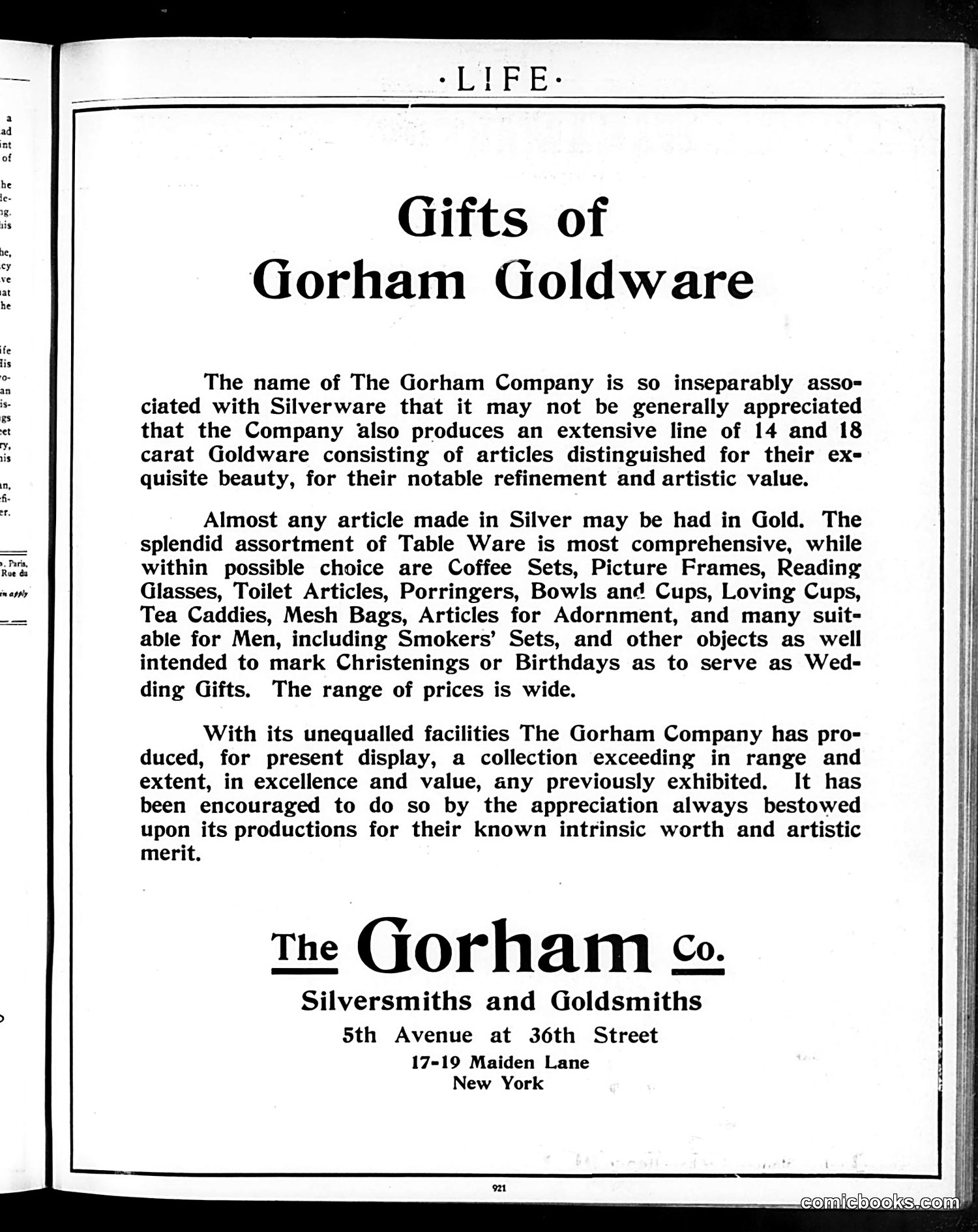
This page contains **no cartoon or satire**—it is a straightforward advertisement for The Gorham Company, a prestigious New York silversmith and goldsmith. The text promotes Gorham's goldware line (14 and 18-carat gold items), emphasizing that while the company is famous for silverware, it also produces gold versions of comparable quality. Products listed include tableware, coffee sets, picture frames, glasses, and decorative items suitable as gifts for weddings, christenings, and birthdays. The advertisement appeals to wealthy consumers by stressing the company's "unequalled facilities," "exquisite beauty," and "artistic value." The tone is purely marketing, with no satirical intent or political commentary. This appears to be a full-page advertisement from *Life* magazine designed to reach affluent readers, rather than editorial or humorous content.
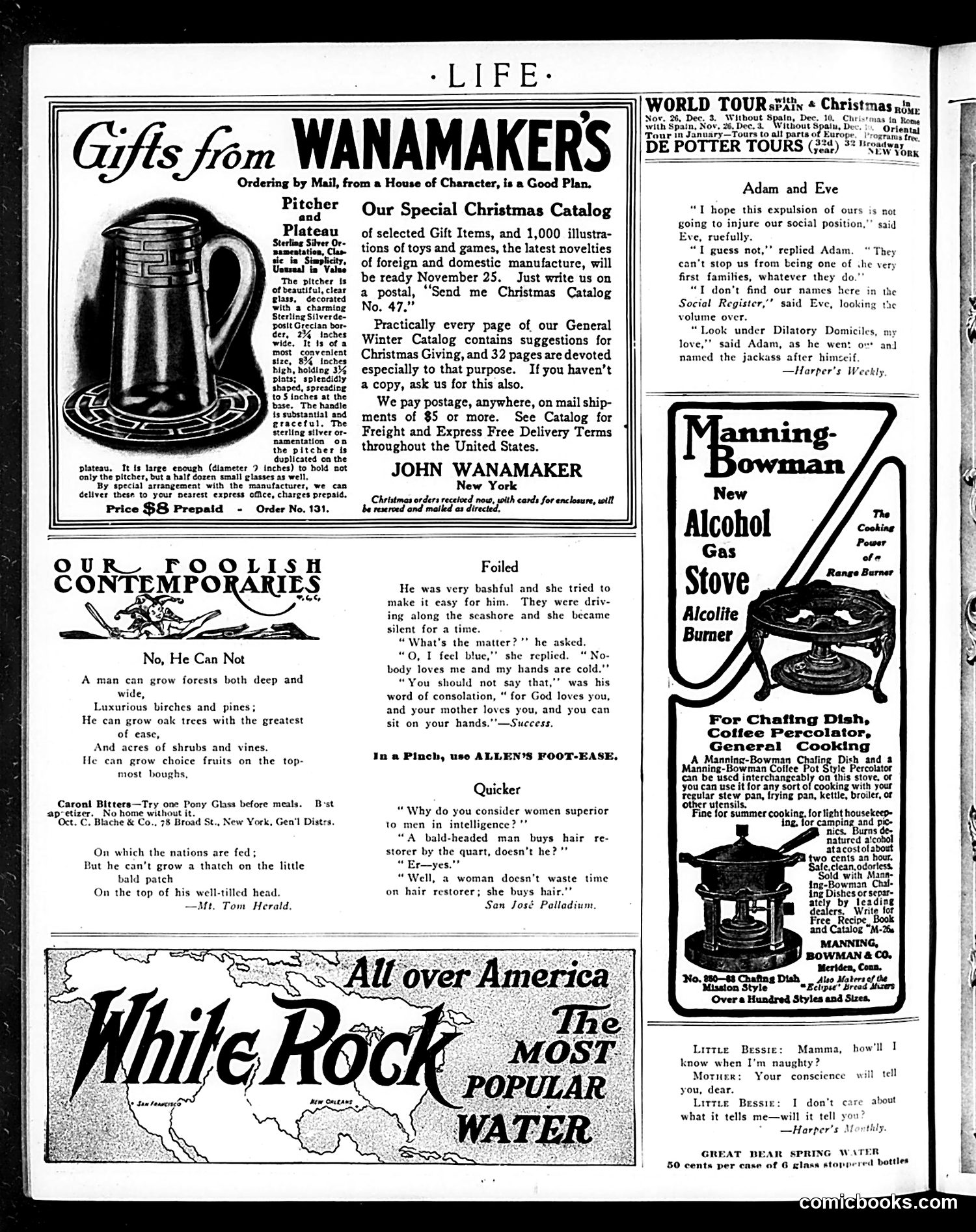
This page is primarily **advertising and light humor**, not political satire. The main content includes: **Advertisements:** Wanamaker's department store catalogs (pitcher/plateau set), Manning-Bowman cooking stoves, White Rock water, and various patent medicines (Carol Bitters, Allen's Foot-Ease). **Humor Sections:** "Our Foolish Contemporaries" reprints jokes from other publications—mostly genteel puns about men's baldness and domestic mishaps. The "Adam and Eve" piece jokes about the biblical couple's social standing after expulsion from Eden, with a pun about "Dilatory Domiciles" (suggesting they're vagrants) and a cryptic reference to naming "the jackass after him." **Context:** This reflects early 1900s Life magazine's mix of advertising revenue and reprinted humor. The jokes are mild by modern standards—domestic comedy, gentle ribbing of male vanity, and wordplay. Nothing here engages serious political or social critique.
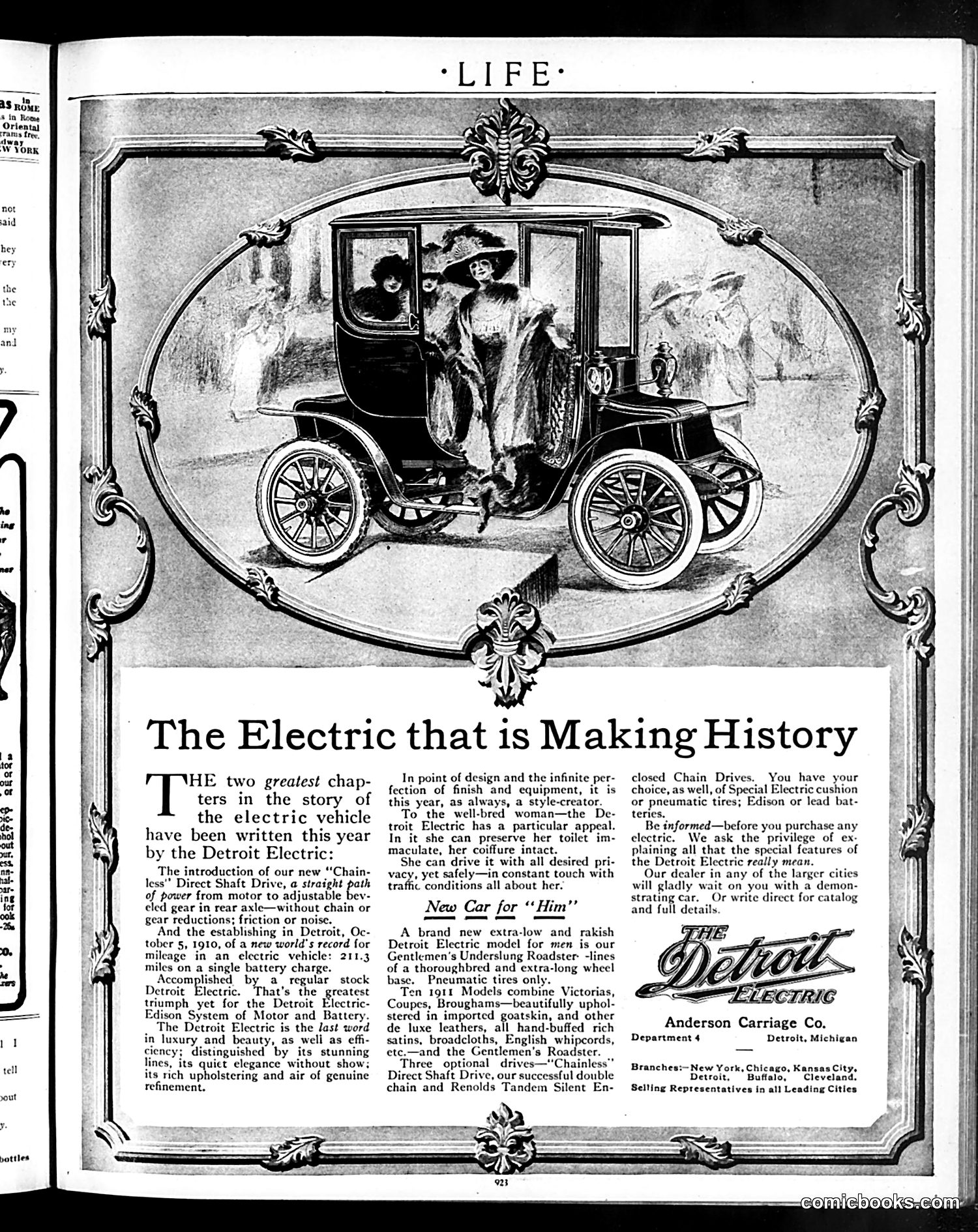
This is **not a satirical cartoon** but rather a **genuine automobile advertisement** for the Detroit Electric vehicle, placed in *Life* magazine circa 1910-1911. The page advertises two models: the Detroit Electric (marketed primarily to women) and a new "Gentlemen's Underslung Roadster" (for men). The illustration shows elegantly dressed passengers in an early electric car—a technology that was then cutting-edge and fashionable. The "satire" of *Life* magazine lay in editorial content elsewhere; this is straightforward product advertising highlighting the vehicle's luxury features, the revolutionary "chainless" direct shaft drive, and a claimed world record of 211.3 miles on a single battery charge. **Key context for modern readers:** Electric vehicles were not niche products in 1910—they competed seriously with gasoline cars, particularly among affluent urban buyers who valued quiet, clean operation and didn't need long-distance range. The gendered marketing (luxury/cleanliness for women, sportiness for men) reflects period assumptions about automobile buyers.
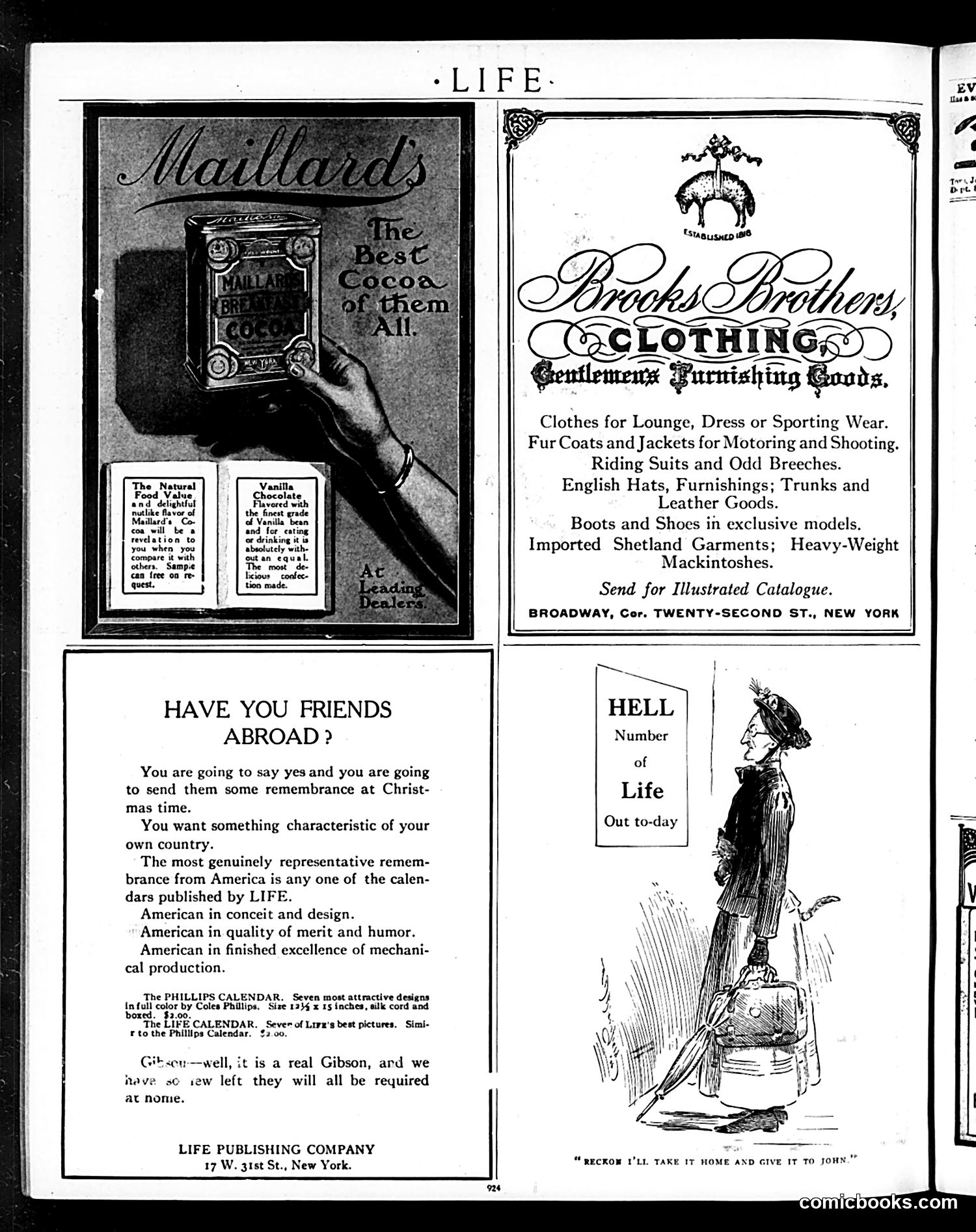
This page is primarily **advertisements and publishing notices** from Life magazine, with minimal satirical content. The main cartoon (bottom right) shows a figure labeled "HELL Number of Life" — a self-promotional joke. The illustration depicts a woman or fashionable figure with luggage, captioned "BECKON I'LL TAKE IT HOME AND GIVE IT TO JOHN." This appears to be a playful advertisement for that particular issue of Life, suggesting the "Hell" edition is so desirable someone would gift it to a friend named John. The page otherwise features ads for **Maillard's cocoa**, **Brooks Brothers clothing**, and **Life calendars** marketed as quintessentially American gift ideas for overseas friends—emphasizing American design, humor, and manufacturing quality. The Gibson girl reference in the text indicates Life's association with that iconic early-1900s illustration style. The overall tone is lighthearted commercial promotion rather than sharp political satire.
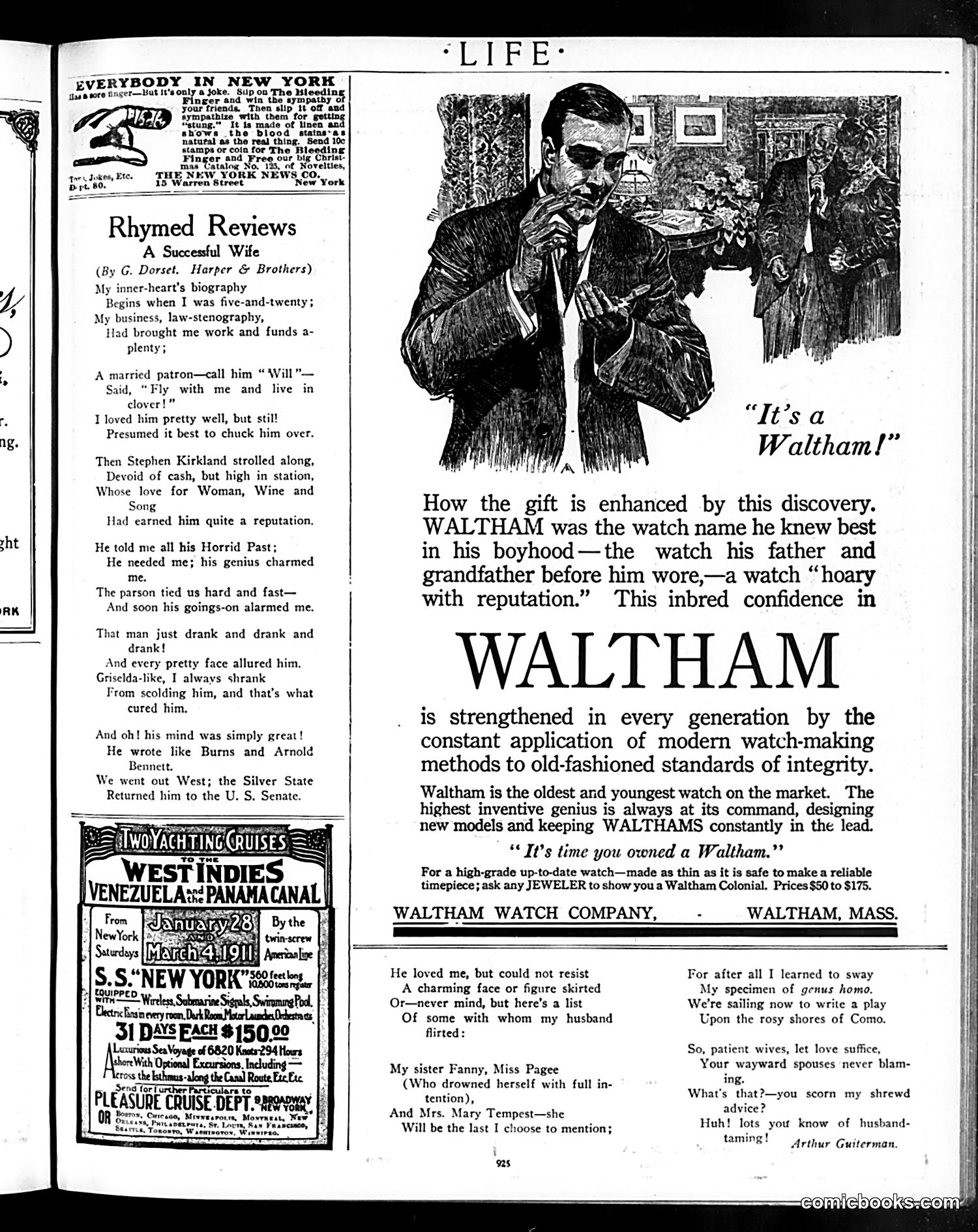
This page contains literary and advertising content from an early 20th-century *Life* magazine. **"Rhymed Reviews"** is a humorous poem by Arthur Guiterman reviewing G. Dorset's novel *A Successful Wife*. The satirical narrative mocks conventional marriage advice: a woman rejects a wealthy suitor to marry Stephen Kirkland, a charming but dissolute politician with a drinking problem and wandering eye. The joke is that her patient, non-confrontational tolerance supposedly "cures" him—and the poem's closing moral ironically advises other wives to follow her example of silent suffering, sarcastically claiming this constitutes "husband-taming." The satire targets both the novel's likely sentimental plot and period assumptions about female virtue requiring self-sacrifice and submissiveness in marriage. **The Waltham Watch advertisement** uses an illustration of a man examining a watch, emphasizing inherited family tradition and modern reliability—a standard early advertising approach combining nostalgia with technological confidence.
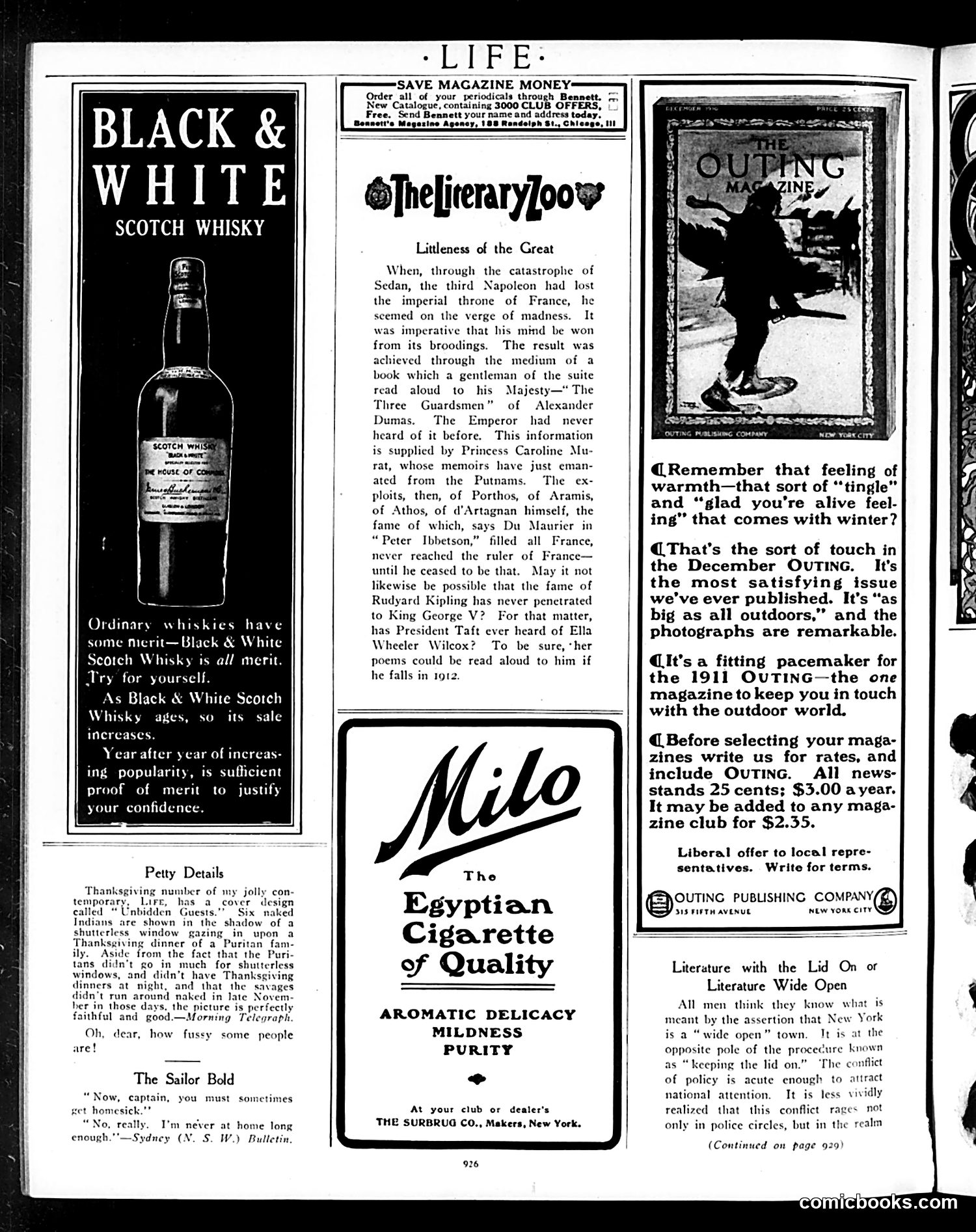
This page is primarily **advertisements and literary content**, not political satire. The main items include: **"Petty Details"** — A humorous editorial critique of *Life* magazine's Thanksgiving cover depicting Native Americans peering at Pilgrims. The author sarcastically mocks historical inaccuracies: Puritans didn't have shutterless windows, didn't dine at night, and Native Americans didn't run naked in November. The joke is that *Life* prioritized dramatic composition over factual accuracy—a gentle jab at the magazine's own editorial choices. **"Littleness of the Great"** — A literary anecdote suggesting that famous works (Dumas's *Three Musketeers*, Kipling, Wilcox) may never reach powerful figures like Napoleon III, King George V, or President Taft, implying that greatness and cultural literacy don't always coincide. The remaining content consists of advertisements (whisky, cigarettes, magazines) typical of early 1910s periodicals. No significant political figures are caricatured on this page.
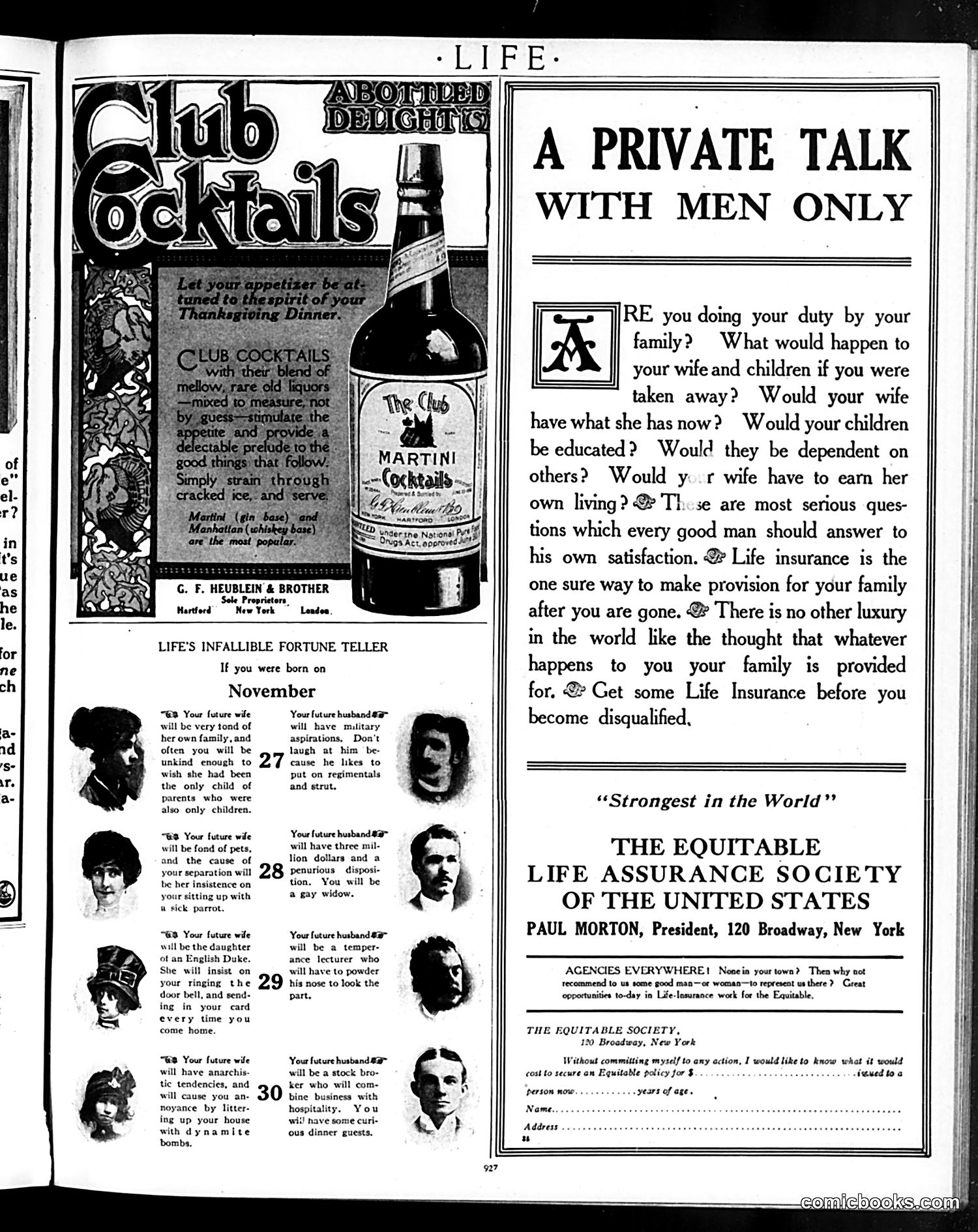
This page contains advertising for life insurance and a fortune-telling game, not political satire. **Left side:** "Life's Infallible Fortune Teller" is a humorous parlor game predicting what wives future husbands will have—ranging from women who "wish she had been the only child" to anarchists who litter homes with "dynamite bombs." It's mild gender satire, playing on period anxieties about marriage. **Right side:** A Equitable Life Assurance Society advertisement uses emotional appeals targeting men, asking whether their families would survive financially if they died. It frames life insurance as a moral duty, warning men not to leave wives and children dependent or destitute. Both pieces reflect early 20th-century assumptions: wives as dependents, marriage anxiety, and the emerging insurance industry's marketing strategy of using family responsibility and fear to sell policies. The fortune-teller mocks stereotypical "types" of wives men feared marrying.
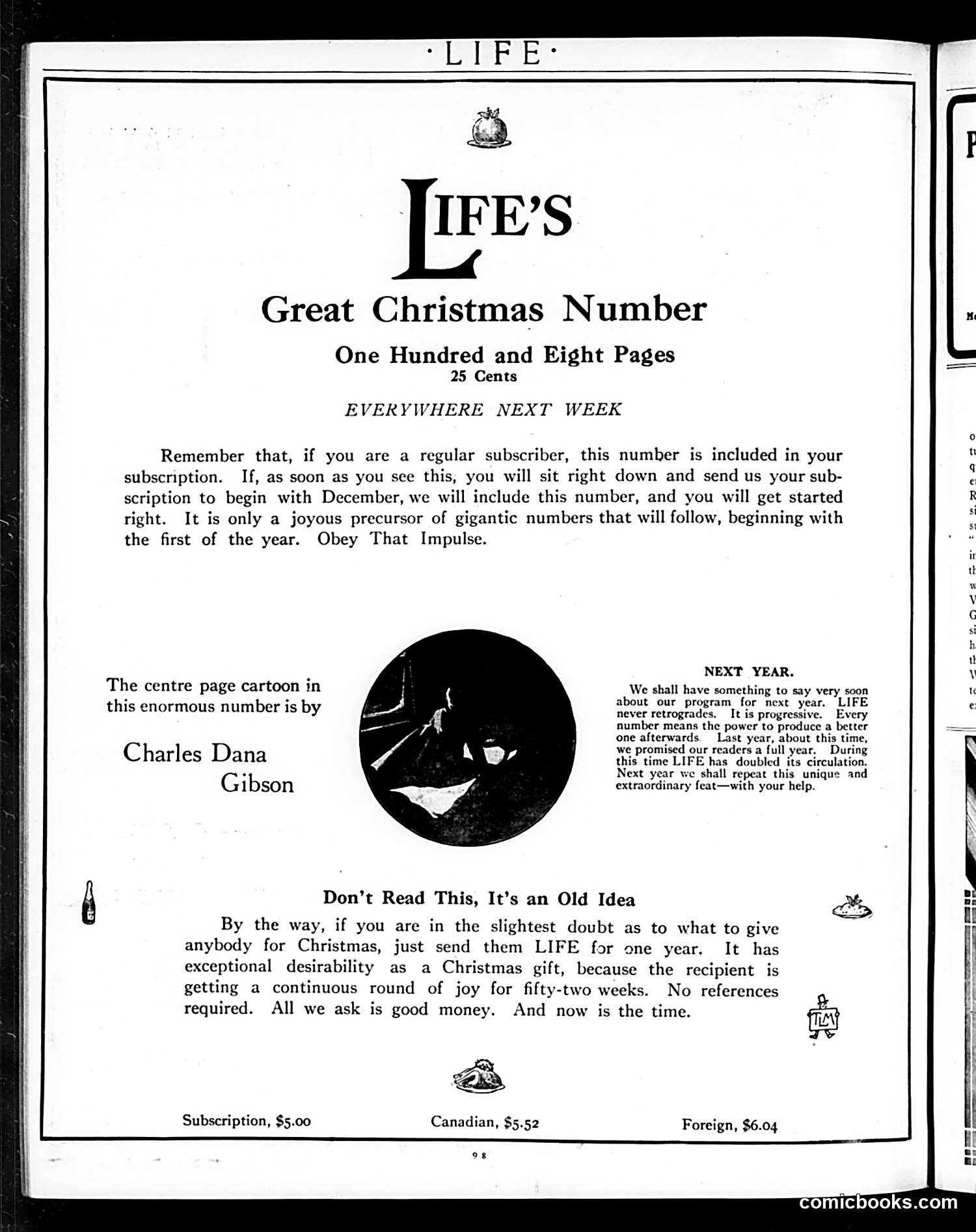
This is a title/advertisement page for *Life* magazine's special Christmas issue—108 pages for 25 cents. The page promotes both the current holiday edition and solicits new annual subscriptions. The circular illustration appears to be by Charles Dana Gibson, *Life*'s famous cartoonist known for the "Gibson Girl." The image itself is largely obscured in this reproduction, but Gibson's work typically featured satirical social commentary on American manners and relationships. The text uses humorous, tongue-in-cheek language ("Obey That Impulse," "Don't Read This, It's an Old Idea") to pitch subscriptions as an ideal Christmas gift—suggesting 52 weeks of entertainment without requiring references, only "good money." The magazine emphasizes it has doubled circulation and promises continued quality content next year. This is primarily a sales pitch wrapped in period humor rather than political satire.
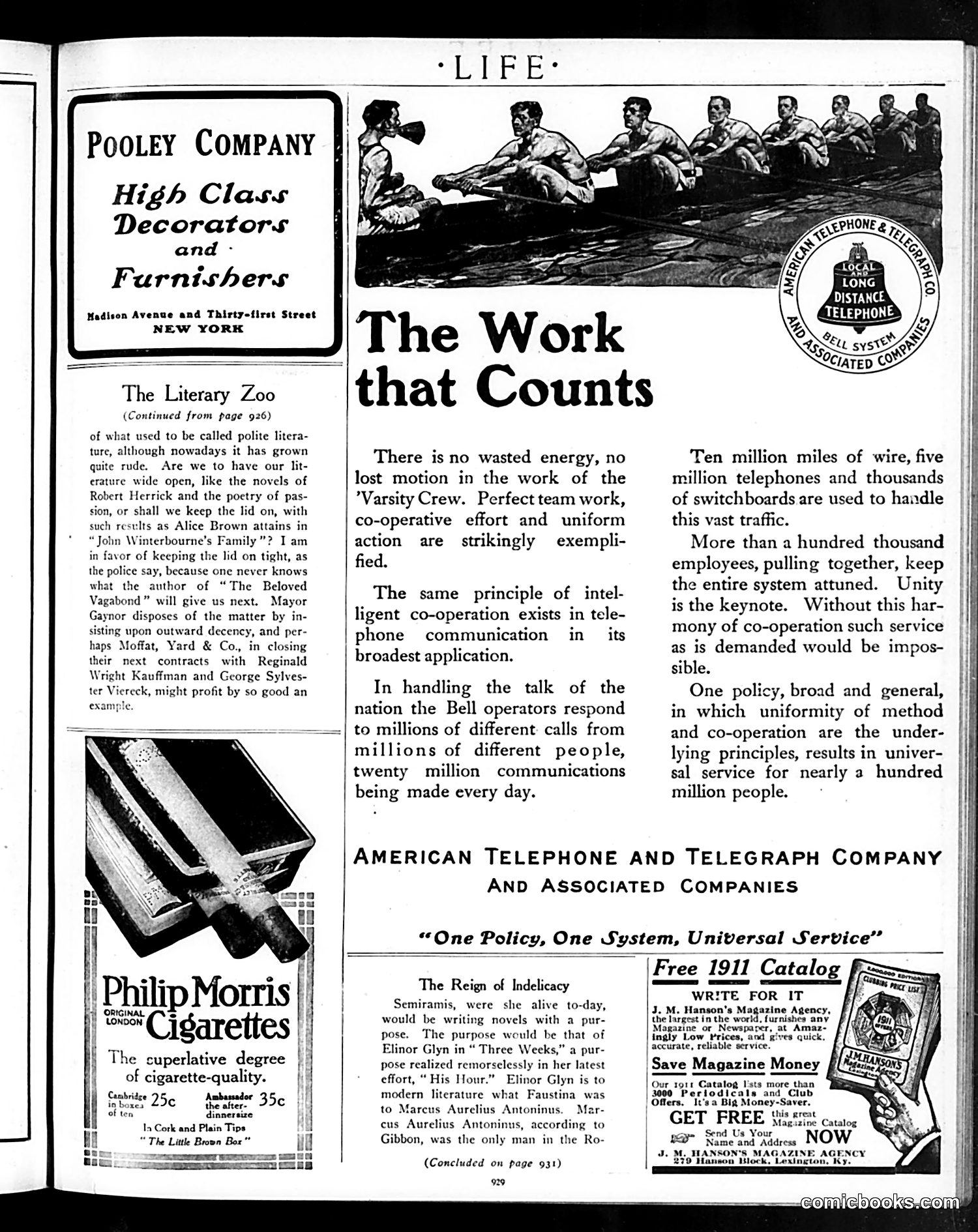
This is primarily an **advertising page** from Life magazine, with one article excerpt about literature. The main content is an **AT&T advertisement** using a rowing crew as a metaphor. The image shows eight rowers working in synchronized unison; the text compares their "perfect team work, co-operative effort and uniform action" to telephone operators managing millions of daily calls. The ad's message: AT&T's massive infrastructure (ten million miles of wire, five million phones, over 100,000 employees) functions seamlessly only through centralized coordination under "One Policy." The irony—invisible to modern readers but likely intentional for 1911 Life readers—is that AT&T's monopoly was simultaneously under antitrust scrutiny. Presenting the monopoly as a beautiful system of cooperation and universal service was propaganda defending AT&T's integrated control. The page also includes ads for **Philip Morris cigarettes** and magazine subscription services, plus a literary column discussing "indelicacy" in modern novels (authors like Elinor Glyn), reflecting contemporary debate about propriety in literature.
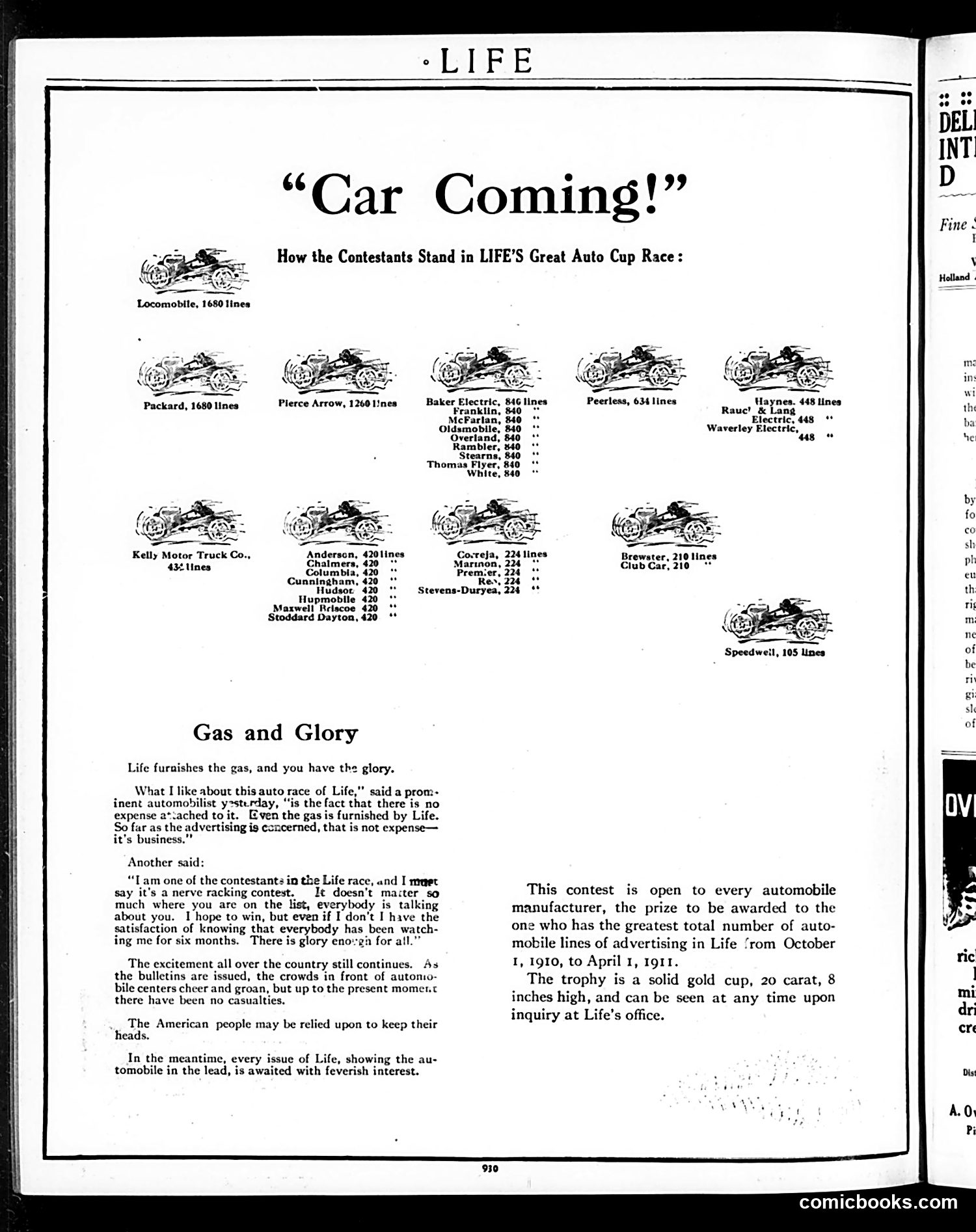
This page documents Life magazine's satirical "Great Auto Cup Race"—a competition tracking which automobile manufacturers purchased the most advertising space in Life between October 1910 and April 1911. **The Satire:** Life mocks both the manufacturers' vanity and readers' obsession with the competition. The magazine humorously presents this advertising contest as a genuine sporting event, complete with a trophy and breathless coverage. **Key Point:** The quoted automobile executive admits the real value isn't winning—it's the *free publicity* from Life's competitive reporting. By tracking which car company "leads," Life guarantees readers will scrutinize each issue, making the advertisement itself newsworthy. **Social Context:** This reflects the early automobile industry's explosive growth and manufacturers' desperate competition for market share. The satirical framing exposes how advertising and editorial content blur together—Life benefits from both the ads and reader engagement the "race" generates. The cartoons show competing vehicles representing manufacturers like Packard, Pierce Arrow, and Baker Electric, ranked by advertising lines purchased.
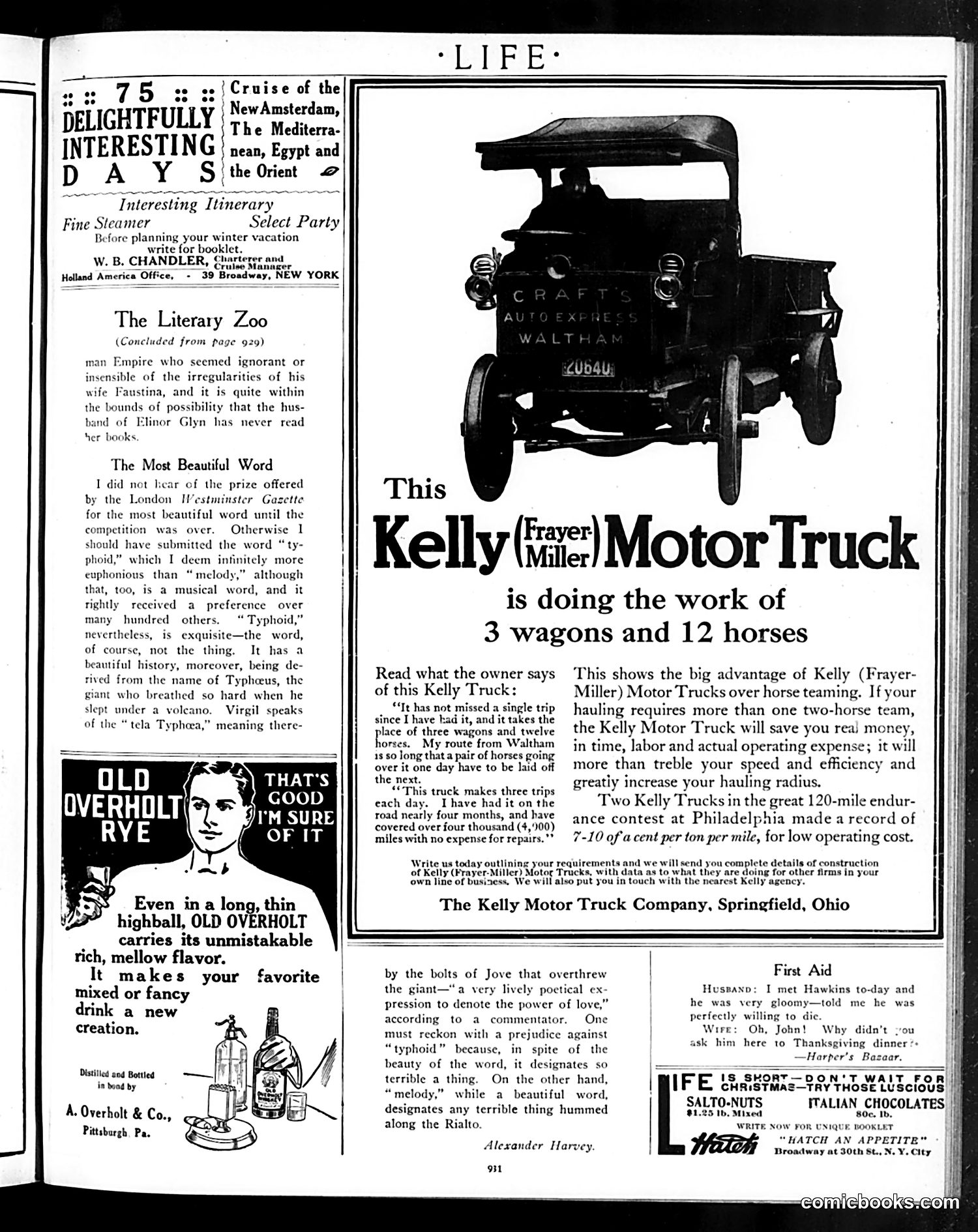
This Life magazine page is primarily **advertising**, with several product promotions dominating the layout. The main advertisement features the **Kelly Motor Truck** (made by Frayer-Miller in Springfield, Ohio), emphasizing its efficiency: one truck replaces three wagons and twelve horses. The testimonial claims it made 4,000 miles with no repair costs—a major selling point in the early automotive era when horse-drawn transport still dominated commerce. Side advertisements include **Old Overholt whiskey** ("in bond," indicating quality) and Italian chocolates. The editorial content includes "The Literary Zoo" (a humorous essay on beautiful words, notably "typhoid") and a brief comic dialogue about Thanksgiving dinner. These satirical pieces are typical of Life's literary humor, but occupy minimal space—the page is dominated by commercial pitches, reflecting how Life balanced satirical journalism with advertising revenue in this period.
This is **not a cartoon or satirical content** — it's a full-page **advertisement for Success Magazine**, disguised as editorial matter in the style of early 20th-century trade publications. The ad targets **state and municipal governments** and business advertisers, arguing that Success Magazine reaches the "right" demographic for ads: 93.8% of their 25,000 life subscribers are aged 20-59, and the majority are active businessmen, professionals, and landowners. The pitch uses case studies (Canadian Pacific Railway securing land inquiry leads cheaply) to demonstrate Success Magazine's advertising effectiveness. The copy emphasizes that Success uses "trained agency force" to build subscriber lists of wealthy, influential men — implying these are proven prospects worth reaching through paid advertisements. The final line directs readers to contact **Frank E. Morrison, Advertising Manager** at Success Magazine's New York office. This reflects the **turn-of-the-century advertising model** where trade magazines convinced advertisers they were reaching an elite, carefully-curated audience of decision-makers and wealth-holders.
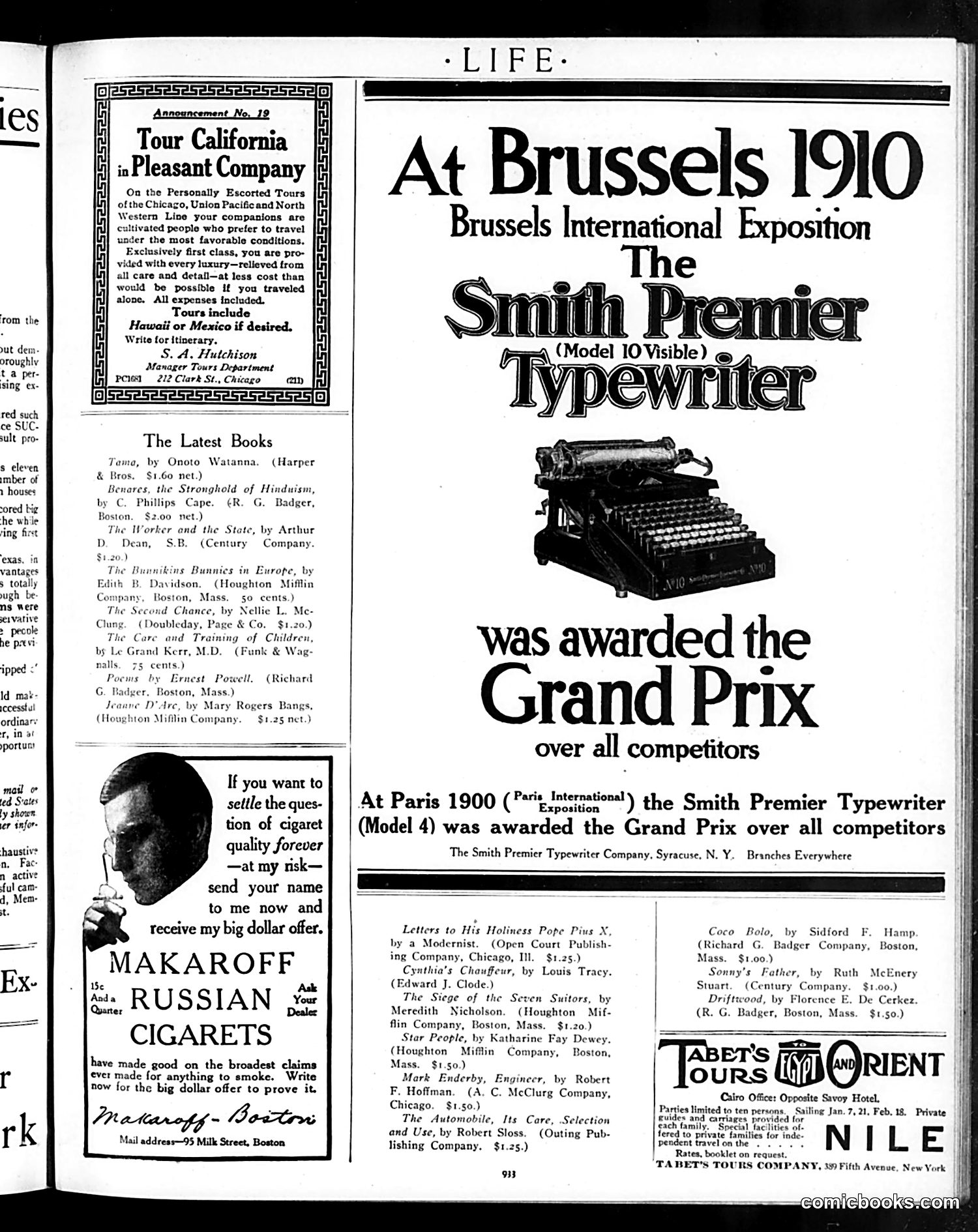
This page is primarily **advertising**, not satire or political commentary. The main content includes: **Major Ads:** - **Smith Premier Typewriter**: Claims it won the Grand Prix at Brussels 1910 and Paris 1900 International Expositions—a sales pitch using prestigious awards to establish product superiority. - **Makaroff Russian Cigarettes**: Features a photograph of what appears to be a man with a mustache making a direct appeal to readers to verify quality by requesting a "big dollar offer." - **Tabet's Tours**: Tour company advertising trips to Egypt and the Orient. **Book Reviews**: "The Latest Books" section lists newly published titles with prices and publishers. **Travel Advertisement**: Chicago, Union Pacific and North Western Line promote luxury tours to California, Hawaii, and Mexico. There is **no discernible political cartoon or satire** on this page. It's a straightforward commercial magazine page from approximately 1910.
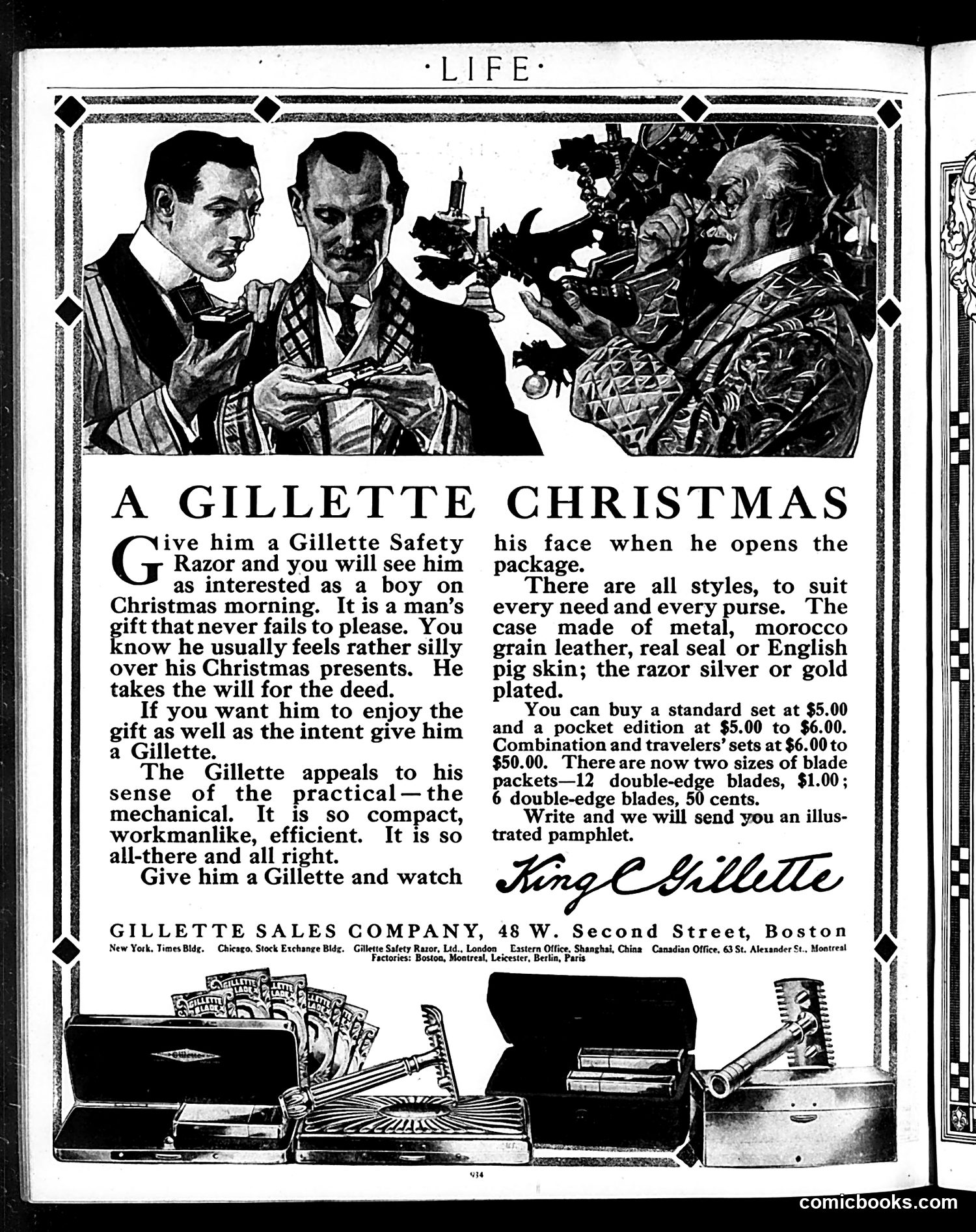
This is a **Gillette razor advertisement**, not political satire. The illustration shows two well-dressed men examining a razor (left) and their delighted reactions alongside other satisfied male customers (right). The ad targets male gift-givers at Christmas, arguing that men find most holiday presents underwhelming—they accept gifts out of politeness ("takes the will for the deed"). However, a Gillette Safety Razor supposedly appeals to masculine practicality and mechanical sensibility, guaranteeing genuine enthusiasm. The text emphasizes the razor's efficiency, compactness, and quality craftsmanship, offering various models from $5 to $50. It's a straightforward commercial pitch leveraging gender stereotypes: men prefer useful, mechanical gifts over frivolous ones. This reflects early-20th-century consumer marketing that directly addressed male recipients' supposed preferences for practical items.
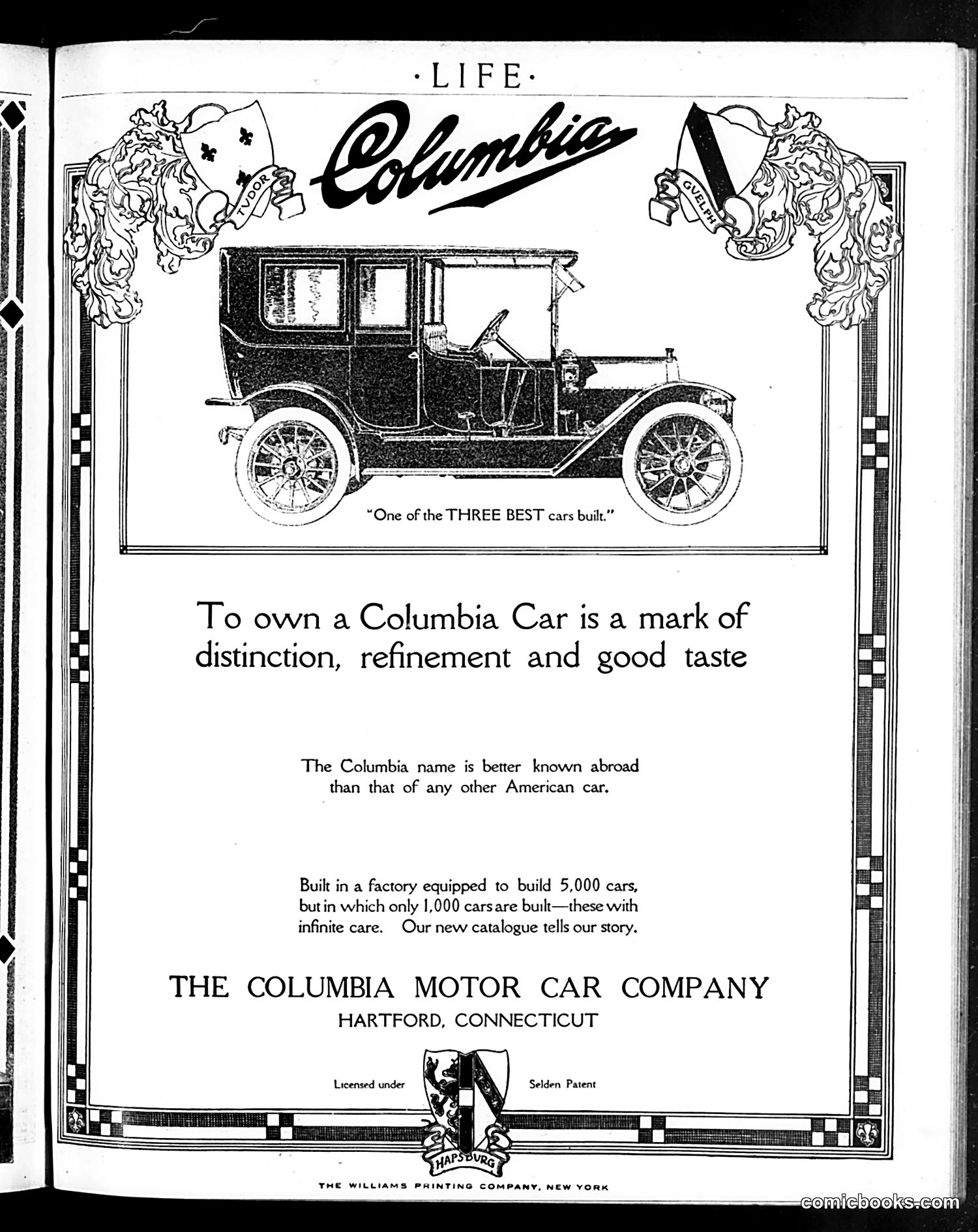
This is a full-page advertisement, not a cartoon or satire. The Columbia Motor Car Company of Hartford, Connecticut advertises their automobile as a luxury product associated with "distinction, refinement and good taste." The ad emphasizes exclusivity and quality control—the factory can produce 5,000 cars annually but deliberately manufactures only 1,000, each built "with infinite care." The claim that Columbia's name is "better known abroad than that of any other American car" appeals to aspirational buyers seeking prestige. The decorative border and formal typography reinforce the product's positioning as premium. There is no satire or political content; this is straightforward period advertising targeting wealthy consumers.
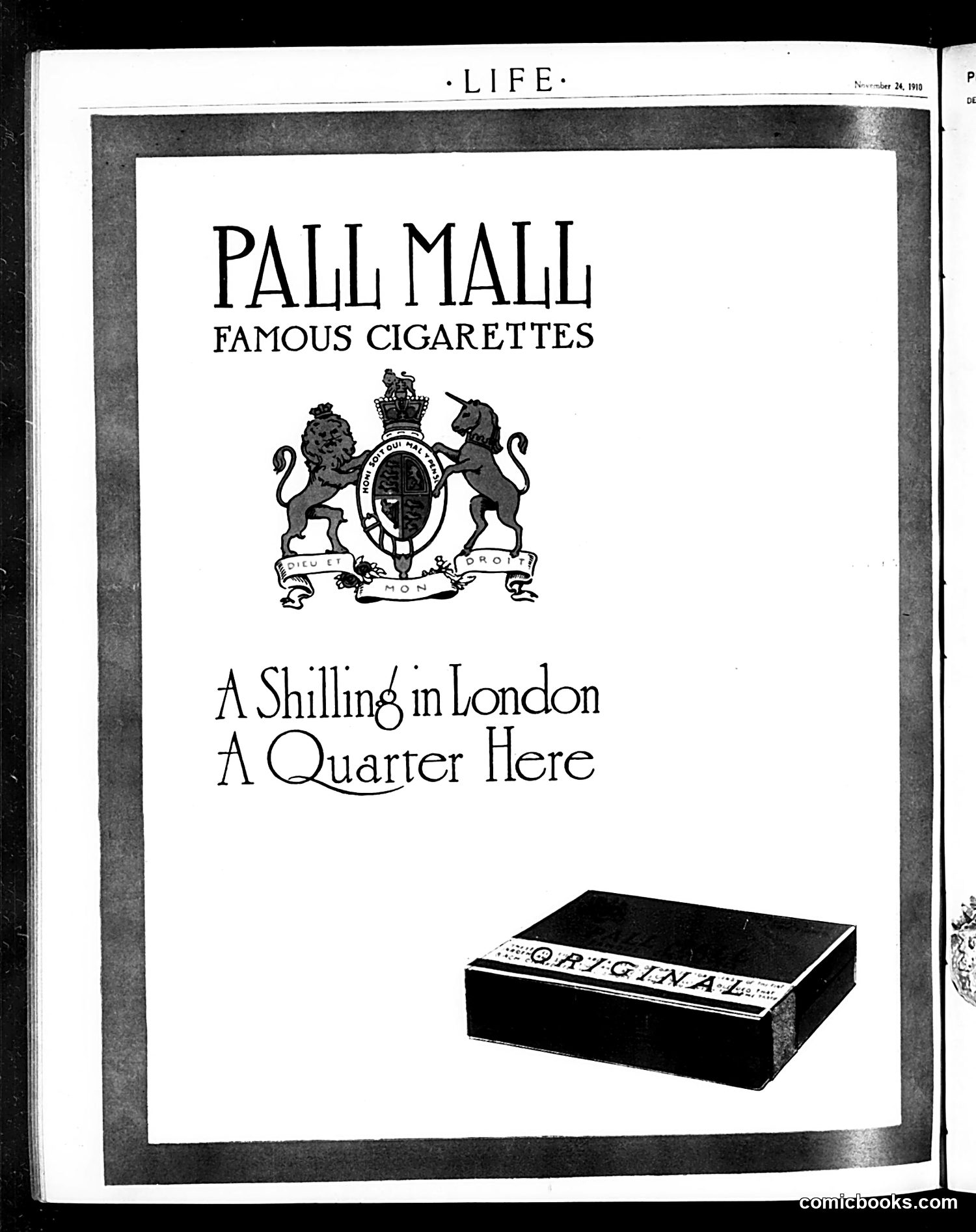
This is a Pall Mall cigarettes advertisement, not a political cartoon. The page showcases the brand's heraldic coat of arms (featuring a lion and unicorn beneath a crown), emphasizing its prestige and British heritage. The advertisement's humor lies in its pricing message: "A Shilling in London / A Quarter Here." This references the price differential between British and American markets—a shilling (British currency) equals roughly a quarter (25 cents) in American money. The joke appeals to American readers by suggesting they get the same famous British cigarettes at comparable value, making the premium product accessible. The elegant typography and formal heraldic imagery reinforce Pall Mall's positioning as a sophisticated, high-quality cigarette brand.