
Life, 1910-11-24 · page 29 of 48
Life — November 24, 1910 — page 29: what you’re looking at
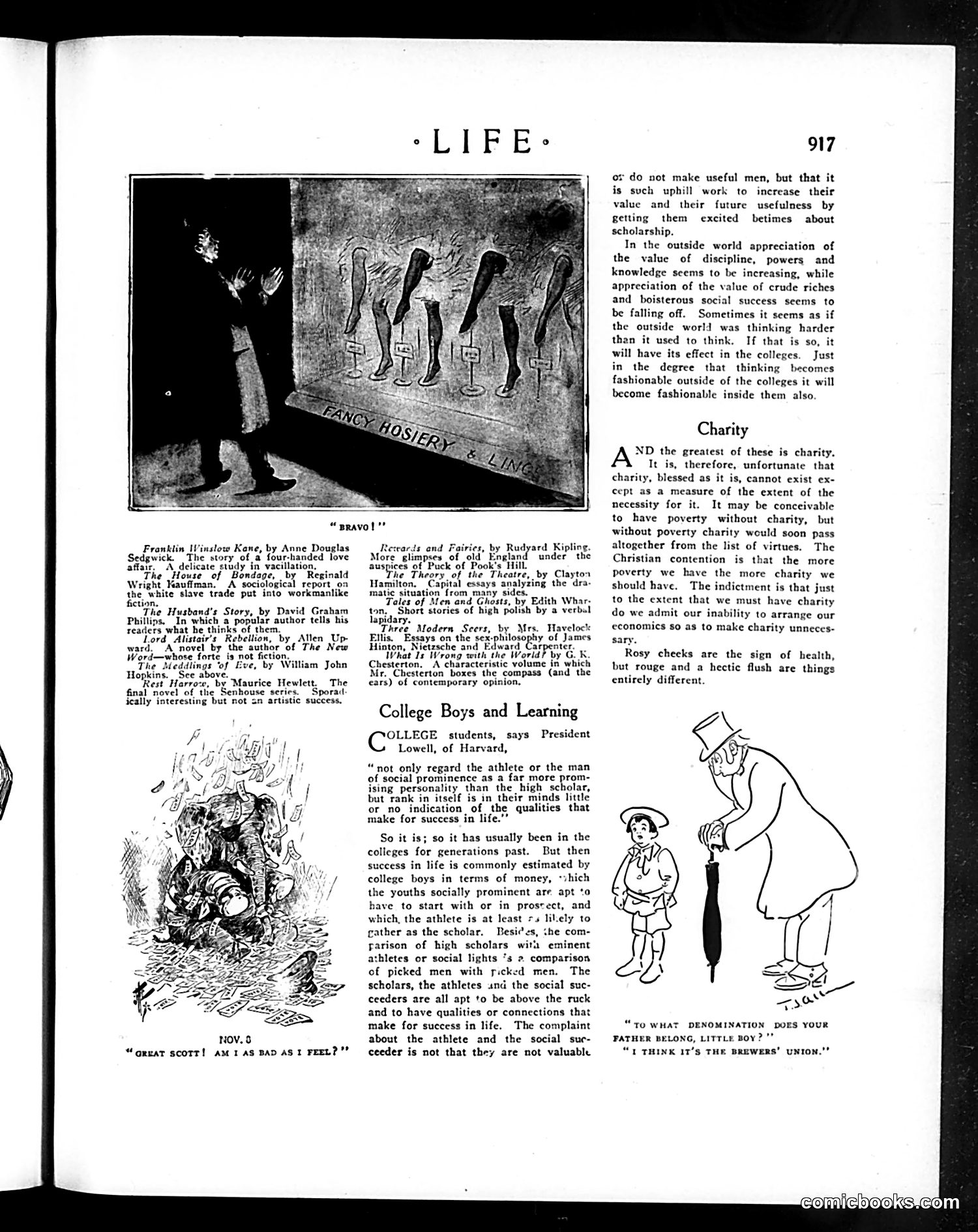
A restored page from Life, 1910-11-24. Page through the whole issue in the reader above.
📄 Transcribed text from this page (OCR, searchable)
Machine-transcribed from the original scan — historical spelling and the odd misread are preserved.
“pravol’” Franklin 1’ by Anne Douglas Sedgwick. The story of a four-handed love affair, A delicate study in vacillation, The House of Bondage, by Reginald Wright Kaufiman. A sociological report on the white slave trade put into workmanlike fiction. ‘The Husband's Story, by David Graham Phillips. In which a popular author tells his readers what he thinks of them, Lord. Alistair’s Rebellion, by Allen Up- A’novel by the author of The New hose forte is not fiction, The Meddlings ‘of Eve, by William John Hopkins. See above. Rest Harrove, by Maurice Hewlett. The final novel of the Senhouse serics. _ Sporad ically interesting but not an artistic success. “arvat scott! AM I AS BAD ASI FEEL?"? Rewards and Fairies, by Rudyard Kipling. More glimpses of old’ England under the auspices of Puck of Pook’s Hill he Theory of the Theatre, by Clayton Hamilton. Capital essays analyzing the dra- matic situation from many sides. Tales of Men and Ghosts, by Edith Whar. |. Short stories of high polish by a verbal lapidary. Three Modern Scers, by Mrs. Ellis, Essays on the sex-philos Hinton, Nietzsche and Edward Carpenter. |. What I: Wrong with the World? by G. K. Chesterton, A characteristic volume in which Mr. Chesterton boxes the compass (and the ears) of contemporary opinion, College Boys and Learning OLLEGE students, Lowell, of Harvard, says President “not only regard the athlete or the man of social prominence as a far more prom- ising personality than the high scholar, but rank in itself is in their minds little or no indication of the qualities that make for success in life.’’ So it is; so it has usually been in the colleges for generations past. But then success in life is commonly estimated by college boys in terms of money, ‘vhich the youths socially prominent are apt to have to start with or in prostect, and which, the athlete is at least 7s lilely to gather as the scholar. Besi¢es, the com- rarison of high scholars with eminent athletes or social lights ‘s 2 comparison of picked men with picked men. The scholars, the athletes und the social suc- ceeders are all apt to be above the ruck and to have qualities or connections that make for success in life. The complaint about the athlete and the social suc- ceeder is not that they are not valuable 917 os do not make useful men, but that it is such uphill work to increase their value and their future usefulness by getting them excited betimes about scholarship. In the outside world appreciation of the value of discipline, powers and knowledge seems to be increasing, while appreciation of the value of crude riches and boisterous social success seems to be falling off. Sometimes it seems as if the outside world was thinking harder than it used to think. If that is so, it will have its effect in the colleges. Just in the degree that thinking becomes fashionable outside of the colleges it will become fashionable inside them also. Charity An? the greatest of these is charity. It is, therefore, unfortunate that charity, blessed as it is, cannot exist ex- cept as a measure of the extent of the necessity for it. It may be conceivable to have poverty without charity, but without poverty charity would soon pass altogether from the list of virtues. The Christian contention is that the more poverty we have the more charity we should have. The indictment is that just to the extent that we must have charity do we admit our inability to arrange our economics so as to make charity unneces- sary. Rosy cheeks are the sign of health, but rouge and a hectic flush are things entirely different. SK ral 1 — = 7v> DENOMINATION DOES YOUR FATHER ING, LITTLE BOY? '* “1 THINK 17’s THE BREWERS’ UNION.'*