
Life, 1910-11-24 · page 18 of 48
Life — November 24, 1910 — page 18: what you’re looking at
What you’re looking at
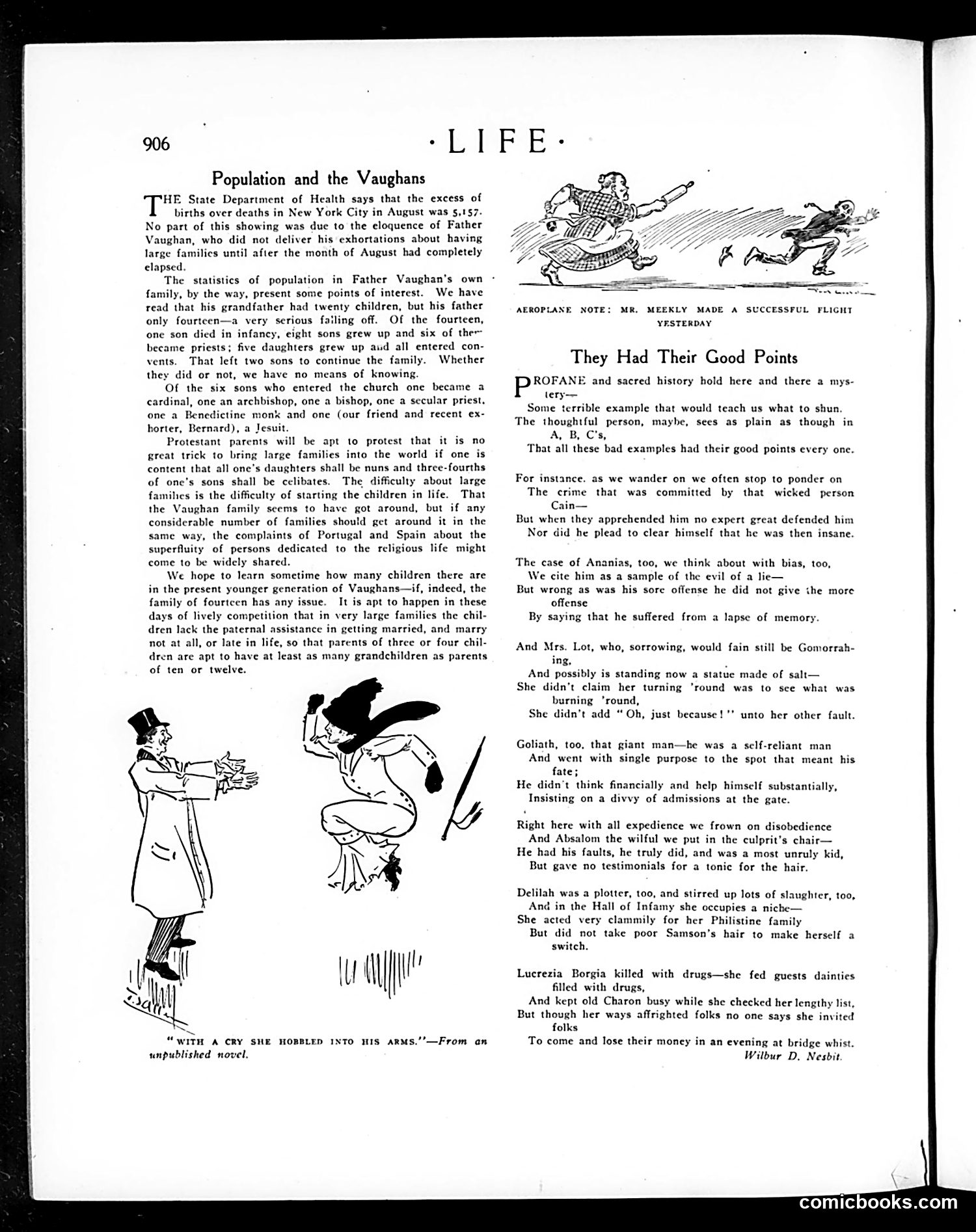
This *Life* magazine page satirizes Father Bernard Vaughan, a Jesuit priest who apparently advocated for large families. The left article notes the irony: Vaughan promoted big families only *after* August's birth statistics were already recorded, so he claimed no credit. It then mocks his own family's approach to population growth—his grandfather had 20 children, but many became priests and nuns (celibate, producing no offspring), making his pro-natalist message hypocritical. The right column is a humorous poem listing biblical and historical "bad examples" who at least took responsibility for their wrongdoing without modern excuses. Cain didn't claim insanity; Ananias didn't blame memory loss; Goliath didn't demand gate receipts. The satire suggests contemporaries are making excuses where historical figures owned their faults—a commentary on modern evasiveness.
📄 Transcribed text from this page (OCR, searchable)
Machine-transcribed from the original scan — historical spelling and the odd misread are preserved.
906 “EARP E Population and the Vaughans HE State Department of Health says that the excess of births over deaths in New York City in August was 5,157. No part of this showing was due to the eloquence of Father Vaughan, who did not deliver his exhortations about having large familics until after the month of August had completely elapsed. The statistics of population in Father Vaughan’s own family, by the way, present some points of interest. We have read that his grandfather had twenty children, but his father only fourteen—a very serious failing off. Of the fourteen, one son died in infancy, eight sons grew up and six of them became priests; five daughters grew up aud all entered con- vents. That left two sons to continue the family. Whether they did or not, we have no means of knowing. Of the six sons who entered the church one became a cardinal, one an archbishop, one a bishop, one a secular priest, one a Benedictine monk and one (our friend and recent ex- horter, Bernard), a Jesuit. Protestant parents will be apt to protest that it is no great trick to bring large families into the world if one is content that all one’s daughters shall be nuns and three-fourths of one’s sons shall be celibates. The difficulty about large famihes is the difficulty of starting the children in life. That the Vaughan family seems to have got around, but if any considerable number of families should get around it in the same way, the complaints of Portugal and Spain about the superfluity of persons dedicated to the religious life might come to be widely shared. We hope to learn sometime how many children there are in the present younger generation of Vaughans—if, indeed, the family of fourteen has any issue. It is apt to happen in these days of lively competition that in very large families the chil- dren lack the paternal assistance in getting married, and marry not at all, or late in life, so that parents of three or four chil- dren are apt to have at least as many grandchildren as parents of ten or twelve. “WITH A CRY SHE HOBBLED INTO HIS aRMS.’’—From unpublished novel. AEROPLANE NOTE: MR, MEEKLY MADE A SUCCESSFUL FLIGHT YESTERDAY They Had Their Good Points ROFANE and sacred history hold here and there a mys- lery— Some terrible example that would teach us what to shun. The thoughtful person, maybe, sees as plain as though in A, B, C's, That all these bad examples had their good points every one. For instance. as we wander on we often stop to ponder on The crime that was committed by that wicked person Cain— But when they apprehended him no expert great defended him Nor did he plead to clear himself that he was then insane. The case of Ananias, too, we think about with bias, too, We cite him as a sample of the evil of a lie— But wrong as was his sore offense he did not give the more offense By saying that he suffered from a lapse of memory. And Mrs. Lot, who, sorrowing, would fain still be Gomorrah- ing, ; And possibly is standing now a statue made of salt— She didn’t claim her turning ‘round was to sce what was burning ‘round, She didn’t add “Oh, just because!'’ unto her other fault. Goliath, too, that giant man—he was a self-reliant: man And went with single purpose to the spot that meant his fate; He didn’t think financially and help himself substantially, Insisting on a divvy of admissions at the gate. Right here with all expedience we frown on disobedience And Absalom the wilful we put in the culprit’s chair— He had his faults, he truly did, and was a most unruly kid, But gave no testimonials for a tonic for the hair. Delilah was a plotter, too, and stirred up lots of slaughter, too, And in the Hall of Infamy she occupies a niche— She acted very clammily for her Philistine family But did not take poor Samson’s hair to make herself a switch, Lucrezia Borgia killed with drugs—she fed guests dainties filled with drugs, And kept old Charon busy while she checked her lengthy list, But though her ways affrighted folks no one says she invited folks To come and lose their money in an evening at bridge whist. Wilbur D, Nesbit. comicbooks.com