
Life, 1910-11-24 · page 16 of 48
Life — November 24, 1910 — page 16: what you’re looking at
What you’re looking at
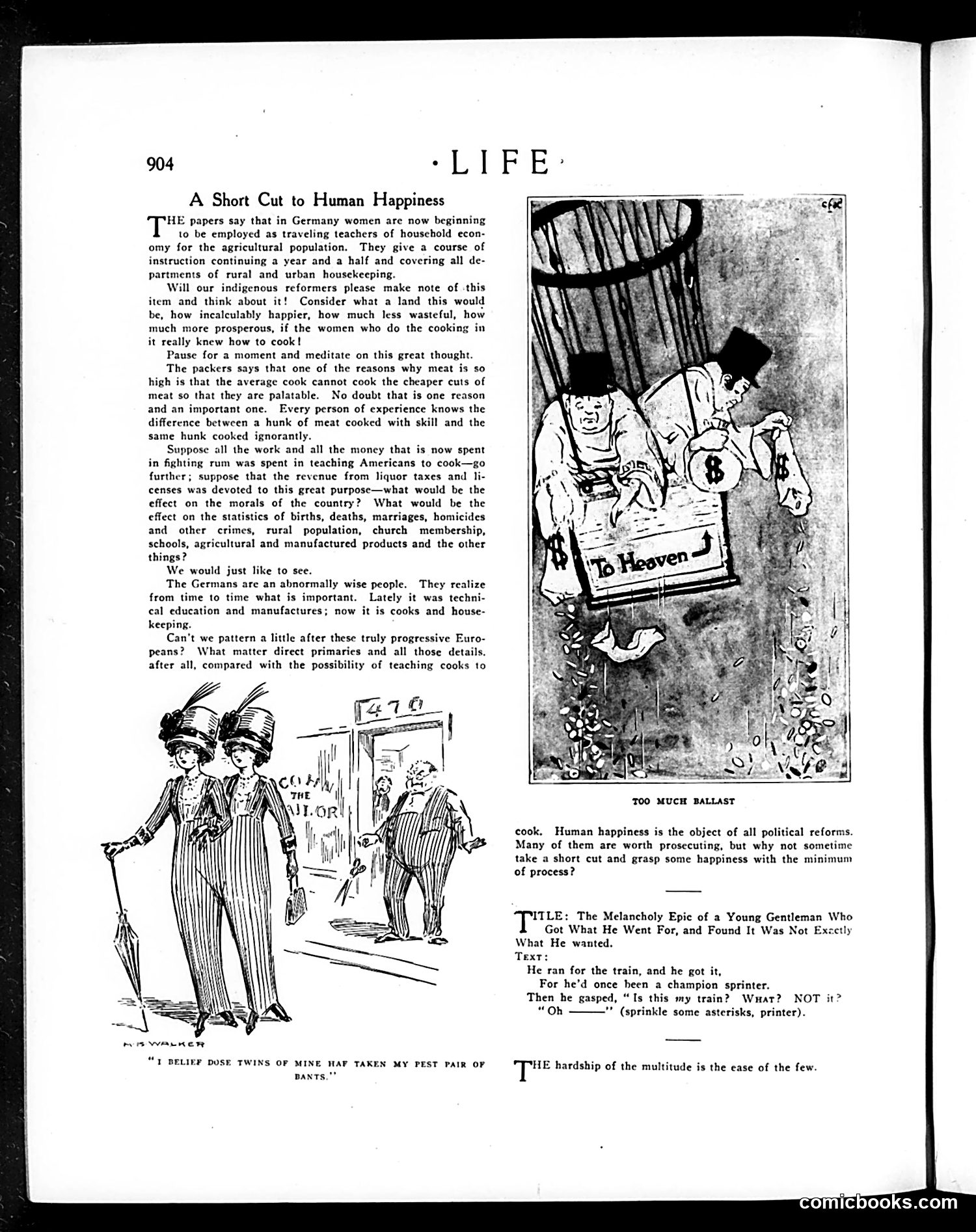
This page contains satirical editorial commentary on American domestic life and reform priorities, illustrated with period cartoons. The main article argues that Germany's progressive approach—training women as traveling teachers of household economics—should be adopted in America. The author contends that teaching American women proper cooking skills would have greater social impact than most political reforms. He suggests that if liquor tax revenues funded cooking instruction instead of temperance campaigns, it would improve public morality, reduce crime, and boost agricultural productivity more effectively than "direct primaries and other details." The cartoons underscore this message: - Upper right: "Too Much Ballast" depicts a woman literally weighed down by excess baggage, symbolizing wasted domestic effort - Lower left: A P.B. Walker cartoon shows two identical figures lamenting stolen "best pair of pants," appearing to mock trivial concerns versus substantive reform The satire suggests American reformers pursue grandiose political schemes while ignoring practical domestic improvements that would genuinely enhance citizens' lives and national prosperity.
📄 Transcribed text from this page (OCR, searchable)
Machine-transcribed from the original scan — historical spelling and the odd misread are preserved.
904 *LIF'E* A Short Cut to Human Happiness HE papers say that in Germany women are now beginning to be employed as traveling teachers of houschold econ- omy for the agricultural population. They give a course of instruction continuing a year and a half and covering all de- partments of rural and urban housekeeping. Will our indigenous reformers please make note of this item and think about it! Consider what a land this would be, how incalculably happier, how much less wasteful, how much more prosperous, if the women who do the cooking in it really knew how to cook! Pause for a moment and meditate on this great thought. The packers says that one of the reasons why meat is so high is that the average cook cannot cook the cheaper cuts of meat so that they are palatable. No doubt that is one reason and an important one. Every person of experience knows the difference between a hunk of meat cooked with skill and the same hunk cooked ignorantly. Suppose all the work and all the moncy that is now spent in fighting rum was spent in teaching Americans to cook—go further; suppose that the revenue from liquor taxes and li- censes was devoted to this great purposc—what would be the effect on the morals of the country? What would be the effect on the statistics of births, deaths, marriages, homicides and other crimes, rural population, church membership, schools, agricultural and manufactured products and the other things? We would just like to see. The Germans are an abnormally wise people. They realize from time to time what is important. Lately it was techni- cal education and manufactures; now it is cooks and house- keeping. Can't we pattern a little after these truly progressive Euro- peans? What matter direct primaries and all those details. after all, compared with the possibility of teaching cooks to TOO MUCH BALLAST cook, Human happiness is the object of all political reforms. Many of them are worth prosecuting, but why not sometime take a short cut and grasp some happiness with the minimum of process? ITLE: The Melancholy Epic of a Young Gentleman Who Got What He Went For, and Found It Was Not Exzctly What He wanted. Text: He ran for the train, and he got it, For he'd once heen a champion sprinter. Then he gasped, “Is this my train? Wat? NOT it? “Oh ** (sprinkle some asterisks, printer). “BELIEF DOSE TWINS OF MINE HAF TAKEN MY PEST PAIR OF T= hardship of the multitude is the ease of the few. DANTS."" comicbooks.com