
Life, 1910-11-24 · page 30 of 48
Life — November 24, 1910 — page 30: what you’re looking at
What you’re looking at
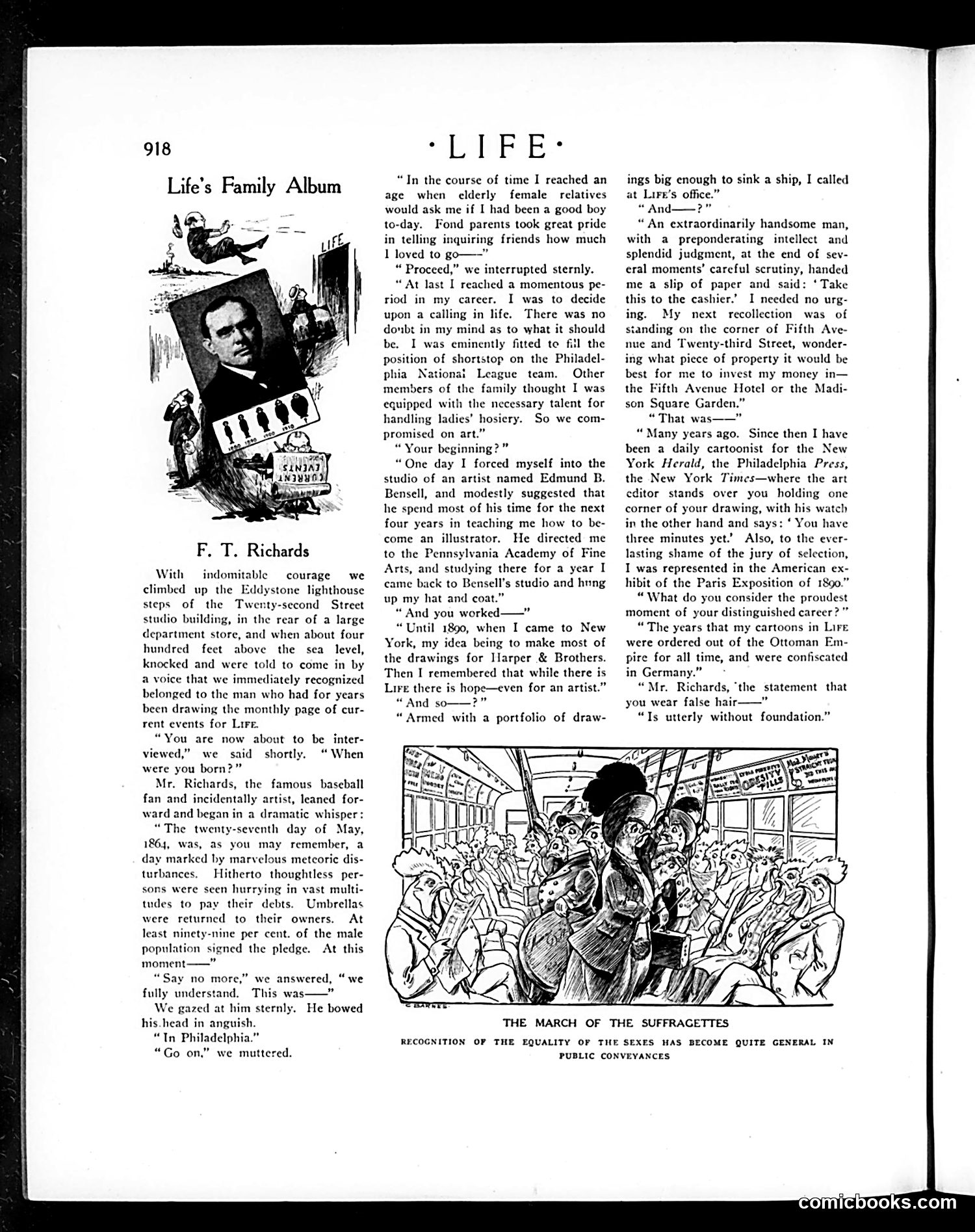
This is a humorous biographical interview with F.T. Richards, a cartoonist and illustrator for *Life* magazine. The text presents Richards's life story in exaggerated, self-aggrandizing fashion—a satirical joke on biographical interviews themselves. The cartoon at bottom, "The March of the Suffragettes," depicts women in a crowded public conveyance, illustrating the caption about gender equality becoming "quite general in public conveyances." This reflects early 20th-century suffrage activism and changing social attitudes toward women's public presence. Richards is presented as a baseball fanatic (born 1864 with theatrical melodrama) who became an artist almost by accident. The satire mocks his grandiose storytelling—he exaggerates minor moments into dramatic turning points. The interview format itself gently ridicules both the subject's self-importance and magazine profile conventions.
📄 Transcribed text from this page (OCR, searchable)
Machine-transcribed from the original scan — historical spelling and the odd misread are preserved.
918 Life’s Family Album 7 Za SM SiNjAI Whig REED! F. T. Richards With indomitable courage — we climbed up the Eddystone lighthouse steps of the Twenty-second Street studio building, in the rear of a large department store, and when about four hundred feet above the sea level, knocked and were told to come in by a voice that we immediately recognized belonged to the man who had for years been drawing the monthly page of cur- rent events for Lire. “You are now about to be inter- viewed,” we said shortly, “ When were you born?” Mr. Richards, the famous baseball fan and incidentally artist, leaned for- ward and began in a dramatic whisper: “The twenty-seventh day of May, 1864, was, as you may remember, a day marked by marvelous meteoric dis- turbances. Hitherto thoughtless per- sons were seen hurrying in vast multi- tudes to pay their debts. Umbrellas were returned to their owners. At least ninety-nine per cent. of the male population signed the pledge. At this moment——” “Say no more,” we answered, “we fully understand. This was——” We gazed at him sternly. He bowed his.head in anguish. “In Philadelphia.” “Go on.” we muttered. 7 LP E- “In the course of time I reached an age when elderly female relatives would ask me if I had been a good boy to-day. Fond parents took great pride in telling inquiring friends how much 1 loved to go—~” “ Proceed,” we interrupted sternly. “At last I reached a momentous pe- riod in my career. I was to decide upon a calling in life. There was no doubt in my mind as to what it should be. I was eminently fitted te fill the position of shortstop on the Philadel- phia National League team. Other members of the family thought I was equipped with the necessary talent for handling ladies’ hosiery. So we com- promised on art.” “Your beginning?” “One day I forced myself into the studio of an artist named Edmund B. Bensell, and modestly suggested that he spend most of his time for the next four years in teaching me how to be- come an illustrator. He directed me to the Pennsylvania Academy of Fine Arts, and studying there for a year I came back to Bensell’s studio and hung up my hat and coat.” “And you worked ——” “Until 1890, when I came to New York, my idea being to make most of the drawings for Ilarper & Brothers. Then I remembered that while there is Lire there is hope—even for an artist.” “And so—?” “Armed with a portfolio of draw- ings big enough to sink a ship, I called at Lire’s office.” “ And——?" “An extraordinarily handsome man, with a preponderating intellect and splendid judgment, at the end of sev- eral moments’ careful scrutiny, handed me a slip of paper and said: ‘Take this to the cashier.’ I needed no urg- ing. My next recollection was of standing on the corner of Fifth Ave- nue and Twenty-third Street, wonder- ing what piece of property it would be best for me to invest my money in— the Fifth Avenue Hotel or the Madi- son Square Garden.” “That was——” “Many years ago. Since then I have been a daily cartoonist for the New York Herald, the Philadelphia Press, the New York Times—where the art editor stands over you holding one corner of your drawing, with his watch in the other hand and says: ‘ You have three minutes yet.’ Also, to the ever- lasting shame of the jury of selection, I was represented in the American ex- hibit of the Paris Exposition of 1890.” “What do you consider the proudest moment of your distinguished career?” “The years that my cartoons in Lire were ordered out of the Ottoman Em- pire for all time, and were confiscated in Germany.” “Mr. Richards, ‘the statement that you wear false hair——” “Ts utterly without foundation.” THE MARCH OF THE SUFFRAGETTES RECOGNITION OF THE EQUALITY OF THE SEXES HAS BECOME QUITE GENERAL IN PUBLIC CONVEYANCES micbooks.com