
Life, 1910-11-24 · page 22 of 48
Life — November 24, 1910 — page 22: what you’re looking at
What you’re looking at
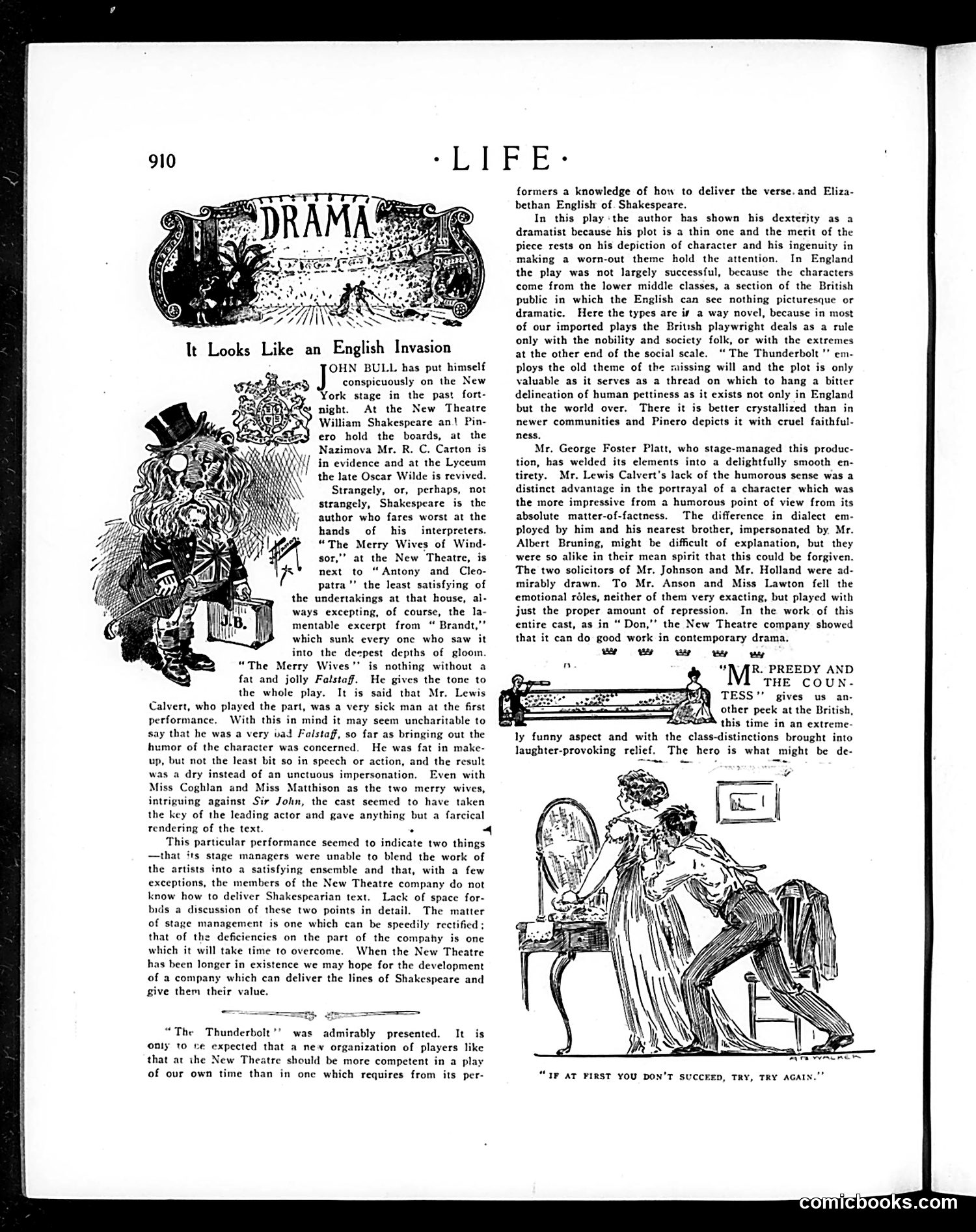
This page reviews recent New York theatrical productions featuring British plays and playwrights. The headline's "invasion" refers to the influx of English dramatic works—Shakespeare, Pinero, and Oscar Wilde—dominating New York stages. The critic argues that while Pinero's contemporary drama "The Thunderbolt" succeeds because it depicts realistic middle-class characters (novel to American audiences accustomed to nobility or extremes in imported plays), Shakespeare's "The Merry Wives of Windsor" fails due to poor ensemble direction and the cast's inability to properly deliver Shakespearean verse and Elizabethan English. The accompanying illustration shows a figure apparently struggling or stumbling, likely satirizing the awkward American attempt to stage British theatrical classics. The point: American companies lack the training to handle Shakespeare effectively, though they manage contemporary realistic drama better.
📄 Transcribed text from this page (OCR, searchable)
Machine-transcribed from the original scan — historical spelling and the odd misread are preserved.
~EIEE- Tt Looks Like an English Invasion OHN BULL has put himself conspicuously on the New York stage in the past fort- night. At the New Theatre William Shakespeare an\ Pin- ero hold the boards, at the Nazimova Mr. R. C. Carton is in evidence and at the Lyceum the late Oscar Wilde is revived. Strangely, or, perhaps, not Strangely, Shakespeare is the author who fares worst at the hands of his interpreters. “The Merry Wives of Wind- sor,"’ at the New Theatre, is next to “Antony and Cleo- patra "" the least satisfying of the undertakings at that house, al- ways excepting, of course, the la- mentable excerpt from “ Brandt,’’ which sunk every one who saw it into the deepest depths of gloom “The Merry Wives’’ is nothing without a fat and jolly Falstaf. He gives the tone to the whole play. It is said that Mr. Lewis Calvert, who played the part, was a very sick man at the first performance. With this in mind it may seem uncharitable to say that he was a very vad Falstaff, so far as bringing out the humor of the character was concerned. He was fat in make- up, but not the least bit so in speech or action, and the result was a dry instead of an unctuous impersonation. Even with Miss Coghlan and Miss Matthison as the two merry wives, intriguing against Sir John, the cast seemed to have taken the key of the leading actor and gave anything but a farcical rendering of the text. . 4 This particular performance seemed to indicate two things —that its stage managers were unable to blend the work of the artists into a satisfying ensemble and that, with a few exceptions, the members of the New Theatre company do not know how to deliver Shakespearian text. Lack of space for- bids a discussion of these two points in detail. The matter of stage management is one which can be speedily rectified ; that of the deficiencies on the part of the compahy is one which it will take time to overcome. When the New Theatre has been longer in existence we may hope for the development of a company which can deliver the lines of Shakespeare and give them their value. “The Thunderbolt’? was admirably presented. It is only to re expected that a new organization of players like that at ihe New Theatre should be more competent in a play of our own time than in one which requires from its per- formers a knowledge of how to deliver the verse. and Eliza- bethan English: of. Shakespeare. In this play-the author has shown his dexterity as a dramatist because his plot is a thin one and the merit of the piece rests on his depiction of character and his ingenuity in making a worn-out theme hold the attention. In England the play was not largely successful, because the characters come from the lower middle classes, a section of the British public in which the English can see nothing picturesque or dramatic. Here the types are if a way novel, because in most of our imported plays the British playwright deals as a rule only with the nobility and society folk, or with the extremes at the other end of the social scale. “ The Thunderbolt '’ em- ploys the old theme of the missing will and the plot is only valuable as it serves as a thread on which to hang a bitter delineation of human pettiness as it exists not only in England but the world over. There it is better crystallized than in newer communities and Pinero depicts it with cruel faithful- ness. Mr. George Foster Platt, who stage-managed this produc- tion, has welded its elements into a delightfully smooth en- tirety. Mr. Lewis Calvert's lack of the humorous sense was a distinct advantage in the portrayal of a character which was the more impressive from a humorous point of view from its absolute matter-of-factness. The difference in dialect em- ployed by him and his nearest brother, impersonated by. Mr. Albert Bruning, might be difficult of explanation, but they were so alike in their mean spirit that this could be forgiven. The two solicitors of Mr. Johnson and Mr. Holland were ad- mirably drawn. To Mr. Anson and Miss Lawton fell the emotional réles, neither of them very exacting, but played with just the proper amount of repression. In the work of this entire cast, as in “ Don,’’ the New Theatre company showed that it can do good work in contemporary drama. wow ere ow * R. PREEDY AND THE COUN- TESS” gives us an- other peek at the British, this time in an extreme ly funny aspect and with the class-distinctions brought into laughter-provoking relief. The hero is what might be de- “IP AT FIRST YOU DON’T SUCCEED, TRY, TRY AGAIN.” comicbooks.com