
Life, 1910-11-24 · page 23 of 48
Life — November 24, 1910 — page 23: what you’re looking at
What you’re looking at
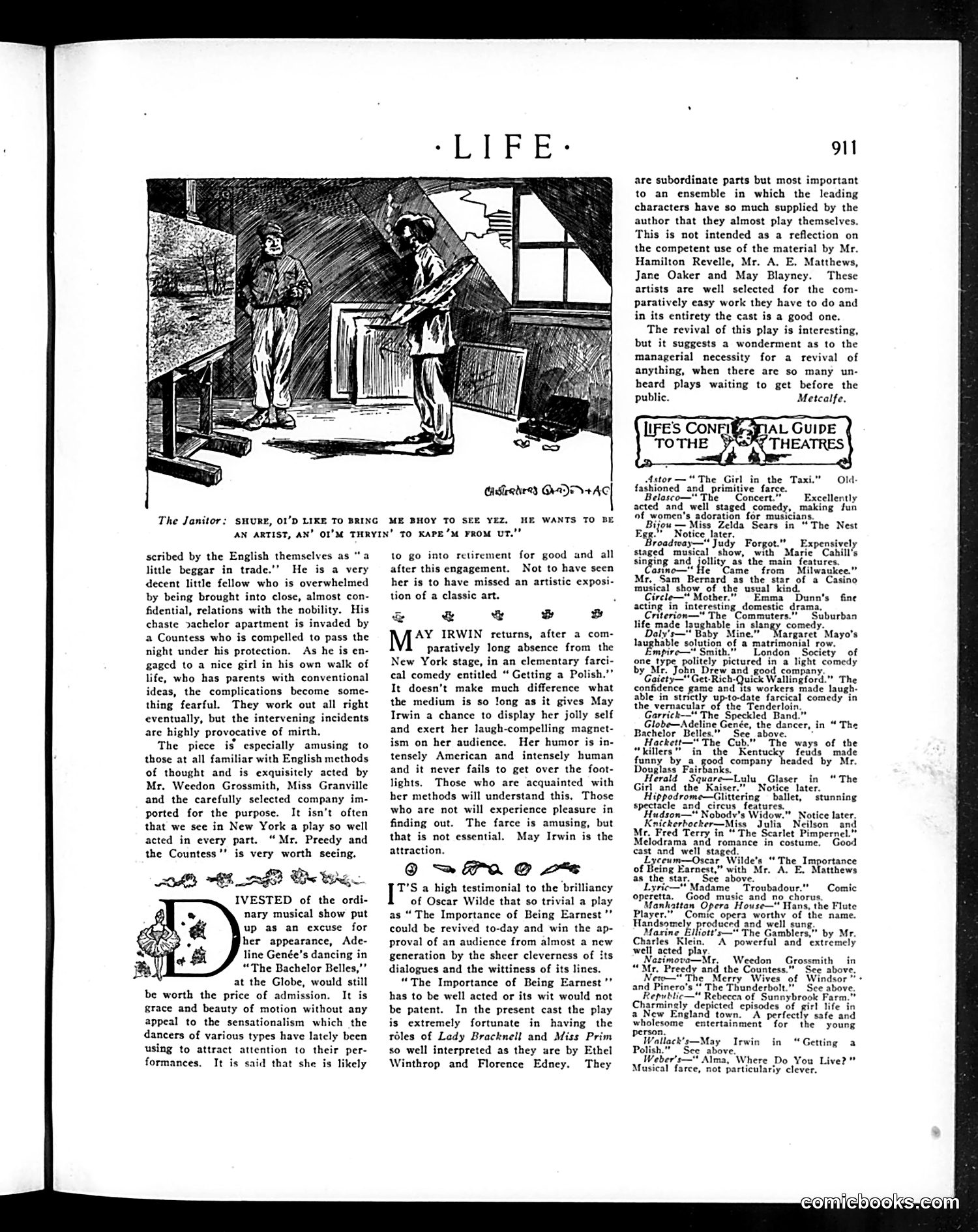
This page from *Life* magazine contains theatrical reviews and a cartoon satirizing class distinctions in early 20th-century America. **The Janitor Cartoon:** An Irish working-class janitor (indicated by his dialect: "SMURY, OI'D LIKE TO BRING ME BHOY") wants his son to become an artist. His employer, apparently a wealthy patron of the arts, discourages this—the boy should stay "from UT" (it). The satire mocks both the rigid class system that confined working-class children to their parents' trades, and the pretension of wealthy aesthetes who appreciated art as a status symbol while opposing genuine social mobility. **The Reviews:** The page discusses theatrical performances, praising classical works (*Oscar Wilde's "The Importance of Being Earnest"*) and performers like dancer Adeline Genée and actress May Irwin. The critical tone emphasizes that good acting and clever writing matter more than spectacle—a position reflecting *Life's* generally intellectual, somewhat snobbish readership. The juxtaposition highlights period anxieties about class, education, and cultural access.
📄 Transcribed text from this page (OCR, searchable)
Machine-transcribed from the original scan — historical spelling and the odd misread are preserved.
The Janitor: SMURY, 01’D LIKE TO BRING ME BHOY TO SEE YEZ. Casiredee} G2) Y+AC] ME WANTS TO BE AN ARTIST, AN’ OI'M THRYIN’ TO KAPE’M FROM UT. scribed by the English themselves as “a little beggar in trad He is a very decent little fellow who is overwhelmed by being brought into close, almost con- fidential, relations with the nobility. His chaste vachelor apartment is invaded by a Countess who is compelled to pass the night under his protection. As he is en- gaged to a nice girl in his own walk of life, who has parents with conventional ideas, the complications become some- thing fearful. They work out all right eventually, but the intervening incidents are highly provocative of mirth, The piece is’ especially amusing to those at all familiar with English methods of thought and is exquisitely acted by Mr. Weedon Grossmith, Miss Granville and the carefully selected company im- ported for the purpose. It isn’t often that we see in New York a play so well acted in every part. “Mr. Preedy and the Countess ’’ is very worth seeing. 3AM BESS Be ree IVESTED of the ordi- nary musical show put up as an excuse for her appearance, Ade- line Genée’s dancing in “The Bachelor Belles,’’ at the Globe, would still be worth the price of admission. It is grace and beauty of motion without any appeal to the sensationalism which the dancers of various types have lately been using to attract attention to their per- formances. It is said that she is likely to go into retirement for good and all after this engagement. Not to have seen her is to have missed an artistic exposi- tion of a classic art. & & & & S AY IRWIN returns, after a com- paratively long absence from the New York stage, in an elementary farci- cal comedy entitled “ Getting a Polish.’’ It doesn’t make much difference what the medium is so long as it gives May Irwin a chance to display her jolly self and exert her laugh-compelling magnet- ism on her audience. Her humor is in- tensely American and intensely human and it never fails to get over the foot- lights. Those who are acquainted with her methods will understand this. Those who are not experience pleasure in finding out. The farce is amusing, but that is not essential, May Irwin is the attraction. 0 >a O 2*s T’S a high testimonial to the brilliancy of Oscar Wilde that so trivial a play as “ The Importance of Being Earnest '’ could be revived to-day and win the ap- proval of an audience from almost a new generation by the sheer cleverness of its dialogues and the wittiness of its lines. “The Importance of Being Earnest’ has to be well acted or its wit would not be patent. In the present cast the play is extremely fortunate in having the roles of Lady Bracknell and Miss Prim so well interpreted as they are by Ethel Winthrop and Florence Edney. They oll are subordinate parts but most important to an ensemble in which the leading characters have so much supplied by the author that they almost play themselves. This is not intended as a reflection on the competent use of the material by Mr. Hamilton Revelle, Mr. A. E. Matthews, Jane Oaker and May Blayney. These artists are well selected for the com- paratively easy work they have to do and in its entirety the cast is a good one. The revival of this play is interesting, but it suggests a wonderment as to the managerial necessity for a revival of anything, when there are so many un- heard plays waiting to get before the Metcalfe. Sa) Astor—“ The Girl in the Taxi.” Old fashioned and_ primitive farce. Belasco—" The Concert." Excellently acted and, well staged comedy, making fun of women's adoration for musicians. jijou — Miss Zelda Sears in “The Nest Fagg.” Notice, later. roadeay—" Judy Forgot.” Expensively staged musical“ show, with Marie Cahill’s singing and, jollity as’ the, main features, ‘asino—" He Came from Milwaukee.” Mr. Sam Bernard as the star of a Casino musical show of the usual kind. Circle—" Mother.” Emma Dunn's fine acting in interesting domestic drama, _Criterion—" The Commuters.” Suburban life made laughable in slangy comedy. Daly's—" Baby Mine.” Margaret’ Mayo's laughable solution of a matrimonial row. Empire—" Smit London | Society of one type politely pictured in a light comedy by Mr. Drew and good company. Goiety—" Get-Rich-Quick Wallingford.” The confidence game and its workers made laugh: able in strictly up-to-date farcical comedy in the vernacular of the Tenderloi Garrick—"* The Speckled Bani Globe—Adeline Genée, the dancer, in “ The Bachelor Belles." See, above. Hackett—" The Cub.” The ways of the “killers” in the Kentucky feuds made funny by_a good company headed by Mr. Douglass Fairbanks. Herald Square—Lulu Glaser in “The Girl and the Kaiser.” Notice later. Hippodrome—Glittering ballet, stunning spectacle and circus, features. Hudson—" Nobody's Wido tice later. Knickerbocker—Miss Julia. Neilson and Mr, Fred Terry in The Scarlet Pimpernel.” Melodrama and romance in costume, Good cast and well stage Lycew car, Wilde's of Being Earnest,” with Mr. as the st © above. Lyric—"" Madame Troubadour.” operetta. Good music and no chorus Manhattan Opera House—" Hans, the Flute Player.” Comic opera worthy of the name. Handsomely produced and well sung Maxine Elliott’s—" The Gamblers," by Mr. Charles Klein. A powerful and extremely well acted play Nazimova—Mr, Weedon Grossmith in “Mr. Preedy and the Countess.” See above, New— The Merry Wives of Windsor” and Pinero’s “* The Thunderbolt." See abov Republic— Rebecca of Sunnybrook Farm. Charmingly depicted episodes of girl life in a New England town. A perfectly safe and wholesome entertainment for the young. The Importance A. E. Matthews Comic perso: Wallack’s—May Irwin in “Getting a Polish.” See above, Weber’s—" Alma, Where Do You Live?” Musical farce, not particulariy clever.