
Life, 1910-11-24 · page 28 of 48
Life — November 24, 1910 — page 28: what you’re looking at
What you’re looking at
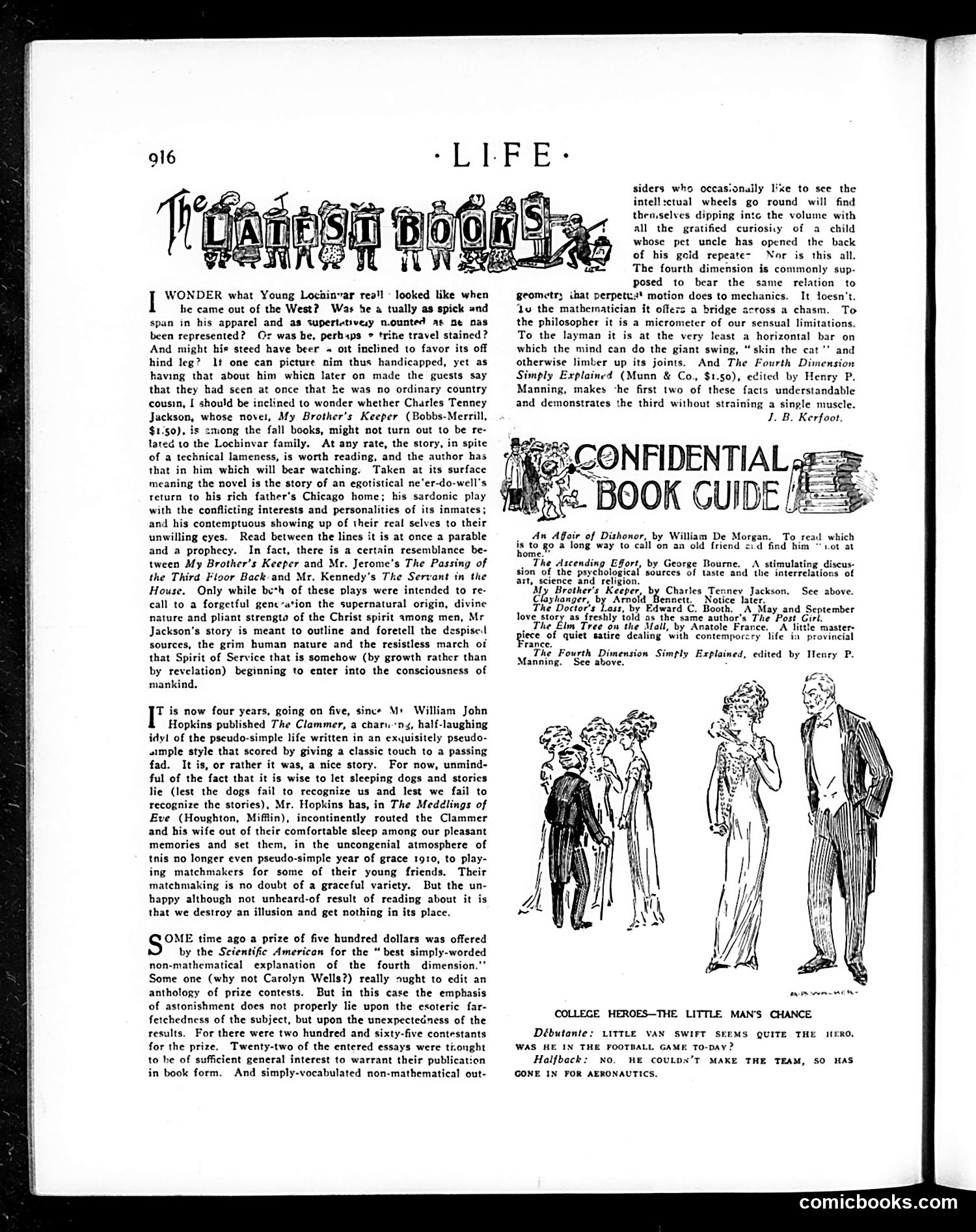
This page contains literary reviews and commentary from Life magazine's "Largest Books" section. The main illustrated feature is a cartoon titled "College Heroes—The Little Man's Chance," depicting what appears to be a young man being introduced to or courted by a woman, with the caption suggesting he missed his chance at football stardom but might find success in aeronautics instead. The reviews discuss contemporary novels including Charles Tenney Jackson's *My Brother's Keeper* and William John Hopkins' *The Meddlings of Eve*. The text also covers a Scientific American contest about explaining the fourth dimension in simple language—which received 265 entries, with 22 deemed worthy of publication. The overall tone reflects early 1900s literary culture and the era's fascination with both traditional romance narratives and emerging scientific concepts.
📄 Transcribed text from this page (OCR, searchable)
Machine-transcribed from the original scan — historical spelling and the odd misread are preserved.
WONDER what Young Lochinvar reall - looked like when he came out of the West? Was he a tually as spick and span in his apparel and as supertetrvesy n.ounted as ne nas been represented? Or was be, perhaps »* trite travel stained? And might hie steed have beer « oit inclined to favor its off hind leg? lf one can picture nim thus handicapped, yet as having that about him which later on made the guests say that they had seen at once that he was no ordinary country cousin, I should be inclined to wonder whether Charles Tenney Jackson, whose novel, My Brother’s Keeper (Bobbs-Merrill, $1.50), is 2zmong the fall books, might not turn out to be re- lated to the Lochinvar family. At any rate, the story, in spite of a technical lameness, is worth reading, and the author has that in him which will bear watching. Taken at its surface meaning the novel is the story of an egotistical ne'er-do-well's return to his rich father’s Chicago home; his sardonic play with the conflicting interests and personalities of its inmates; and his contemptuous showing up of their real selves to their unwilling eyes. Read between the lines it is at once a parable and a prophecy. In fact, there is a certain resemblance be- tween My Brother’s Keeper and Mr. Jerome's The Passing of the Third Floor Back and Mr. Kennedy's Tke Servant in the House. Only while be*h of these plays were intended to re- call to a forgetful gene~a*ion the supernatural origin, divine nature and pliant strengts of the Christ spirit among men, Mr Jackson's story is meant to outline and foretell the despise: sources, the grim human nature and the resistless march of that Spirit of Service that is somehow (by growth rather than by revelation) beginning to enter into the consciousness of mankind. T is now four years, going on five, since Mr William John Hopkins published The Clammer, a charu--ng, half-laughing idyl of the pseudo-simple life written in an exquisitely pseudo- simple style that scored by giving a classic touch to a passing fad. It is, or rather it was, a nice story. For now, unmind- ful of the fact that it is wise to let sleeping dogs and storics lie (lest the dogs fail to recognize us and lest we fail to recognize the stories), Mr. Hopkins has, in The Meddlings of Eve (Houghton, Mifflin), incontinently routed the Clammer and his wife out of their comfortable sleep among our pleasant memories and set them, in the uncongenial atmosphere of tnis no longer even pseudo-simple year of grace 1910, to play- ing matchmakers for some of their young friends. Their matchmaking is no doubt of a graceful variety. But the un- happy although not unheard-of result of reading about it is that we destroy an illusion and get nothing in its place. OME time ago a prize of five hundred dollars was offered by the Scientific American for the “best simply-worded non-mathematical explanation of the fourth dimension.’’ Some one (why not Carolyn Wells?) really ought to edit an anthology of prize contests. But in this case the emphasis of astonishment does not properly lie upon the esoteric far- fetchedness of the subject, but upon the unexpectedness of the results. For there were two hundred and sixty-five contestants for the prize. Twenty-two of the entered essays were tionght to he of sufficient general interest to warrant their publication in book form. And simply-vocabulated non-mathematical out- siders who occasionally like to see the intell:ctual wheels go round will find thenselves dipping inte the volume with all the gratified curiosicy of a child whose pet uncle has opened the back of his gold repeate- Nor is this all. The fourth dimension is commonly sup- posed to bear the same relation to geometry ihat perpetus' motion does to mechanics. It loesn't. ‘tu the mathematician it offers a bridge across a chasm. To the philosopher it is a micrometer of our sensual limitations. To the layman it is at the very least a horizontal bar on which the mind can do the giant swing, “skin the cat'’ and otherwise limber up its joints. And The Fourth Dimension Simply Explained (Munn & Co., $1.50), edited by Henry P. Manning, makes che first two of these facts understandable and demonstrates the third without straining a single muscle. J. B. Kerfoot. _ An Afoir of Dishonor, by William De Morgan. To read which is to go a long way to call on an old friend cid find him “ot at ome. __ The Ascending Efort, by George Bourne. A stimulating discus- sion of the psychological sources of taste and the interrelations of art, science and religion. My Brother's Keeper, by Charles Tenney Jackson, See above. Clayhanger, by Arnold Bennett. Notice later. The Doctor's Lass, by Edward C. Booth. A May and September love story as freshly told as the same author's The Post Girl. The Elm Tree on the Mall, by Anatole France, A little master- piece of quiet satire dealing ‘with contemporsry life in provincial ance. The Fourth Dimension Simply Explained, edited by Wenry P. Manning. See above. PR Ree COLLEGE HEROES—THE LITTLE MAN'S CHANCE Débutante: vitTLe VAN SWIFT SEEMS QUITE THE IIERO, WAS HE IN THE FOOTBALL GAME TO-DAY? Halfback: No. NE COULDX’T MAKE THE TEAM, SO HAS GONE IN POR AERONAUTICS. comicbooks.com