
Life, 1910-11-24 · page 11 of 48
Life — November 24, 1910 — page 11: what you’re looking at
What you’re looking at
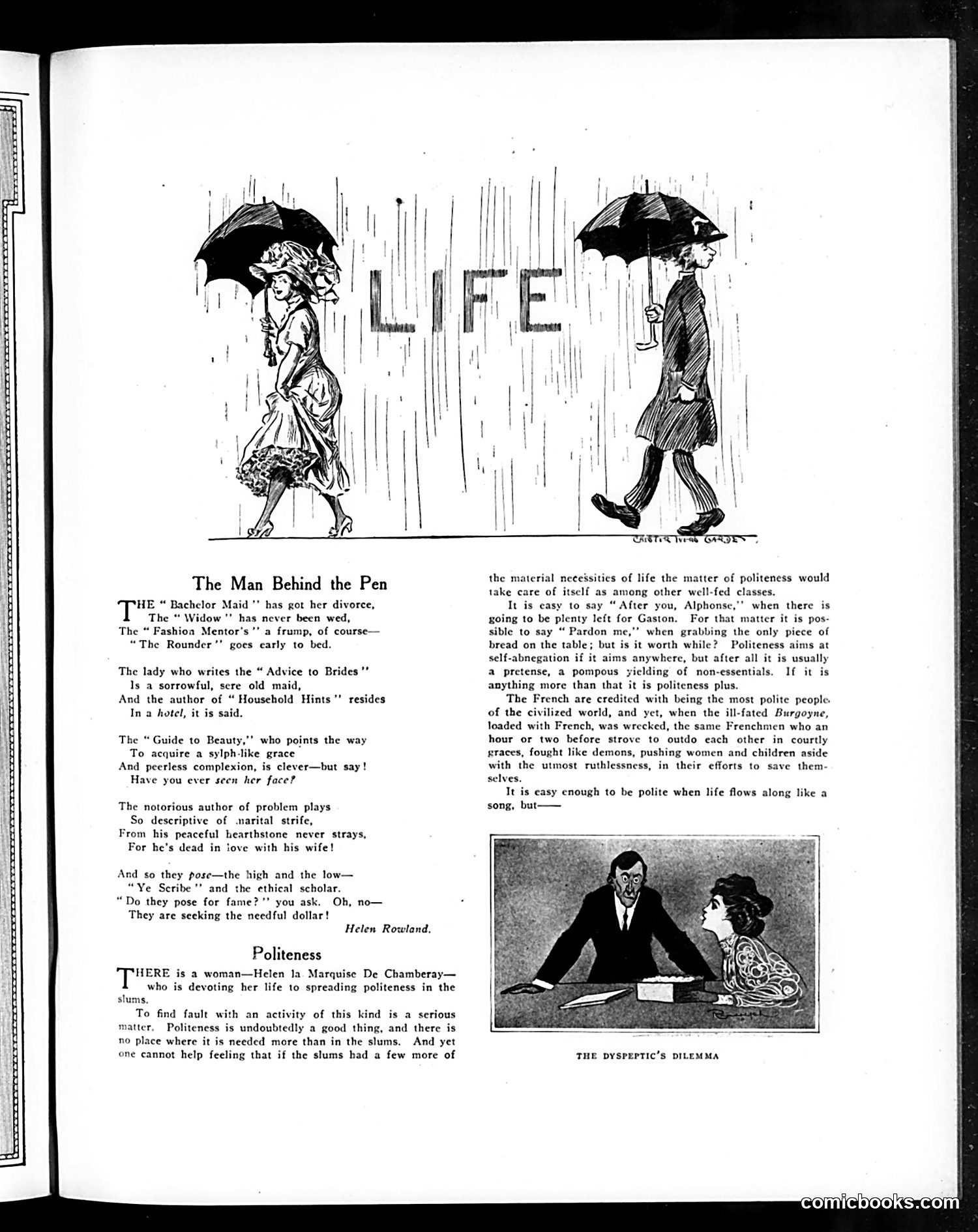
**Main Cartoon ("The Man Behind the Pen"):** This satirical poem by Helen Rowland mocks prolific male writers of popular literature—authors of "Bachelor" stories, "Widow" tales, fashion memoirs, and advice columns. The cartoon shows two figures in the rain labeled "LIFE," suggesting these writers profit from dramatizing romantic and domestic struggles while remaining emotionally detached ("dead in love with his wife"). The satire critiques how male authors monetize sentimentality and domestic advice for female readers. **Lower Section ("Politeness"):** The text discusses Helen La Marquise De Chamberay, who spreads politeness in slums. It argues that while politeness is valuable, it's insufficient as a solution to poverty—a critique of well-meaning but ineffectual charity efforts that address manners rather than material needs. **"The Dyspeptic's Dilemma" illustration** shows a business interaction, likely commenting on social awkwardness in commercial contexts.
📄 Transcribed text from this page (OCR, searchable)
Machine-transcribed from the original scan — historical spelling and the odd misread are preserved.
The Man Behind the Pen HE “ Bachelor Maid '’ has got her divorce, The “ Widow" has never been wed, The “ Fashioa Mentor’s "’ a frump, of course— “The Rounder’ goes carly to bed. The lady who writes the “ Advice to Brides ’’ ls a sorrowful, sere old maid, And the author of “ Household Hints’ resides In a hotel, it is said. The “Guide to Beauty,’’ who points the way To acquire a sylph-like grace And peerless complexion, is clever—but say! Have you ever seen her face? The notorious author of problem plays So descriptive of .narital strife, From his peaceful hearthstone never strays, For he’s dead in love with his wife! And so they pose—the high and the low— “Ye Scribe’ and the ethical scholar. “Do they pose for fame?" you ask. Ob, no— They are seeking the needful dollar! Helen Rowland. Politeness HERE is a woman—Helen la Marquise De Chamberay— who is devoting her life to spreading politeness in the slums, To find fault with an activity of this kind is a serious matter, Politeness is undoubtedly a good thing, and there is no place where it is needed more than in the slums. And yet one cannot help feeling that if the slums had a few more of the material neeedsities of life the matter of politeness would take care of itself as among other well-fed classes. It is easy to say “After you, Alphonse,”’ when there is going to be plenty left for Gaston. For that matter it is pos- sible to say “ Pardon me," when grabbing the only piece of bread on the table; but is it worth while? Politeness aims at self-abnegation if it aims anywhere, but after all it is usually a pretense, a pompous yielding of non-essentials. If it is anything more than that it is politeness plus. The French are credited with being the most polite people. of the civilized world, and yet, when the ill-fated Burgoyne, loaded with French, was wrecked, the same Frenchmen who an hour or two before strove to outdo each other in courtly graces, fought like demons, pushing women and children aside with the utmost ruthlessness, in their efforts to save them- selves. It is easy enough to be polite when life flows along like a song, but—— THE DYSPEPTIC’S DILEMMA