
Life, 1910-11-24 · page 31 of 48
Life — November 24, 1910 — page 31: what you’re looking at
What you’re looking at
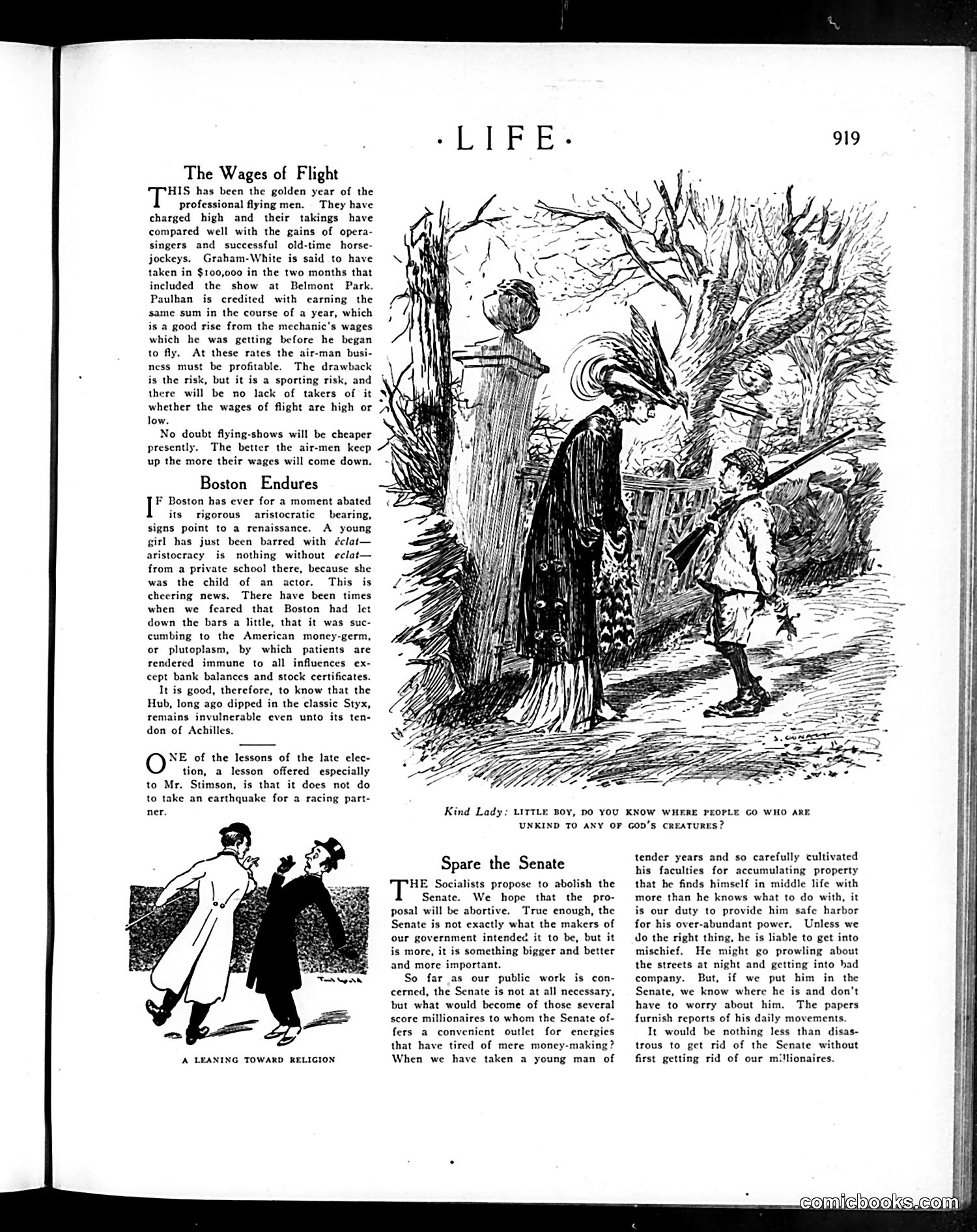
This page contains three distinct satirical pieces: **"The Wages of Flight"** discusses early aviation pioneers (Graham-White and Paulhan are named) earning exceptional incomes—up to $100,000—from flight demonstrations, comparing their earnings to opera singers and jockeys. The satire suggests this lucrative bubble will burst as aviation becomes commonplace. **"Boston Endures"** mocks Boston's aristocratic pretension by celebrating that a young girl was expelled from a private school *because her father was an actor*—treating this as proof Boston maintains its snobbish standards against "the American money-germ" (plutocracy). The satire is ironic: Life ridicules Boston's rigidity. **"Spare the Senate"** sarcastically argues against abolishing the Senate by claiming it serves as a useful containment for wealthy men with "over-abundant power" who might otherwise cause mischief. It's a tongue-in-cheek critique of the Senate as a sinecure for the rich. The cartoons—"A Leaning Toward Religion" and one showing two figures—appear to be unrelated vignettes typical of Life's format.
📄 Transcribed text from this page (OCR, searchable)
Machine-transcribed from the original scan — historical spelling and the odd misread are preserved.
The Wages of Flight HIS has been the golden year of the professional flying men. They have charged high and their takings have compared well with the gains of opera- singers and successful old-time horse- jockeys. Graham-White is said to have taken in $100,000 in the two months that included the show at Belmont Park. Paulhan is credited with earning the same sum in the course of a year, which is a good rise from the mechanic's wages which he was getting before he began to fly. At these rates the air-man busi- ness must be profitable. The drawback is the risk, but it is a sporting risk, and \ there will be no lack of takers of it whether the wages of flight are high or low. No doubt flying-shows will be cheaper presently. The better the air-men keep up the more their wages will come down. Boston Endures F Boston has ever for a moment abated its rigorous aristocratic bearing, signs point to a renaissance. A young girl has just been barred with éclat— aristocracy is nothing without eclat— from a private school there, because she was the child of an actor. This is cheering news. There have been times when we feared that Boston had let down the bars a little, that it was suc- cumbing to the American moncy-germ, or plutoplasm, by which patients are rendered immune to all influences ex- cept bank balances and stock certificates. It is good, therefore, to know that the Hub, long ago dipped in the classic Styx, remains invulnerable even unto its ten- don of Achilles. NE of the lessons of the late elec- tion, a lesson offered especially to Mr. Stimson, is that it does not do to take an earthquake for a racing part- A LEANING TOWARD RELIGION Kind Lady: LittLe woy, po YOU KNOW WHERE PEOPLE GO WHO ARE UNKIND TO ANY OF GOD’S CREATURES? Spare the Senate HE Socialists propose to abolish the Senate. We hope that the pro- posal will be abortive. True enough, the Senate is not exactly what the makers of our government intended it to be, but it is more, it is something bigger and better and more important. So far as our public work is con- cerned, the Senate is not at all necessary, but what would become of those several score millionaires to whom the Senate of- fers a convenient outlet for energies that have tired of mere money-making? When we have taken a young man of tender years and so carefully cultivated his faculties for accumulating property that he finds himself in middle life with more than he knows what to do with, it is our duty to provide him safe harbor for his over-abundant power. Unless we do the right thing, he is liable to get into mischief. He might go prowling about the streets at night and getting into bad company. But, if we put him in the Senate, we know where he is and don't have to worry about him. The papers furnish reports of his daily movements. It would be nothing less than disas- trous to get rid of the Senate without first getting rid of our miMionaires.