
Life, 1910-11-24 · page 14 of 48
Life — November 24, 1910 — page 14: what you’re looking at
What you’re looking at
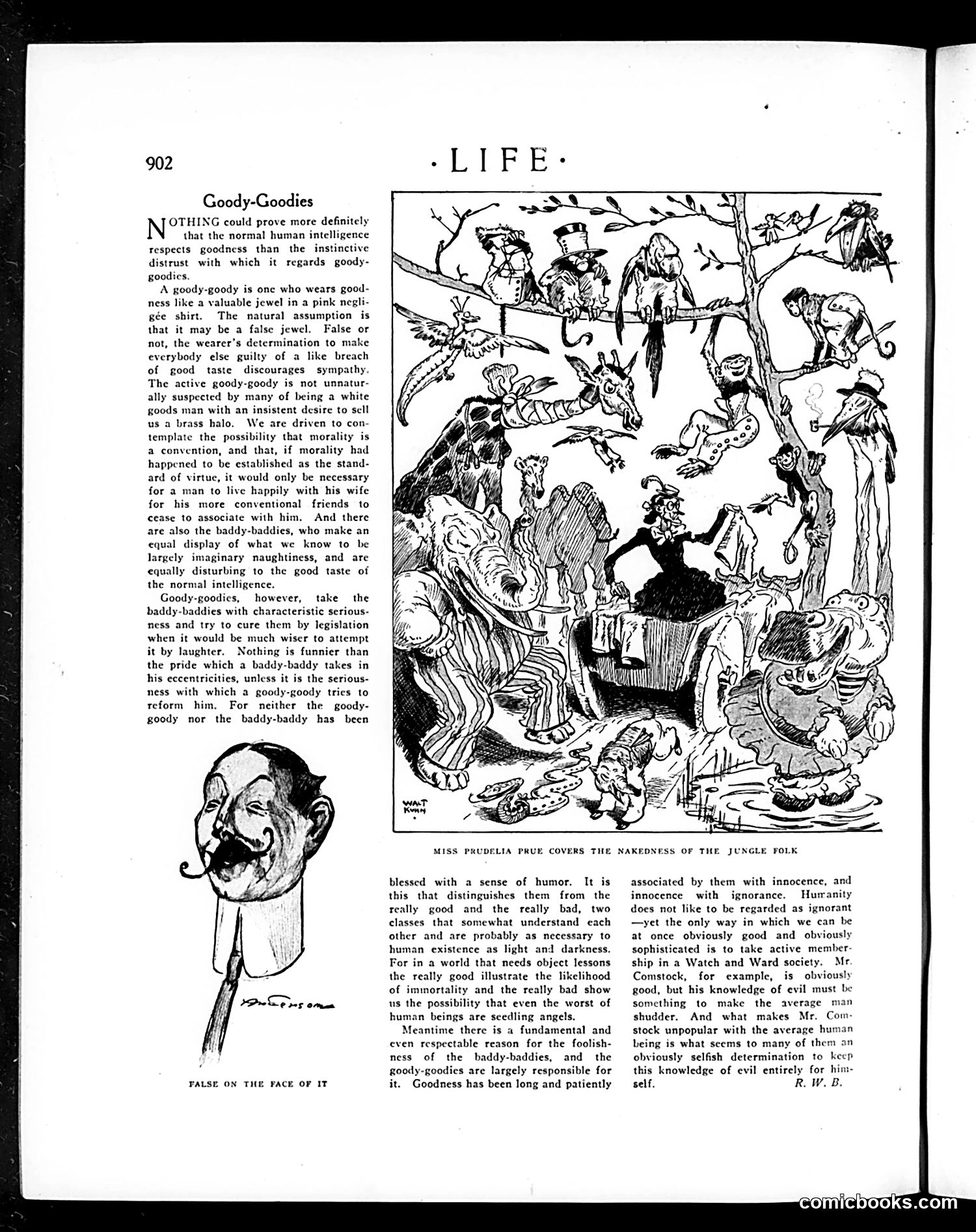
This satirical essay attacks self-righteous moralists ("goody-goodies") who ostentatiously display virtue while attempting to reform others through legislation and judgment rather than humor. The author distinguishes between genuinely good/bad people (who understand each other and lack pretension) versus performative "goody-goodies" and "baddy-baddies" (who lack humor and self-awareness). The essay singles out **Anthony Comstock**, the infamous anti-vice crusader, as exemplifying this hypocrisy: he appears morally pure but possesses extensive knowledge of "evil" he's determined to keep from others—making him unpopular despite obvious goodness. The large illustration shows "Miss Prudelia Prue" covering jungle inhabitants' nudity, satirizing how goody-goodies impose their moral standards on others under guise of propriety. The cartoon mocks this missionary zeal as self-serving rather than genuinely altruistic.
📄 Transcribed text from this page (OCR, searchable)
Machine-transcribed from the original scan — historical spelling and the odd misread are preserved.
902 Goody-Goodies OTHING could prove more definitely that the normal human intelligence respects goodness than the instinctive distrust with which it regards goody- goodies. A goody-goody is one who wears good- ness like a valuable jewel in a pink negli- gée shirt. The natural assumption is that it may be a false jewel. False or not, the wearer’s determination to make everybody else guilty of a like breach of good taste discourages sympathy. The active goody-goody is not unnatur- ally suspected by many of being a white goods man with an insistent desire to sell us a brass halo. We are driven to con- template the possibility that morality is a convention, and that, if morality had happened to be established as the stand- ard of virtue, it would only be necessary for a man to live happily with his wife for his more conventional friends to cease to associate with him, And there are also the baddy-baddies, who make an equal display of what we know to be largely imaginary naughtiness, and are equally disturbing to the good taste of the normal intelligence. Goody-goodies, however, take the baddy-baddies with characteristic serious- ness and try to cure them by legislation when it would be much wiser to attempt it by laughter. Nothing is funnier than the pride which a baddy-baddy takes in his eccentricities, unless it is the serious- ness with which a goody-goody tries to reform him. For neither the goody- goody nor the baddy-baddy has been FALSE ON THE PACE OF IT ( a lan Oe by MISS PRUDELIA PRUE COVERS THE NAKEDNESS OF THE JUNGLE FOLK blessed with a sense of humor. It is this that distinguishes them from the really good and the really bad, two classes that somewhat understand cach other and are probably as necessary to human existence as light and darkness. For in a world that needs object lessons the really good illustrate the likelihood of immortality and the really bad show us the possibility that even the worst of human beings are scedling angels. Meantime there is a fundamental and even respectable reason for the foolish- ness of the baddy-baddies, and the goody-goodies are largely responsible for it. Goodness has been long and patiently associated by them with innocence, and innocence with ignorance. Huranity does not like to be regarded as ignorant —yet the only way in which we can be at once obviously good and obviously sophisticated is to take active member ship in a Watch and Ward society. Mr Comstock, for example, is obviously good, but his knowledge of evil must be something to make the average man shudder. And what makes Mr. Com stock unpopular with the average human being is what seems to many of them an obviously selfish determination to keep this knowledge of evil entirely for him- self. R.W. B.