
A complete issue · 72 pages · 1910
Life — May 5, 1910
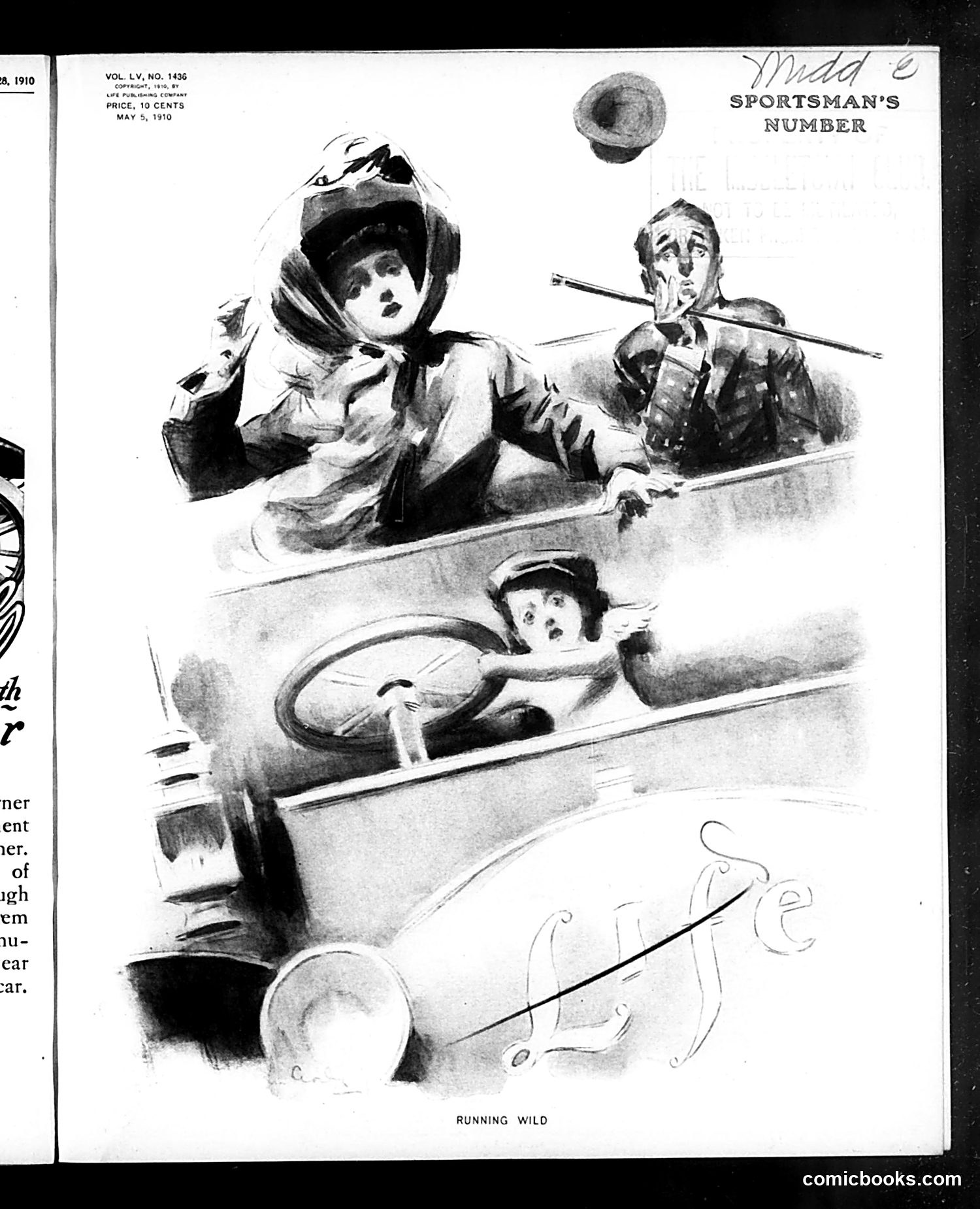
This cartoon satirizes early automobile culture and reckless driving. The illustration depicts a chaotic scene where a woman driver operates a speeding motorcar while a man beside her appears anxious, gripping the side of the vehicle. A child sits in the back seat looking alarmed, and a ball flies through the air above—suggesting near-collision with pedestrians or obstacles. The title "Running Wild" mocks both the dangerous driving habits of the era and, likely, the novelty of women drivers. The woman's fashionable hat and confident expression contrast sharply with her passengers' terror, suggesting satirical commentary on whether women were safe or competent automobile operators—a contemporary social debate during the early automotive age.
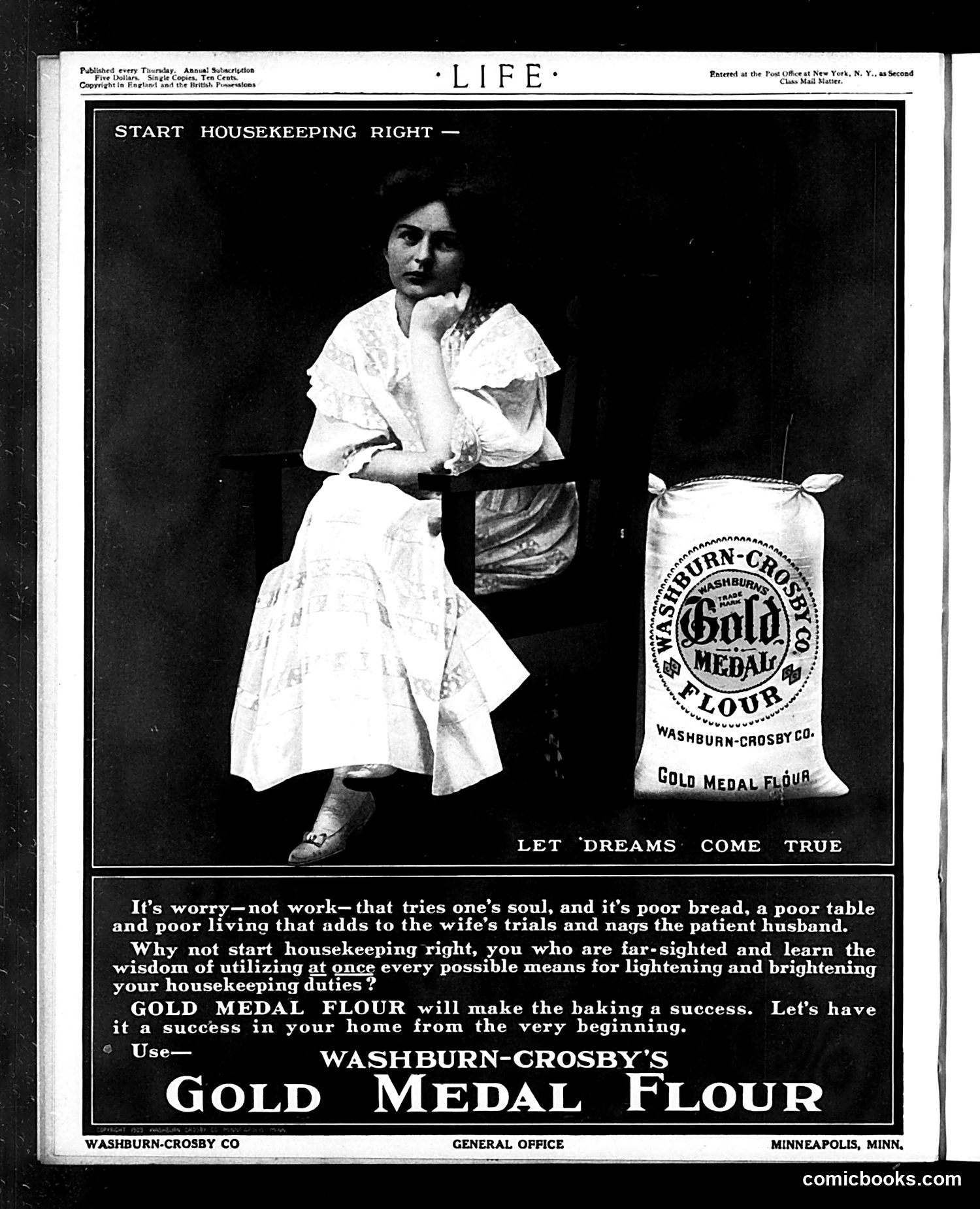
This is a **Washburn-Crosby Gold Medal Flour advertisement**, not political satire. The page shows a woman in early 1900s dress with the headline "START HOUSEKEEPING RIGHT — LET 'DREAMS' COME TRUE." The ad addresses wives directly, acknowledging their domestic frustrations: "worry—not work—that tries one's soul" and complaints about "poor bread, a poor table and poor living." It frames Gold Medal Flour as the solution to marital harmony and successful housekeeping. The "dreams" reference suggests that using quality flour will transform a wife's baking success, thereby improving her household and marriage. This reflects period advertising that positioned consumer products as solutions to domestic discontent and gender roles.
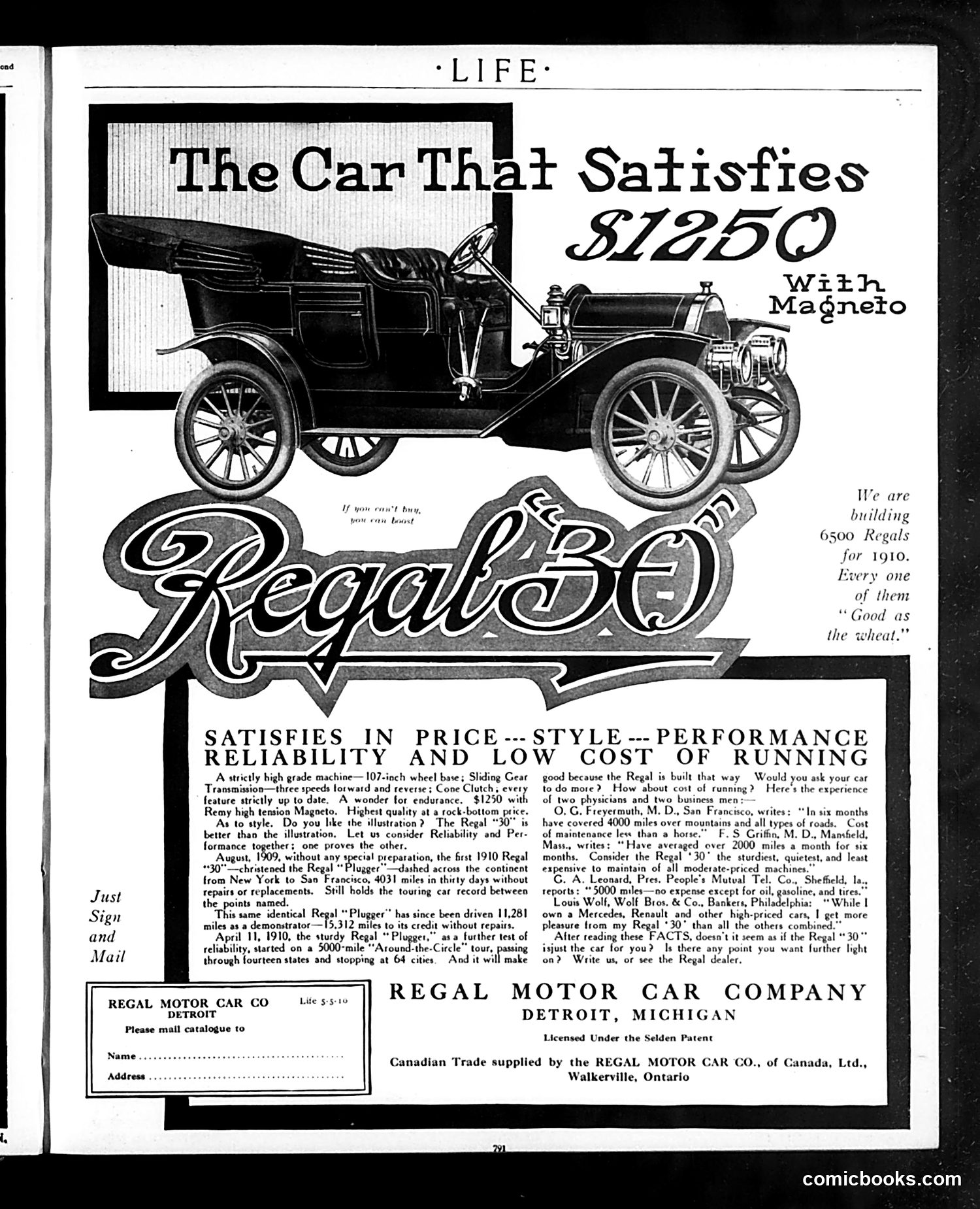
This is primarily **advertising, not satire or political commentary**. The page features a full-page advertisement for the Regal "50" automobile, manufactured by Regal Motor Car Company in Detroit, Michigan. The ad emphasizes the car's affordability at $1,250 with a Magneto ignition system, claiming it satisfies multiple buyer priorities: price, style, performance, reliability, and low running costs. The testimonials from satisfied owners (physicians, businessmen) stress durability and dependability. The only potentially humorous element is the small text "If you can't have, you can't brag," suggesting social aspiration—but this is straightforward marketing, not satire. The page includes a mail-in coupon for catalog requests, typical of early 20th-century automotive advertising.
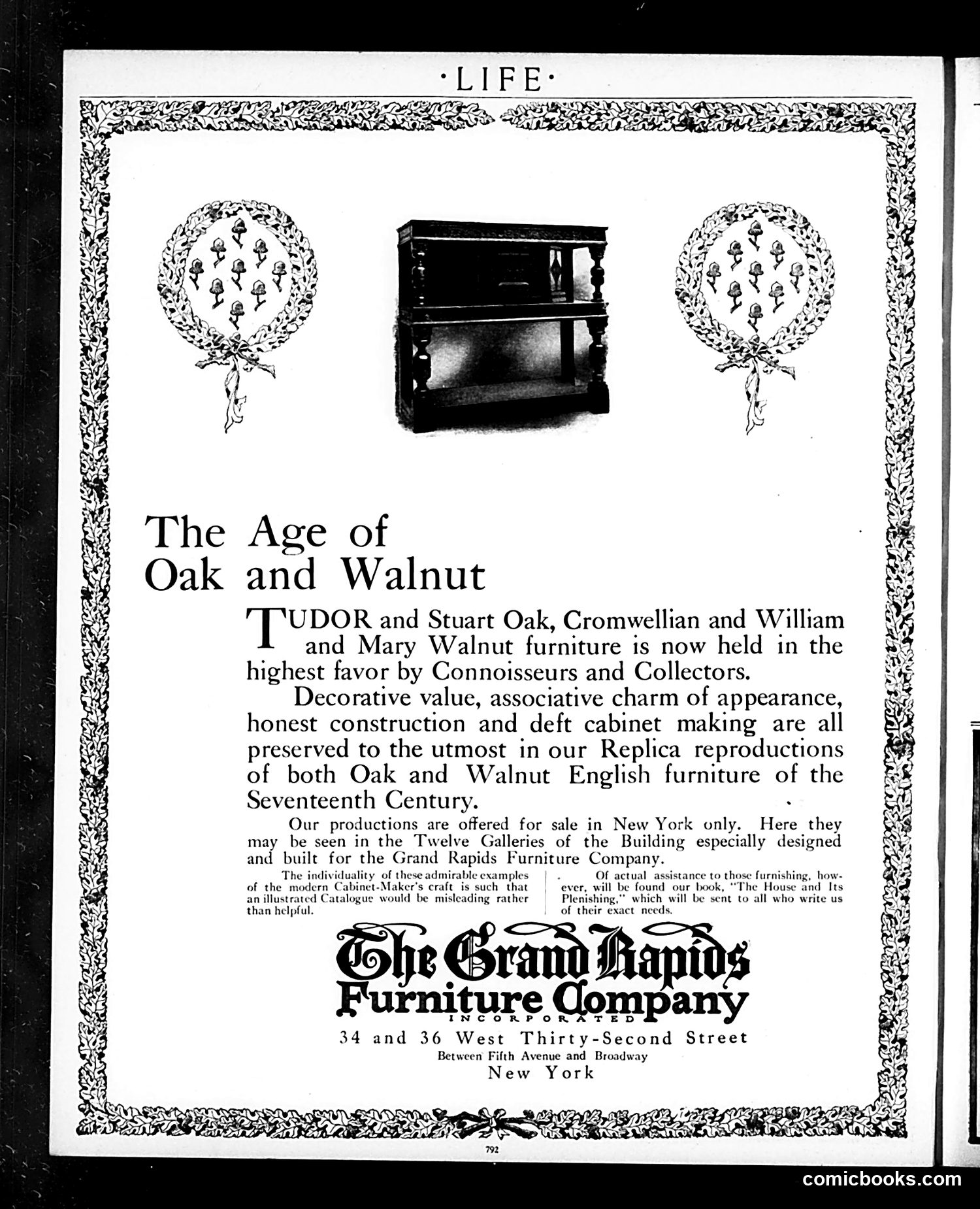
This is primarily an **advertisement, not political satire**. The Grand Rapids Furniture Company is marketing Tudor, Stuart, Cromwellian, and William and Mary style oak and walnut furniture to wealthy collectors and connoisseurs in New York. The decorative elements—the wreaths with portrait medallions on either side and the ornamental borders—are purely aesthetic framing devices typical of 1920s luxury advertising. They reference historical periods to enhance the furniture's perceived value and prestige. The piano image in the center appears as a product showcase rather than satirical commentary. The ad emphasizes "honest construction and deft cabinet making" to appeal to buyers seeking authentic reproductions of 17th-century English furniture. This is a straightforward commercial appeal to upper-class taste and historical authenticity, not social or political commentary.
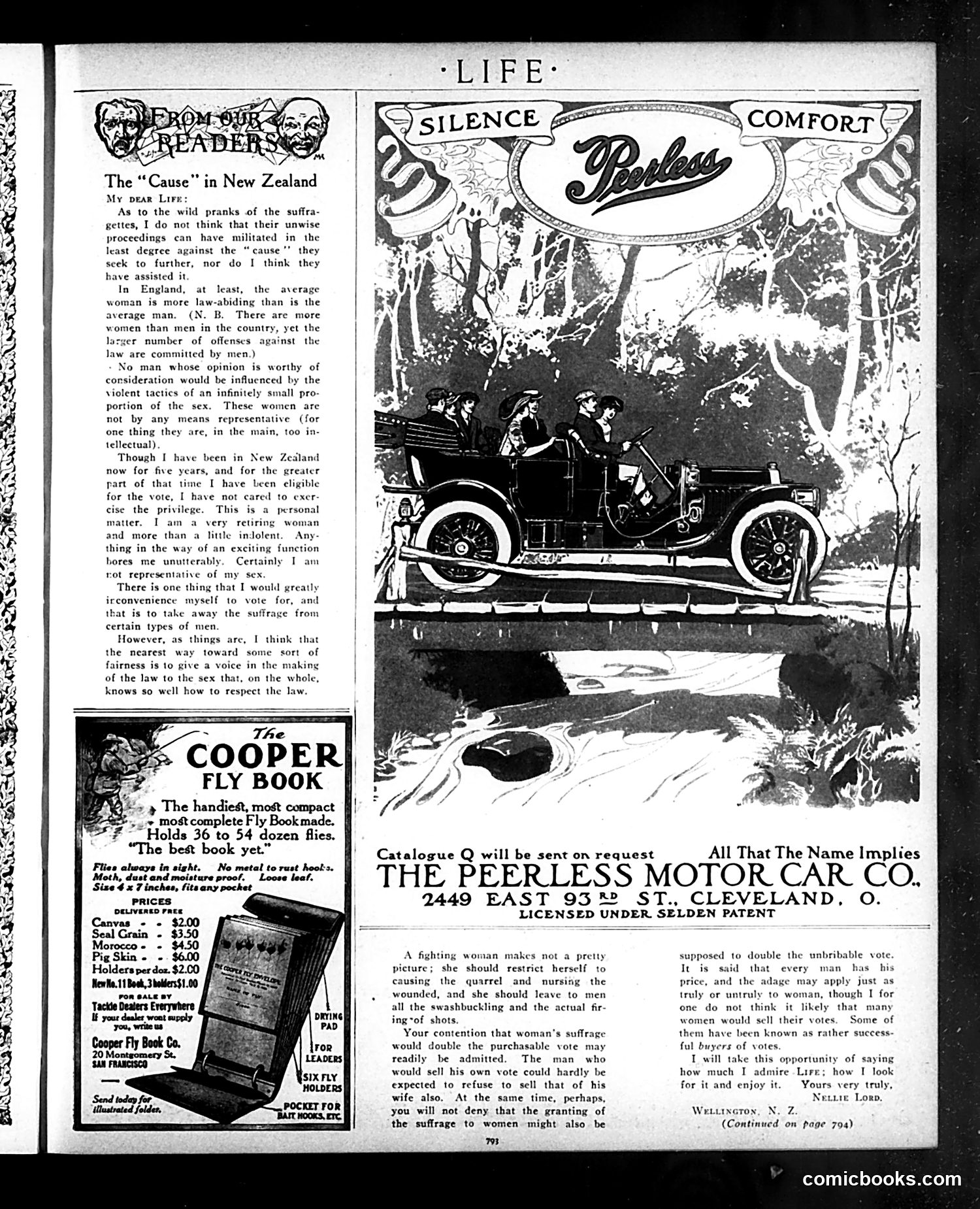
This page contains a reader's letter about women's suffrage in New Zealand, paired with a Peerless Motor Car advertisement. The letter writer, opposing suffrage, argues that suffragettes' "unwise proceedings" discredit their cause. He contends women commit more crimes than men and shouldn't vote as a group. He also claims New Zealand women (where suffrage had already been granted) don't represent broader female opinion. The accompanying advertisement shows well-dressed people in an automobile, captioned "Silence Comfort Peerless"—using leisure and respectability imagery to market cars to affluent readers. The juxtaposition appears satirical: the ad's depiction of genteel automobility contrasts sharply with the letter's dismissive arguments about women's political capability, highlighting the contradiction between treating women as consumers versus as citizens.
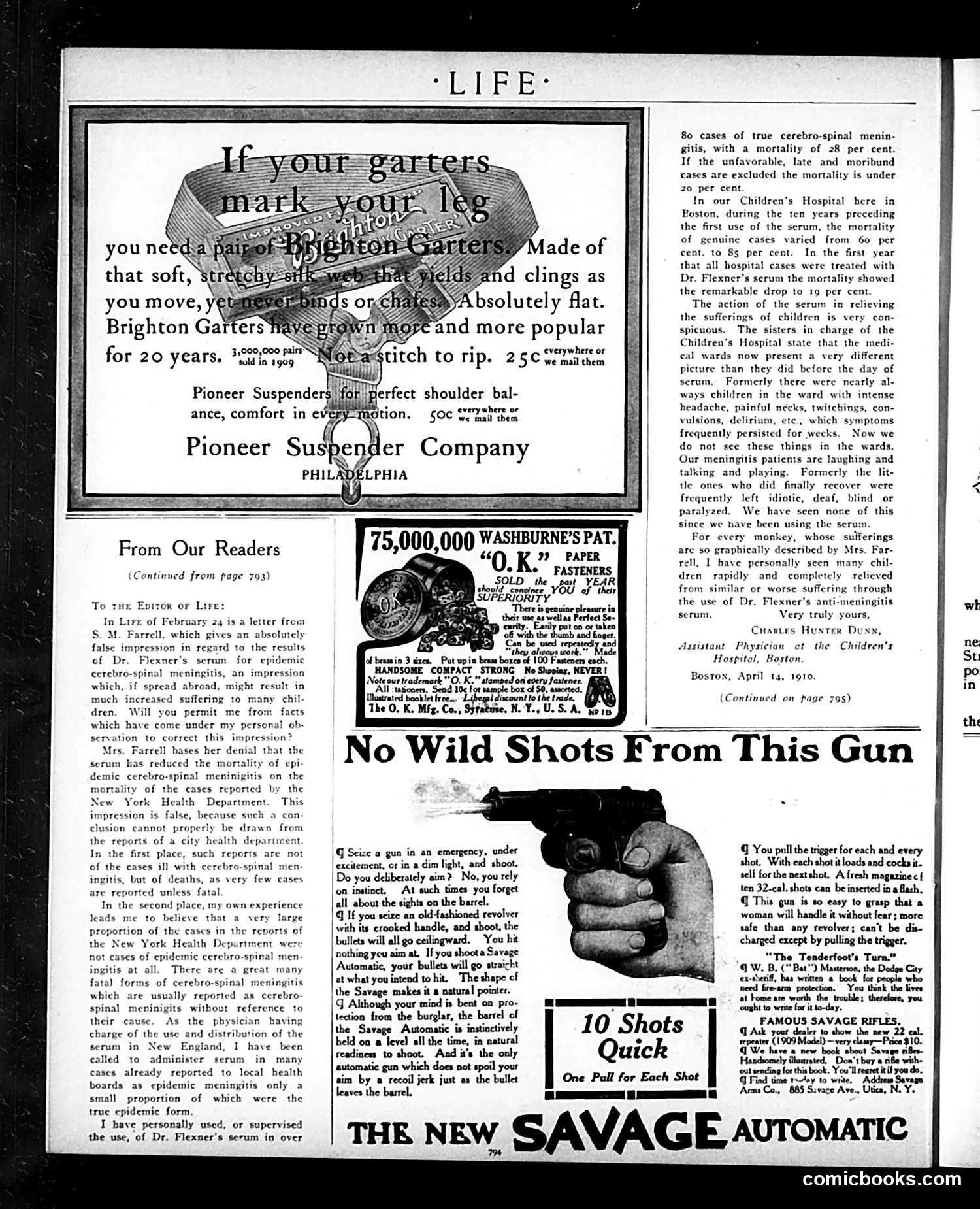
This page is **primarily advertising**, not satire. It features three distinct ads: 1. **Brighton Garters** (top): A vintage undergarment ad claiming 20 years of popularity, emphasizing comfort and durability. 2. **Washburne's "O.K." Fasteners** (middle): A product advertisement for industrial fasteners, highlighting superiority. 3. **Savage Automatic Rifle** (bottom): The largest ad promotes a new rifle model, emphasizing accuracy and ease of use—"10 shots quick, one pull for each shot." The page also includes a letter to the editor about Dr. Flexner's meningitis serum and hospital treatment results. The rifle advertisement reflects early 20th-century marketing norms when firearms were advertised alongside domestic goods without controversy. No political cartoon or satire appears on this page.
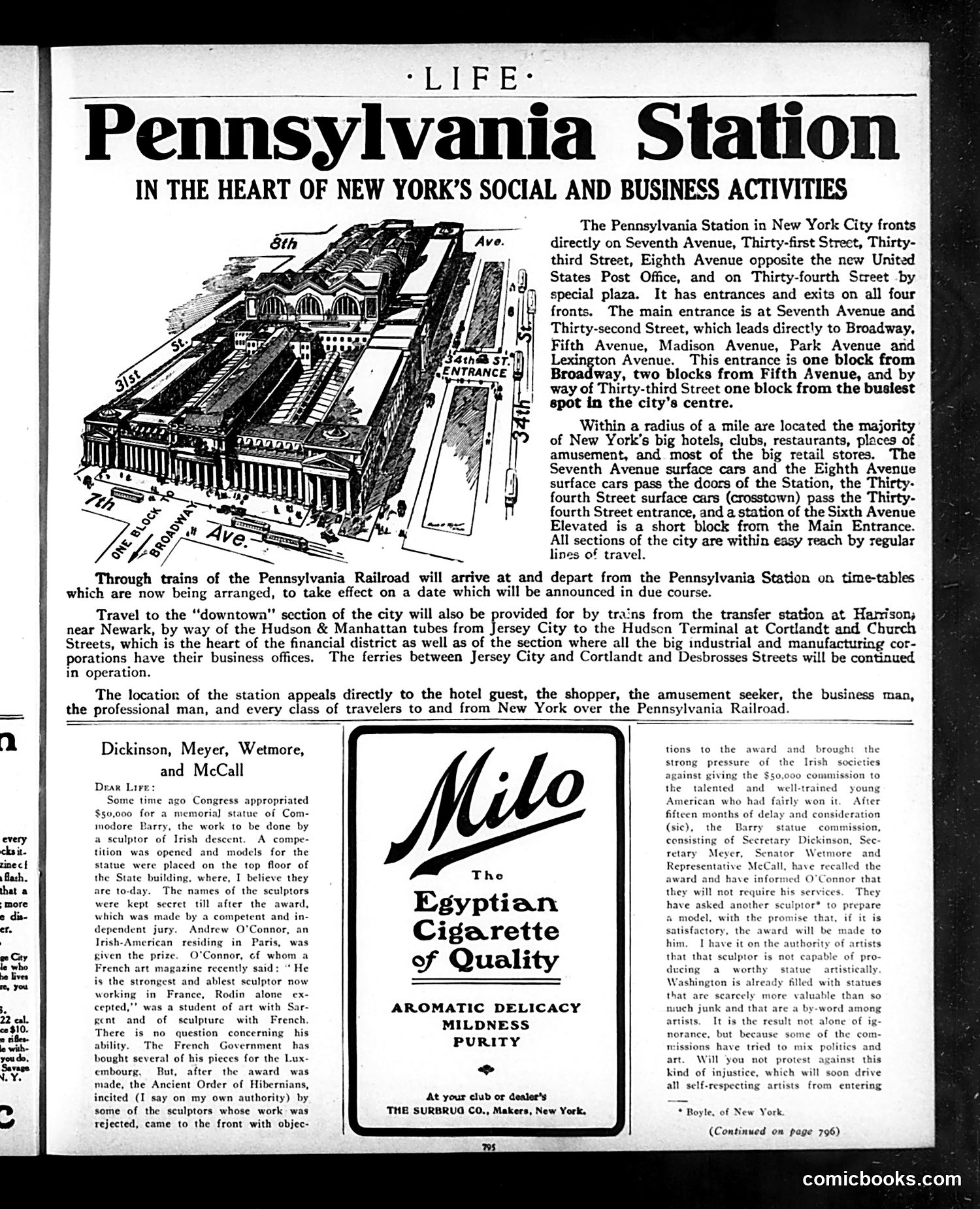
This page is primarily **informational and promotional**, not satirical. The top half features an architectural drawing and description of Pennsylvania Station in New York City—a major new transportation hub. The text explains its central location, multiple entrances, and convenient access to Manhattan's business and social districts. The bottom half contains a letter to the editor about a Commodore Barry memorial statue competition, followed by a **Milo Egyptian Cigarette advertisement** emphasizing "aromatic delicacy, mildness, purity." There are no political cartoons or caricatures on this page. It's a mix of civic infrastructure promotion and period advertising—representative of Life magazine's content bridging news, commentary, and commercial announcements.
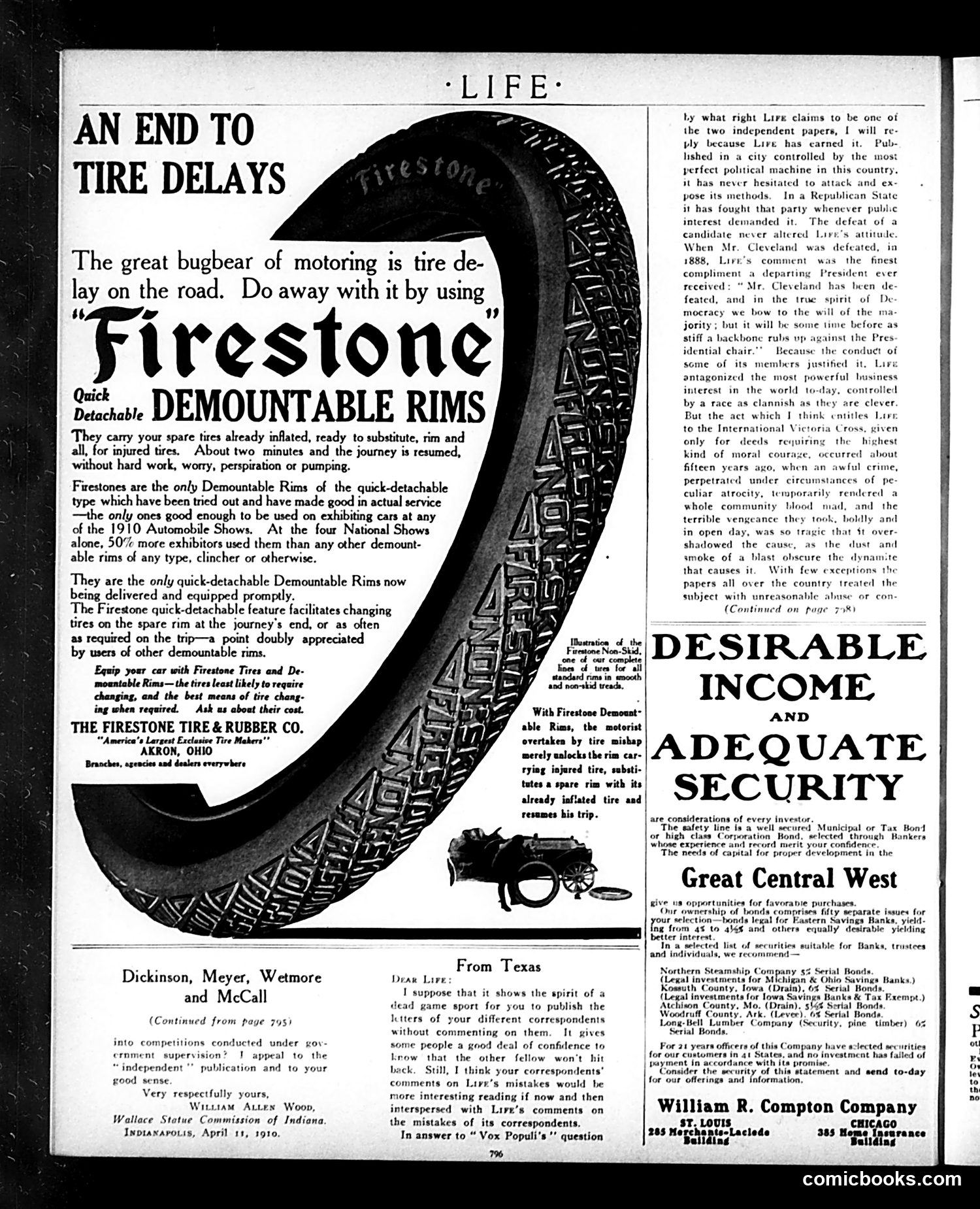
This page is primarily **advertising and letters to the editor**, not political satire. The dominant ad promotes **Firestone Demountable Rims** — a then-novel tire technology allowing quick spare-tire changes without tools. The accompanying illustration shows the tire's tread pattern. Below is a letter from **William Allen Wood** of the Wallace Stolar Commission of Indiana, praising Life's coverage of political correspondence and Cleveland's defeat (likely referring to a recent election or political event). The right column contains a financial advertisement for the **William R. Compton Company**, promoting municipal bonds and securities as "desirable income." The page reflects early 1900s concerns: automotive reliability, political commentary, and investment opportunity. No notable caricatures or satirical cartoons appear — this is primarily commercial content with reader correspondence.
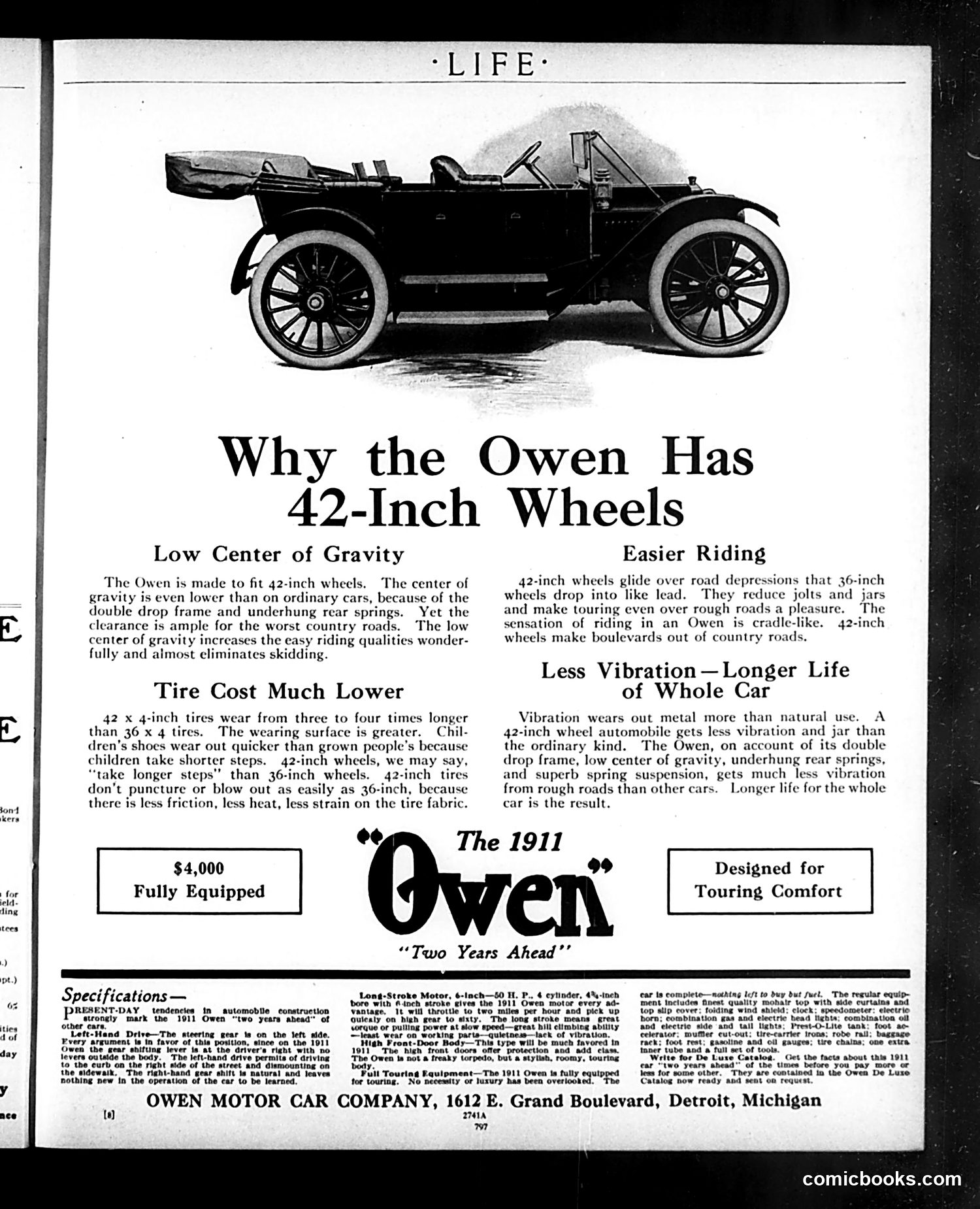
This is a straightforward automobile advertisement, not satirical content. It promotes the 1911 Owen automobile, manufactured in Detroit, Michigan, priced at $4,000 fully equipped. The ad emphasizes the vehicle's distinctive 42-inch wheels (compared to standard 36-inch wheels), arguing this design offers practical advantages: lower center of gravity for stability on rough roads, better ride quality, reduced vibration, and longer tire life. The headline "Two Years Ahead" suggests the Owen company viewed this wheel size as forward-thinking engineering. This represents early automotive marketing that highlighted technical specifications and engineering features as selling points to consumers evaluating competing car models during the automobile industry's rapid expansion period.
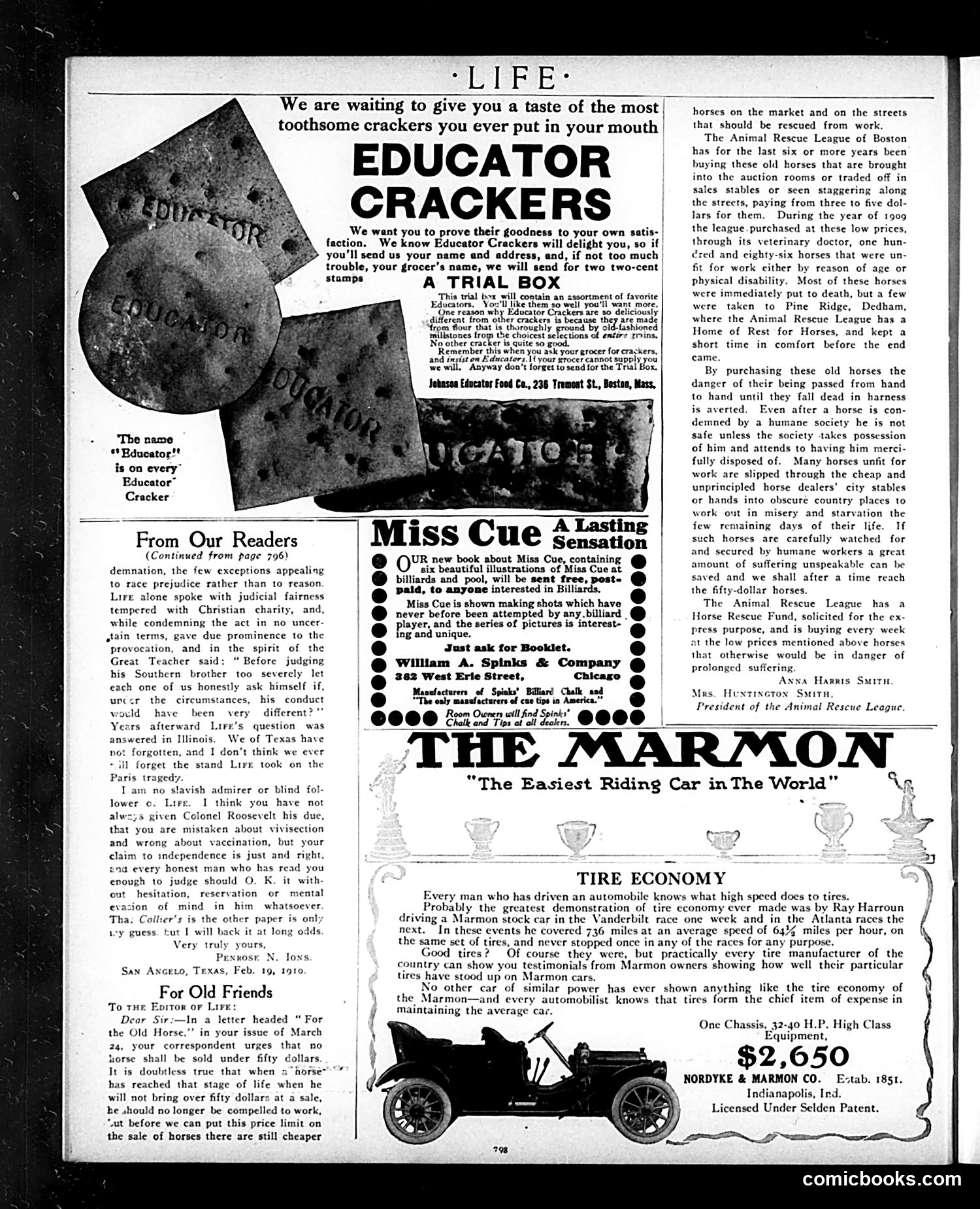
This page is primarily **advertising and reader letters**, not political satire. The dominant content includes: - A large **Educator Crackers advertisement** featuring product imagery and a "trial box" offer - A **Miss Cue billiards advertisement** with illustrations - **The Marmon automobile ad** ("The Easiest Riding Car in The World") - A **tire economy article** about Marmon vehicles - A reader letters section titled "From Our Readers" discussing horses, vaccination policy, and editorial disagreements The only satirical element is the readers' section, where correspondents debate Life's editorial positions—one defending Colonel Roosevelt, another criticizing Life's stance on vaccination and independence claims. The page reflects early 20th-century magazine publishing: mixing editorial content with substantial advertising to fund operations.
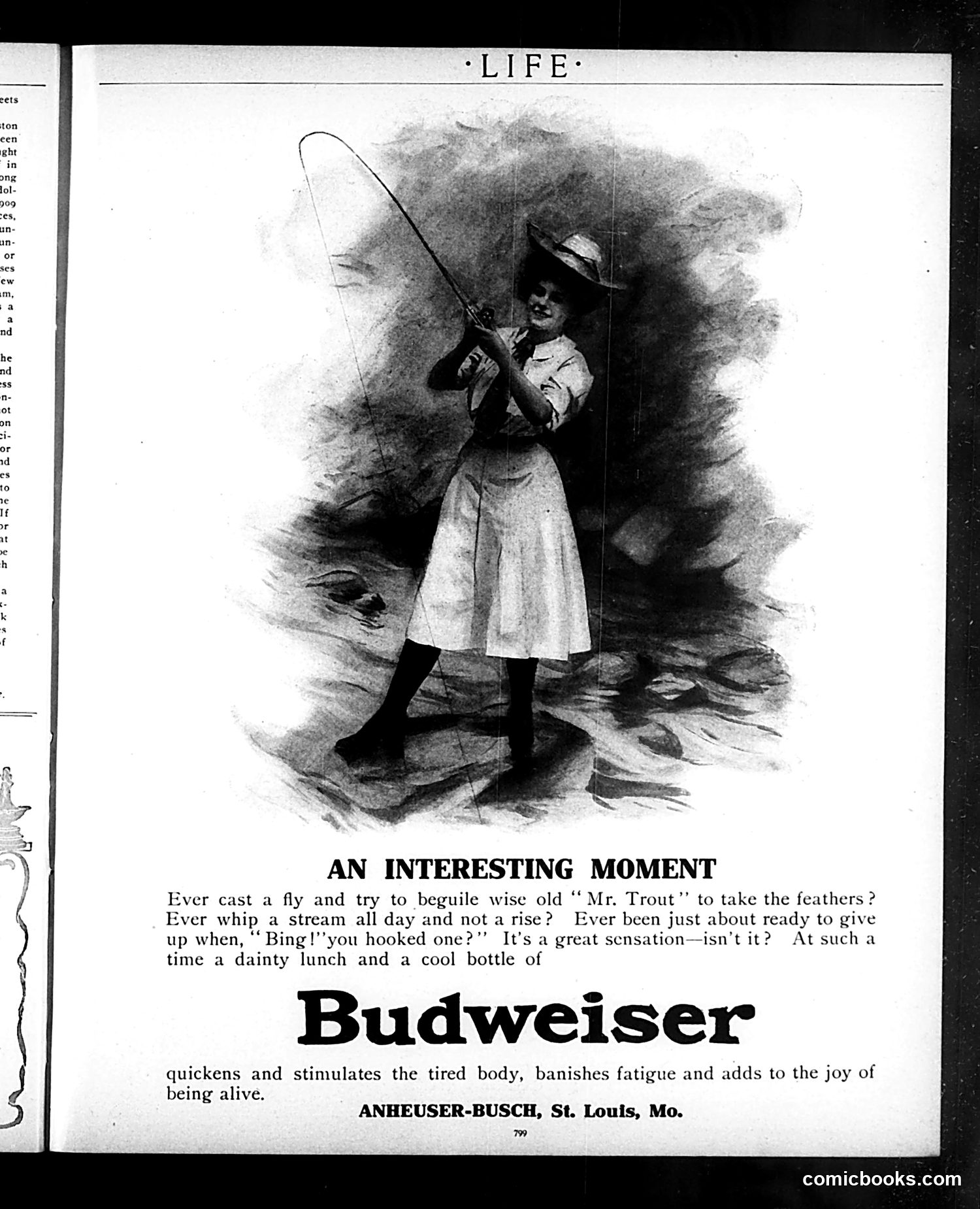
This is a **Budweiser beer advertisement**, not political satire. The page shows a woman in early 20th-century dress fly-fishing, titled "An Interesting Moment." The ad uses a rhetorical question format to appeal to outdoor enthusiasts: "Ever cast a fly and try to beguile wise old 'Mr. Trout'... At such a time a dainty lunch and a cool bottle of Budweiser quickens and stimulates the tired body, banishes fatigue and adds to the joy of being alive." The advertisement associates the beer with outdoor recreation, leisure, and refreshment—positioning Budweiser as an essential companion to active pursuits. The illustration depicts an idealized recreational scenario typical of early 20th-century advertising's aspirational lifestyle marketing.
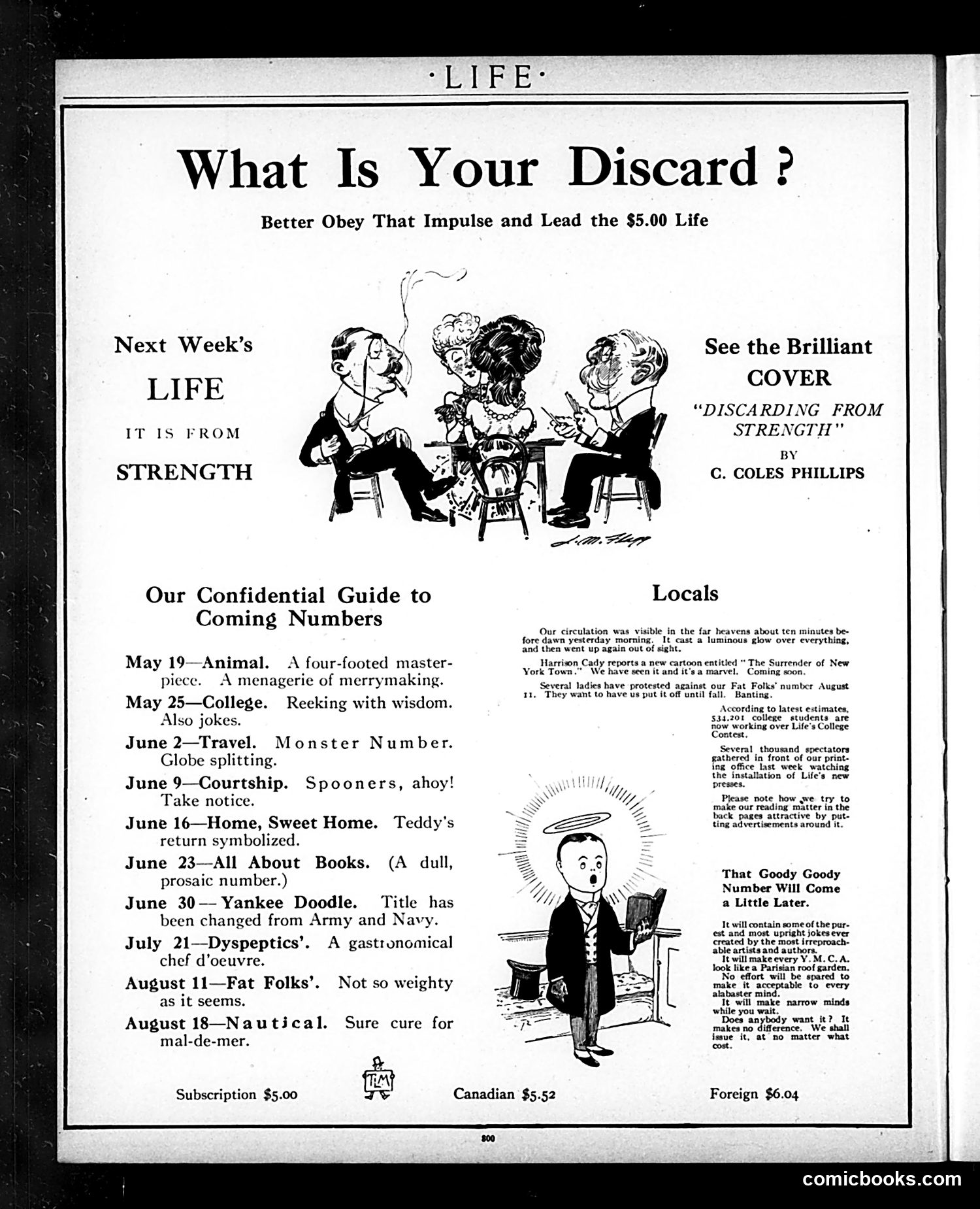
This is a **Life magazine advertisement/promotion page**, not a political cartoon. The main content advertises next week's issue, promising cover art by C. Coles Phillips titled "Discarding from Strength" — likely a social commentary on rejecting weakness or poor choices. The page's central joke, "What Is Your Discard?" plays on card games, suggesting readers should "obey that impulse" and subscribe to Life's $5.00 subscription. The left section lists upcoming article topics (Animal, College, Travel, Courtship, Home, Books, Yankee Doodle, Dyspepsia, Fat Folks, Nautical) — typical lighthearted magazine fare. The right section describes circulation growth and teases an upcoming "Goody Goody Number." The illustrations are generic period cartoons, not specific political satire.
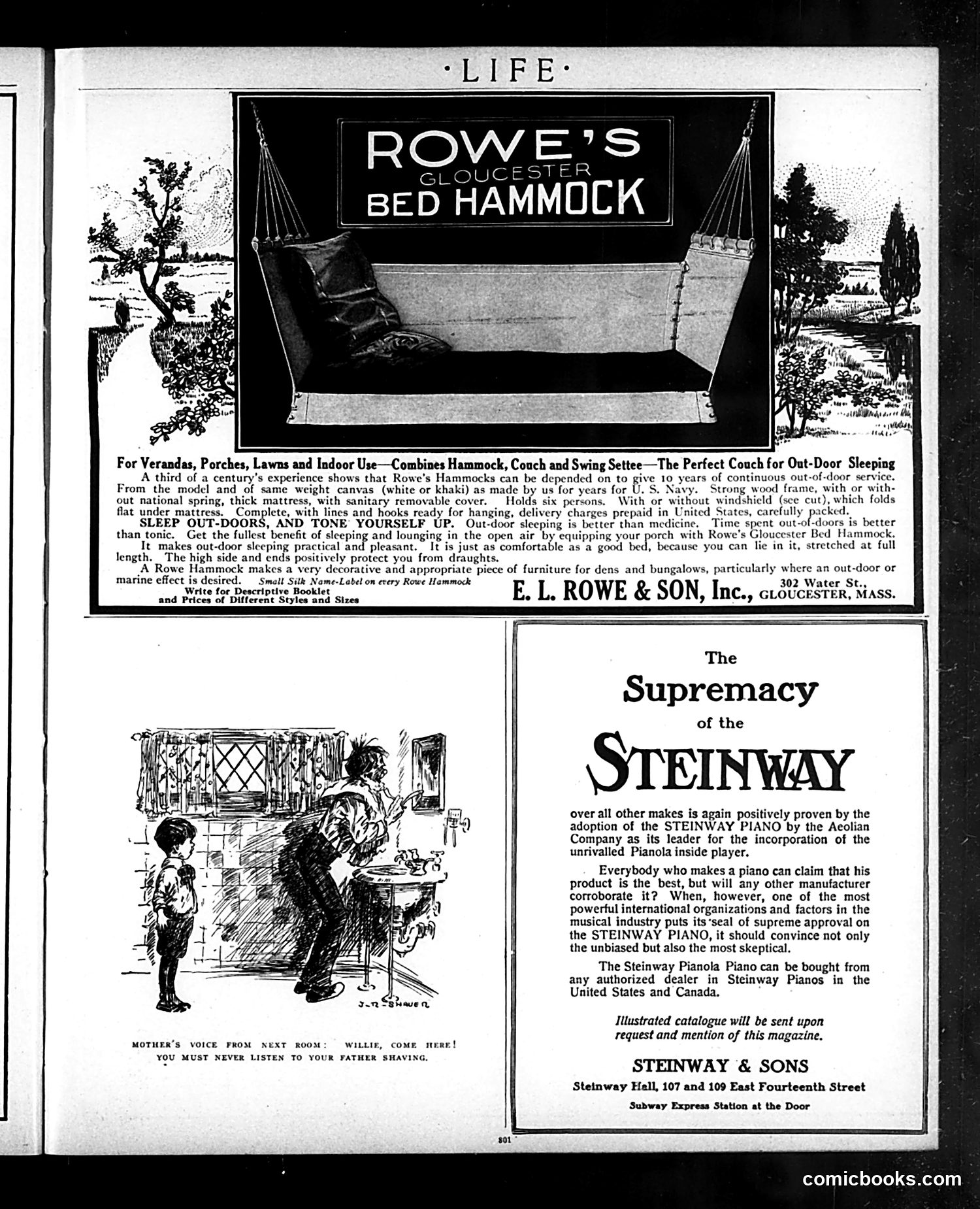
This page contains **two advertisements** rather than satirical cartoons: 1. **Rowe's Gloucester Bed Hammock** (top): A product advertisement emphasizing durability and comfort for outdoor sleeping, positioned as suitable for porches, lawns, and naval use. 2. **Steinway Piano** (bottom right): Promotes Steinway's piano superiority, claiming institutional adoption proves their quality. The accompanying illustration shows a domestic scene—a child being told by his mother to listen to his father shaving, humorously suggesting even mundane household sounds are preferable to poor piano music (likely a joke about competitors' instruments). The page is primarily commercial content from *Life* magazine's advertising section, not political or social satire. The Steinway ad's humor is product-based rather than topical.
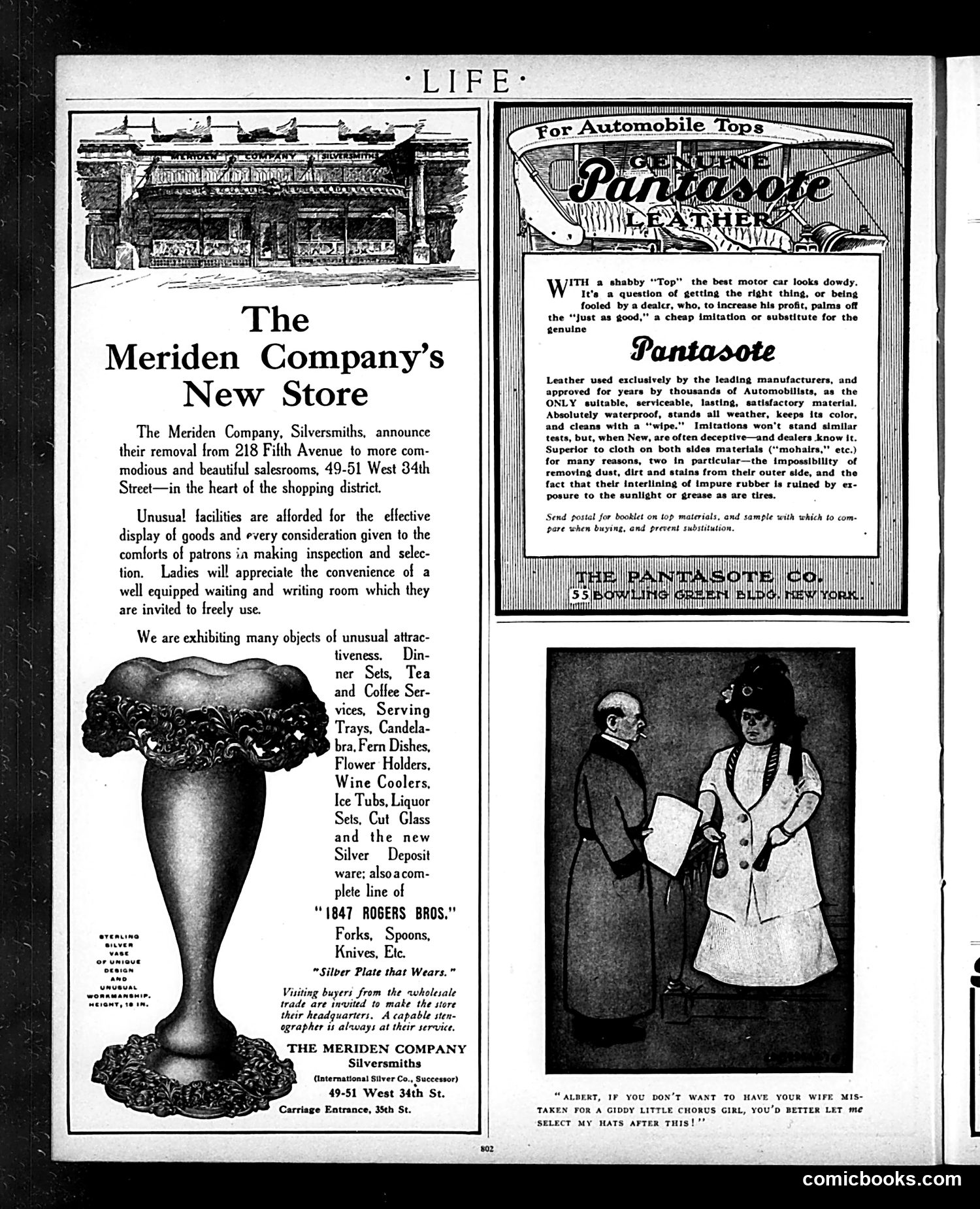
This page is primarily **advertisements** interspersed with one small cartoon. **The Meriden Company ad** announces their new silverware showroom, highlighting dining sets, flatware, and decorative items typical of early 20th-century home furnishings. **The Pantasote ad** warns car owners against cheap imitation convertible tops, promoting their genuine leather product as superior to substitutes dealers might try to sell. **The small cartoon at bottom** shows a domestic scene where a man tells his wife he should choose her hats to prevent her looking like a "giddy little chorus girl"—satirizing both male condescension and period anxieties about women's fashion choices. Chorus girls represented morally dubious entertainment; the joke mocks husbands who thought they needed to control wives' appearances to maintain respectability. The humor reflects early 1900s gender dynamics and class-consciousness about proper female presentation.
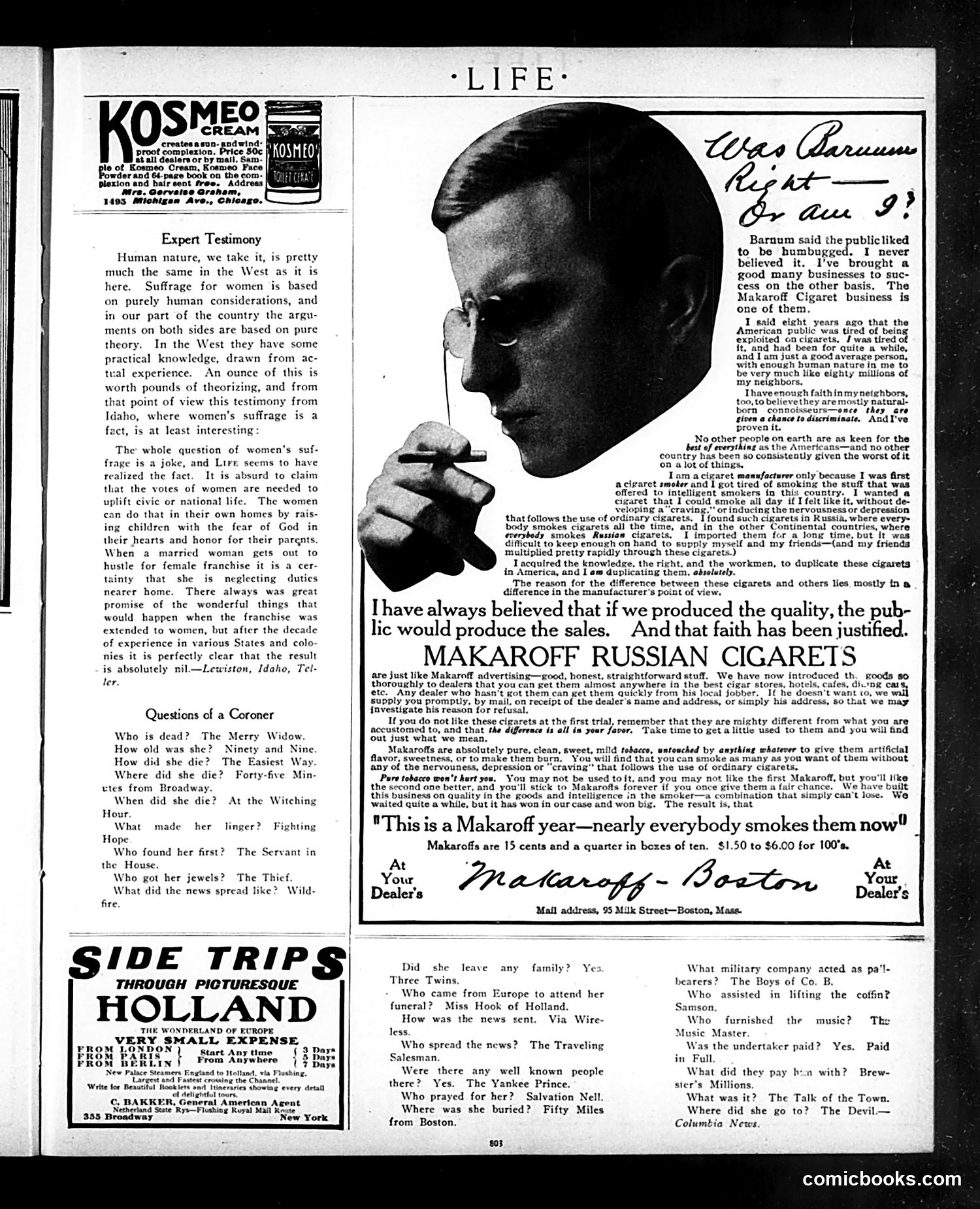
This page is primarily an advertisement for Makaroff Russian Cigarets, presented as a testimonial from the cigarette manufacturer. The central figure is the unnamed businessman/manufacturer who claims to have revolutionized the cigarette industry through honest marketing rather than humbug. The satire targets both cigarette advertising practices and American consumer culture. The manufacturer claims Americans are exploited with inferior products, yet he alone discovered Russians smoke "natural" cigarets without developing "cravings" or nervousness. This is ironic: he's actually using the same manipulative marketing tactics he claims to reject—appealing to vanity and sophistication while making unverifiable health claims. The page also contains unrelated content: a "Questions of a Coroner" joke section (wordplay on Broadway play titles) and travel advertisements for Holland. The Kosmeo Cream ad at top left is similarly dubious beauty product marketing of the era. The implicit joke: even "honest" advertising still exploits consumer insecurities.
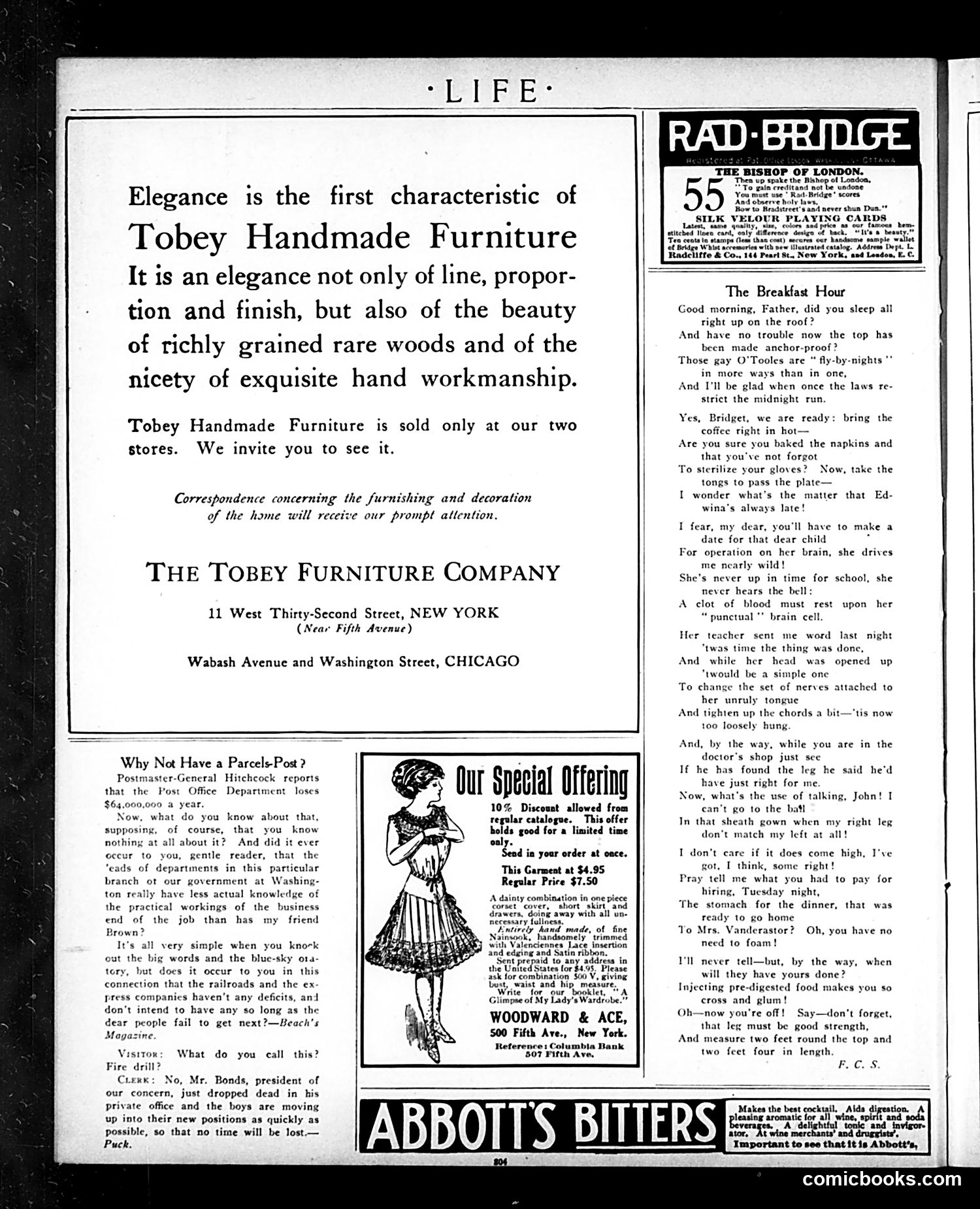
This page is primarily **advertising with one humorous piece**, not political satire. The main comedic content is "The Breakfast Hour," a domestic humor piece depicting a conversation between a husband and wife. It satirizes **early 20th-century upper-class anxieties** about modern conveniences and medical procedures. The wife casually discusses: - Installing "anchor-proof" roofing (apparently a contemporary concern) - Sterilizing gloves for dinner - Her daughter needing brain surgery to fix her tardy behavior (the joke being the absurdity of medical intervention for a child's punctuality problem) - Obtaining a prosthetic leg from a doctor The satire mocks both the wife's obsession with modern safety standards and the era's over-medicalization of everyday problems. The tone suggests this was meant as light social commentary on how newfangled technology and medical science were being applied to trivial domestic matters. The page otherwise contains straightforward advertisements for furniture, corsets, and bitters—typical of *Life* magazine's revenue model.
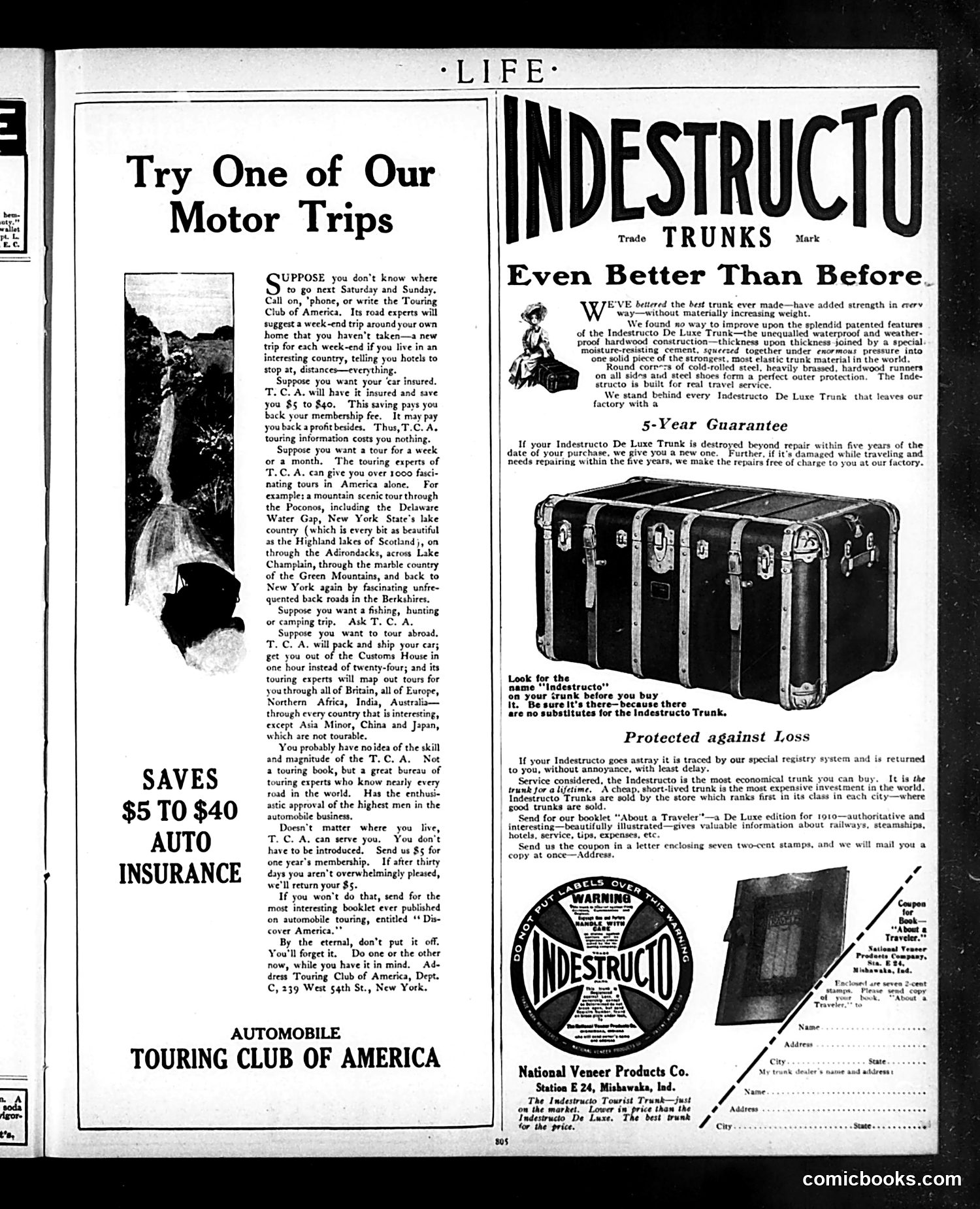
This is primarily an **advertising page**, not satirical content. It contains two major advertisements: **Left side:** The Touring Club of America promotes membership ($5/year), emphasizing its services: vacation route planning, auto insurance savings ($5-$40), and international travel expertise. The ad targets affluent car owners seeking curated road trips across America and Europe—a luxury service reflecting the early automobile era's novelty. **Right side:** Indestructo Trunks advertises travel luggage, highlighting durability through "waterproof hardwood construction" and a five-year guarantee. The trunk image and circular warning label emphasize the product's protective qualities for travelers. **Historical context:** This appears to be from the 1910s-1920s automobile boom, when motorized tourism was novel and membership clubs coordinated travel routes. The ads target middle-to-upper-class readers who could afford cars and leisure travel—a privilege requiring explanation of how to use these services. There is no political satire here; this is straightforward commercial promotion reflecting period attitudes toward automobile ownership and tourism.
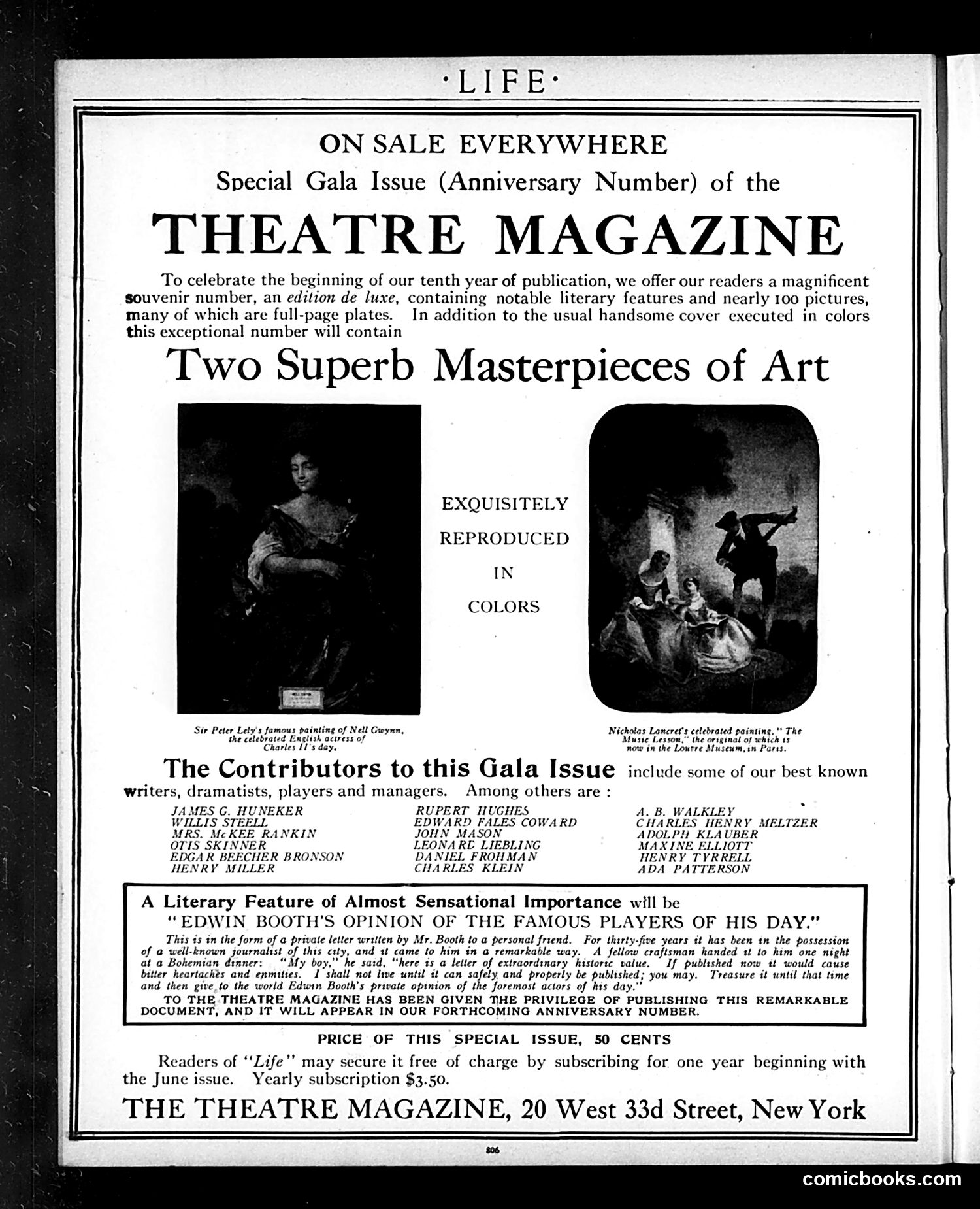
This is primarily an **advertisement** for Theatre Magazine's tenth-anniversary special issue, not a political cartoon or satirical piece. The page promotes two featured artworks: Sir Peter Lely's portrait of **Nell Gwynn** (mistress of King Charles II, famous English actress) and Nicolas Lancret's **"The Music Lesson."** Both are classical paintings being reproduced in color—presented as prestige content. The main draw is a promised letter from **Edwin Booth** (the famous 19th-century Shakespearean actor), offering his private opinions on celebrated performers of his era. The copy emphasizes this as historically significant and previously unpublished material. The page lists prominent **theatre contributors**—playwrights, actors, and critics of the era—to establish credibility and appeal to theatre enthusiasts. The tone is celebratory marketing: positioning this as a luxury publication (50 cents, or free with yearly subscription at $3.50) aimed at educated readers interested in theatre history and classical art.
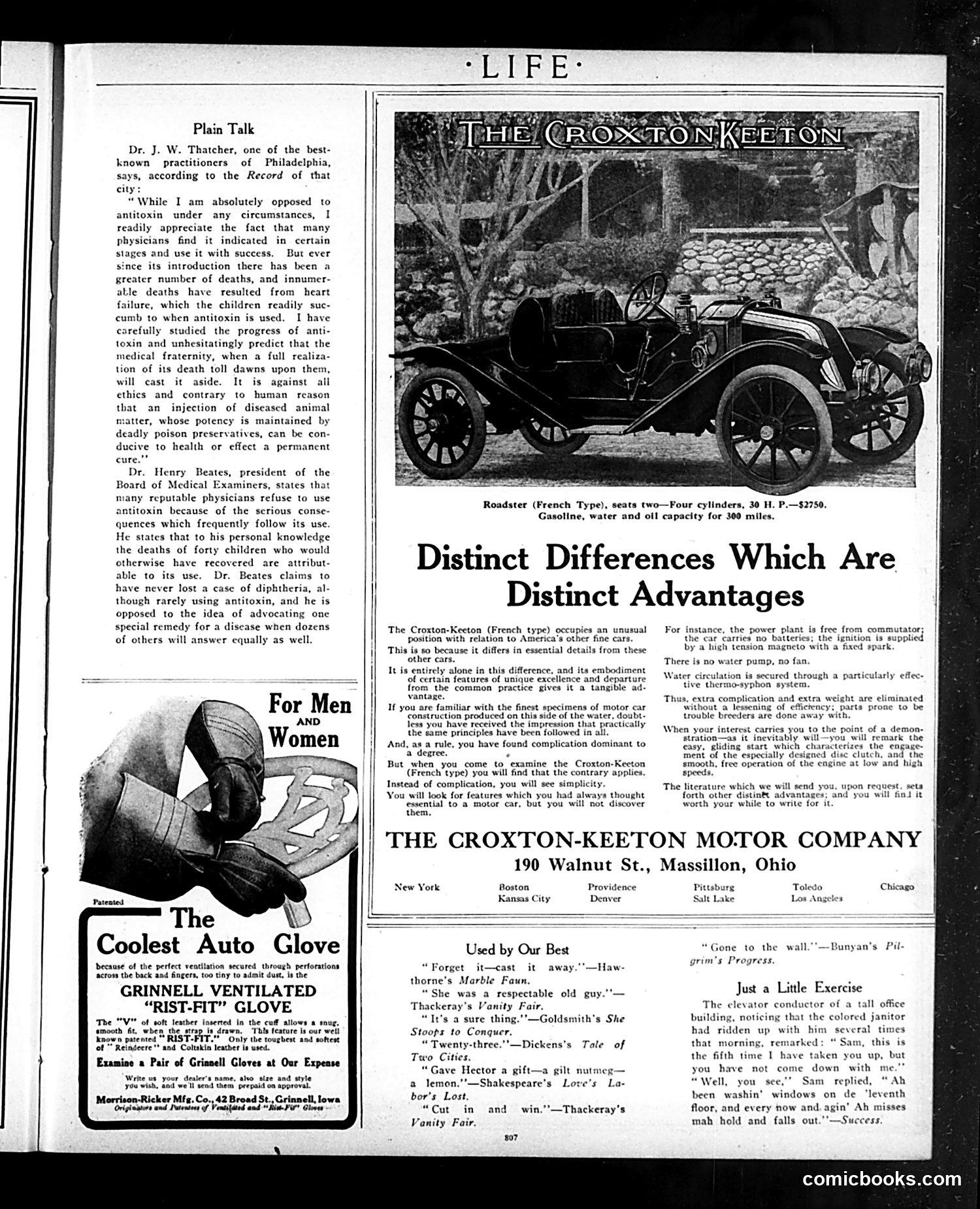
This page contains **no political cartoon**—it's primarily advertisements and a medical opinion column. The "Plain Talk" section presents **medical controversy** from early 1900s Philadelphia. Doctors Thatcher and Beates argue against **antitoxin** for diphtheria, claiming it causes more deaths than it prevents (Beates claims 40 child deaths from it). They advocate alternative treatments instead. This reflects genuine medical debate of the era—antitoxin was newly introduced and controversial, with legitimate concerns about side effects, though modern medicine recognizes it as having saved countless lives. The page also advertises the **Croxton-Keeton automobile** (a French luxury car sold in Ohio) and **Grinnell ventilated driving gloves**—typical period automobile advertising emphasizing mechanical innovation and comfort for motorists. No satire or caricature is present. The page represents early-1900s concerns about medical safety and consumer goods marketing.
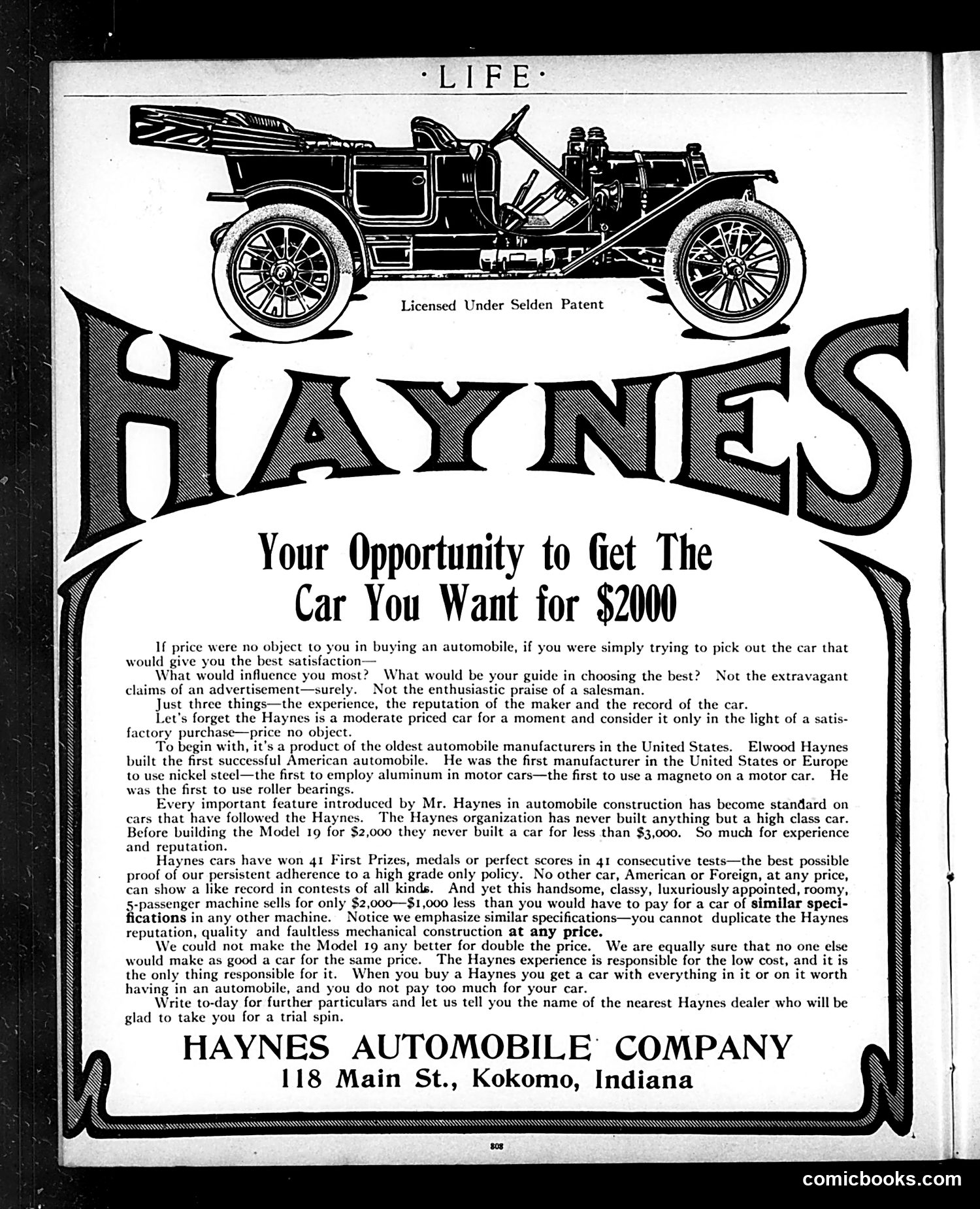
This is **not a cartoon or satire**—it's a straightforward automobile advertisement from Life magazine's early automotive era. The page advertises the **Haynes Automobile**, priced at $2,000, manufactured by the Haynes Automobile Company in Kokomo, Indiana. The ad emphasizes the car's quality and value by highlighting the company's pioneering history: founder Elwood Haynes built "the first successful American automobile" and introduced innovations (nickel steel, aluminum, magneto, roller bearings) that became industry standards. The pitch appeals to rational buyers by emphasizing three factors—maker's experience, reputation, and performance record (41 consecutive test victories)—rather than salesman hype. The core argument: you get a luxury car with proven quality at half the typical price for comparable specifications. This reflects early-1900s automotive marketing when establishing manufacturer credibility was crucial to selling automobiles, a still-novel consumer purchase.
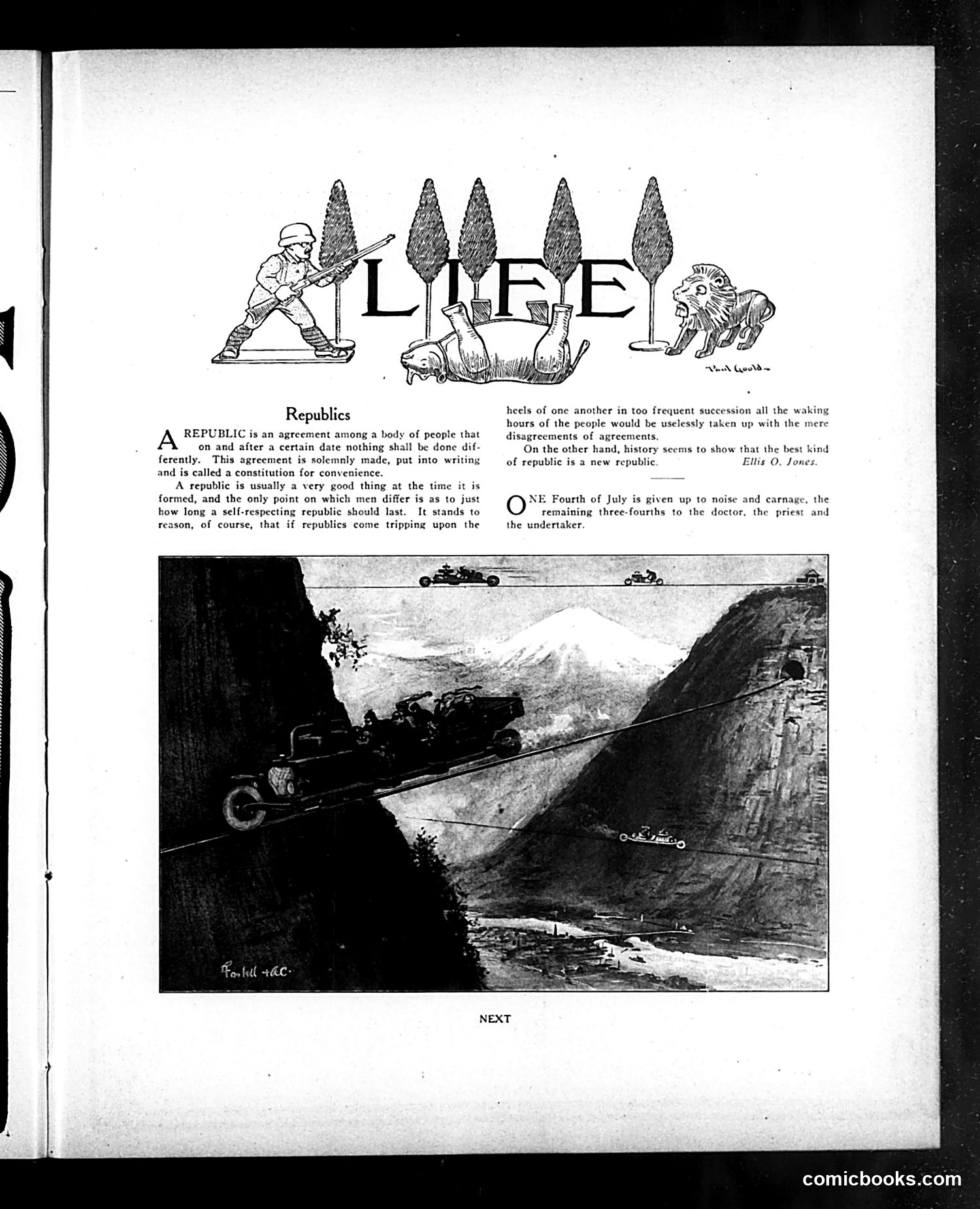
This page satirizes the instability of republics and frequent governmental upheaval. The header illustration depicts soldiers, cypress trees (symbolizing death/loss), and animals—suggesting violence and chaos accompanying political change. The text mocks the contradiction inherent in republics: they're defined by written constitutions meant to provide stability, yet history shows constant governmental turnover. The satire suggests that if republics are constantly replaced, citizens waste energy managing endless political transitions rather than living peacefully. The final quote attributed to "Ellis O. Jones" delivers the punchline: Americans celebrate Independence Day with noise and "carnage," then spend the remaining three-quarters of the year dealing with consequences (doctors, priests, undertakers)—implying the violence and upheaval of republican revolutions causes ongoing death and suffering. The photograph below shows dangerous early automobile racing, visually reinforcing themes of reckless speed and peril.
This page discusses Woodrow Wilson's recent speech at a Pittsburgh dinner, where he advocated for "democratic regeneration" of American colleges. The editorial acknowledges Wilson's idealism—he demands colleges become less exclusive and more aligned with common people—while expressing skepticism about his absolutism. The writer notes that prestigious colleges (Princeton, Yale, Harvard) have actually produced significant leaders (Wilson himself, Taft, Theodore Roosevelt), suggesting they work reasonably well despite their elitism. The piece gently mocks Wilson's conviction that college "steers" determine life outcomes, arguing many successful men succeed *despite* their education, not because of it. The satire is mild: Wilson is presented as earnest but perhaps naive—a man of genuine ideals who underestimates how students chart their own paths regardless of institutional values. The reference to making "a finished snob" through "compulsory democracy" suggests forced egalitarianism may backfire.
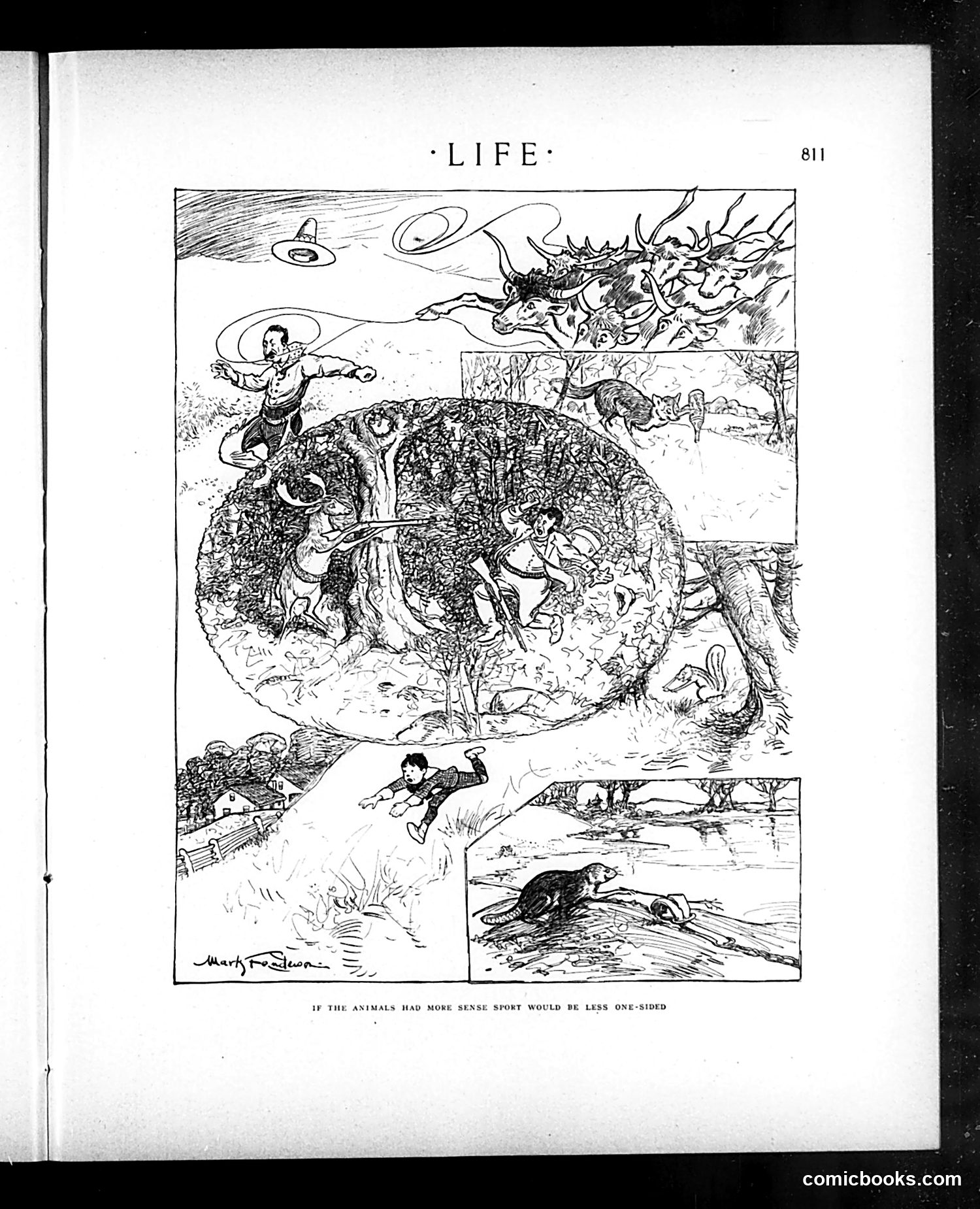
This page from *Life* magazine (page 811) features a satirical cartoon by artist Mary Peterman titled "If the Animals Had More Sense Sport Would Be Less One-Sided." The cartoon depicts humans engaged in hunting and sport activities (visible: a hunter with a gun, people fishing) contrasted against a central circular scene showing animals in their natural state. The implication is satirical commentary on hunting and fishing as "sports"—suggesting that if animals possessed human reasoning, they would recognize these activities as fundamentally unfair rather than sporting, since animals lack weapons and equal means of defense. The satire critiques the human characterization of hunting and fishing as legitimate "sport" when the contest is inherently one-sided in humans' favor through technology and weaponry.
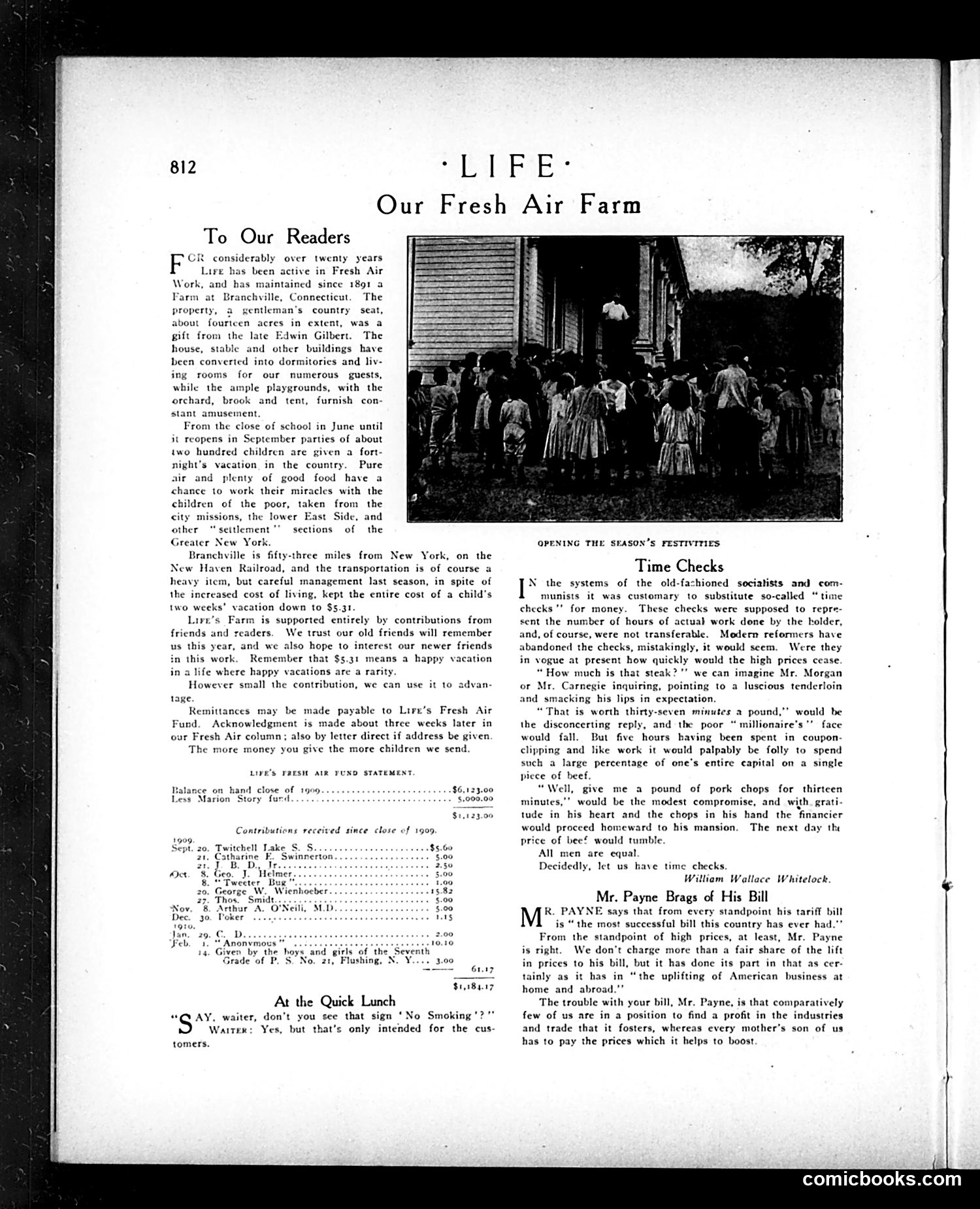
This page contains **philanthropic content and light social satire**, not political cartoons. The main feature is an appeal for donations to Life magazine's Fresh Air Farm in Connecticut, which provided summer vacations to poor children from New York's Lower East Side from 1891 onward. The accompanying photograph shows children "opening the season's festivities." The satirical content appears in two brief pieces: 1. **"Time Checks"** — A commentary mocking wealthy industrialists (clearly referencing J.P. Morgan and Andrew Carnegie) by imagining they'd become far more economical if labor time were literally visible. The joke: if a steak cost "thirty-seven minutes of work," millionaires would suddenly realize the value of their time and stop wasteful spending. 2. **"At the Quick Lunch"** — A one-liner joke about a waiter ignoring a "No Smoking" sign because it's only meant for customers, not staff. Both pieces reflect progressive-era skepticism toward capitalism and class disparities—themes aligned with Life's satirical mission during this period.
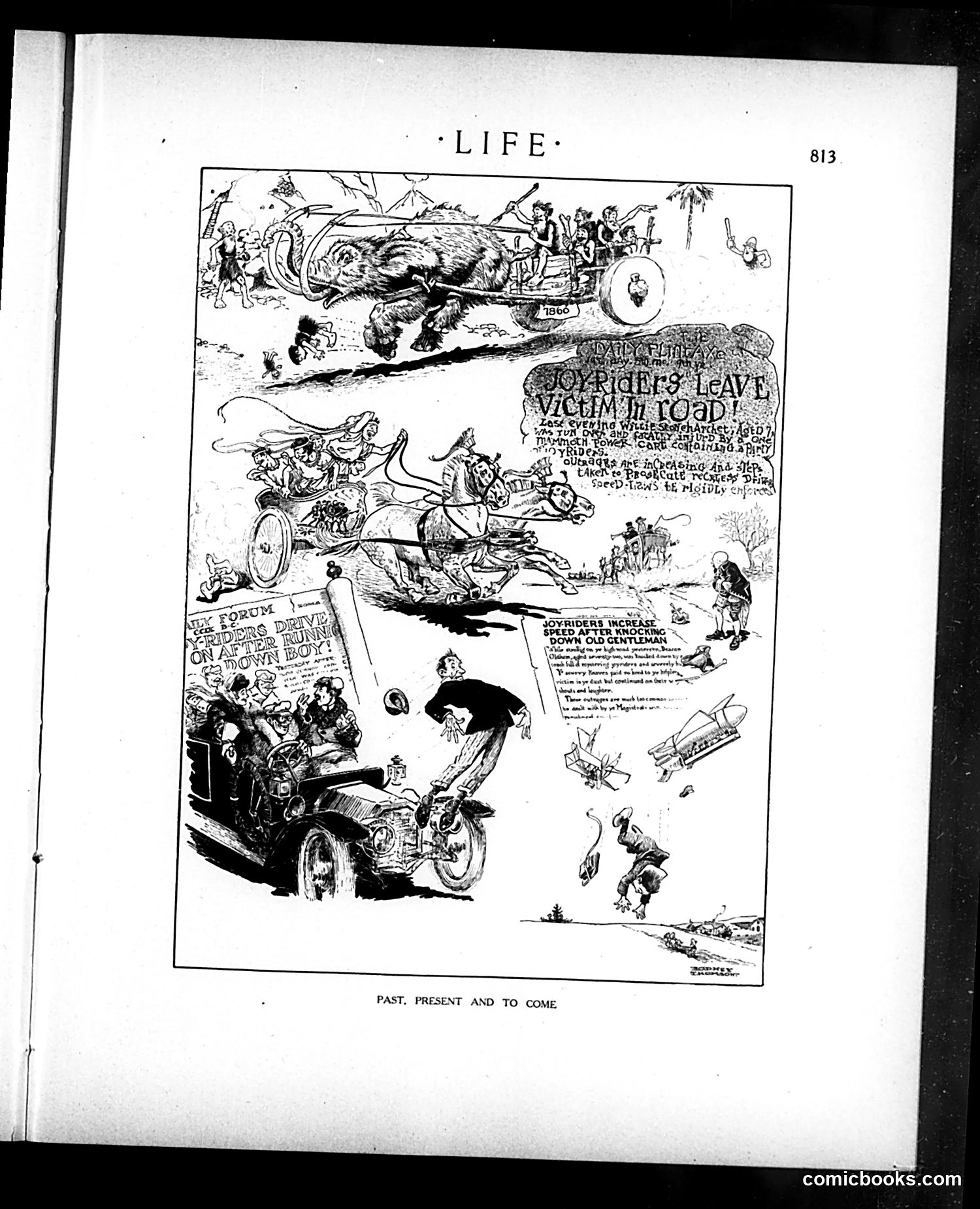
This Life magazine page presents a satirical montage about automobile and road safety, spanning historical periods. The top panel shows an elaborate carnival wagon or float from the past. The middle sections depict early automobiles and joyrides. A central panel titled "Sojourns Leave Victim in Toad" appears to address pedestrian injuries. Another section, "Joyriders Increase Speed After Knocking Down a Person," critiques reckless driving behavior. The bottom illustration shows an early automobile accident scene. Throughout, the cartoons mock the dangers posed by vehicles to pedestrians and highlight irresponsible driving practices. The overall message satirizes society's progression from horse-drawn transport to automobiles while suggesting motorists show insufficient concern for public safety—a contemporary concern as automobiles became more common in early 20th-century America.
This domestic comedy depicts a married couple negotiating their summer vacation plans. The husband, skeptical and sardonic, repeatedly interrupts his wife's attempts to explain her preferences, while she grows frustrated by his dismissiveness of her desires and constant references to money. The satire targets early 20th-century gender dynamics: the wife has clearly already decided where to go (an expensive hotel) but must perform the charade of persuading her husband, who claims to listen impartially while immediately reverting to cost-consciousness. The "Racing Term / The First Lap" illustration below suggests marriage itself is a race or competition. The piece mocks both spouses—her indirect manipulation and his condescension—while highlighting the fundamental inability of married partners to communicate authentically. The school textbooks visible in the apartment suggest they have children, adding domestic complexity to their financial tensions.
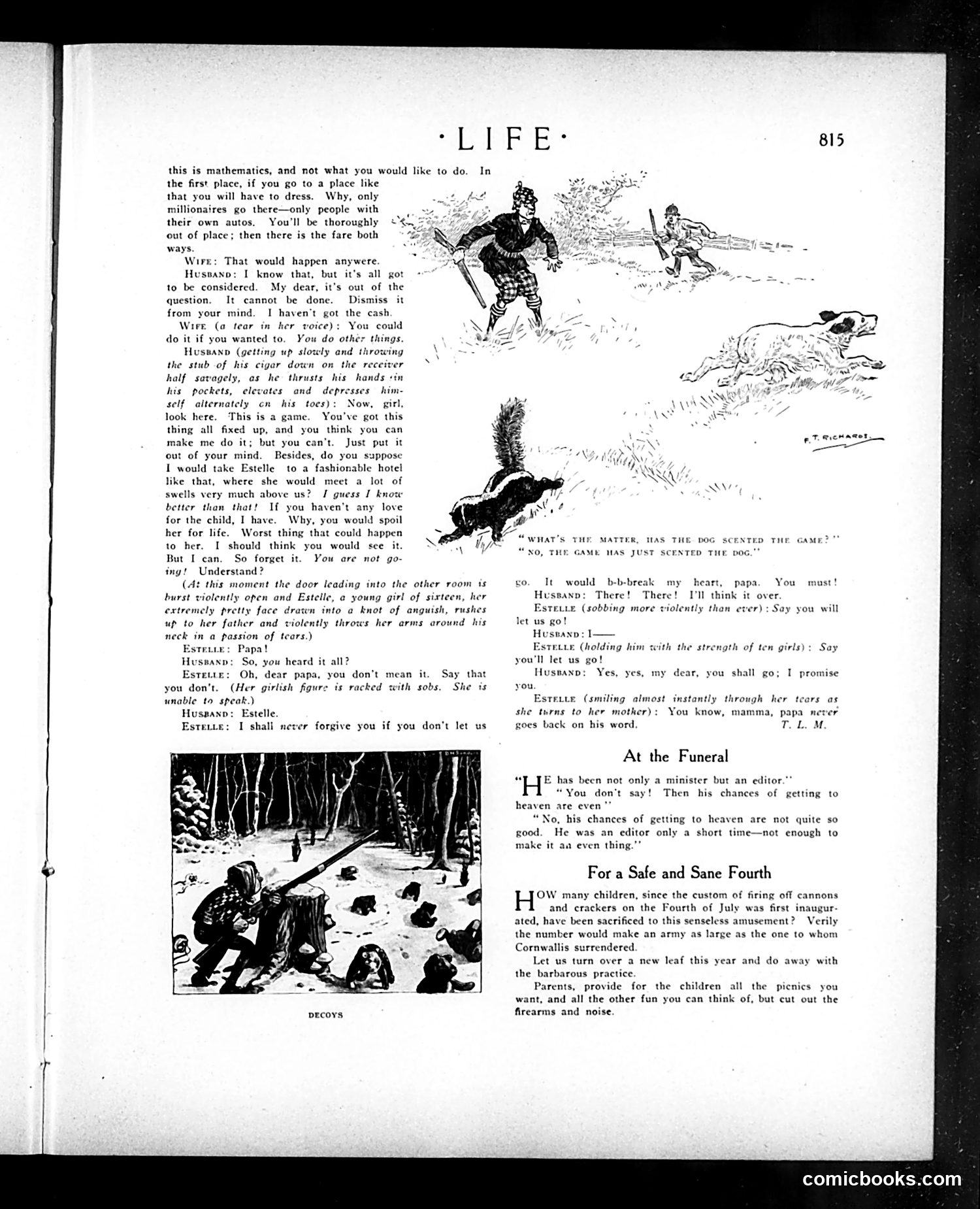
This page contains three distinct pieces of satirical content: **Top section**: A domestic drama sketch depicting a working-class husband refusing his wife's request to take their daughter Estelle to a fashionable hotel outing. The husband cites financial constraints and worries about their daughter being "spoiled" by mingling with wealthy people. When Estelle overhears and emotionally appeals to him, he capitulates—satirizing both marital dynamics and class anxiety of the era. **Middle illustration**: A hunting scene with the caption "What's the matter, has the dog scented the game?" / "No, the game has just scented the dog"—a simple joke about role reversal in predator-prey relationships. **Bottom sections**: Two brief jokes mocking clergy (a minister/editor's poor heavenly prospects) and a serious editorial plea for "Safe and Sane Fourth" celebrations, urging parents to eliminate firecrackers and cannons from Fourth of July festivities due to child injuries and deaths. The page blends domestic comedy with social reform messaging typical of Life's satirical approach.
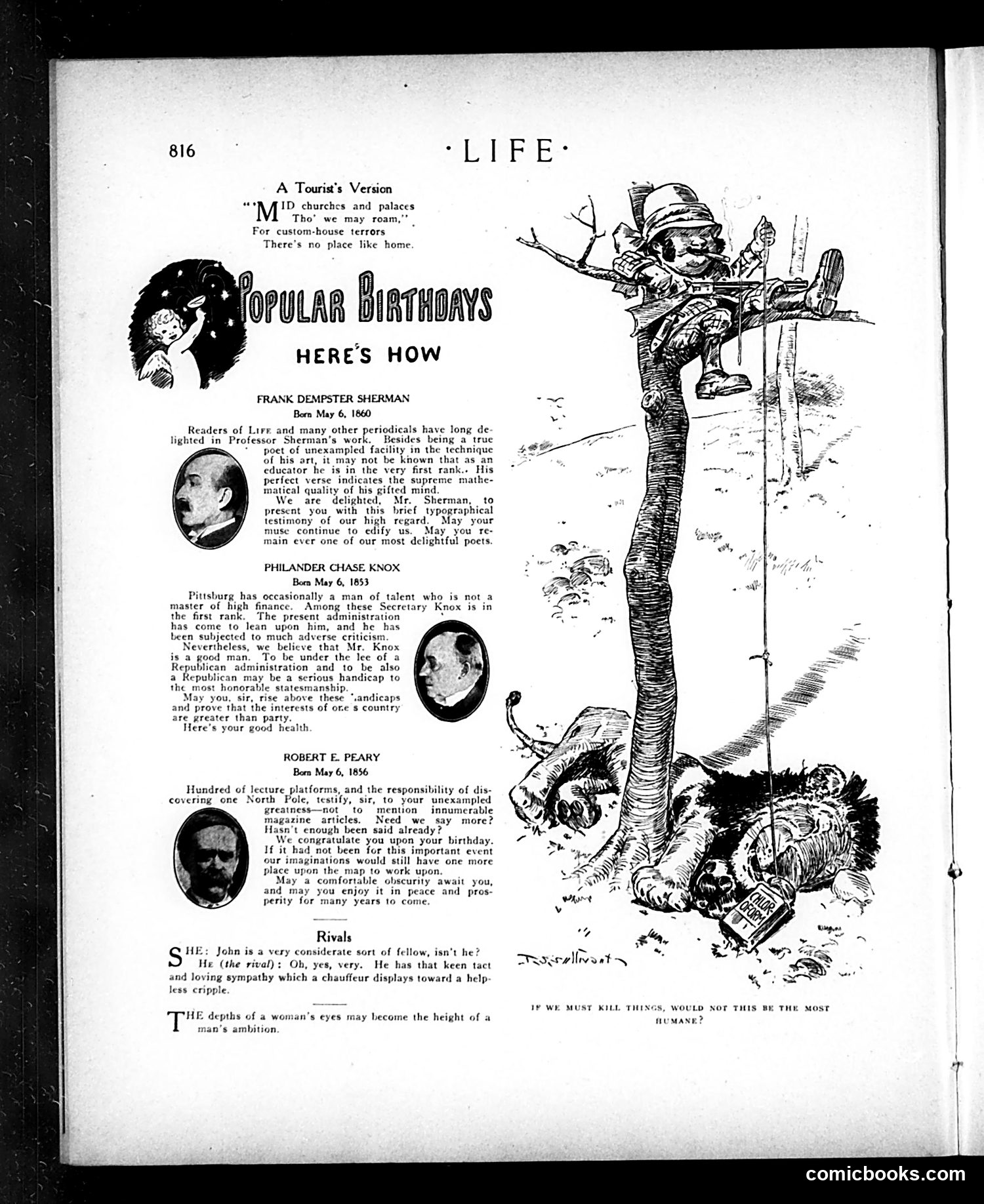
This page celebrates three notable Americans sharing a May 6 birthday: poet Frank Dempster Sherman, Secretary of State Philander Chase Knox, and Arctic explorer Robert E. Peary. The "Popular Birthdays" feature offers mock-serious tributes with gentle satire. Sherman receives praise as an accomplished poet and educator. Knox, a Pittsburgh financier-turned-politician, gets cautious endorsement—the text acknowledges he's faced criticism but argues Republican statesmanship shouldn't be undermined by party loyalty. Peary, famous for North Pole expeditions and subsequent lecture tours, is gently mocked for over-publicizing his achievements ("Need we say more? Hasn't enough been said already?"). The right-side cartoon depicts a figure (unclear who, possibly representing colonial expansion or conquest) perched atop a tree stump labeled with what appears to be territorial conquest, captioned "If we must kill things, would not this be the more humane?"—likely satirizing imperialist ambitions. The brief "Rivals" dialogue mocks insincere civility between romantic competitors.
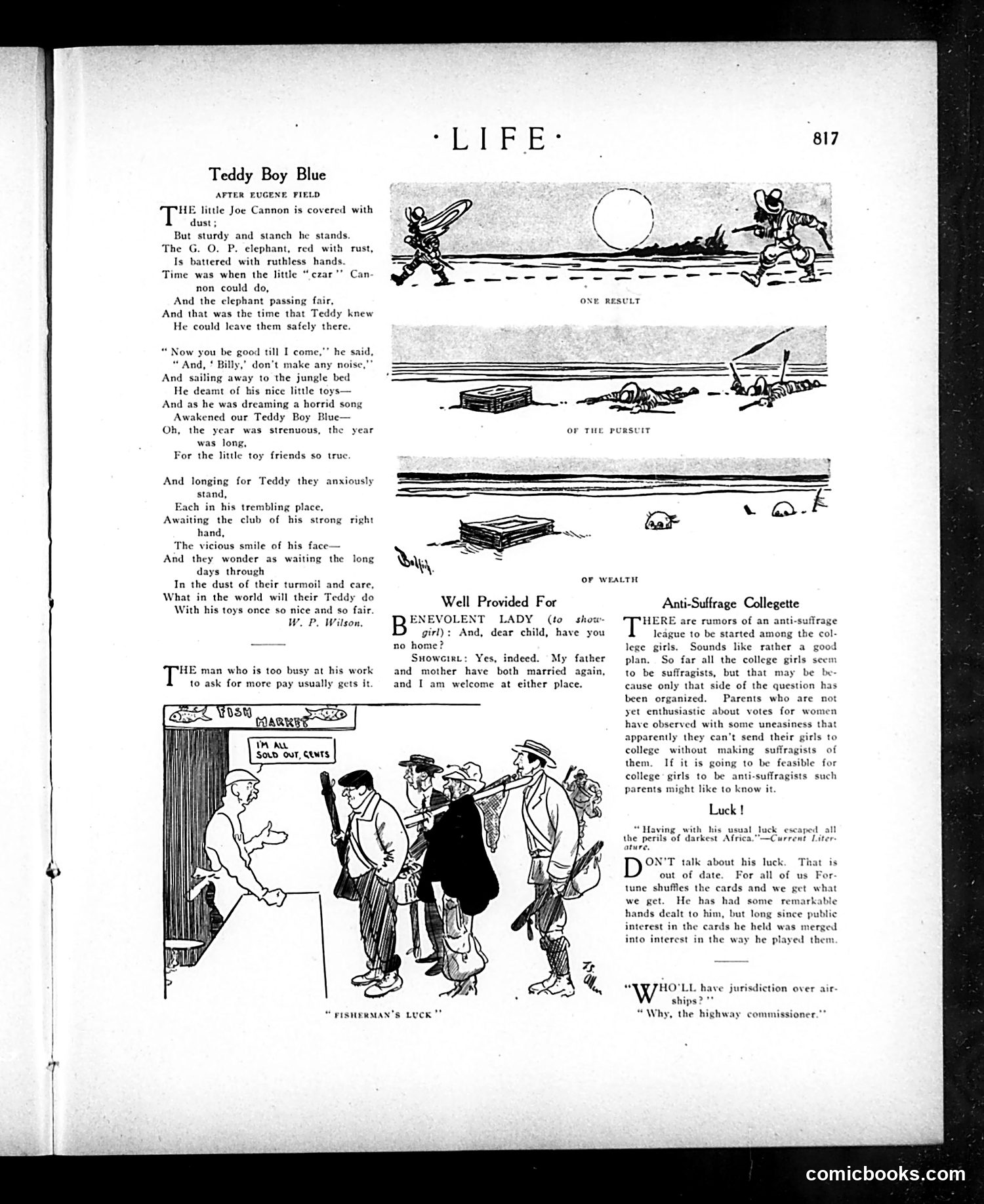
This page contains satirical commentary on Theodore Roosevelt's presidency. The main poem, "Teddy Boy Blue" (after Eugene Field), uses a nursery-rhyme style to mock Roosevelt's absence from domestic politics. The "little Joe Cannon" and "G.O.P. elephant" represent Republican leadership left behind while Roosevelt pursued his "strenuous" activities—likely referring to his conservation efforts and imperialist foreign adventures ("jungle bed"). The satire suggests Roosevelt neglected party machinery and left Republican institutions neglected and weakened. The three shorter items below mock contemporary social issues: female servants' domestic situations, college girls' political views, and Roosevelt's famous "luck" in avoiding danger. The "Fisherman's Luck" cartoon depicts working-class men discussing pay disputes.
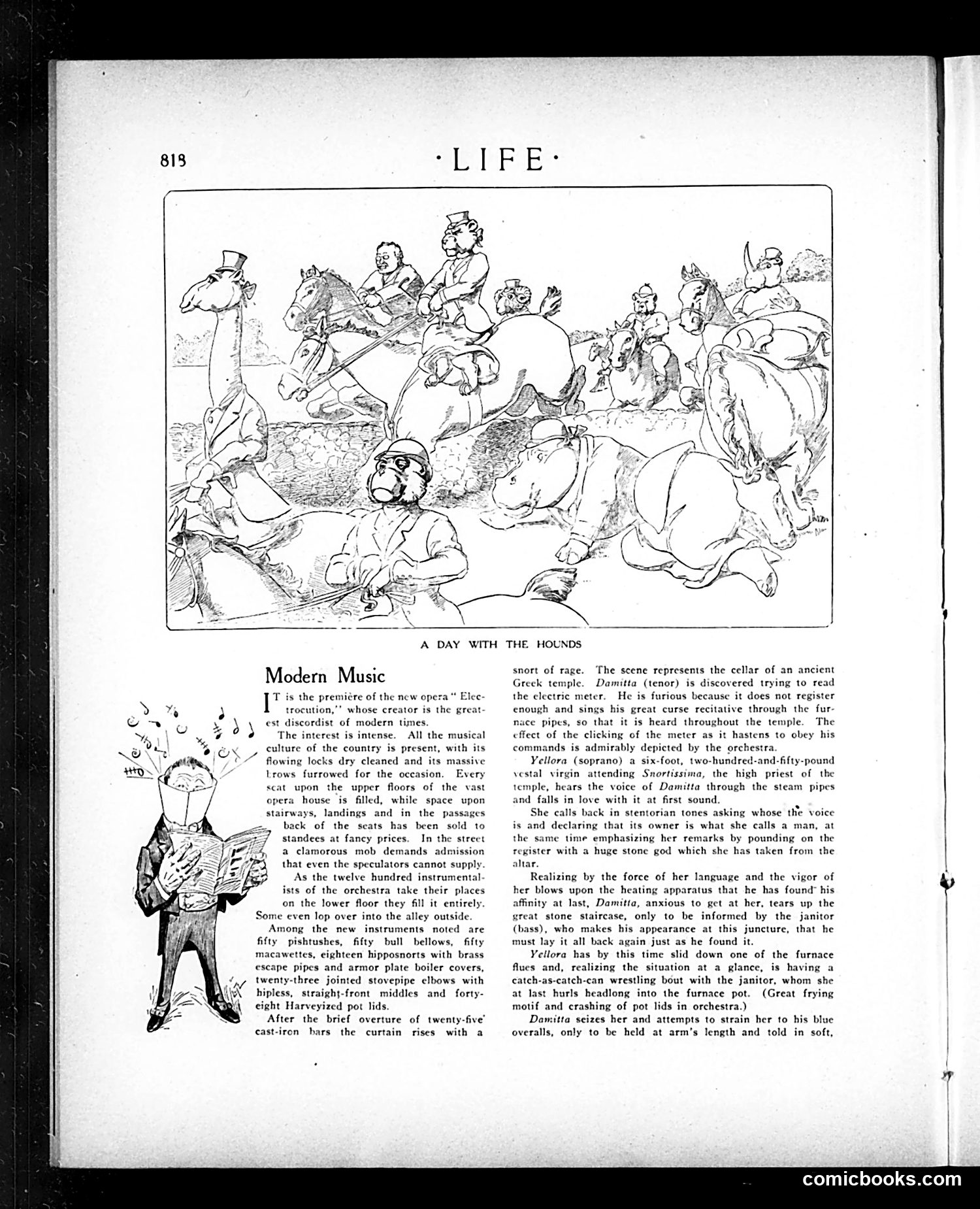
This is a satirical piece mocking contemporary avant-garde opera and "modern music." The cartoon depicts an absurdly overcrowded opera house premiere, while the text parodies a pretentious new opera with nonsensical plot and instrumentation. The satire targets: **The music**: Ridiculous "new instruments" (pishtushes, hipposnorts, Harveyized pot lids) mock experimental composers creating discordant, incomprehensible work. **The plot**: The absurd story—a tenor discovering an electric meter in a Greek temple cellar, a soprano weighing 250 pounds, a janitor throwing people in furnaces—mocks operatic melodrama taken to ridiculous extremes. **The audience**: Depicted as pretentiously cultured ("flowing locks dry cleaned"), willing to pay inflated prices and stand in hallways for incomprehensible art. The core joke: Modern composers are creating nonsensical noise and calling it art, while fashionable audiences pretend to appreciate it. This reflects early-20th-century debates about modernism versus tradition in high culture.
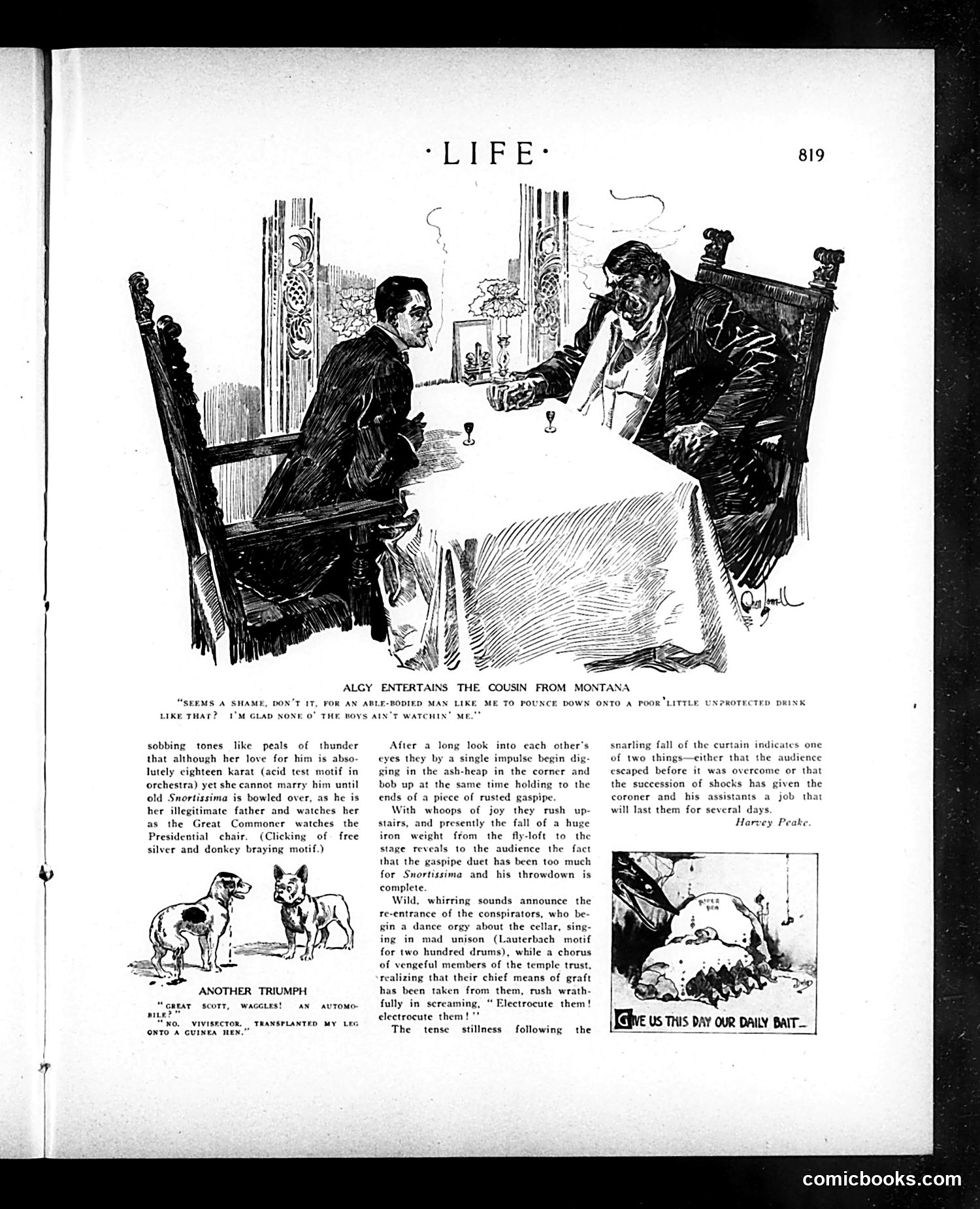
This is a satirical theater review from *Life* magazine mocking an absurdly melodramatic stage production. The main cartoon shows "Algy" entertaining a cousin from Montana, with the caption joking that it's shameful for an able-bodied man to "pounce down onto a poor little unprotected drink"—satirizing overwrought dramatic dialogue. The text describes the plot's ridiculous elements: characters dig through ash-heaps, a man falls from a fly-loft after a "gaspipe duet," conspirators dance in the cellar while temple officials demand electrocution, and the finale is so shocking the audience either flees or requires a coroner. The humor lies in *Life*'s mocking description of early 20th-century stage melodrama—its overwrought emotions, absurd plot mechanics, and gratuitous violence. References to "free silver" and "Great Commoner" suggest this parodies contemporary political theater or populist themes popular at the time.
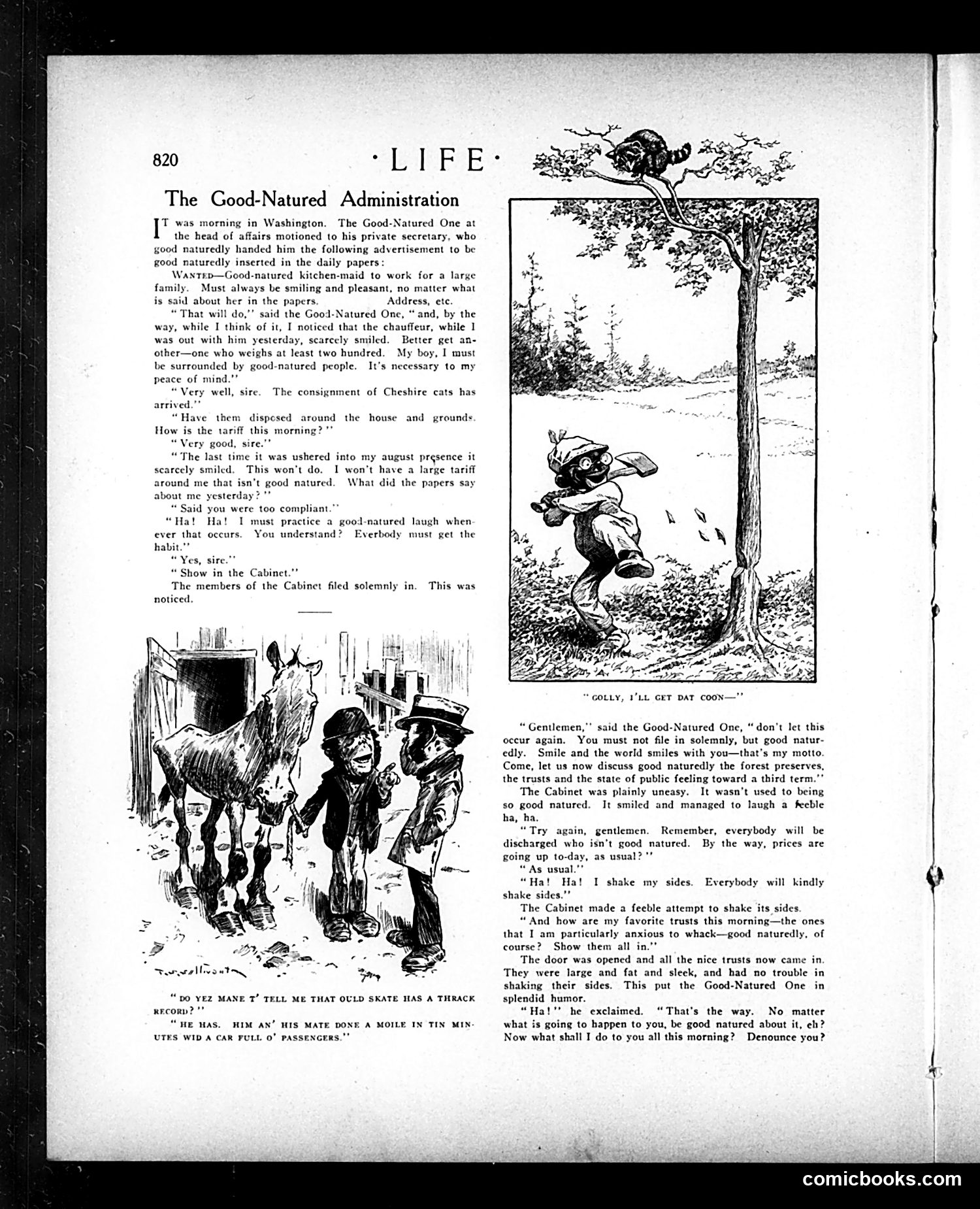
This satire mocks an administration—likely Theodore Roosevelt's, given references to trusts and forest preserves—for prioritizing superficial pleasantness over substantive governance. The "Good-Natured One" demands that everyone around him constantly smile and appear content, regardless of circumstances or criticism. The joke is that this obsession with maintaining a cheerful facade becomes absurd: the president wants to hire only perpetually smiling servants, complains that the tariff "scarcely smiled," and forces his Cabinet to laugh on command. The trusts (large corporations) arrive and effortlessly shake with laughter, suggesting they're complicit in or untreatened by the administration's supposedly reformist stance. The satire implies the administration uses friendly rhetoric and optics to mask inaction on genuine problems—rising prices, unchecked trusts, public discontent. "Good nature" becomes a tool for avoiding accountability rather than addressing real issues.
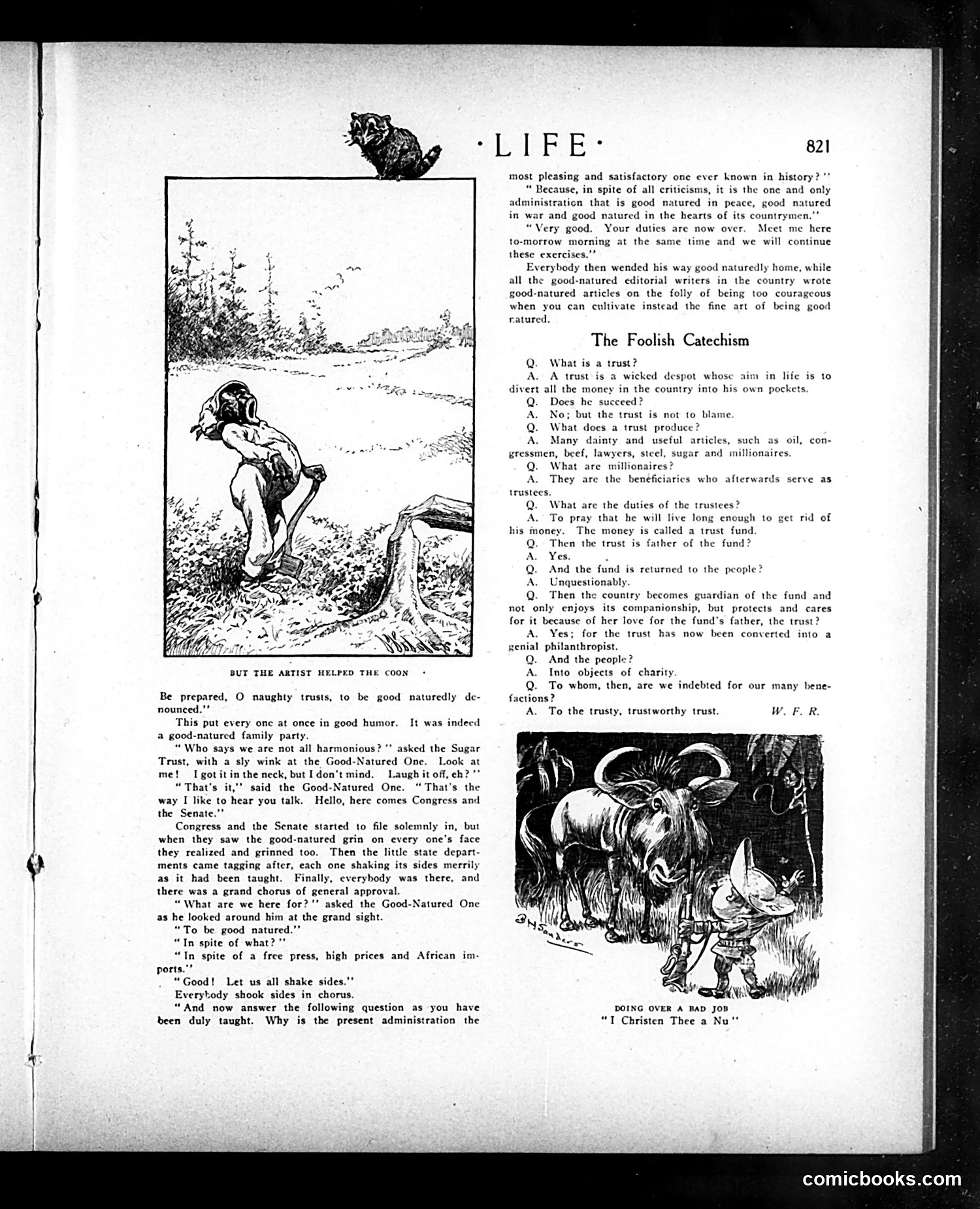
This page satirizes the failure of Progressive-era trust-busting legislation. The main narrative mocks an administration that prefers "good nature" over actual enforcement against monopolistic trusts—depicting Congress, the Senate, and government departments as complacently complicit rather than genuinely regulating corporate power. "The Foolish Catechism" uses Q-and-A format to expose the logical absurdity: trusts are supposedly "wicked despots," yet they produce "congressmen" (implying bribery), and their ill-gotten wealth eventually becomes "charitable" when converted to philanthropic trusts, with the public portrayed as passive "objects of charity." The satire suggests that instead of breaking up monopolies, the government has reached a corrupt accommodation where trusts operate freely in exchange for performative "good nature" and public relations gestures. The cartoons mock governmental toothlessness against corporate power during the early 20th century.
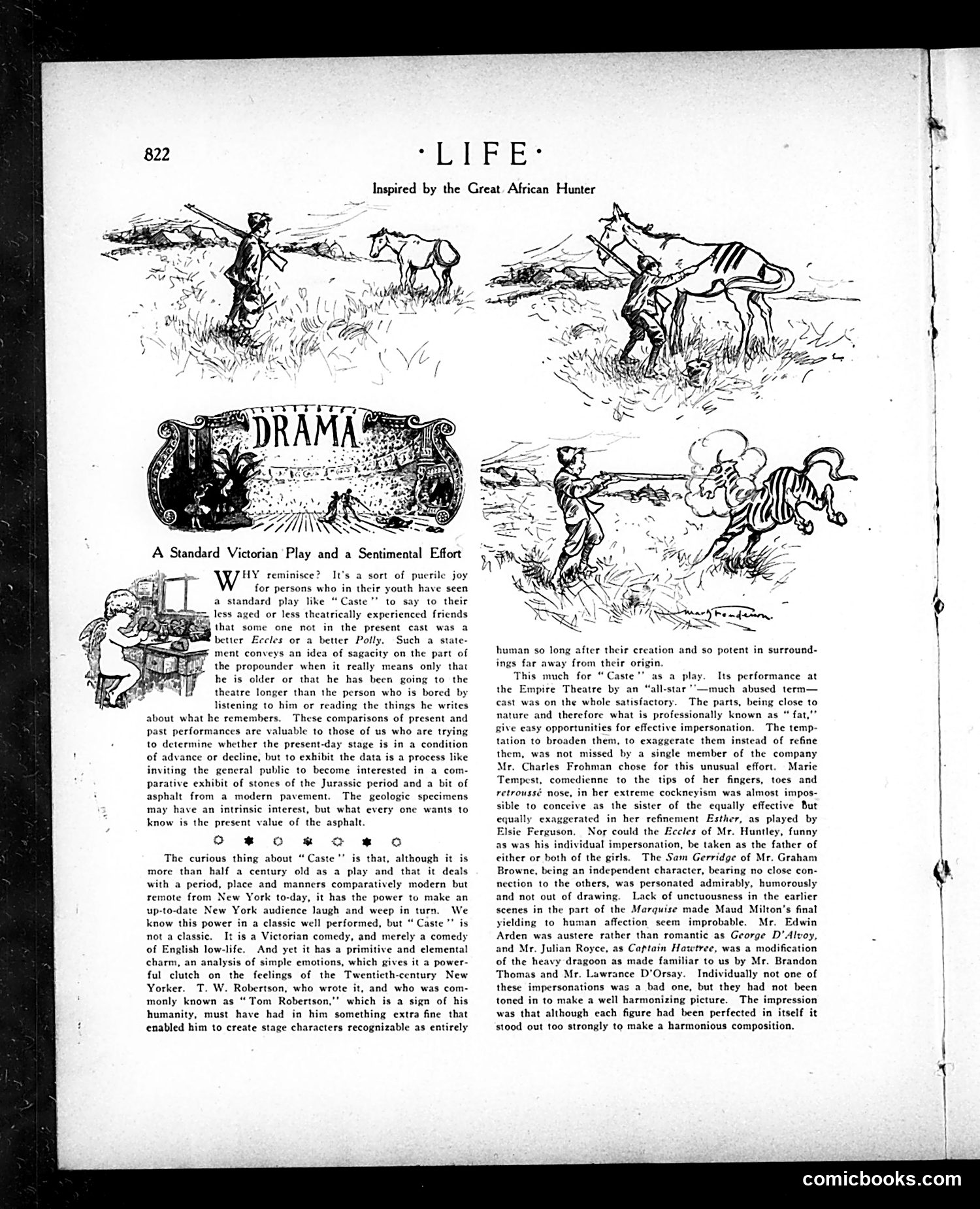
This page reviews a 1920s production of T.W. Robertson's Victorian play "Caste" (written over 50 years earlier) at the Empire Theatre, starring an "all-star" cast including Marie Tempest and Elsie Ferguson. The sketches at top depict hunting scenes, illustrating the article's subtitle "Inspired by the Great African Hunter"—likely a humorous reference to the play's themes or perhaps a contemporary figure. The critic argues that while "Caste" is merely a Victorian comedy about English working-class life, it possesses "primitive and elemental charm" allowing modern New York audiences to engage emotionally despite its age and distant setting. However, the reviewer criticizes the cast for *exaggerating* rather than refining their roles—finding the performances ham-handed. Specific actors (Tempest, Ferguson, Huntley) receive mixed assessments for their interpretations of working and upper-class characters. The piece reflects early 20th-century theater criticism's concern with naturalistic acting versus theatrical excess.
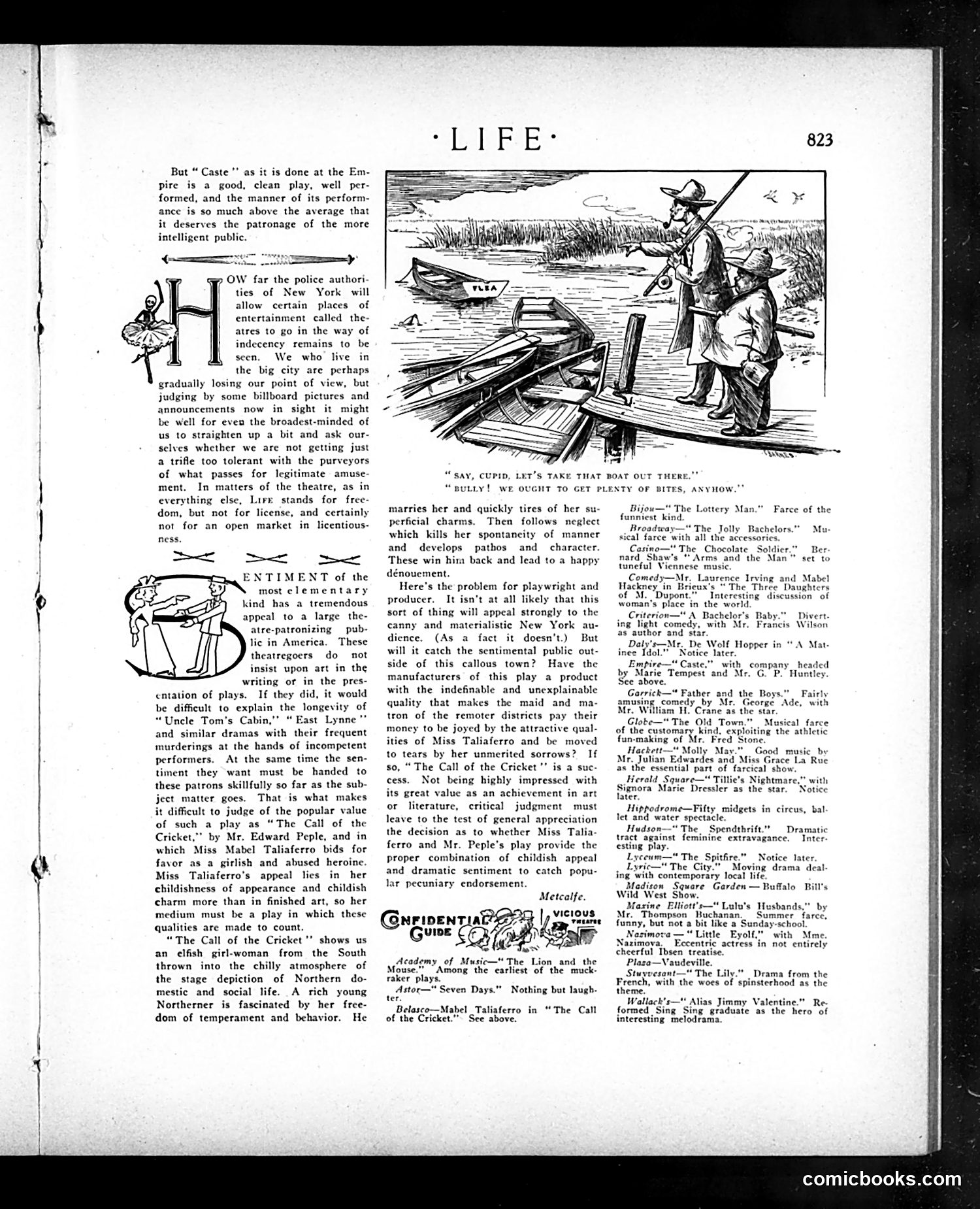
This page contains theater reviews and a cartoon about fishing. The main illustration shows two figures at a riverside: one appears to be an older man with a fishing rod, the other a cherubic cupid-like figure. The caption reads "Say, Cupid, let's take that boat out there" / "Bully! We ought to get plenty of bites, anyhow." The joke plays on double meaning: "bites" refers both to fish biting hooks and romantic/amorous encounters. Cupid—the Roman god of love—is enlisted as a fishing companion, creating humor by literalizing the metaphor of "catching" romantic partners. The surrounding text reviews theatrical productions, particularly discussing Miss Mabel Taliaferro in "The Call of the Cricket." The review critiques New York's tolerance of questionable entertainment while praising sentiment-driven plays that appeal to provincial audiences. The overall page reflects early 20th-century attitudes about theater, morality, and audience taste.
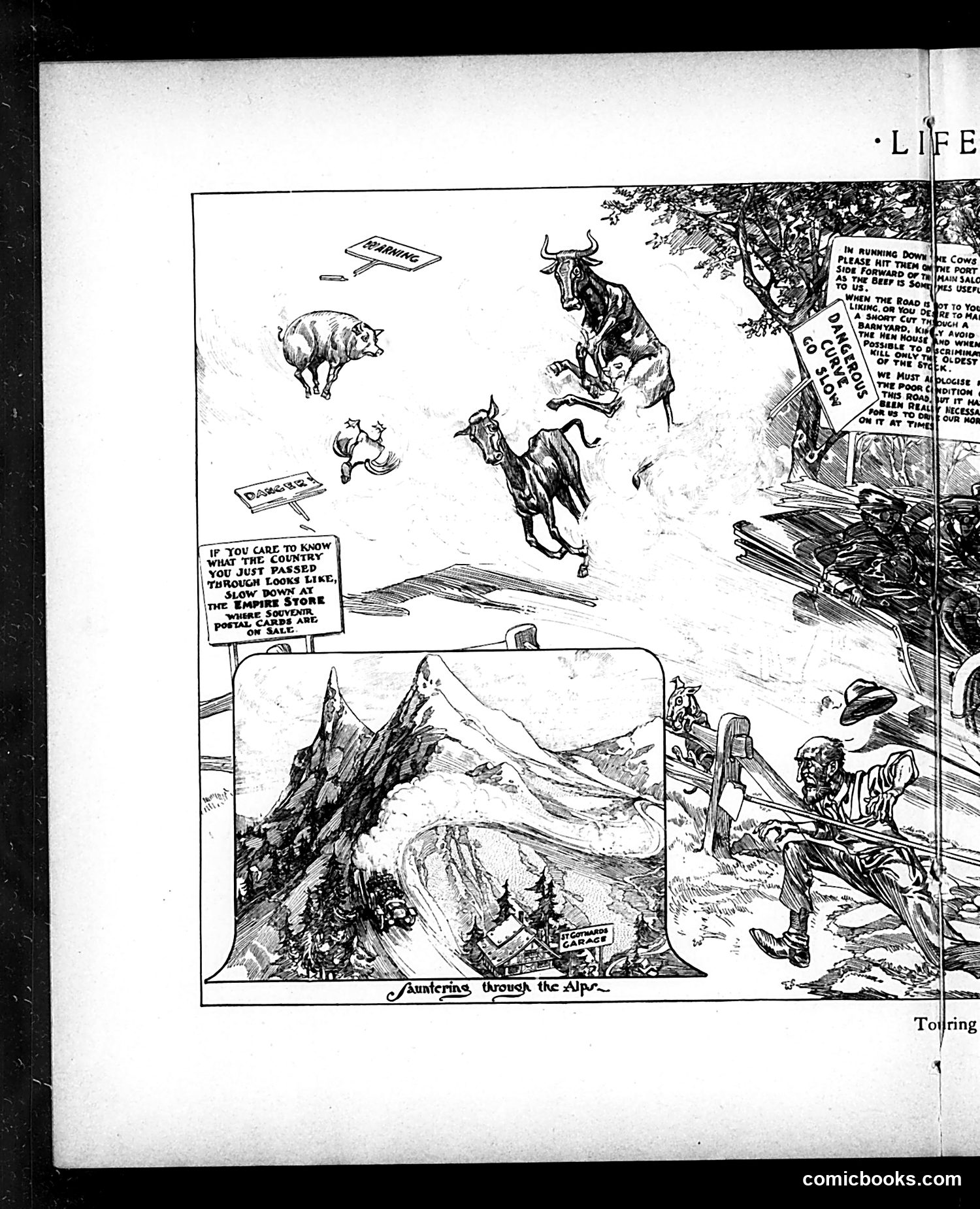
This page contains a satirical cartoon titled "Sauntering through the Alps." The upper portion shows farm animals (a pig, bull, goat, and sheep) jumping around playfully near signs reading "Danger" and "Damaged," apparently unaware of or indifferent to warnings. The lower panel depicts Alpine mountain scenery with what appears to be travelers or hikers, contrasting the carefree animals above with human activity below. The accompanying text box suggests this is commentary on tourists or travelers who ignore cautionary signs and warnings—the joke being that animals navigate dangers instinctively while humans need explicit warnings yet often disregard them. The cartoon appears to satirize human carelessness or willful ignorance compared to animal instinct, likely aimed at travelers or a general audience about safety awareness.
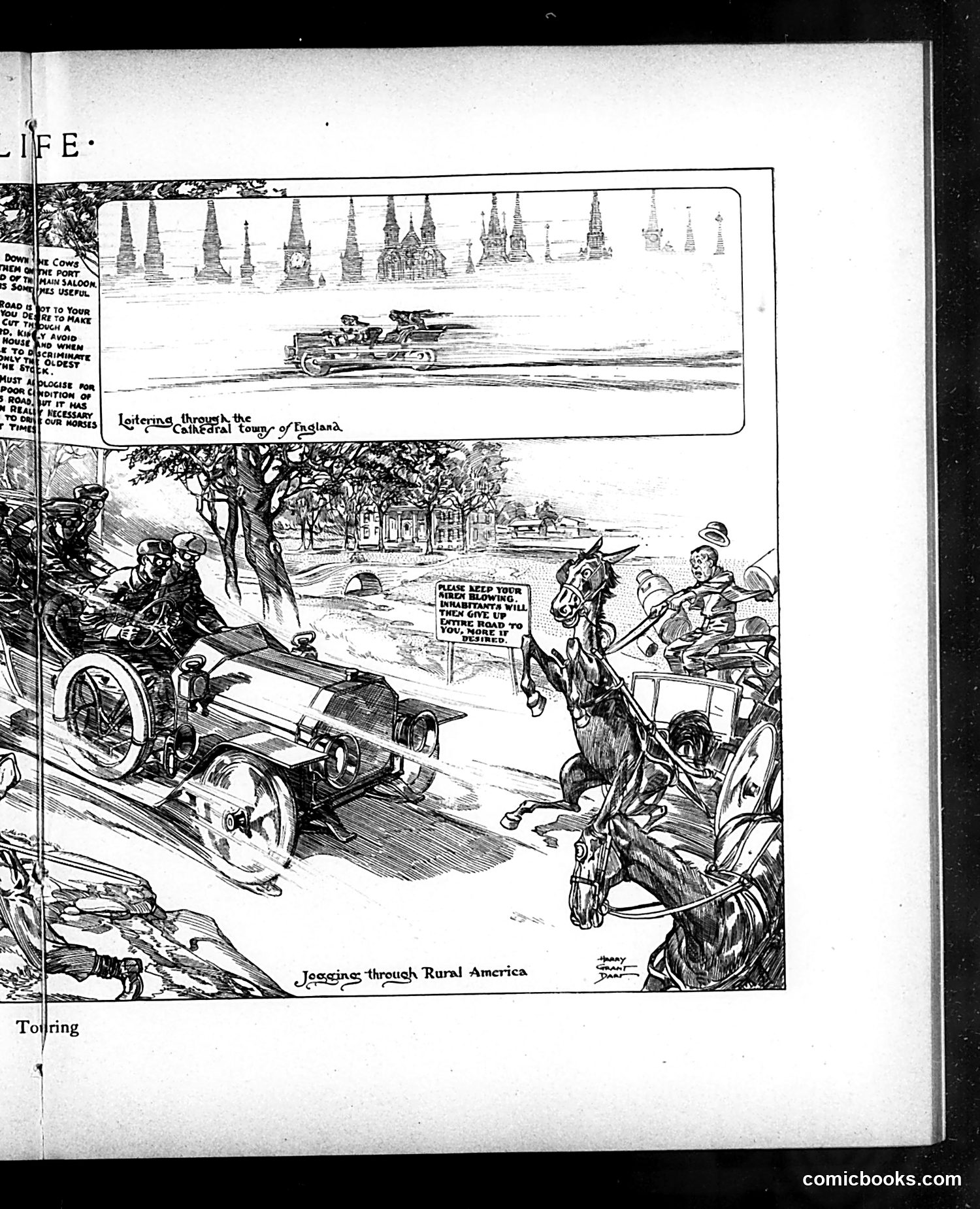
This page contains two satirical illustrations about touring: **Top panel**: "Loitering through the Cathedral 'temps' of England" shows a speeding automobile passing Gothic cathedral spires, satirizing American tourists who rush through England's historic religious sites without proper appreciation. **Bottom panel**: "Jogging through Rural America" depicts the reverse—Europeans on horseback encountering an American automobile, suggesting Americans race through the countryside too quickly to experience it meaningfully. The satire targets both American tourists abroad and the cultural clash between modern automobile travel and traditional European horseback/walking tourism. The irony is mutual: neither Americans nor Europeans are taking time to truly experience what they're touring. This reflects early 20th-century anxieties about how automobiles were changing travel culture and reducing appreciation for historical landmarks.
This page contains book reviews rather than political cartoons. The small decorative illustrations are generic vignettes, not satirical commentary. The reviews discuss three recent books: 1. **H.G. Wells's *The History of Mr. Polly*** — praised as Wells the "novelist" rather than "sociological enthusiast," depicting a haberdasher's apprentice as a "round peg in a square hole," an ineffective everyman figure. 2. ***The Diary of a Daly Débutante*** — a memoir from 1879 about theater life at Augustin Daly's Theatre, valued for its youthful enthusiasm and immediacy. 3. **Grace Sartwell Mason's *The Godparents*** — a romantic story with comedic elements (*opera bouffe*). The page's humor is literary rather than political—gentle observations about human nature and artistic merit. The "Confidential Book Guide" section provides brief notices of other titles. This represents typical early-20th-century literary journalism aimed at educated readers.
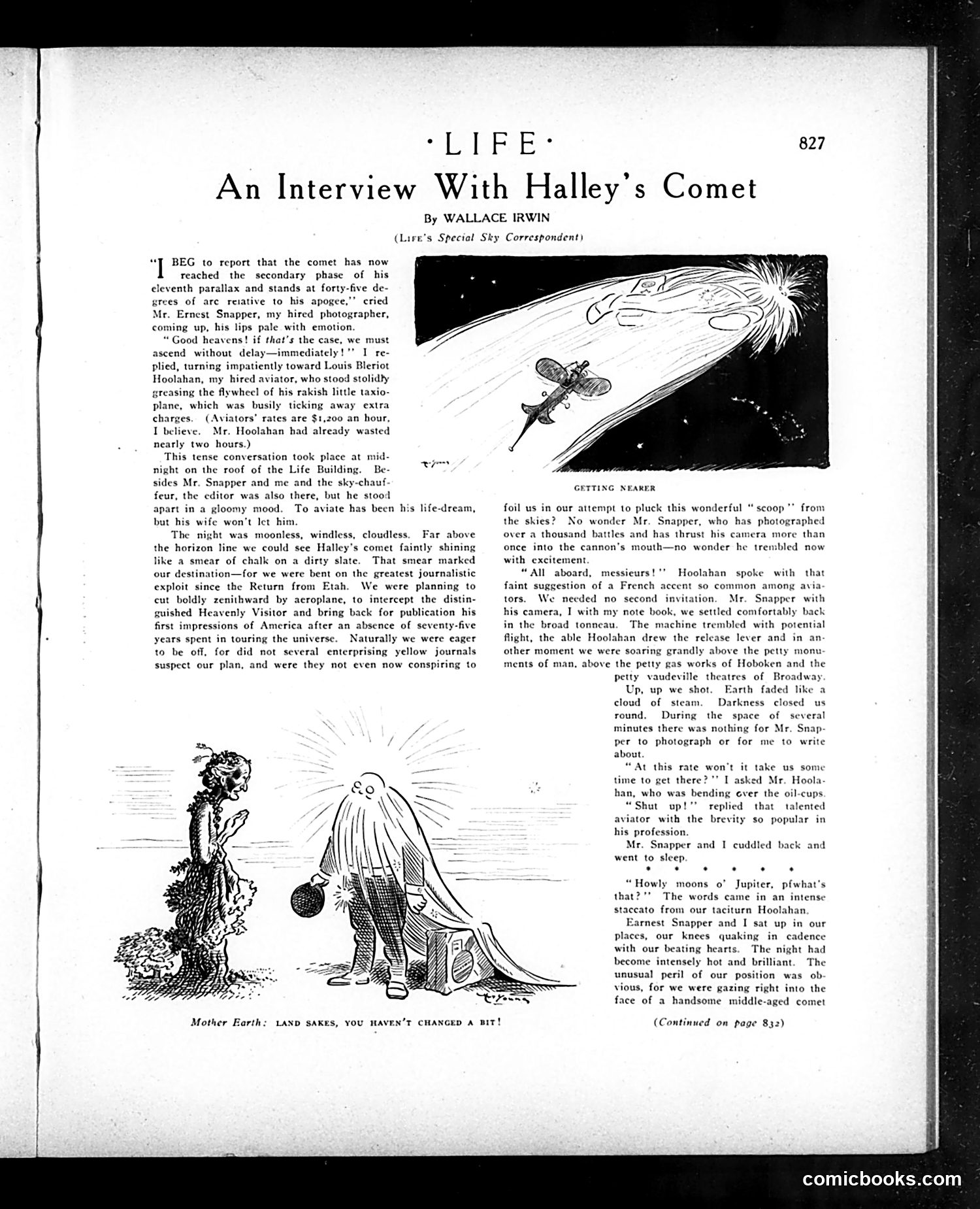
This is a humorous fictional account by Wallace Irwin about a *Life* magazine team attempting to interview Halley's Comet during its 1910 appearance. The satire targets several things: **The Setup:** A photographer, aviator, and narrator fly via early airplane to "intercept" the comet and get its "first impressions of America" after 75 years away—presented as the ultimate journalistic "scoop." **The Jokes:** - Mocking competitive yellow journalism and sensationalism - Poking fun at newly-invented aviation (the aviator charges $1,200/hour) - Absurdist scientific jargon ("eleventh parallax," "apogee") - The comet is personified as a "handsome middle-aged" being **The Bottom Cartoon:** Shows Mother Earth unchanged, suggesting humanity hasn't progressed—satirizing the idea that grand celestial events matter while ordinary life continues mundanely. The entire piece is comedic fiction exploiting public excitement over Halley's Comet's 1910 return.
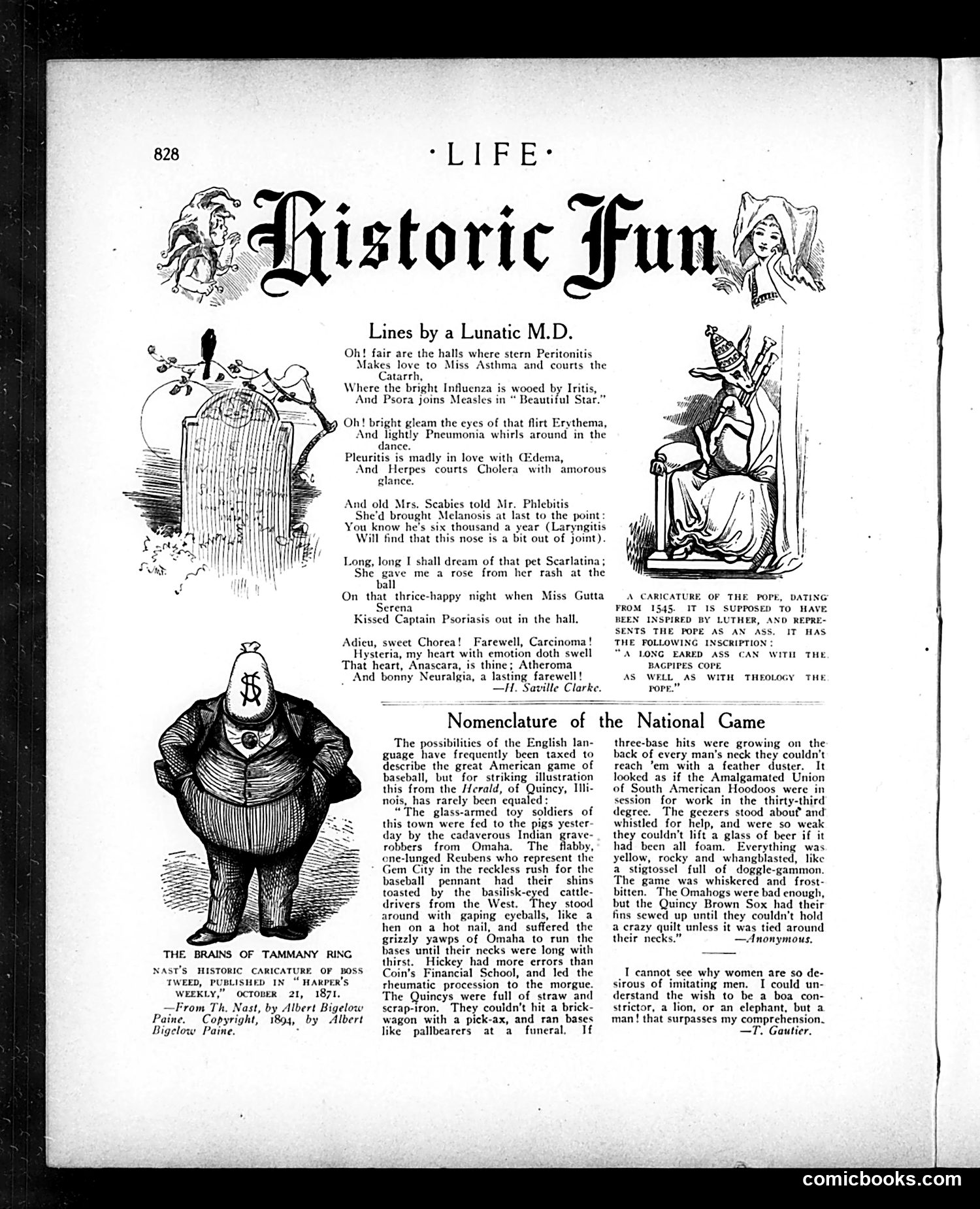
This page contains three distinct satirical pieces from an 1871 Harper's Weekly republication: **"Historic Fun"** mocks medical conditions as romantic figures—a darkly humorous poem personifying diseases (Peritonitis, Pneumonia, Cholera, etc.) in courtship scenarios. The joke relies on 19th-century medical terminology sounding absurd when romanticized. **"The Brains of Tammany Ring"** reproduces Thomas Nast's famous 1871 caricature of Boss Tweed, the corrupt New York politician. The enormous head filled with dollar signs visualizes his greed and dominance over Tammany Hall's political machine—one of the era's most recognizable political cartoons. **"Nomenclature of the National Game"** satirizes flowery, overwrought baseball sportswriting through absurdist description—teams as "glass-armed toy soldiers," players as "pallbearers," etc. It mocks the era's purple prose sports journalism. The page reflects Life's satirical approach: mocking medical jargon, political corruption, and journalistic pretension through exaggeration and wordplay.
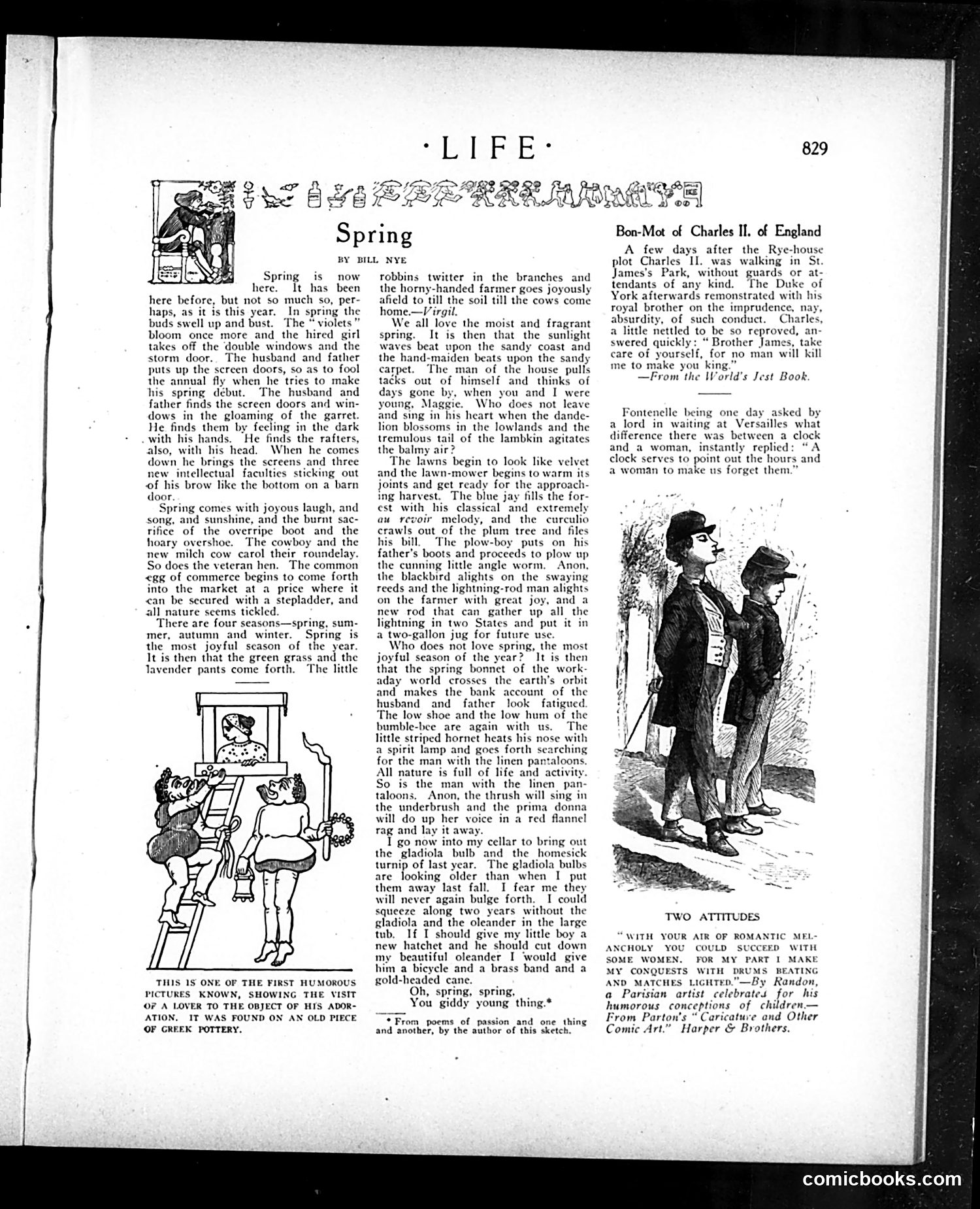
This is a humorous essay on spring by Bill Nye (a popular 19th-century humorist), accompanied by two illustrations. The text is largely comedic commentary on spring's arrival—celebrating nature's renewal while poking fun at domestic inconveniences: husbands installing screens, the expense of spring bonnets, egg prices, and encounters with insects like hornets and cutworms. The left cartoon depicts a classical scene labeled as "one of the first humorous pictures known" from Greek pottery—showing a lover visiting his beloved, establishing that romantic pursuit is an ancient, timeless human behavior. The right illustration, captioned "Two Attitudes," contrasts two male figures' body language—likely illustrating different approaches to romantic interest or courtship. The accompanying quote about "romantic melancholy" and conquests suggests satire on male attitudes toward women. Together, the page blends nature commentary with gentle social satire about spring's effects on romance and domestic life.
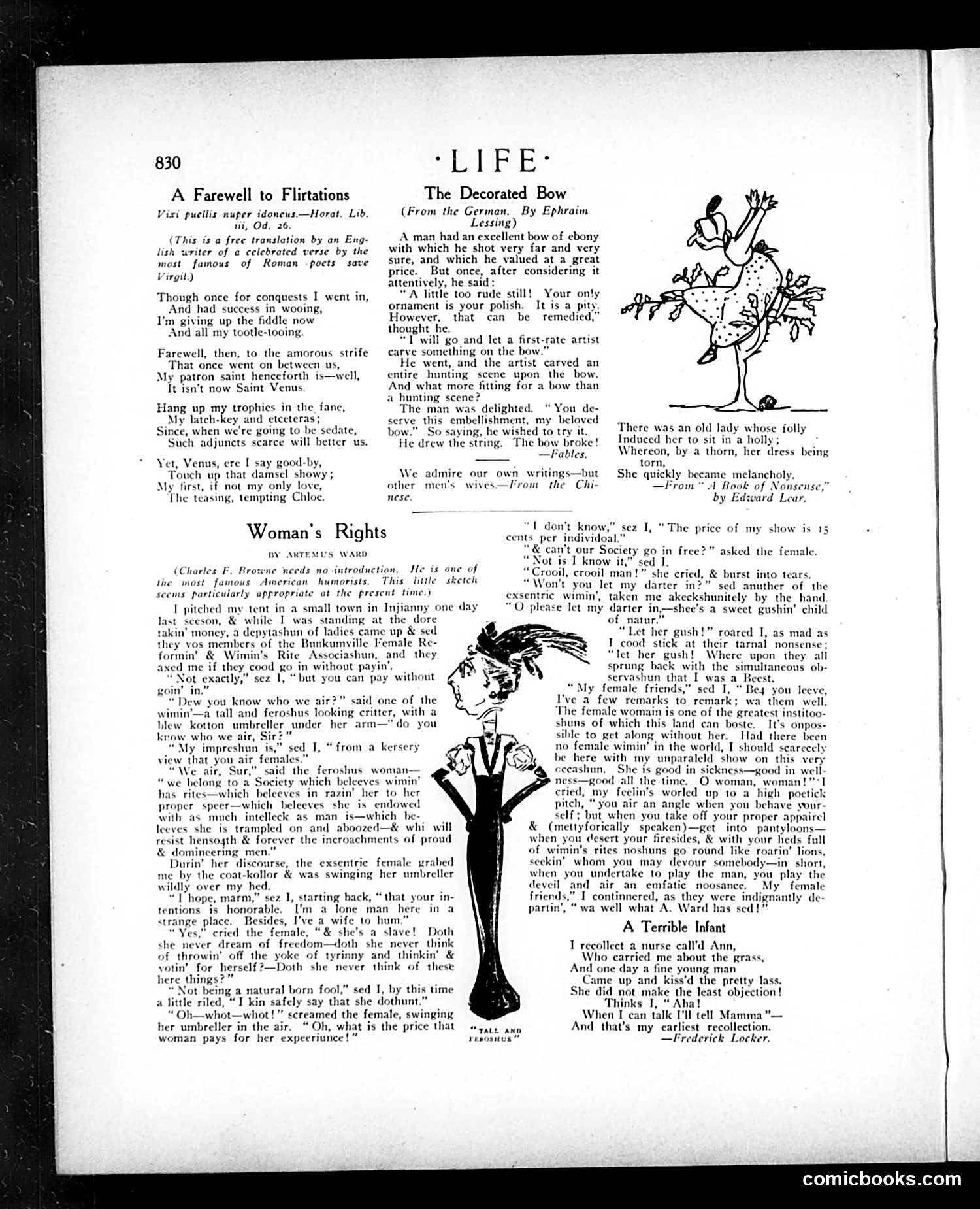
This *Life* magazine page (page 830) contains three distinct pieces of social satire: **"A Farewell to Flirtations"** is a poem where a man renounces romantic conquests, referencing classical Latin poetry to add mock-gravity to the decision. **"The Decorated Bow"** is a fable warning against over-ornamentation—a craftsman decorates a functional bow so elaborately it breaks. This likely critiques excessive decoration or superficial "improvement" of practical things. **"Woman's Rights"** (by humorist Artemus Ward) is the page's main satirical commentary. Ward portrays female suffrage/equality activists as aggressive, shrewish, and absurdly militant—a common anti-women's-rights stereotype of the era. The exaggerated dialect and the image of an umbrella-wielding woman haranguing a hapless man mock the suffragettes' demands for voting rights and social equality as ridiculous and threatening to male authority. The satire represents early-20th-century resistance to women's rights movements.
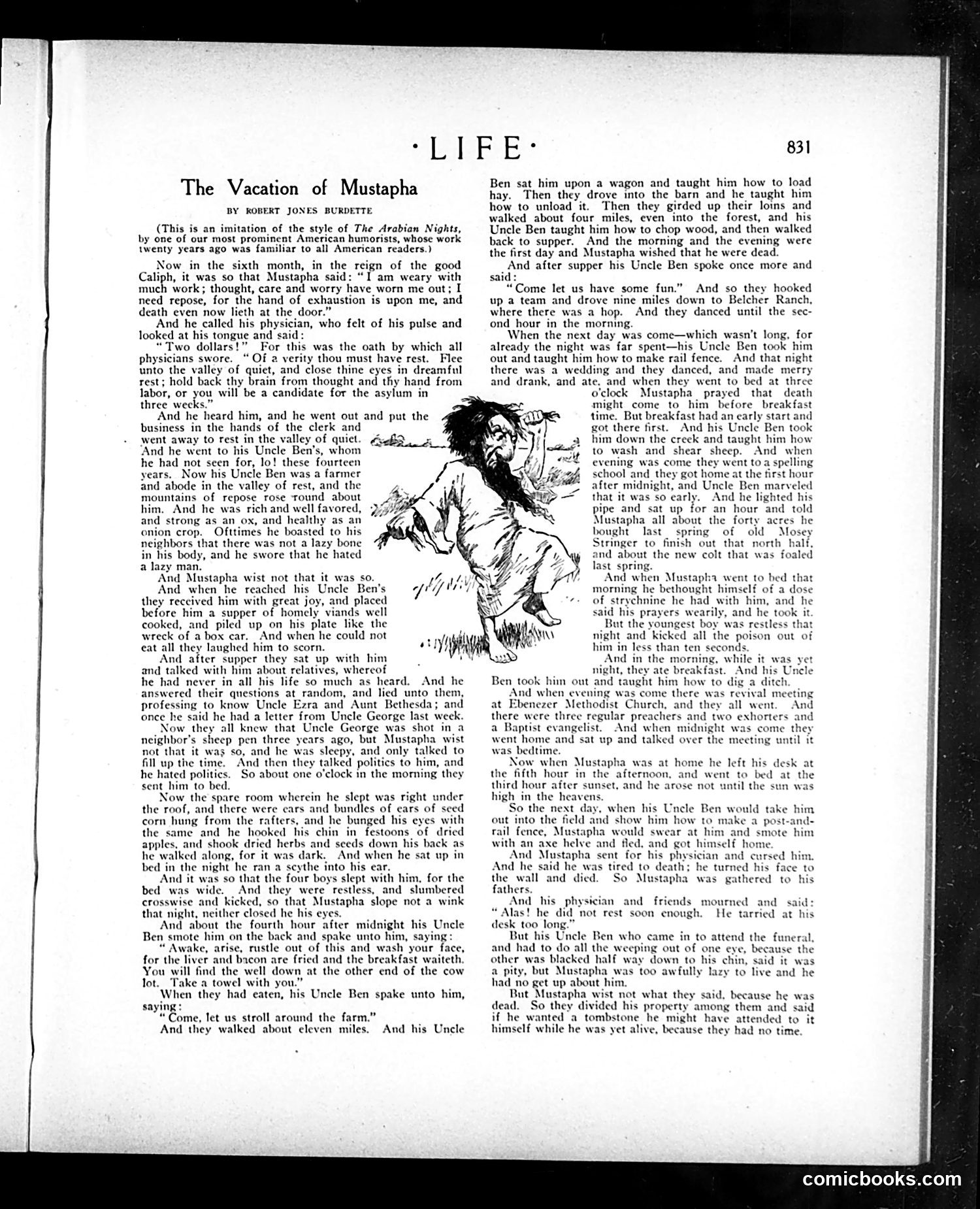
This is a comedic story (not a political cartoon) parodying *Arabian Nights* style, written by humorist Robert Jones Burdette. The illustration shows the protagonist Mustapha, an exhausted city dweller who seeks rest at his Uncle Ben's farm on doctor's orders. The satire targets the era's romanticization of rural life as restorative. Mustapha expects peaceful countryside repose but instead endures relentless farm labor, sleepless nights crammed with relatives and livestock in a cramped bedroom, and the blunt pragmatism of his Uncle Ben—who equates idleness with moral failure. The joke reflects late-19th-century class tensions: Mustapha's urban weariness clashes with rural culture's valorization of constant work and family obligation. Rather than healing rest, the farm vacation becomes exhausting physical toil and social discomfort. The humor derives from subverting expectations of pastoral peace.
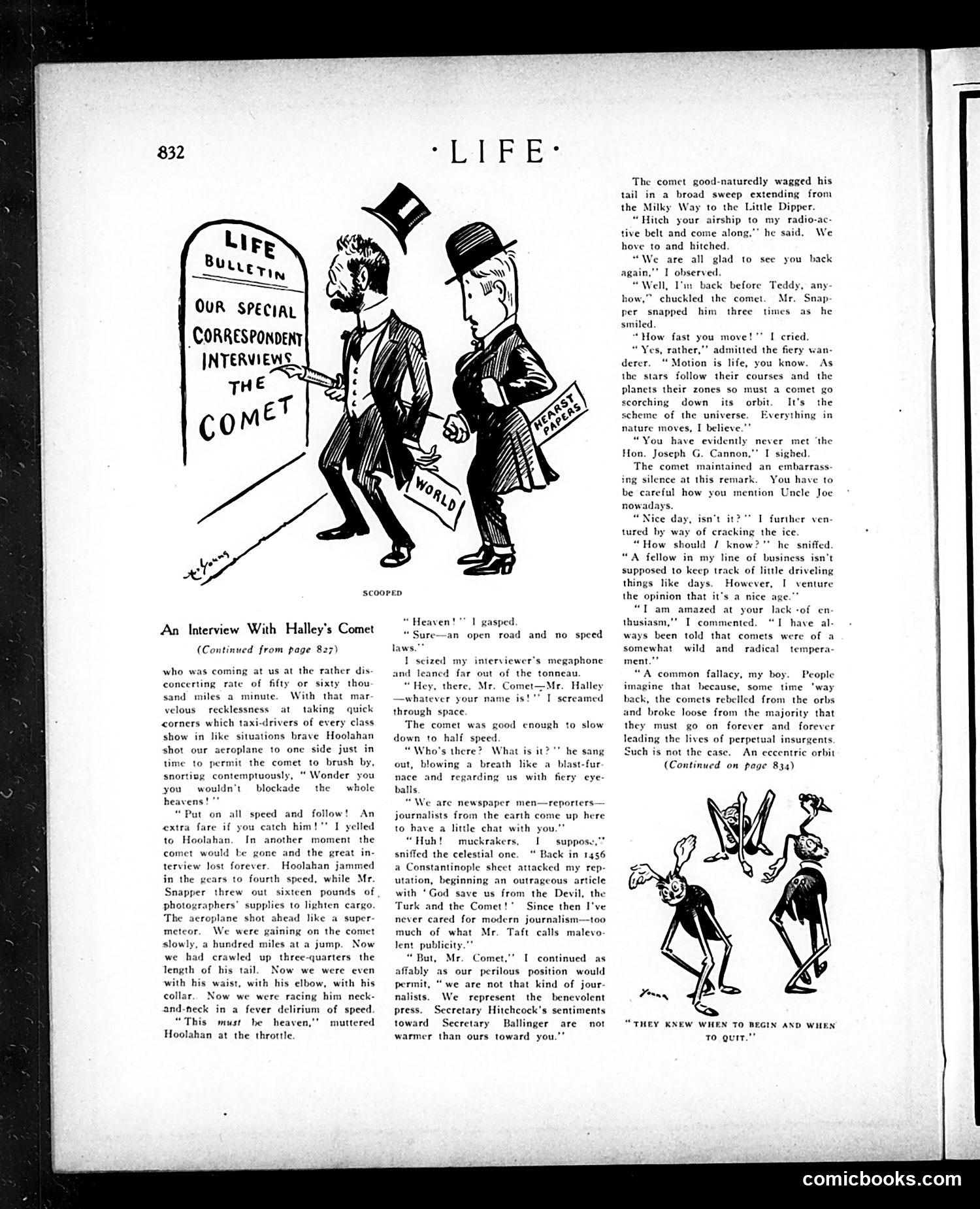
This is a humorous satirical piece imagining an interview with Halley's Comet, presented as a "Life Bulletin" exclusive. The cartoon shows reporters chasing the comet in an airplane. The satire mocks several contemporary figures and issues: - **Joseph G. Cannon**: Referenced as someone notably stationary/immobile—the comet says it's never met him, implying Cannon was politically stuck or inactive. - **Taft and Hitchcock-Ballinger scandal**: The comet compares public sentiment toward itself to Secretary Hitchcock's feelings toward Secretary Ballinger (a real conservation controversy during Taft's presidency, 1909-1913). - **Press criticism**: The comet initially assumes the reporters are "muckrakers," referencing contemporary investigative journalism. The joke plays on the comet's periodic returns (visiting "before Teddy"—Theodore Roosevelt) and its "motion" as a metaphor for progress, contrasting it with stagnant politicians. The overall effect satirizes both contemporary journalism and political figures through irreverent, absurdist humor typical of Life magazine's style.
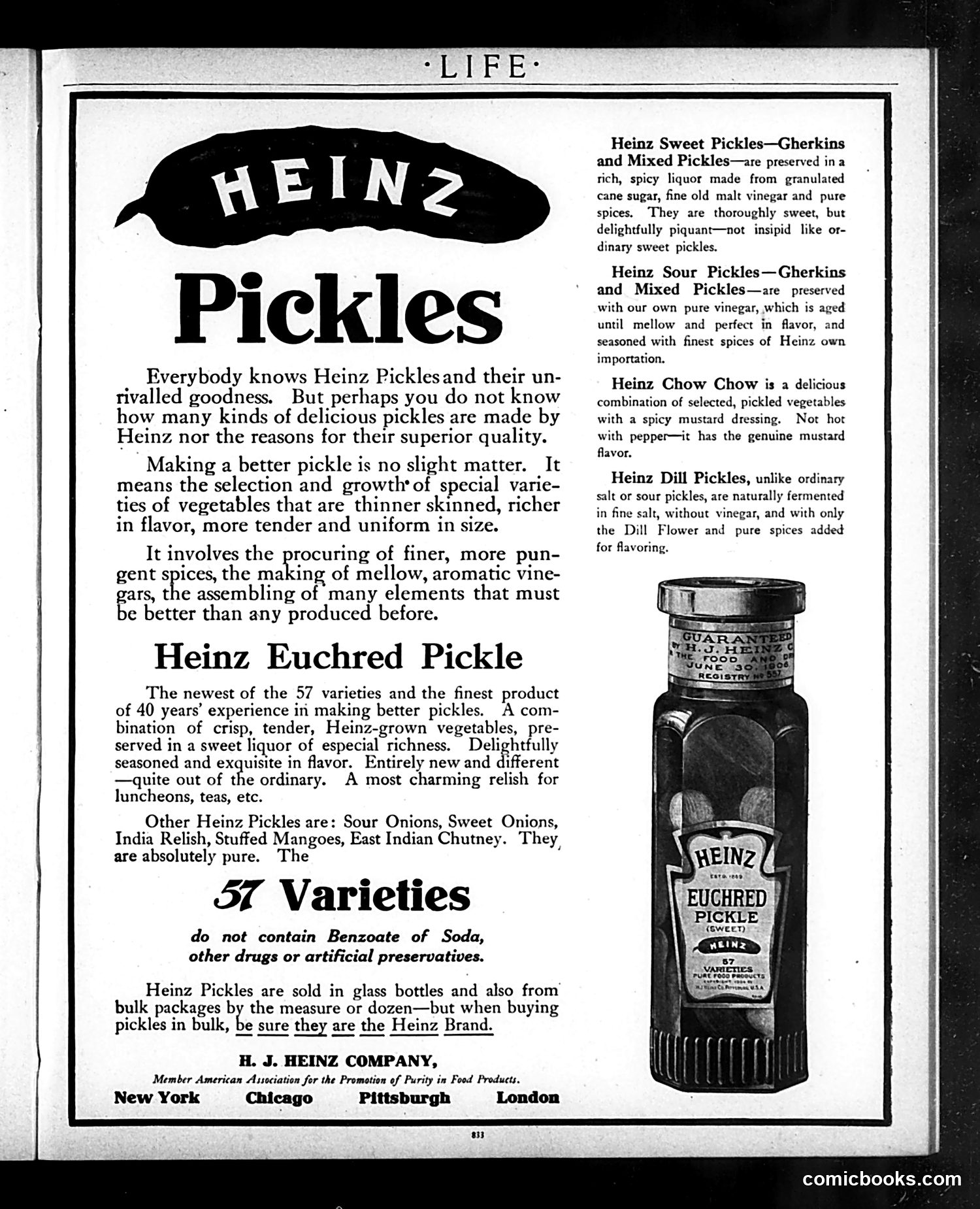
This is a **straightforward advertisement**, not satire or a political cartoon. There is no cartoon content on this page from *Life* magazine. The page promotes Heinz pickles, emphasizing their superior quality through detailed descriptions of production methods and varieties (Sweet Pickles, Sour Pickles, Chow Chow, Dill Pickles, and the new "Euchred Pickle"). A notable marketing claim is that all 57 varieties "do not contain Benzoate of Soda, other drugs or artificial preservatives"—reflecting early 20th-century concerns about food safety and additives. The company also emphasizes membership in the "American Association for the Promotion of Purity in Food Products," appealing to consumer anxieties about food quality. The page includes a product image of a Heinz Euchred Pickle bottle and is purely commercial content, typical of *Life* magazine's advertising sections.
This is a humorous interview between the narrator and Halley's Comet, visiting Earth after 75 years. The satire mocks American boosterism and materialism in the early 20th century. **The targets:** - American pride in growth and progress (skyscrapers, railroads, automobiles) presented as if these are genuine accomplishments - Urban sprawl ("New York City" as a "big blotch") - Rapid apartment construction enabling quick marriages and consumer culture - American obsession with "Tariff" (trade policy) and divorce - Millionaires as cultural heroes despite their single-minded pursuit of wealth **The joke:** The comet—having traveled the universe for millennia—finds American achievements trivial or concerning. The narrator's desperate attempts to impress a celestial body with speed, size, and wealth expose American values as shallow. References to William Jennings Bryan suggest political/economic debate of the era. The satire suggests Americans conflate *bigger* and *faster* with *better*, missing what truly matters.
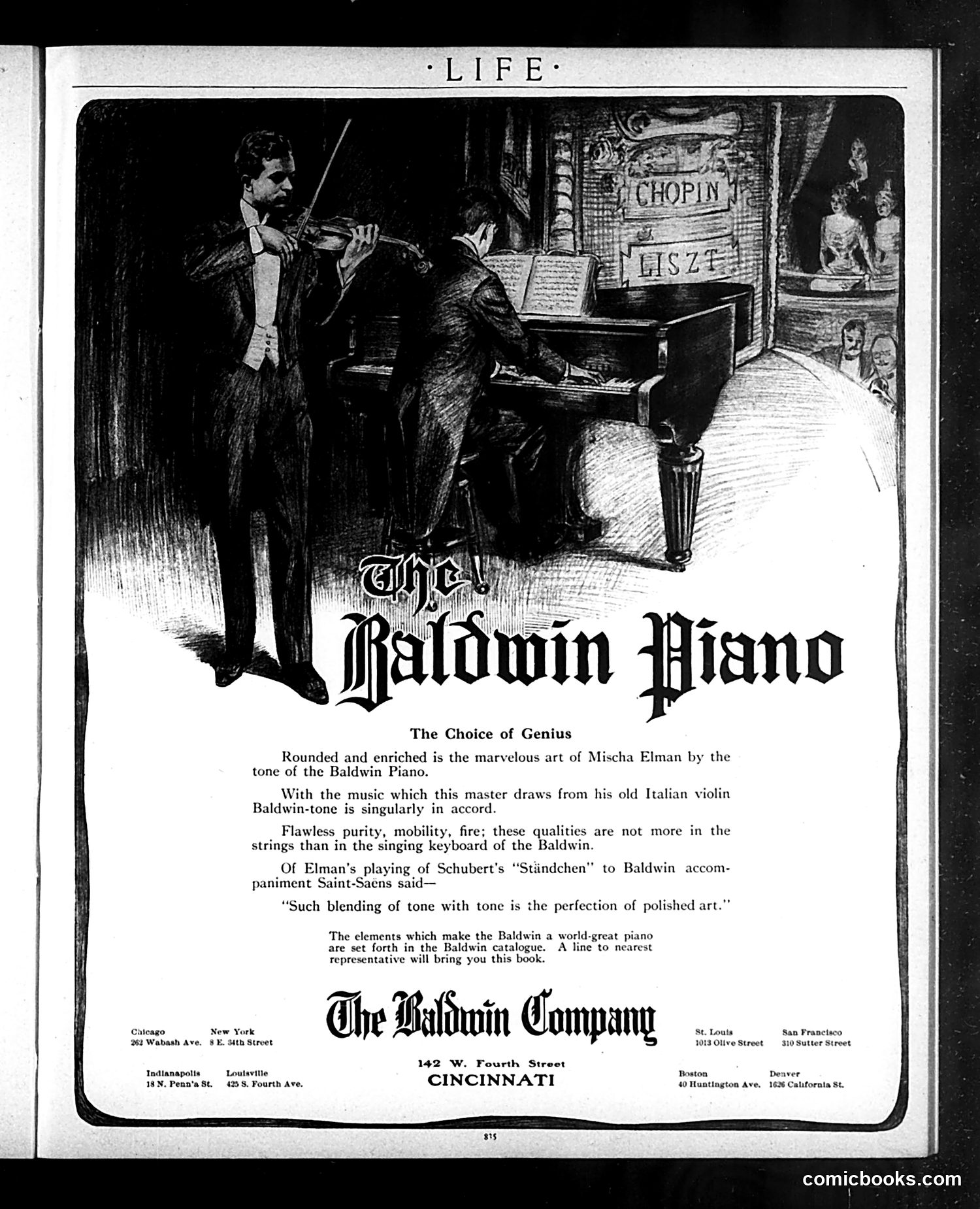
This is not a political cartoon but a **piano advertisement** from *Life* magazine. It endorses the Baldwin Piano by associating it with **Mischa Elman**, a renowned violinist of the era, and quotes **Saint-Saëns** (the famous composer) praising the instrument's tone quality. The advertisement uses a common marketing strategy: celebrity endorsement and artistic prestige. By showing Elman performing violin alongside a Baldwin Piano, the ad claims the instrument's sound complements even a master musician's artistry. The quote about "perfection of polished art" attempts to position Baldwin as the choice of serious musicians. The illustration depicts a concert performance, reinforcing the piano's association with classical music and high culture. The ad includes multiple Baldwin Company office locations, indicating it was a major manufacturer.
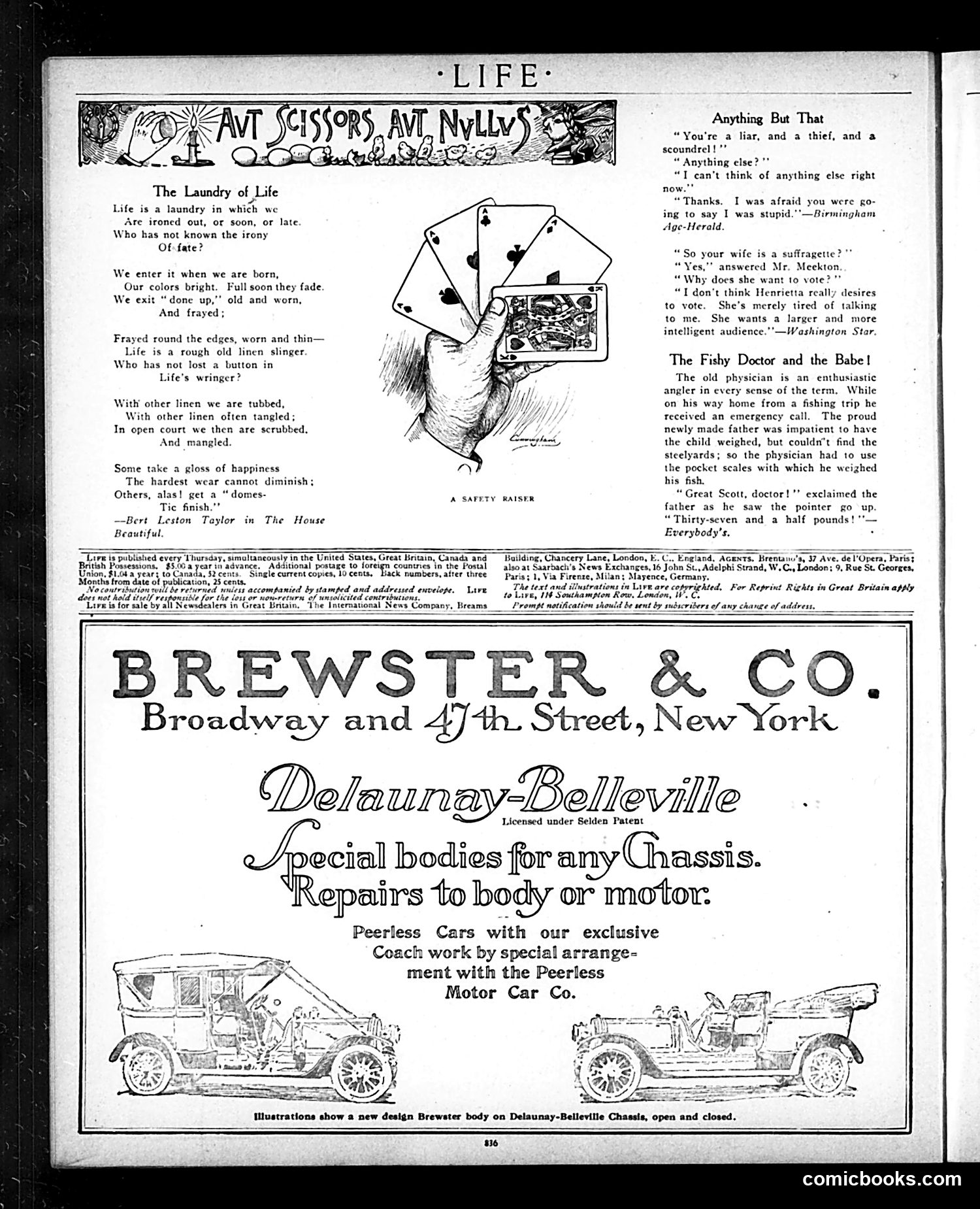
This page contains satirical humor pieces typical of early 20th-century Life magazine, plus period advertising. **The Poetry & Jokes:** "The Laundry of Life" uses extended metaphor comparing life's hardships to laundry—fading colors, torn fabric, lost buttons, tangling with others. The accompanying jokes mock domestic relations: a husband relieved when called a "liar, thief, and scoundrel" rather than "stupid"; a wife seeking suffrage (voting rights) mainly to escape her husband's conversation; a doctor who uses fishing scales to weigh a newborn, finding it implausibly heavy at 37½ pounds. **Social Context:** The suffragette joke reflects contemporary debates over women's voting rights. The domestic humor reflects traditional gender dynamics and marital tension as comedy fodder. **The Advertisement:** The lower half promotes Brewster & Co.'s automobile bodies and Delaunay-Belleville chassis—luxury car customization services for wealthy buyers. The detailed technical language and illustrations target affluent readers. The page mixes lightweight domestic satire with upscale consumer marketing, typical of Life's educated, middle-to-upper-class audience.

This page is a straightforward advertisement, not satire or political commentary. It promotes two Pond's Extract Company products: their general extract (claimed as a 60-year standard remedy for cuts, bruises, burns, and sore throat) and their Vanishing Cream (a non-oily toilet cream with rose fragrance). The ad uses typical early-20th-century marketing language, emphasizing the products' "harmlessness" and "healing properties." The bottle illustration shows product labeling. There is no cartoon, political reference, or joke—this is simply a vintage print advertisement appearing in Life magazine, offering free samples and trial sizes to potential customers at their New York address.
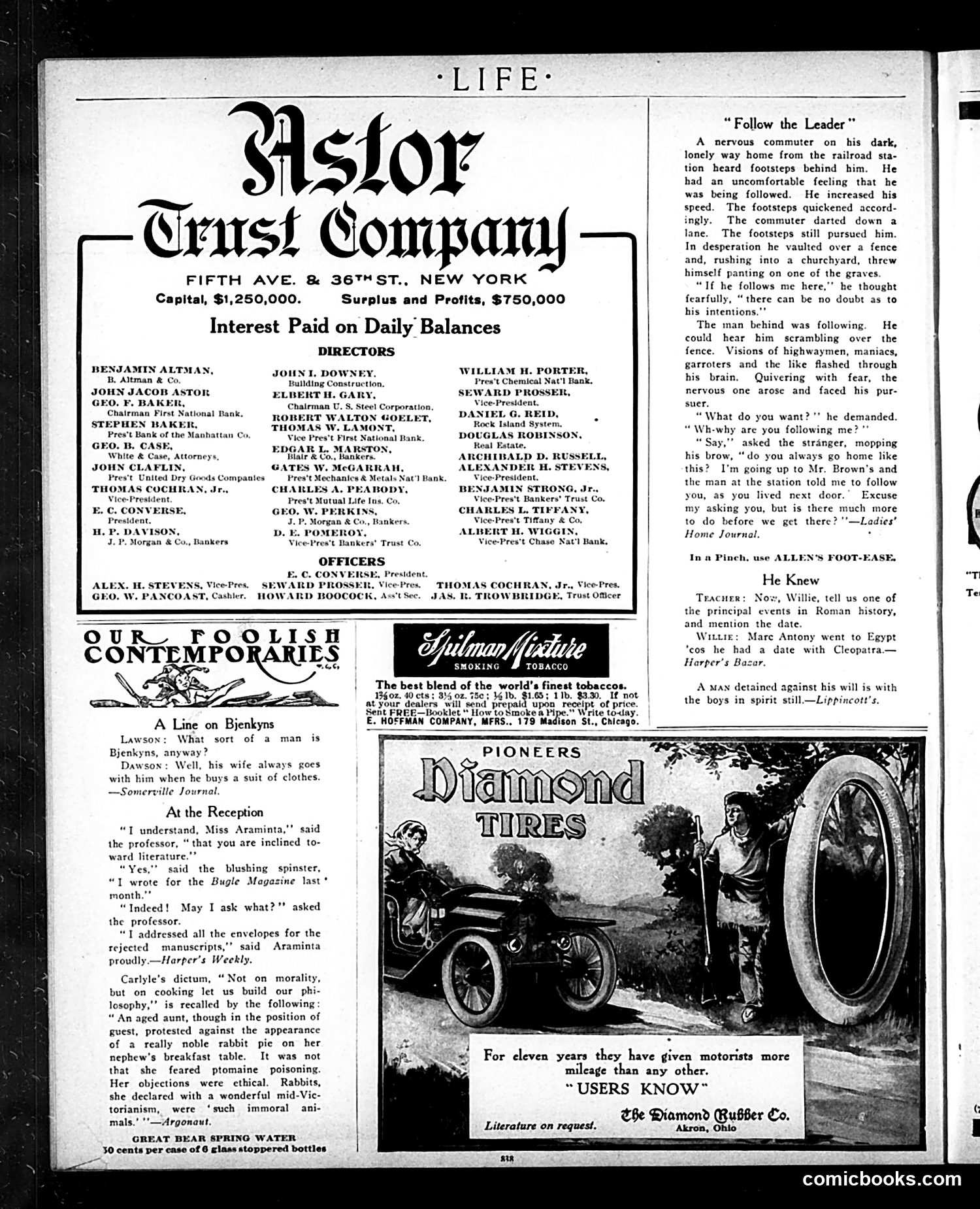
This page is primarily **advertising and filler content** from Life magazine, with a bank advertisement dominating the upper portion and several short humorous anecdotes below. The main illustrated content is a **"Follow the Leader" story** (text only, no cartoon): a nervous commuter fleeing home believes he's being pursued by a menacing figure through dark streets. The tension builds dramatically—the pursuer follows over fences, through churchyards. The punchline: the stranger is merely a neighbor who was told by a station employee to follow him home since they're neighbors heading the same direction. The satire targets **urban paranoia and misunderstanding**—the comedy stems from mistaken identity and anxiety. Below are brief joke items mocking pretension (a spinster "wrote" for a magazine by addressing envelopes) and domestic life. A Diamond Tires advertisement occupies the lower half. **Context for modern readers**: This reflects early 20th-century anxieties about urban crime and the comedy of miscommunication in a growing city.
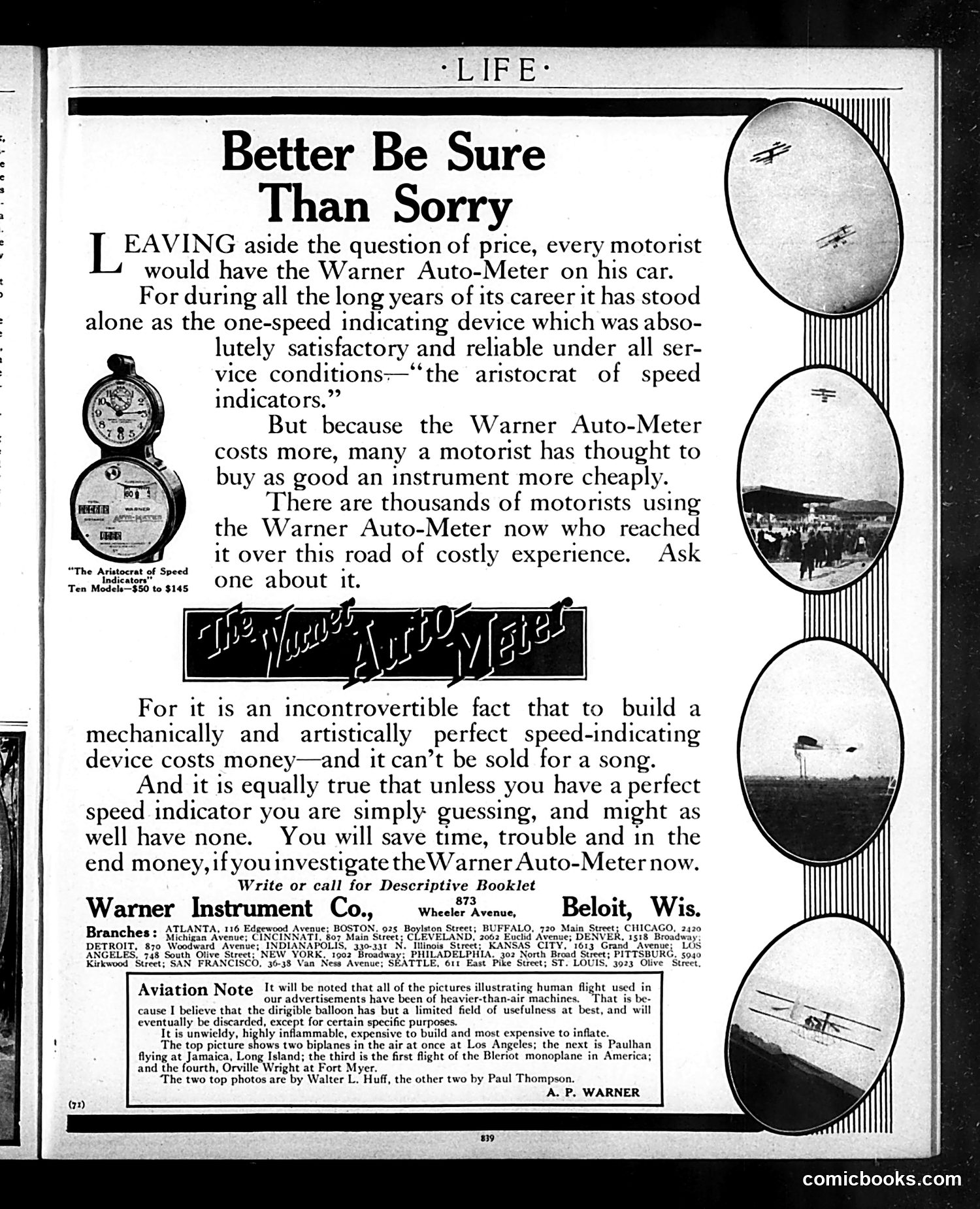
This is a **product advertisement**, not a political cartoon. The page promotes the Warner Auto-Meter, a speedometer for automobiles. The ad's pitch is straightforward: while cheaper speed indicators exist, the Warner Auto-Meter costs more because it's superior quality—"the aristocrat of speed indicators." The headline "Better Be Sure Than Sorry" warns motorists against false economy. The argument: buying an inferior, cheaper speedometer is false savings; thousands have learned this through "costly experience" and now use Warner products. The accompanying images show early aviation scenes (biplanes, Wright brothers) unrelated to the speedometer itself—likely included because Life magazine featured such photographs and A.P. Warner (the advertiser) wanted to associate his brand with technological progress and innovation. The dense listing of branch offices nationwide indicates Warner Instrument Company was a significant manufacturer of the era (early 1900s), when automobile accessories were still novel and speedometers were relatively new technology.
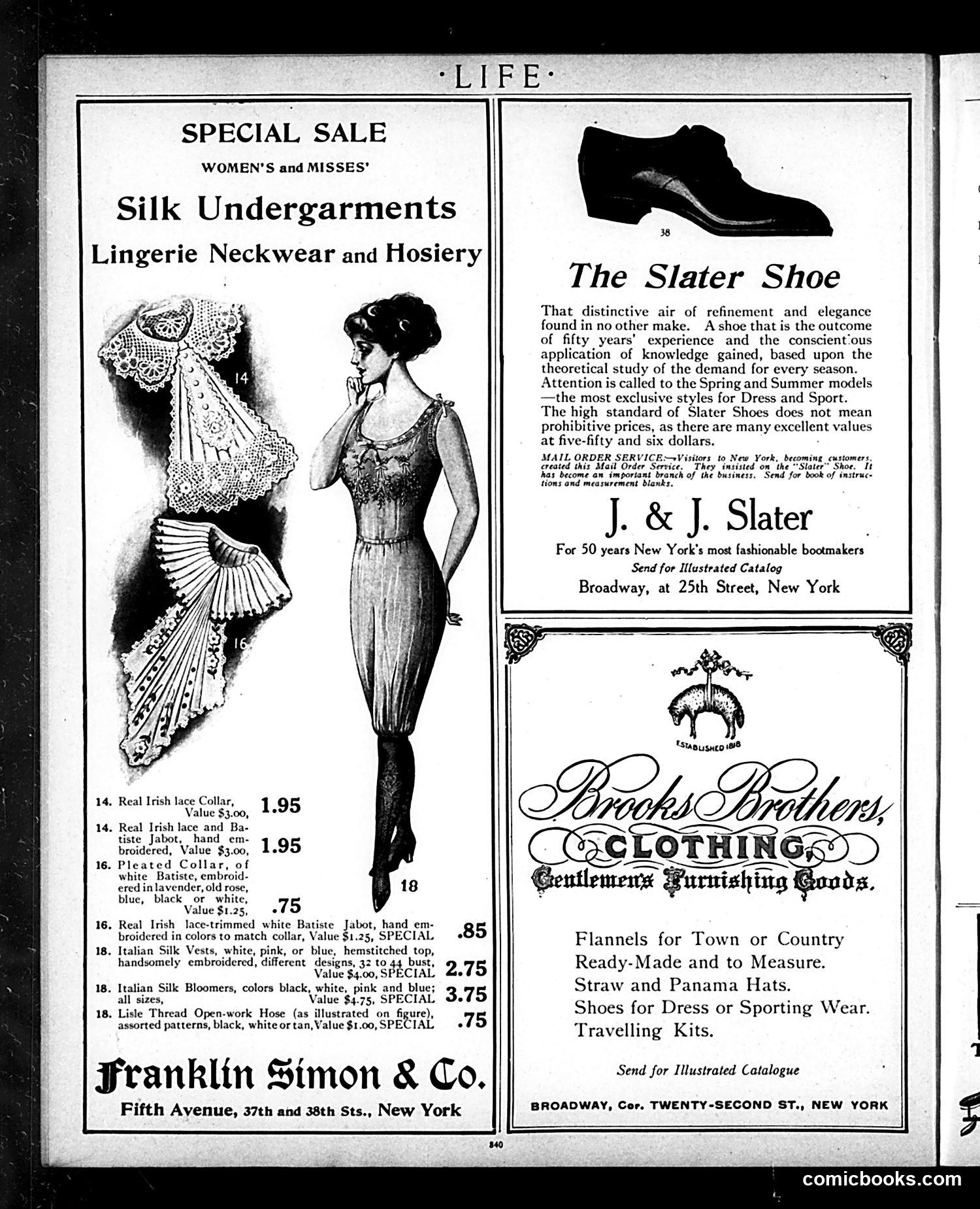
This page contains **no cartoons or satire**—it is purely **advertising**. The page features four commercial advertisements from high-end New York retailers circa early 1900s: 1. **Franklin Simon & Co.** (left): A special sale on women's silk undergarments, lingerie, neckwear, and hosiery, with illustrated fashion sketches showing a woman in undergarments and a corsetted dress. 2. **J. & J. Slater** (top right): Shoe advertisement emphasizing 50 years of bootmaking experience and exclusive styles for "Dress and Sport," priced at $5.50–$6. 3. **Brooks Brothers** (bottom right): Listing gentlemen's clothing and accessories including flannels, hats, shoes, and travelling kits. All three ads emphasize quality, New York location, and mail-order service—reflecting early 20th-century retail marketing. There is no political commentary, satire, or caricature present on this page.
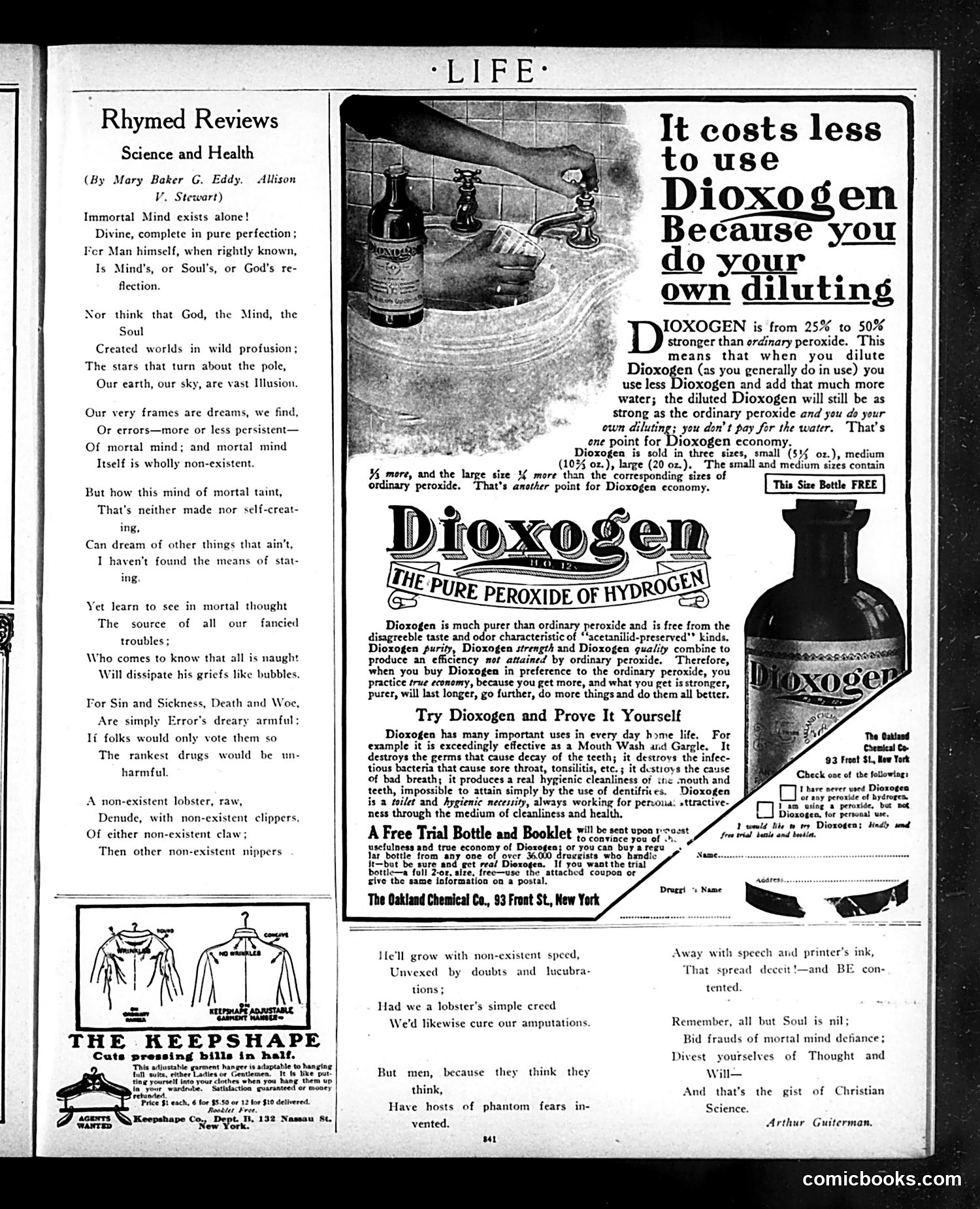
This page satirizes **Mary Baker G. Eddy's "Science and Health,"** the foundational text of Christian Science, through verse parody. The poem mocks Eddy's core teaching that matter and illness are illusions—that "mortal mind" creates all suffering through error, not physical causes. The satire climaxes absurdly: if sickness is merely mistaken thought, then "rankest drugs would be unharmful," and one could imagine a "non-existent lobster" being prepared with non-existent tools. The **adjacent Dioxogen advertisement** (a hydrogen peroxide product) is the joke's punchline: positioned directly next to text ridiculing the rejection of medicine, it hawkingly promotes an actual chemical disinfectant. The irony is unmistakable—Life magazine uses Christian Science's denial of material reality to sell a very real, material product as necessary for health. This represents early-1900s skepticism toward Christian Science's anti-medical stance, which was controversially gaining followers.
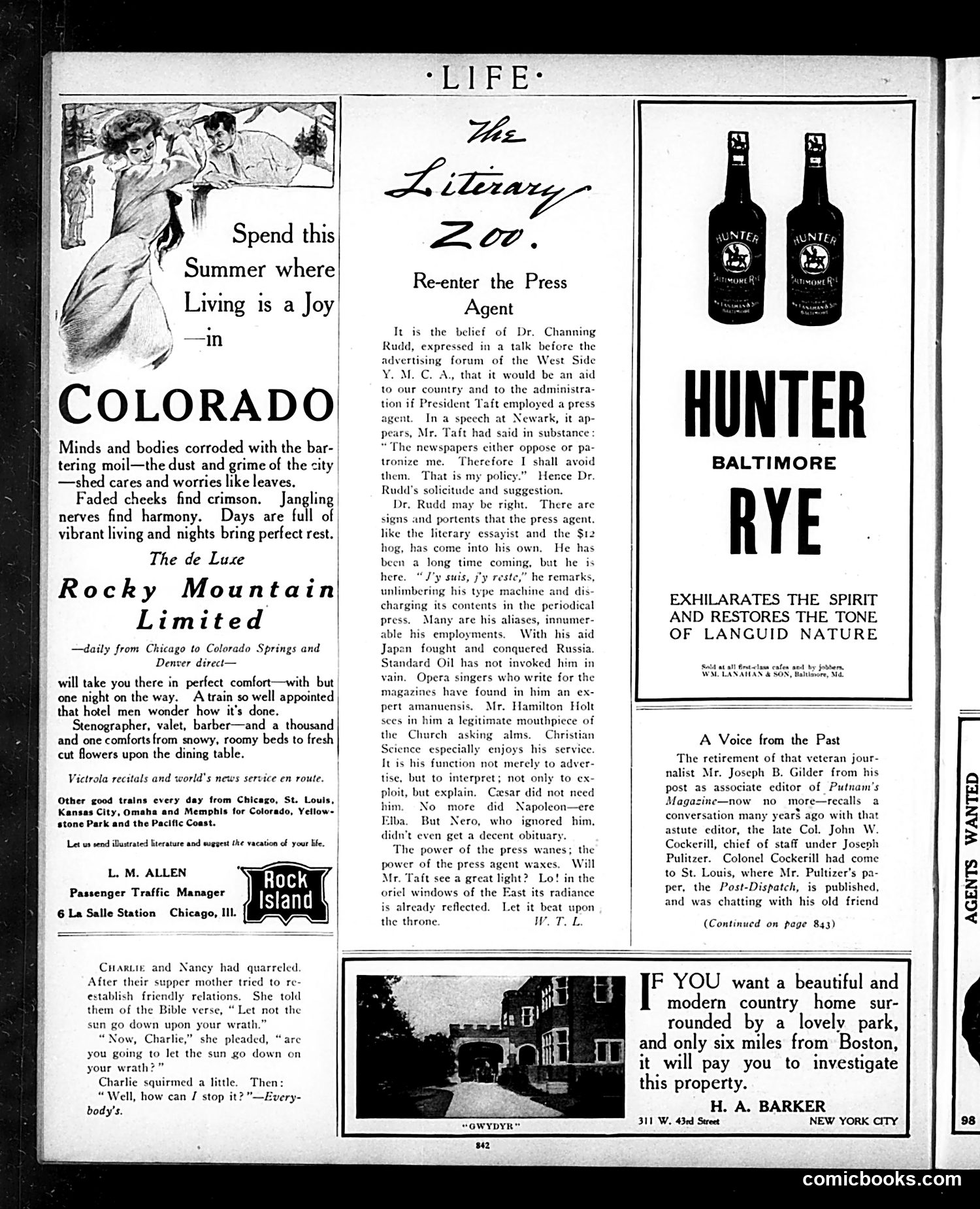
This satirical article (likely by W.T.L., based on the byline) discusses Dr. Changing Rudd's suggestion that President Taft should employ a press agent. Taft had apparently stated he would avoid newspapers since they "oppose or patronize" him. The piece sarcastically argues for the "press agent's" growing power and necessity in modern life. It catalogs examples: Japan's military victory, Standard Oil's operations, opera singers' magazine contributions, and the Church's fundraising—all supposedly benefiting from press agents' interpretive and explanatory work. The satirical thrust: Caesar and Napoleon didn't need press agents, but Nero (who ignored publicity) didn't even get "a decent obituary." The joke is that in the modern age, controlling narrative through a professional publicist has become essential—even presidents need spin doctors, though Taft stubbornly refuses. This reflects early 20th-century anxiety about media manipulation and the emerging profession of public relations.
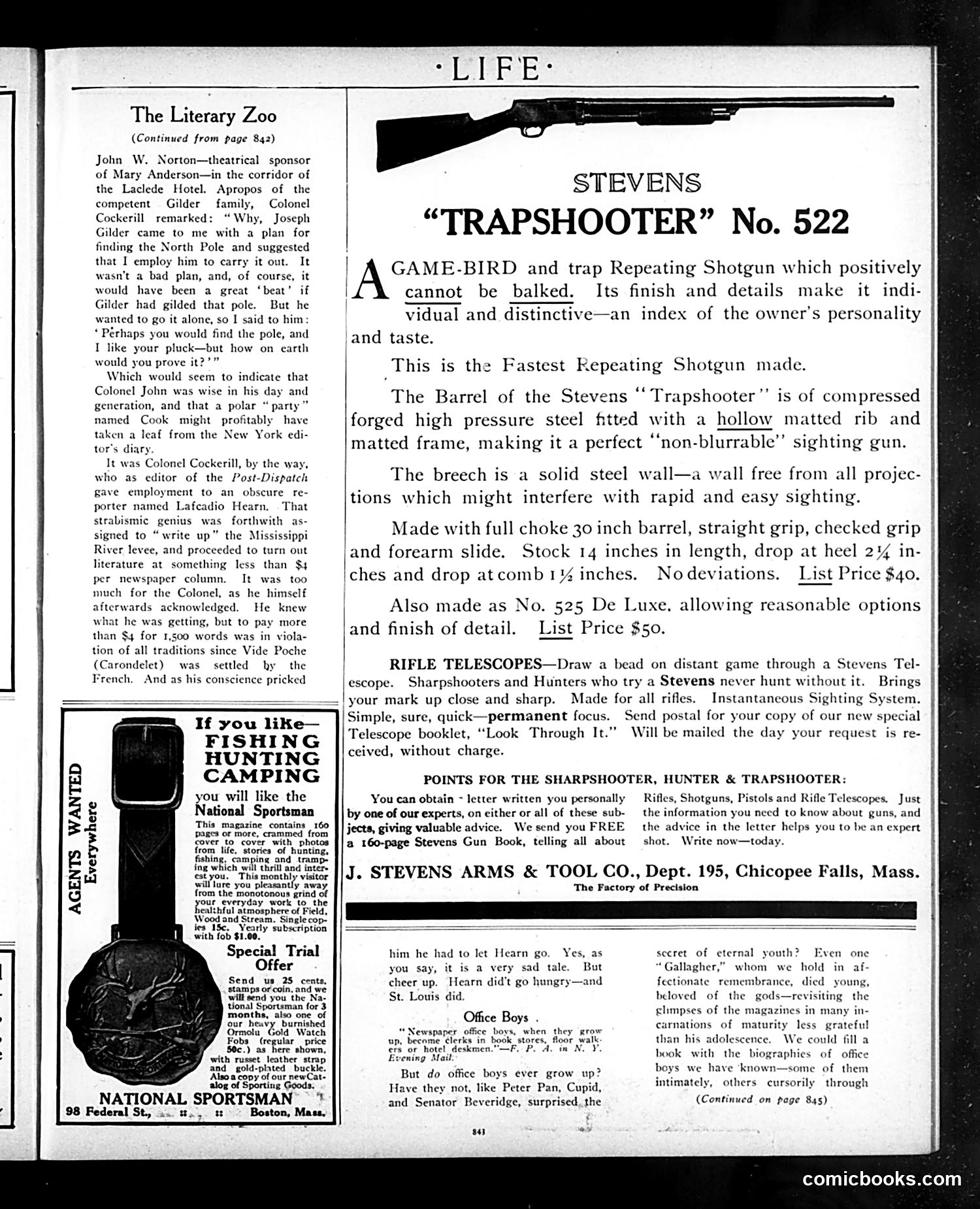
This page is primarily **advertising**, not satire. The dominant content features a Stevens "Trapshooter" shotgun advertisement with technical specifications and sales copy. The upper left contains "The Literary Zoo," a gossipy column about theatrical and journalistic figures. It mentions **Colonel John W. Norton** (theatrical sponsor), the **Gilder family** (competent people), and **Colonel Cockerill** of the *Post-Dispatch*, who employed the writer **Lafcadio Hearn**—described as a "strabismic genius" (cross-eyed). The anecdote mocks Colonel John's practical wisdom about an explorer claiming to find the North Pole. The sidebar advertises *National Sportsman* magazine with a hunting/fishing focus. There is **no political cartoon** on this page. The content reflects early 20th-century advertising conventions and literary gossip typical of Life magazine's format, mixing entertainment news with commercial messaging.
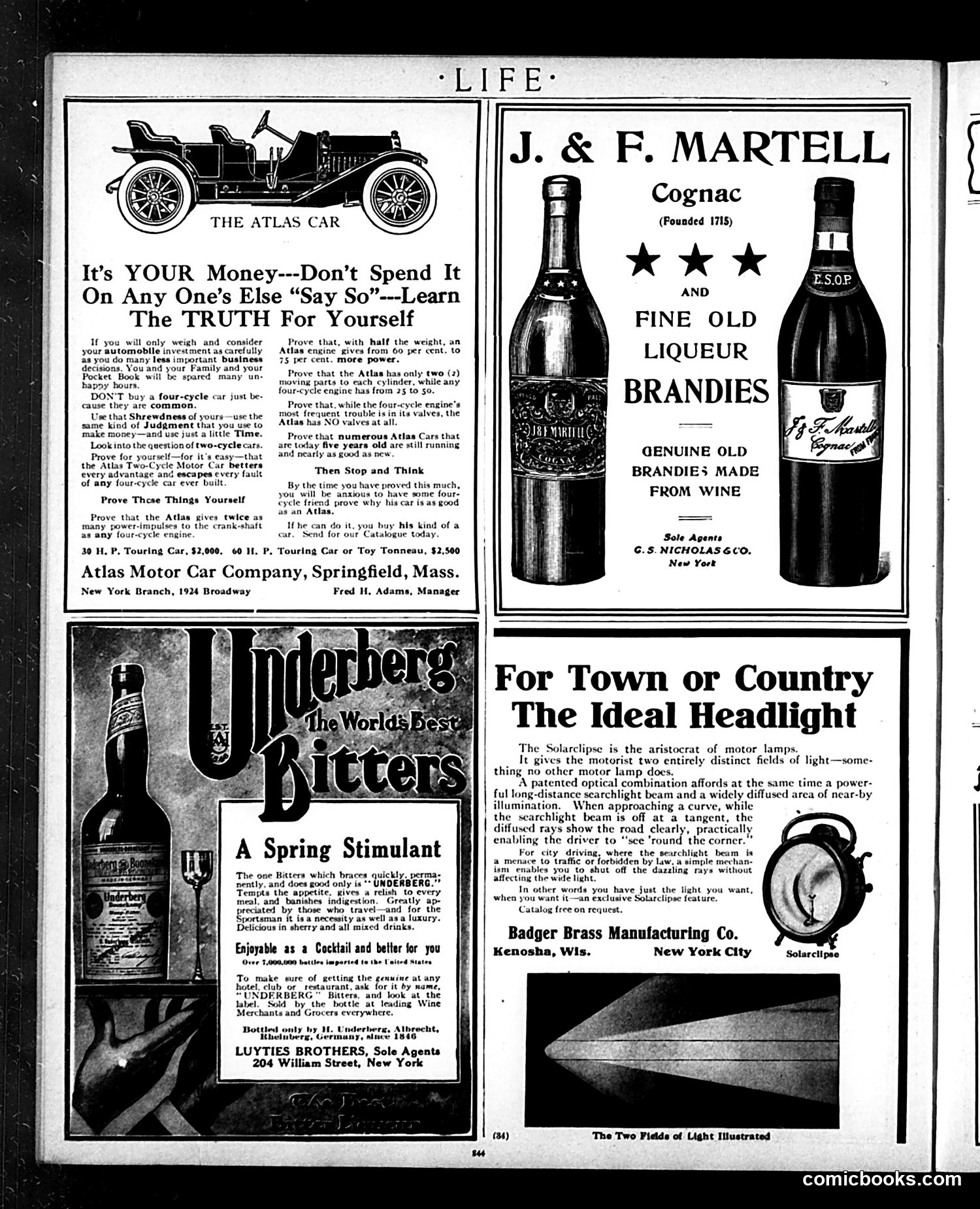
This page is primarily **advertising**, not editorial satire. It contains four distinct product advertisements with no political cartoons or commentary. The ads promote: 1. **Atlas Motor Car** — argues consumers should independently verify that two-cycle engines outperform four-cycle engines in power, simplicity, and reliability 2. **Underberg Bitters** — a digestive liqueur marketed as an appetite stimulant and indigestion remedy, available at hotels and restaurants 3. **J. & F. Martell Cognac and Brandies** — premium spirits founded 1715, distributed through G.S. Nicholas & Co. 4. **Solarclipse Headlight** — automotive lighting with dual fields (long-distance beam and near-field diffusion) For modern readers: these ads reflect early automotive technology debates (two-cycle vs. four-cycle engines were genuine competing designs) and period attitudes toward alcohol as medicinal/digestive aids—acceptable advertising even during Prohibition's enforcement era. No satire or political content is present. The page demonstrates how Life monetized circulation through luxury goods advertising.
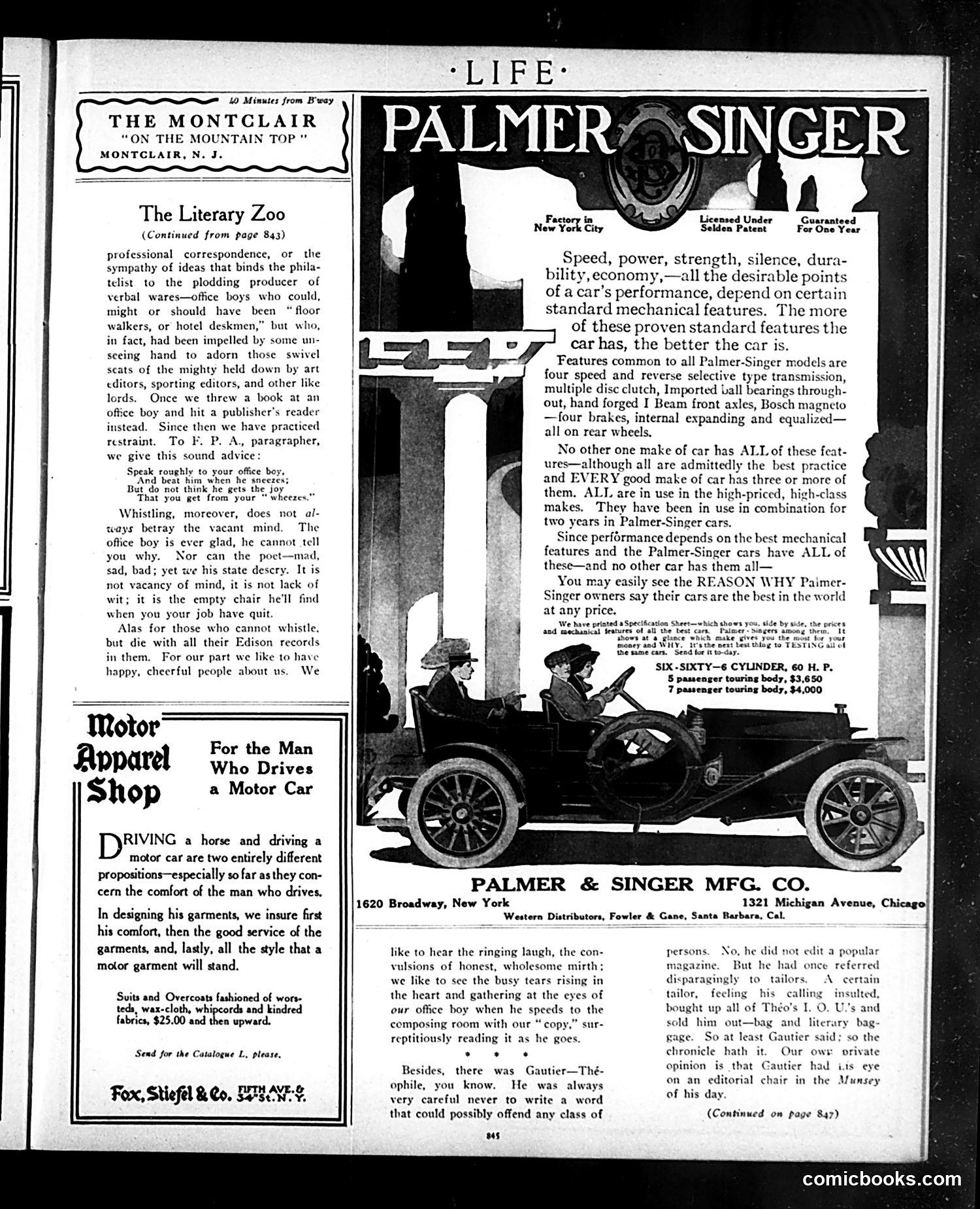
This page mixes editorial content with advertising, typical of early 20th-century Life magazine. **Left side:** "The Literary Zoo" continues a satirical piece about office boys at publishing houses. The author playfully critiques these young workers—suggesting they're often underqualified ("impelled by some unseeing hand") yet occupy important editorial positions. The advice to humorist F.P.A. uses whimsical verse to defend whistling office boys as potentially cheerful rather than vacant-minded, warning that dismissing them carelessly might leave the writer jobless when their own career ends. **Right side:** A full-page Palmer-Singer automobile advertisement claims their cars possess all desirable mechanical features (transmission, bearings, brakes) that competitors lack or only partially include. The ad targets affluent buyers by asserting superiority through technical specification rather than style alone. Pricing ($3,650-$4,000) places it in the luxury market of the era. **Bottom:** The text discusses an unnamed "Gautier"—appears to be editorial commentary about someone careful with published words, though context is unclear from this page alone.
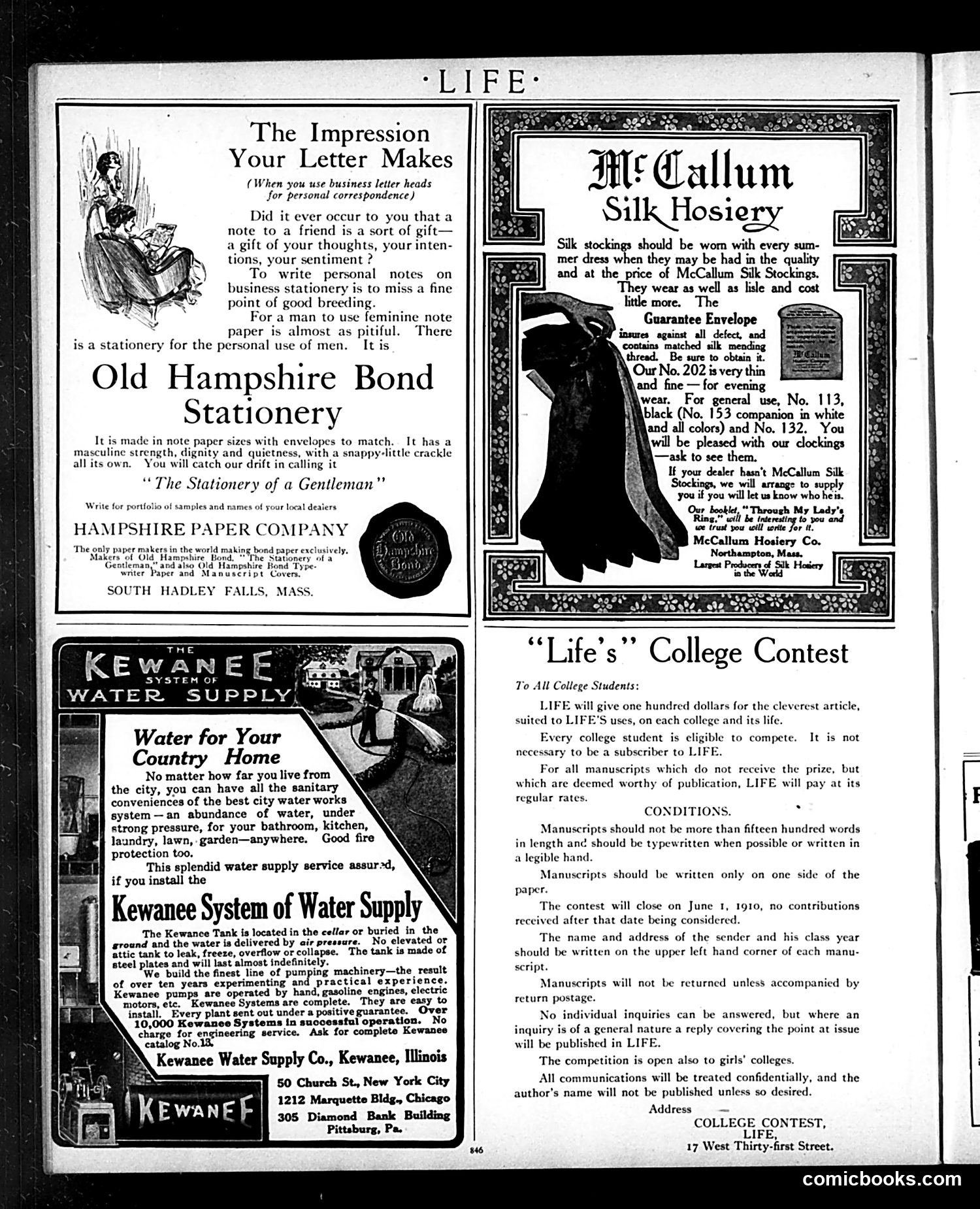
This page is primarily **advertising**, featuring four product advertisements rather than political cartoons or satire. The ads promote: 1. **Old Hampshire Bond Stationery** — appeals to class consciousness by claiming using business letterhead for personal notes violates "good breeding." It emphasizes masculine propriety ("a stationery for the personal use of men"). 2. **McCallum Silk Hosiery** — targets women, suggesting silk stockings are essential summer wear. 3. **Kewanee Water Supply System** — pitches indoor plumbing for rural homes, positioning modern water systems as bringing city conveniences to the countryside. 4. **Life's College Contest** — announces a writing competition offering $100 for the best article about college life, with submission guidelines. The page reflects early 1900s consumer culture and class anxieties about proper etiquette and modern conveniences, rather than containing political satire or caricatured figures. It's a straightforward commercial publication targeting educated, middle-to-upper-class readers.
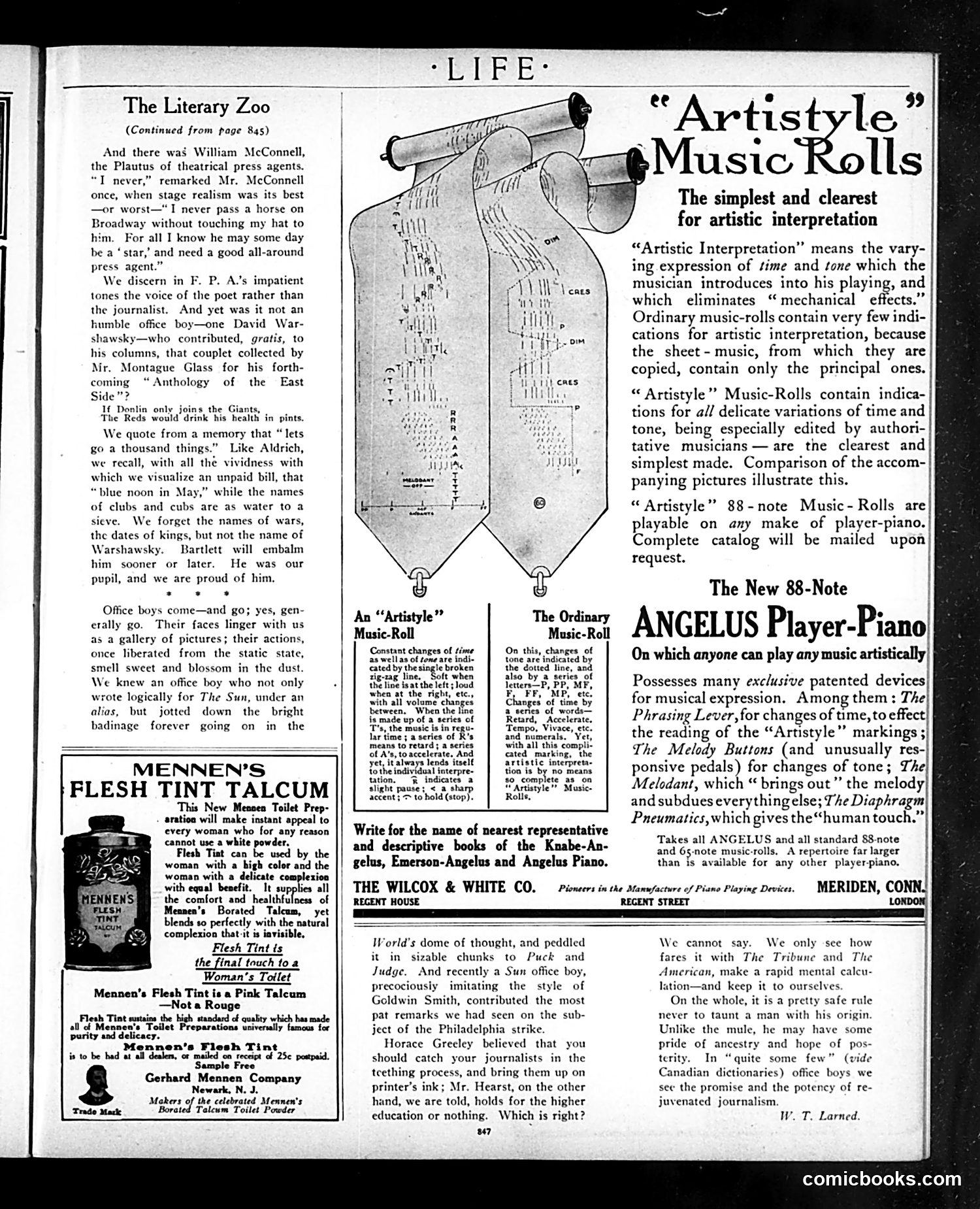
This page is primarily **advertising** for player-piano music rolls and related products, with a brief literary column sidebar. The "Literary Zoo" column (left) concludes an earlier piece, discussing journalists and theater press agents, particularly William McConnell. The author affectionately recalls an office boy named Warshawsky who contributed anonymous witty couplets to the column—a nostalgic anecdote about forgotten contributors to journalism. The dominant content features advertisements for: 1. **"Artistyle" Music Rolls** — promoting player-piano rolls with detailed artistic interpretation markings (tempo, tone variations) superior to ordinary rolls 2. **Angelus Player-Piano** — touting exclusive patented devices for musical expression 3. **Mennen's Flesh Tint Talcum** — a cosmetic powder for women The diagrams compare standard music rolls versus "Artistyle" rolls, showing how the latter includes nuanced markings for artistic performance. This reflects early 20th-century consumer marketing positioning technological products as enabling "artistic" experiences for average home users.
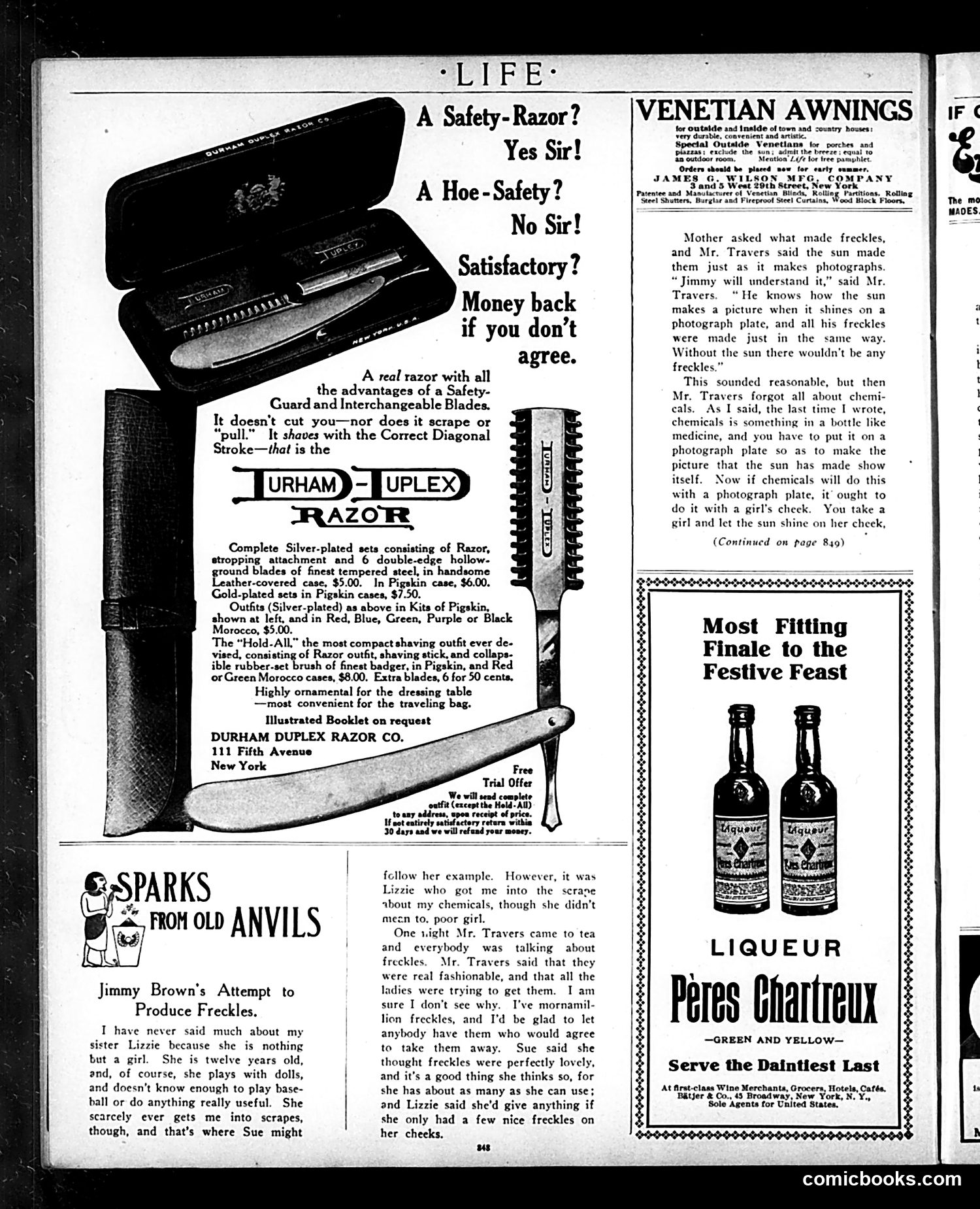
This page contains advertisements and a humorous story called "Sparks from Old Anvils." **The Main Content:** "Jimmy Brown's Attempt to Produce Freckles" is a comedic narrative about a boy who misunderstands scientific explanations. Mr. Travers explains that freckles form when the sun acts on skin like it does on a photograph plate. Jimmy then confuses this with the chemical development process used in photography, apparently attempting to use photographic chemicals on his sister's cheek to create freckles—though the text breaks off before revealing what happens. **The Humor:** The joke relies on a child's literal misinterpretation of adult explanation. Jimmy knows that chemicals are necessary to develop photographs but doesn't grasp that they function differently on skin than on photographic plates. The satire gently mocks both the pseudo-scientific explanations adults offer children and children's tendency to misapply logic. **Advertisements:** The page also features razor, awning, and liqueur ads typical of the era—these are straightforward commercial content with no satirical intent.
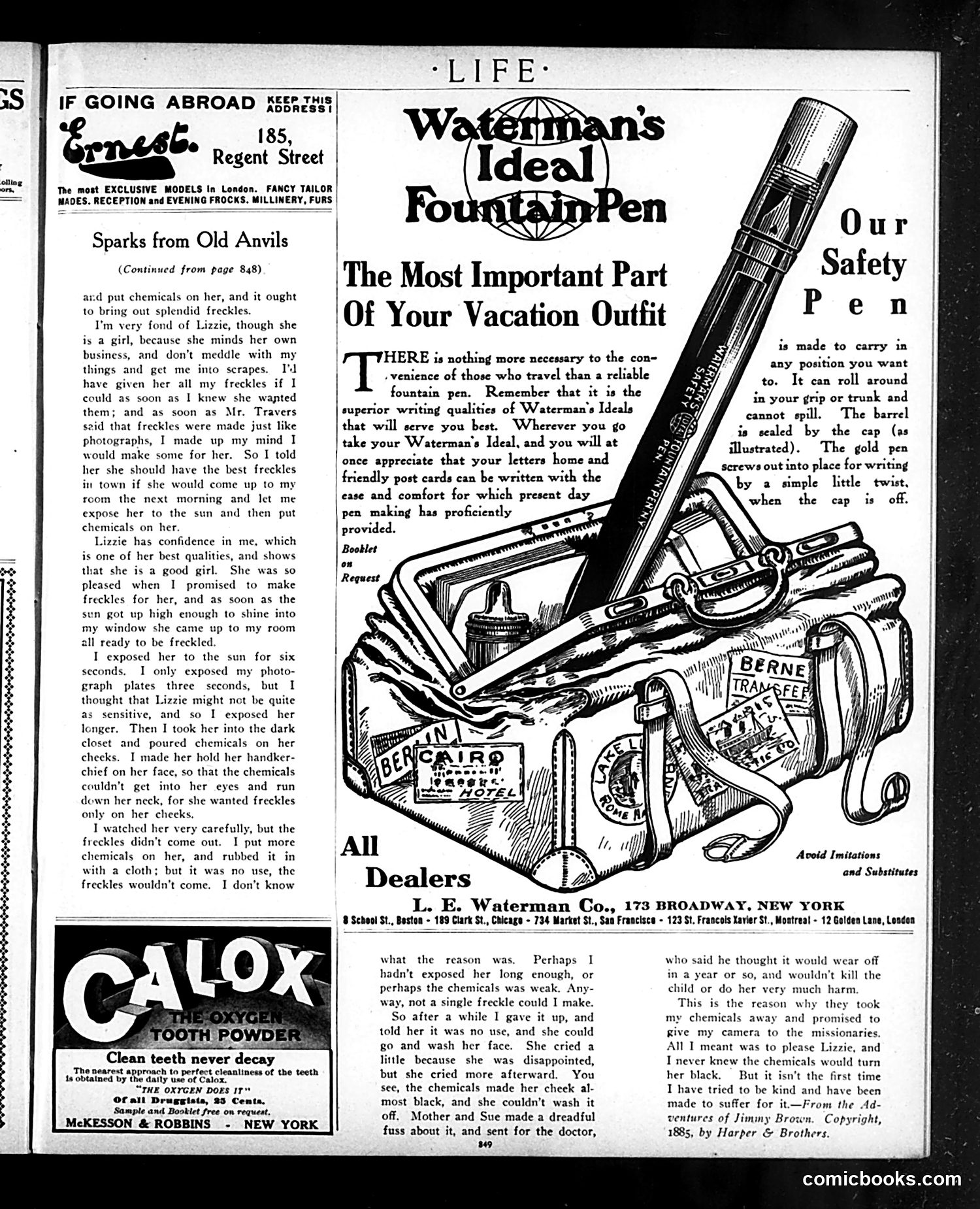
This page contains a serialized story ("Sparks from Old Anvils," continued from page 848) about a child narrator who attempts to artificially create freckles on his friend Lizzie using photographic chemicals and sun exposure—mimicking the process used to develop photographs. The humor derives from the narrator's misguided logic: if chemicals can create images on photographic plates, they should work on skin. Instead, the chemicals burn Lizzie's cheeks black, requiring a doctor's intervention. The story satirizes childhood naiveté and pseudo-scientific thinking. The surrounding advertisements (Waterman fountain pens, Calox toothpaste, Ernest tailoring) are period-appropriate travel and grooming products aimed at affluent readers—unrelated to the story's satire. The joke's appeal lay in recognizing how absurd the chemical "experiment" was, while the moral conclusion (the boy learns consequences through Lizzie's suffering) reflects contemporary attitudes about children's mischief and responsibility.
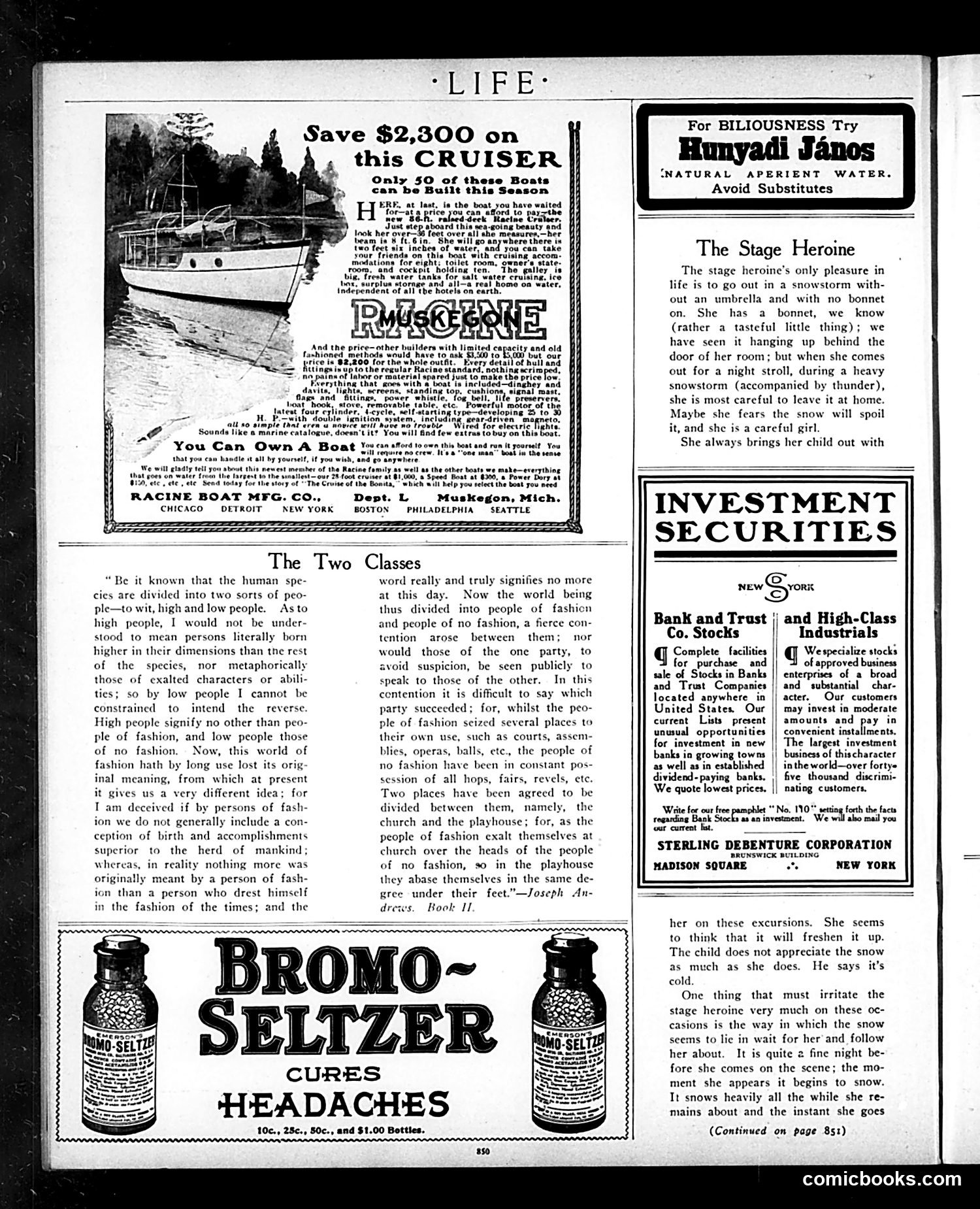
This page is primarily **advertisements and editorial content**, not political satire. The main items are: 1. **Cruiser boat advertisement** (left): Promoting a 36-foot motorboat for $2,300—positioned as affordable luxury. Claims only 50 can be built that season, emphasizing exclusivity and modern convenience (engine, galley, toilet room). 2. **"The Stage Heroine"** (right): A satirical piece mocking theatrical melodrama conventions—specifically the trope of heroines venturing into snowstorms without proper protection to appear romantic or dramatic, despite owning bonnets they deliberately leave behind. 3. **"The Two Classes"** (center): A lengthy excerpt (credited to Joseph Andrews, Book II) discussing the division between "people of fashion" and "people of no fashion"—not about wealth or birth, but about who follows current trends versus those indifferent to fashion. 4. **Advertisements**: For Hunyadi Janos water, investment securities, and Bromo-Seltzer. The page reflects early 20th-century consumer culture and light social commentary on class pretension and theatrical absurdity, rather than political cartooning.
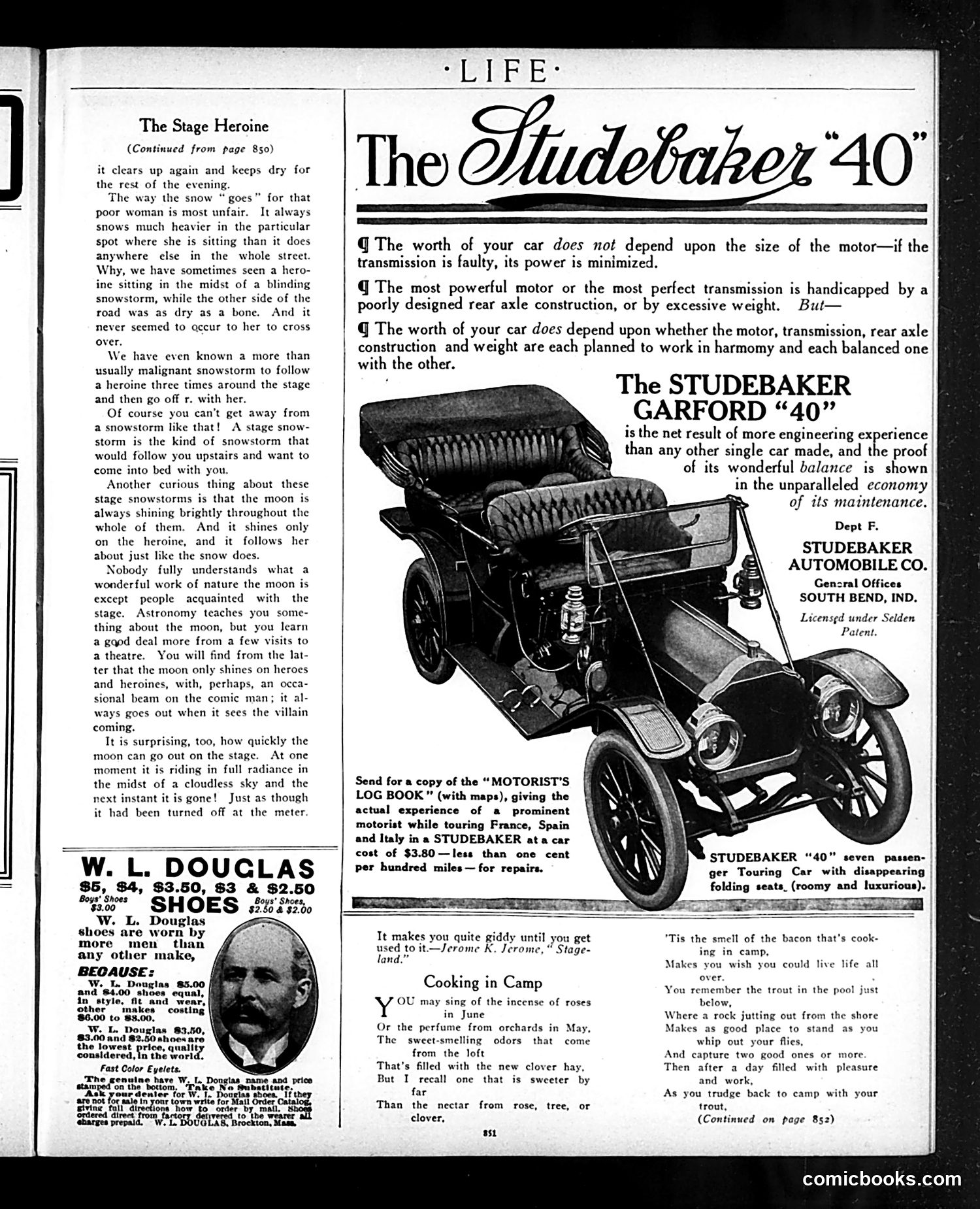
This page contains two distinct elements: a humorous theater critique and automobile advertising. **The Theater Piece**: A satirical essay mocking theatrical conventions of the era, particularly the unrealistic staging of snowstorms around stage heroines. The author ridicules how snow falls only on the protagonist while the rest of the stage remains dry, and how a spotlight (the moon) mysteriously follows the heroine, conveniently disappearing when villains approach. This is gentle satire on the melodramatic staging techniques and artificial dramatic devices common in early 20th-century theater productions. **The Advertising**: The page features two car ads (Studebaker and W.L. Douglas shoes), typical of Life's mixed editorial-advertising format. These are straightforward product pitches with no satirical content, common in period magazines. The "Stage Heroine" piece would resonate with theater-goers familiar with these conventions, poking fun at how theatrical "magic" relied on obvious, somewhat absurd technical tricks.
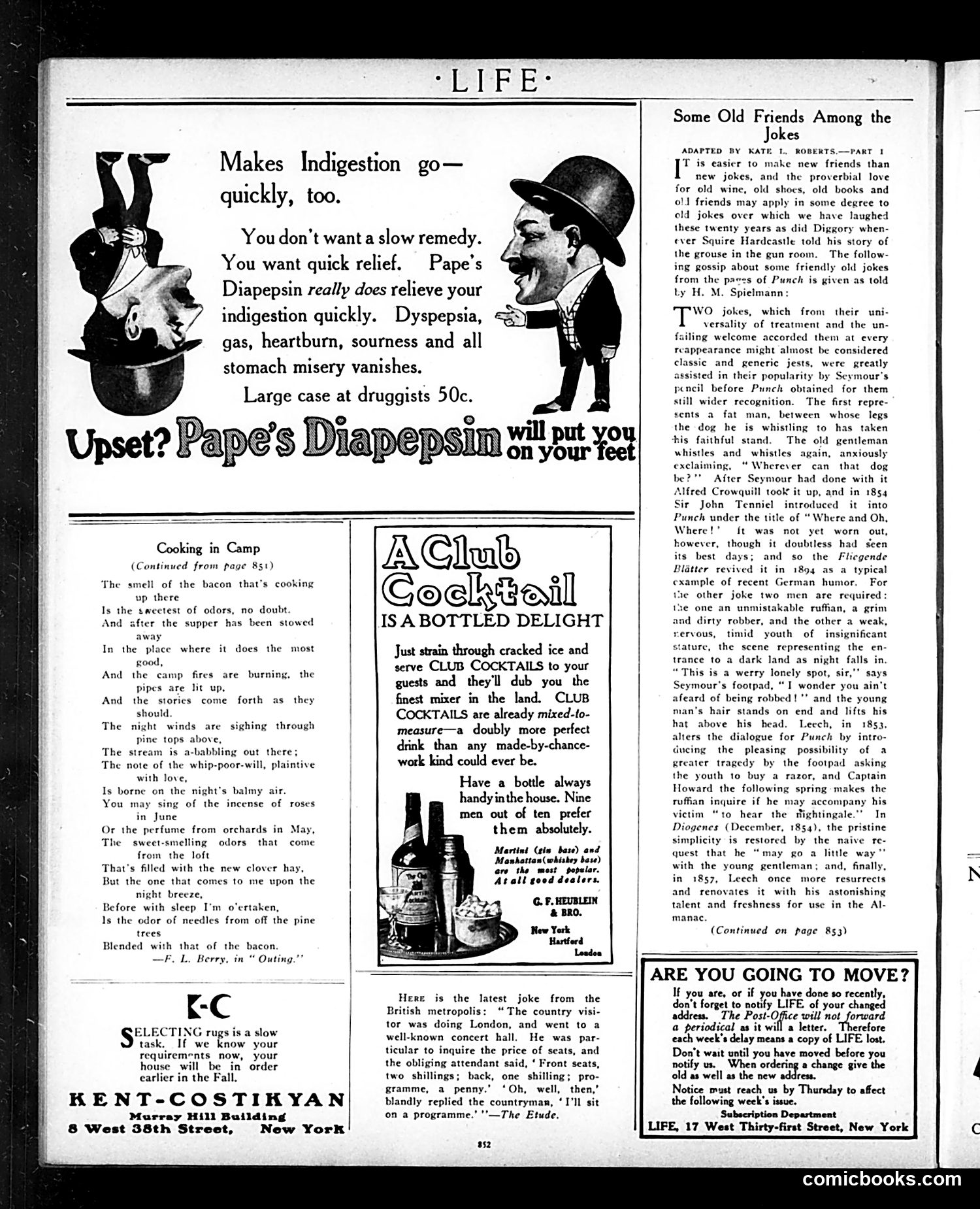
This page mixes **advertisements with humorous content** typical of Life magazine's satirical format. **The main cartoon** (top left) advertises Pape's Diapepsin indigestion remedy. It depicts a caricatured man with an exaggerated grimacing expression, clutching his stomach—a visual pun on digestive distress. The humor relies on the dramatic contrast between his obvious suffering and the product's promise of "quick relief." **The editorial content** discusses **vintage jokes from Punch magazine**. The piece traces how certain "generic jests" remained popular across decades through different artists' interpretations. Two examples are mentioned: one involving a fat man and his dog (illustrated by Seymour, Crowquill, and Tenniel), another involving a nervous youth confronted by a footpad robber. The article humorously notes these jokes were so durable they even appeared in German publications years later. The page also includes advertising for **Club Cocktails** (pre-mixed drinks) and a rug company, reflecting 1920s consumer culture alongside editorial humor.
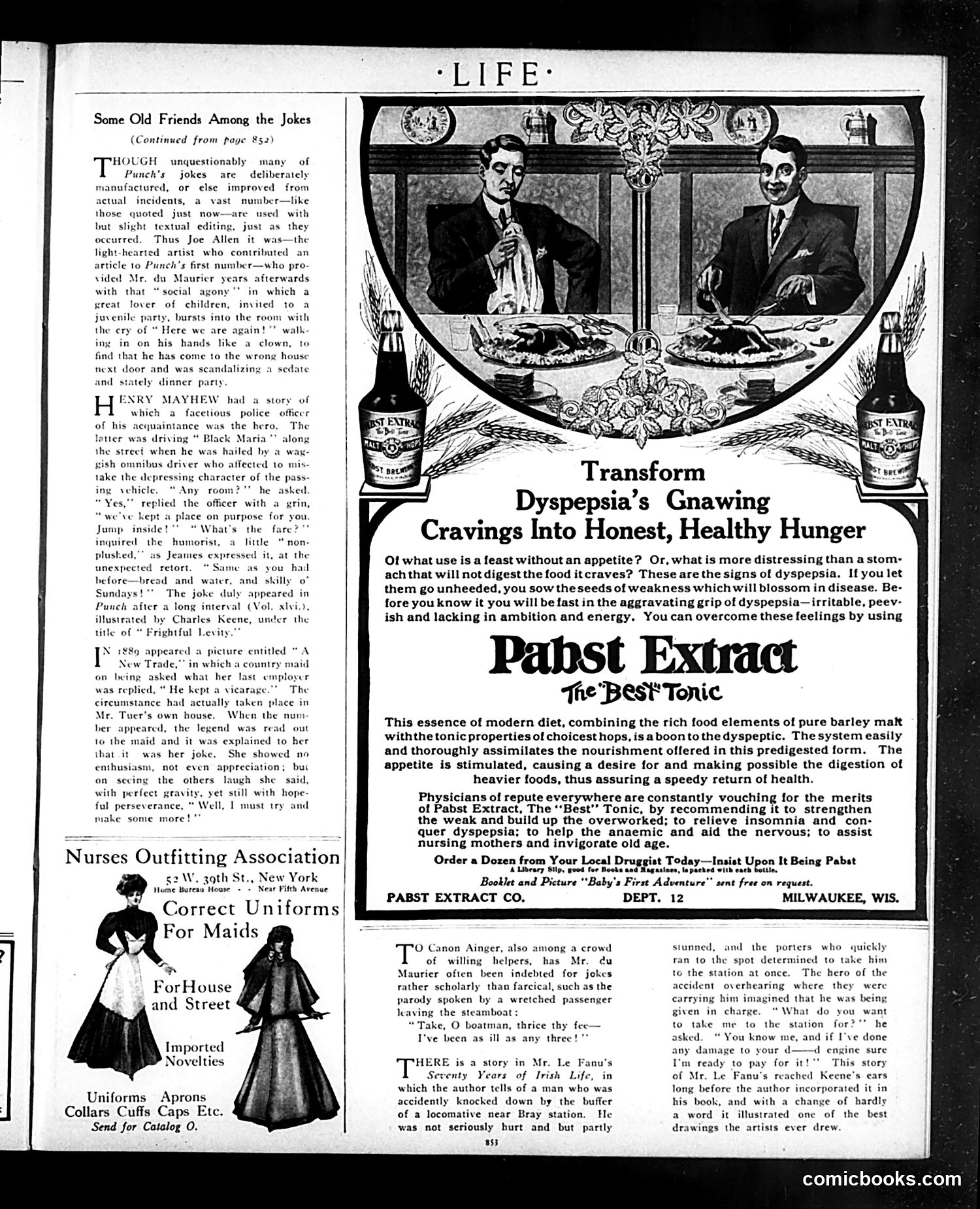
This page from *Life* magazine combines editorial content about joke origins with period advertising. The main article discusses how *Punch* magazine (a British satirical publication) sourced its humor—some jokes were manufactured, others drawn from real incidents with minimal editing. The illustrated anecdotes demonstrate this practice: stories about a clown at a children's party, a police officer's witty encounter, and a country maid who later realized her own experience had become published material. These examples show how Victorian-era humor mining worked—real social mishaps were recycled as comedy. The dominant advertisement for **Pabst Extract** ("The Best Tonic") reflects contemporary medical attitudes: marketed as a cure for dyspepsia (indigestion) and various ailments including insomnia and weakness. This was typical late 19th/early 20th-century patent medicine promotion, claiming near-miraculous health benefits from barley malt and hops extract—claims modern readers would recognize as unsubstantiated. The page essentially shows how both humor and medicine were "sourced and repackaged" for commercial purposes during this era.
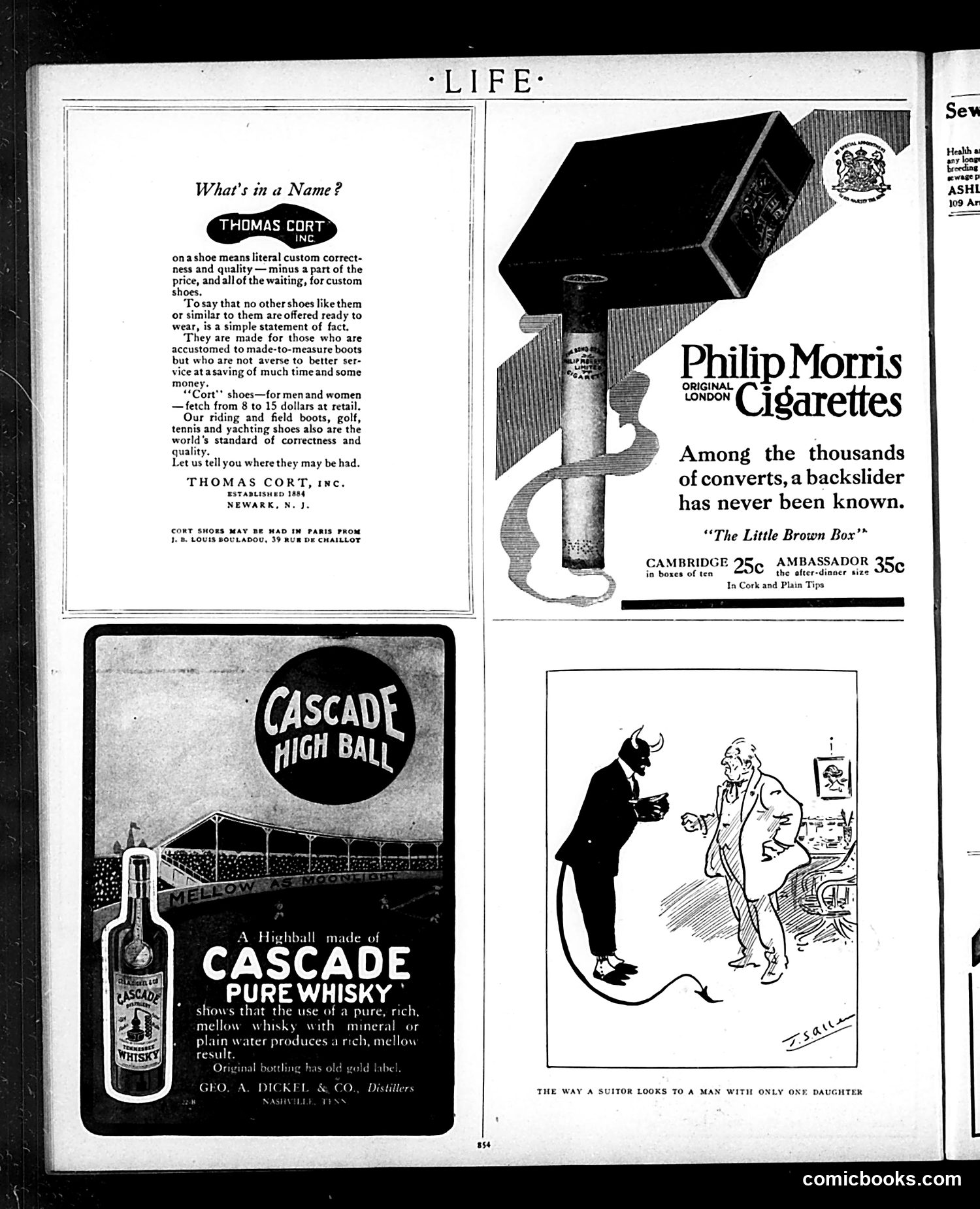
This page contains primarily **advertisements** interspersed with one cartoon. The **cartoon** (bottom right) depicts a man with exaggerated devil horns confronting what appears to be a stern, disapproving father figure. The caption reads "The Way a Suitor Looks to a Man With Only One Daughter." This is a domestic humor joke: the father sees his daughter's suitor as a threatening, demonic figure—a common satirical trope about protective fathers viewing any potential romantic rival with suspicion and hostility. The advertisements are for luxury/quality goods: Thomas Cort shoes (emphasizing custom quality at ready-made prices), Cascade Pure Whisky, and Philip Morris cigarettes. These reflect early 20th-century consumer culture targeting affluent readers. The cartoon relies on visual exaggeration and a universal domestic scenario rather than specific political commentary, making it accessible humor about family dynamics.
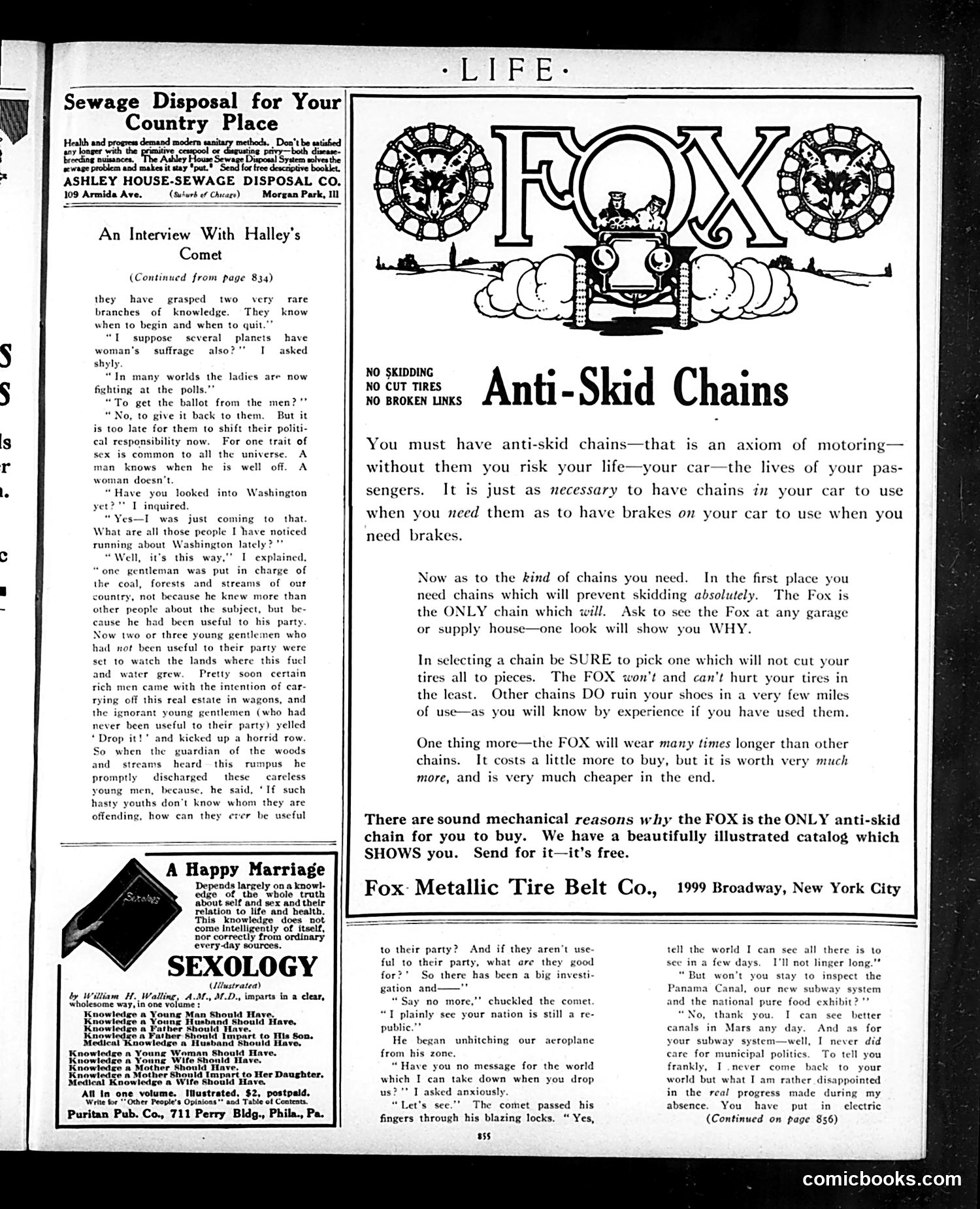
This page contains two distinct elements: **Left side - "An Interview With Halley's Comet"**: A satirical dialogue where the comet is questioned about conditions on other planets. The joke relies on early 20th-century concerns: women's suffrage (the comet notes women on other worlds have won voting rights), and American political corruption. The comet observes that bureaucrats are appointed based on party loyalty rather than competence—young men "not useful to their party" are fired even when they've prevented environmental theft, illustrating Progressive Era frustration with patronage politics. **Right side - Advertisement**: A commercial for Fox anti-skid tire chains, emphasizing they won't damage tires like competitors' products do. This is practical automobile safety advertising from the early motorcar era. The page juxtaposes satirical political commentary with period-specific automotive advertising, typical of *Life* magazine's format mixing humor and commerce.
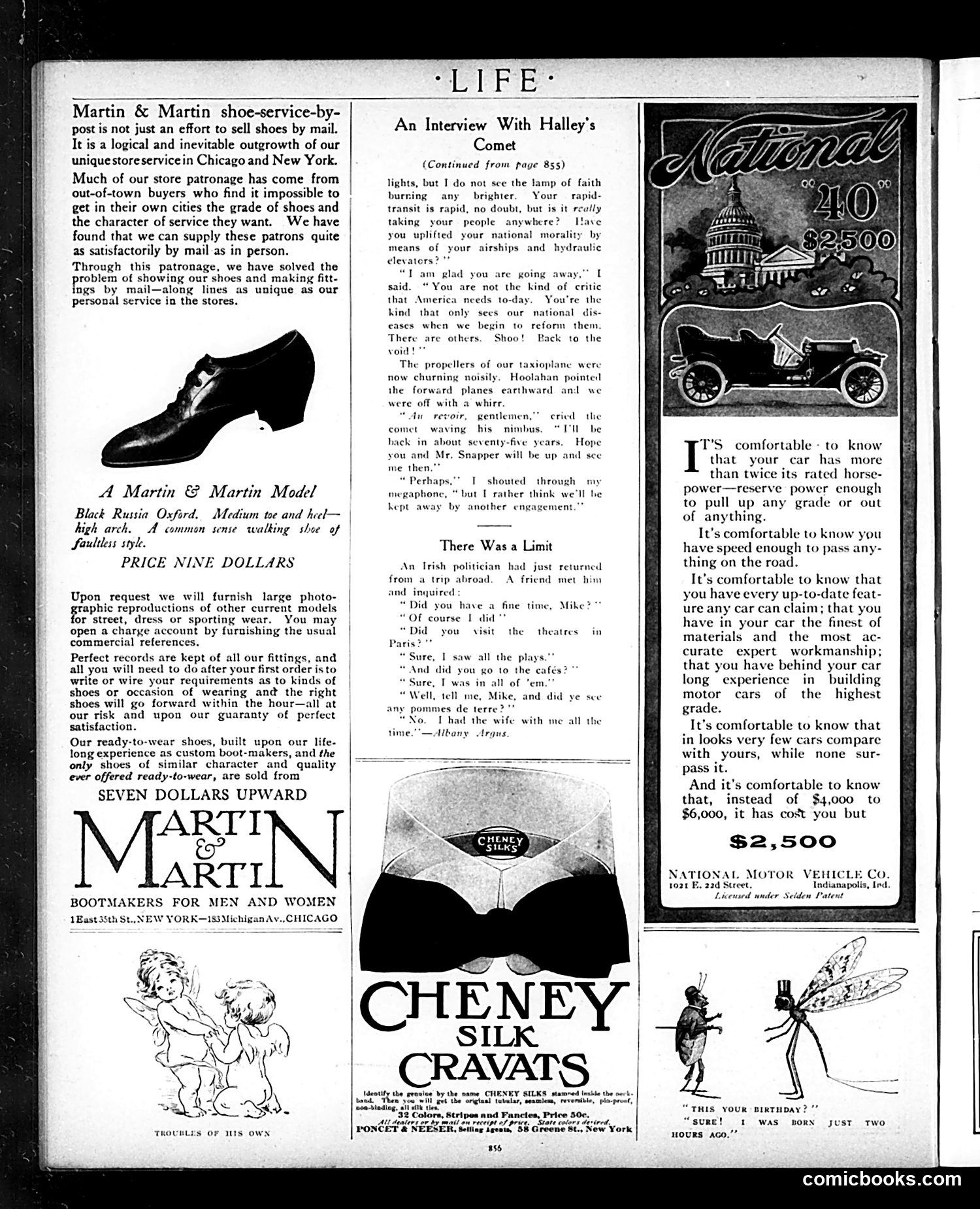
This page is primarily **advertising content** with two satirical pieces interspersed. The main satirical content is **"An Interview With Halley's Comet,"** a dialogue between a journalist and the famous comet during its 1910 appearance. The comet criticizes America's rapid development—rapid transit, airships, hydraulic elevators—questioning whether this progress is actually *improving* people's lives or just moving them faster toward nowhere. The comet appears as a social critic lamenting that Americans only recognize problems when they finally attempt reform. The joke relies on the comet's 75-year absence creating ironic distance; it's essentially early-20th-century anxiety about whether technological progress equals genuine progress. The second piece, **"There Was a Limit,"** is a brief ethnic joke about an Irish politician returning from Paris, ultimately punchlined by a crude reference to his wife. The remainder consists of advertisements for **Martin & Martin shoes, Cheney silk cravats, and a National Motor Vehicle Company automobile** ($2,500), representing typical commercial messaging of the era.
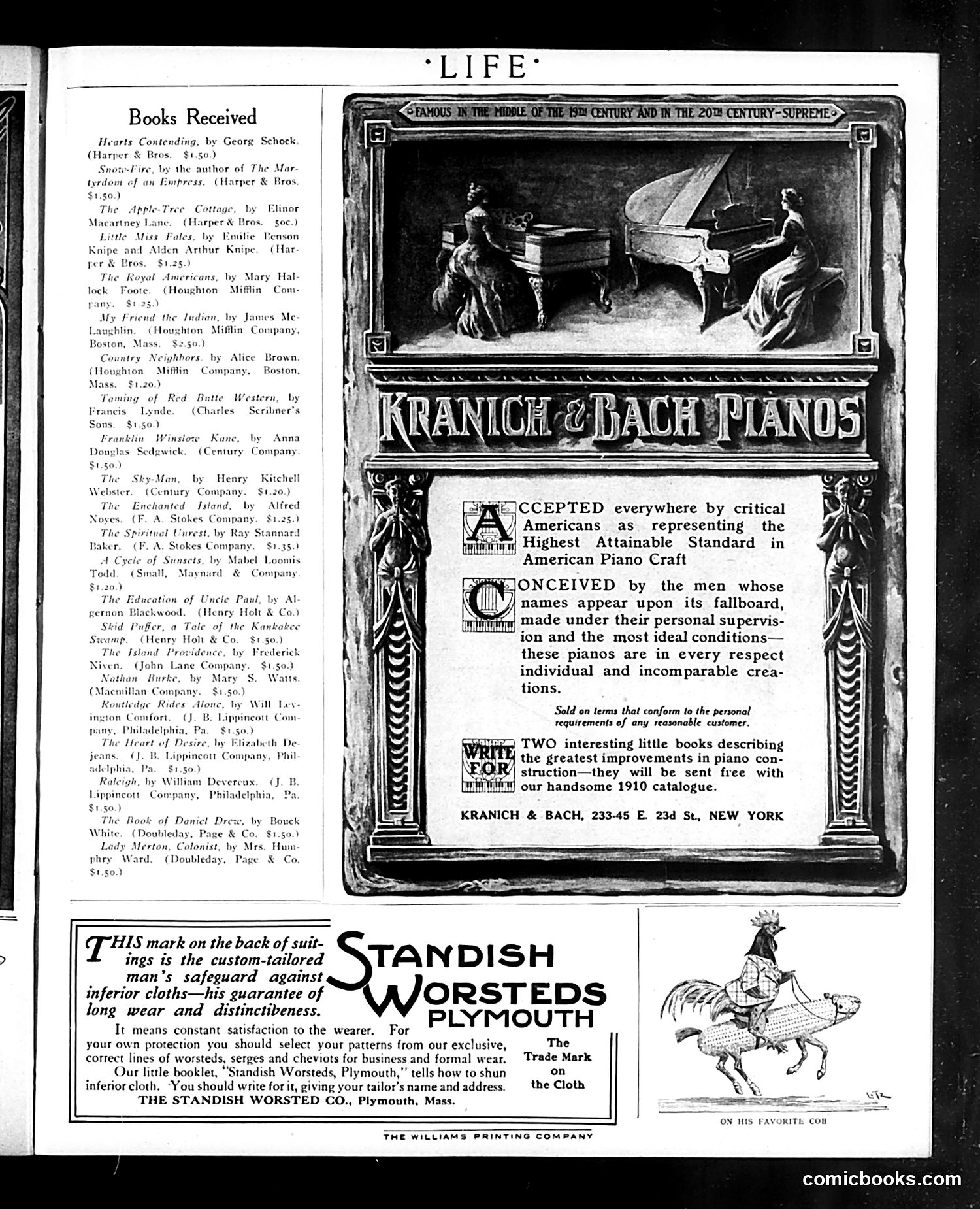
This is primarily a **books and advertisements page** from Life magazine, not a political cartoon page. The content includes: **Books Received section** (left column): A standard literary review listing of contemporary novels and their publishers/prices—titles like *Hearts Contending*, *The Sky-Man*, and *The Enchanted Island*. **Advertisements**: Two major ads dominate: 1. **Kranich & Bach Pianos** (top right)—promoting pianos as "accepted everywhere by critical Americans" representing the highest standard in piano craftsmanship 2. **Standish Worsteds Plymouth** (bottom)—advertising quality fabric with a trademark mark as a guarantee against inferior cloth The only illustration is a small sketch labeled "On His Favorite Cob" (bottom right), showing a rooster on a horse—likely a humorous or decorative element unrelated to the page's main content. This page reflects early 1900s middle-class consumer culture and literary tastes rather than satirical commentary.
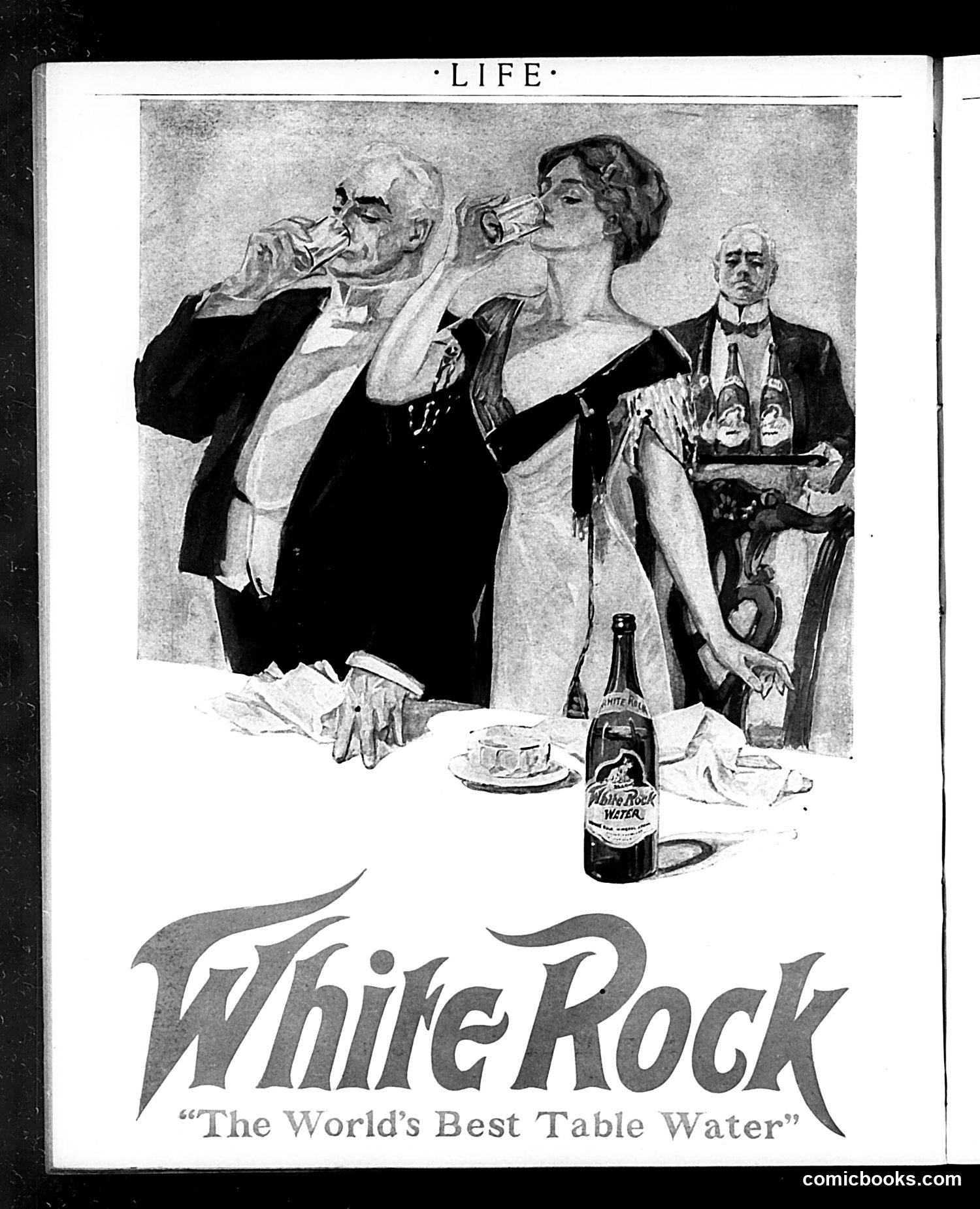
This is an advertisement for White Rock brand table water, positioned as "The World's Best Table Water." The image depicts an elegant dinner scene where three well-dressed men in formal attire are drinking from glasses, while a woman in an evening gown also drinks from a glass. A bottle of White Rock Water is prominently displayed on the table alongside place settings. The satire appears to target the pretensions of luxury goods marketing: the fancy formal setting and refined figures are meant to suggest that White Rock water is sophisticated enough for elite social occasions. The humor likely lies in the absurdity of advertising ordinary table water as a status symbol, playing on consumers' desire to appear refined and cultured through their beverage choices.
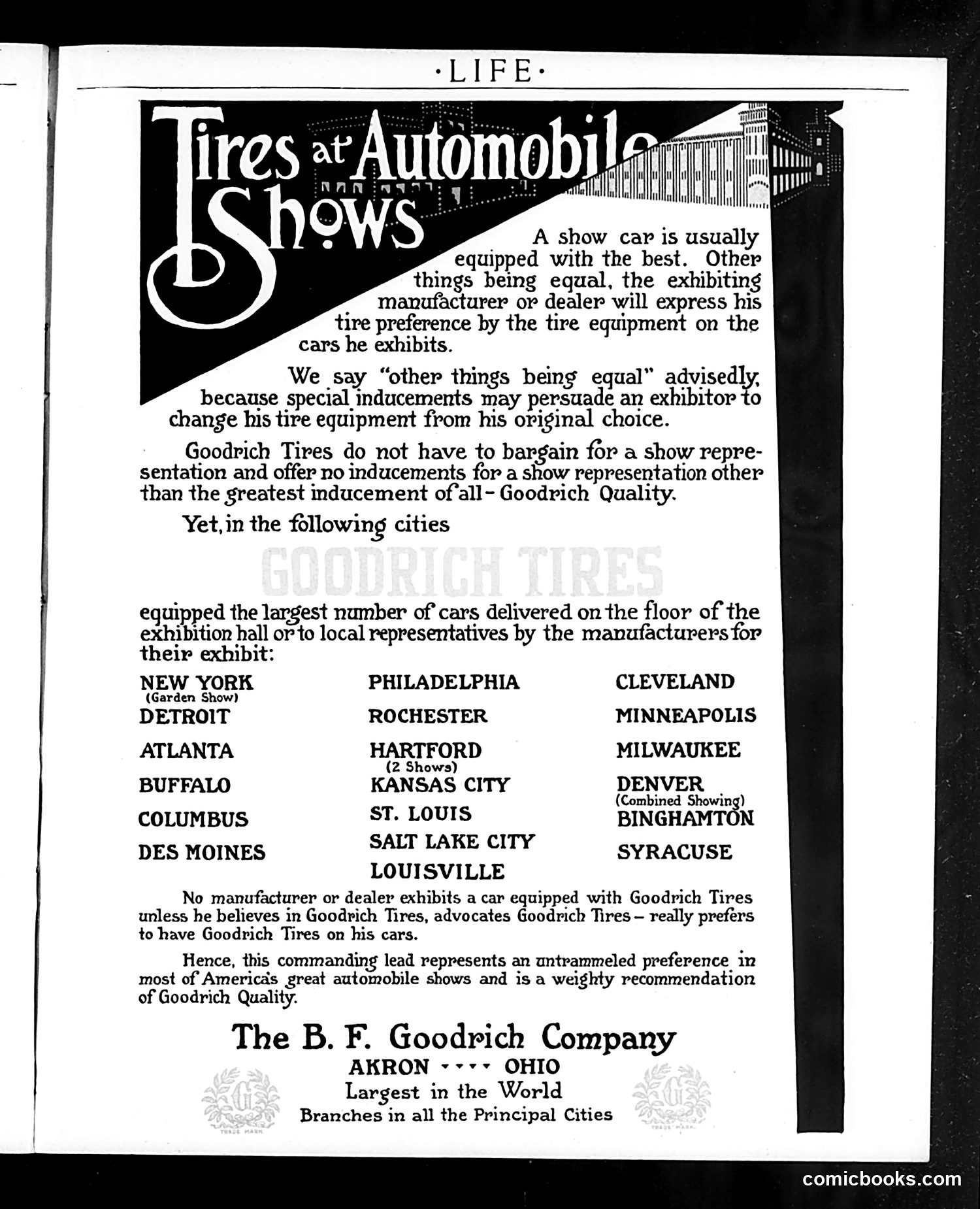
This is a **Goodrich Tire company advertisement**, not a political cartoon. It addresses automobile manufacturers and dealers exhibiting cars at major trade shows across America. The ad's argument is straightforward: Goodrich Tires appear on more exhibition vehicles than competitors not because of special deals or incentives, but because manufacturers genuinely prefer them. The company lists 20+ cities where Goodrich equipped the most show cars, positioning this as proof of "untrammeled preference"—meaning authentic choice, not manipulation. The subtle message: while competitors might resort to kickbacks or inducements to secure show representation, Goodrich relies solely on product quality. This claim positions Goodrich as the honest, premium choice trusted by industry insiders who make tire decisions based on merit rather than marketing pressure. It's corporate branding disguised as objective market evidence.
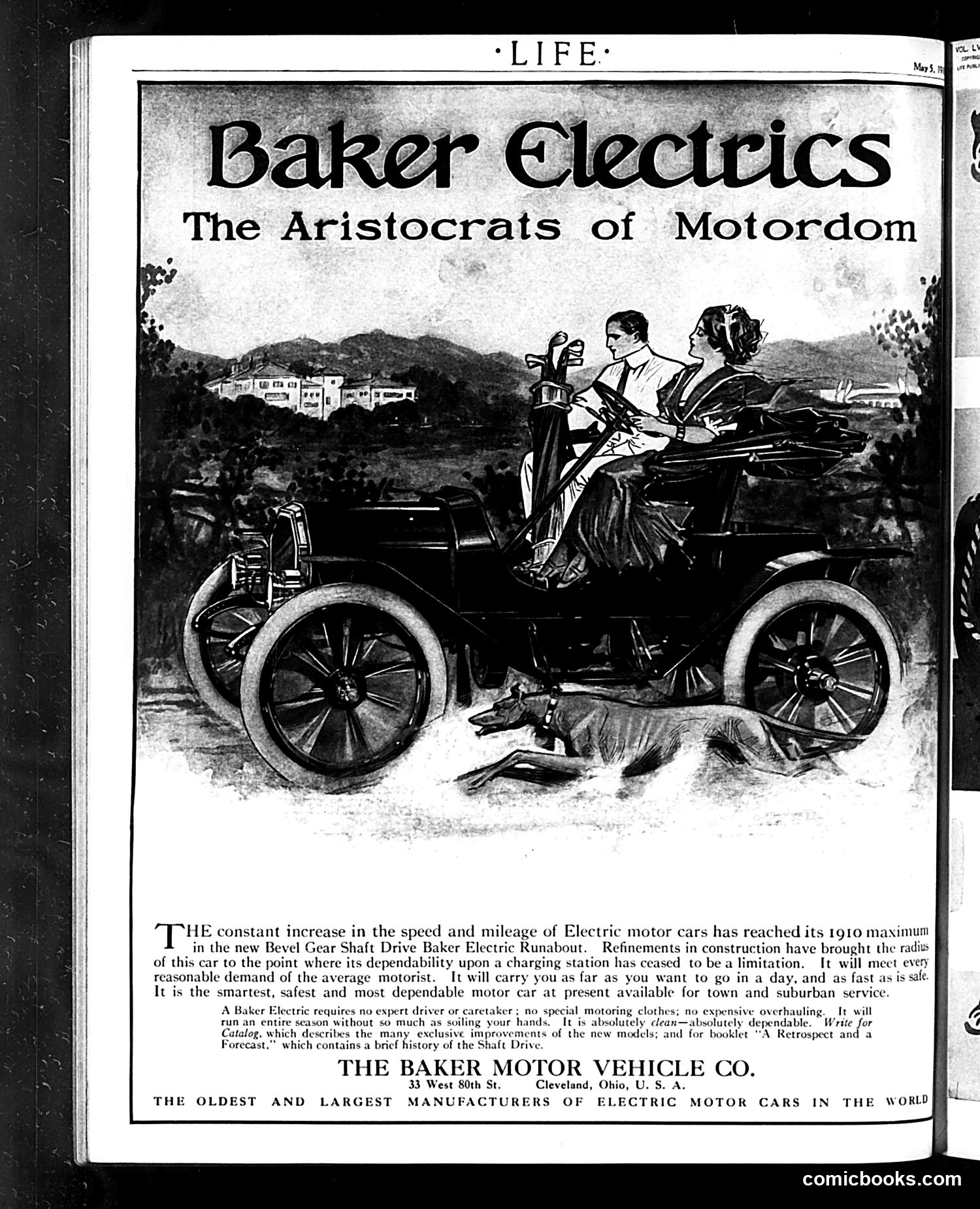
This is primarily a **product advertisement** rather than political satire. It promotes Baker Electric automobiles as luxury vehicles for the wealthy, depicting an elegantly dressed couple and a chauffeur in an electric motorcar. The key pitch targets early-1910s anxieties about **automobile reliability**: the ad emphasizes that Baker Electrics no longer depend heavily on charging stations, can travel far distances daily, and require minimal maintenance—addressing real concerns that made electric cars impractical for many users. The phrase "The Aristocrats of Motordom" reflects the **class positioning**: electric cars were expensive, silent, and clean—marketed as sophisticated alternatives to loud, dirty gasoline vehicles. The image of genteel passengers suggests exclusivity and refinement. The ad's mention of "no expert driver" needed and "no special motoring clothes" suggests electric cars were marketed as easier and safer than contemporary gasoline automobiles, appealing to wealthy urbanites seeking convenience and status rather than mechanical expertise.