
Life, 1910-05-05 · page 35 of 72
Life — May 5, 1910 — page 35: what you’re looking at
What you’re looking at
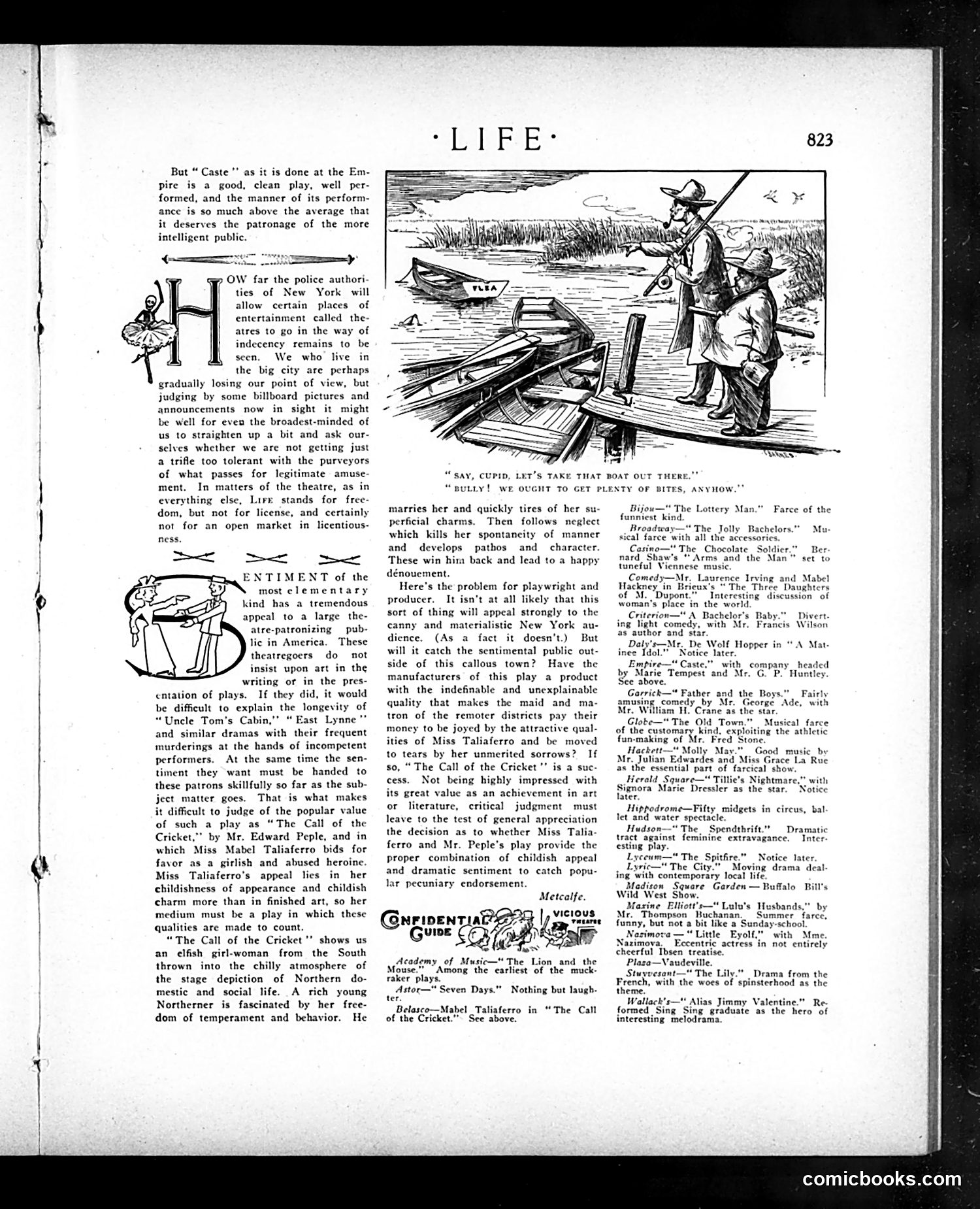
This page contains theater reviews and a cartoon about fishing. The main illustration shows two figures at a riverside: one appears to be an older man with a fishing rod, the other a cherubic cupid-like figure. The caption reads "Say, Cupid, let's take that boat out there" / "Bully! We ought to get plenty of bites, anyhow." The joke plays on double meaning: "bites" refers both to fish biting hooks and romantic/amorous encounters. Cupid—the Roman god of love—is enlisted as a fishing companion, creating humor by literalizing the metaphor of "catching" romantic partners. The surrounding text reviews theatrical productions, particularly discussing Miss Mabel Taliaferro in "The Call of the Cricket." The review critiques New York's tolerance of questionable entertainment while praising sentiment-driven plays that appeal to provincial audiences. The overall page reflects early 20th-century attitudes about theater, morality, and audience taste.
📄 Transcribed text from this page (OCR, searchable)
Machine-transcribed from the original scan — historical spelling and the odd misread are preserved.
| But “ Caste" as it is done at the Em- pire is a good, clean play, well per- formed, and the manner of its perform- ance is so much above the average that it deserves the patronage of the more intelligent public. OW far the police authori- ties of New York will allow certain places of entertainment called. the- atres to go in the way of indecency remains to be seen. We who live in the big city are perhaps gradually losing our point of view, but judging by some billboard pictures and announcements now in sight it might be well for even the broadest-minded of us to straighten up a bit and ask our- selves whether we are not getting just a trifle too tolerant with the purveyors of what passes for legitimate amuse- ment. In matters of the theatre, as in everything else, Lire stands for fr dom, but not for license, and certainly not for an open market in licentious- ness. ad ENTIMENT of the most elementary kind has a tremendous appeal to a large the- atre-patronizing —pub- lic in America. These theatregoers. do not insist upon art in the writing of in the pres- entation of plays. If they did, it would be difficult to explain the longevity of “Uncle Tom's Cabin,’” “ t Lynne" and similar dramas with their frequent murderings at the hands of incompetent performers. At the same time the sen- timent they want must be handed to these patrons skillfully so far as the sub- ject matter goes. That is what makes it difficult to judge of the popular value of such a play as “The Call of the Cricket,” by Mr. Edward Peple, and in which Miss Mabel Taliaferro bids for favor as a girlish and abused heroine. Miss Taliaferro’s appeal lies in her childishness of appearance and childish charm more than in finished art, so her medium must be a play in which these qualities are made to count. “The Call of the Cricket’ shows us an clfish girl-woman from the South thrown into the chilly atmosphere of the stage depiction of Northern do- mestic and social life. A rich young Northerner is fascinated by her free- dom of temperament and behavior. He AY, CUPID, LET’: BuLLy! WE ove marries her and quickly tires of her su- perficial charms. Then follows neglect which kills her spontancity of manner and develops pathos and character. These win him back and lead to a happy dénouement. Here's the problem for playwright and producer. It isn’t at all likely that this Sort of thing will appeal strongly to the canny and materialistic New York au- dience. (As a fact it doesn’t.) But will it catch the sentimental public out- side of this callous town? Have the manufacturers of this play a product with the indefinable and unexplainable quality that makes the maid and ma- tron of the remoter districts pay their money to be joyed by the attractive qual- ities of Miss Taliaferro and be moved to tears by her unmerited sorrows? If so, “The Call of the Cricket” is a suc- cess. Not being highly impressed with its great value as an achievement in art or literature, critical judgment must leave to the test of general appreciation the decision as to whether Miss Talia ferro and Mr. Peple’s play provide the proper combination of childish appeal and dramatic sentiment to catch popu- lar pecuniary endorsemen| Metcalfe. | vicious Sree ae Academy of Music—" The Lion and the Mouse.” “Among the earliest of the muck- raker plays. Astor—" Seven Days. ter Belasco—Mabel Taliaferro in “The Call of the Cricket." See above. Nothing but laugh- TAKE THAT BOAT OUT THERE." T TO GET PLENTY OF BITES, ANYHOW Bijou—" The Lottery Man.” Farce of the funniest kind. Broadway—" The Jolly Bachelors." Mt sical farce with all the accessories, Casino—"* The Chocolate Soldier.” Ber nard Shaw's ‘Arms and the Man” set to tuneful Viennese music Comedy—Mr. Laurence In ng and Mabel Hackney in Brieux’s “ The Three Daugh of Dupont.” Interesting discussion of woman's place in the world. __ Criterion—" A Bachelor's Raby.” Divert. ing light comedy, with Mr. Francis Wilson as author and star _ Daly's—Mr. De Wolf Hopper in “A Mat- inee Idol.” Notice later. Empire—" Caste,” with company headed Marie Tempest’ and Mr. G. P. Huntley. See above. Garrick—“ Father and the Boys.” Fairly amusing comedy by Mr. George Ade, with Mr. William H. Crane as the star. Globe—" The Old Town.” Musical farce of the customary kind, exploiting the athletic fun-making of Mr. Fred Stone. Hackett—" Molly Ma: Good music by Mr. Julian Edwardes and Miss Grace La Rue as the essential part of farcical show Herald Square—“ Tiltie’s Nightmare.” with Signora Marie Dressler as the star. Notice later. Hippodrome—Fifty midgets in circus, bal let and water spectacle, Hudson—* The Spendthrift."”__ Dramatic tract against feminine extravagance, Inter- esting pla} Lycenm—" The Spitfire.” Notice later. __ Lyric—" The City.” Moving drama deal ing with contemporary local life Medison Square Garden — Buffalo Bill's Wild West Show. Maxine Elliott's—“ Lulu's Husbands,” by Mr. Thompson Buchanan. Summer farce, funny, but not a bit like a Sunday-school Nazimova —"“ Little Eyolf,” with Mme. Nazimova. Eccentric actress in not entirely cheerful Ibsen treatise Plaza—Vaudeville. Stuyvesant—" The Lily." Drama from the French, with the woes of spinsterhood as the theme. Wallack’s—" Alias Jimmy Valentine.” Re. formed Sing Sing graduate as the hero of interesting melodrama. comicbooks.com