
Life, 1910-05-05 · page 24 of 72
Life — May 5, 1910 — page 24: what you’re looking at
What you’re looking at
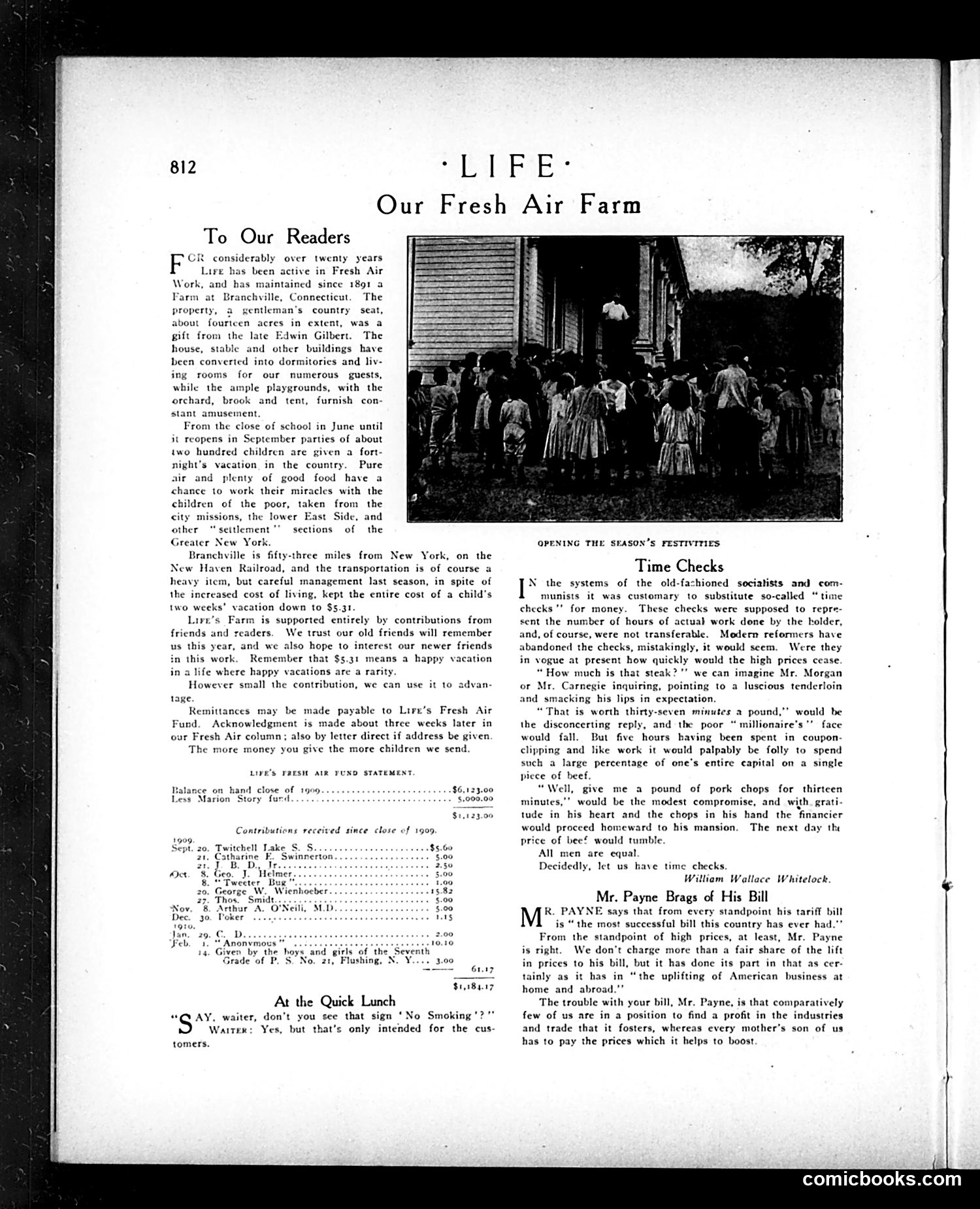
This page contains **philanthropic content and light social satire**, not political cartoons. The main feature is an appeal for donations to Life magazine's Fresh Air Farm in Connecticut, which provided summer vacations to poor children from New York's Lower East Side from 1891 onward. The accompanying photograph shows children "opening the season's festivities." The satirical content appears in two brief pieces: 1. **"Time Checks"** — A commentary mocking wealthy industrialists (clearly referencing J.P. Morgan and Andrew Carnegie) by imagining they'd become far more economical if labor time were literally visible. The joke: if a steak cost "thirty-seven minutes of work," millionaires would suddenly realize the value of their time and stop wasteful spending. 2. **"At the Quick Lunch"** — A one-liner joke about a waiter ignoring a "No Smoking" sign because it's only meant for customers, not staff. Both pieces reflect progressive-era skepticism toward capitalism and class disparities—themes aligned with Life's satirical mission during this period.
📄 Transcribed text from this page (OCR, searchable)
Machine-transcribed from the original scan — historical spelling and the odd misread are preserved.
SMES. Our Fresh Air Farm To Our Readers Fe considerably over twenty years Lire has been active in Fresh Air Work, and has maintained since 1891 a Farm at Branchville, Connecticut. The property, gentleman's country seat, about fourtcen acres in extent, was a gift from the late Edwin Gilbert. The house, stable and other buildings have been converted into dormitories and liv- ing rooms for our numerous guests, while the ample playgrounds, with the orchard, brook and tent, furnish con- stant amusement. From the close of school in June until it reopens in September parties of about two hundred children are given a fort- night’s vacation in the country. Pure air and plenty of good food have a chance to work their miracles with the children of the poor, taken from the city missions, the lower East Side, and other “settlement” sections of the Greater New York. Branchville is fifty-three miles from New York, on the New Haven Railroad, and the transportation is of course a heavy item, but careful management last season, in spite of the increased cost of living, kept the entire cost of a child's two weeks’ vacation down to $5.31. Lire’s Farm is supported entirely by contributions from friends and readers. We trust our old friends will remember us this year, and we also hope to interest our newer friends in this work. Remember that $5.31 means a happy vacation in a life where happy vacations are a rarity However small the contribution, we can use it to advan- tage. Remittances may be made payable to Lire’s Fresh Air Fund. Acknowledgment is made about three weeks later in our Fresh Air column; also by letter direct if address be given The more money you give the more children we send LIVE’S FRESH AIR YUND STATEMENT Ralance on hand close of 1909.....0+c0s00+ Less Marion Story furd Contributions received since close of 1999 Sept. 20, Twitchell Lake SS... 221 $5.60 ) Catharine E. Swinnertoa 's.00 2. J B.D. Te. : es Il 2iso Or. “8. Geo. J. Helmer... ... eee. ‘ tees $00 “Tweeter Bug... hoo George W. Wienhoeber. 20000000021 $82 Thos. Smidt.... - TIT eo Nov. 8. Arthur A. O° 3.00 Dec Toker -.....0 nis Jan. CDi Feb. 1. “Anonvmous #7221002 ae 14. Given by the hoys. and girls of ‘the rade of P. S.No. 2t, Flushing, > At the Quick Lunch “OQ AY, waiter, don’t you see that sign ‘No Smoking’?"’ NS) Warrex: Yes, but that's only intended for the cus- tomers. OPENING THE SEASON’S FESTIVITIES Time Checks I the systems of the old-fachioned socialists and com- munists it was customary to substitute so-called “ time checks’ for money. These checks were supposed to repr sent the number of hours of actual work done by the holder, and, of course, were not transferable. Modern reformers have abandoned the checks, mistakingly, it would seem, Were they in vogue at present how quickly would the high prices cease “How much is that steak?" we can imagine Mr. Morgan or Mr. Carnegie inquiring, pointing to a luscious tenderloin and smacking his lips in expectation. “That is worth thirty-seven minutes a pound,’’ would be the disconcerting reply, and the poor “ millionaire's’ face would fall. But five hours having been spent in coupon- clipping and like work it would palpably be folly to spend such a large percentage of one’s entire capital on a single piece of beef. “Well, give me a pound of pork chops for thirtcen minutes," would be the modest compromise, and with. gra tude in his heart and the chops in his hand the financier would proceed homeward to his mansion. The next day the price of beef would tumble All men are equal Decidedly, let us have time checks. William Wallac Mr. Payne Brags of His Bill M®* PAYNE says that from every standpoint his tariff bill is “the most successful bill this country has ever had." From the standpoint of high prices, at least, Mr. Payne is right. We don’t charge more than a fair share of the lift in prices to his bill, but it has done its part in that as cer- tainly as it has in “the uplifting of American business at home and abroad.” The trouble with your bill, Mr. Payne, is that comparatively few of us are in a position to find a profit in the industries and trade that it fosters, whereas every mother’s son of us has to pay the prices which it helps to boost Whitelock. comicbooks.com