
Life, 1910-05-05 · page 34 of 72
Life — May 5, 1910 — page 34: what you’re looking at
What you’re looking at
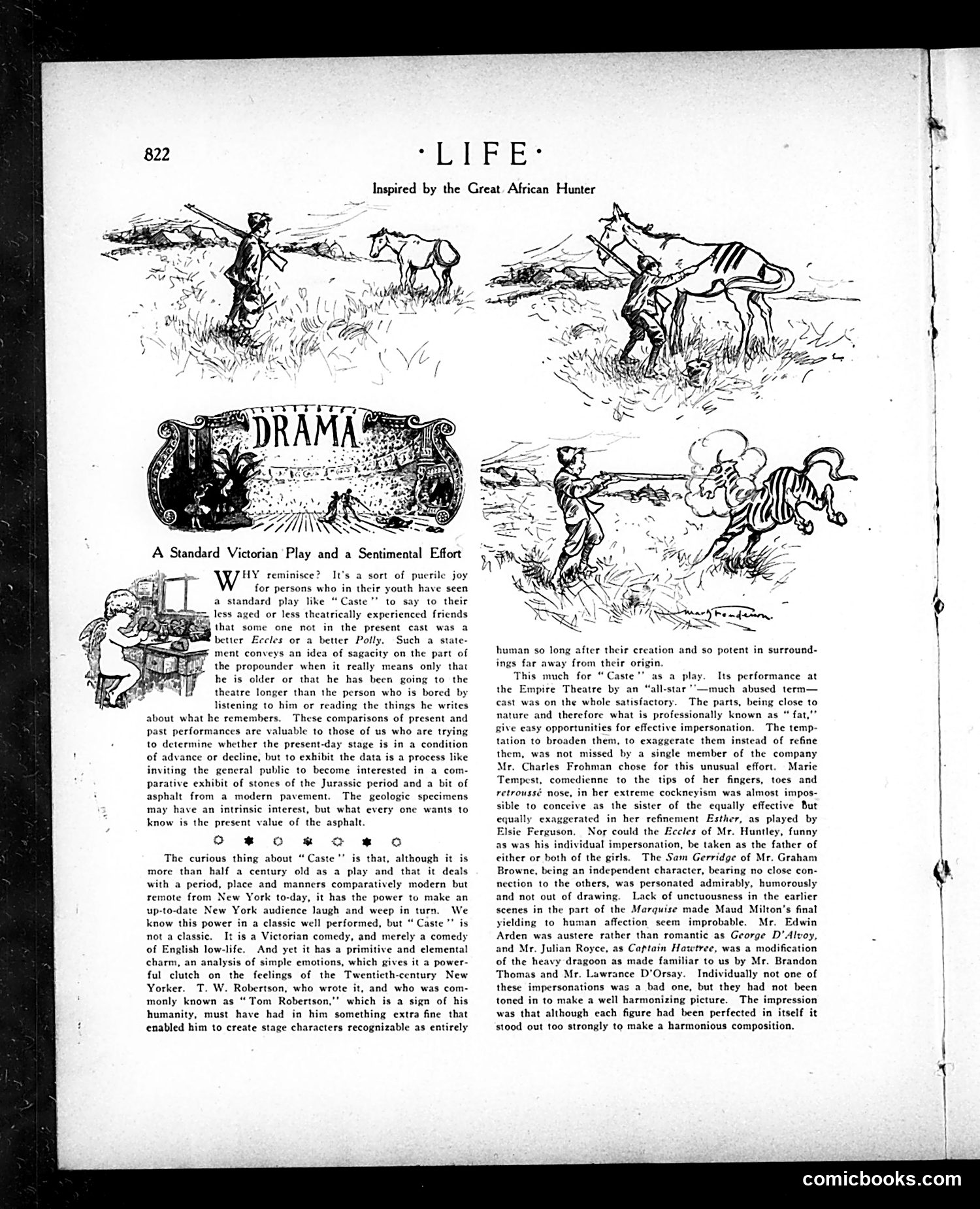
This page reviews a 1920s production of T.W. Robertson's Victorian play "Caste" (written over 50 years earlier) at the Empire Theatre, starring an "all-star" cast including Marie Tempest and Elsie Ferguson. The sketches at top depict hunting scenes, illustrating the article's subtitle "Inspired by the Great African Hunter"—likely a humorous reference to the play's themes or perhaps a contemporary figure. The critic argues that while "Caste" is merely a Victorian comedy about English working-class life, it possesses "primitive and elemental charm" allowing modern New York audiences to engage emotionally despite its age and distant setting. However, the reviewer criticizes the cast for *exaggerating* rather than refining their roles—finding the performances ham-handed. Specific actors (Tempest, Ferguson, Huntley) receive mixed assessments for their interpretations of working and upper-class characters. The piece reflects early 20th-century theater criticism's concern with naturalistic acting versus theatrical excess.
📄 Transcribed text from this page (OCR, searchable)
Machine-transcribed from the original scan — historical spelling and the odd misread are preserved.
See we sar RAM A Standard Victorian Play and a Sentimental Effort HY reminisce? It’s a sort of pucrile joy for persons who in their youth have seen a standard play like “Caste” to say to their zed or less theatrically experienced friends that some one not in the present cast was a better Eccles or a better Polly. Such a state- ment conveys an idea of sagacity on the part of the propounder when it really means only that he is older or that he has been going to the theatre longer than the person who is bored by listening to him or reading the things he writes about what he remembers. These comparisons of present and past performances are valuable to those of us who are trying to determine whether the present-day stage is in a condition of advance or decline, but to exhibit the data is a process like inviting the general public to become interested in a com- parative exhibit of stones of the Jurassic period and a bit of asphalt from a modern pavement. The geologic specimens may have an intrinsic interest, but what every one wants to know is the present value of the asphalt. o *£ O * 2 *€ 6 The curious thing about “Caste” is that, although it is more than half a century old as a play and that it deals with a period, place and manners comparatively modern but remote from New York to-day, it has the power to make an up-to-date New York audience laugh and weep in turn, We know this power in a classic well performed, but 0 “Caste” is not a classic. It is a Victorian comedy, and merely a comedy of English low-life. And yet it has a primitive and elemental charm, an analysis of simple emotions, which gives it a power- ful clutch on the feelings of the Twenticth-century Yorker. T. W. Robertson, who wrote it, and who was com- monly known as “Tom Robertson,’ which is a sign of his humanity, must have had in him something extra fine that enabled him to create stage characters recognizable as entirely BIEN Wiel Inspired by the Great. African Hunter human so long after their creation and so potent in surround- ings far away from their origin This much for “ Caste’’ as a play. Its performance at the Empire Theatre by an “all-star ’—much abused term— cast was on the whole satisfactory. The parts, being close to nature and therefore what is professionally known as “ fat,” ive easy opportunities for effective impersonation. The temp- tation to broaden them, to exaggerate them instead of refine them, was not missed by a single member of the company Mr. Charles Frohman chose for this unusual effort. Maric Tempest, comedienne to the tips of her fingers, toes and retroussé nose, in her extreme cockneyism was almost impos- sible to conceive as the sister of the equally effective But equally exaggerated in her refinement Esther, as played by Elsie Ferguson. Nor could the Eccles of Mr. Huntley, funny as was his individual impersonation, be taken as the father of cither or both of the girls. The Sam Gerridge of Mr. Graham Browne, being an independent character, bearing no close con- nection to the others, was personated admirably, humorously and not out of drawing. Lack of unctuousness in the earlier scenes in the part of the Marquise made Maud Milton's final yielding to human affection seem improbable. Mr. Edwin Arden was austere rather than romantic as George D’Alvoy, and Mr. Julian Royce, as Captain Hatwtree, was a modification of the heavy dragoon as made familiar to us by Mr. Brandon Thomas and Mr. Lawrance D'Orsay. Individually not one of these impersonations was a bad one, but they had not been toned in to make a well harmonizing picture. The impression was that although cach figure had been perfected in itself it stood out too strongly to make a harmonious composition. ——— comicbooks.com