
Life, 1910-05-05 · page 22 of 72
Life — May 5, 1910 — page 22: what you’re looking at
What you’re looking at
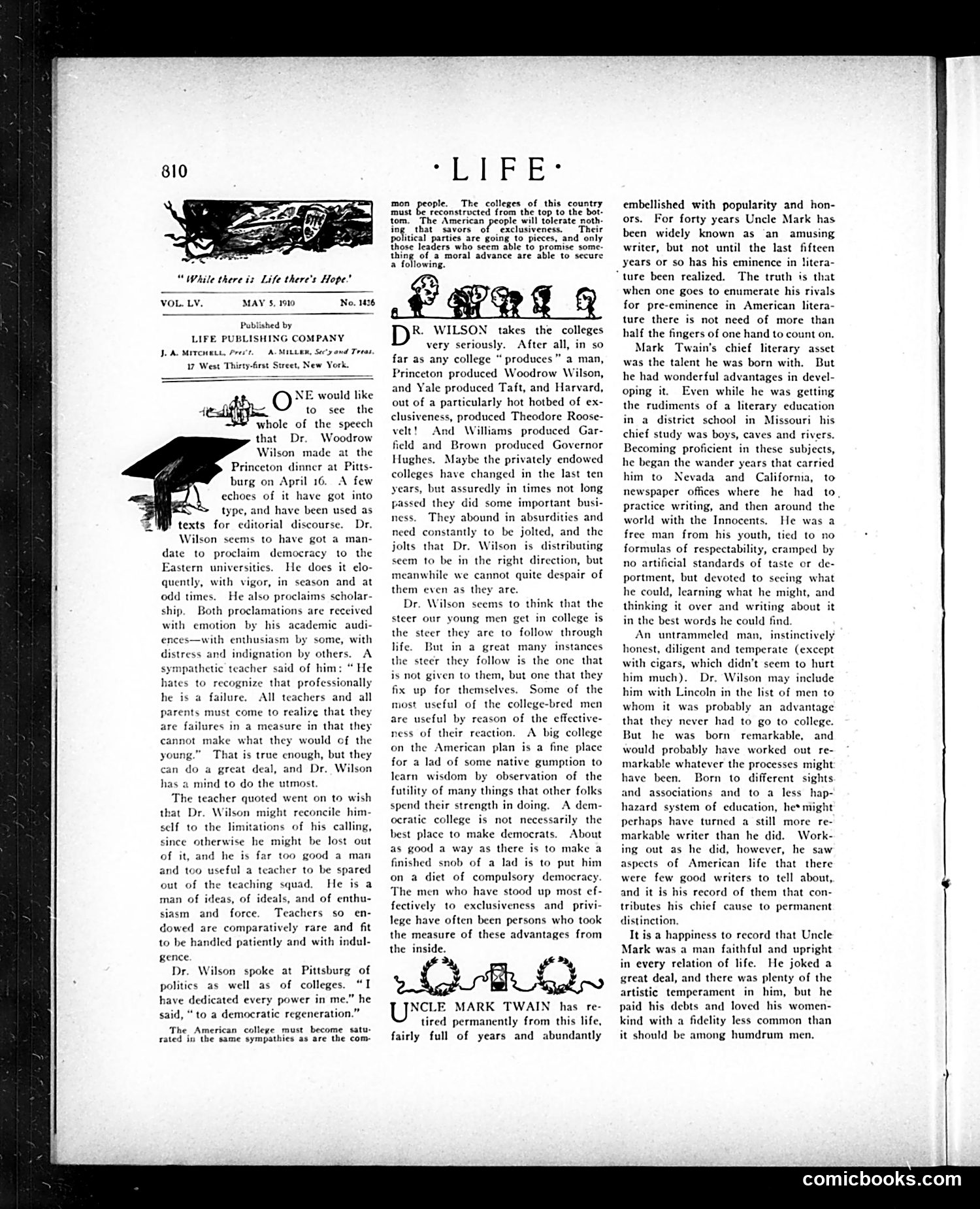
This page discusses Woodrow Wilson's recent speech at a Pittsburgh dinner, where he advocated for "democratic regeneration" of American colleges. The editorial acknowledges Wilson's idealism—he demands colleges become less exclusive and more aligned with common people—while expressing skepticism about his absolutism. The writer notes that prestigious colleges (Princeton, Yale, Harvard) have actually produced significant leaders (Wilson himself, Taft, Theodore Roosevelt), suggesting they work reasonably well despite their elitism. The piece gently mocks Wilson's conviction that college "steers" determine life outcomes, arguing many successful men succeed *despite* their education, not because of it. The satire is mild: Wilson is presented as earnest but perhaps naive—a man of genuine ideals who underestimates how students chart their own paths regardless of institutional values. The reference to making "a finished snob" through "compulsory democracy" suggests forced egalitarianism may backfire.
📄 Transcribed text from this page (OCR, searchable)
Machine-transcribed from the original scan — historical spelling and the odd misread are preserved.
“While there iz Life there's Hope" No. 1436 VOL. LV. MAY 5, 1910 Published by LIFE PUBLISHING COMPANY A. MILLER, Sec'y ond Tr w York. JA. Mrronmnt, Pret 17 West Thirty-frst Street, Or would like sedi to see the whole of the speech that Dr. Woodrow Wilson made at the Princeton dinner at Pitts- burg on April 16. A few echoes of it have got into type, and have been used as texts for editorial discourse. Dr. Wilson seems to have got a man- date to proclaim democracy to the Eastern universities. He does it elo- quently, with vigor, in season and at odd times. He also proclaims scholar- ship. Both proclamations are received with emotion by his academic audi- ences—with enthusiasm by some, with distress and indignation by others. A mpathetic teacher said of him: “ He hates to recognize that professionally he is a failure, All teachers and all parents must come to realize that they are failures in a measure in that they cannot make what they would of the young.” That is true enough, but they can do a great deal, and Dr. Wilson has a mind to do the utmost The teacher quoted went on to wish that Dr. Wilson might reconcile him- self to the limitations of his calling, since otherwise he might be lost out of it, and he is far too good a man and too useful a teacher to be spared out of the teaching squad. He is a man of ideas, of ideals, and of enthu- siasm and force. Teachers so en- dowed are comparatively rare and fit to be handled patiently and with indul- gence. Dr. Wilson spoke at Pittsburg of politics as well as of colleges. “I have dedicated every power in me.” he said, “to a democratic regeneration.” The American college must become satu- rated in the same sympathies as are the com- Wi ARIE mon people. The colleges of this, country must be reconstructed from the top to the bot- tom. The American people will tolerate noth- ing that savors of exclusiveness. Their political parties are going to pieces, and only those leaders who seem able to promise some- thing of a moral advance are able to secure a following. bY R. WILSON takes the colleges very seriously. After all, in so far as any college “ produces” a man, Princeton produced Woodrow Wilson, and Yale produced Taft, and Harvard, out of a particularly hot hotbed of ex- clusiveness, produced Theodore Roose- velt! And Williams produced Gar- field and Brown produced Governor Hughes. Maybe the privately endowed colleges have changed in the last ten years, but assuredly in times not long passed they did some important busi- ness. They abound in absurdities and need constantly to be jolted, and the jolts that Dr. Wilson is distributing seem to be in the right direction, but meanwhile we cannot quite despair of them even as they are. Dr. Wilson seems to think that the steer our young men get in college is the steer they are to follow through life. But in a great many instances the steer they follow is the one that is not given to them, but one that they fix up for themselves. Some of the most useful of the college-bred men are useful by reason of the effective- ness of their reaction. A big college on the American plan is a fine place for a lad of some native gumption to learn wisdom by observation of the futility of many things that other folks spend their strength in doing, A dem- ocratic college is not necessarily the best place to make democrats. About as good a way as there is to make a finished snob of a lad is to put him on a diet of compulsory democracy. The men who have stood up most ef- fectively to exclusiveness and_privi- lege have often been persons who took the measure of these advantages from the inside. YCLE MARK TWAIN has re- tired permanently from this life, U fairly full of years and abundantly “ture been realized. embellished with popularity and hon- ors. For forty years Uncle Mark has been widely known as ‘an amusing writer, but not until the last fifteen years or so has his eminence in litera- The truth is that when one goes to enumerate his rivals for pre-eminence in American litera- ture there is not need of more than half the fingers of one hand to count on, Mark Twain's chief literary asset was the talent he was born with. But he had wonderful advantages in devel- oping it. Even while he was getting the rudiments of a literary education in a district school in Missouri his chief study was boys, caves and rivers. Becoming proficient in these subjects, he began the wander years that carried him to Nevada and California, to newspaper offices where he had to practice writing, and then around the world with the Innocents. He was a free man from his youth, tied to no formulas of respectability, cramped by no artificial standards of taste or de- portment, but devoted to secing what he could, learning what he might, and thinking it over and writing about it in the best words he could find An untrammeled man, instincti honest, diligent and temperate (ex with cigars, which didn’t seem to hurt him much). Dr, Wilson may include him with Lincoln in the list of men to whom it was probably an advantage that they never had to go to colleg But he was born remarkable, and would probably have worked out re- markable whatever the processes might have been. Born to different sights and associations and to a less hap- hazard system of education, he* might perhaps have turned a still more re- markable writer than he did. Work- ing out as he did, however, he saw aspects of American life that there were few good writers to tell about, and it is his record of them that con- tributes his chief cause to permanent distinction. It is a happiness to record that Uncle Mark was a man faithful and upright in every relation of life. He joked a great deal, and there was plenty of the artistic temperament in him, but he paid his debts and loved his women- kind with a fidelity less common than it should be among humdrum men. comicbooks.com