
Life, 1910-05-05 · page 41 of 72
Life — May 5, 1910 — page 41: what you’re looking at
What you’re looking at
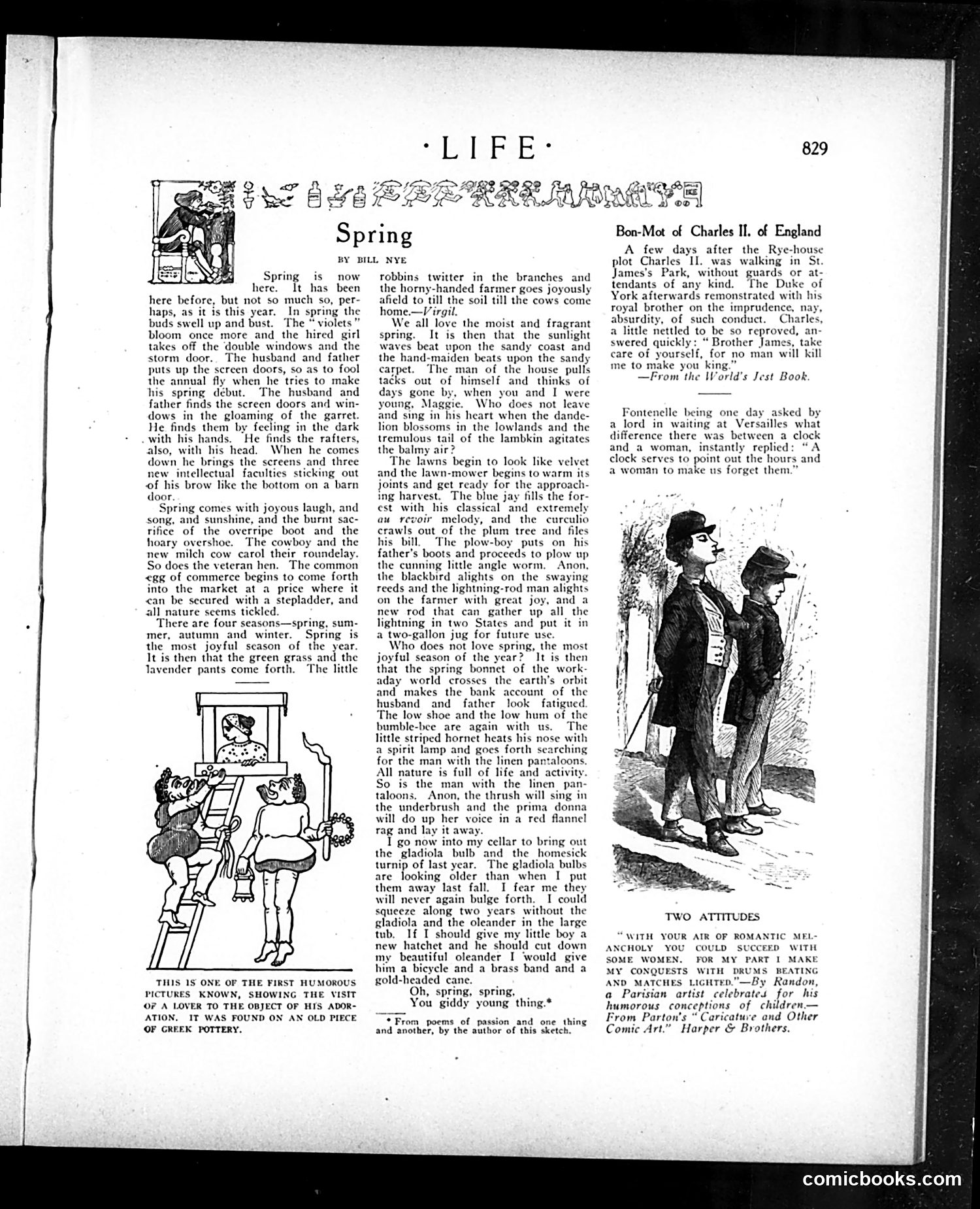
This is a humorous essay on spring by Bill Nye (a popular 19th-century humorist), accompanied by two illustrations. The text is largely comedic commentary on spring's arrival—celebrating nature's renewal while poking fun at domestic inconveniences: husbands installing screens, the expense of spring bonnets, egg prices, and encounters with insects like hornets and cutworms. The left cartoon depicts a classical scene labeled as "one of the first humorous pictures known" from Greek pottery—showing a lover visiting his beloved, establishing that romantic pursuit is an ancient, timeless human behavior. The right illustration, captioned "Two Attitudes," contrasts two male figures' body language—likely illustrating different approaches to romantic interest or courtship. The accompanying quote about "romantic melancholy" and conquests suggests satire on male attitudes toward women. Together, the page blends nature commentary with gentle social satire about spring's effects on romance and domestic life.
📄 Transcribed text from this page (OCR, searchable)
Machine-transcribed from the original scan — historical spelling and the odd misread are preserved.
Spring is now here. It has been here before, but not so much so, per- haps, as it is this year. In spring the buds swell up and bust. The “ violets” bloom once more and the hired girl takes off the double windows and the storm door. The husband and father puts up the screen doors, so as to fool the annual fly when he tries to make his spring début. The husband and father finds the screen doors and win- dows in the gloaming of the garret. He finds them by feeling in the dark with his hands. He finds the rafters, also, with his head. When he comes down he brings the screens and three new intellectual faculties sticking out of his brow like the bottom on a barn door. Spring comes with joyous laugh, and song, and sunshine, and the burnt’ sac- rifice of the overripe boot and the hoary overshoe. The cowboy and the new milch cow carol their roundelay. So does the veteran hen. The common egg of commerce begins to come forth into the market at a price where it an be secured with a stepladder, and all nature seems tickled. There are four seasons—spring, sum- mer, autumn and winter. Spring is the ‘most joyful season of the year. It is then that the green grass and the lavender pants come forth. The little THIS 1S ONE OF THE FIRST HUMOROUS, PICTURES KNOWN, SHOWING THE VISIT OF A LOVER TO THE OBJECT OF HIS ADOR- ATION. IT WAS FOUND ON AN OLD PIECE OF GREEK POTTERY. Spring BY BILL N leese” robbins twitter in the branches and the horny-handed farmer goes joyously afield to till the soil till the cows come home.—Virgil. We all love the moist and fragrant sprinj It is then that the sunlight waves beat upon the sandy coast and the hand-maiden beats upon the sandy carpet. The man of the house pulls tacks out of himself and thinks of days gone by, when you and I were young, M Who does not leave and sing in his heart when the dande- lion blossoms in the lowlands and the tremulous tail of the lambkin agitates the balmy air? The lawns begin to look like velvet and the lawn-mower begins to warm its joints and get ready for the approach- ing harvest. The blue jay fills the for- est with his classical and extremely au revoir melody, and the curculio crawls out of the plum tree and files his bill. The plow-boy puts on his father's boots and proceeds to plow up the cunning little angle worm, Anon, the blackbird alights on the swaying reeds and the lightning-rod man alights on the farmer with great joy, and a new rod that can gather up all the lightning in two States and put it in a two-gallon jug for future use. Who does not love spring, the most joyful season of the year? ‘It is then that the spring bonnet of the work- aday world crosses the earth's orbit and makes the bank account of the husband and father look fatigued. The low shoe and the low hum of the bumble-bee are again with us. The little striped hornet heats his nose with a spirit lamp and goes forth searching for the man with the linen pantaloons. All nature is full of life and activity. So is the man with the linen. pan- taloons. Anon, the thrush will sing in the underbrush and the prima donna will do up her voice in a red flannel rag and lay it aw T go now into my cellar to bring out the gladiola bulb and the homesick turnip of last year. The gladiola bulbs are looking older than when I put them away last fall. I fear me they will never again bulge forth. I could squeeze along two years without the gladiola and the oleander in the large tub. If I should give my little boy a new hatchet and he should cut down my beautiful oleander I ‘would give him a bicycle and a brass band and a gold-headed cane. Oh, spring, spring, You giddy young thing.* From poems of passion and one thing and another, by the author of this sketch. 829 Bon-Mot of Charles II. of England A few days after the Rye-house plot Charles II. was walking in St. James's Park, without guards or at- tendants of any kind. The Duke of York afterwards remonstrated with his royal brother on the imprudence, nay, absurdity, of such conduct. Charles, a little nettled to be so reproved, an- swered quickly: “Brother James, take care of yourself, for no man will kill me to make you king.” —From the World's Jest Book. Fontenelle being one day asked by a lord in waiting at Versailles what difference there was between a clock and a woman, instantly replied: “A clock serves to point out the hours and a woman to make us forget them.” TWO ATTITUDES “WITH YOUR AIR OF ROMANTIC MEL- ANCHOLY YOU COULD § D WITH SOME WOMEN. FOR MY PART I MAKE MY CONQUESTS WITH DRUMS BEATING AND MATCHES LicHtep.”—By Randon, a Parisian artist celebrates for his humorous conceptions of children — From Parton's “ Caricature and Other Comic Art.” Harper & Brothers. comicbooks.com