
Life, 1910-05-05 · page 42 of 72
Life — May 5, 1910 — page 42: what you’re looking at
What you’re looking at
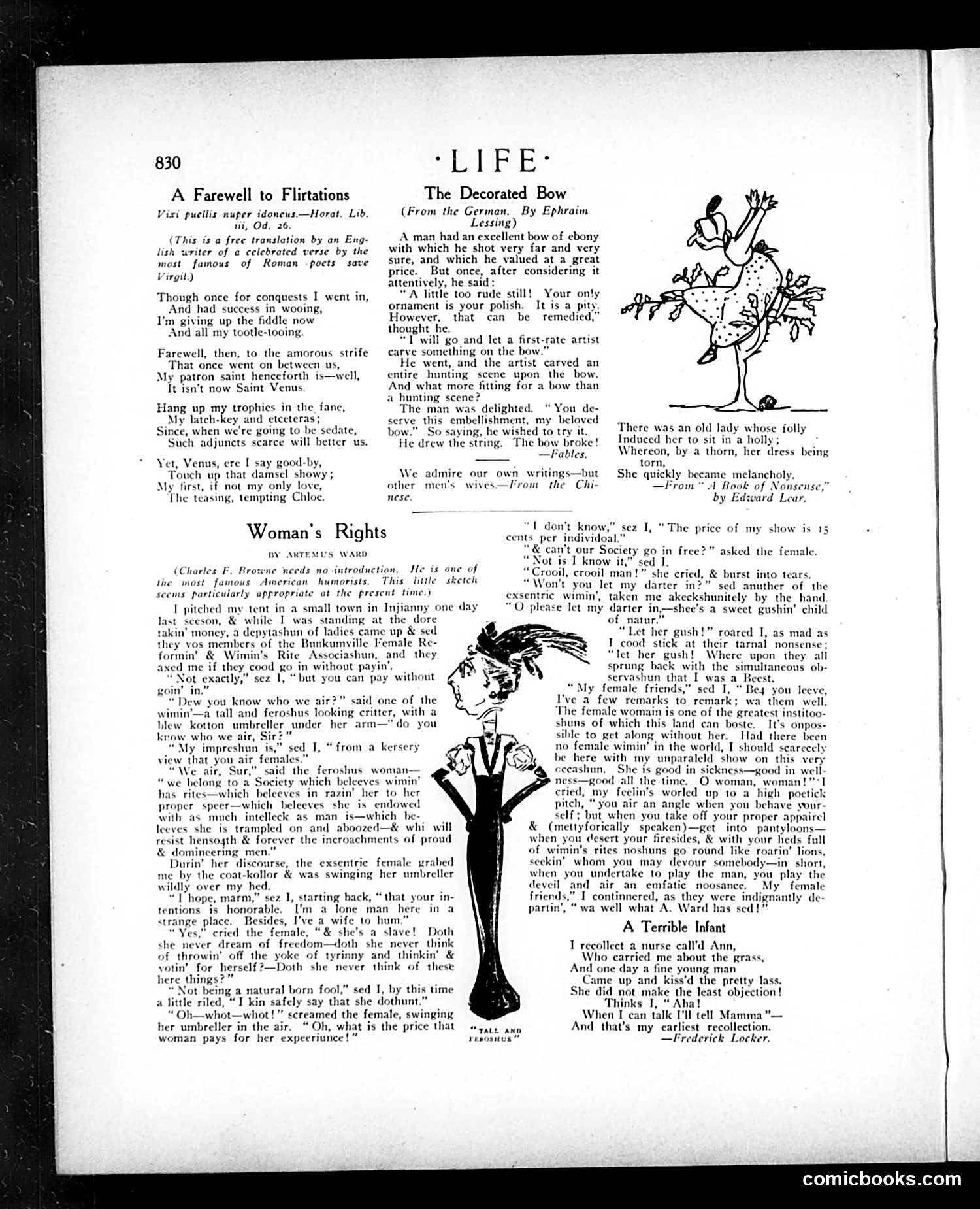
This *Life* magazine page (page 830) contains three distinct pieces of social satire: **"A Farewell to Flirtations"** is a poem where a man renounces romantic conquests, referencing classical Latin poetry to add mock-gravity to the decision. **"The Decorated Bow"** is a fable warning against over-ornamentation—a craftsman decorates a functional bow so elaborately it breaks. This likely critiques excessive decoration or superficial "improvement" of practical things. **"Woman's Rights"** (by humorist Artemus Ward) is the page's main satirical commentary. Ward portrays female suffrage/equality activists as aggressive, shrewish, and absurdly militant—a common anti-women's-rights stereotype of the era. The exaggerated dialect and the image of an umbrella-wielding woman haranguing a hapless man mock the suffragettes' demands for voting rights and social equality as ridiculous and threatening to male authority. The satire represents early-20th-century resistance to women's rights movements.
📄 Transcribed text from this page (OCR, searchable)
Machine-transcribed from the original scan — historical spelling and the odd misread are preserved.
830 A Farewell to Flirtations Vixi puellis nuper idoneus—Horat, Lib. tii, Od. 26. (This is @ free translation by an Eng- lish writer of a celebrated verse by the most famous of Roman poets save Virgil.) Though once for conquests I went in, And had success in wooing, I'm giving up the fiddle now And all my tootle-tooing. Farewell, then, to the amorous strife That once went on between us, My patron saint henceforth is—well, It isn’t now Saint Venus Hang up my trophies in the. fane, My latch-key and etceteras; i when we're going to be sedate, Such adjuncts scarce will better us. Yet, Venus, ere I say good-by, Touch up that damsel show My first, if not my only love, The teasing, tempting Chloe. aL FRIE The Decorated Bow (From the German. By Ephraim Lessing) A man had an excellent bow of ebony with which he shot very far and very sure, and which he valued at a great price. But once, after considering it attentively, he said: “A little too rude still! ornament is your polish. However, that can be thought he. 1 will go and let a first-rate artist carve something on the bow.” He went, and the artist carved an entire hunting scene upon the bow. And what more fitting for a bow than a hunting scene? The man was delighted. “You de- this embellishment, my beloved So saying, he wished to try it. He drew the string. The bow broke! —Fables. Your only It is a pity, remedied,” We admire our own writings—but other men’s wives —From the Chi- nese. There was an old lady whose folly Induced her to sit ina holly; Whercon, by a thorn, her dress being torn, She quickly became melancholy. —From” A Book of Nonsense,” by Edward Lear. Woman's Rights BY ARTEMUS WARD He is one of sketch (Charles F. Browne needs no -introduction te most famous American humorists. This little seems particularly appropriate at the present time.) I pitched my tent in a small town in Injianny one day last seeson, & while I was standing at the dore takin’ money, a depytashun of ladies came up & sed they vos members of the Bunkumville Female Re- formin’ & Wimin’s Rite Associashun, and they axed me if they cood go in without payin’. “Not exactly,” sez I, “but you can pay without goin’ in.” “Dew you know who we air?” said one of the wimin’—a tall and feroshus looking critter, with a blew kotton umbreller under her arm—“do you krow who we air, Sir?” “My impreshun is,” sed I, “from a kersery view that you air females.” aN ir, Sur,” said the feroshus woman— “Wwe helong to a Society which beleeves wimin’ has rites—which beleeves in razin’ her to her proper speer—which heleeves she is endowed with as much intelleck as man is—which be- leeves she is trampled on and aboozed—& whi will resist hensogth & forever the incroachments of proud & domineering men.” Durin’ her discourse, the exsentric female grabed me by the coat-kollor & was swinging her umbreller wildly over my hed. “LT hope, marm,” sez I, starting back, “that your in- tentions is honorable. I’m a lone man here in strange pla Besides, I’ve a wife to hum,” “Yes,” cried the female, “& she's a sla Doth she never dream of freedom—doth she never think of throwin’ off the yoke of tyrinny and thinkin’ & votin’ for herself?—Doth she never think of these here things?” “Not being a natural born fool,” sed I, by this time a little riled, “I kin safely say that she dothunt.” “ Oh—whot—whot !” screamed the female, swinging her umbreller in the air. “Oh, what is the price that woman pays for her expeeriunce! reeosnus” “1 don’t know,” sez I, “The price of my show is 15 cents per individoal.”” “& can’t our Society go in free?” “Not is I know it,” sed 1, “Crooil, crooil man!” she cried, & burst into tears. “Won't you let my darter in?” sed anuther of the sentric wimin’, taken me akeckshunitely by the hand. O please let my darter in—shee’s a sweet gushin’ child of natur.” “Let her gush!” roared I, as mad as T cood stick at their tarnal nonsense; “let her gush! Where upon they all sprung back with the simultaneous ob- servashun that I was a Beest. “My female friends,” sed I, “Bey you leeve, I've a few remarks to remark; wa them well. The female womain is one of the greatest institoo- shuns of which this land can boste. It's onpos- sible to get along without her. Had there been no female wimin’ in the world, I should scarecely be here with my unparaleld show on this very eceashun. She is good in sickness—good in well ness—good all the time. O woman, woman!" cried, my feclin’s worled up to a high poetick pitch, “you air an angle when you behave your- self ;’but when you take off your proper appairel & (mettyforically speaken)—get into pantyloons— when you desert your firesides, & with your heds full imin’s rites noshuns go round like roarin’ lions, in’ whom you may devour somebody—in short, when you undertake to play the man, you play. the deveil and air an emfatic noosance, My female friends,” I continnered, as they were indignantly de- partin’, “wa well what A. Ward has sed!” . A Terrible Infant I recollect a nurse call’d Ann, Who carried me about the grass, And one day a fine young man Came up and. kiss’d the pretty lass. She did not make the least objection! Thinks I, “Aha! When I can talk I'll tell Mamma "— And that's my earliest recollection. —Frederick Locker. asked the female. comicbooks.com