
Life, 1910-05-05 · page 38 of 72
Life — May 5, 1910 — page 38: what you’re looking at
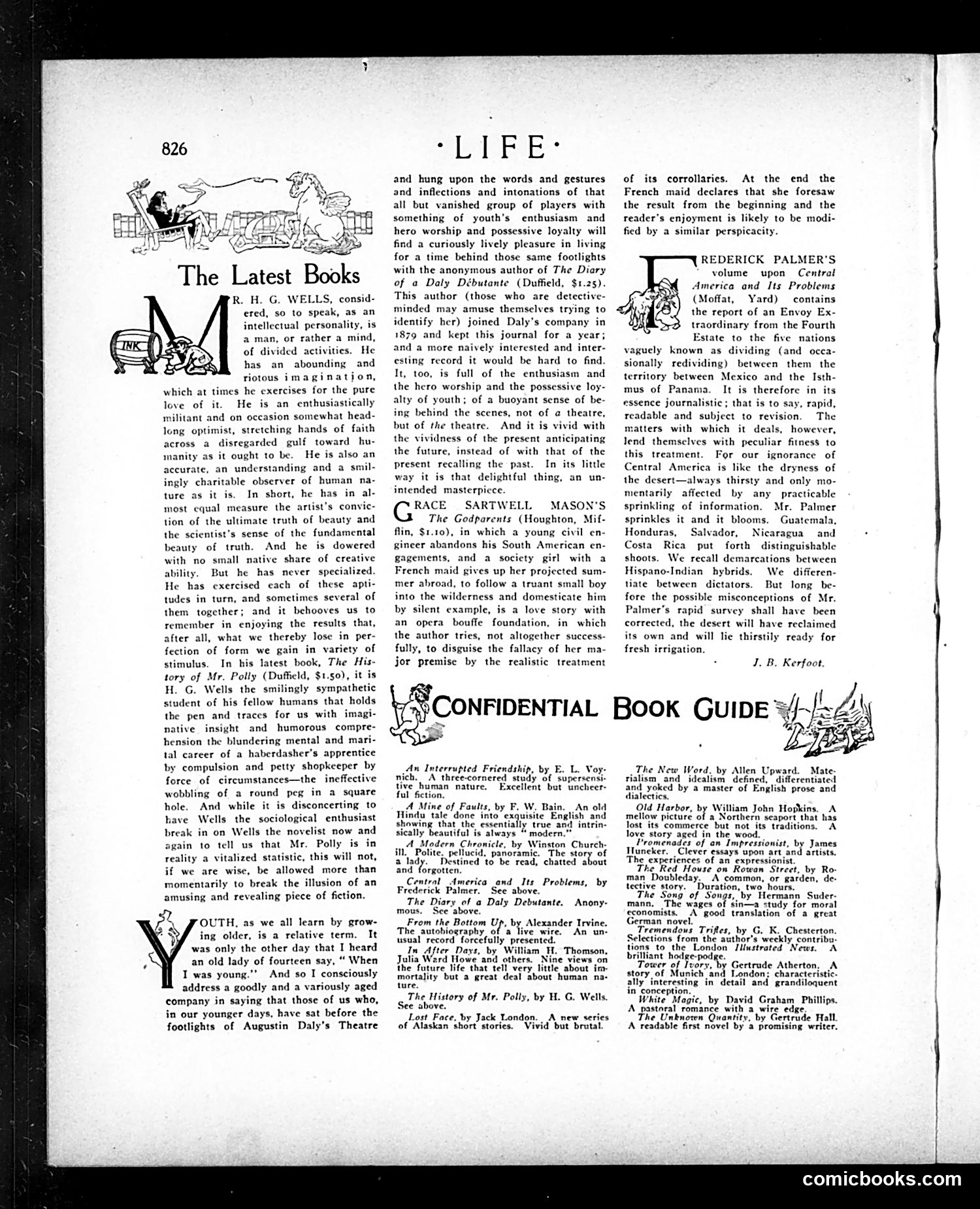
What you’re looking at
This page contains book reviews rather than political cartoons. The small decorative illustrations are generic vignettes, not satirical commentary. The reviews discuss three recent books: 1. **H.G. Wells's *The History of Mr. Polly*** — praised as Wells the "novelist" rather than "sociological enthusiast," depicting a haberdasher's apprentice as a "round peg in a square hole," an ineffective everyman figure. 2. ***The Diary of a Daly Débutante*** — a memoir from 1879 about theater life at Augustin Daly's Theatre, valued for its youthful enthusiasm and immediacy. 3. **Grace Sartwell Mason's *The Godparents*** — a romantic story with comedic elements (*opera bouffe*). The page's humor is literary rather than political—gentle observations about human nature and artistic merit. The "Confidential Book Guide" section provides brief notices of other titles. This represents typical early-20th-century literary journalism aimed at educated readers.
📄 Transcribed text from this page (OCR, searchable)
Machine-transcribed from the original scan — historical spelling and the odd misread are preserved.
Latest Books R. H. G. WELLS, consid- ered, so to speak, as an intellectual personality, is a man, or rather a mind, of divided activities. He has an abounding and riotous imagination, which at times he exercises for the pure love of it. He is an enthusiastically militant and on occasion somewhat head- long optimist, stretching hands of faith across a disregarded gulf toward hu- manity as it ought to be. He is also a accurate, an understanding and a smil- ingly charitable observer of human na- ture as it is. In short, he has in al- most equal measure the artist's convic- tion of the ultimate truth of beauty and the scientist's sense of the fundamental beauty of truth. And he is dowered with no small native share of creative abili But he has never specialized. He has exercised cach of these apti- tudes in turn, and sometimes several of them together; and it behooves us to remember in enjoying the results that, after all, what we thereby lose in per- fection of form we gain in variety of stimulus. In his latest book, The His- tory of Mr. Polly (Duffield, $1.50), it is H. G. Wells the smilingly sympathetic student of his fellow humans that holds the pen and traces for us with imagi- native insight and humorous compre- hension the blundering mental and mari- al career of a haberdasher’s apprentice by compulsion and petty shopkeeper by force of circumstances—the ineffective wobbling of a round peg in a square hole. And while it is disconcerting to have Wells the sociological enthusiast break in on Wells the novelist now and to tell us that Mr. Polly is in reality a vitalized statistic, this will not, if we are wise, be allowed more than momentarily to break the illusion of an amusing and revealing piece of fiction. Th again OUTH, as we all learn by grow- ing older, is a relative term. It was only the other day that I heard an old lady of fourteen say, “ When I was young."” And so I consciously address a goodly and a variously aged company in saying that those of us who, in our younger days, have sat before the footlights of Augustin Daly's Theatre o| Lay Al oa and hung upon the words and gestures and inflections and intonations of that all but vanished group of players with something of youth’s enthusiasm and hero worship and possessive loyalty will find a curiously lively pleasure in living for a time behind those same footlights with the anonymous author of The Diary of a Daly Débutante (Duffield, $1.25). This author (those who are detective- minded may amuse themselves trying to identify her) joined Daly’s company in 1879 and kept this journal for a year; and a more naively interested and inter- esting record it would be hard to find. It, too, is full of the enthusiasm and the hero worship and the possessive loy- alty of youth; of a buoyant sense of be- ing behind the scenes, not of a theatre, but of the theatre. And it is vivid with the vividness of the present anticipating the future, instead of with that of the present recalling the past. In its little way it is that delightful thing, an un- intended masterpiece. ACE SARTWELL MASON’S The Godparents (Houghton, Mif- flin, $1.10), in which a young civil en- gincer abandons his South American en- gagements, and a society girl with a French maid gives up her projected sum- mer abroad, to follow a truant small boy into the wilderness and domesticate him by silent example, is a love story an opera bouffe foundation, in which the author tries, not altogether success- fully, to disguise the fallacy of her ma- jor premise by the realistic treatment CONFIDENTIAL An Interrupted Friendship, by E. L. Voy: nich. A three-cornered study of supersensi- tive human nature. Excellent but uncheer- ful ction, A Mine of Faults, by F. W. Bain. An old Hindu tale done into exquisite English and showing that the essen! sically beautiful is alway 4 Modern Chronicle, by Winston Church: iN Polite. pellucid, panoramic. The story of 2 lady. Destined to be Tead, chatted about and forgotten. Centrat America and Its Problems, by Frederick Palmer. See above. The Diary of a Daly Debutante. mous. See above. From the Bottom Up, by Alexander Irvine. ‘The autobiography of a Tive wire. An un- usual record forcefully presented. In After Days, by William H. Thomson, Julia Ward Howe’ and others. Nine views on the future life that tell very little about in mortality but a great deal about human na- ture. The History of Mr. Polly, by H. G. Wells. See above. Lost Face, by Jack London. A new series of Alaskan short stories. Vivid but brutal. Anony- of its corollaries. At the end the French maid declares that she foresaw the result from the beginning and the reader's enjoyment is likely to be modi- fied by a similar perspicacity. REDERICK PALMER'S volume upon Centrat America and Its Problems (Moffat, Yard) contains the report of an Envoy Ex- traordinary from the Fourth Estate to the five nations vaguely known as dividing (and occa- sionally redividing) between them the territory between Mexico and the Isth- mus of Panama. It is therefore in its essence journalistic; that is to say, rapid, readable and subject to revision. The matters with which it deals, however, lend themselves with peculiar fitness to this treatment. For our ignorance of Central America is like the dryness of the desert 8 thirsty and only mo- mentarily affected by any practicable sprinkling of information. Mr. Palmer sprinkles it and it blooms. Guatemala, Honduras, Salvador, Nicaragua and Costa Rica put forth distinguishable shoots. We recall demarcations between Hispano-Indian hybrids. We difieren- tiate between dictators. But long be- fore the possible misconceptions of Mr. Palmer's rapid survey shall have been corrected, the desert will have reclaimed its own and will lie thirstily ready for fresh irrigation. J.B. Kerfoot. BOoK GUIDE The New Word. by Allen Upward. Mate. rialism and idealism defined, differentiated and yoked by a master of English prose and dialectics. Old Harbor, by William John Hopkins. A mellow picture of a Northern seaport that has lost its commerce but not its traditions. A love story aged in the wood. Promenades of an Impressionist, by James Muneker. Clever essays upon art and artists. The experiences of an expressionist. The Red House on Rowan Street, by Ro- man Doubleday. A common, or garden, de- tective story. Duration, two hours. The Song’ of Songs, by Hermann Suder- mann. “The wages of sin—a study for moral economists. A good translation of a great German novel. Tremendous Trifles, by G. K. Chesterton. Selections from the author's weekly contribu tions to the London Iilxstrated News. A brilliant hodge-podge. Tower of Ivory, by Gertrude Atherton, A story of Munich and London: characteristic. ally interesting in detail and grandiloquent in conception. White Magic, by David Graham Phillips. A pastoral romance with a wire edge. The Unknoten Quantity, by Gertrude Hall A readable first novel by a promising writer. comicbooks.com