
A complete issue · 48 pages · 1909
Life — September 2, 1909
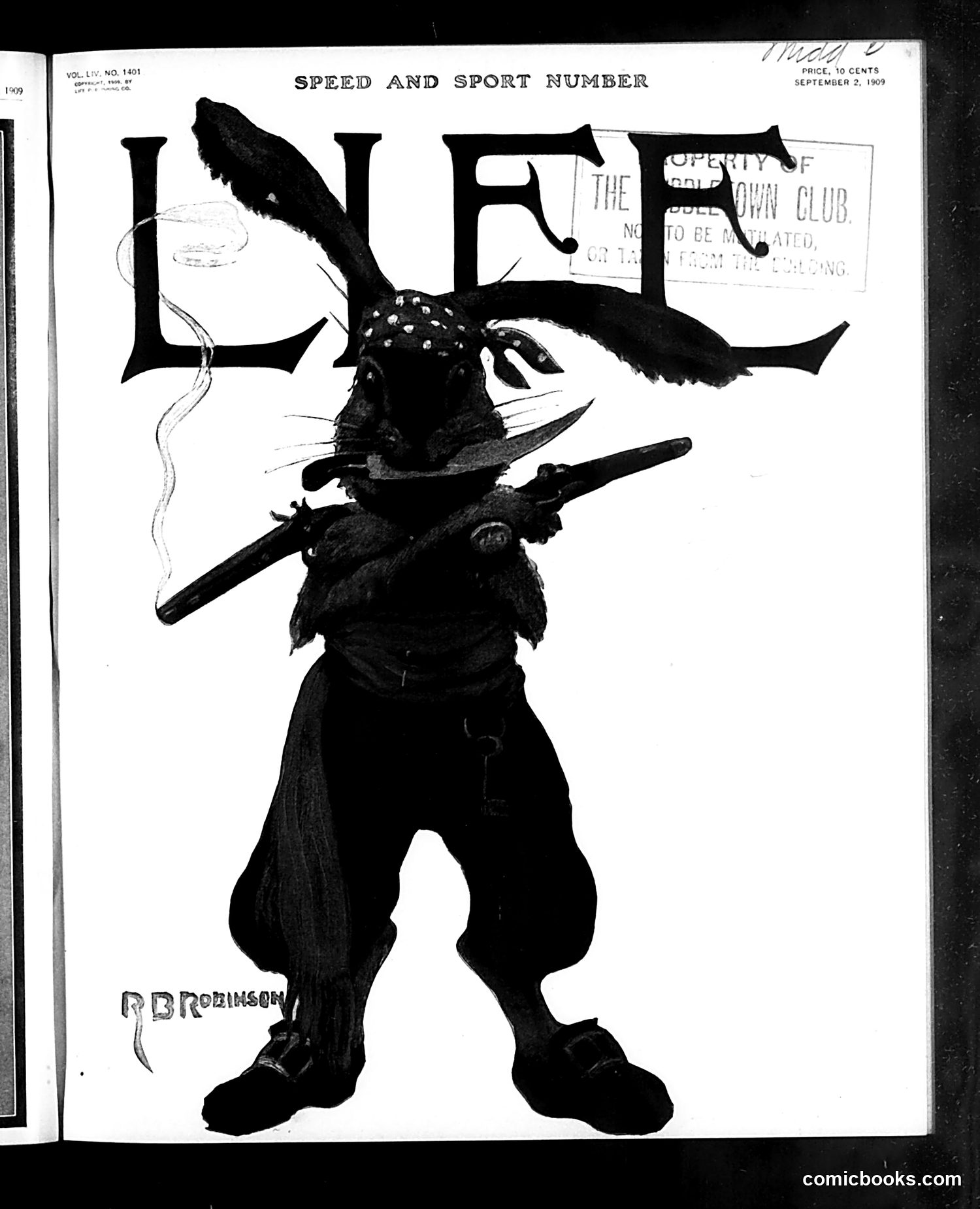
This is a cover illustration by artist P.B. Robinson for "Speed and Sport" number of Life magazine. The central figure is an anthropomorphic cat character wearing a decorated hat, goggles, and holding a rifle—depicted in exaggerated, dynamic pose suggesting movement and action. The character appears to represent a sporting or adventurous type popular in early 1900s American humor. The "speed and sport" theme likely references the contemporary fascination with automobiles, aviation, and outdoor activities that were novel and exciting during this era. The cat's theatrical outfit and aggressive pose suggest satire of enthusiastic sportsmen or adventurers of the period. The illustration exemplifies Life magazine's satirical visual humor through animal caricature.
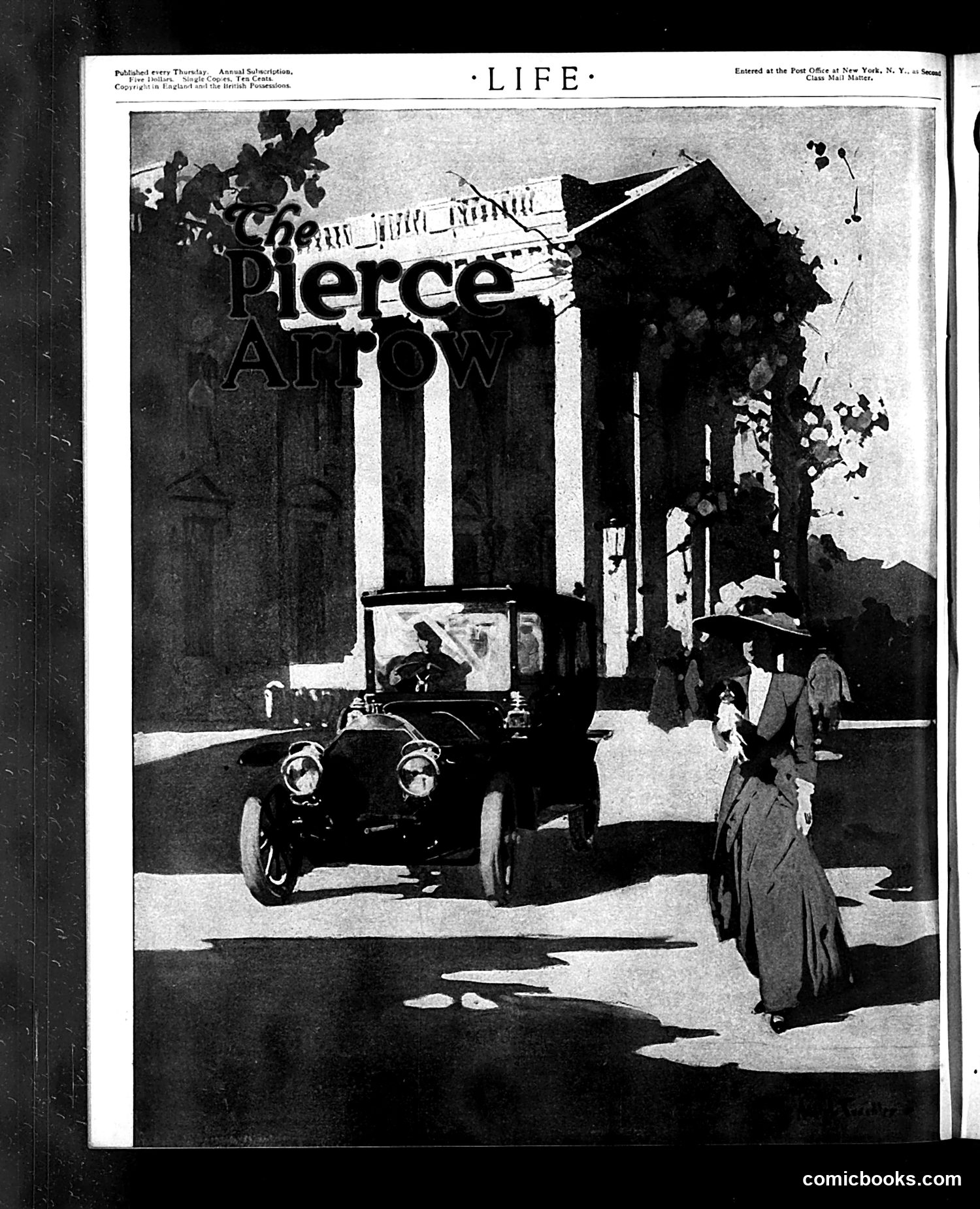
This appears to be an advertisement for Pierce-Arrow automobiles rather than a political cartoon. The image shows a luxury car positioned prominently in front of classical Greek or Roman columns with well-dressed figures nearby. The architectural setting and fashionable clothing suggest wealth and sophistication. The "Pierce Arrow" text watermark overlays the scene. This type of advertisement was common in *Life* magazine during the early-to-mid 20th century, using classical imagery and elegant settings to associate the automobile brand with prestige, refinement, and upper-class status. The composition emphasizes the car as a symbol of success and good taste for affluent consumers.
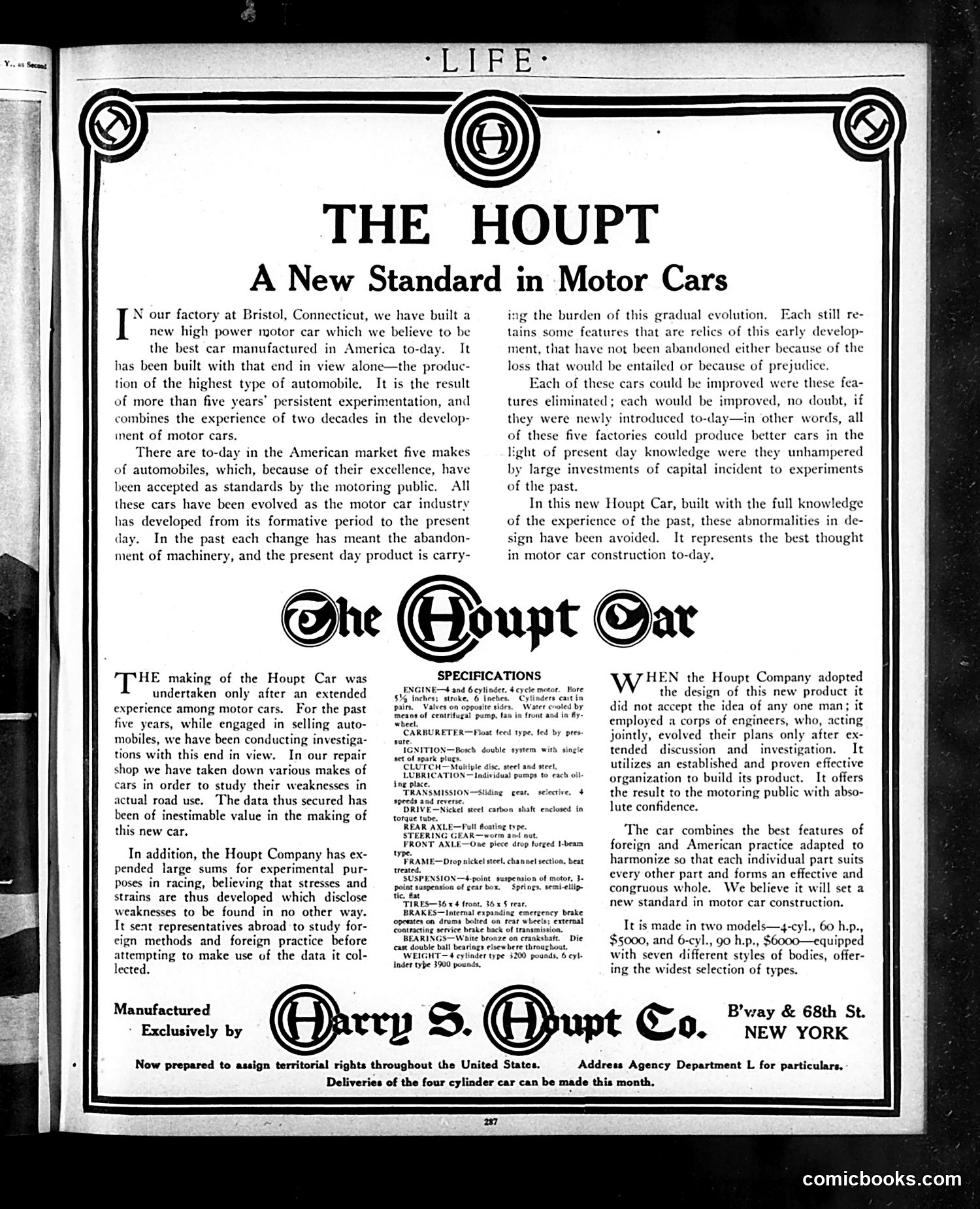
This page is **not a cartoon or satirical content**—it is a straightforward **automobile advertisement** for the Houpt Car, manufactured by Harry S. Houpt Co. in New York. The advertisement promotes the Houpt as "a new standard in motor cars," claiming it represents the best thinking in automotive construction. It emphasizes the company's research and experimentation over five years, highlighting features like a four-cylinder engine, sliding gear transmission, and various mechanical innovations. The elaborate Art Deco border design and ornamental typography are typical of 1910s-1920s advertising aesthetics, not satirical elements. This appears to be a paid product advertisement rather than editorial satire or cartoon content.
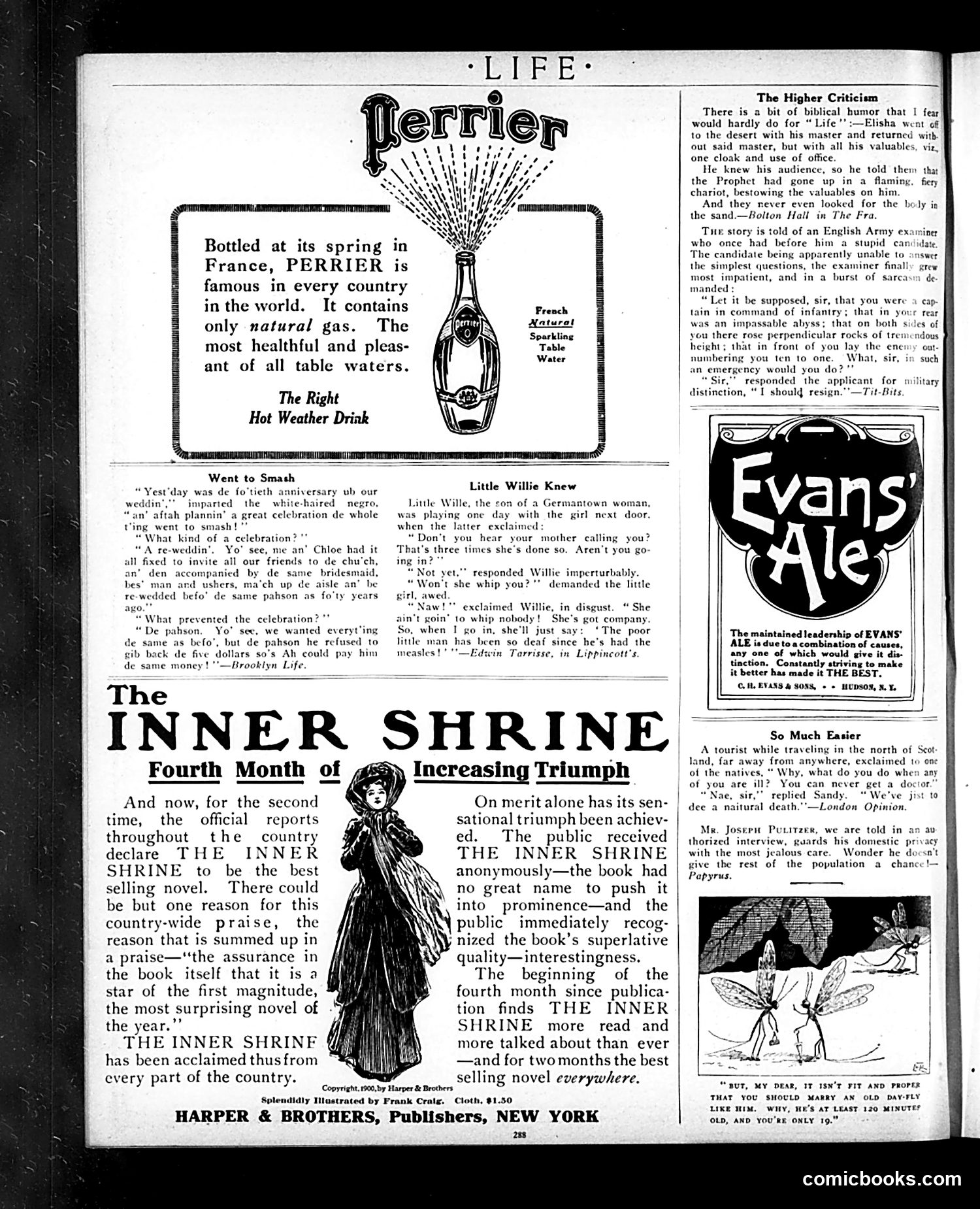
This page is primarily **advertising and light humor** rather than political commentary. The main content includes: 1. **Perrier water ad** - promoting French sparkling water as a healthful beverage 2. **Evans' Ale advertisement** - emphasizing product quality 3. **"The Inner Shrine" book promotion** - advertising a novel as a bestseller in its fourth month, claiming it's "the most surprising novel of the year" 4. **Three brief humorous anecdotes** ("Went to Smash," "Little Willie Knew," "So Much Easier") - typical light domestic comedy pieces common to Life magazine's satirical humor section The cartoons and jokes target everyday social situations—anniversary celebrations, childhood misbehavior, and tourist confusion—rather than political figures or events. This represents Life's lighter entertainment content alongside its satirical commentary.
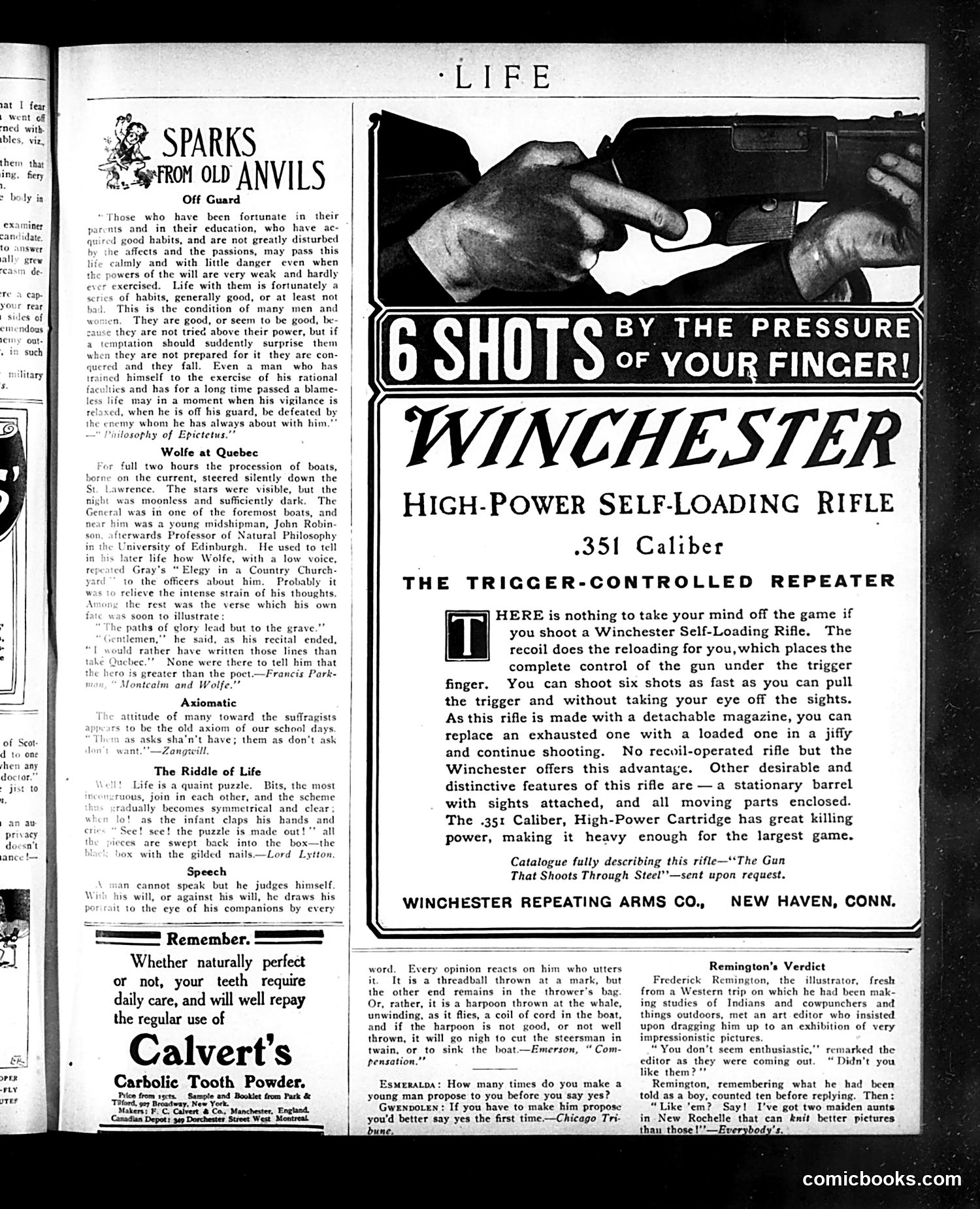
This page contains **no political cartoons or satirical commentary**. Instead, it's primarily **advertising and miscellaneous editorial content**. The main feature is a **Winchester rifle advertisement** emphasizing the self-loading mechanism that allows "6 shots by the pressure of your finger" without reloading. The ad targets hunters, highlighting the rifle's power for "large game." The left column contains brief essays titled "Sparks from Old Anvils," including pieces on character ("Off Guard"), historical anecdotes ("Wolfe at Quebec"), and aphorisms about life and speech. Below is an advertisement for **Calvert's Carbolic Tooth Powder**. The page reflects early 20th-century *Life* magazine content: a mix of advertising, light philosophy, and historical vignettes—not satirical commentary.
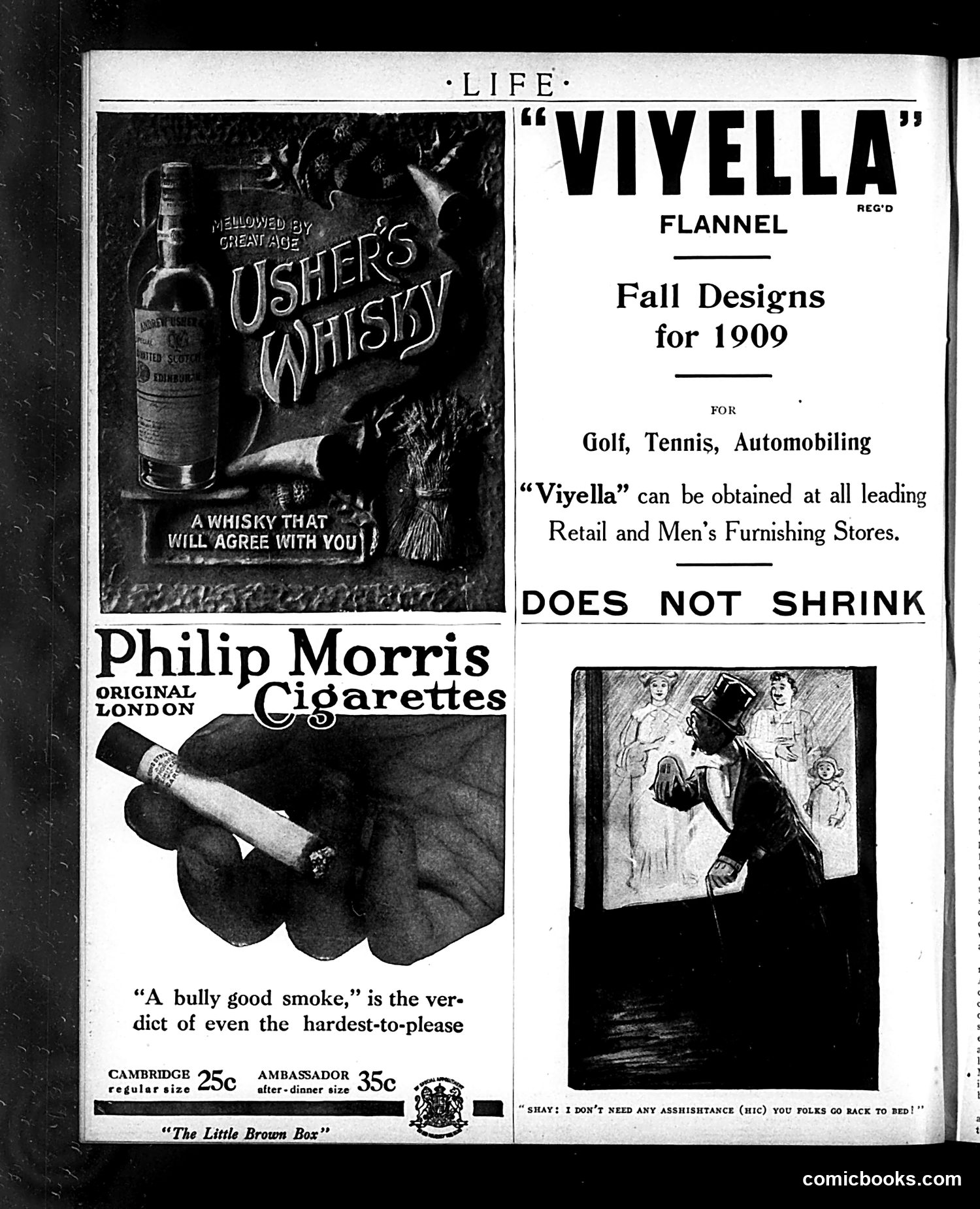
This page is primarily **advertising**, not satirical content. The left side features two product ads: Usher's Whisky (with ornamental styling) and Philip Morris Cigarettes, which emphasizes being "a bully good smoke" for "the hardest-to-please." The right side advertises **Vivella Flannel** fabric for fall 1909, marketed for golf, tennis, and automobiling—activities associated with affluent leisure. The ad emphasizes the fabric "does not shrink," a practical selling point for quality clothing. The small illustration at bottom right appears to be a generic social scene (man in formal wear), likely just decorative framing for the advertisement rather than satirical commentary. This reflects early 1900s advertising conventions blending product promotion with genteel lifestyle imagery.
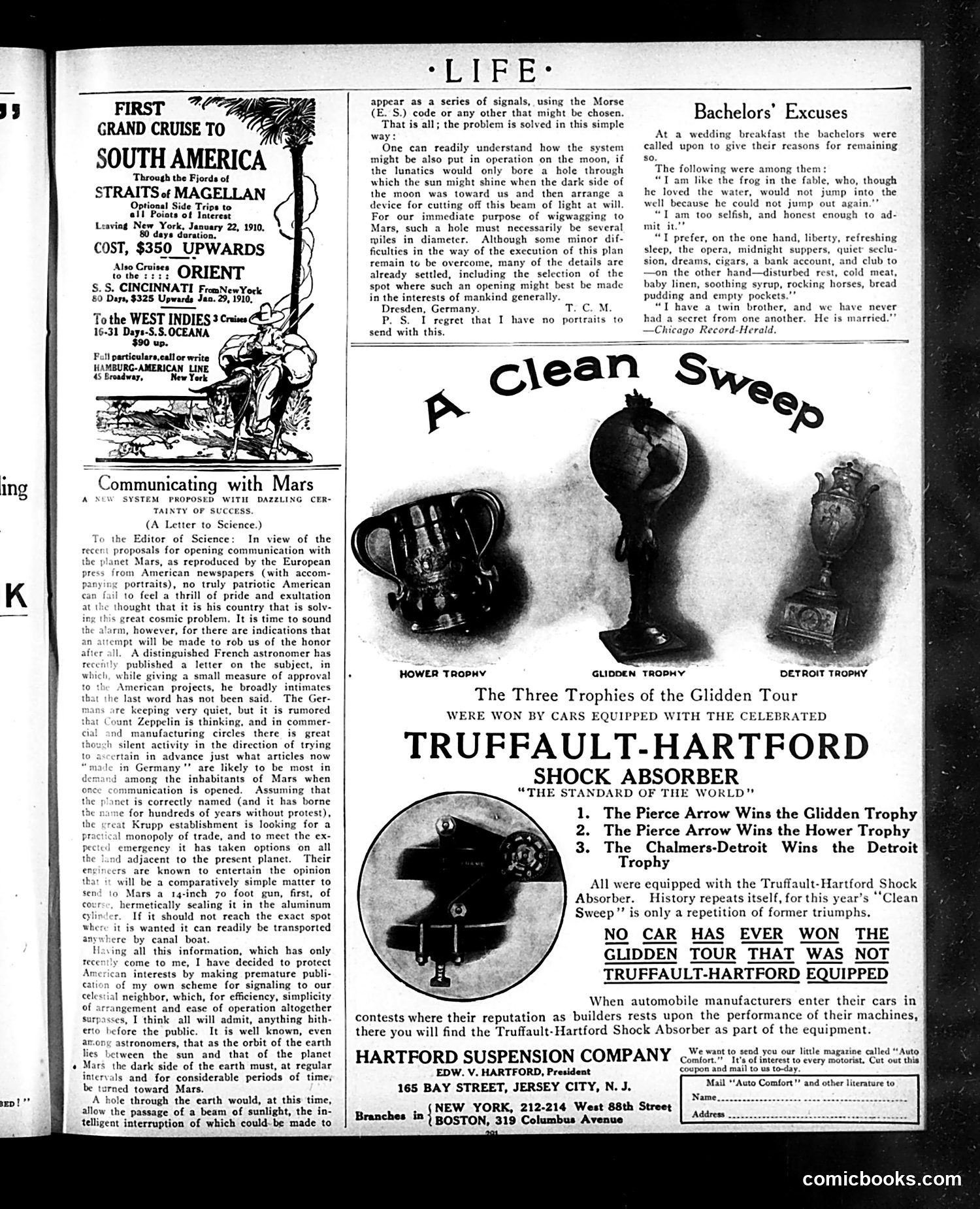
This page is **primarily advertising**, not political satire. The upper left features a cruise ship advertisement for a South American voyage via the SS Cincinnati. Below that is a brief article titled "Communicating with Mars," discussing proposals for signaling the planet—a serious scientific topic of the era reflecting early 20th-century fascination with extraterrestrial life. The dominant content is a large advertisement for **Truffault-Hartford Shock Absorber**, featuring three trophy images (Hower, Glidden, and Detroit Trophies). The ad emphasizes that cars equipped with this suspension system won the Glidden Tour races. The text stresses competitive automotive performance and product superiority. A smaller section titled **"Bachelors' Excuses"** contains humorous quotes from unmarried men explaining why they haven't married—light comedic filler typical of *Life* magazine's satirical sections. Overall, this is a commercial page blending advertisements with minor satirical content.
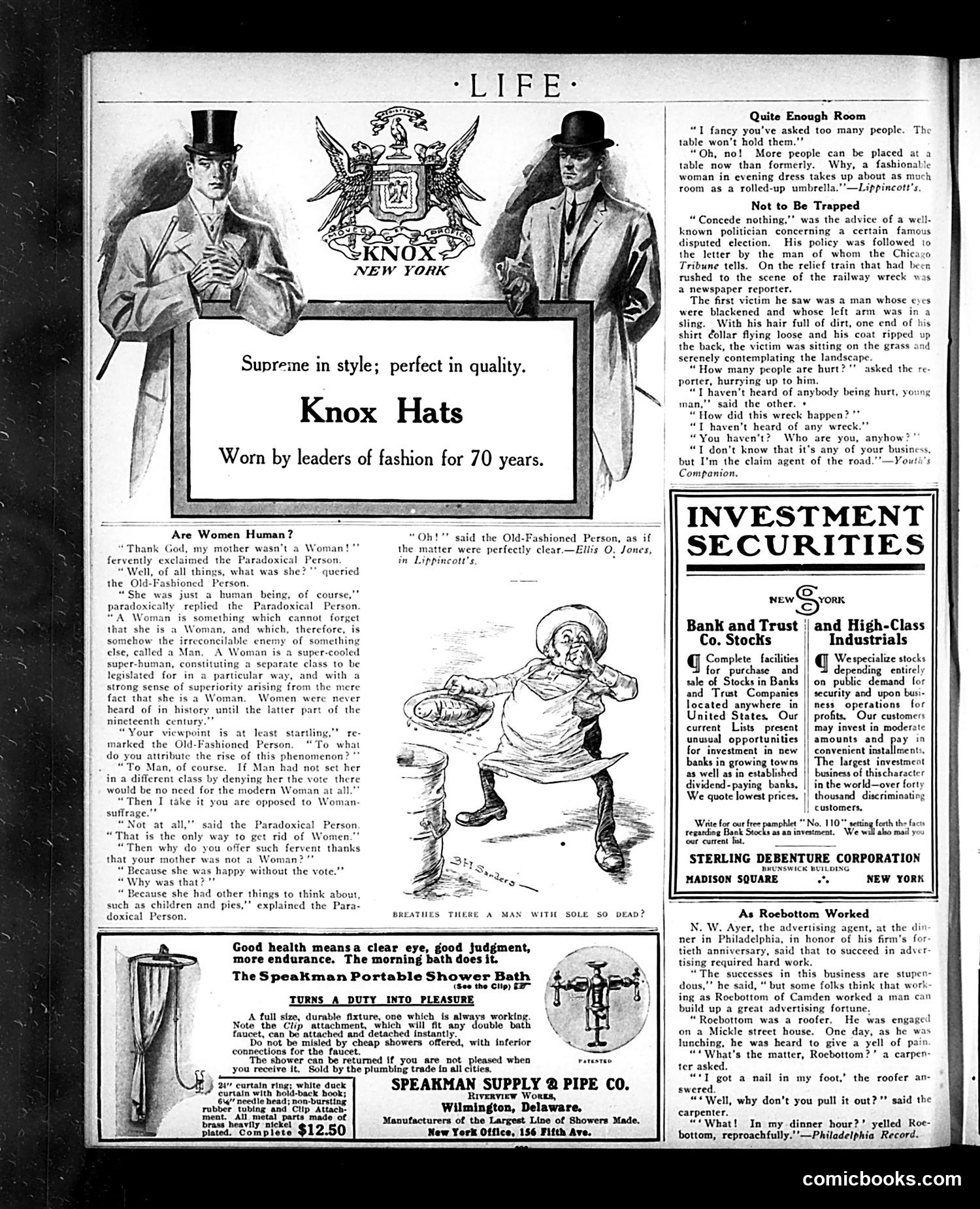
This page is primarily **advertisements and satirical articles**, not political cartoons. The main content includes: 1. **Knox Hats ad** - A fashion advertisement claiming 70 years of style leadership 2. **"Are Women Human?" dialogue** - A satirical debate between a "Paradoxical Person" and an "Old-Fashioned Person" about women's rights and nature, likely referencing early 20th-century suffrage debates 3. **"Breathes There a Man with Sole So Dead?"** - A cartoon showing someone examining shoes, playing on patriotic poetry for humorous effect about footwear 4. **Multiple advertisements** for investment securities, plumbing fixtures, and other products typical of the era The satire appears gentle and domestic rather than politically pointed. The "Are Women Human?" piece mocks both progressive and traditionalist views through exaggerated dialogue.
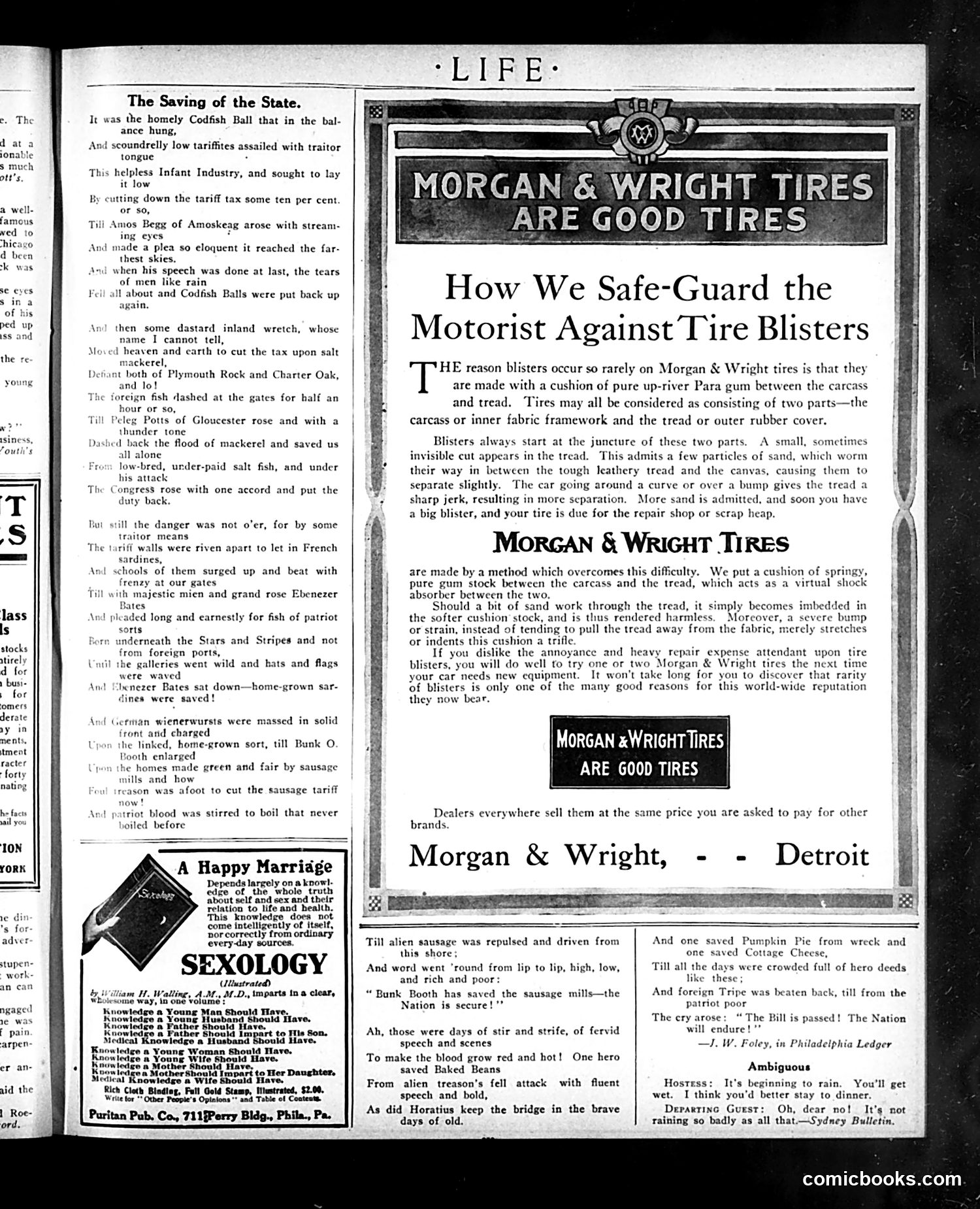
This page is primarily a **Morgan & Wright Tires advertisement**, not political satire. The ad uses educational messaging to explain tire construction and promote their product's durability against "blisters" (tire damage from overheating). The left column contains **"The Saving of the State,"** a patriotic poem apparently celebrating tariff policy and nationalist economic measures—though the OCR text is fragmentary, making specific references unclear. It mentions figures like "Amos Begg of Amokeag" and references to tariffs, salt fish, and "foreign ports." Below that is an advertisement for a book called **"Sexology"** by William H. Walling, marketed as medical/educational knowledge for married couples. The right side includes poems about food preservation during what appears to be wartime rationing ("alien sausage was repulsed"). **This is advertising and patriotic content, not political commentary.**
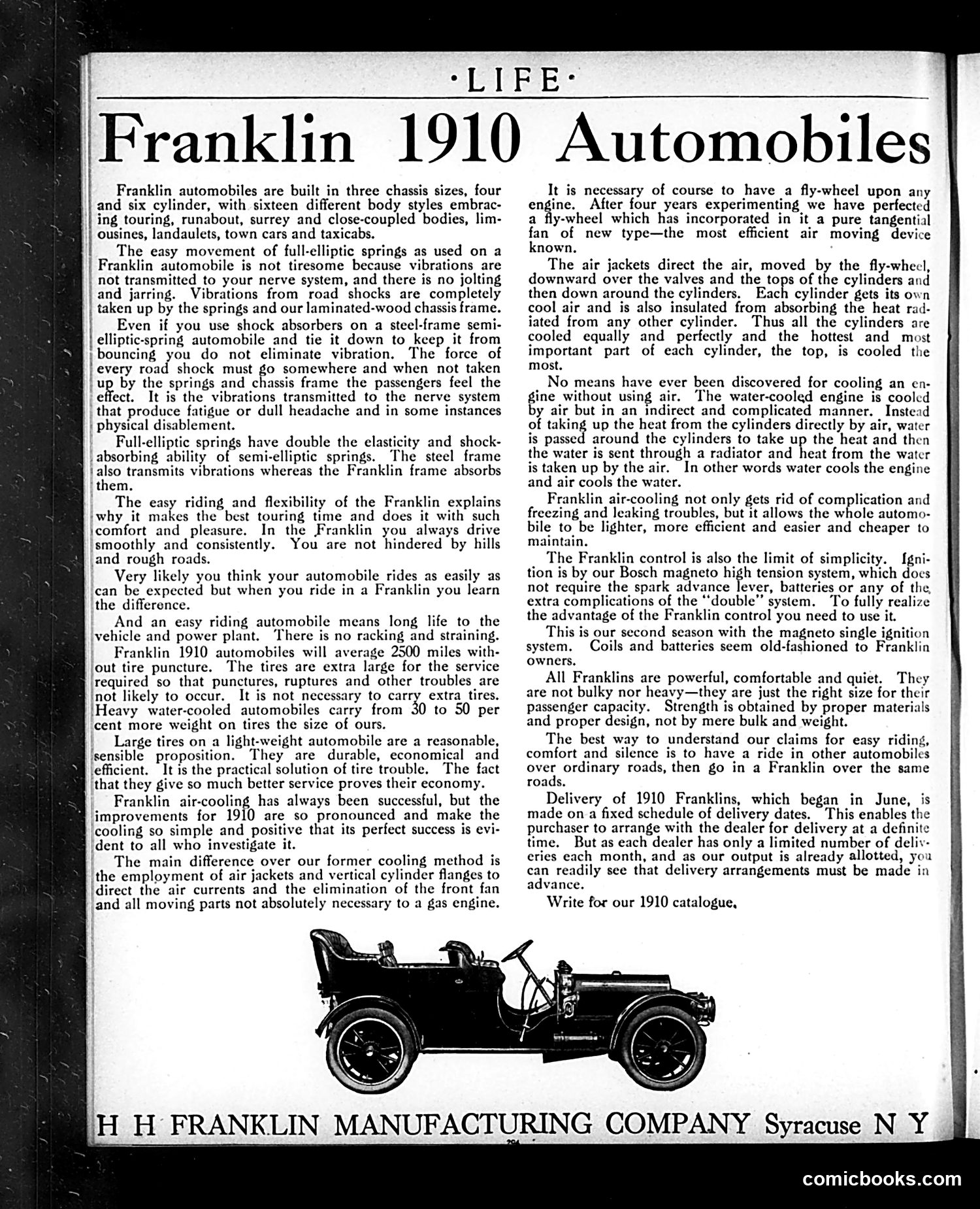
This is a straightforward product advertisement, not satirical content. The H.H. Franklin Manufacturing Company of Syracuse, New York promotes their 1910 automobiles, emphasizing technical innovations like air-cooled engines, full-elliptic springs for smooth riding, and simplified magnetic ignition systems. The ad highlights practical advantages: durability, easy maintenance, comfortable rides, and reliable delivery schedules. The accompanying illustration shows a period touring car with an open cabin design typical of early automobiles. The marketing pitch emphasizes Franklin's engineering superiority over competitors, particularly regarding cooling efficiency and the elimination of vibration—selling points that would matter to early automobile buyers concerned about mechanical reliability and comfort.
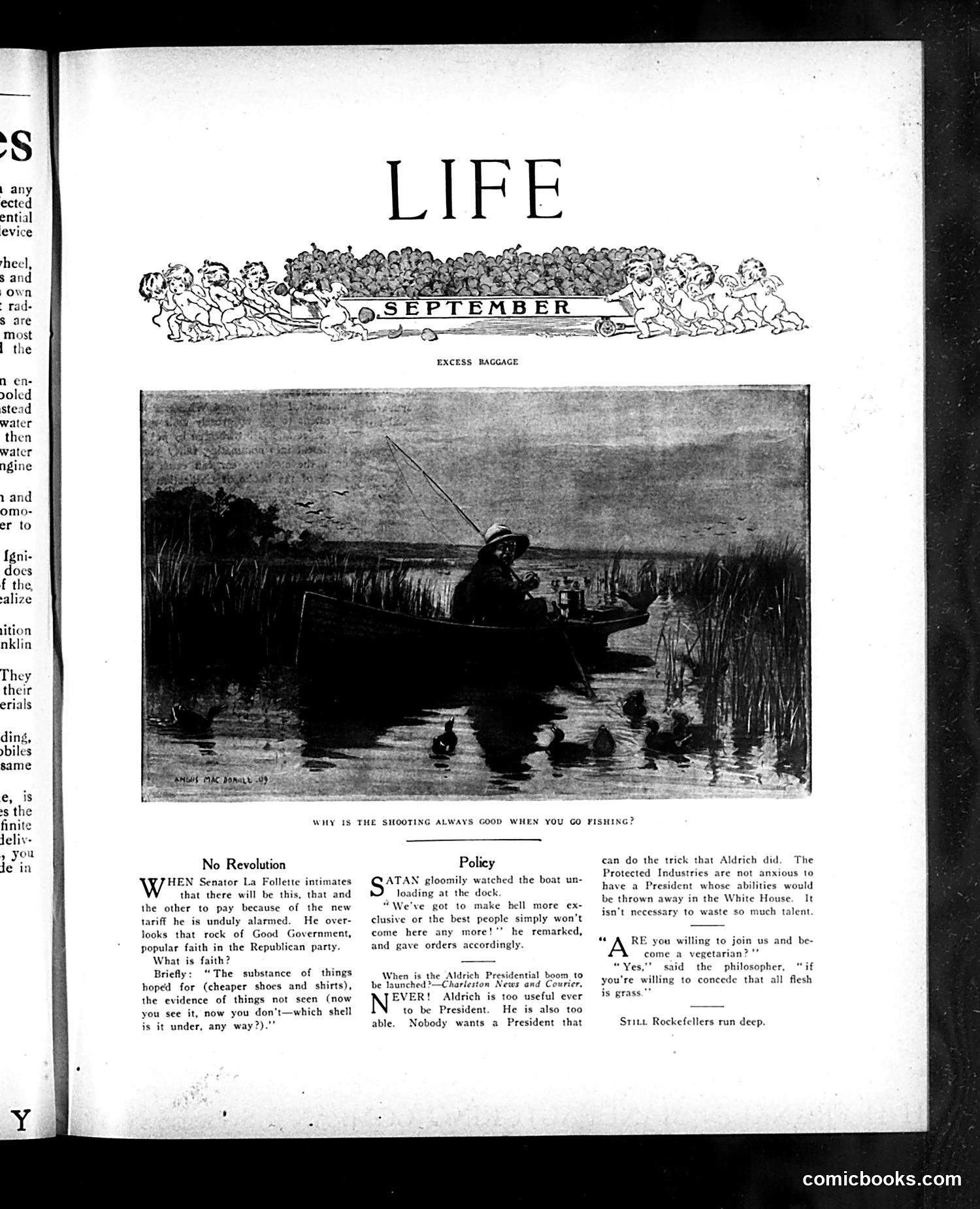
This page satirizes Republican politics and conservative policy during what appears to be the early 20th century. The main cartoon depicts a boat scene with the caption "WHY IS THE SHOOTING ALWAYS GOOD WHEN YOU GO FISHING?" The text section "No Revolution" mocks Senator La Follette's political intimations, suggesting Republicans fear change. "Satan" (depicted watching a boat) and references to "Aldrich" (likely Senator Nelson Aldrich) indicate satire about protective tariffs and industrial policy. The dialogue jokes that Aldrich is "too useful ever to be President" due to his controversial economic policies. The final line "Still Rockefellers run deep" suggests criticism of wealthy industrial interests controlling Republican politics. The overall thrust criticizes conservative Republican resistance to reform and their protection of wealthy industrialists' interests.
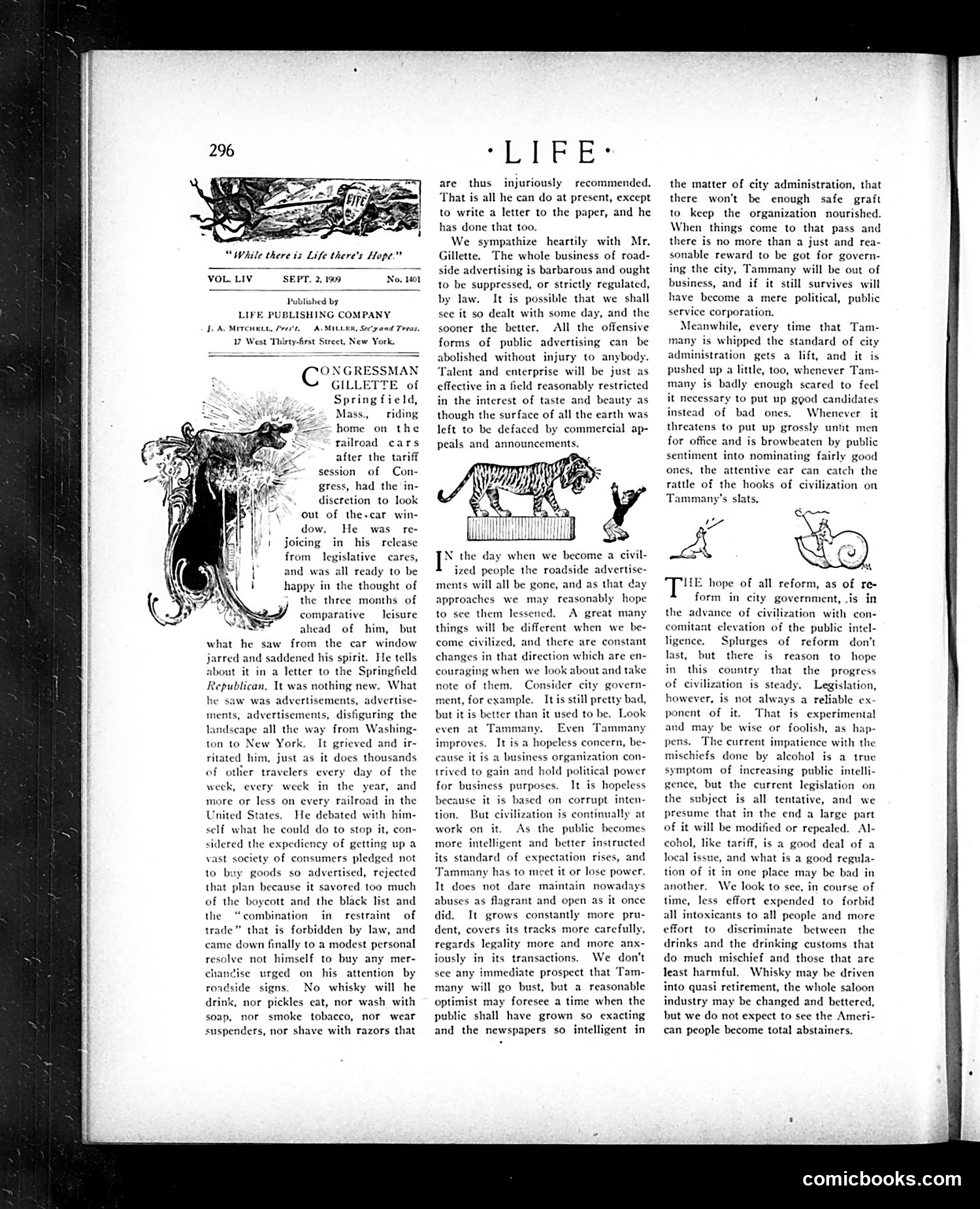
**The Main Cartoon** ("While there is Life there's Hope") depicts **Congressman Gillette of Springfield, Massachusetts**, shown as a figure emerging from or associated with a large bird or eagle. The text indicates Gillette had just been released from legislature and was celebrating his leisure time ahead. **The Point**: The cartoon satirizes Gillette's relief at escaping from congressional duties. The accompanying article criticizes his advertisement practices—specifically that he'd promoted roadside advertisements extensively during his tenure. The satire suggests he's pleased to leave behind the responsibilities of office, while the text argues such commercial displays should be regulated or suppressed. The cartoon exemplifies early 20th-century critique of both politicians and aggressive commercial advertising culture.
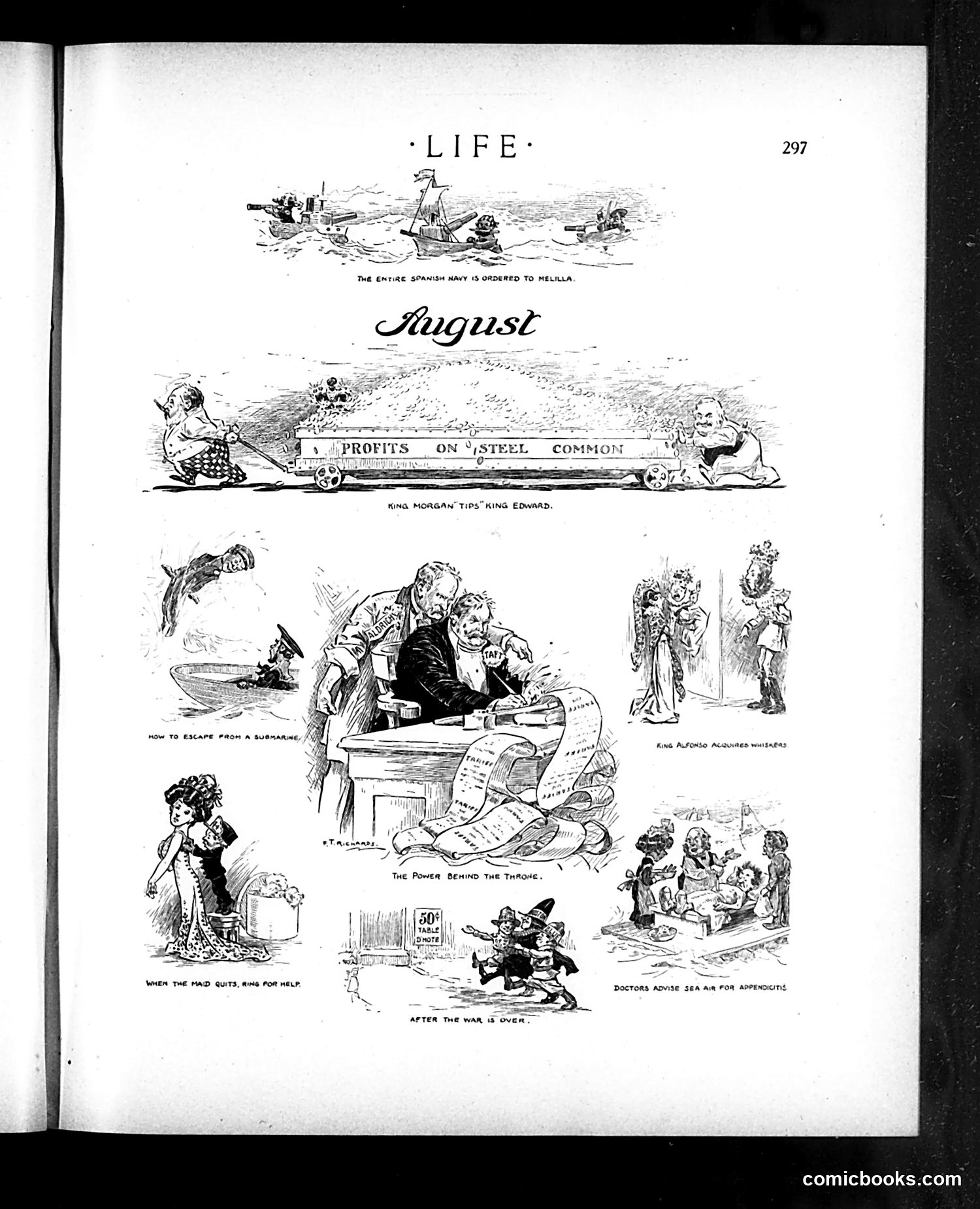
This page presents multiple cartoon vignettes satirizing World War I-era politics and social issues. The top panel shows "King Morgan Tips King Edward"—likely referencing J.P. Morgan (American financier) and King Edward VII, satirizing wealthy Americans' influence on British leadership during wartime. Central image depicts "The Power Behind the Throne," showing a figure manipulating a ruler, commenting on hidden financial or political control during the war. Other panels include: "Profits on Steel Common" (criticizing war profiteering), "How to Escape from a Submarine" (mocking naval dangers), "King Alfonso Acquires Whiskers" (unclear reference), and "Doctors Advise Sea Air for Appendicitis" (likely medical satire). The overall theme appears critical of wartime corruption, profiteering, and political manipulation by wealthy interests.
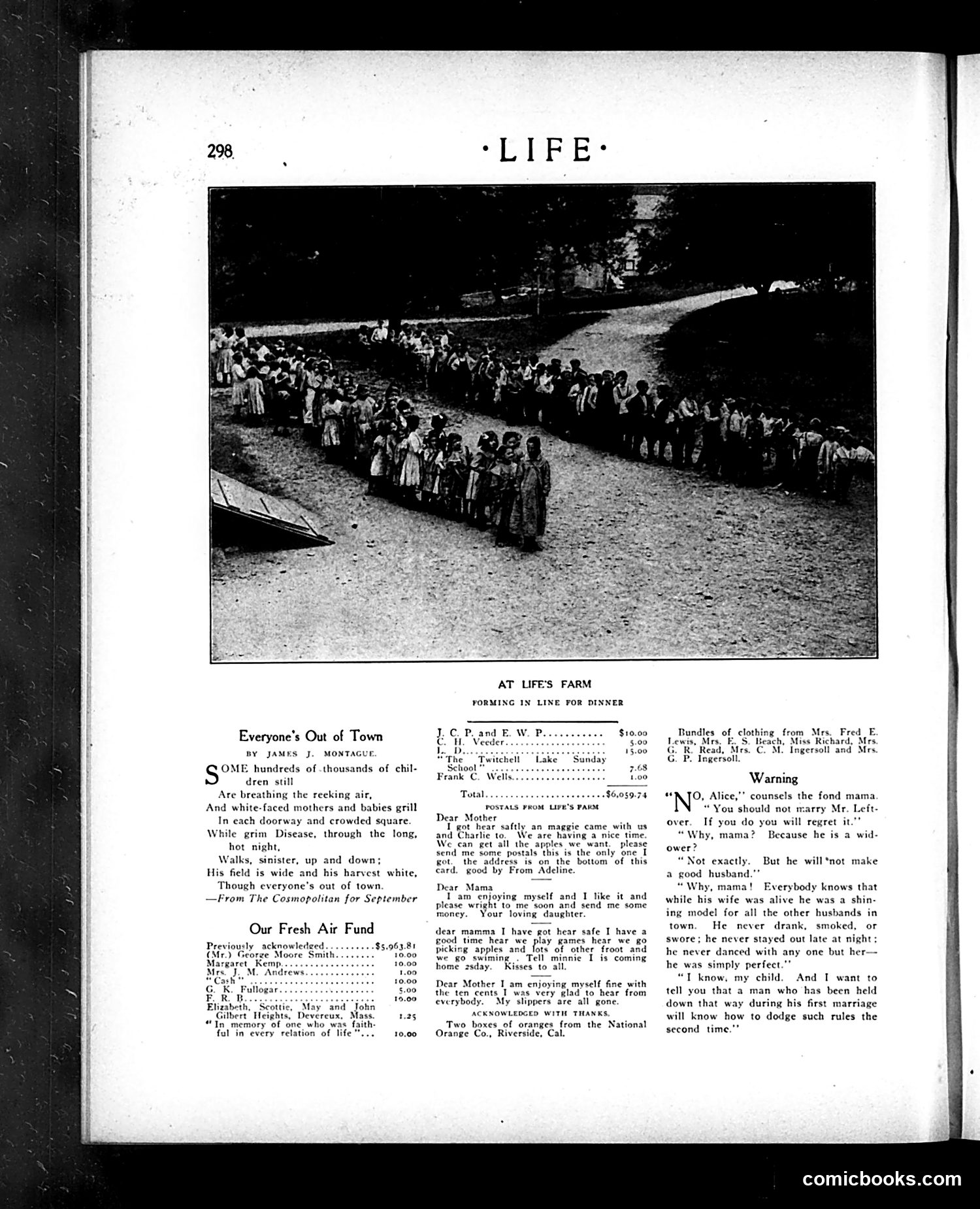
This page combines poetry, charitable fundraising, and satirical advice. The main photograph shows children lined up at "Life's Farm," depicting a Fresh Air Fund program—a real initiative that sent poor urban children to the countryside during hot summers to escape disease-ridden city tenements. The poem "Everyone's Out of Town" critiques wealthy Americans' indifference: while the affluent flee summer heat, poor children and mothers suffer Disease and pestilence in crowded urban areas. It's an indictment of class inequality during the Progressive Era. The "Fresh Air Fund" section lists donations and includes touching postcards from children grateful for the country respite—highlighting the program's humanitarian value. The final "Warning" section offers satirical marriage advice: a widow warns her daughter against marrying a reformed man, arguing his previous marital perfection proves he'll chafe under restrictions in a second marriage. It's gentle domestic satire about male nature and marital expectations.
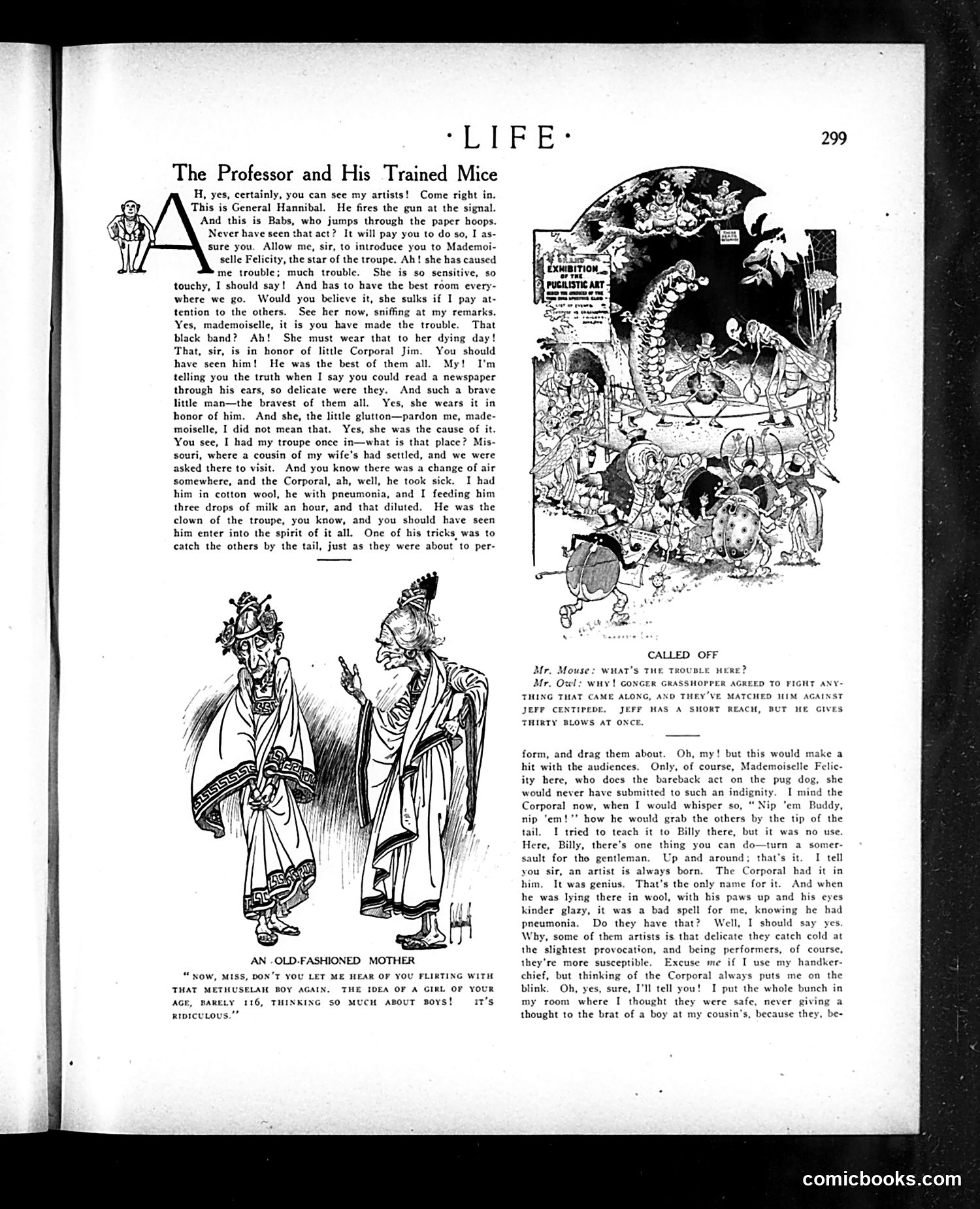
This Life magazine page contains three satirical pieces: **"The Professor and His Trained Mice"** is a sentimental monologue by a circus trainer about his performing mice troupe. The satire mocks overly emotional showmen who anthropomorphize animals—he treats them like temperamental opera stars, complete with jealousies and mourning rituals. The humor lies in the absurdity of applying human drama to mice. **"Called Off"** depicts animal characters (a mouse, owl, and grasshopper) as boxing promoters, with a centipede fighter. It's a brief joke about competitive animal matchmaking, likely satirizing the era's popular boxing culture by reducing it to insect-level absurdity. **"An Old-Fashioned Mother"** uses a humorous age reference—the mother warns her 116-year-old daughter against flirting with a "Methuselah boy"—to mock outdated parental attitudes about courtship and propriety. The satire suggests such protective moralizing is prehistoric and ridiculous. All three pieces employ exaggeration and anthropomorphism to mock contemporary social attitudes around sentimentality, spectacle, and traditional morality.
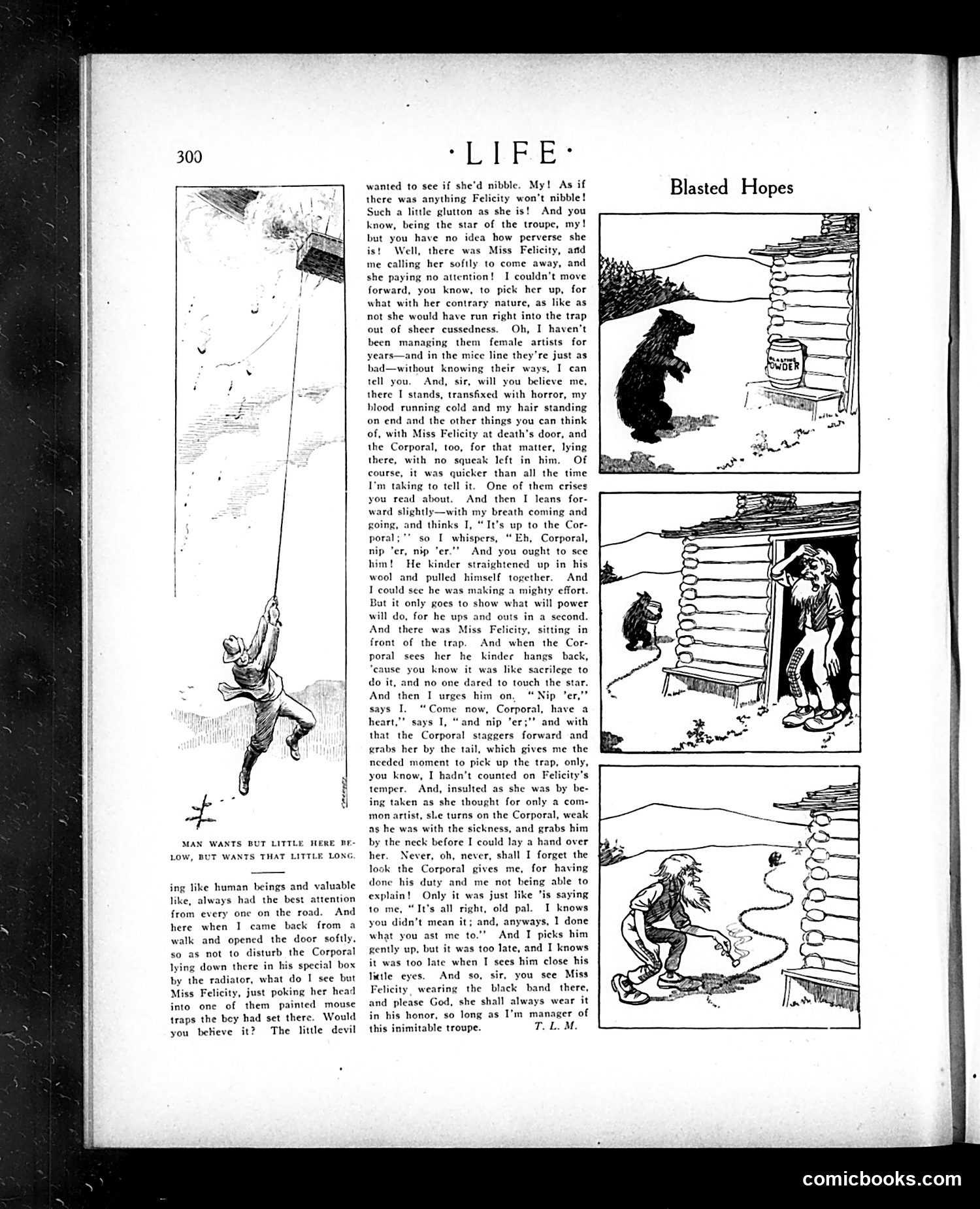
This story satirizes theatrical management and animal performers in early 20th-century vaudeville. The narrator manages a trained mouse act featuring "Miss Felicity" (the star) and a performing dog called "the Corporal." The narrative's dark humor lies in its mock-tragic tone applied to trivial stakes: a manager's desperate effort to save his star performer from a mousetrap. The illustrations show the comedic tension—the Corporal heroically rescues Miss Felicity despite illness, only for the ungrateful mouse to attack him in revenge. The satire targets theatrical vanity and the absurdity of treating animals as temperamental prima donnas deserving mourning bands. The overwrought language ("transfixed with horror," "death's door") applied to a mouse's near-accident heightens the joke. The Corporal becomes a tragic hero—faithful, misunderstood, and sacrificed for an ungrateful star—inverting typical theatrical hierarchies while mocking the sentimentality managers applied to their animal performers.
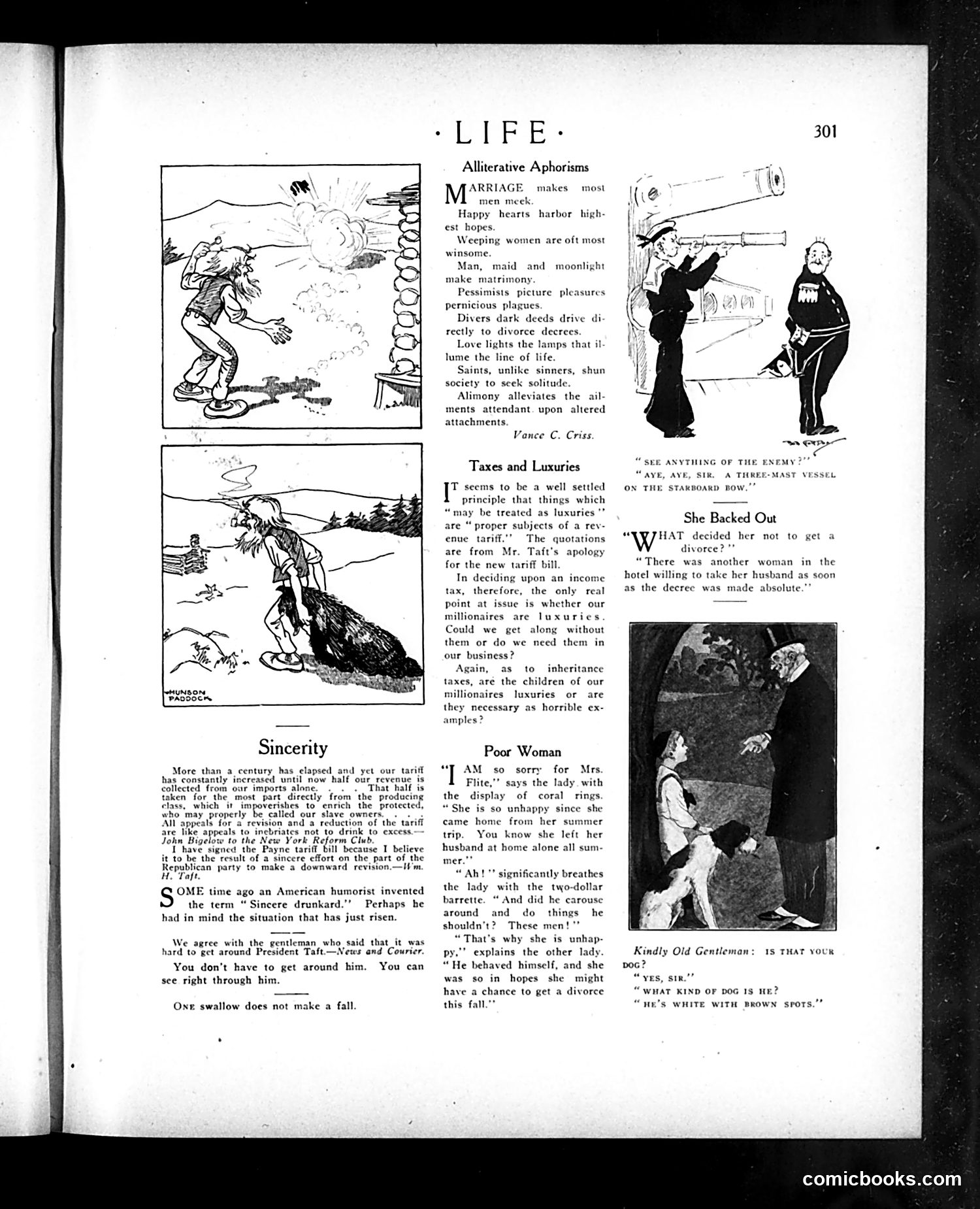
This Life magazine page satirizes President Taft's tariff policy through multiple angles: **"Sincerity"**: The main political cartoon mocks Taft's claim that the Payne tariff bill represented genuine tariff *reduction*. The page juxtaposes Taft's statement against a reform advocate's criticism that tariffs have continuously *increased*, enriching the wealthy while impoverishing workers. The final quip—"You can see right through him"—suggests Taft's sincerity is transparent hypocrisy. The "sincere drunkard" reference implies Taft claims moderation while continuing excess behavior. **"Taxes and Luxuries"**: A sardonic piece questioning whether millionaires and their heirs constitute "luxuries" subject to taxation—implicitly criticizing the tariff's protection of the wealthy. **Side pieces**: "She Backed Out," "Poor Woman," and other vignettes are unrelated social humor, typical of Life's mixed-content format. The page's core message: Taft presented the tariff as reform while actually maintaining protectionist policies favoring the wealthy.
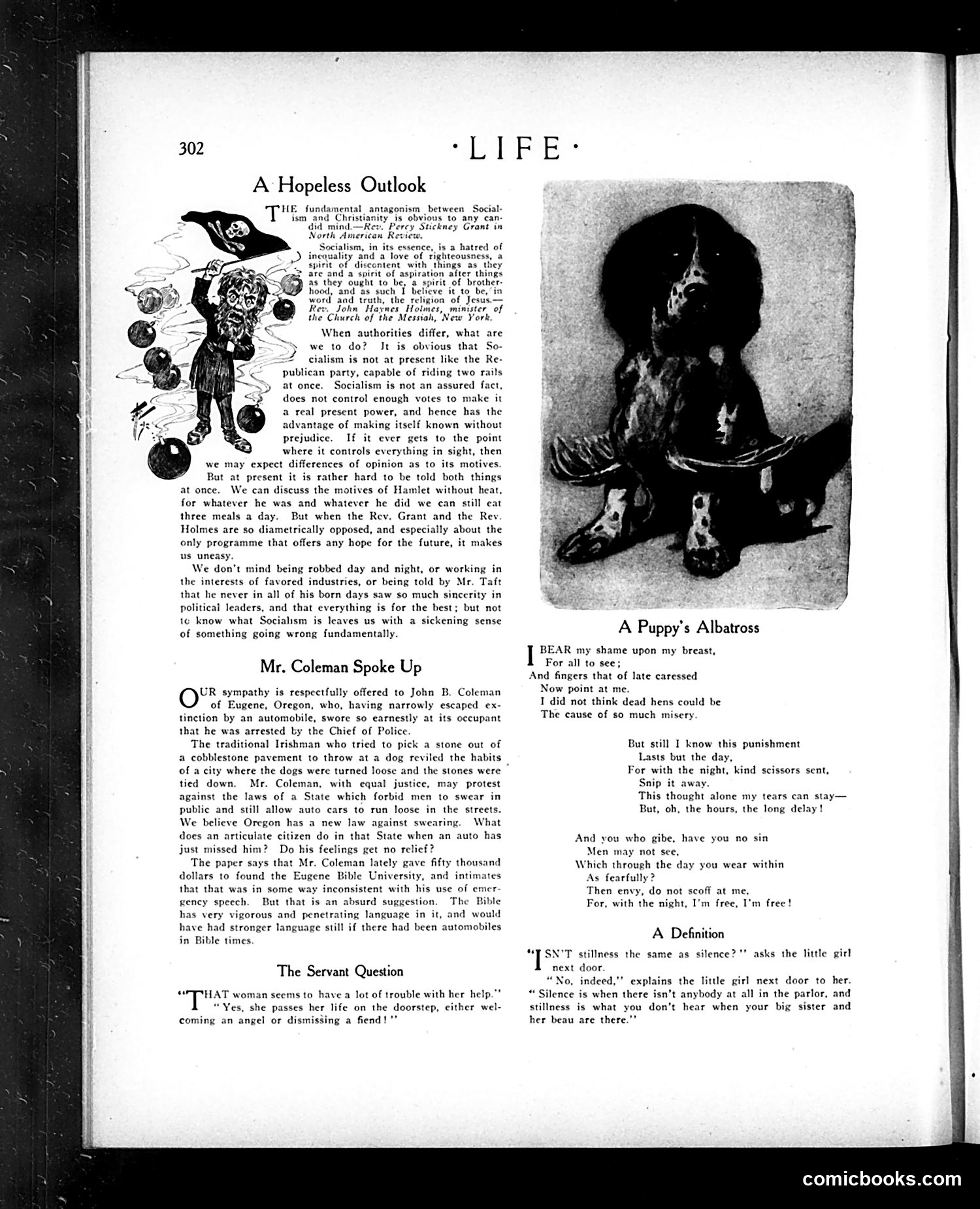
This page satirizes contradictions in early-20th-century American thought, primarily through commentary rather than visual cartoons. **"A Hopeless Outlook"** juxtaposes two clergymen's opposing views on socialism: Rev. Grant calls it fundamentally anti-Christian, while Rev. Holmes calls it Christianity's true expression. The article mocks this contradiction, noting that while we can discuss fictional characters like Hamlet dispassionately, we cannot comfortably discuss socialism when its future implications remain unclear—creating genuine public anxiety. **"Mr. Coleman Spoke Up"** describes a real incident where an Oregon man arrested for swearing at an automobile driver had recently donated $50,000 to found a Bible university. Life ridicules the supposed inconsistency, arguing that vigorous language in the Bible itself suggests such outbursts are justified—particularly when automobiles endanger lives. The remaining pieces are lighter: "A Puppy's Albatross" presents a sentimental poem about a dog punished for catching dead hens, and "The Servant Question" offers a brief joke about domestic help difficulties. The page reflects Progressive-era anxieties about modernity, religion, and social change.
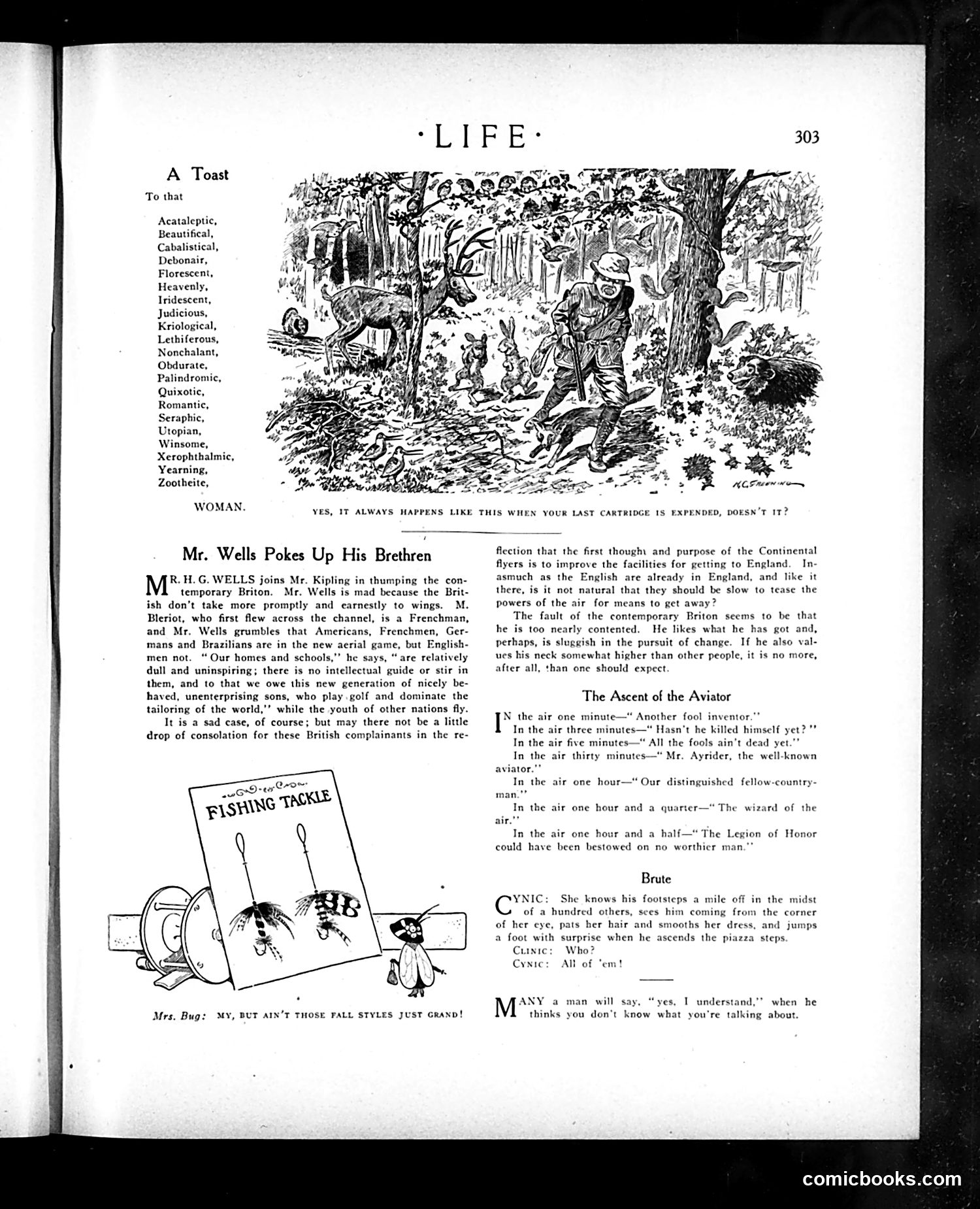
This page contains several satirical pieces mocking early 1900s British society and technology: **"A Toast to Woman"** is a humorous alphabetical list of exaggerated adjectives celebrating feminine qualities, paired with a cartoon showing a woman in a forest with hunters—likely mocking sentimental Victorian praise of womanhood. **"Mr. Wells Pokes Up His Brethren"** critiques H.G. Wells and Rudyard Kipling's complaints that British men lack ambition in aviation. The article humorously defends Britain's reluctance to pursue flying, suggesting contentment with home isn't shameful. It implies Continental nations are developing aircraft primarily to invade England. **"The Ascent of the Aviator"** satirizes public opinion's dramatic reversal: the same aviator transforms from "fool inventor" to celebrated hero simply by remaining aloft longer—mocking fickle public sentiment toward new technology. **"Brute"** jokes that women universally recognize their romantic interest by his footsteps, then feign surprise—mocking women's performative behavior. The tone is gently satirical toward British reserve, women's courtship rituals, and the hype surrounding early aviation.
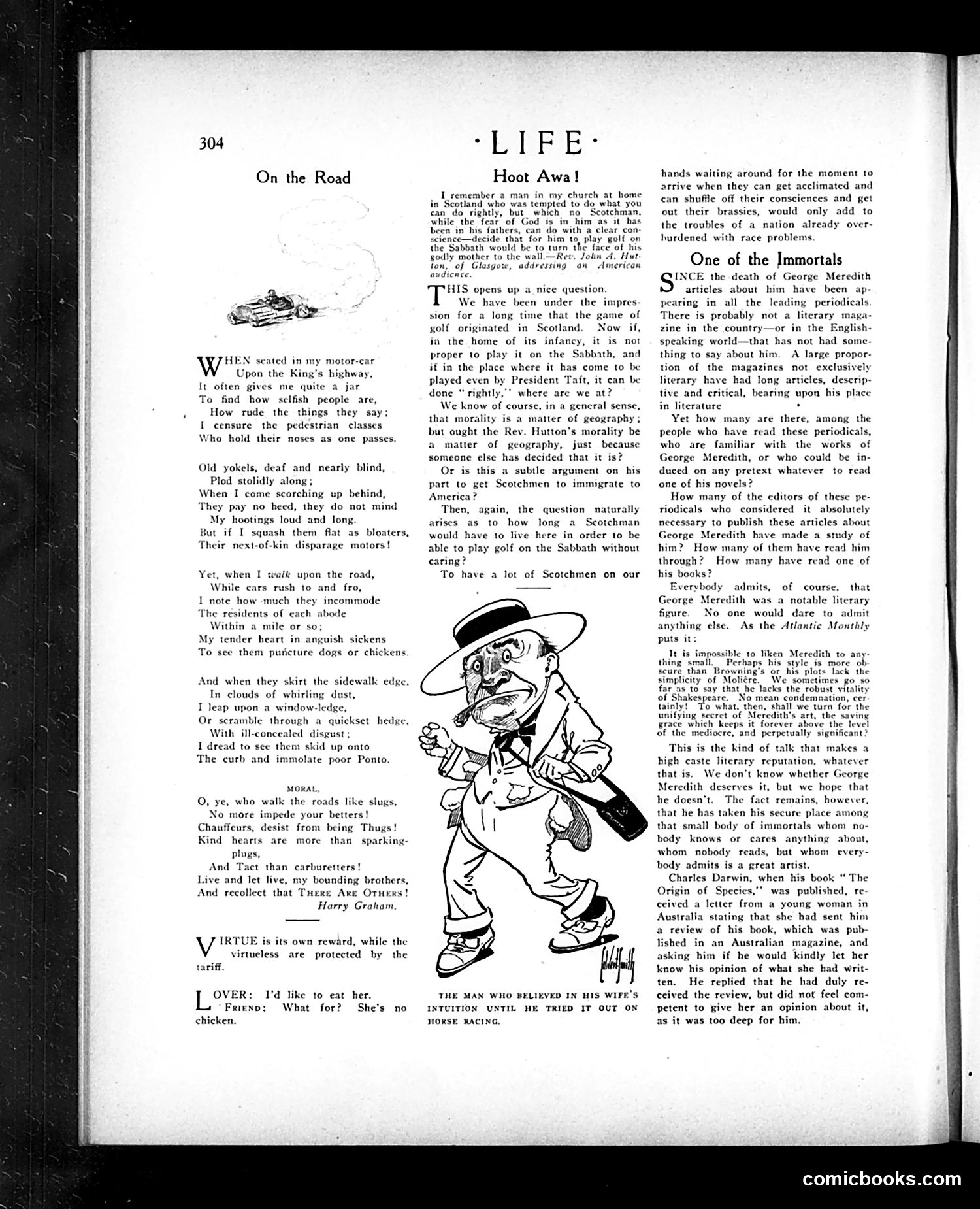
This page from *Life* magazine contains several distinct pieces of satire: **"On the Road"** (left): A poem by Harry Graham mocking the hypocrisy of early motorists. The speaker complains about pedestrians ignoring his car while driving recklessly, then complains about cars' dangers when he's on foot. The satire targets the selfish double standards of new automobile owners—they demand right-of-way but resent being inconvenienced themselves. **"Hoot Awa!"** (right, top): Commentary on Scottish Presbyterian morality, referencing a Scottish minister who forbids Sabbath golf. The piece sarcastically questions whether morality is merely geographical—if golf is sinful in Scotland but acceptable in America (where President Taft played), does moving change one's conscience? It mocks both rigid religious hypocrisy and the assumption that immigration erases moral conviction. **"One of the Immortals"** (right, bottom): Critiques literary journalism's obsession with dead author George Meredith. It notes that magazines publish extensive articles about him despite few readers actually reading his novels—satire on performative literary culture. The small cartoon depicts a caricatured figure, likely representing a ridiculous character type.
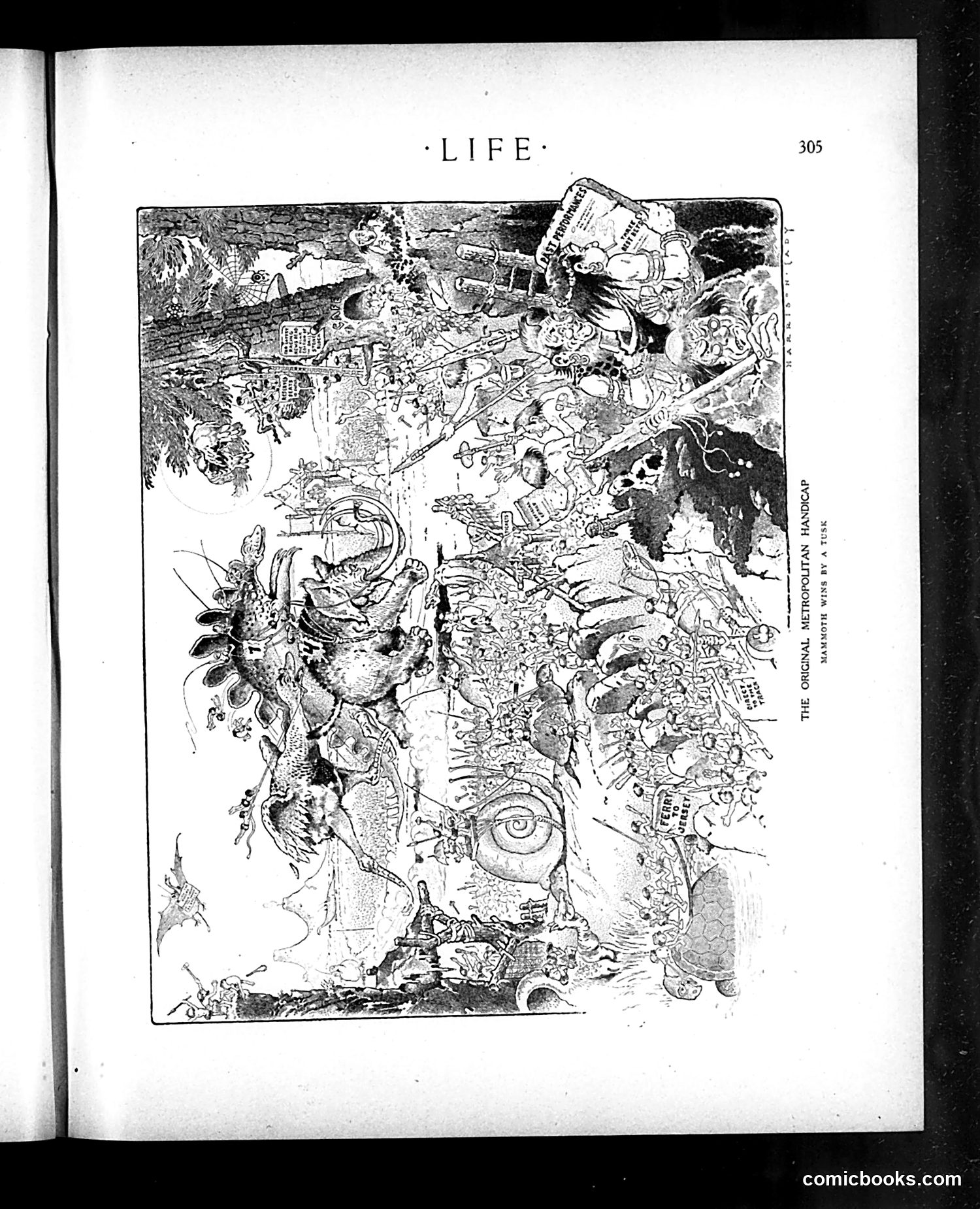
I can see this is page 305 from *Life* magazine featuring a densely-packed satirical illustration. The image appears to be a surreal, crowded composition filled with numerous figures, creatures, and objects rendered in detailed line work. The caption reads "THE ORIGINAL METROPOLIS LANDMARK WAS BY TESS" (OCR quality is poor here). However, the OCR text is largely corrupted and unreadable, making it difficult to identify specific political figures or references with confidence. The artistic style suggests this is likely early 20th-century social or political satire, given *Life*'s editorial focus, but without clearer text or caption information, I cannot reliably identify which specific contemporary figures or events are being satirized. The intricate, chaotic composition is typical of *Life*'s satirical visual humor from this era.
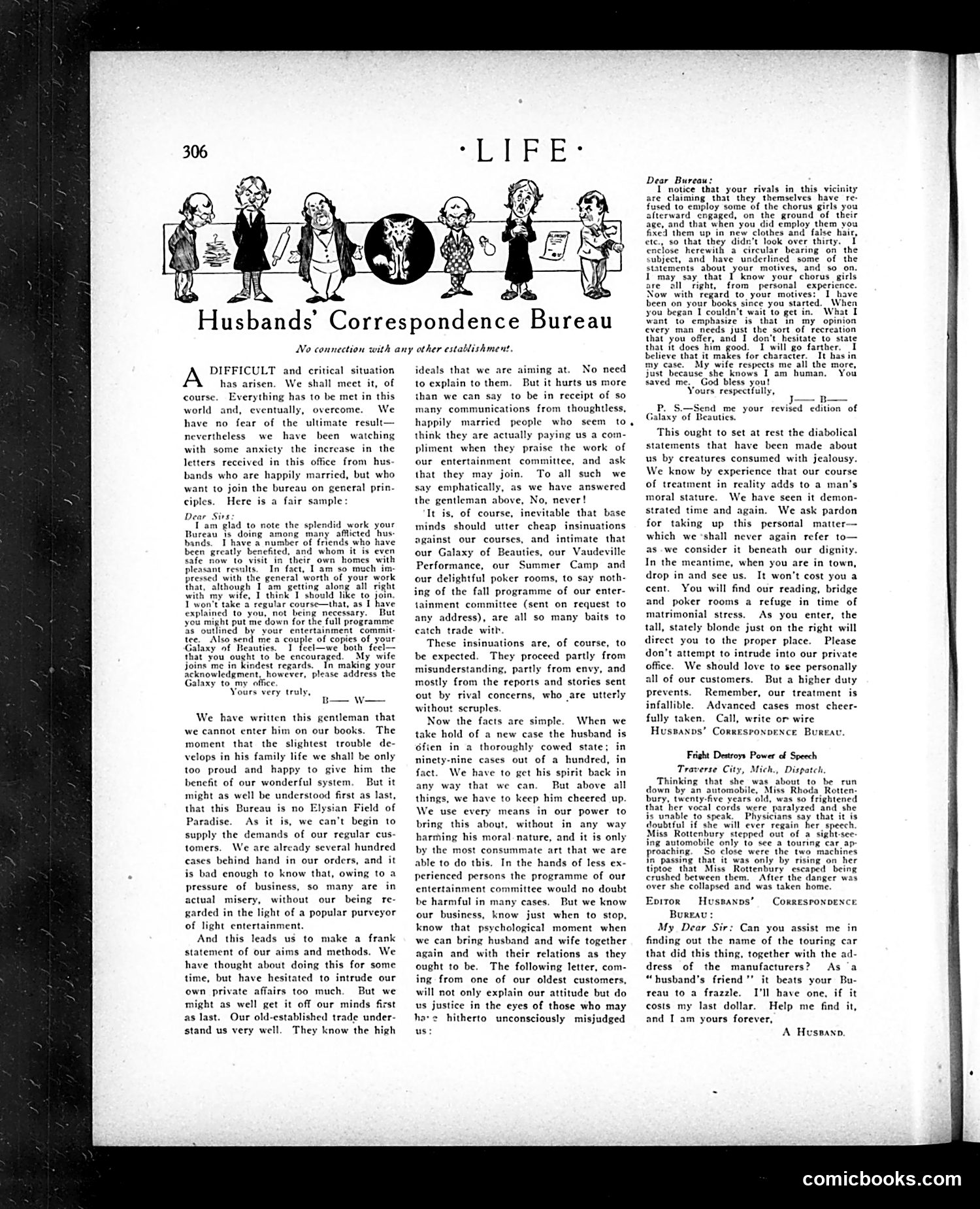
This satirical piece mocks a fictional "bureau" that purports to help unhappy married men—through entertainment, social activities, and presumably romantic distractions ("Galaxy of Beauties," poker rooms, vaudeville). The humor lies in the bureau's indignant response to a happily married man requesting membership "on general principles." The organization insists it serves only genuinely distressed husbands, not those seeking entertainment as a luxury service. The satire targets two things: (1) the absurdity of institutionalizing marital discord remedies, and (2) the hypocrisy of the bureau's self-righteous stance—it offers entertainments and "beautiful women" to keep men "cheered up," yet protests that rivals spread "cheap insinuations" about its true purpose. The cartoon illustrations above show cartoon figures, likely representing typical clients or the bureau's operations, though specific identities aren't clear from the image alone.
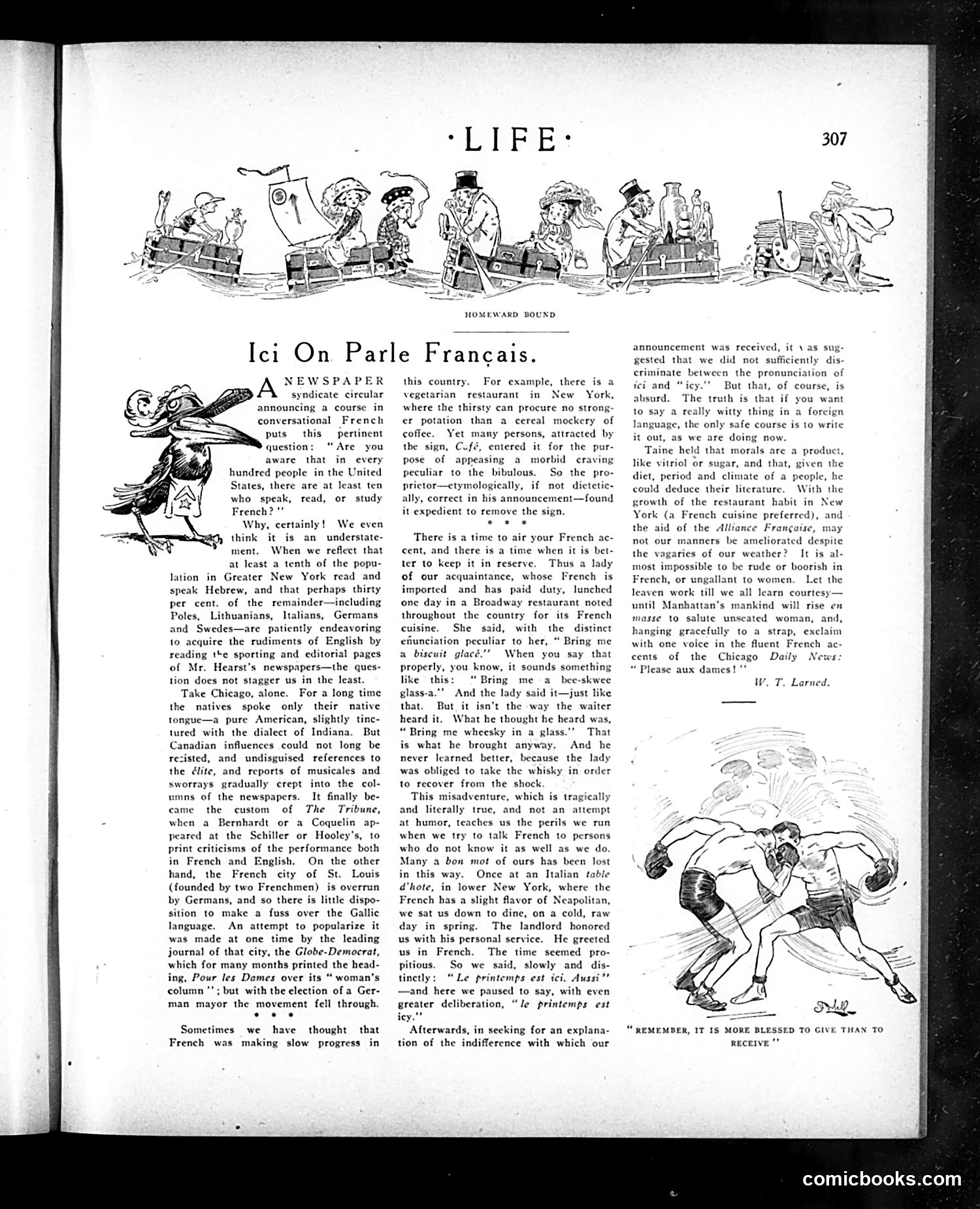
This satirical article mocks Americans' pretensions about speaking French and the absurd consequences. The cartoon at top shows immigrants arriving by train, labeled "Homeward Bound"—illustrating the essay's broader point about America's diverse immigrant population. The author argues that claims about widespread French-speaking in America are exaggerated. He cites examples: a New York vegetarian restaurant that removed its French sign "Café" because patrons mistakenly entered seeking alcohol; a woman at a restaurant who pronounced "biscuit glacé" so badly the waiter heard "whiskey in a glass" and served her exactly that. The satire targets both pretentious French-speakers attempting to seem cultured and ordinary Americans' inability to understand them—leading to comic miscommunication. The piece suggests that in a nation of immigrants speaking various languages (Yiddish, Polish, Italian, German), French affectation is particularly foolish and impractical.
This is a detailed satirical engraving showing a grand theatrical or ceremonial scene. The composition depicts luxuriously dressed figures observing what appears to be an elaborate spectacle or pageant unfolding before them. The ornate architectural backdrop, elaborate costumes, and hierarchical arrangement suggest satire of aristocratic excess or ostentatious display. The partially visible text "WHAT M[...]" at bottom right is cut off, preventing full identification of the cartoon's specific subject. Without the complete caption or visible date, I cannot definitively identify which political figures or historical event this targets. The style and printing technique suggest late 19th or early 20th-century origin. The satirical intent appears directed at mocking wealth, pretension, or governmental spectacle, but the specific political commentary remains unclear without additional context.
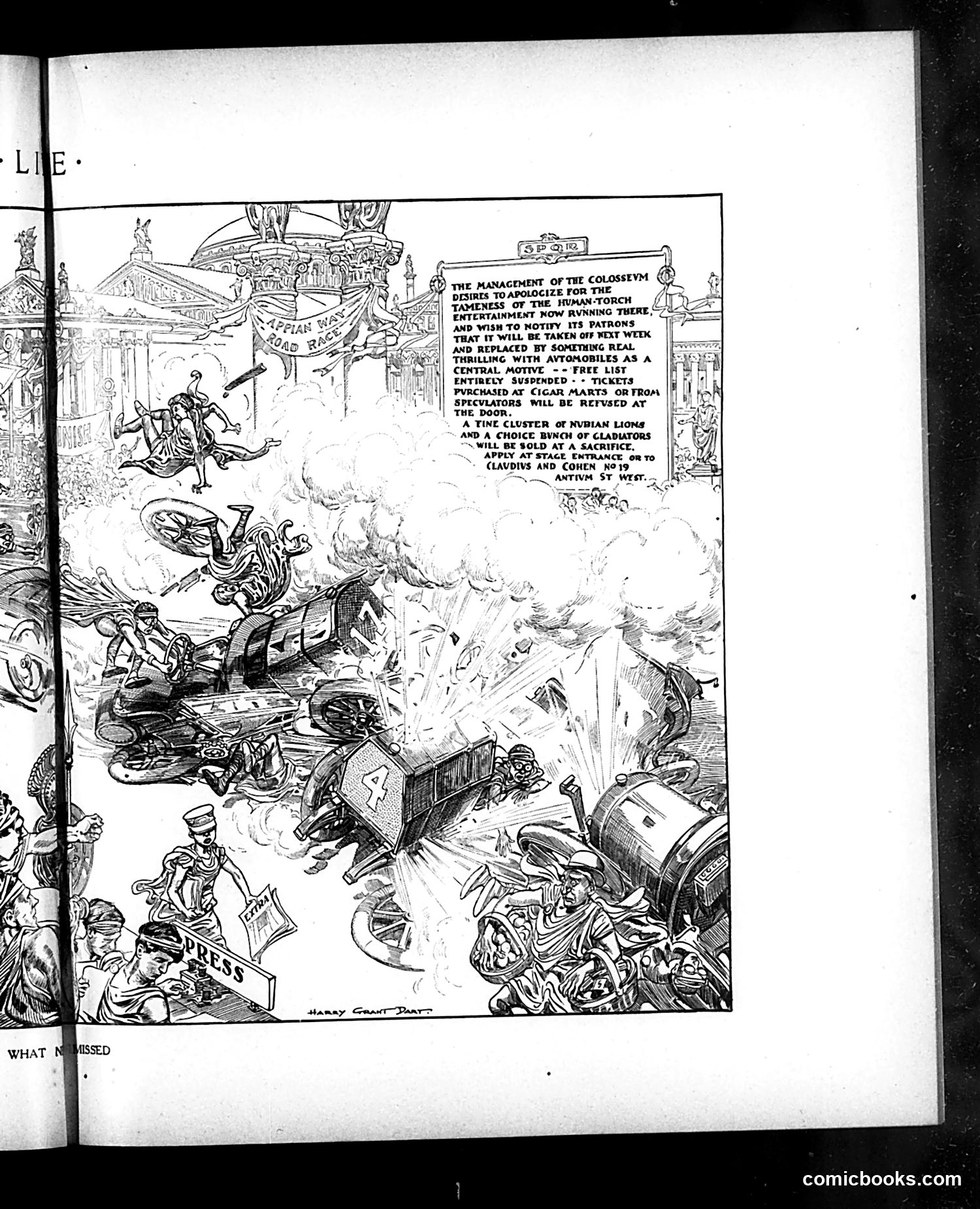
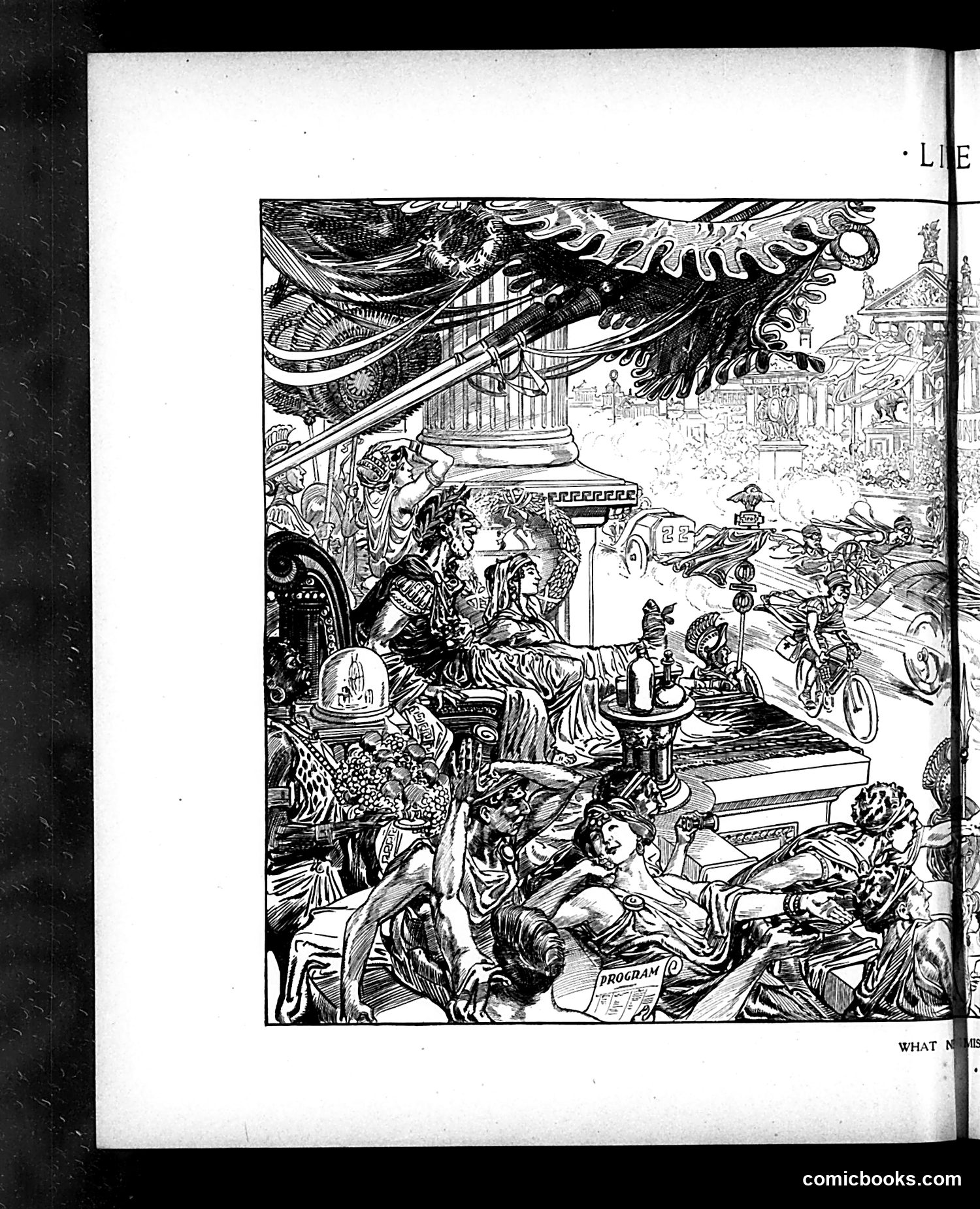
This satirical cartoon ridicules the popularity of automobile crashes as public entertainment, comparing modern American society to ancient Rome's Colosseum. The image depicts a chaotic, explosive automobile accident with multiple vehicles crashing and burning. The mock advertisement announces the Colosseum is replacing its "Human-Torch" entertainment (likely a circus act) with automobile crashes as the main attraction—presented as more thrilling spectacle. The satire equates contemporary America's fascination with automobile accidents to Roman decadence and bloodlust. By advertising "Nubian lions and gladiators" for sale alongside the auto-crash entertainment, the cartoonist suggests modern audiences are as morally depraved as ancient Romans who enjoyed gladiatorial violence. The cartoon critiques both the public's morbid appetite for witnessing real danger and crashes, and likely reflects anxieties about the automobile era's rapid proliferation and accompanying fatalities. It's biting social commentary on spectacle and society's darker impulses.
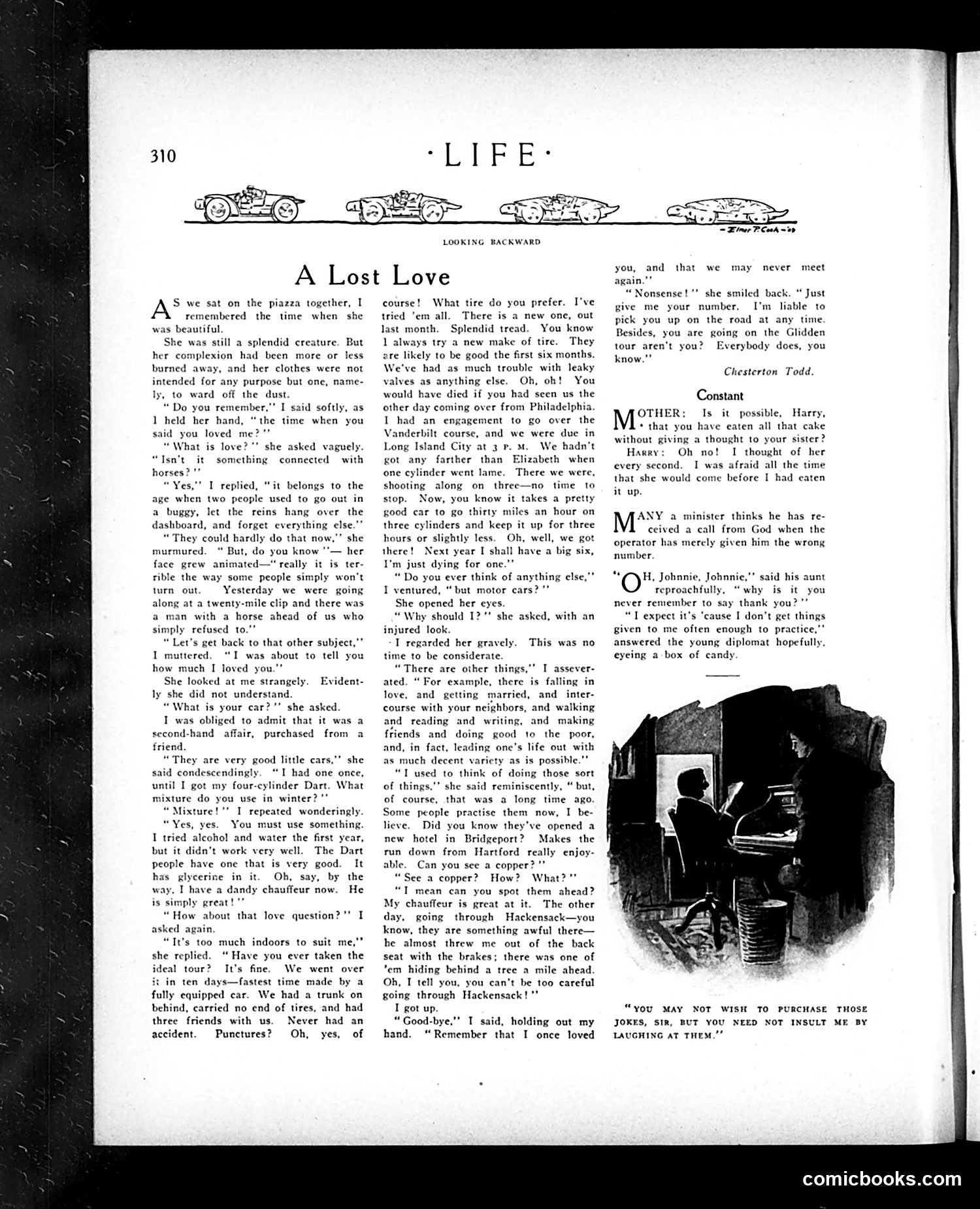
This story satirizes the 1920s obsession with automobiles and how car culture had displaced romantic sentiment and traditional values. The narrator reunites with a former flame, expecting nostalgic romance. Instead of discussing their past love, she dismisses romance as outdated ("belongs to the age when two people used to go out in a buggy") and interrogates him about his car—a secondhand vehicle she finds beneath her status. She monopolizes conversation with technical details: tire types, engine mixtures, her superior "four-cylinder Dart," driving records, and her excellent chauffeur. When he tries to return to romantic topics, she redirects to cars. She admits she once considered "those sort of things"—love, marriage, friendship, charity—but "that was a long time ago." The satire mocks how consumer materialism and technological advancement had replaced human connection and emotional depth. Women's new automotive independence is portrayed as making them shallow and status-conscious. The joke is that passionate love has become quaint nostalgia, replaced by horsepower and brand loyalty.
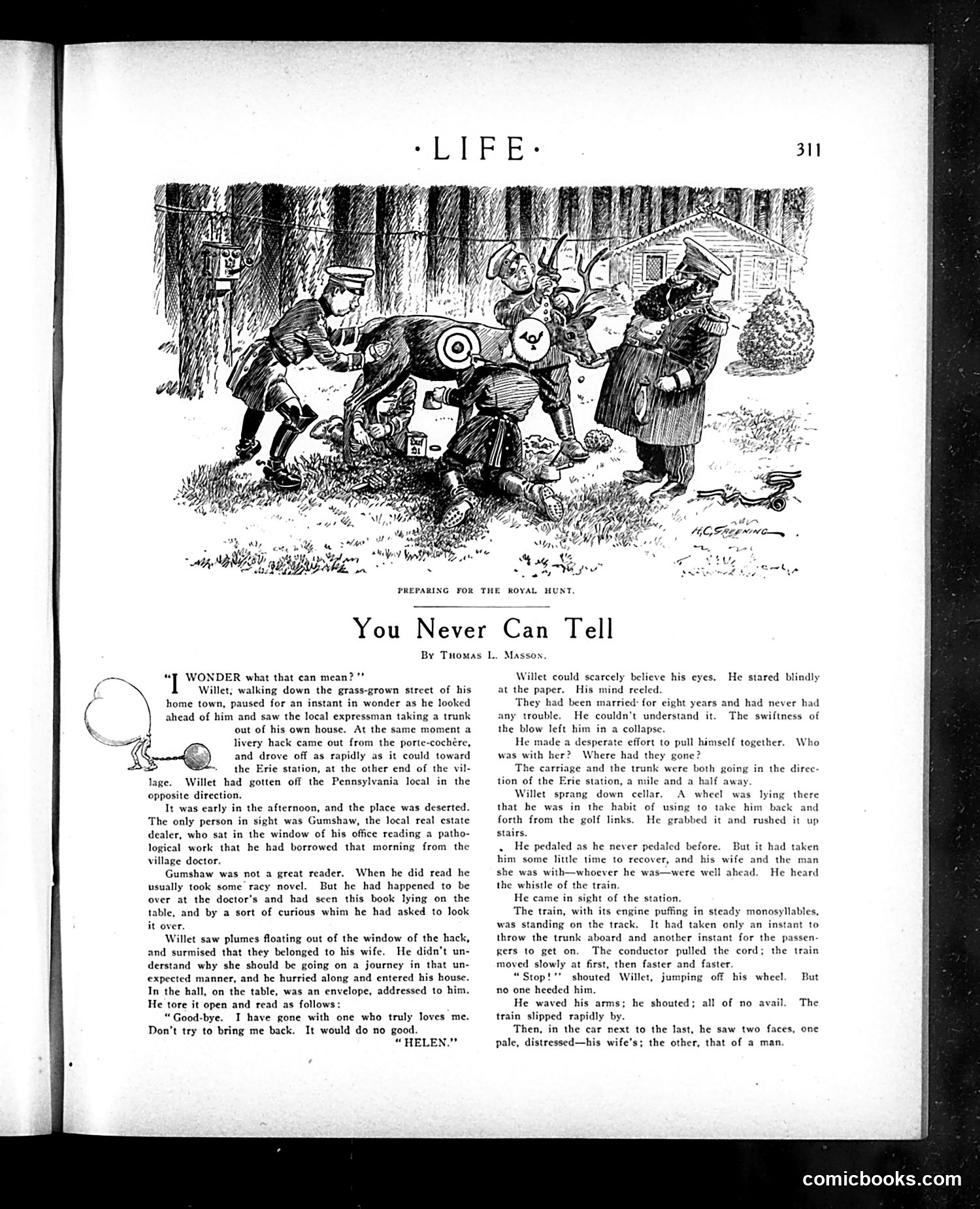
The cartoon caption "Preparing for the Royal Hunt" shows well-dressed figures examining hunting equipment, likely satirizing upper-class leisure pursuits. The accompanying story by Thomas L. Masson presents dramatic irony: a man returns home to find his wife gone with another man—or so he assumes from circumstantial evidence (a departing carriage with plumes, a hastily-packed trunk, a note). He frantically pursues them to the train station. The satire targets human tendency to jump to conclusions. The title "You Never Can Tell" suggests appearances deceive. The story likely ends with a misunderstanding revealed—perhaps the "man" is innocent, or the departure has an explanation. This reflects common Life magazine humor: poking fun at how quickly people construct narratives from incomplete information, especially regarding scandal and infidelity. The joke mocks both the protagonist's assumptions and readers' expectations of melodrama.
This page presents a serialized short story rather than a political cartoon. The narrative depicts a domestic melodrama: a man named Willet discovers his wife has eloped with an unattractive man named Stubbs while Willet was away on a month-long trip. The story's satire lies in **Gumshaw's psychological insight**. When Willet expresses shock that his refined wife would run off with the "homely," "repulsive" Stubbs, Gumshaw explains the paradox: **she was fascinated precisely *because* he was so objectionable and different** from her refined domestic existence. This inverts conventional expectations about attraction and desire. Gumshaw serves as the voice of worldly wisdom, attempting to calm the enraged Willet (who threatens murder) by suggesting acceptance rather than confrontation. The satire critiques both rigid social assumptions about matrimony and male presumptions about controlling wives' choices—suggesting deeper, irrational human motivations underlie even "respectable" marriages. The page is pure narrative fiction—no illustrations visible—typical of Life's literary content during this period.
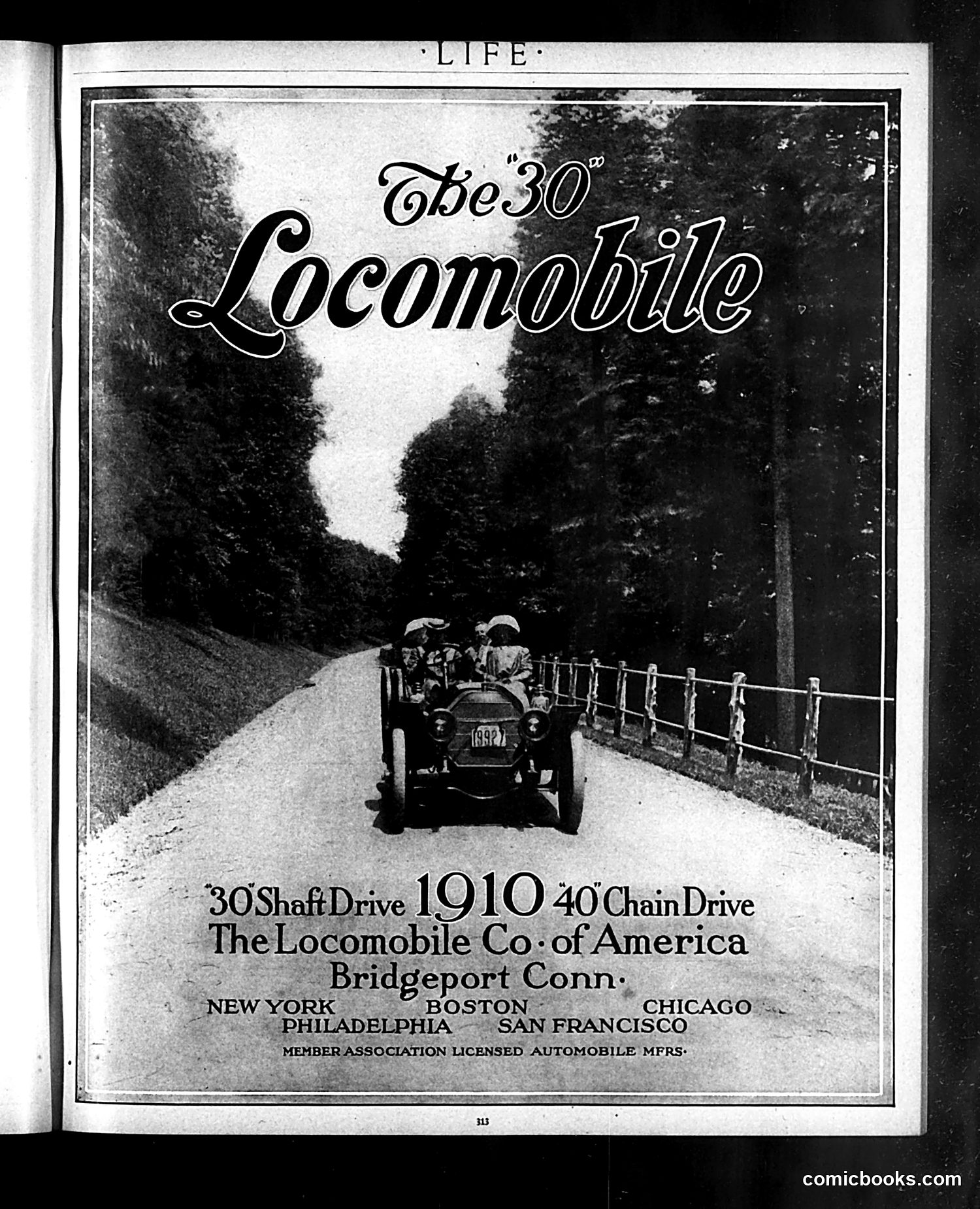
This is an advertisement for the "30" Locomobile automobile, not a political cartoon. The page promotes the 1910 model with "30 Shaft Drive" and "40 Chain Drive" options, manufactured by The Locomobile Co. of America in Bridgeport, Connecticut. The image shows an early motorcar traveling down a tree-lined country road with two passengers wearing period driving attire (dusters and hats). The advertisement lists sales offices in major American cities: New York, Boston, Chicago, Philadelphia, and San Francisco. This represents early automotive marketing targeting wealthy consumers during the automobile's early commercial era, before mass production made cars commonplace. The emphasis on the road trip and leisurely driving reflects how automobiles were then luxury recreational goods rather than practical transportation.
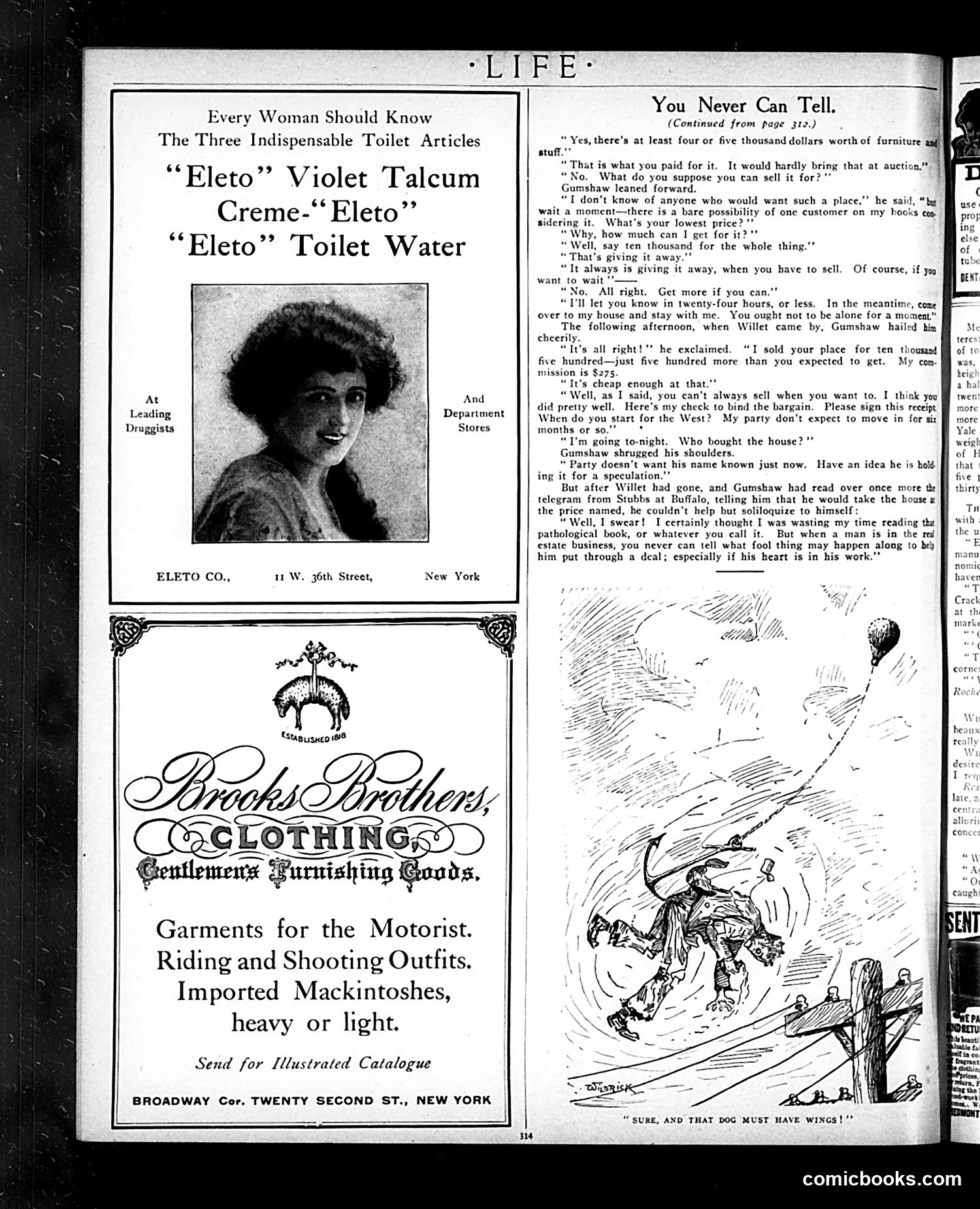
This page combines advertisements with a serialized short story titled "You Never Can Tell." **The Story Content:** The narrative concerns real estate dealings. A character named Willet attempts to sell property through agent Gumshaw, who initially struggles to find a buyer willing to pay the asking price of ten thousand dollars. Gumshaw unexpectedly secures a sale for $10,500, claiming the buyer wishes anonymity and is speculating on the property. The story's ironic ending reveals Gumshaw received a telegram from someone named Stubbs in Buffalo—suggesting Gumshaw himself orchestrated the deal, profiting from the transaction while misleading his client. **The Satire:** The story satirizes real estate agents' dubious practices and self-interested dealings during this period—the deceptive manipulation of property sales and hidden commissions. **The Cartoon:** The small sketch at bottom-right depicts someone being thrown from a horse or vehicle, with the caption "SURE, AND THAT DOG MUST HAVE WINGS!" This appears unrelated humor, likely a separate comic vignette. **Advertisements:** The page includes toiletry and men's clothing ads typical of the era.
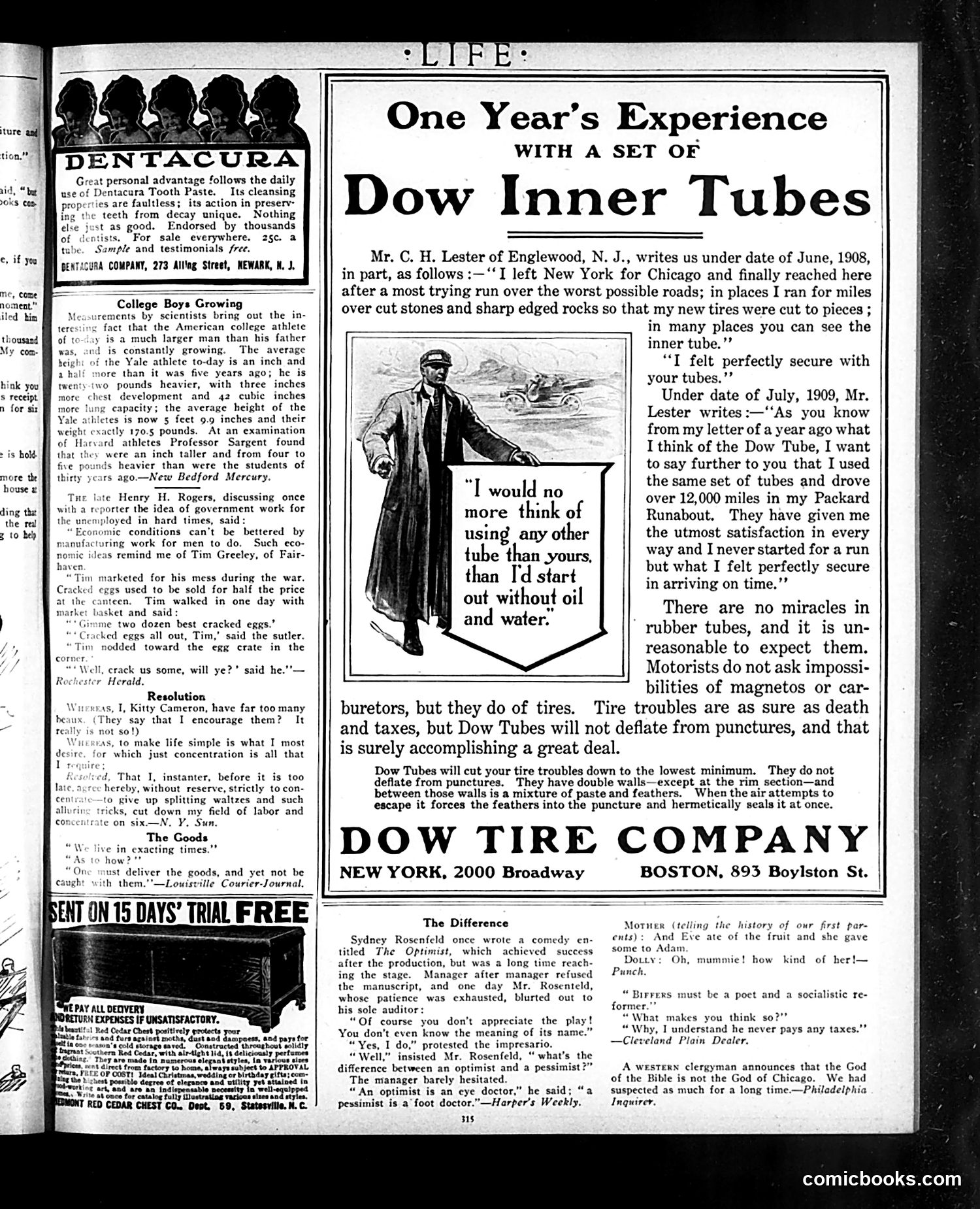
This page is primarily **advertising-driven**, not satirical content. The dominant feature is a full-page advertisement for Dow Inner Tubes (automobile tires), showcasing customer testimonials from Mr. C. H. Lester praising their durability across 12,000 miles. The smaller text sections are brief humor pieces and notices typical of Life's satirical format: - "College Boys Growing" reports (apparently seriously) that American college athletes are taller and heavier than previous generations - Henry H. Rogers anecdote mocks inefficient economic thinking - "The Difference" contains light comedy about optimists vs. pessimists The illustrated figure in the Dow ad is simply a **generic motorist**—not a specific political figure—depicted to represent the satisfied customer endorsing the product. For modern readers: this reveals early 1900s automotive culture, when tire punctures were routine hazards and rubber tube technology was marketed as cutting-edge innovation. The feather-paste sealant described sounds dubious by today's standards.
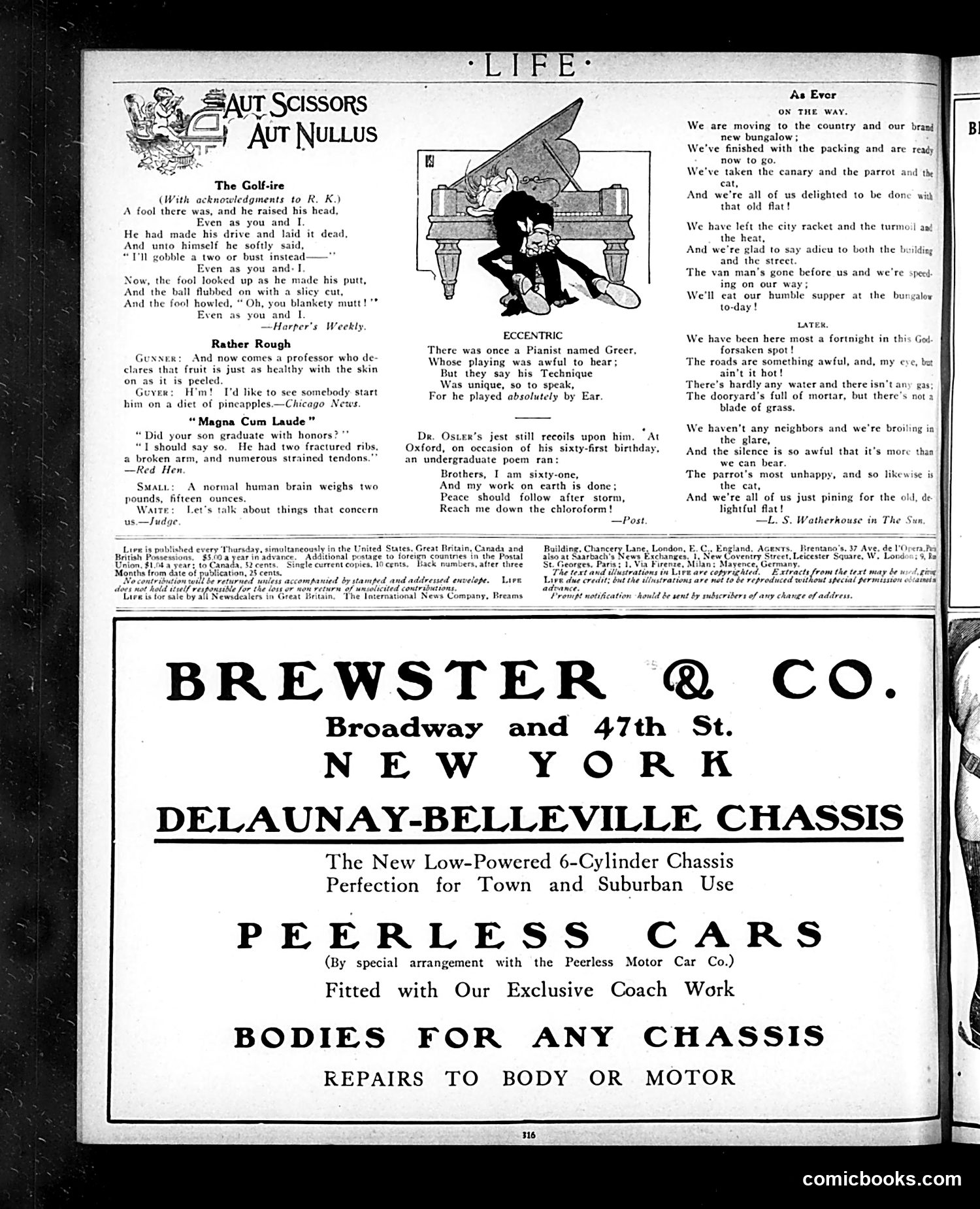
This page combines **satirical humor columns** with **advertisements** from the early automobile era. The top section features **"Aut Scissors Aut Nullus"** (a Latin pun meaning "automobiles or nothing")—a series of short comic vignettes mocking common human behaviors: - **"The Golf-ire"**: A golfer's frustration at his poor playing, referencing Kipling's poem structure - **"Rather Rough"**: A joke about fruit peels and a professor's impracticality - **"Magna Cum Laude"**: A college graduate's injuries presented as "honors" - **"Eccentric"**: A pianist who plays "by ear" (literally, not musically trained) - **"As Ever"**: Urban residents moving to the country, then regretting it—satirizing suburban aspirations versus reality The bulk of the page is a **Brewster & Co. automobile advertisement** promoting Delaunay-Belleville chassis and Peerless Cars, emphasizing their suitability for "town and suburban use." The satire reflects early-1900s anxieties about modern life, including automobile culture and the growing suburban movement.
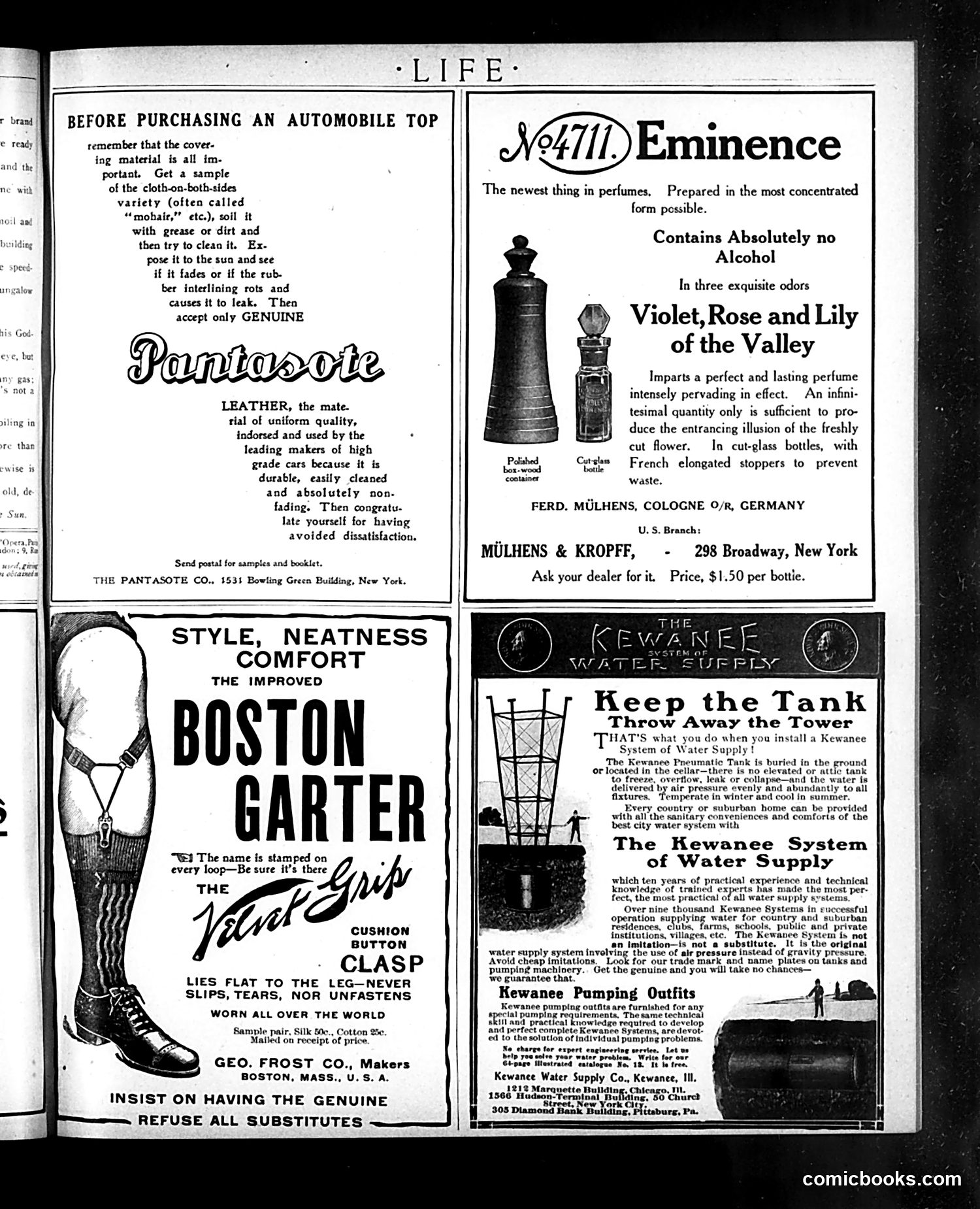
This is primarily an **advertising page** from Life magazine, not a satirical cartoon page. It contains four unrelated product advertisements typical of early 20th-century American commerce: 1. **Pantasote** - automobile top covering material, emphasizing durability and genuine leather 2. **No. 4711 Eminence** - a German perfume (alcohol-free) sold in New York, marketed as highly concentrated 3. **Boston Garter** - men's garters with cushioned buttons, emphasizing they won't slip or tear 4. **Kewanee Water Supply System** - an underground pneumatic water tank system for homes, contrasting itself against older elevated tank designs The page reflects early 1900s consumer concerns: automobile maintenance, luxury imported goods, men's undergarments, and modern plumbing technology. There is **no satire or political content** visible—these are straightforward commercial advertisements promoting quality and innovation in their respective product categories.
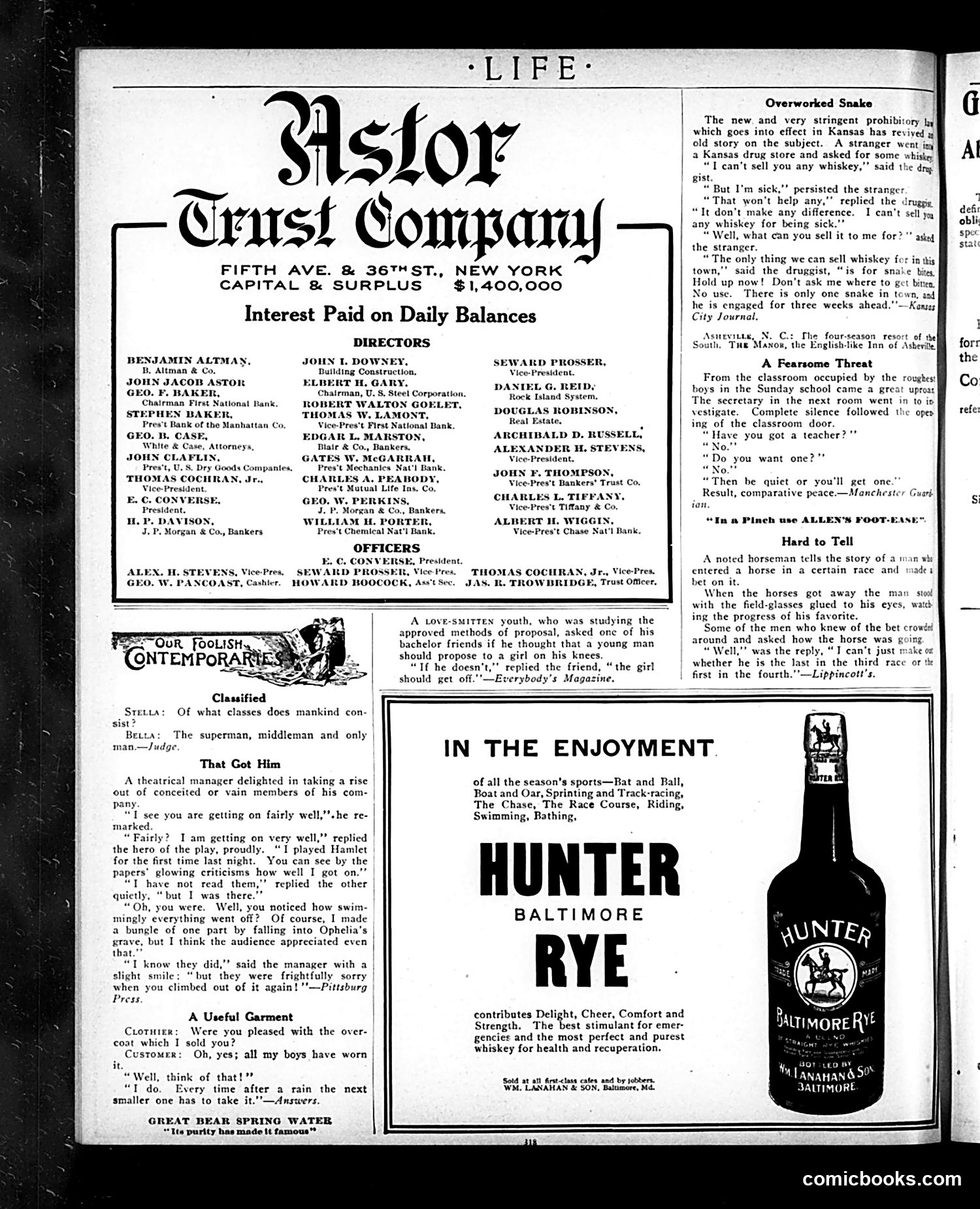
This page is primarily a **banking advertisement** for Astor Trust Company, displaying its directors and capital. The left side contains several humorous short jokes typical of Life magazine's satirical format. The cartoons/jokes mock everyday situations: - **"Classified"**: A joke about human social hierarchy (superman, middleman, ordinary man) - **"That Got Him"**: An actor's pompous boasting about playing Hamlet is deflated when the theater manager notes the audience was only "frightfully sorry" when he climbed out of Ophelia's grave—mocking theatrical vanity - **"A Useful Garment"**: A joke about an oversized overcoat being passed down through boys, getting smaller each time - **"Overworked Snake"**: Kansas prohibition law is satirized—a druggist claims whiskey can only be sold for snakebites, but the town's single snake is "engaged for three weeks," mocking the absurdity of Prohibition enforcement The right side contains additional short humorous items and a Hunter Baltimore Rye whiskey advertisement—ironic given the Prohibition-era "Overworked Snake" joke, suggesting this may predate national Prohibition (1920).
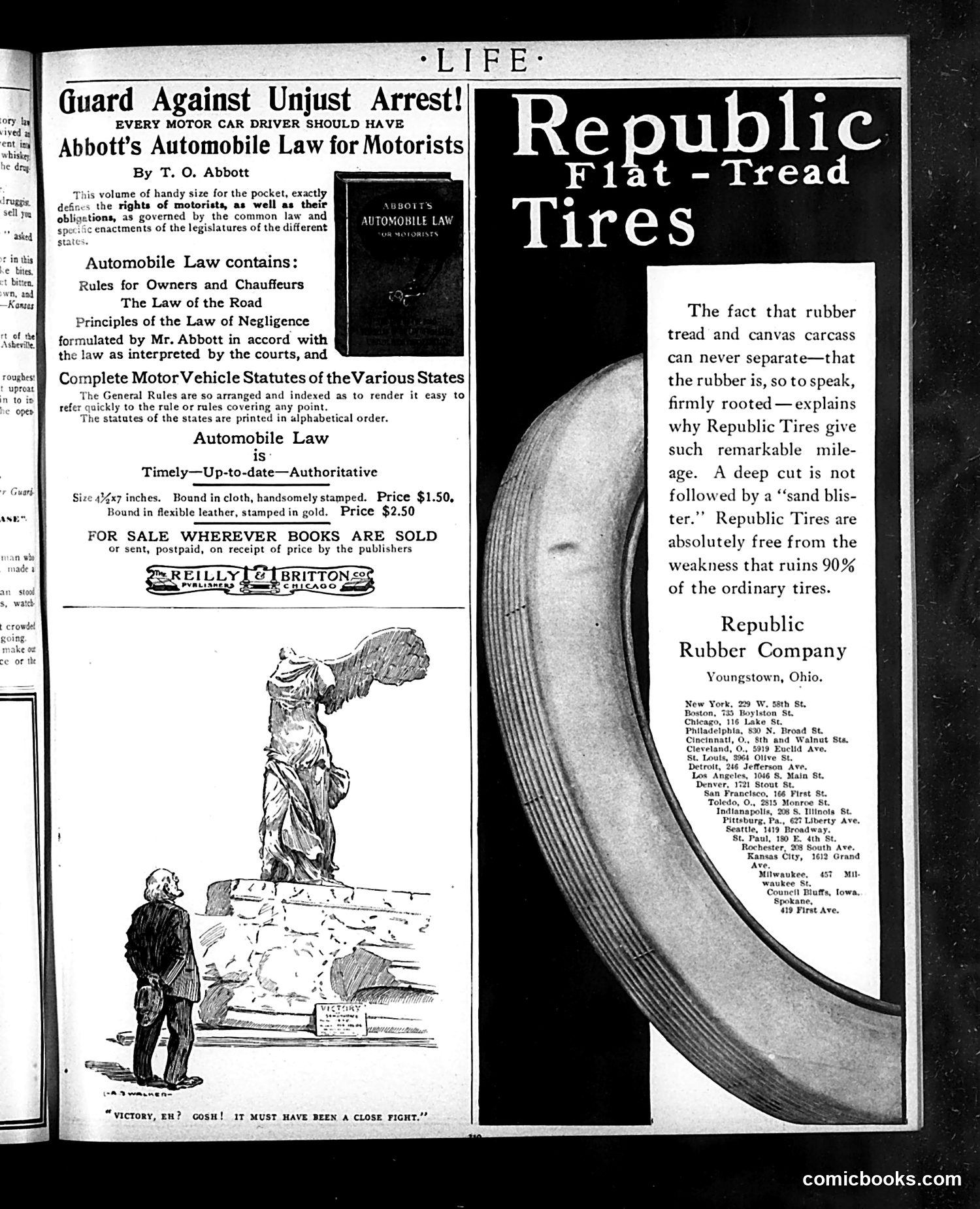
This page mixes advertising with a political cartoon addressing early automotive law. The cartoon shows a soldier standing before a "Victory" monument, with the caption "Victory, eh? Gosh! It must have been a close fight." The image appears to reference **World War I**, suggesting the fight for victory was difficult and costly. The left side advertises **Abbott's Automobile Law for Motorists**, a handbook protecting drivers' rights against "unjust arrest"—reflecting early concerns that motorists faced arbitrary legal harassment from authorities unfamiliar with new traffic laws. The right side contains a **Republic Flat-Tread Tires advertisement**, emphasizing the tire's durability and mileage superiority over competitors. The page reflects an era (likely 1910s-1920s) when automobiles were still novel, legal protections for drivers were developing, and companies competed aggressively on tire quality—concerns now largely obsolete.
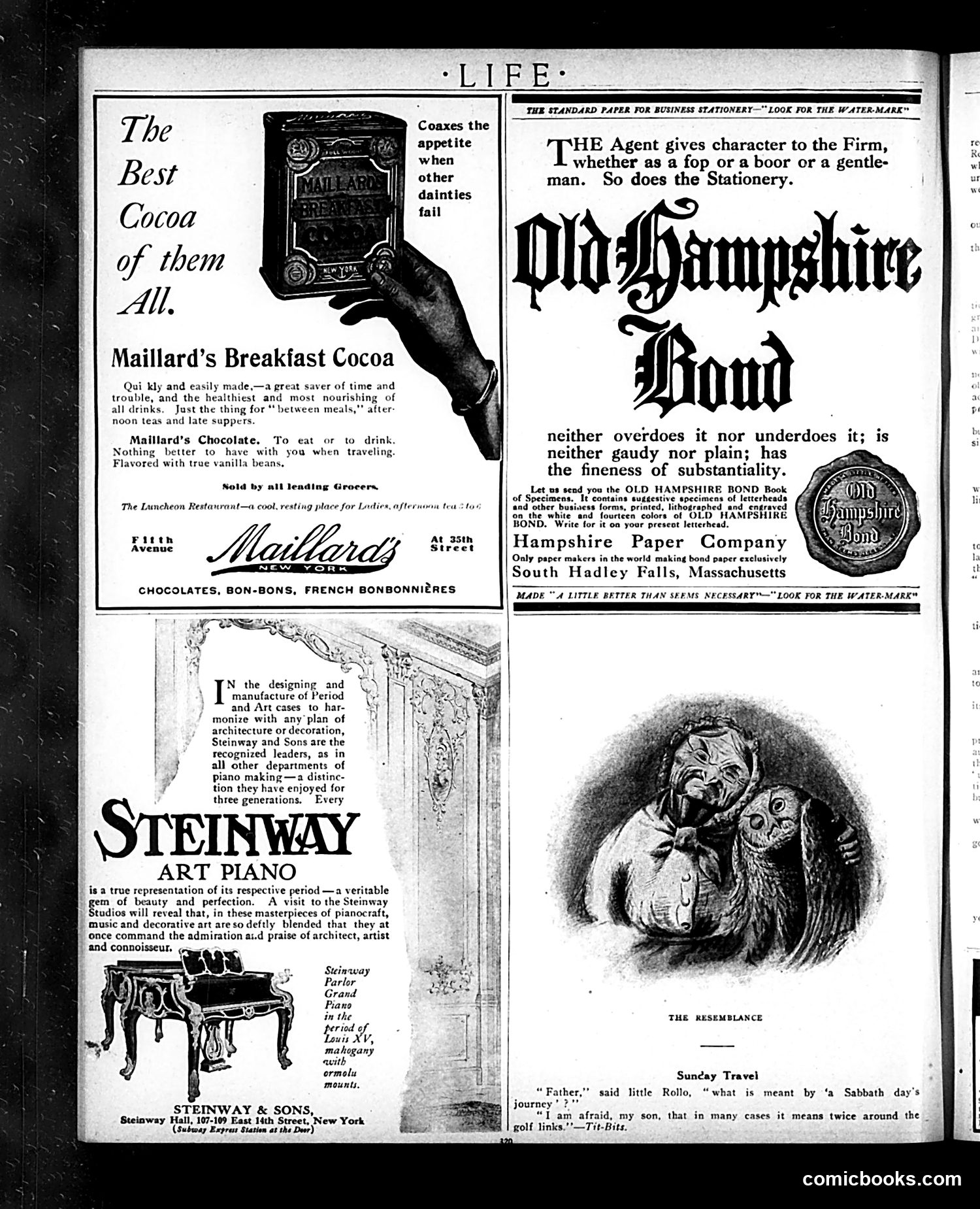
This page is primarily **advertisements** for luxury goods interspersed with minimal editorial content. The main satirical element appears at bottom right: a small cartoon titled "The Resemblance" depicting a dialogue between a child named Rollo and an adult about what "Sabbath day's journey" means. **The Satire:** The joke mocks wealthy Americans' Sunday behavior. A biblical "Sabbath day's journey" refers to limited travel on the holy day, but the cartoon suggests modern wealthy people interpret this as "twice around the golf links"—implying they've replaced religious observance with leisure activities. **The Point:** This reflects early 20th-century social criticism about how the wealthy prioritize golf and pleasure over genuine religious practice, treating Sunday as recreational rather than sacred. The remaining content—ads for Maillard's Cocoa, Hampshire Bond paper, Steinway pianos, and Maillard's chocolates—represents typical Life magazine advertising targeting affluent readers.
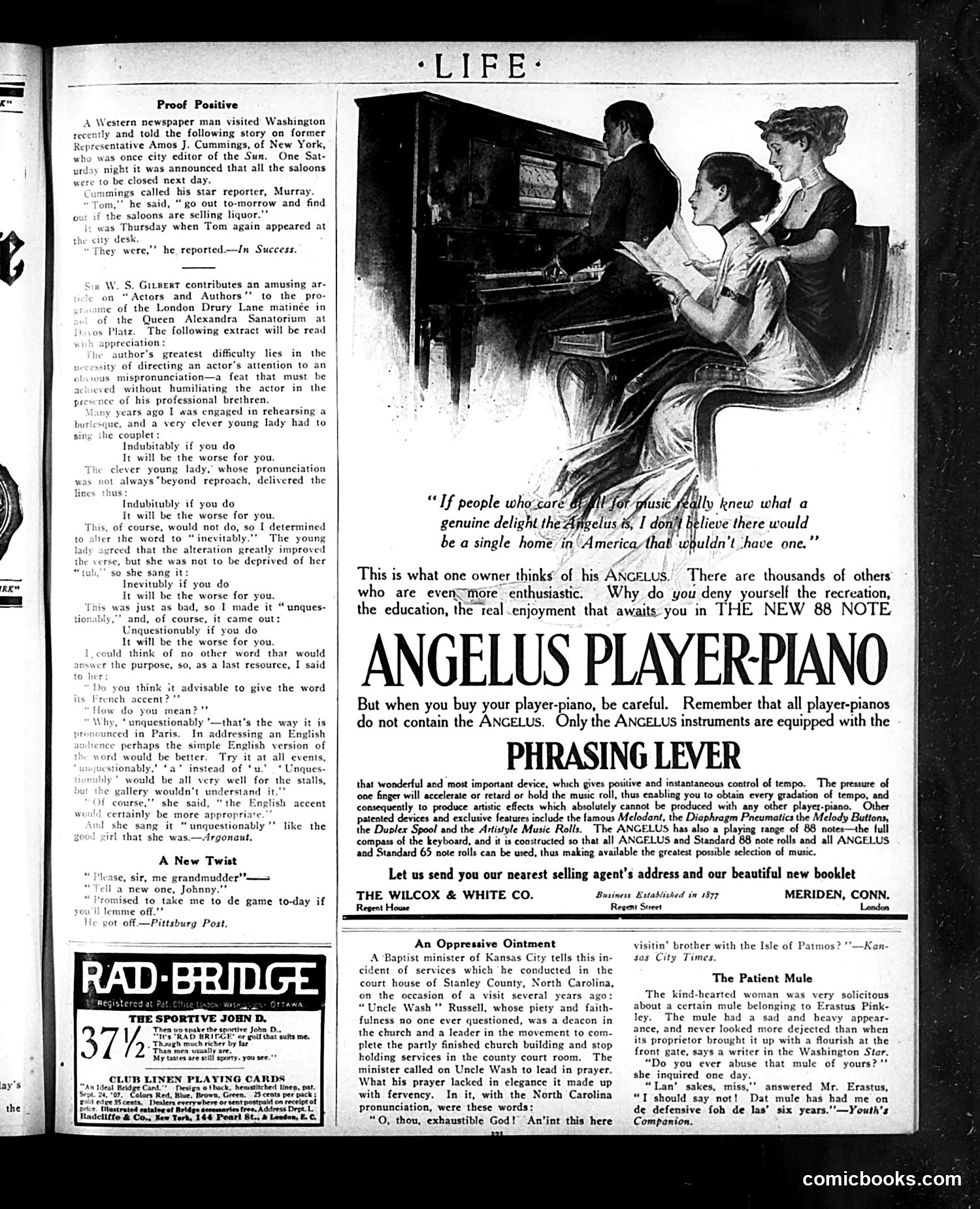
This page is primarily **advertising**, with minor satirical content. The main visual element shows a family at an Angelus player-piano. The large advertisement promotes the Angelus brand, emphasizing its exclusive "phrasing lever" that allows tempo control—a technical feature distinguishing it from competitors. The quoted testimonial ("If people who care a jot for music really knew...") suggests the product's cultural cachet. The surrounding text contains brief humorous anecdotes unrelated to the advertisement: 1. **"Proof Positive"** recounts former Representative Amos J. Cummings dispatching a reporter to find saloons open on a day they supposedly closed—a joke about either the reporter's incompetence or saloons' ubiquity. 2. **W.S. Gilbert's piece** humorously depicts a stage director struggling to correct an actress's mispronunciation; no matter what word he substitutes, she mispronounces it identically. These are period-appropriate light humor pieces. The page reflects early 20th-century *Life* magazine's mix of advertising and satirical vignettes.
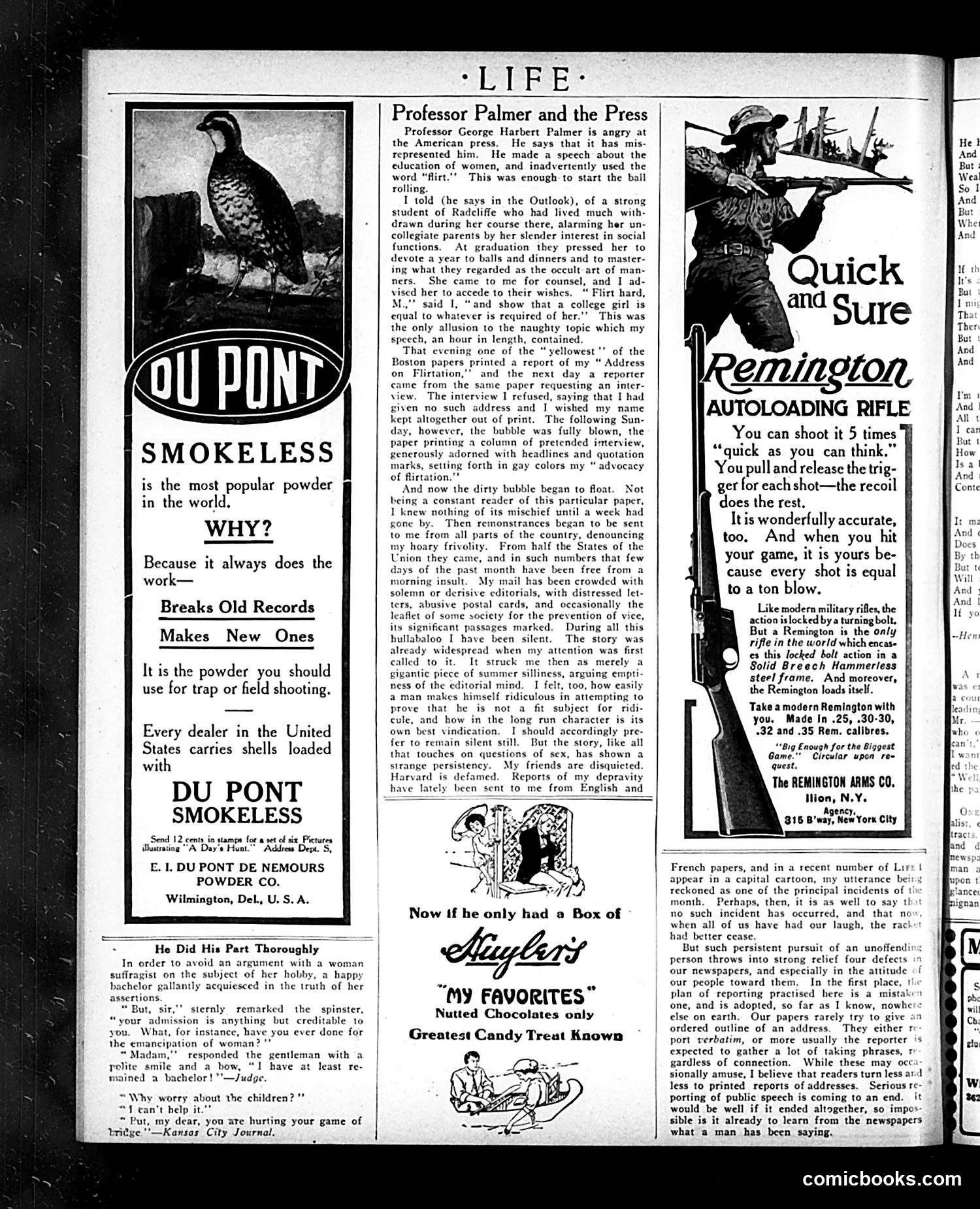
This article satirizes yellow journalism and media sensationalism. Professor George Herbert Palmer of Radcliffe College made an innocent remark during a speech about women's education—he advised a withdrawn student to "flirt hard" to learn social skills. A Boston newspaper (described as "yellowest," meaning most sensational) deliberately misrepresented this as an "Address on Flirtation," fabricating quotes and headlines. Palmer's complaint illustrates a recognizable early-1900s problem: irresponsible press manufactured scandal from nothing. The story spread nationally, generating hundreds of critical letters and editorials denouncing his "advocacy of flirtation"—despite his original statement occupying mere seconds of an hour-long speech. The satire critiques both the newspaper's dishonesty and the public's gullibility in believing fabricated reports. Palmer notes the futility of defending oneself against deliberate misquotation, a frustration still relevant today.
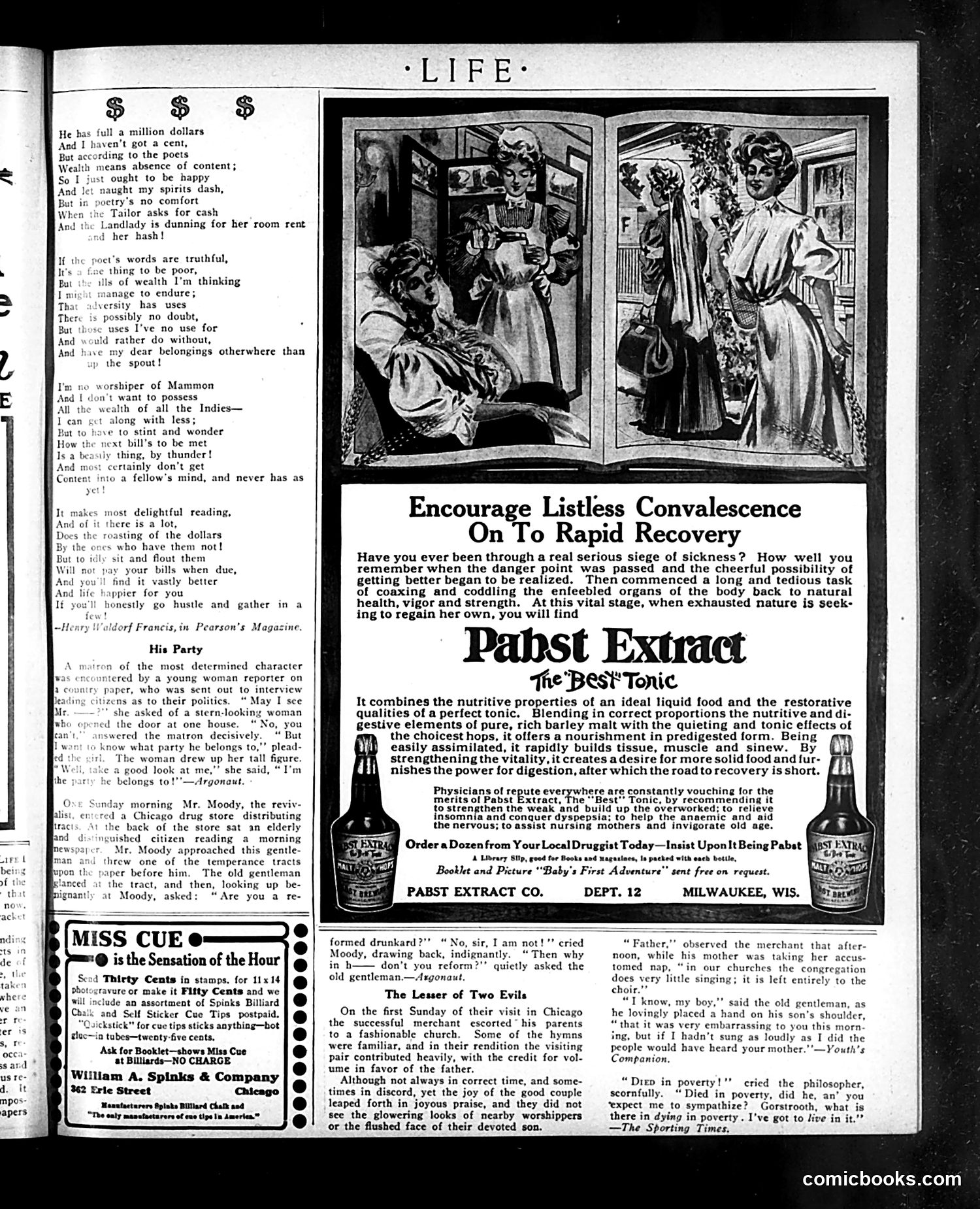
This page contains **poetry and satirical prose** rather than traditional political cartoons, plus period advertising. The left column features a **humorous poem about poverty and wealth**: a poor person ironically notes that poets claim poverty brings happiness, yet he experiences only discomfort—his tailor demands cash, his landlady dunns him for rent. The satire mocks romantic notions that poverty is spiritually superior; the speaker would prefer actual money. Below, an anecdote titled "His Party" satirizes **a stern, judgmental matron** encountered by a newspaper reporter seeking interviews. When asked her politics, she refuses, declaring "I'm not a beggar." The humor lies in her defensive pride despite her apparent hardship. Another brief story mocks a **temperance activist** ("Mr. Moody") who distributes anti-drinking tracts to an elderly newspaper reader. When Moody asks if he's "reformed," the man irritably responds he's never been a drunkard—satirizing preachy, sanctimonious reformers who assume moral failure. The right side is dominated by a **Pabst Extract advertisement** targeting convalescents, claiming the tonic aids recovery and digestion. The overall theme: satirizing poverty myths, moral pretension, and self-righteousness among the period's reformist classes.
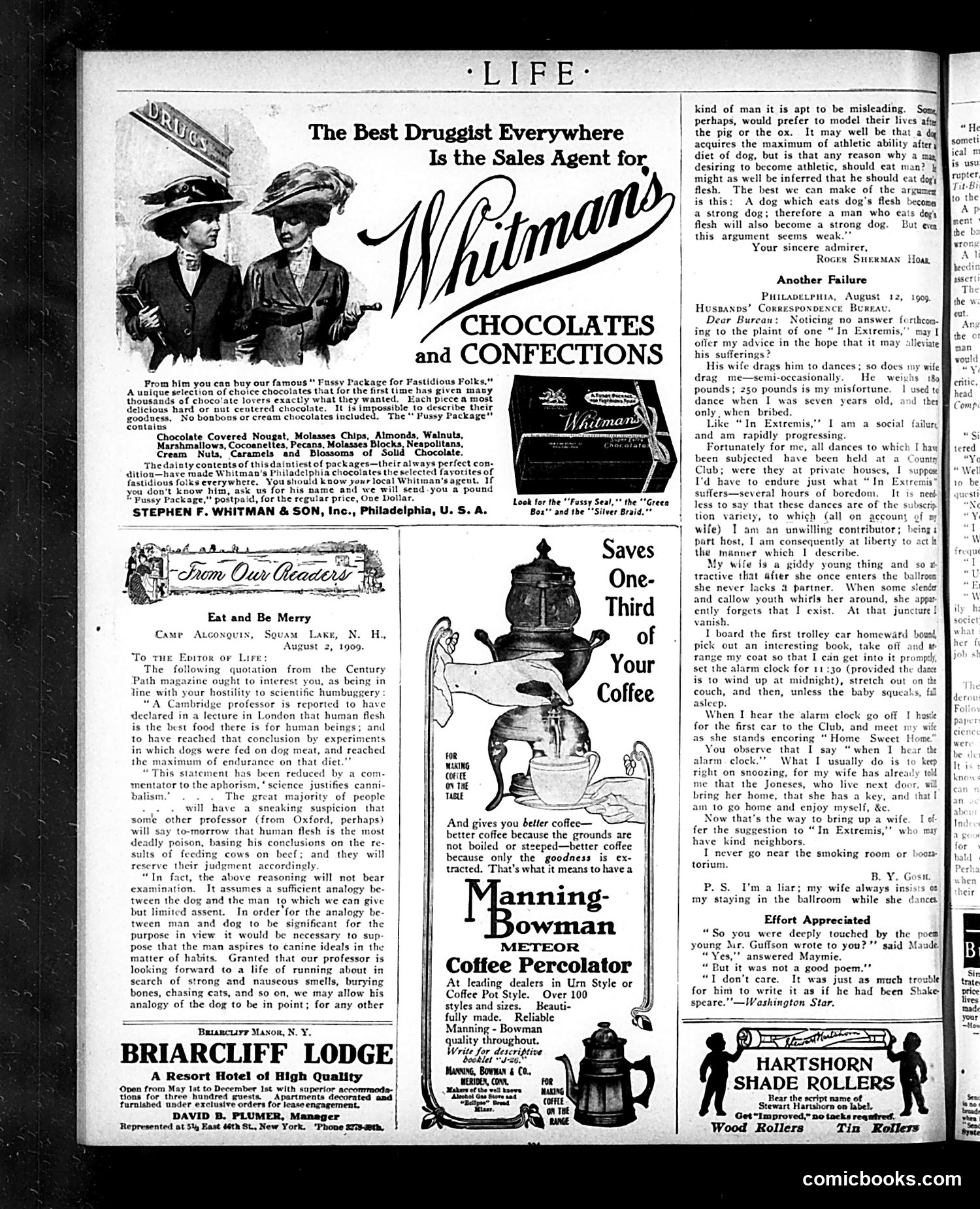
This page is primarily **advertising** with one substantive letter-to-the-editor. The main content is a satirical letter from "Balancourt Manor" responding to a *Century Path* magazine claim that a California professor proved human flesh is optimal food based on dog experiments. The writer mocks this pseudoscientific reasoning, noting the absurd logic: even if dogs thrive on dog meat, humans needn't follow canine "ideals"—unless one aspires to "running about in search of strong and nauseous smells, burying bones, chasing cats." The satire targets **pseudoscientific justifications** for extreme claims—a common early-1900s concern. The letter argues that analogies between animals and humans require shared behavioral assumptions to be valid, otherwise they're meaningless. The remainder consists of **period advertisements**: Whitman's chocolates, Manning-Bowman coffee percolators, Briarcliff Lodge resort hotel, and Hartshorn shade rollers—typical consumer goods marketed to middle-class readers. No political figures or cartoons are present; this is standard editorial and advertising content reflecting early-20th-century consumer culture and intellectual discourse.
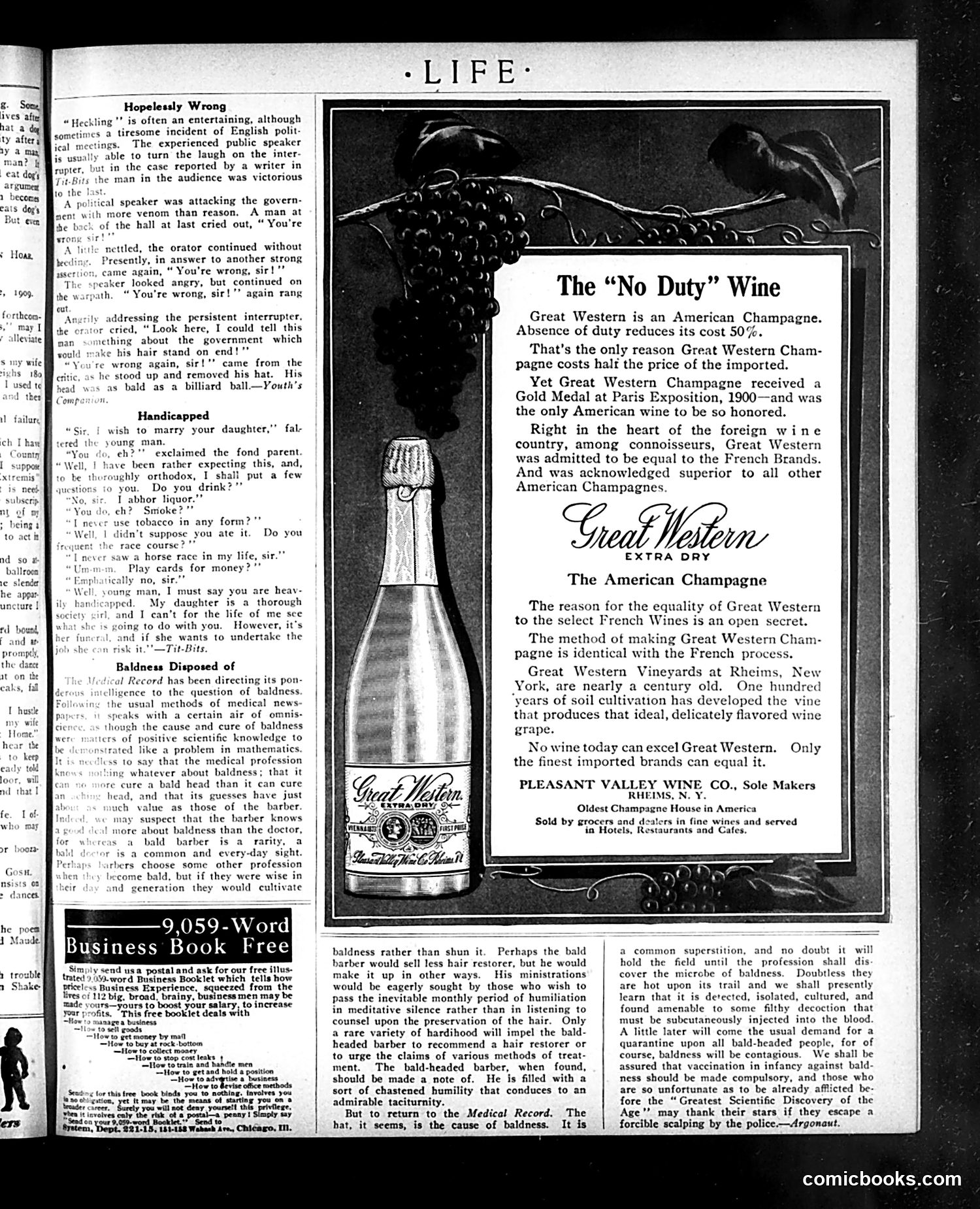
This page contains three distinct pieces of satirical content: **"Hopelessly Wrong"** presents a political heckler scenario where a speaker is repeatedly interrupted with "You're wrong, sir!" The joke's payoff: when the exasperated orator removes his hat to make a dramatic point, he's revealed to be completely bald—the heckler's final insult being a visual one. The satire mocks both persistent political interrupters and the speaker's ineffective rhetoric. **"Handicapped"** depicts a father interrogating a suitor, asking about drinking, smoking, gambling, and horse racing. The suitor denies all vices, prompting the father to despair: "I can't for the life of me see what she's going to do with you." The joke satirizes Victorian courtship rigidity—a "perfect" man with no flaws or entertainments is actually unsuitable, exposing the absurdity of moral perfectionism. **"Baldness Disposed of"** offers mock-serious commentary suggesting barbers understand baldness better than doctors, since bald barbers are rare while bald doctors are common. It's gentle satire about professional expertise and occupational hazards. The page also contains a Great Western Champagne advertisement.
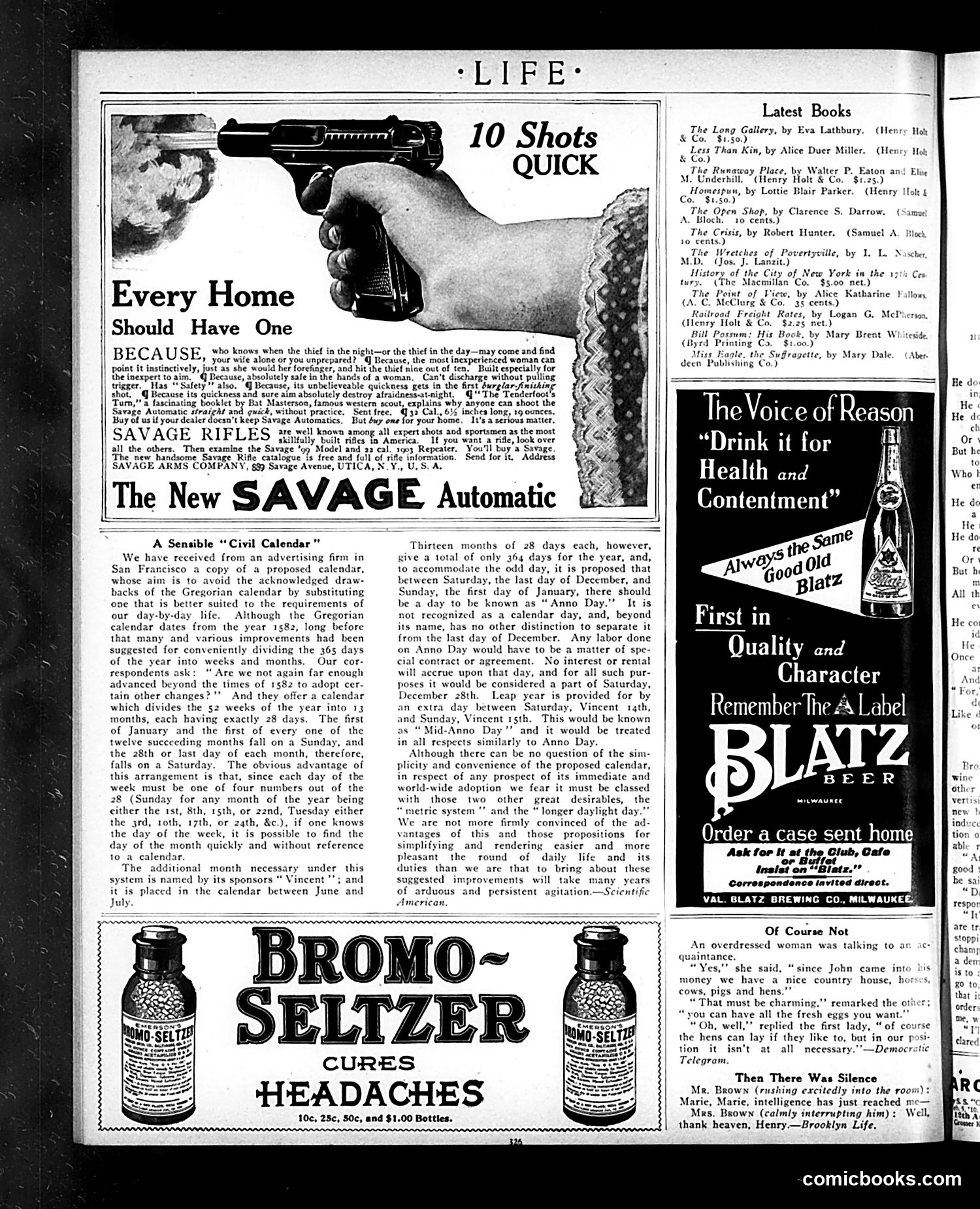
This page contains **product advertisements**, not political satire. The dominant content is a Savage Arms advertisement promoting automatic rifles for home defense, emphasizing that "Every Home Should Have One." The ad's pitch targets women specifically, claiming the rifle is "built especially for the inexpert to aim" and "absolutely safe in the hands of a woman"—suggesting wives should use it against nighttime intruders. It references Bat Masterson, a famous Old West figure, to lend credibility. The secondary content discusses a proposed calendar reform (replacing the Gregorian calendar with 13 equal months of 28 days), presented as a rational modernization idea. The page also advertises Bromo-Seltzer for headaches and Blatz Beer. Rather than satire, this reflects early 20th-century marketing attitudes: normalizing armed home defense and promoting firearms to non-traditional users (women). The calendar discussion represents Progressive-era faith in rational system improvements.
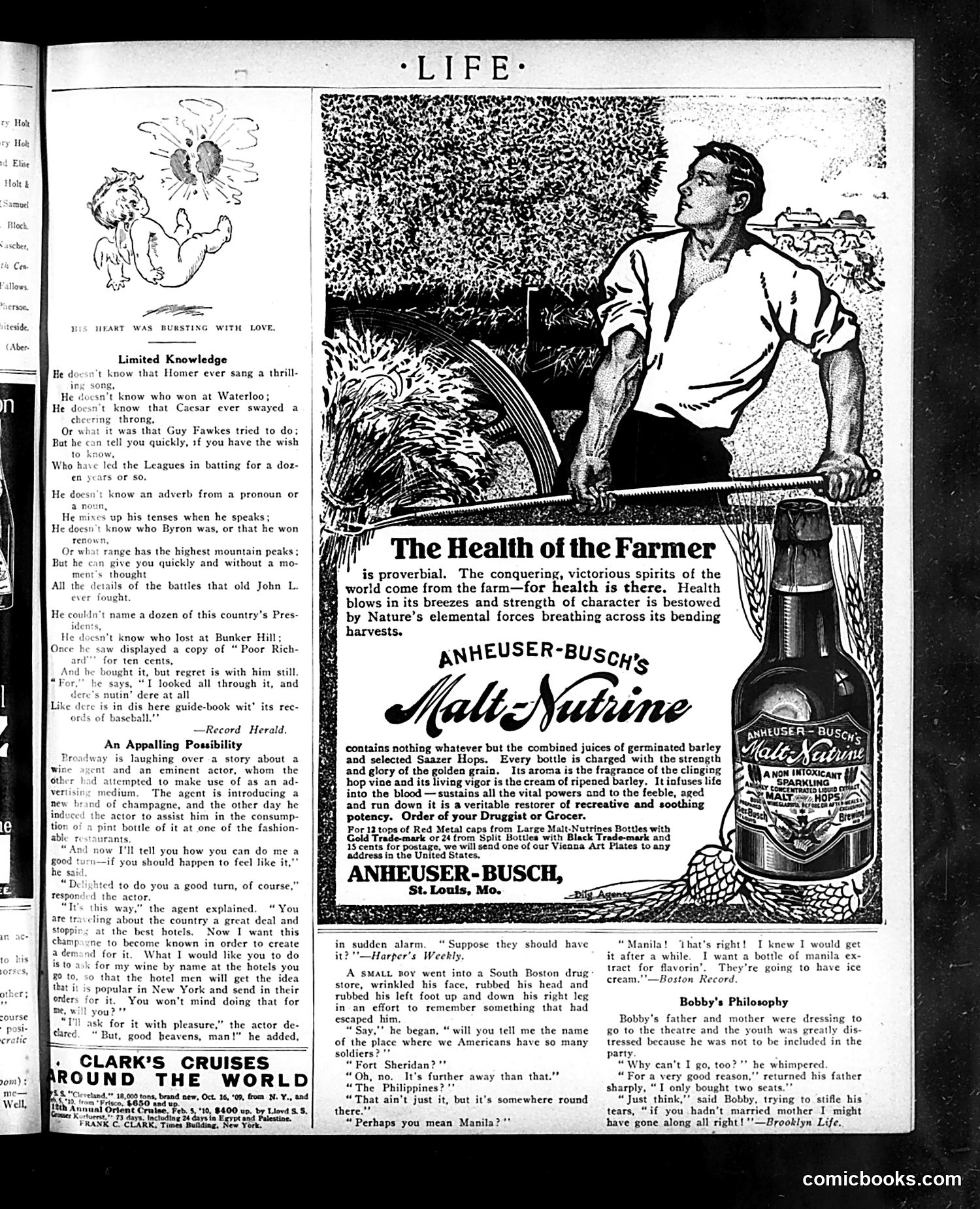
This page contains three distinct elements: a poem satirizing Americans' ignorance of history and literature, a humorous anecdote about advertising champagne, and a substantial advertisement for Anheuser-Busch Malt Nutrine. **The "Limited Knowledge" poem** mocks working-class Americans who know baseball statistics intimately but cannot name U.S. presidents or identify historical figures like Homer, Byron, or Caesar. The satire targets the gap between practical knowledge and cultural literacy—a common Progressive Era critique of American education. **The champagne anecdote** jokes about an advertising agent's scheme to manipulate hotel demand by having an actor repeatedly order a specific brand, exposing early 20th-century marketing manipulation tactics. **The beer advertisement** uses health rhetoric common to patent medicines of the era, claiming Malt Nutrine restores vitality and strengthens character—appeals particularly directed at farmers. This reflects pre-Prohibition advertising's grandiose health claims. The fragmented dialogue at page's bottom appears unrelated, possibly continuing another article.
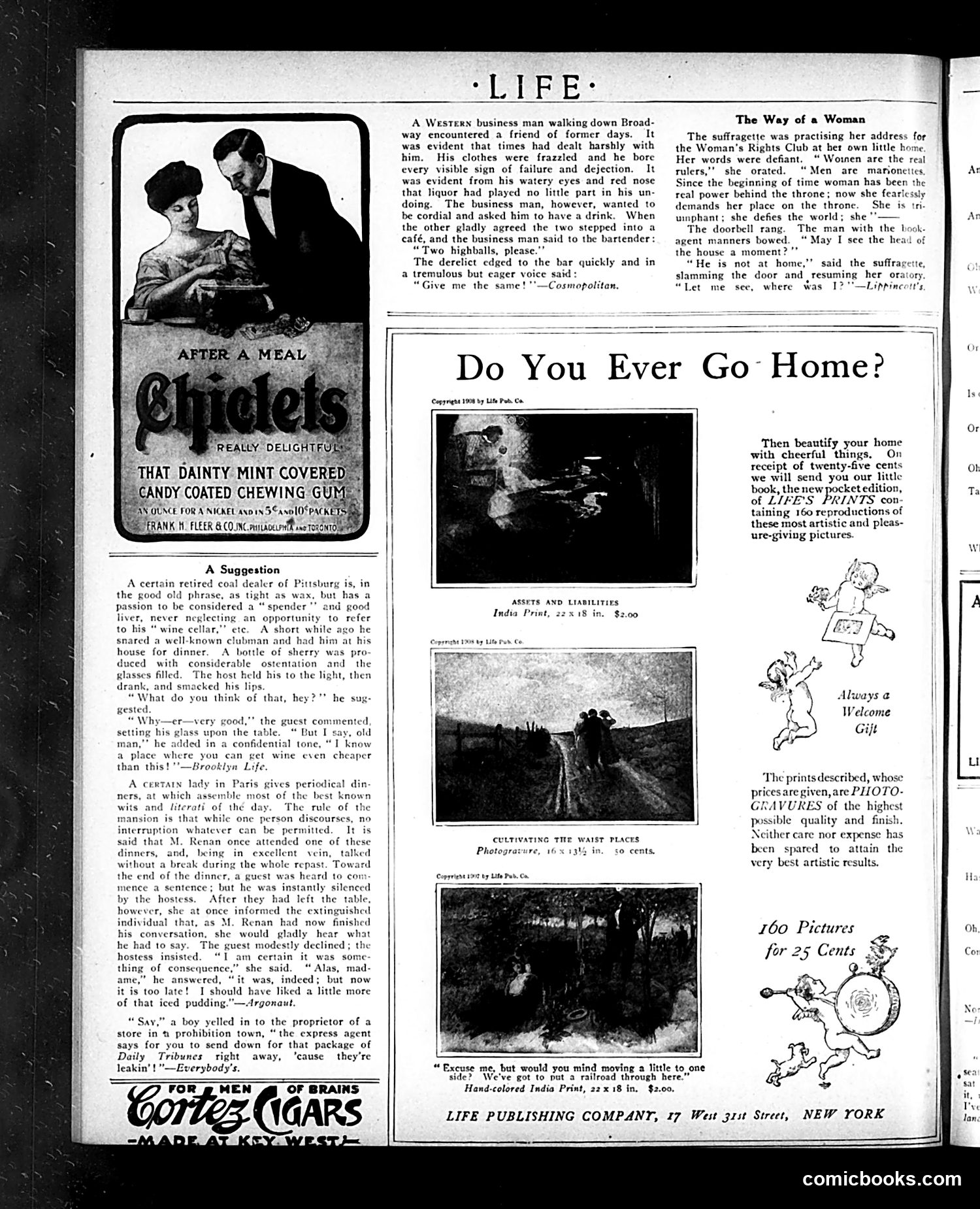
This page from *Life* magazine (a satirical publication, circa 1908-1912 based on style) contains several short humorous anecdotes poking fun at social pretension and hypocrisy: **"A Suggestion"** mocks a newly wealthy Pittsburgh coal dealer who ostentatiously displays his "wine cellar" to impress a clubman guest, only to be told the guest knows cheaper places to buy wine—deflating his social climbing. **"The Way of a Woman"** satirizes a suffragette practicing a fiery speech about female power and dominance, who immediately becomes submissive and deferent when a male visitor arrives at her door, contradicting her own rhetoric about women's independence. **Other anecdotes** ridicule a miser pretending to be a spender, a Parisian hostess's pretentious dinner rules, and a prohibition-era joke about leaking newspapers. The satire targets bourgeois pretension, gender hypocrisy, and social affectation common to the era. The page also includes Chiclets and Cortez cigars advertisements and a *Life* Publishing Company promotion for home decoration prints.
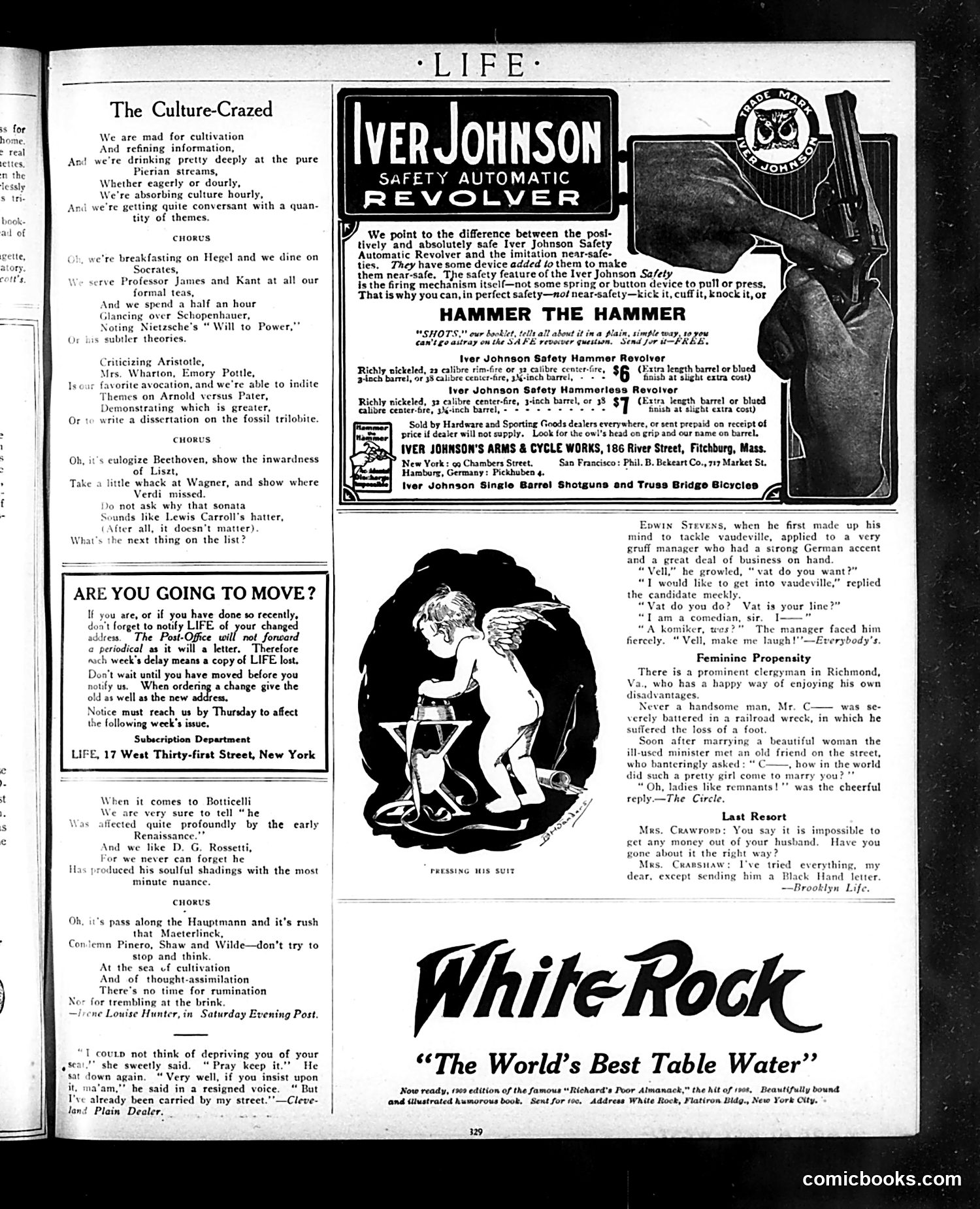
**"The Culture-Crazed" (left column):** This satirical poem mocks intellectuals obsessed with appearing cultured. The speaker boasts of casually consuming high philosophy (Hegel, Nietzsche, Schopenhauer) and fine arts (Beethoven, Wagner) while admitting they don't actually understand any of it—they simply want to *appear* refined. The satire targets what we'd call performative intellectualism: people frantically name-dropping philosophers and composers at social gatherings to seem educated, regardless of genuine comprehension. Lines like "do not ask why that sonata sounds like Lewis Carroll's hatter, (After all, it doesn't matter)" openly mock this shallow pretense. **"Pressing His Suit" (center cartoon):** A couple embraces on a chair while the man presses his suit—a visual pun on courtship language. The humor plays on double meaning: he's literally ironing his clothes while courting the woman. **Advertisements:** The Iver Johnson revolver ad and White Rock water ad occupy substantial page space, typical of Life magazine's revenue model.
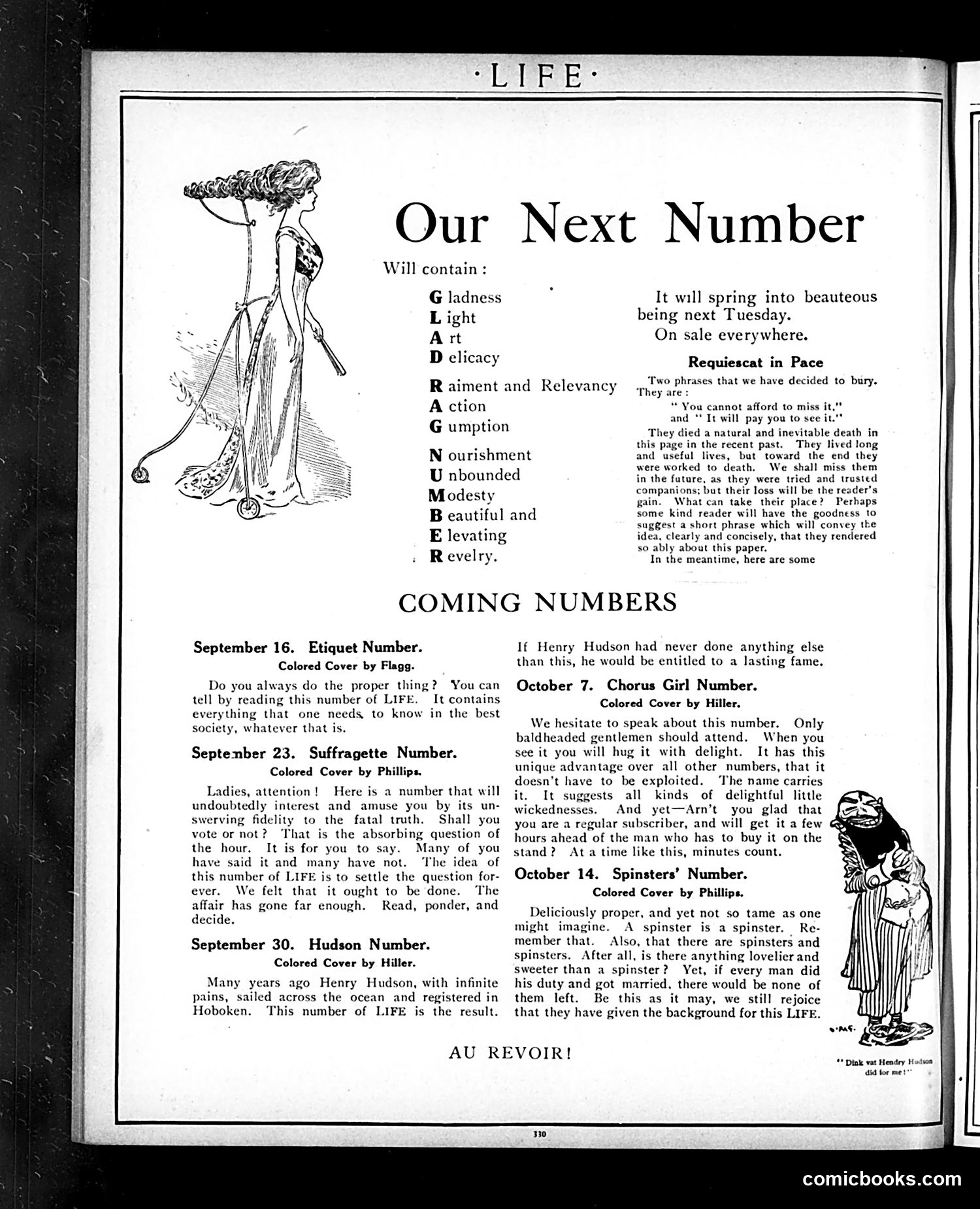
This is a **promotional page** announcing upcoming issues of Life magazine (a satirical publication), not a political cartoon. The page previews four themed issues for September-October. **Key content:** The masthead acrostic spells "GLADNESS LIGHT ART DELICACY RAIMENT AND RELEVANCY ACTION GUMPTION NOURISHMENT UNBOUNDED MODESTY BEAUTIFUL AND ELEVATING REVELRY"—essentially Life's stated values. **Notable previews:** - **September 23: Suffragette Number**—addresses women's voting rights, a major contemporary debate - **October 7: Chorus Girl Number**—promises salacious content ("only baldheaded gentlemen should attend"), exploiting subscriber exclusivity - **September 30: Hudson Number**—celebrates Henry Hudson's exploration, with a humorous aside about him "registering in Hoboken" **The satire:** Life gently mocks its own promotional language, including a "Requiescat in Pace" (funeral notice) for overused advertising phrases like "You cannot afford to miss it." The tone is self-aware and tongue-in-cheek about magazine marketing conventions.
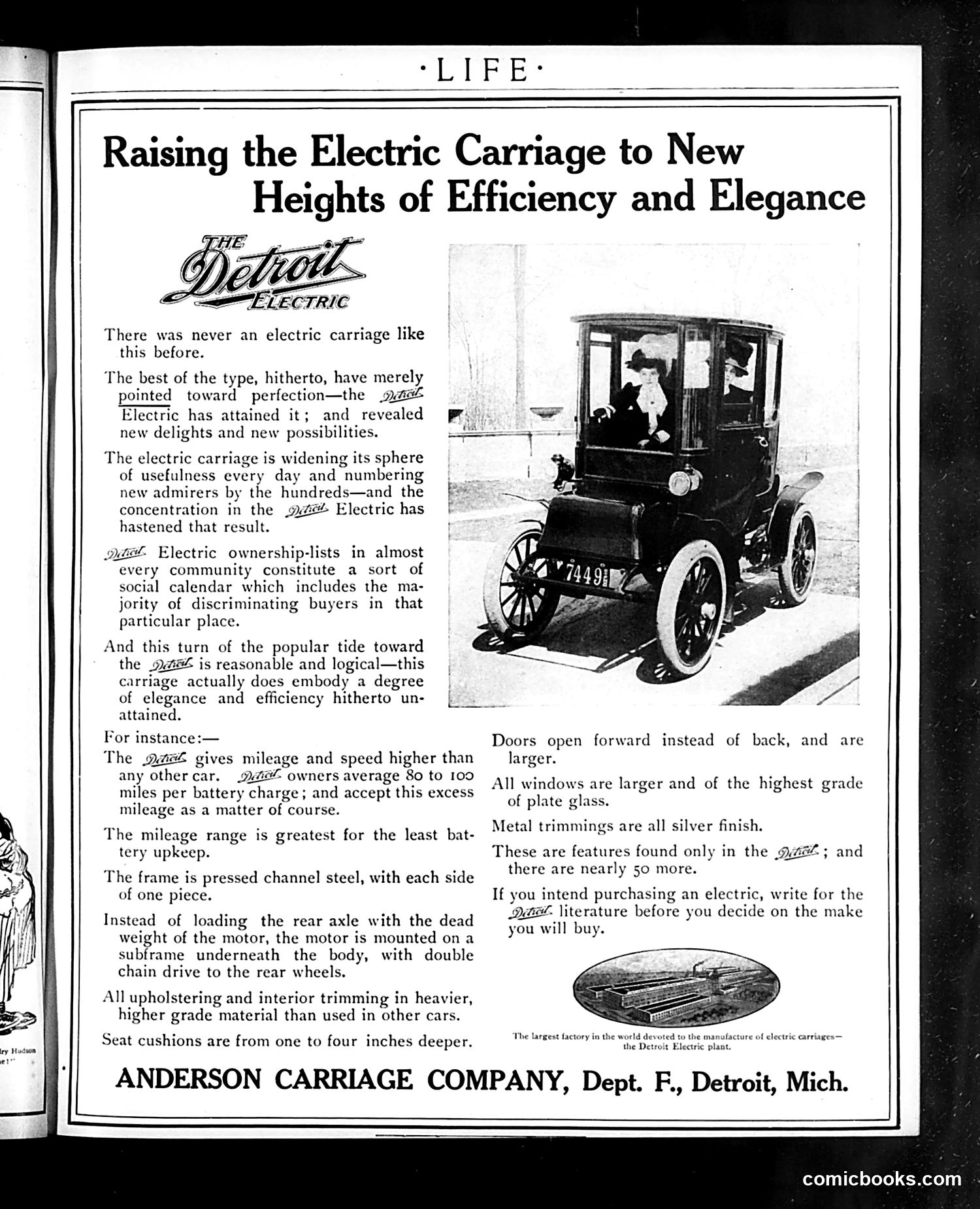
This is **not a cartoon or satire**—it's a straightforward advertisement for the Detroit Electric automobile, placed in *Life* magazine. The page promotes the Detroit Electric carriage as a luxury vehicle for affluent, "discriminating buyers." The ad emphasizes elegance and efficiency: features like forward-opening doors, large plate-glass windows, silver trim, and deep upholstered seats. It claims owners average 80-100 miles per battery charge. The Anderson Carriage Company (Detroit) is positioning the electric car as a status symbol. The text notes that electric car owners "constitute a sort of social calendar" in their communities—meaning ownership signals social standing. **Context for modern readers:** This reflects the early 1900s when electric vehicles were actually popular among the wealthy, seen as cleaner and more refined than gasoline cars. The electric car's association with affluence and femininity (quieter, no hand-crank starting) made it desirable before gasoline engines dominated the market. There is no satirical content here—just vintage advertising.
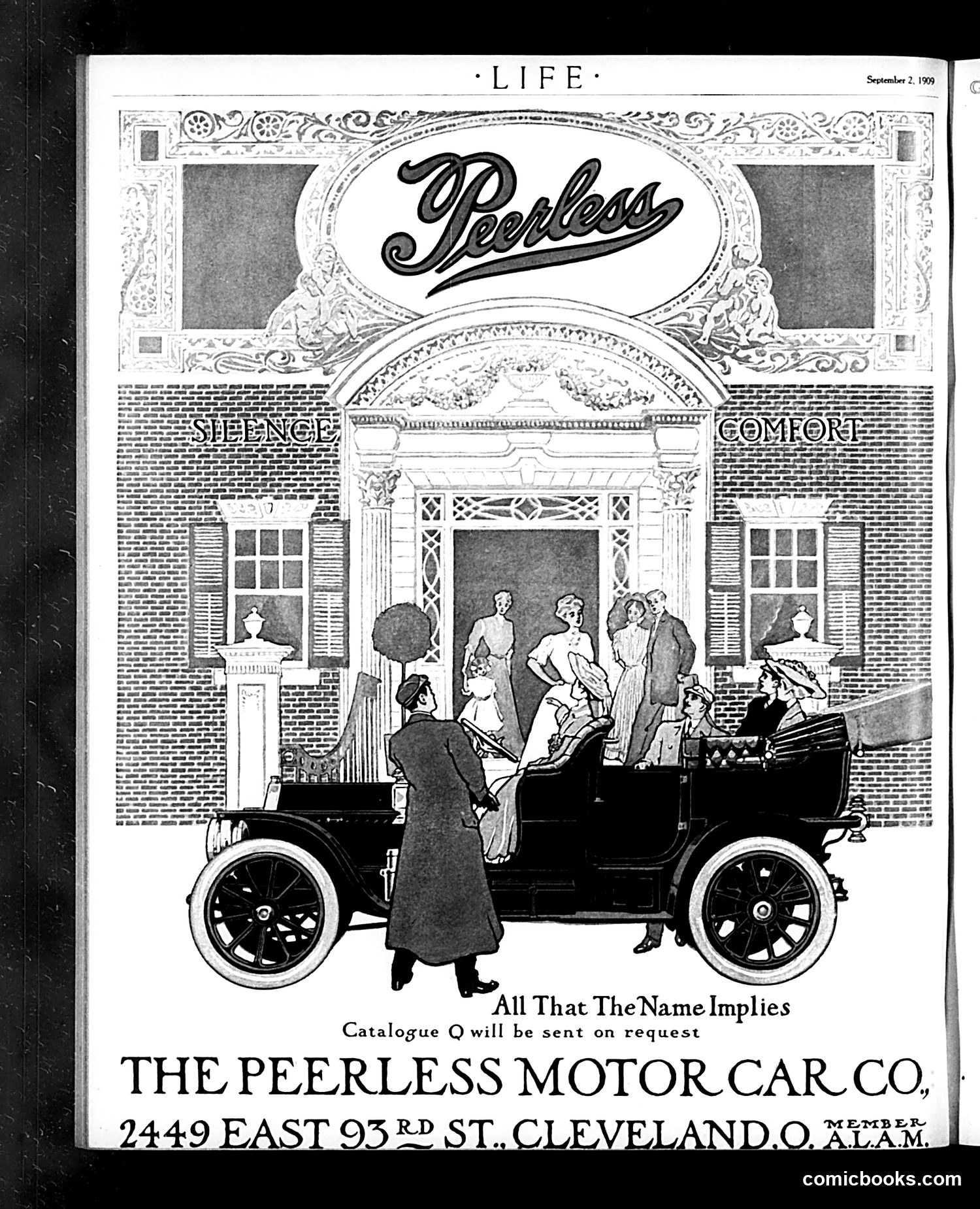
This is primarily an **automobile advertisement**, not political satire. The Peerless Motor Car Company is advertising their vehicle through a full-page ad in *Life* magazine (dated September 2, 1909). The illustration depicts an elegantly dressed woman approaching a Peerless automobile parked before an upscale brick mansion. Well-dressed passengers and staff are visible inside and around the vehicle, suggesting luxury and social status. The tagline "All That The Name Implies" and emphasis on "SILENCE" and "COMFORT" are marketing claims about the car's quality. The ad's rhetorical strategy associates the vehicle with wealth, sophistication, and refined taste—typical early-automotive advertising that positioned cars as status symbols for the affluent classes rather than practical transportation.