
Life, 1909-09-02 · page 18 of 48
Life — September 2, 1909 — page 18: what you’re looking at
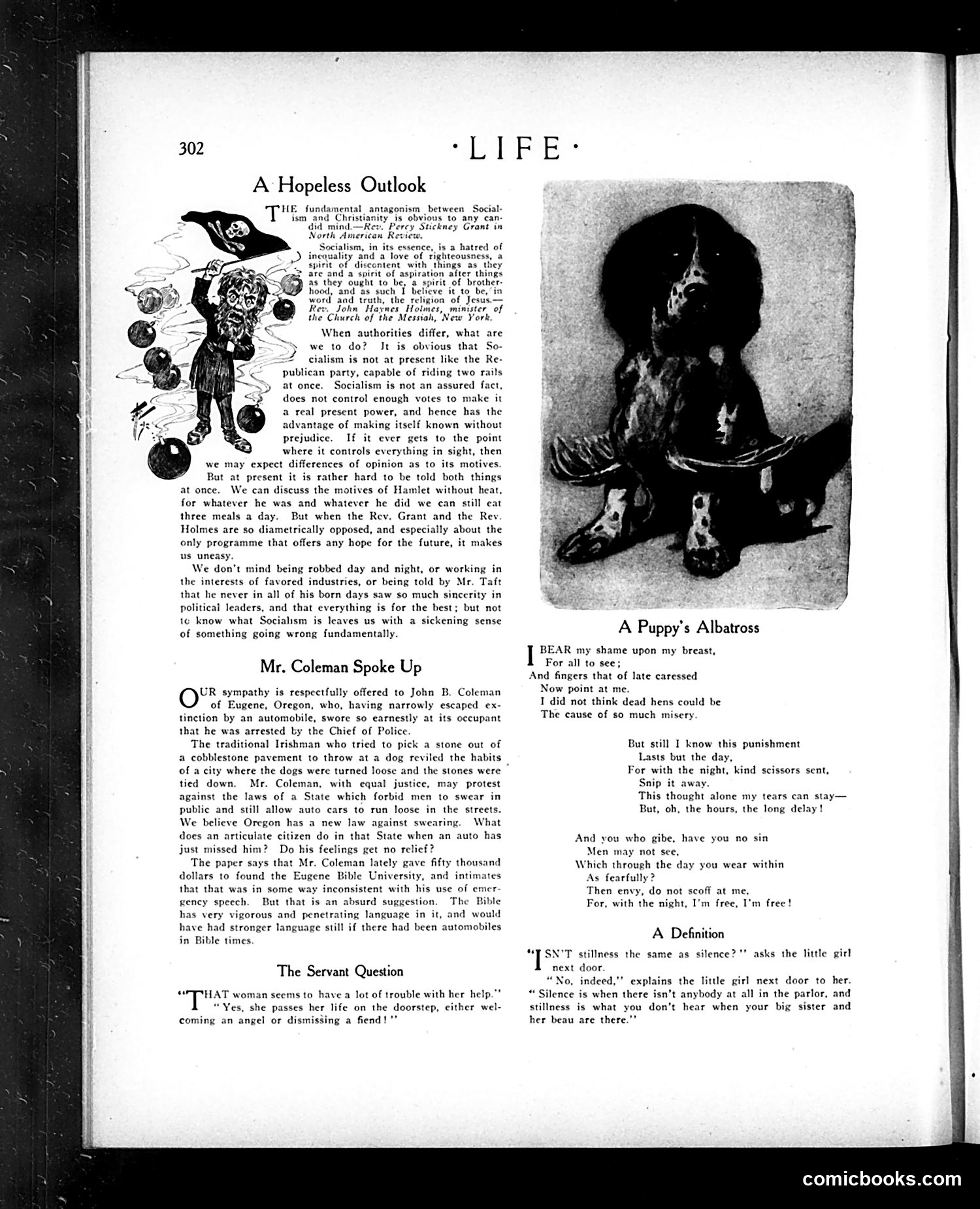
What you’re looking at
This page satirizes contradictions in early-20th-century American thought, primarily through commentary rather than visual cartoons. **"A Hopeless Outlook"** juxtaposes two clergymen's opposing views on socialism: Rev. Grant calls it fundamentally anti-Christian, while Rev. Holmes calls it Christianity's true expression. The article mocks this contradiction, noting that while we can discuss fictional characters like Hamlet dispassionately, we cannot comfortably discuss socialism when its future implications remain unclear—creating genuine public anxiety. **"Mr. Coleman Spoke Up"** describes a real incident where an Oregon man arrested for swearing at an automobile driver had recently donated $50,000 to found a Bible university. Life ridicules the supposed inconsistency, arguing that vigorous language in the Bible itself suggests such outbursts are justified—particularly when automobiles endanger lives. The remaining pieces are lighter: "A Puppy's Albatross" presents a sentimental poem about a dog punished for catching dead hens, and "The Servant Question" offers a brief joke about domestic help difficulties. The page reflects Progressive-era anxieties about modernity, religion, and social change.
📄 Transcribed text from this page (OCR, searchable)
Machine-transcribed from the original scan — historical spelling and the odd misread are preserved.
‘LIFE ® A Hopeless Outlook HE fundamental antagonism between Social ism and Christianity. is obvious to any can- did mind.—Rev. Percy Stickney Grant in North Amerie ce Socialism, in its essence, is a hatred of incouality and a love of righteousness, a spirit of discontent with things as they are and a spirit of aspiration after things as they ought to be, a spirit of brother: hood, and as such I believe it to be, in word and truth, the religion of Jesus— Rev. John Hares Holmes, mimuter of the Church of the Messiah, ‘New York When authorities differ, what are we to do? Jt is obvious that cialism is not at present like the Re- an party, capable of riding two rails at once. Socialism is not an assured fact, does not control enough votes to make it a real present power, and hence has the advantage of making itself known without prejudice. If it ever gets to the point where it controls everything in sight, then we may expect differences of opinion as to its motives. But at present it is rather hard to be told both things at once. We can discuss the motives of Hamlet without heat, for whatever he was and whatever he did we can still eat three meals a day. But when the Rev. Grant and the Rev Holmes are so diametrically opposed, and especially about the only programme that offers any hope for the future, it makes us uneasy. We don’t mind being robbed day and night, or working in the interests of favored industries, or being told by Mr. Taft that he never in all of his born days saw so much sincerity in political leaders, and that everything is for the best; but not tc know what Socialism is leaves us with a sickening sense of something going wrong fundamentally. Mr. Coleman Spoke Up UR sympathy is respectfully offered to John B. Coleman of Eugene, Oregon, who, having narrowly escaped ex- tinction by an automobile, swore so earnestly at its occupant that he was arrested by the Chief of Police. The traditional Irishman who tried to pick a stone out of a cobblestone pavement to throw at a dog reviled the habits of a city where the dogs were turned loose and the stones were tied down. Mr. Coleman, with equal justice, may protest against the laws of a State which forbid men to swear in public and still allow auto cars to run loose in the streets. We believe Oregon has a new law against swearing. What does an articulate citizen do in that State when an auto has just missed him? Do his feelings get no relief? The paper says that Mr. Coleman lately gave fifty thousand dollars to found the Eugene Bible University, and intimates that that was in some way inconsistent with his use of emer. gency speech. But that is an absurd suggestion. The Bible has very vigorous and penetrating language in it, and would have had stronger language still if there had been automobiles in Bible times. The Servant Question “THAT woman seems to have a lot of trouble with her help.” Yes, she passes her life on the doorstep, either wel- coming an angel or dismissing a fiend!’ A Puppy’s Albatross BEAR my shame upon my breast, For all to see; And fingers that of late caressed Now point at me. I did not think dead hens could be The cause of so much misery But still I know this punishment Lasts but the day, For with the night, kind scissors sent, Snip it away. This thought alone my tears can stay— But, oh, the hours, the long delay! And you who gibe, have you no sin Men may not see. Which through the day As fearfully? Then envy, do not scoff at me, For, with the night, I'm free, I'm free! ‘ou wear within A Definition “TSN’T stillness the same as silence? "* asks the little girl next door. “No, indeed,"’ explains the little girl next door to her. “ Silence is when there isn’t anybody at all in the parlor, and stillness is what you don’t hear when your big sister and her beau are there.’’ comicbooks.com