
Life, 1909-09-02 · page 23 of 48
Life — September 2, 1909 — page 23: what you’re looking at
What you’re looking at
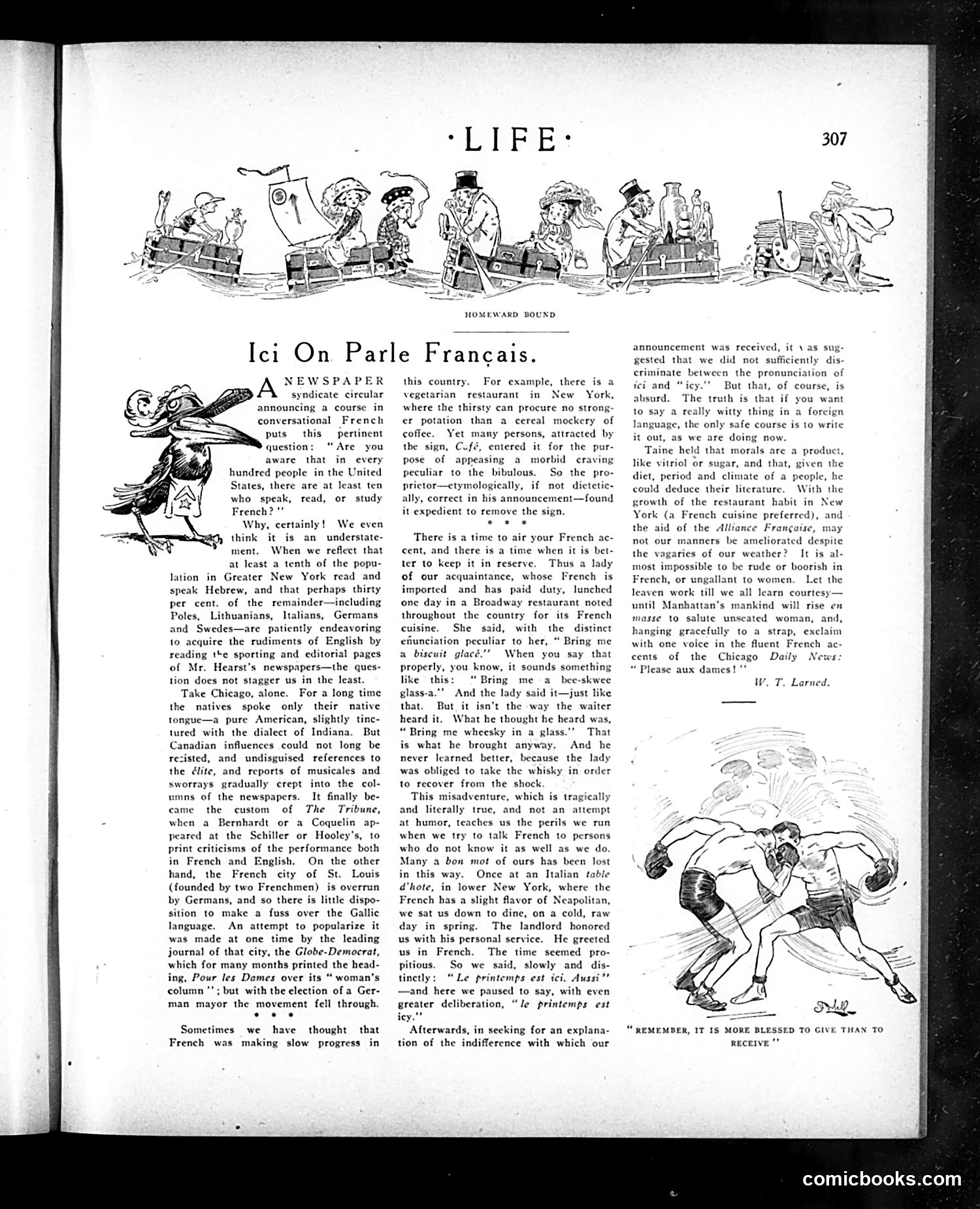
This satirical article mocks Americans' pretensions about speaking French and the absurd consequences. The cartoon at top shows immigrants arriving by train, labeled "Homeward Bound"—illustrating the essay's broader point about America's diverse immigrant population. The author argues that claims about widespread French-speaking in America are exaggerated. He cites examples: a New York vegetarian restaurant that removed its French sign "Café" because patrons mistakenly entered seeking alcohol; a woman at a restaurant who pronounced "biscuit glacé" so badly the waiter heard "whiskey in a glass" and served her exactly that. The satire targets both pretentious French-speakers attempting to seem cultured and ordinary Americans' inability to understand them—leading to comic miscommunication. The piece suggests that in a nation of immigrants speaking various languages (Yiddish, Polish, Italian, German), French affectation is particularly foolish and impractical.
📄 Transcribed text from this page (OCR, searchable)
Machine-transcribed from the original scan — historical spelling and the odd misread are preserved.
MOMEWARD BOUND Ici On Parle Francais. NEWSPAPER syndicate circular announcing a course in conversational French puts this pertinent question: “Are you aware that in every hundred people in the United States, there are at least ten who speak, read, or study French?” Why, certainly! We even think it is an understate- ment. When we reflect that at least a tenth of the popu- lation in Greater New York read and speak Hebrew, and that perhaps thirty per cent. of the remainder—including Poles, Lithuanians, Italians, Germans and Swedes—are patiently endeavoring to acquire the rudiments of English by reading the sporting and editorial pages of Mr. Hearst’s newspapers—the ques- tion does not stagger us in the least. Take Chicago, alone. For a long time the natives spoke only their native tongue—a pure American, slightly tinc- tured with the dialect of Indiana. But Canadian influences could not long be recisted, and undisguised references to the élite, and reports of musicales and sworrays gradually crept into the col- umns of the newspapers. It finally be- came the custom of The Tribune, when a Bernhardt or a Coquelin ap- peared at the Schiller or Hooley’s, to print criticisms of the performance both in French and English, On the other hand, the French city of St. Louis (founded by two Frenchmen) is overrun by Germans, and so there is little dispo- sition to make a fuss over the Gallic language. An attempt to popularize it was made at one time by the leading journal of that city, the Globe-Democrat, which for many months printed the head- ing, Pour les Dames over its “ woman's column '’; but with the election of a Ger- man mayor the movement fell through. eee Sometimes we have thought that French was making slow progress in this country. For example, there is a vegetarian restaurant. in New York, where the thirsty can procure no strong- er potation than a cereal mockery of coffee. Yet many persons, attracted by the sign, Cufé, entered it for the pur- pose of appeasing a morbid craving peculiar to the bibulous. So the pro- prictor—etymologically, if not dictetic- ally, correct in his announcement—found it expedient to remove the sign. There is a time to air your French ac- cent, and there is a time when it is bet- ter to keep it in reserve. Thus a lady of our acquaintance, whose French is imported and has paid duty, lunched one day in a Broadway restaurant noted throughout the country for its French cuisine. She said, with the distinct ciunciation peculiar to her, “ Bring me a biscuit glacé.”” When you say that properly, you know, it sounds something like this: “Bring me a_ bee-skwee glass-a.""" And the lady said it—just like that. But it isn’t the way the waiter heard it. What he thought he heard was, “Bring me wheesky in a glass.” That is what he brought anyway. And he never Icarned better, because the lady was obliged to take the whisky in order to recover from the shock. This misadventure, which is tragically and literally true, and not an attempt at humor, teaches us the perils we run when we try to talk French to persons who do not know it as well as we do. Many a bon mot of ours has been lost in this way. Once at an Italian table d'hote, in lower New York, where the French has a slight flavor of Neapolitan we sat us down to dine, on a cold, raw day in spring. The landlord honored us with his personal service. He greeted us in French. The time seemed pro- pitious. So we said, slowly and dis- tinetly: “Le printemps est ici, Aussi”? —and here we paused to say, with even greater deliberation, “le printemps est icy Afterwards, in seeking for an explana- tion of the indifference with which our announcement was received, it \ as sug- gested that we did not sufficiently dis- criminate between the pronunciation of ici and “icy.” But that, of course, is absurd. The truth is that if you want to say a really witty thing in a foreign language, the only safe course is to write it out, as we are doing now. Taine held that morals are a product, like vitriol or sugar, and that, given the diet, period and climate of a people, he could deduce their literature. With the growth of the restaurant habit in New York (a French cuisine preferred), and the aid of the Alliance Francaise, may not our manners be ameliorated despi the vagaries of our weather? It is al- most impossible to be rude or boorish in French, or ungallant to women. Let the leaven work till we all learn courtesy— until Manhattan's mankind will rise en masse to salute unseated woman, and, hanging gracefully to a strap, exclaim with one voice in the fluent French ac- cents of the Chicago Daily News: “ Please aux dames!" W. T. Larned. “ REMEMBER, IT 18 MORE BLESSED TO GIVE THAN TO RECEIVE"? comicbooks.com