
Life, 1909-09-02 · page 27 of 48
Life — September 2, 1909 — page 27: what you’re looking at
What you’re looking at
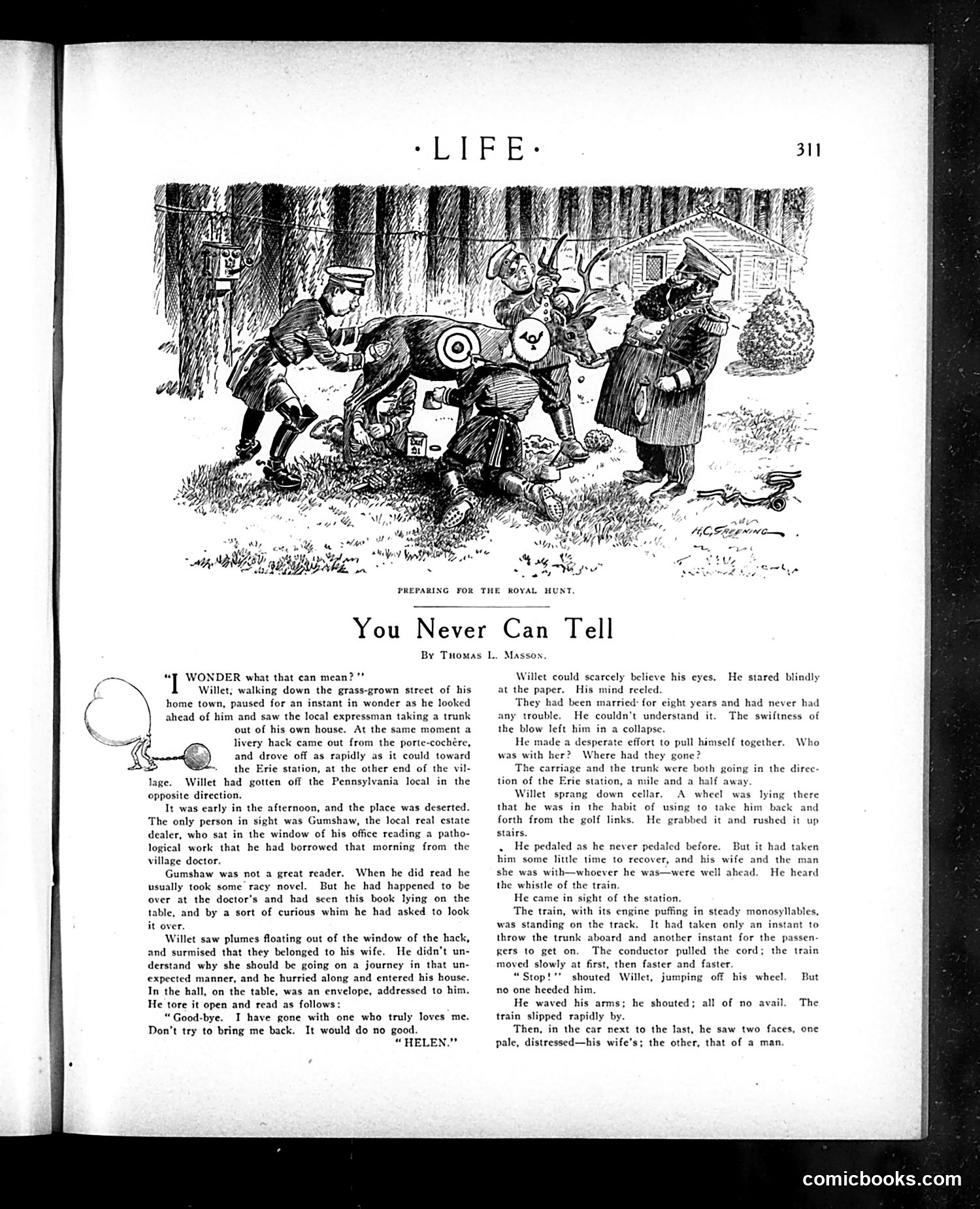
The cartoon caption "Preparing for the Royal Hunt" shows well-dressed figures examining hunting equipment, likely satirizing upper-class leisure pursuits. The accompanying story by Thomas L. Masson presents dramatic irony: a man returns home to find his wife gone with another man—or so he assumes from circumstantial evidence (a departing carriage with plumes, a hastily-packed trunk, a note). He frantically pursues them to the train station. The satire targets human tendency to jump to conclusions. The title "You Never Can Tell" suggests appearances deceive. The story likely ends with a misunderstanding revealed—perhaps the "man" is innocent, or the departure has an explanation. This reflects common Life magazine humor: poking fun at how quickly people construct narratives from incomplete information, especially regarding scandal and infidelity. The joke mocks both the protagonist's assumptions and readers' expectations of melodrama.
📄 Transcribed text from this page (OCR, searchable)
Machine-transcribed from the original scan — historical spelling and the odd misread are preserved.
4 Royo KE Al LA R ie Monn PREPARING FOR THE ROYAL HUNT. You Never Can Tell By Tuomas L. Masson “J WONDER what that can mean?* I Willet, walking down the grass-grown street of his home town, paused for an instant in wonder as he looked ahead of him and saw the local expressman taking a trunk out of his own house. At the same moment a livery hack came out from the porte-cochére, and drove off as rapidly as it could toward AL S the Erie station, at the other end of the vil- lage. Willet had gotten off the Pennsylvania local in the opposite direction. It was early in the afternoon, and the place was deserted. The only person in sight was Gumshaw, the local real estate dealer, who sat in the window of his office reading a patho- logical work that he had borrowed that morning from the village doctor. Gumshaw was not a great reader. When he did read he usually took some racy novel. But he had happened to be over at the doctor's and had seen this book lying on the table, and by a sort of curious whim he had asked to look it over. Willet saw plumes floating out of the window of the hack, and surmised that they belonged to his wife. He didn’t un- derstand why she should be going on a journey in that un- expected manner, and he hurried along and entered his house. In the hall, on the table, was an envelope, addressed to him. He tore it open and read as follows: “Good-bye. I have gone with one who truly loves me. Don’t try to bring me back. It would do no good. “HELEN.” Willet could scarcely believe his eyes. at the paper. His mind reeled. ‘They had been married: for eight years and had never had any trouble, He couldn't understand it. The swiftness of the blow left him in a collapse He made a desperate effort to pull himself together. Who was with her? Where had they gone? The carriage and the trunk were both going in the direc- tion of the Erie station, a mile and a hal 'y Willet sprang down cellar. A wheel was lying there that he was in the habit of using to take him back and forth from the golf links. He grabbed it and rushed it up stairs. . He pedaled as he never pedaled before. But it had taken him some little time to recover, and his wife and the man she was with—whoever he was—were well ab He heard the whistle of the train, He came in sight of the station. The train, with its engine puffing in steady monosyllables. was standing on the track. It had taken only an instant to throw the trunk aboard and another instant for the passen- gers to get on. The conductor pulled the cord; the train moved slowly at first, then faster and faster “Stop!’’ shouted Willet, jumping off his wheel. But no one heeded him. He waved his arms; he shouted; all of no avail. The train slipped rapidly by. Then, in the car next to the last, he saw two faces, one pale, distressed—his wife's; the other, that of a man He stared blindly comicbooks.com